Effect of Warm Asphalt Additive on The Creep And Recovery Behaviour
of Aged Binder Containing Waste Engine Oil
Norhidayah Abdul Hassan
1,a,,
Nurul Hidayah Mohd Kamaruddin
1,2,b*, Mohd
Rosli Hainin
1,c, Mohd Ezree Abdullah
2,d1Faculty of Civil Engineering, Universiti Teknologi Malaysia (UTM), 81310 Skudai, Johor, Malaysia.
2Faculty of Civil and Environmental Engineering, Universiti Tun Hussein Onn Malaysia (UTHM),
86400 Parit Raja, Batu Pahat, Johor, Malaysia.
a[email protected], b[email protected], c[email protected], d[email protected]
*corresponding author
Keywords: Warm mix asphalt; bitumen; Rediset; Waste oil; Creep recovery; Modified binder
Abstract. The use of waste engine oil as an additive in asphalt mixture has been reported to be able to offset the stiffening effect caused by the recycled asphalt mixture. Additionally, the fumes and odor of the waste engine oil has caused an uncomfortable condition for the workers during road construction particularly at higher production temperature. Therefore, this problem was addressed by integrating chemical warm asphalt additive into the mixture which functions to reduce the mixing and compaction temperature. This study was initiated by blending the additive in the asphalt binder of bitumen penetration grade 80/100 prior to the addition of pavement mixture. The effect of chemical warm asphalt additive, Rediset WMX was investigated by modifying the aged binder containing waste engine oil with 0%, 1%, 2% and 3% by weight of the binder. The samples were then tested for determining the rutting behaviour under different loading stress levels of 3Pa (low), 10Pa (medium) and 50Pa (high) using Dynamic Shear Rheometer (DSR). A reference temperature of 60 C was fixed to reflect the maximum temperature of the pavement. The results found that the addition of Rediset did not affect the creep and recovery behavior of the modified binder under different loading. On the other hand, 2% Rediset resulted a slight decrease in its rutting resistance as shown by the reduction of non-recoverable compliance under high load stress. However, overall, the inclusion of chemical warm asphalt additive to the modified binder did not adversely affect the rutting resistance which could be beneficial in lowering the temperature of asphalt production and simultaneously not compromising the binder properties.
Introduction
Warm mix asphalt (WMA) is a technology that competent to lower the mixing and production temperature about 10 - 40C from actual temperature, less burner fuel required to heat aggregates, lower emissions at asphalt plant, reduce the polluting emissions, less bitumen aging during construction which extending the life of the road and faster opening to traffic [1]. Generally, there are three main types of WMA technology widely used in the world:(1) foamed technique (water based or water-containing) (2) organic additives (3) chemical additives. The advantage of WMA technology is it can be used with high percentage of RAP without excessive aging, maintain the workability by decreasing the viscosity of binder and improved the diffusion of RAP and virgin binder [2]. The long term exposure to the environment, ultra-violet (UV) and continuous traffic load has stiffened the binder of RAP.
Currently, the application of warm mix asphalt is extensively applied in construction due to the lower production temperature, less emissions, better working condition and lower energy consumptions [7], [8]. This study was motivated to conduct with aimed to comply the sustainable development. Literature review has shown The influence of warm asphalt additive to the aged binder containing waste engine oil is still not thoroughly studied. Therefore, this study was carried out to investigate the influence of Rediset WMX as one of the warm mix additives to the rutting resistance of aged binder containing waste engine oil under various loading conditions using creep and recovery test.
Creep Description
Creep is a type of deformation that occurs mostly on the upper layers of pavement due to continuous loading, heavy traffic and high tire pressure [7]. Creep, typically referred to as rutting, usually consists of longitudinal depression due to unrecovered deformation under wheel path which may cause uncomfortable driving and hydroplaning as a result of water accumulation on the road surface. This risky situation can lead to the loss of control during braking and steering while driving. In this study, one cycle creep-recovery was conducted in order to investigate the rutting behaviour under various loading conditions. The creep and recovery test in this study was conducted at modified conditions compare to Multiple Stress Creep and Recovery (MSCR) test. The detail of MSCR test are described in ASTM D7405-10 “Standard Test Method for Multiple Stress Creep and Recovery (MSCR) of Asphalt Binder using a Dynamic Shear Rheometer [9]. The modification is in term of load stress and duration of creep as well as recovery [8], [10], [11][12]. According to Xiao et al. [1], the compliance value is typically used to indicate the creep associated with load/stress applied. The loading is applied for certain time and the strain induced is monitored after the loading is removed. Principally, compliance (J) function is the ratio of the strain () to the constant applied load () and can be expressed using Equation 1. The unit of Jnr is Pa-1.
( )
)
(t t
J (1)
Materials and Methods
The base binder was supplied by Kemaman Bitumen Company. Aged binder was obtained from the extraction and recovery of reclaimed asphalt pavement (RAP) taken from surface layer milled from a section in Johor Route State J5, Malaysia. The proportion of RAP used in this study was 50% from the total mass of binder. The chemical additive used was Rediset WMX, developed by Akzo Nobel in a form of solid palette. This additive was mixed with base and aged binders containing 0%, 1%, 2% and 3% of waste engine oil by weight of binder respectively. Detailed constituents of the testing samples are shown in Table 1.
Table 1: Label and constituents of testing sample
Label Bitumen WEO ( by weight of
bitumen)
Rediset (by weight of bitumen)
A Base binder - -
B
Base binder + aged binder
- -
C
15%
0%
D 1%
E 2%
All modified binders were blended at 600 rpm at a temperature around 155±5C using Silverson-L4RT high shear mixer. The mixtures were then subjected to viscosity and creep recovery tests. An oscillatory rheometer (HAAKE Rheo Stress 1, Karlsruhe, Germany) equipped with water bath for controlling temperature and data acquisition software (HAAKE RheoWin 4.30.0022) was used to conduct the testing. A 25 mm diameter of circular disk-shaped with 1 mm gap setting for asphalt binder sample was used at reference temperature of 60C to represent the service temperature of pavement during high temperature. The creep and recovery tests were performed at three different stress levels, 3Pa (loading for 100 seconds, recovery for 600 seconds), 10Pa (loading for 20 seconds, recovery for 600 seconds) and 50Pa (loading for 1 seconds, recovery for 300 seconds). These stress level represented the low, medium and high intensities of traffics on pavement
respectively [8], [10], [11][12] . The tests were performed on the samples that were conditioned for short term aging in a Rolling Thin Film Oven (RTFO) to depict the newly traffic accessible road. During this phase, the pavement was prone to rutting .
Results and Discussions
[image:3.595.81.456.661.784.2]Creep Recovery Properties
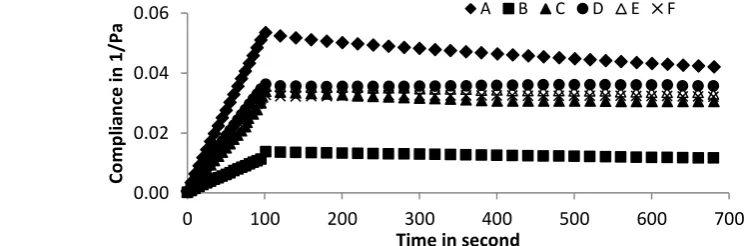
Figure 1 shows the creep-recovery curve with compliance value as a function of time at different stress levels. It can be observed that sample A (base binder - without aged binder and waste engine oil) has the higher compliance value at any given load stress while the lowest compliance was recorded by sample B (base binder + aged binder). A higher compliance indicates higher rutting susceptibility and low compliance value was due to the high stiffness [13]. Meanwhile, it can be seen that the sample of aged binder containing waste engine oil with Rediset exhibit lower compliance value as compared with the base binder. As shown in Figure 1(a), when samples with Rediset were tested at low loading condition, they exhibit an overlapped curve (100t300s) and the relatively small different from each other (300t700). In details, the compliance value particularly for binder D(1%Rediset), binder E (2%Rediset) and binder F(3%Rediset) are slightly
higher compared to binder C (without Rediset). According to Figure 1(b) and 1(c), the increase in the load applied has caused the curves to overlap among each other.
However, in Figure 1(c), there is a slight decrease in compliance value for binder E (2% Rediset) at the recovery phase (250t300s). In general, the results demonstrated that the addition of Rediset WMX did not improve the creep and recovery behaviour of aged binder containing waste engine oil. Additionally, there is no noticeable different can be found for the influence of chemical warm asphalt additive on the creep compliance. These results were consistent with that reported by Hamzah & Golchin [14] which implies that the presence of Rediset did not significantly affect the rutting resistance of asphalt binder. Additionally, it was found that the content of Rediset did not adversely affect the high performance grade of the asphalt binder [1, [14], [15].
(a)
0.00 0.02 0.04 0.06
0 100 200 300 400 500 600 700
Co
m
p
lian
ce
in
1/
Pa
Time in second
(c)
Figure 1: Creep and creep-recovery properties at (a)3Pa (b) 10Pa (d) 50Pa
Non-recoverable Compliance
Figure 2 clearly depicts the non-recoverable compliance (Jnr) of asphalt binder for different binder types. Non-recoverable creep compliance is an indicator of resistance of an asphalt binder to permanent deformation according to ASTM 7405-10 [9]. Higher non-recoverable compliance indicates lower rutting resistance or easy to deform under traffic loading. The lowest compliance value was recorded for sample containing aged binder which could be due to the stiffening effect. In Figure 2(a), there was no significant difference of Jnr between the samples containing Rediset except for binder D (1%Rediset) which is slightly increased. The same trend was also found for Figure 2(b) when tested at 10Pa. Meanwhile, in Figure 2(c) shows that binder E (with 2% Rediset) was found to increase rutting resistance of the aged binder containing waste engine oil. Additionally, the finding shows that the modified sample can effectively improved the deformation resistance of asphalt binder as compared to base binder [16]. Meanwhile, the lowest Jnr value which is obviously shows by sample B is to represent that the aged binder is higher rutting resistance compared to others.
(a) (b) (c)
Figure 2: Non-recoverable compliance behavior of (a) 3Pa (b) 10Pa (c) 50Pa (b) 0 0.0002 0.0004 0.0006 0.0008 0.001
A B C D E F
Jnr, Pa -1 Binder Type 0.00 0.01 0.02 0.03 0.04 0.05
A B C D E F
Jnr, Pa -1 Binder Type 0.000 0.002 0.004 0.006 0.008 0.010
A B C D E F
Jnr, Pa -1 Binder Type 0.000 0.005 0.010
0 50 100 150 200 250 300 350 400 450 500 550 600 650
Co m p lian ce in 1/ Pa
Time in second
A B C D E F
0.0000 0.0005 0.0010
0 50 100 150 200 250 300
Co m p lian ce in 1/ Pa
Time in second
[image:4.595.63.513.640.776.2]Conclusions
As a conclusion, it can be summarised that chemical warm asphalt additive, Rediset WMX did not affect the rutting resistance at different loading stress of the aged binder containing waste engine oil. This is showed by the creep and recovery curve of the binders containing Rediset WMX did not show noticeable difference compliance for all loading conditions at high testing temperature, 60C. It is therefore favourable for the Rediset to be used as warm asphalt additive in the asphalt modification to reduce the asphalt production temperature but still maintaining the binder’s properties at acceptable performance. The future research work is currently being conducted for further investigation.
Acknowledgements
The authors wish to acknowledge support from Ministry of Education Malaysia (MOE) and Universiti Teknologi Malaysia for funding this study under the research grant of FRGS 4F436 and Universiti Tun Hussein Onn Malaysia for the scholarship and laboratory facilities.
References
[1] F. Xiao, V. S. Punith, and S. N. Amirkhanian, “Effects of non-foaming WMA additives on asphalt binders at high performance temperatures,” Fuel, vol. 94, pp. 144–155, Apr. 2012. [2] M. Zaumanis and R. B. Mallick, “Review of very high-content reclaimed asphalt use in
plant-produced pavements: state of the art,” Int. J. Pavement Eng., pp. 1–17, Mar. 2014. [3] A. Villanueva, S. Ho, and L. Zanzotto, “Asphalt modification with used lubricating oil,”
Can. J. Civ. Eng., vol. 35, no. 2, pp. 148–157, Feb. 2008.
[4] M. N. Borhan, F. Suja, A. Ismail, and R. A. Rahmat, “The Effects of Used Cylinder Oil on Asphalt Mixes,” Eur. J. Sci. Res., vol. 28, no. 3, pp. 398–411, 2009.
[6] C. D. Dedene, “Investigation of Using Waste Engine Oil Blended with Reclaimed Asphalt Materials to Improve Pavement Recyclability,” Michigan Technological University, 2011. [7] S. Abo-Qudais and H. Al-Shweily, “Effect of antistripping additives on environmental
damage of bituminous mixtures,” Build. Environ., vol. 42, no. 8, pp. 2929–2938, Aug. 2007. [8] C. K. K. Akisetty, “Evaluation of Warm Asphalt Additive on Performance Properties of
CRM Binders and Mixtures,” PhD Thesis. Clemson University., 2008.
[9] ASTM D7405-10, “Standard Test Method for Multiple Stress Creep and Recovery ( MSCR ) of Asphalt Binder Using a Dynamic Shear Rheometer,” ASTM Int. West Conshohocken, PA, USA., pp. 1–4, 2012.
[10] S. Biro, T. Gandhi, and S. Amirkhanian, “Midrange Temperature Rheological Properties of Warm Asphalt Binders,” J. Mater. Civ. Eng., vol. 21, no. 7, pp. 316–323, Jul. 2009.
[11] A. N. Amirkhanian, F. Xiao, and S. N. Amirkhanian, “Characterization of Unaged Asphalt Binder Modified with Carbon Nano Particles,” Int. J. Pavement Res. Technol., vol. 4, no. 5, pp. 281–286, 2011.
[12] A. Diab, Z. P. You, and H. N. Wang, “Using Modified Creep and Recovery Tests to Evaluate the Foam-Based Warm Mix Asphalt Contained Nano Hydrated Lime,” Adv. Mater. Res., vol. 646, pp. 90–96, Jan. 2013.
[13] M.K. Nurul Hidayah, M. R. Hainin, N. A. Hassan, and M. E. Abdullah, “Rutting Evaluation of Aged Binder Containing Waste Engine Oil,” Adv. Mater. Res., vol. 911, pp. 405–409, 2014.
[15] F. Xiao, M. Chen, S. Wu, and S. Amirkhanian, “A Long term Ultraviolet Aging Effect on Rheology of WMA Binders,” Int. J. Pavement Res. Technol., vol. 6, no. 5, pp. 496–504, 2013.