0095-1137/06/$08.00⫹0 doi:10.1128/JCM.44.5.1887–1891.2006
Copyright © 2006, American Society for Microbiology. All Rights Reserved.
Multiplex PCR-Based Reverse Line Blot Hybridization Assay To Identify
23
Streptococcus pneumoniae
Polysaccharide Vaccine Serotypes
Fanrong Kong,
1Mitchell Brown,
1,2Archcna Sabananthan,
1,3Xianyu Zeng,
1,4and Gwendolyn L. Gilbert
1*
Centre for Infectious Diseases and Microbiology, Institute of Clinical Pathology and Medical Research, Westmead, New South Wales, Australia1; Department of Cell and Molecular Biology, Faculty of Science, University of
Technology, Sydney, New South Wales, Australia2; School of Biotechnology and Biomolecular Sciences,
The University of New South Wales, New South Wales, Australia3; and Wuhan First Hospital,
Hubei Province, Wuhan 430022, People’s Republic of China4
Received 11 November 2005/Returned for modification 28 January 2006/Accepted 27 February 2006
We developed a multiplex PCR-based reverse line blot assay to identify 23 pneumococcal serotypes repre-sented in the polysaccharide vaccine, using 334 well-characterized isolates, representing all 90 serotypes, and 268 “unknowns.” The assay identified all target serotypes, but 11, which cross-react with 1 to 4 nonvaccine serotypes, could be distinguished using serotype-specific antisera.
Previously, we developed a molecular capsule type predic-tion system for 90Streptococcus pneumoniaeserotypes, based on a combination of partialcpsA-cpsB sequencing and sero-type- and/or serogroup-specific PCR (3, 6). While this system is useful, it is too slow, expensive, and labor-intensive for rou-tine use.
Multiplex PCR-based reverse line blot hybridization (mPCR/ RLB) is a promising method for simultaneous detection and genotyping of microorganisms, which we have used previously in several applications (5, 9, 10). In the present study we applied it to identification of the 23S. pneumoniaeserotypes represented in the polysaccharide vaccine (Pneumovax 23; Merck & Co, Inc.).
The design of primers and probes was based on recently published fullcpsgene cluster sequences of all 90 pneumococ-cal serotypes (http://www.sanger.ac.uk/Projects/S_pneumoniae /CPS/) and others available in GenBank (3, 6; F. Kong, G. L. Gilbert, L. Wang, D. Liu, and J. Tao, 13 April 2004, Australian Patent Office). For the mPCR, we modified the primers we had used previously for serotype-specific PCR for the 23 vaccine serotypes (3, 6; Kong et al., Australian Patent Office) and a publishedS. pneumoniae-specific primer (7). For the RLB, we designed two probes for each of the 23 serotypes, as well as two
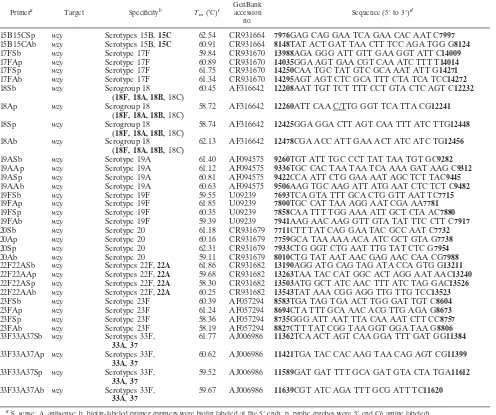
S. pneumoniae-specific control probes (Table 1). Probes and primers were designed to have similar physical characteristics so as to allow simultaneous amplification and hybridization in a multiplex reaction system (5); they were synthesized by Sigma-Aldrich (Sydney, Australia). Primers were biotinylated at the 5⬘end and probes had a 5⬘-amine group (5).
The DNA extraction method (4), the mPCR system, and the thermal profiles used were as previously described (5), except that we included 24 (rather than 10) primer pairs (Table 1) in a 25-l mPCR system and used 1 U (rather than 0.5) of QIAGEN HotstartTaqpolymerase. For serotype 23F, 25 pM
of each primer were used, whereas 12.5 pM of each primer was used for all other serotypes.
RLB hybridization was based on previously published meth-ods (http://www.nioo.knaw.nl/cl/me/) (8, 11) with the following modifications: the hybridization temperature was 60°C, and 1.25 pM of each probe, in 150l of 500 mM NaHCO3(pH
8.4), was used in each slot to label the membrane (Fig. 1). A collection of 334 reference strains and well-characterized clinical isolates were used to develop the assay, of which 244 had been used in our previous studies (3, 6) and 90 were serotype reference strains, newly purchased from Statens Se-rum Institut of Denmark (1, 2). Except for serotypes 10C, 11F, 12B, 25A, 33D, and 44, all serotypes were represented by two or more strains.
All of the putative serotype-specific primers or probes yielded mPCR products and RLB signals from isolates with the corresponding serotypes. However, as demonstrated previ-ously, serotype discrimination based solely on thewzygene (or even the wholecpsgene cluster) is not straightforward (3, 6). Primers and probes designed to identify serotypes 6B, 7F, 9N, 9V, 10A, 11A, 12F, 15B, 18C, 22F, and 33F could not distin-guish between the target and one or more closely related serotypes, usually but not always in the corresponding sero-group (Table 1 and Fig. 1) because they share virtually iden-ticalwzysequences. Thus, 17 serotypes, in addition to those in the 23-valent polysaccharide vaccine, were amplified and hy-bridized by the mPCR/RLB system. These cross-reactions are predictable, and individual serotypes can be identified using a limited number of factor antisera. The remaining 12 primer pairs and probe pairs were truly serotype specific, and there was excellent agreement between paired probes for the same serotypes, indicating that single probes would be adequate for most serotypes.
The method was further evaluated using 268 clinical isolates, the serotypes of which were unknown at the time of mPCR/ RLB testing. These isolates included 135 consecutive invasive isolates referred to the NSW Pneumococcal Reference Labo-ratory for serotyping and 133 colonizing isolates from patients with respiratory infections at the Children’s Hospital,
West-* Corresponding author. Mailing address: Centre for Infectious Dis-eases and Microbiology, Institute of Clinical Pathology and Medical Research (ICPMR), Westmead Hospital, Darcy Road, Westmead, New South Wales 2145, Australia. Phone: (612) 9845-6255. Fax: (612) 9893-8659. E-mail: [email protected].
1887
on May 16, 2020 by guest
http://jcm.asm.org/
TABLE 1. Oligonucleotide primers and probes for multiplex PCR-based reverse line blot assay used in this study
Primera Target Specificityb T
m(°C)c
GenBank accession
no.
Sequence (5⬘to 3⬘)d
SpIaSbe Pneumolysin S. pneumoniae 61.43 M17717 384ATT TCT GTA ACA GCT ACC AAC GA406 SpSp Pneumolysin S. pneumoniae 65.49 M17717 531AGC GAT AGC TTT CTC CAA GTG G552
SpAp Pneumolysin S. pneumoniae 75.10 M17717 556ACC CCA GCA ATT CAA GTG TTC GCG579
SpIbAbe Pneumolysin S. pneumoniae 61.69 M17717 730GAA TTC CCT GTC TTT TCA AAG TC708 1Sb wzy Serotype 1 59.03 Z83335 10307GGG ACT TTA ATT TTA TGC AGT G10328
1Ap wzy Serotype 1 59.22 Z83335 10402AAA TTT CAC AAT TAT CAT TGC C10381
1Sp wzy Serotype 1 62.00 Z83335 10529CTG GCT TTG GCA ACT TTG10546
1Ab wzy Serotype 1 60.67 Z83335 10576CAC AAT GGC TTT AGA AGG TAG AG10554
2Sb wzy Serotype 2 59.86 AF026471 9730CGG CAT TGT ATT CTT TAT ATC G9751
2Ap wzy Serotype 2 60.40 AF026471 9849CCA ATA AAT CTT GTG TGA ATA TAA CTG9823
2Sp wzy Serotype 2 60.76 AF026471 9989GCA ACA TTT CAA TCT TAT GGT G10010
2Ab wzy Serotype 2 63.05 AF026471 10049CGT TTG TAT CCA TTT AAC TGC ATC10026
3Sb wze Serotype 3 59.32 Z47210 5807TTG ATA TTC CCC TTG ACA ATA G5828
3Sp wze Serotype 3 59.62 Z47210 5910TTT ACT ACA GTC CTC TTT CTC TGC5887
3Ap wze Serotype 3 58.63 Z47210 6056GCC TCA TCC TTA ATT GGA G6038
3Ab wze Serotype 3 61.69 Z47210 6102GGA GGC TTC AAG ATT CAA CTC6082
4Sb wzy Serotype 4 61.09 AF316639 9619CCG TCT ATA TTT ATA TGG GTT TGC9642
4Ap wzy Serotype 4 60.08 AF316639 9774TTG AAA CCC CAT ATA CTC ATT G9753
4Sp wzy Serotype 4 60.49 AF316639 9848GGA TTT TGT TTT GTT ATT CTG TAG G9872
4Ab wzy Serotype 4 59.48 AF316639 9934CCT GAT AAT TTT GTA CTT CTG AAT G9910
5Sb wzy Serotype 5 61.23 AY336008 6052GTT TTC CCA ATA GTA GTT TGC G6073
5Ap wzy Serotype 5 61.86 AY336008 6118TGC GAT AAA ATA GAT AAG GCA ATC6095
5Sp wzy Serotype 5 62.20 AY336008 6275TGC TTT GTT AGA TAT AGT TAC GGG AG6300
5Ab wzy Serotype 5 62.04 AY336008 6349CCC ACA GCC AAA TAG AGT TG6330
6B6ASb wzy Serogroup 6 (6A, 6B) 58.77 AF316640 9263TCA ACC TGC AGT AAT TTT AAC A9284
6B6AAp wzy Serogroup 6 (6A, 6B) 60.95 AF316640 9322TTA ACT AGA GCA CTT GCA ATC G9301
6B6Asp wzy Serogroup 6 (6A, 6B) 59.01 AF316640 9461GAA AGA AAT AAA TCC TTC AAA GAT AAT9487
6B6AAb wzy Serogroup 6 (6A, 6B) 60.19 AF316640 9555CTA CTT TCT GAA TTT CAC GGA TAT AAA G9528
7F7ASb wzy Serotypes 7F,7A 61.48 CR931643 14476GCA AGT GTT TCA ATG GGA GTA14496
7F7AAp wzy Serotypes 7F,7A 58.71 CR931643 14537AAA TTC CAC AAT ATT GGT AAT ACT G14513
7F7Asp wzy Serotypes 7F,7A 58.58 CR931643 14776TTT TTG TAT GAT TTA AAT ATT GCG14799
7F7AAb wzy Serotypes 7F,7A 61.51 CR931643 14820ACG GAG GGA CCA TAC AAT AAG14800
8Sb wzy Serotype 8 60.50 AF316641 10827GAT GTT AGT TTC TTC GAT TCC AG10849
8Ap wzy Serotype 8 59.15 AF316641 10870GAG GAA ACC CAC AAA GTC AAA AAA C10849
8Sp wzy Serotype 8 59.38 AF316641 11012AAA ATT ATG TTT ACT TTA CGA GTT GG11037
8Ab wzy Serotype 8 61.32 AF316641 11066TCA TAA TGA ATC GTA CCA ATC AAC11043
9N9LSb wzy Serotypes 9N,9L 62.46 CR931647 9818TCA ATG GCG ACT TTA TTT GC9837
9N9LAp wzy Serotypes 9N,9L 58.53 CR931647 9893GAA CTT TGG GAA TAT AAT CAA AAG9870
9N9LSp wzy Serotypes 9N,9L 62.15 CR931647 10139GTC GGT TTC GAT TCT TTG C10157
9N9LAb wzy Serotypes 9N,9L 60.41 CR931647 10179AGT CTA TTA TCT CCT GTA GGG TGC10156
9V9ASb wzy Serotypes 9V,9A 58.70 AF402095 8546AAC TAT ATT TAC CCT ACT CTC CAC AG8571
9V9AAp wzy Serotypes 9V,9A 58.76 AF402095 8639AAT CAG CGT TAC CTT ATA CTG TG8617
9V9ASp wzy Serotypes 9V,9A 59.62 AF402095 8797GCC TCT TTT TAA CCT TTA TCT TGT8820
9V9AAb wzy Serotypes 9V,9A 61.56 AF402095 8860ACC GGA AAA AGC AAT TGA G8842
10A10BSb wzy Serotypes 10A,10B 61.86 CR931649 7172TGA GCT ATT TAA GGA CCT GGG7192
10A10BAp wzy Serotypes 10A,10B 62.30 CR931649 7206GTT TAG AAA CCT TGC CCA GG7187
10A10BSp wzy Serotypes 10A,10B 62.25 CR931649 7353ACC ATA TGG TAT TTG TTG CCT G7374
10A10BAb wzy Serotypes 10A,10B 61.76 CR931649 7450GCA AGC GTC ACT TTC TTG A7432
11A11DSb wzy Serotypes 11A11D 59.48 CR931653 11368GAA ATA TCG CCA TTC ATC AG11387
11A11DAp wzy Serotypes 11A,11D 59.34 CR931653 11407TGT AAG ATG AAA AAA GCA TGC11387
11A11DSp wzy Serotypes 11A,11D 59.42 CR931653 11676GGA TTT CTC GTA TCA GCA TAT TAC11699
11A11DAb wzy Serotypes 11A,11D 62.68 CR931653 11744CAA CAG CAA CTG TGC CAC T11726
124446Sb wzy Serotypes 12F,12A, 12B,44, 46
59.41 CR931660 8914TGA ATA TGG ACG GTG GAG8931
124446Ap wzy Serotypes 12F,12A, 12B,44, 46
58.48 CR931660 8951GAA GAA GTT CAA CAA TCG CT8932
124446Sp wzy Serotypes 12F,12A, 12B,44, 46
59.37 CR931660 9104GCA TGA TAT GGG AAG TTT TG9123
124446Ab wzy Serotypes 12F,12A, 12B,44, 46
59.69 CR931660 9155AGC AAA GAA AGC CGA AAG9138
14Sb wzy Serotype 14 60.41 X85787 7376CCT ACT TCC AAA ACA GTT TAT GC7398
14Ap wzy Serotype 14 59.77 X85787 7494CCA TAC AAA AAG ACG GTG TAT C7473
14Sp wzy Serotype 14 59.30 X85787 7587GCA TTT AAT TGG CTA ATA GCA G7608
14Ab wzy Serotype 14 59.69 X85787 7652GTC AAT ATT GAT TGG CAT TTT C7631
15B15CSb wzy Serotypes 15B,15C 62.63 CR931664 7797TAA TAA GCG GAT GAT TGT AGC G7818
15B15CAp wzy Serotypes 15B,15C 58.19 CR931664 7837GAG GTA TAG TTG GAT AAA ACG C7816
Continued on following page
on May 16, 2020 by guest
http://jcm.asm.org/
mead, New South Wales, Australia. Conventional serotyping was performed using the Quellung reaction, as previously de-scribed (3). Two isolates were not amplified by mPCR/RLB, and phenotypic retesting showed that they were notS. pneu-moniae. Of 266 pneumococcus strains, 12 (4.5%) were non-typeable by mPCR/RLB (amplified by mPCR but hybridized only with the pneumococcal control probe); of these, 10 be-longed to serotypes not represented in the current mPCR/RLB assay, namely, 16F (one isolate), 23A (three isolates), 35F (four isolates), 35B (one isolate), and 38 (one isolate), and 2 were not serotypeable. Another 4 of the 266 pneumococcus isolates were not serotypeable but were identified by mPCR/ RLB as serotype(s) 4, 11A/11D, 14, and 33F/33A/37. The pre-dicted serotype(s) of the other 250 isolates were as follows: 3 (5
isolates), 4 (13 isolates), 6B/6A (45 isolates), 7F/7A (1 isolate), 9V/9A (15 isolates), 10A/10B (2 isolates), 11A/11D (2 iso-lates), 14 (51 isoiso-lates), 15B/15C (4 isoiso-lates), 18 (14 isoiso-lates), 19F (63 isolates), 19A (12 isolates), 22F/22A (2 isolates), and 23F (21 isolates). Thus, 181 of 254 (71%) isolates that were typeable by mPCR/RLB were identified exactly, and another 73 (29%) were identified to within one to five serotypes, for which a limited number of antisera were needed to distinguish individual serotypes.
[image:3.585.43.539.82.497.2]Three isolates identified by mPCR/RLB as serotypes 19A, 9V/9A, and 23F had been serotyped, initially, as 19F, 19A, and 6B, respectively. The discrepancies were resolved by repeating the serotyping, which confirmed that the mPCR/ RLB results were correct.
TABLE 1—Continued
Primera Target Specificityb T
m(°C)c
GenBank accession
no.
Sequence (5⬘to 3⬘)d
15B15CSp wzy Serotypes 15B,15C 62.54 CR931664 7976GAG CAG GAA TCA GAA CAC AAT C7997
15B15CAb wzy Serotypes 15B,15C 60.91 CR931664 8148TAT ACT GAT TAA CTT TCC AGA TGG G8124
17FSb wzy Serotype 17F 59.84 CR931670 13988AGA GGG ATT GTT GAA GGT ATT C14009
17FAp wzy Serotype 17F 60.89 CR931670 14035GGA AGT GAA CGT CAA ATC TTT T14014
17FSp wzy Serotype 17F 61.75 CR931670 14250CAA TGC TAT GTC GCA AAT ATT G14271
17FAb wzy Serotype 17F 61.34 CR931670 14295AGT AGT CTC GCA TTT CTA TCA TCC14272
18Sb wzy Serogroup 18
(18F, 18A, 18B,18C)
60.45 AF316642 12208AAT TGT TCT TTT CCT GTA CTC AGT C12232
18Ap wzy Serogroup 18
(18F, 18A, 18B,18C)
58.72 AF316642 12260ATT CAA C/TTG GGT TCA TTA CG12241
18Sp wzy Serogroup 18
(18F, 18A, 18B,18C)
58.74 AF316642 12425GGA GGA CTT AGT CAA TTT ATC TTG12448
18Ab wzy Serogroup 18
(18F, 18A, 18B,18C)
62.13 AF316642 12478CGA ACC ATT GAA ACT ATC ATC TG12456
19ASb wzy Serotype 19A 61.40 AF094575 9260TGT ATT TGC CCT TAT TAA TGT GC9282
19AAp wzy Serotype 19A 61.12 AF094575 9336TGC CAC TAA TAA TCA AAA GAT AAG C9312
19ASp wzy Serotype 19A 60.81 AF094575 9422CCA ATT CTG GAA AAT AGC TCT TAC9445
19AAb wzy Serotype 19A 60.63 AF094575 9506AAG TGC AAG ATT ATG AAT CTC TCT C9482
19FSb wzy Serotype 19F 59.55 U09239 7693TCA GTA TTT GCA CTG GTT AAT TC7715
19FAp wzy Serotype 19F 61.85 U09239 7800TGC CAT TAA AGG AAT CGA AA7781
19FSp wzy Serotype 19F 60.35 U09239 7858CAA TTT TGG AAA ATT GCT CTA AC7880
19FAb wzy Serotype 19F 59.39 U09239 7941AAG AAC AAG GTT GTA TAT TTC CTT C7917
20Sb wzy Serotype 20 61.18 CR931679 7711CTT TAT CAG GAA TAC GCC AAT C7732
20Ap wzy Serotype 20 60.16 CR931679 7759GCA TAA AAA ACA ATC GCT GTA G7738
20Sp wzy Serotype 20 62.31 CR931679 7933CTG GGT CTG AAT TTG TAT CTC G7954
20Ab wzy Serotype 20 59.11 CR931679 8010CTG TAT AAT AAC GAG AAC CAA CG7988
22F22ASb wzy Serotypes 22F,22A 61.86 CR931682 13190AGG ATG CAG TAG ATA CCA GTG G13211
22F22AAp wzy Serotypes 22F,22A 59.68 CR931682 13263TAA TAC CAT GGC ACT AGG AAT AAC13240
22F22ASp wzy Serotypes 22F,22A 58.30 CR931682 13503ATG GCT ATC AAC TTT ATC TAG GAC13526
22F22AAb wzy Serotypes 22F,22A 60.25 CR931682 13543TAT AAA CGG AGG TTG TTG TCC13523
23FSb wzy Serotype 23F 60.39 AF057294 8583TGA TAG TGA ACT TGG GAT TGT C8604
23FAp wzy Serotype 23F 61.24 AF057294 8694CTA TTT GCA AAC ACG TTG AGA G8673
23FSp wzy Serotype 23F 58.36 AF057294 8735GGG ATT AAT TTA CAA AAT CTT CC8757
23FAb wzy Serotype 23F 58.19 AF057294 8827CTT TAT CGG TAA GGT GGA TAA G8806
33F33A37Sb wzy Serotypes 33F,
33A, 37
61.77 AJ006986 11362TCA ACT AGT CAA GGA TTT GAT GG11384
33F33A37Ap wzy Serotypes 33F,
33A, 37
60.62 AJ006986 11421TGA TAC CAC AAG TAA CAG AGT CG11399
33F33A37Sp wzy Serotypes 33F,
33A, 37
59.52 AJ006986 11589GAT GAT TTT GCA GAT GTA CTA TGA11612
33F33A37Ab wzy Serotypes 33F,
33A,37
59.67 AJ006986 11639CGT ATC AGA TTT GCG ATT TC11620
aS, sense; A, antisense; b, biotin-labeled primer (primers were biotin labeled at the 5⬘end); p, probe (probes were 5⬘end C6 amine labeled).
bBased on published sequence data for the wholecpsgene cluster, it was not possible to design primers/probes that could distinguish some individual serotypes from
one or four closely related ones (shown in boldface), usually (but not always) belonging to the same serogroup.
cT
mvalues were provided by the primer synthesizer (Sigma-Aldrich).
dNumbers represent the base positions at which primer/probe sequences start and finish (starting at “1” of the corresponding GenBank sequence). eTwo primers published previously (8) were used as species-specific probes.
on May 16, 2020 by guest
http://jcm.asm.org/
Our molecular serotype prediction mPCR/RLB assay for 23 pneumococcal “vaccine” serotypes is clearly less discriminatory than conventional serotyping (1–3, 6; Kong et al., Australian Patent Office) because individual serotype-specific targets are not available withincpsgene clusters of some serotypes. How-ever, there are obvious advantages of the mPCR/RLB. First, it uses reagents and techniques that are available in many micro-biology laboratories; an uncomplicated, rapid DNA prepara-tion method (4); and a single mPCR/RLB reacprepara-tion (5). Sec-ond, it provides more consistent and objective results than immunological methods such as the Quellung reaction;
cross-reactions are predictable and can be resolved with a small number of antisera. Serotypes that are nontypeable by the mPCR/RLB are isolated uncommonly from clinical specimens (⬃5% of invasive isolates in NSW in the past 3 years [data not shown]). Third, the method, potentially, could to be used di-rectly to test clinical specimens and so rapidly identify possible vaccine failure.
Currently, there is no single, ideal technique for pneumo-coccal serotyping, but this mPCR/RLB format is convenient, rapid, objective, reproducible, and discriminatory when used in conjunction with a limited number of antisera.
FIG. 1. mPCR/RLB results for a representative sample of 43 clinical isolates. See Table 1 for descriptions and specificities of probes listed at left. The choice of probes for this membrane, in addition to two pairs ofS. pneumoniae-specific probes, was based on two for each of the serotypes represented in the 11-valent conjugate vaccine (serotypes 1, 3, 4, 5, 6B, 7F, 9V, 14, 18C, 19F, and 23F [shown in the top half of the membrane]) and others that are identified relatively commonly (serotypes 8, 9N, 19A, 20, and 33F) and single probes for each of the less common serotypes among those represented in the 23-valent vaccine (serotypes 2, 10A, 11A, 12, 15B, 17F, and 22F). The conventional serotypes of the 43 isolates shown on this membrane are (from left to right): 14, NT, 19F, NT, 19F, 22F, 9V, 6A, 19F, 18C, NSP, 19F, 16F, 11A, 4, 19F, 19F, 19F, 19F, 6B, 10A, 19F, 23F, 19F, 23F, 19A, 23F, 6A, 6B, 9V, 3, 14, 19F, 6B, 11A, 6A, 14, 23F, 19F, 46, 47F, 47A, and 48. NT, nontypeable. NSP, notS. pneumoniae.
on May 16, 2020 by guest
http://jcm.asm.org/
We thank Denise Murphy, Queensland Health Scientific Services, Brisbane, Australia; Diana Martin, Institute of Environmental Science Research, Porirua, New Zealand for providing isolates; and Ping Zhu for technical assistance.
This study was funded, in part, by the National Centre for Immuni-zation Research and Surveillance of Vaccine Preventable Disease, Children’s Hospital at Westmead, New South Wales, Australia.
REFERENCES
1.Henrichsen, J. 1995. Six newly recognized types of Streptococcus pneu-moniae. J. Clin. Microbiol.33:2759–2762.
2.Henrichsen, J.1999. Typing ofStreptococcus pneumoniae: past, present, and future. Am. J. Med.107:50S–54S.
3.Kong, F., and G. L. Gilbert.2003. UsingcpsA-cpsBsequence polymorphisms and serotype-/group-specific PCR to predict 51Streptococcus pneumoniae
capsular serotypes. J. Med. Microbiol.52:1047–1058.
4.Kong, F., S. Gowan, D. Martin, G. James, and G. L. Gilbert.2002. Serotype identification of group B streptococci by PCR and sequencing. J. Clin. Microbiol.40:216–226.
5.Kong, F., L. Ma, and G. L. Gilbert. 2005. Simultaneous detection and serotype identification ofStreptococcus agalactiaeusing multiplex PCR and reverse line blot hybridization. J. Med. Microbiol.54:1133–1138.
6.Kong, F., W. Wang, J. Tao, L. Wang, Q. Wang, A. Sabananthan, and G. L. Gilbert.2005. A molecular-capsular-type prediction system for 90 Strepto-coccus pneumoniaeserotypes using partialcpsA-cpsBsequencing andwzy-or
wzx-specific PCR. J. Med. Microbiol.54:351–356.
7.Salo, P., A. Ortqvist, and M. Leinonen.1995. Diagnosis of bacteremic pneu-mococcal pneumonia by amplification of pneumolysin gene fragment in serum. J. Infect. Dis.171:479–482.
8.van den Brule, A. J., R. Pol, N. Fransen-Daalmeijer, L. M. Schouls, C. J. Meijer, and P. J. Snijders.2002. GP5⫹/6⫹PCR followed by reverse line blot analysis enables rapid and high-throughput identification of human papillo-mavirus genotypes. J. Clin. Microbiol.40:779–787.
9.Zeng, X., F. Kong, H. Wang, A. Darbar, and G. L. Gilbert.2006. Simulta-neous detection of nine antibiotic resistance-related genes inStreptococcus agalactiaeusing multiplex PCR and reverse line blot hybridization assay. Antimicrob. Agents Chemother.50:204–209.
10.Zhao, Z., F. Kong, and G. L. Gilbert.2006. Reverse line blot assay for direct identification of sevenStreptococcus agalactiaemajor surface protein antigen genes. Clin. Vaccine Immunol.13:145–149.
11.Zwart, G., E. J. van Hannen, M. P. Kamst-van Agterveld, G. K. Van der, E. S. Lindstrom, J. Van Wichelen, T. Lauridsen, B. C. Crump, S. K. Han, and S. Declerck.2003. Rapid screening for freshwater bacterial groups by using reverse line blot hybridization. Appl. Environ. Microbiol.69:5875–5883.