http://dx.doi.org/10.4236/psych.2015.64043
Cognitive Principles in Mobile Learning
Applications
William B. Huffman, Sowon Hahn
Department of Psychology, University of Oklahoma, Norman, USA Email: [email protected], [email protected]
Received 31January 2015; accepted 23March 2015; published 26March 2015
Copyright © 2015 by authors and Scientific Research Publishing Inc.
This work is licensed under the Creative Commons Attribution International License (CC BY).
http://creativecommons.org/licenses/by/4.0/
Abstract
As m-learning (mobile-learning) applications are rapidly growing, it is important to incorporate principles of human cognition in those applications. In the present study, a foreign language learning application environment was developed using various learning methods in order to iden-tify optimal m-learning applications. Using computer-based learning experiments that assimilate an m-learning environment, participants were tested over their long-term memory retention of newly learned German vocabulary words. Specifically, we compared the effectiveness of rote learning, retrieval practice, repeated retrieval practice, and the keyword method. Experiment 1 showed that repeated retrieval practice was more beneficial for memory especially for longer re-tention intervals. Experiment 2 yielded that repeated retrieval practice was more effective for learning German vocabulary words than the keyword and rote learning methods. No statistical differences were found between the keyword and rote learning conditions. The present research suggests that retrieval practice can be effectively incorporated in m-learning applications. Impli-cations and future directions are discussed.
Keywords
Foreign Language Learning, m-Learning, Retrieval Practice, Repeated Retrieval Practice, Keyword Method
1. Introduction
mate-rial at a pace that is useful for them. Regardless of how fast each student has learned information; in theory, the student will have learned the material sufficiently. Another advantage of machine assisted learning is that each student follows a programmed method which is expected to foster effective learning. By applying effective learning methods over ineffective learning methods efficiency of learning can be maximized.
Technologies for learning apparatuses today are still rapidly advancing. A wide variety of these language learning tools can be seen for modern day computers, tablets, and even mobile phones (Barrs, 2012; Godwin- Jones, 2011; Sandberg, Maris, & de Geus, 2011). Such learning tools allow the learner to continue learning and provide effective instruction methods even outside of the classroom. However, cognitive psychologists and other researchers are continuously finding new ways to improve learning procedures in order to make them both more effective as well as more efficient. As cognitive psychologists, we must continue to provide new learning meth-ods that will be effective alongside technology as it continuously improves. In other words, as new effective and efficient learning methods are found, they also should be applied to the software that runs new technological de-vices. This project aims to further develop learning software that is to be used in conjunction with new techno-logical devices through use of an electronic learning environment.
1.1. Effective Language Learning
Cognitive psychology and its memory enhancement/effective learning literature have much to offer language learning applications. The simplest way of foreign language learning may be via rote learning—merely exposing a learner to a native and foreign language word pair. However, rote learning is not the most effective method of learning (Anderson, 2000). Research consistently finds that retrieval practice often outperforms rote learning (Fritz, Morris, Action, Voelkel, & Etkind, 2007; Kang, 2010; Pyc & Rawson, 2009). Retrieval practice, also known as the testing effect, can be utilized by testing learners immediately after acquisition of new information. In other words, if participants learn new information once and then are tested, they can retain the information more than learning the material twice. It is proposed that testing can strengthen retrieval pathways towards to be remembered information so that it can be more easily recalled later (Tulving & Craik, 2000). In addition, Kar-picke and Roediger (2007) provide evidence that repeated retrieval practice is beneficial to long term memory retention over a single retrieval practice. Pyc and Rawson (2009) found that the first retrieval practice made the greatest impact on memory retention, more so than the second and third tests. The first retrieval must be the most effortful instance, thus the effortful retrieval practice may further strengthen the retrieval pathways. This principle is also closely related with the learning principle known as desirable difficulty.
Although it may sound paradoxical, sometimes it is easier to learn difficult materials. For example, Sungkhasettee, Friedman, and Castel (2011) demonstrated that inverted words were recalled more than upright words. Encoding of inverted words must be more difficult than encoding upright words, thus the increased dif-ficulty during encoding process seems to result in a strong memory trace (leading to a greater likelihood of fu-ture recall). Interestingly, a metacognitive questionnaire revealed that learners were not aware of the benefit of the difficulty in learning. Researchers refer to this area of research as desirable difficulties. More specifically, desirable difficulties are learning aids that are introduced during an initial training phase that will typically in-crease long term memory retention for that respective to-be remembered information (Schmidt & Bjork, 1992; Yue, Bjork, & Bjork, 2013). The advantage of retrieval practice can also be understood in the framework of de-sirable difficulty as retrieval practice, which would be the most difficult, yields the largest impact in learning.
1.2. Keyword Method
Another learning method that has been known to be effective in foreign language learning is the keyword method (Fritz et al., 2007; Sagarra & Alba, 2006). The keyword method requires learners to use strong, vivid imagery to link a foreign word to the equivalent English word. For example, the German for map is karte. Learners can try to make a strong image of former president Jimmy Carter reading a map. In this instance Carter would be the keyword that links the German word karte to its English equivalent map. Prior research suggests that this method of learning is as beneficial for learning as one instance of retrieval practice (Fritz et al., 2007). The benefit of the keyword method can be explained with the depth of processing phenomenon.
processing questions because the questions activate is shallow or minimal. On the other hand, questions such as “does the word belong to this category?” or “does the word fit in this sentence?” belong to the deeper level of processing questions. Compared to the shallow levels of processing, deeper levels of processing resulted in bet-ter memory. The idea that effortful, deeper levels of processing can lead to betbet-ter memory retention, is now a well-accepted element in cognitive psychology.
1.3. Experiments
The overall goal of this project is to explore the effectiveness of different foreign language learning methods using a computerized learning environment. The learning conditions of the present study are designed such that they can be implemented for language learning applications for computers, tablets, and smart phones. First, we hypothesized that conditions utilizing retrieval practice will outperform the rote learning condition. Second, it is expected that repeated retrieval practice will yield better memory recall than a single instance of retrieval prac-tice. Although retrieval practice has been known to be beneficial for the long-term memory retention, keyword method has shown unique value in foreign language learning. Thus, it is hypothesized that both the repeated re-trieval practice, and keyword conditions will be beneficial in foreign language vocabulary learning when ad-ministered within an m-learning environment.
2. Method (Experiment 1)
2.1. ParticipantsTwo hundred and two students from the University of Oklahoma participated in Experiment 1. Twenty-two par-ticipants were excluded from this study for failing to return to the second part of the experiment. Eight partici-pants were also excluded from this study for indicating intermediate or better previous experience with the German language. For the remaining 172 participants, 30 were male and 142 were female with ages ranging from 18 - 23 (M = 18.66, SE = 0.07).
2.2. Materials and Procedure
Materials used in this experiment were four randomly selected wordlists from Roediger and McDermott (1995). Each wordlist contained 15 words for a total of 60. These wordlists were translated using an online translator (dict.cc) and were then verified for accuracy by a German instructor. Articles were dropped from all German words (e.g. der, die, das, etc.) and all words were presented in lower case. German words that contained an um-laut were switched to the vowel-e notation. For example the German word kätzchen (kitten in English) would be presented as kaetzchen. The experiment used in this project was programmed using E-prime 2.0. All participants in this experiment were approximately 24'' away from a 17'' square monitor.
This project implemented a 4 (learning schedule) × 2 (retention interval) between factorial design. The learn-ing schedules used in this experiment were similar to Zaromb and Roediger (2010) in which participants were exposed to various combinations of study (S) and test (T). Each participant was exposed to only one combina-tion of study and test. The combinacombina-tions used in this experiment were as follows: combinacombina-tion one = SS SS SS SS [S], combination two = SS SS SS SS [T], combination three = ST SS ST SS [T], combination four = ST ST ST ST [T]. The [T] represents that at the end of the experiment participants were ran through all the wordlists one final time using the test phase (for a total of 60 trials). All combinations consisted of 540 trials. Participants were asked to return for a retention test after a 1-day delay or 7-day delay.
approximately 10 minutes to complete.
2.3. Results (Experiment 1)
The number of correctly learned German words was analyzed using a two-way ANOVA. An interaction was found between learning schedule and retention interval such that 1-day delay condition outperformed the 7-day delay condition; likewise as the number of tests increased during the learning phase so did the learners perform-ance F (3, 164) = 2.66, p = 0.05, η2 = 0.05 (see Figure 1). A main effect was found for the learning schedules F (3, 164) = 15.46, p < 0.001, η2 = 0.22. A multiple comparison Bonferroni suggests that there is a significant dif-ference between combination 1 (M = 10.08, SE = 1.50) and all other combinations, combination 2 (M = 18.06, SE = 1.42) and 3 (M = 19.46, SE = 1.41) were significantly different from 1 and 4, and combination 4 (M = 24.21, SE = 1.48) significantly outperformed all other combinations in terms of number of German words learned. These findings suggest that repeated tests are beneficial for long term memory retention. A main effect was also found between the retention intervals such that the 1-day delay (M = 26.28, SE = 1.06) significantly outperformed the 7-day delay (M = 9.62, SE = 1.00) in terms of number of German words learned F (1, 164) = 130.88, p < 0.001, η2 = 0.44. Due to a large difference between the retention intervals each retention interval will be analyzed individually to further investigate the impact of repeated testing and delay length between study and test on foreign language acquisition.
The number of correctly learned German words after 1-day delay was analyzed using a one-way ANOVA with the study-test combination condition as a between subject factor. A significant main effect was found, F (3, 76) = 8.06, p < 0.001, η2 = 0.24. A multiple comparison Bonferroni revealed that there was a significant differ-ence between combination one (M = 15.16, SE = 2.81) and all other combinations. There were no significant differences between combination two (M = 28.80, SE = 2.73), combination three (M = 27.65, SE = 2.73), and combination four (M = 33.52, SE = 2.67). These findings suggest that the retrieval practice has a positive effect on foreign vocabulary word retention after a 1-day delay (see Figure 2).
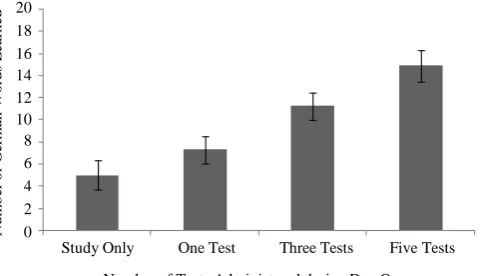
The number of correctly learned German words after 7-day delay was analyzed using a one-way ANOVA with the study-test combinations as a between subject factor. A significant main effect was found F (3, 88) = 10.35, p < 0.001, η2 = 0.26. A multiple comparison Bonferroni suggests that combination one (M = 5.00, SE = 1.36) was significantly different from combination three (M = 11.27, SE = 1.22) and combination four (M = 14.90, SE = 1.40). Combination two (M = 7.32, SE = 1.25) was significantly different from combination four. Combination three was significantly different from combination one. Combination four was significantly dif-ferent from combination one and combination two. These findings suggest that repeated retrieval practice has a positive impact on longer retention intervals (see Figure 3).
2.4. Discussion (Experiment 1)
The data suggests that the repeated retrieval practice is the most effective way to aid long-term memory reten-tion of German vocabulary words. The more test trials that were included, the greater the number of correct re-calls after a 7-day delay. These findings fall in line with Karpicke and Roediger (2007) that highlight the testing effect in memory. But how does repeated retrieval practice compare to other cognitive mnemonic techniques? Some of the popular memory techniques may not be suitable for foreign language learning. For example, mne-monic devices such as elaborative encoding and depth of processing techniques often require the learner to have prior knowledge about a given subject to have a positive impact on learning (Anderson, 2000). On the other hand, keyword method that incorporates vivid imagery has been found to be effective in foreign language learn-ing (Fritz et al., 2007; Sagarra & Alba, 2006). In Experiment 2, we continued to investigate the effectiveness of the keyword method compare to repeated retrieval practice.
3. Method (Experiment 2)
3.1. ParticipantsFigure 1. Mean number of German words learned after a 1-day and 7-day delay by study and test combination type. Indi-viduals in the shorter retention interval (1-day delay) condition retained more words than in the longer retention interval (7-day delay) condition. Combination one (study only) learned significantly fewer German words than all other combina-tions. Combination two (one test) and three (three tests) learned significantly fewer German words than combination four. Combination four (five tests) resulted in the greatest memory retention out of all combinations. Number of German words learned is out of 60. Error bars represent standard error.
Figure 2. Mean number of German words retained after a 1-day delay by study and test combination type. Combination one (study only) resulted in lower German word retention than all other combinations types. Combination two (one test), com-bination three (three test), and comcom-bination four (five test) were not significantly different from one another. Number of German words learned is out of 60. Error bars represent standard error.
Figure 3. Mean number of German words retained after a 7-day delay by study and test combination type. Combination one (study only) resulted in significantly less German words learned than combination three (three test) and combination four (five test). Combination four resulted in significantly more German words learned than combination one and combination two (one test). Number of German words learned is out of 60. Error bars represent standard error.
Study Only One Test Three Tests Five Tests
Number of Tests Administered during Day One
Seven-Day Delay One-Day Delay N u m b er o f G erm an W o rd s L ea rn ed 40 35 30 25 20 15 10 5 0
Study Only One Test Three Tests Five Tests
Number of Tests Administered during Day One
N u m b er o f G erm an W o rd s L ea rn ed 40 35 30 25 20 15 10 5 0
Study Only One Test Three Tests Five Tests
Number of Tests Administered during Day One
[image:5.595.198.440.530.668.2]3.2. Materials and Procedure
Twenty stimuli were taken at random from Fritz et al. (2007) for the Keyword portion of the experiment. Forty stimuli were randomly taken from the top 200 nouns that were most frequently used in the English language between 2005 and 2006 (Shaoul & Westbury, 2006). The forty English nouns were then translated using dict.cc and verified by a German instructor for accuracy. All other properties of the stimuli were normalized so that they would match the stimuli in Experiment 1. For the second part of the experiment participants were tested over all 60 words they learned on the previous day. Participants were asked to complete a series of metacogni-tion quesmetacogni-tions assessing the difficulty of each learning method. A Likert scale was used to rate the difficulty of each learning condition: 1 = hard, 2 = somewhat hard, 3 = neither hard nor easy, 4 = somewhat easy, and 5 = easy.
A 3 within (learning method) × 2 between (typing type) mixed factorial design was used. For the first part of the experiment, all participants ran through rote, test (repeated retrieval practice), and keyword conditions. Twenty English German word pair combinations were used for each condition. In all conditions, participants went through a whole wordlist once (20 words) before repeating the same wordlist 5 more times. For the rote learning condition of the experiment each participant was shown an English German word pair combination and asked to type out the German word in the text box (typing condition) or was merely exposed to the word pair (no typing condition). Each rote word pair combination was seen 6 times for a total of 120 trials. For the testing condition of the experiment, each participant was exposed to the stimuli in following fashion: RT RT RT, where R represents a rote trial and T represents a test trial. During the testing condition, participants were given an English word and asked to type equivalent German word (test trials were always typed out, however during the no typing condition participants did not type in the German word during the rote trials). Each rote word pair oc-curred 3 times and each testing ococ-curred 3 times for a total of 120 trials. For the keyword condition each par-ticipant was given an English word as well as its German counterpart within a keyword phrase. Parpar-ticipants were told that the keyword phrase should help them remember the English German translation. Each participant was asked to type out the German word highlighted within the keyword phrase or was merely exposed to each keyword phrase condition 6 times for a total of 120 trials. Rote, testing, and keyword condition orders were counterbalanced. The learning phase took approximately 35 minutes to complete.
For the second part of the experiment participants were tested over all 60 words they learned on the previous day. Participants were asked to complete a series of metacognition questions assessing the difficulty of each learning method. Participants were also asked to report which learning method they preferred and which they thought would result in the best overall learning out of the retrieval practice, keyword method, and rote methods of learning. The second part of the experiment took approximately 10 minutes to complete. Participants were then thanked for their time, given course credit, and debriefed about the nature of the experiment.
3.3. Results (Experiment 2)
A 3 within (learning method) × 2 between (typing type) mixed ANOVA was used to analyze our data. A main effect was found for the method of learning factor F (1, 36) = 78.19, p < 0.001, η2 = 0.69. A multiple compari-son Bonferroni suggests that the repeated retrieval practice (M = 8.87, SE = 0.77) method significantly outper-formed the keyword (M = 3.47, SE = 0.54) and rote (M = 3.42, SE = 0.55) methods of learning (see Figure 4). No significant difference was found between the keyword and rote methods of learning. No significance was found between the typing (M = 5.81, SE = 0.64) and no typing (M = 4.70, SE = 0.64) conditions. Our hypothesis that the retrieval practice condition would outperform the rote method of learning was supported however our hypothesis that the keyword method would outperform the rote learning condition was not supported.
Metacognition measures revealed no significant differences in the level of difficulty between the rote (M = 2.37, SE = 0.16), keyword (M = 2.68, SE = 0.21), and retrieval practice (M = 2.82, SE = 0.21) methods of learn-ing F (1, 37) = 3.30. No significant preferences were seen between rote (8), keyword (15), and retrieval practice (15) methods of learning χ2
(2, N = 38) = 2.58. It was found that participants tended to think that the keyword (21) method would results in better learning over the rote (6) and retrieval practice (11) conditions χ2
(2, N = 38) = 9.21, p = 0.01 (see Table 1).
3.4. Discussion (Experiment 2)
Figure 4. Mean number of German words retained after a 1-day delay by learning condition. The retrieval practice condi-tion significantly outperformed the keyword and rote methods of learning. No significant differences were found between the keyword and rote methods of learning. Number of German words learned is out of 20. Error bars represent standard error.
Table 1. Participant’s preferences for learning and predicted best for learning.
Method selected
Testing Keyword Rote
Preference 15 15 8
Best for learning 11 21 6
learning. These findings conflict with Fritz et al. (2007) which found that retrieval practice and keyword meth-ods performed at comparable levels. Differences in methodology may account for the differences in results. Fritz et al. (2007) used both visual and auditory modalities while our study used only a visual modality. Another key component that our experiment incorporated was repeated retrieval practice. Past research has only compared a single instance of retrieval practice to the keyword method while our study compared multiple instances of re-trieval practice. In accordance with Karpicke and Roediger (2007) this current study suggests that multiple in-stances of retrieval practice behooves long term memory retention.
Metacognition measures suggest that participants think that the keyword method will result in the best learn-ing. These findings are troublesome because in reality the repeated testing condition outperformed the keyword and rote methods of learning. These results fall in line with the desirable difficulty literature which states that learners often do not know which learning procedure is best (Yue et al., 2013). Due to finding no differences in overall difficulty between the three learning methods it is recommended to use repeated testing when possible when training novice foreign language learners because of the methods memory enhancement properties.
4. Summary and Concluding Discussion
The present study highlights the robustness of retrieval practice and repeated retrieval practice in the area of for-eign language learning. In both experiments it was found that repeated retrieval practice outperformed rote methods of learning, such findings fall in line with prior research (Karpicke & Roediger, 2007; Pyc & Rawson, 2009). Retrieval practice and repeated retrieval practice is thought to strengthen retrieval pathways to target to-be-remembered information so that data may be easier retrieved at a later time. Inconsistent with prior re-search (Fritz et al., 2007), it was found that the keyword method of learning was no more effective than rote learning conditions.
Metacognitive measurements included in Experiment 2 indicate that participants thought that the keyword method would result in better learning when in reality the repeated retrieval practice (or testing) method resulted in the best learning. These findings with metacognition measures are consistent with prior research that suggests that learners are often unaware which methods of learning are most effective in reality (Yue et al., 2013). If electronic learning software is properly programmed with effective learning methods then the learners that use these devices will be taught in an effective fashion regardless of what they think is the best way of learning.
Retrieval practice and repeated retrieval practice seem powerful enough to be implemented without the use of prior knowledge; recall that all the learners included this study had little or no knowledge of the German
lan-Testing Keyword Rote Method of Learning
N
u
m
b
er
o
f G
erm
an
W
o
rd
s L
ea
rn
ed 2018
[image:7.595.88.544.288.345.2]guage. As such, future projects should inquire the effectiveness of retrieval practice and repeated retrieval prac-tice in research and applied settings of learning. Future researchers should also include an auditory modality which may further aid learners in foreign language learning. Lastly, the use of feedback has also seen some ef-fectiveness in the area of foreign language learning and should be further inquired in conjunction with repeated retrieval practice (Kang, McDermott, & Roediger, 2007).
Acknowledgements
We thank the German material reviewer John W. Love from the University of Oklahoma for his contributions to this project.
References
Anderson, J. R. (2000). Learning and Memory. Hoboken, NJ: John Wiley & Sons.
Barrs, K. (2012). Fostering Computer-Mediated L2 Interaction beyond the Classroom. Language Learning & Technology, 16, 10-25.
Craik, F. I. M., & Tulving, E. (1975). Depth of Processing and the Retention of Words in Episodic Memory. Journal of Ex-perimental Psychology General, 104, 268-294. http://dx.doi.org/10.1037/0096-3445.104.3.268
Fritz, C. O., Morris, P. E., Acton, M., Voelkel, A. R., & Etkind, R. (2007). Comparing and Combining Retrieval Practice and the Keyword Mnemonic for Foreign Vocabulary Learning. Applied Cognitive Psychology, 21, 499-526.
http://dx.doi.org/10.1002/acp.1287
Godwin-Jones, R. (2011). Mobile Apps for Language Learning. Language Learning & Technology, 15, 2-11.
Kang, S. K. (2010). Enhancing Visuospatial Learning: The Benefit of Retrieval Practice. Memory & Cognition, 38, 1009- 1017. http://dx.doi.org/10.3758/MC.38.8.1009
Kang, S. K., McDermott, K. B., & Roediger, H. (2007). Test Format and Corrective Feedback Modify the Effect of Testing on Long-Term Retention. European Journal of Cognitive Psychology, 19, 528-558.
http://dx.doi.org/10.1080/09541440601056620
Karpicke, J. D., & Roediger, H. (2007). Repeated Retrieval during Learning Is the Key to Long-Term Retention. Journal of Memory and Language, 57, 151-162. http://dx.doi.org/10.1016/j.jml.2006.09.004
Pyc, M. A., & Rawson, K. A. (2009). Testing the Retrieval Effort Hypothesis: Does Greater Difficulty Correctly Recalling Information Lead to Higher Levels of Memory? Journal of Memory and Language, 60, 437-447.
http://dx.doi.org/10.1016/j.jml.2009.01.004
Roediger, H. L., & McDermott, K. B. (1995). Creating False Memories: Remembering Words Not Presented in Lists. Jour-nal of Experimental Psychology: Learning, Memory, and Cognition, 21, 803-814.
http://dx.doi.org/10.1037/0278-7393.21.4.803
Sagarra, N., & Alba, M. (2006). The Key Is in the Keyword: L2 Vocabulary Learning Methods with Beginning Learners of Spanish. Modern Language Journal, 90, 228-243. http://dx.doi.org/10.1111/j.1540-4781.2006.00394.x
Sandberg, J., Maris, M., & de Geus, K. (2011). Mobile English Learning: An Evidence-Based Study with Fifth Graders. Computers & Education, 57, 1334-1347. http://dx.doi.org/10.1016/j.compedu.2011.01.015
Schmidt, R. A., & Bjork, R. A. (1992). New Conceptualizations of Practice: Common Principles in Three Paradigms Suggest New Concepts for Training. Psychological Science, 3, 207-217. http://dx.doi.org/10.1111/j.1467-9280.1992.tb00029.x
Shaoul, C., & Westbury, C. (2006). USENET Orthographic Frequencies for the 40,481 Words in the English Lexicon Pro-ject. Edmonton: University of Alberta.
Sungkhasettee, V. W., Friedman, M. C., & Castel, A. D. (2011). Memory and Metamemory for Inverted Words: Illusions of Competency and Desirable Difficulties. Psychonomic Bulletin & Review, 18, 973-978.
http://dx.doi.org/10.3758/s13423-011-0114-9
Tulving, E., & Craik, F. I. M. (2000). The Oxford Handbook of Memory. New York: Oxford University Press.
Yue, C. L., Bjork, E., & Bjork, R. A. (2013). Reducing Verbal Redundancy in Multimedia Learning: An Undesired Desir-able Difficulty? Journal of Educational Psychology, 105, 266-277. http://dx.doi.org/10.1037/a0031971