© 2017, IRJET | Impact Factor value: 6.171 | ISO 9001:2008 Certified Journal | Page 633
Number Plate Recognition System: A Smart City Solution
Gagandeep Somal
1, Aakar Kale
2, Rachit Vijan
3, Meena Murumkar
4123Students, Information Technology Engineering, Fr. Conceicao Rodrigues College of Engineering,
University of Mumbai
4Student, Electronics and Communication Engineering, Usha Mittal Institute of Technology,
SNDT University, Mumbai, India.
---***---Abstract
-
For a city to be termed as a Smart City, it musthave many factors which makes it productive. The factors might include a smarter parking system, measures to control the traffic, to monitor the congestion, to manage the safety and have surveillance for the drivers. Nowadays we have seen an enormous increase in the population of the vehicles in the city, because of which it has become difficult for people to monitor it. Now we definitely needs a solution to this. Hence here is where Automatic Number Plate Recognition using SVM comes into the picture which helps in vital working of the Smart Cities and this system can very well be used to monitor traffic, tracking stolen cars, enforcing red light violations, managing parking toll, border and custom checkpoints. As we know there is a demanding problem because of the diversity of plate formats in different countries, different scales, irregular illuminations and rotations during image capture, our objective is to provide a novel algorithm for recognition of license plates in complex scenarios. We have achieved this using various mathematical morphology and Support Vector Machine.
Key Words: Number plate, Support Vector Machine (SVM), Extraction, Recognition, Image Processing, Smart City.
1. INTRODUCTION
Number Plate Recognition (NPR) has turned out to be an essential tool in our day to day life since there has been a rapid growth of vehicles, which is definitely not a cup of tea to be managed by humans single handedly. There has arised a need in the cities for a smarter way, hence NPR has become something which is preferred and desperately needed. Mumbai Traffic Police’s implementation of NPR as Road Traffic Control is the best example of it's application. Yet, it’s a very challenging problem, due to the diversity of plate formats, different scales, rotations and non-uniform illumination conditions during image acquisition.
With the aim of developing a novel algorithm to combat these issues for license plate recognition in complex scenes, particularly for the all-day traffic surveillance environment. This is achieved using mathematical morphology and SVM. A pre-processing step is applied to improve the performance of license plate localization in case of severe imaging conditions. The first and second stages utilize edge detection and mathematical morphology followed by connected component analysis.
SVM is employed in the last stage to construct a classifier to categorize the input numbers of the license plate.
In metropolitan cities, all we can see are vehicles more than the human population. Vehicles play an essential part in transportation. In India, the number of vehicles had a sudden increase in the last decade because of many factors like more affordable, availability of easy-n-quick loan services, etc. Along with that, congestion, traffic rules violation and parking related issues are still a conundrum. In order to combat this problem, a specialized image processing technology can be used to identify vehicles by using the number plate as the only parameter.
Since we all know that the number plates are a unique identification provided by Government authorities, this data could be sufficient to obtain all the details related to the car and the owner of the car. This technology is Number Plate Recognition (NPR), which can be the ultimate solution to these problems by providing traffic and security control, parking control, speed control, parking entrance admissions etc.
Basically making the drivers maintain decorum and the authorities to identify any violations of traffic laws in the city.
Extraction of pattern, image processing and artificial intelligence are the three fundamental elements used in NPR system. Number Plate Recognition is a computer vision and is amongst the most important aspects of smart transportation systems in our society. Number Plate Recognition processes as follows:
- Image Preprocessing - Pattern Extraction - Character Recognition
© 2017, IRJET | Impact Factor value: 6.171 | ISO 9001:2008 Certified Journal | Page 634
Different factors like angle and distance light variations and illumination, scales, resolution etc are to be considered.
1.1Project Objective
1. To successfully acquire car image.
2. To extract number plate from the image acquired 3. To successfully recognise the characters recognised by matching with the pre requisite information.
1.2Workflow
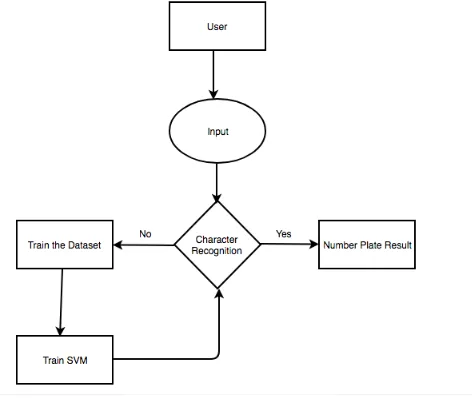
A typical NPR system extracts a number plate from a captured image working of NPR comprises of three stages. Firstly, an image is acquired from the camera so parameters related camera for example the type, orientation resolution, illumination etc are considered. In the next stage the exact license plate is extracted from the image captured by the camera based on some specific details like the colour of number plate or the characters allotted etc. In the final stage, the licence plate details are matched using template matching or by using ANN, SVMs and similar classifiers.
Fig -1: Flowchart of a typical NPR
1.3 Applications of the system
NPR system recognises characters optically and read vehicle number plate after successful detection. Closed-circuit television (CCTV) or road-law enforcement cameras, or specially designed cameras specifically for NPR can be used. For law enforcement purposes, NPR is used by police and government authorities to check whether licensed vehicles are used or to determining details of any driver who fails to follow road rules. It can be very essential for toll collections and as a method to catalogue the traffic movements by highways agency.
NPR can be used to store the images and the text details extracted from the license plate in a memory that is configured to store a photograph of the driver as well. This System commonly uses IR lighting, as illumination and night-day period doesn't affect the quality of images acquired.
Only concern are the misidentification, failure to detect number plate because of different modifications and font patterns used by the driver on his number plate, privacy policy as confidential information are tracked by
government, high error rates etc.
2. SUPPORT VECTOR MACHINE
In the literature review many Number Plate Recognition methods were studied. Where the number plate recognition is the hotspot area of research now a days due to rapid development of transportation systems and the literature review that we studied various existing techniques take place for number plate recognition, amongst them Support Vector Machine (SVM) suits our requirements. [1]
2.1 SVM Description
The fundamental issue in number recognition is shape analysis. Many methods on shape analysis have been seen in the past ten years such as methods using Morphological Functions, methods based on gradient propagation and methods by comparing weighted shape graphs. Many other techniques such as Fourier description, template matching, invariant moments and neural network are also used for shape analysis. This technique uses a Support Vector Machine (SVM) to train character samples and obtain the rules that are used to recognize the numbers on number plates. SVM is forcefully competing with many methods for pattern classification. An SVM is a supervised learning technique first discussed by Vapnik.
SVM takes Statistical Learning Theory (SLT) as its theoretical foundation, and the structural risk minimization as its optimal object to realize the best generalization. They are based on some simple ideas and provide a clear intuition of what learning from examples is all about. More importantly, they possess the feature of high performance in practical applications. From 1960s to present, SVMs become more and more important in the field of pattern recognition.
2.1 Principles of SVM
[image:2.595.50.286.379.578.2]
© 2017, IRJET | Impact Factor value: 6.171 | ISO 9001:2008 Certified Journal | Page 635
the classes, but there is only one optimal separating hyperplane.
The optimal one is expected to generalize well in comparison to the others. The optimal hyperplane is determined only by support vectors which are ideally distributed in class boundaries. The hyperplane is constructed so as to maximize a measure of the “margin” between classes. An SVM corresponds to a linear method in a very high dimensional feature space. The feature space is nonlinearly related to the input space. Classification is achieved by realizing a linear or nonlinear separation surface in this space.
2.2 Multi-class Model of SVMs
Among many classification methods, SVM has demonstrated superior performance. It has been successfully utilized in handwritten numeral recognition. SVM was originally designed for binary classification but its extension to solve multi-class problems is not straightforward. The popular methods for applying SVM to multi-class problems decompose a multi-class problem into many binary-class problems and incorporate many binary-class SVMs.
Two main approaches have been suggested for applying SVMs for multi-class classification. In each approach, the underlying basis has been to reduce the multi-class problem to a set of binary problems, and to enable the use of basic SVM. The first approach, called “one against all”, uses a set of binary classifiers, each trained to separate one class from the rest. The second approach is called “one against one”. In this approach, a series of classifiers are applied to each pair of classes, and only the label of the most commonly computed class is kept for each case.
3 SYSTEM ARCHITECTURE
The proposed NPR has four parts:
(i) Pre-processing.
(ii) License Plate Extraction from image. (iii) Feature Extraction
(iv) Recognition of those characters by SVM Classification.
3.1 Proposed Algorithm NPR system using SVM
We summarize the SVM based algorithm for number recognition in this paper as follows. In order to recognize a number plate, we go through the following steps.
Step.1: Pre-process the image of number plate. Step.2: Find contours on the image.
Step.3: Extract the digits from the contours found. Step.4: Extract the feature vector of each candidate
Step.5: Recognizes the single character (a digit or a letter) by the SVM trained in advance.
Step.6: If there are no more unclassified samples, then STOP; otherwise, go to Step 5.
Step.7: Add these test samples into their corresponding database for further training.
Step.8: Recognize number plate by bringing all characters used together.
When a number plate region is extracted, the individual characters’ contours are found. The number plate contour is found and the images containing individual characters (digits and letters) forming the number plate are obtained. Each image of a character is normalized into size of 40x40. Then the support vectors are calculated directly from the normalized sub-images. The high dimensional feature vectors are stored into a database. The above feature vectors are used to train SVM. High dimensional feature vectors are input into SVM which have been trained successfully. Then, which character a given candidate should be can be obtained in according to the outputs of SVMs. When all digits and letters on a number plate are recognized (or classified), the recognition of the number plate is complete.
3.2 Solution to Above Problem
The Image of a license plate is first processed to find the license plate region. After the license plate region has been recognized the characters are extracted from the plate. The characters that have been extracted are then processed to find the feature vectors in them. The feature vectors extracted are then given to the classifier as input An order to check against the database what the particular character is and thus we get the Number Plate as output.
4. PROJECT DESCRIPTION
4.1 Overview of the project
© 2017, IRJET | Impact Factor value: 6.171 | ISO 9001:2008 Certified Journal | Page 636
number plate recognition algorithm is proposed for character recognition. [3]
This algorithm employs an SVM to recognize numbers. Each character is recognized by an SVM, which is trained by some known samples in advance. The algorithm starts from a collection of samples of numbers from number plates. In order to recognize a number plate correctly, all numbers are tested one by one using the trained model. The results are achieved by finding the max value between the outputs.
4.2 Module Description
Modules are listed as follows:-
4.2.1 Pre-processing
The license plate normally has a rectangular shape with a known aspect ratio, it can be extracted by finding all possible rectangles in the image. There are a number of different methods to extract the number plate from the image:
– Gray Scale Conversion
The image is converted to a grayscale image.
– Convert to Binary
The gray scale image is then converted to binary using adaptive Gaussian thresholding.
4.2.2 Converting to binary
– Morphological Processing
The binary image is further processed using structural operations like erosion and dilation. Structural techniques examine an image with a small shape called a structuring element.
The structuring element is arranged at all possible locations in the image and it is compared with the corresponding neighborhood of pixels.
4.2.3 Dilation using 3x3 element
In the structuring element, each with a value of zero or one. The matrix dimensions specify the size of the element. The pattern of ones and zeros specifies the shape of the element. An origin of the structuring element is usually one of its pixels, although generally, the origin can be outside the structuring element.
4.2.4 After applying morphological operations
Contours are often obtained from edges, but they are aimed at being object contours. Thus, they need to be closed curves.
Contour tracing is a preprocessing technique performed on digital images in order to get the info about their general shapes. Once the contour of a given pattern is received, it’s different attributes will be studied and used as features which will later on be used in pattern classification. Hence, correct extraction of the contour will produce better and perfect features which will increase the probability of correctly classifying a given pattern.
We get all of the contours and arrange them in a double leveled hierarchy. At the top-most level, there are external boundaries of the components. At the second level, there are boundaries of the holes. If there is another contour inside a hole of a connected component, it is still put at the top level.
4.2.5 License Plate Extraction
Tracing all possible Contours:-
We have defined a filter to just contours which might be the size of the number plate. After that again contours are found which are of the size of the individual characters using a filter defined.
4.2.6 Feature Extraction
Feature extraction is a technique that extracts some features from the character. After applying Specific Filters. It reduces the processing time for template matching because not all pixels are involved. The extracted features form a feature vector which is compared with the pre-stored feature vectors to measure the similarity.[2]
The individual images of the characters are taken and resized to find the feature vectors.
We find 32 feature vectors from the image and store it. This is repeated for all characters and stored. The feature vectors are stored as a matrix. [3]
4.2.7. Classification
Classification is the problem of identifying to which of a set of categories (sub- populations) a new observation belongs, on the basis of a training set of data containing observations (or instances). Classification is an example of pattern recognition. An algorithm that implements classification, especially in a concrete implementation, This is known as a classifier.
© 2017, IRJET | Impact Factor value: 6.171 | ISO 9001:2008 Certified Journal | Page 637
Then, we perform classification by finding the hyperplane that differentiate the two classes very well.
4.2.8 Hyperplane separating feature vectors
Support Vectors are simply the coordinates of individual observation. Support Vector Machine is a frontier which best segregates the two classes (hyperplane/ line).
An SVM model is a representation of the examples as points in space, mapped so that the examples of the separate categories are divided by a clear gap that is as wide as possible. New examples are then mapped into that same space and predicted to belong to a category based on which side of the gap they fall on.
Finding the right hyperplane is very important in order get the best accuracy.
We choose the hyperplane so that the distance from it to the nearest data point on each side is maximized.
In addition to performing linear classification, SVMs can efficiently perform a non- linear classification using what is called the kernel trick, implicitly mapping their inputs into high-dimensional feature spaces. [4]
6. IMPLEMENTATION
6.1 Database and Dataset
The database is made of license plates from various countries taken from various angles and distances.
The lighting and brightness also varies from image to image and also the images are of varying resolutions.
i. Database
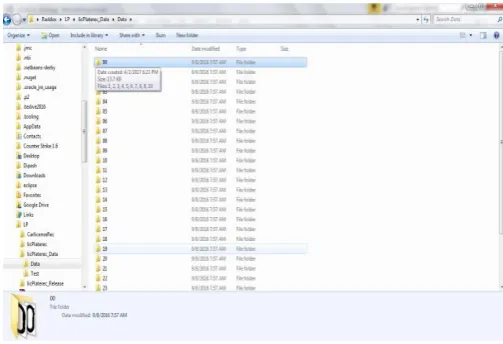
The dataset contains all the images of the characters extracted from the license plates. The images are segregated into different folders. Each folder contains one specific character only. Figure 3 shows the image of character stored in the folder.
ii. Training Dataset
This shows characters after their extraction from the image of the vehicle.
Fig -2: An image of the car from the database
Fig -3: Collection of the trained dataset of alphabet M
These images are stored in the Debug folder from where they are moved to the dataset folder according to the character extracted.
5.2 Training SVM
After the dataset is ready the SVM needs to be trained. Inside the GUI "Machine Learning" is clicked and the dataset folder.
[image:5.595.307.563.62.225.2] [image:5.595.307.561.254.401.2] [image:5.595.307.559.554.726.2]© 2017, IRJET | Impact Factor value: 6.171 | ISO 9001:2008 Certified Journal | Page 638
The SVM storage location is selected and it is stored. The SVM gets trained and finally a "Training completed" dialog box pops up.
Fig -5: SVM Training
The GUI is designed to do all the functions needed for Number Plate Recognition.
Fig -6: GUI
5.3 GUI of the System
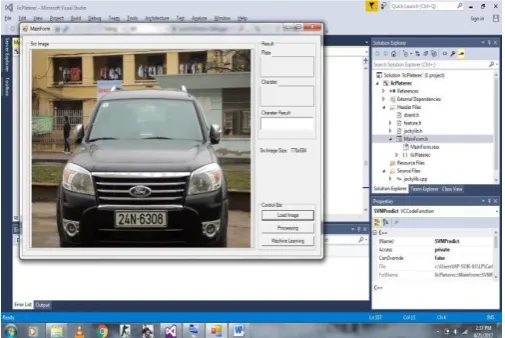
• The image is loaded onto the GUI as shown in figure 5.10.
Fig -7: An image loaded in the GUI
5.4 Loading the image on the GUI
The Number Plate Recognition is done by clicking the
"Processing" button.The output is in text format and can
be copied somewhere else.
Fig -6: Individual character obtained from the number plate of the car in the image
6. CONCLUSION AND FUTURE SCOPE
Number Plate Recognition is a developing area of research and development in the field of Transportation Systems. Different researchers have provided different methods and techniques for this system. However, every technique has its own advantages and disadvantages.
The presented is a detailed explanation of the proposed Number Plate Recognition system by categorizing it according to the features used in each stage. We used image processing and morphological operations for extracting the License Plate from the image and get the characters from the image. The feature vectors extracted will be used to train the SVM Classifiers and make the database. This method has suggested a new approach for high accurate and real time recognition of poor quality number plates. Furthermore, it can be used for toll charge supervision of highway and in other applications. The accuracy is high for images taken from the rear side of the vehicle.
[image:6.595.36.290.128.263.2] [image:6.595.308.562.151.327.2] [image:6.595.35.290.332.494.2] [image:6.595.37.290.570.739.2]© 2017, IRJET | Impact Factor value: 6.171 | ISO 9001:2008 Certified Journal | Page 639
This is a budget-friendly technology hence the implementation of NPR would help any city for law enforcement without the need for large human power. Hence there is a subsequent demand in developing and implementing such technologies in both large and small cities.
ACKNOWLEDGEMENT
This research was supported by Fr. CRCE, Bandra. We thank our guide, Mrs. Jagruti Save, H.O.D. for assistance with our project, mainly SVM techniques & Mrs. Sangeeta Parshionikar for comments that greatly improved the project research.
We would also like to show our gratitude to our colleague Ms. Meena Murumkar, from SNDT University, for sharing the pearls of wisdom with us during the course of the research, although any errors are our owned and should not tarnish the reputations of these esteemed persons.
REFERENCES
[1] Nupur, Alisha, “A Review Paper on License Plate Recognition System,” International Journal for Research in Applied Science & Engineering Technology (IJRASET), Volume 5 Issue IV, April 2017.
[2] Shan Du, “Automatic License Plate Recognition (ALPR): A State-of-the-Art Review,” IEEE TRANSACTIONS ON CIRCUITS AND SYSTEMS FOR VIDEO TECHNOLOGY, VOL. 23, NO. 2, FEBRUARY 2013.
[3] Anand Sumatilal Jain, Jayshree M. Kundargi, “Automatic Number Plate Recognition Using Artificial Neural Network,” International Research Journal of Engineering and Technology (IRJET), Volume: 02 Issue:04,July-2015.
[4] Zemeng Wang, “Using Support Vector Machine by MATLAB,” The Open Automation and Control Systems Journal,pp.497–502,2014.
BIOGRAPHIES
Gagandeep Somal
B.E. (Information Technology), Fr. Conceicao Rodrigues College of Engineering
Research Area: Artificial Intelligence
Aakar Kale
B.E. (Information Technology), Fr.Conceicao Rodrigues College of Engineering
Research Area: Business Intelligence
Rachit Vijan
B.E. (Information Technology), Fr.Conceicao Rodrigues College of Engineering
Research Area: Information & Database management and
Business Analysis
Meena Murumkar
B.Tech (Electronics and Communication Engineering)
Usha Mittal Inst of Technology