© 2017, IRJET | Impact Factor value: 6.171 | ISO 9001:2008 Certified Journal | Page 319
A Survey Paper On Different Encoding Techniques
Based On Quantum Computing
Abbasali Antelawala
1, Hatim Chathiwala
2, Nihal Kaul
3, Rishabh Shukla
41,2,3,4
KJ College of Engineering and Management Research, Pune, India
---***---Abstract -
Quantum computing is the branch of science thatstudies theoretical computation systems (Quantum computers) that make direct use of mechanical phenomena, such as superposition and entanglement, to perform operations on data. Quantum computers are different from binary digital electronic computers based on transistors. Whereas commonly used digital computing requires that the data be encoded into binary digits (bits), each of which is always in one of two definite states (0 or 1). Quantum computation uses Quantum bits, which can be in superposition of states. Quantum key distribution (QKD) uses Quantum mechanics to guarantee secure communication. It enables two parties (Alice and Bob) to produce a shared random secure secret key known only to them, which can then be used to encrypt and decrypt messages. Quantum communication involves encoding information in Quantum states, or qubits, as opposed to classical communications & use of bits. Usually, photons are used for these Quantum states. Quantum key distribution exploits certain properties like superposition and entanglement principles of these Quantum states to ensure its security. Thus, encoding techniques can be used to generate a shared secret key which can then be used to transmit message securely and can prevent eavesdroppers at bay.
Key Words: Quantum Computing, QKD (Quantum Key
Distribution), Bloch sphere, Cryptographic Protocols, Quantum Cryptography, No-Cloning theorem
1. INTRODUCTION
1.1 Quantum Computing
Quantum Computing is the branch of science which deals with the design and development of computers based on the principles of Quantum Mechanics. The subject of physics studies elementary objects and simple systems & the study becomes more interesting when things are larger & more complicated. Quantum Computation & information based on the principles of Quantum Mechanics will provide tools to ll up the gulf between the small & the relatively complex systems in Physics.
Quantum Mechanics arose in the early 1920's when classical physics could not explain everything ever after adding ad-hoc hypothesis. The rules of Quantum Mechanics were simple but overlooked counter intuitive. Quantum means very small i.e. it deals with the elementary particles (atoms) in space.
1.2 Quantum Computer
We know that a bit (a0 or a1) is the fundamental concept of
[image:1.595.308.560.570.734.2]classical computation& information. Also a classical computer is built from an electronic circuit containing wires & logic gates. Similarly, in Quantum Computer's we have Quantum Bits (also known as qubit) & Quantum Circuits which are analogous to bits & circuits in classical computer. A Quantum Bit or simply a Qubit can be mathematically defined as,
|ψ> = α|0> + β|1>
Two possible states for a qubit are the states |0> and |1>. The notation |1> is known as the Dirac notation. Unlike a classical bit, a qubit can be infinite numbers of states, other than |0> and |1>. It can be in a state |ψ> = α|0> + β|1>, where α and β are complex numbers such that α2 + β2 = 1.
The 0 and 1 are called the computational basis states & |ψ> is called a superposition. We can call |ψ> = α|0> + β|1> as a Quantum state. The Quantum bits are suspended using coefficients like α, β, γ, σ, etc to denote the magnitude of energy required to spin the atom to appropriate position. The coefficients are probabilistic nature it means that the coefficient may represent different values at different instance of time. The coefficients are related with Quantum spins.
1.3. Quantum Spin
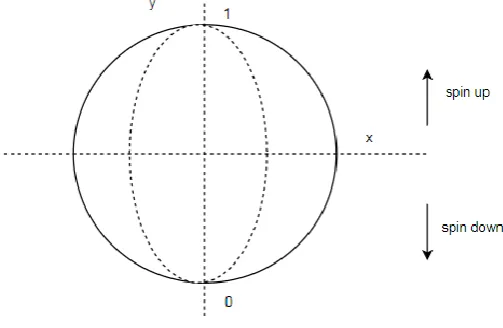
Let’s have a look at the structure of 1 - qubit (1 - qubit = 2 states)
© 2017, IRJET | Impact Factor value: 6.171 | ISO 9001:2008 Certified Journal | Page 320 In 1-qubit structure, the x-axis denotes horizontal
[image:2.595.40.288.233.408.2] [image:2.595.339.526.680.736.2]polarization and y-axis denotes the vertical polarization. Spin up is the phenomena of spinning the position of the qubit upwards. Spin down is the phenomena of spinning the position of a qubit downwards. The spin up and Spin down is required to change the value if the qubit from 0 to 1 or 1 to 0. Therefore the qubits can be represented mathematically as
α|0> + β|1> → Amount of energy required to spin the atom
Similarly, 2 qubits can be structured as: 2- Qubits will represent 4 states.
Figure 2 : 2-Qubit
Therefore to spin the atom to any of four state, we will require four coefficients determining the magnitude to change the state of the qubit. Therefore, the qubit can be represented as
α|00> + β|01> + γ|10> + σ|11> Amount of energy required to spin the atom
Similarly, we can imagine for 3-qubits, 4-qubits, ..., n-qubits, which will have 2n states. Quantum bits can exist in
superposition and entanglement.
1.3.1 Superposition principle
Superposition is the principle of Quantum mechanics and its states that a particular atom can exist in multiple states in space simultaneously.
1.3.2 Entanglement
Entanglement states the two or more qubits can exist in correlation with each other in space such that the change in one qubit will react in the state of its correlated qubit as well.
1.4 Quantum gates
Quantum logic gates are basic Quantum circuit which operates on single or multiple qubits. Quantum logic gates
shows two analogous behavior to Quantum computers as the classical logic gates shows for digital computers. Logic gates are reversible and irreversible. But Quantum logic gates are reversible showing non-identical properties than classical logic gates.
1.4.1 Reversible and irreversible gates
Quantum logic gates operation is based in elementary unitary matrix operation which is reversible. The importance of reversible logic in Quantum computing is considered as a promising design paradigm. It is the ultra low power computation and is the emerging future technology because of the possibility of nearly energy free computation.
Quantum computing as a physical realization of reversible logic motivates to do further research in this domain. The gates in Quantum which are represented using the unitary matrix of matrices also have potential to implement the reversible logic. Classical logical reversible gates are ones which act on binary digits or bits.
Similarly, reversible gates are used in Quantum gates and act on qubit which is a unit of Quantum information. A circuit is called a reversible if and only if there is a one to one correspondence between its input and output. Here, the output can be uniquely determined from input and input can also be recovered from the output.
If a reversible function is shown by a truth table, then its output pattern must be the permutation of its input pattern. This phenomenon implies that the number of input and output of a reversible circuit are equal. Generally, with a input there exists 2n reversible gates.
1.5 Commonly used Quantum gates
1. NOT gate
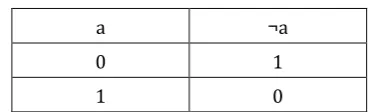
NOT gate is the simplest example of reversible logic gate. NOT gate represents 1-input / 1-output gate that simply inverts the bit value it gets. The truth table of NOT gate is shown below. In quantum computing a circuit may not have any physical wires connecting the gates together. Instead a circuit can be merely a visual specification of a sequence of gate operations with time increasing from left to right in the circuit diagram as successive gates are applied.
Table -1: NOT gate: Truth Table
a ¬a
0 1
© 2017, IRJET | Impact Factor value: 6.171 | ISO 9001:2008 Certified Journal | Page 321 The representation of NOT gate is shown below:
Figure 3 : NOT gate
2. CNOT gate
[image:3.595.381.492.115.323.2]Alternative icon for a SWAP gate that is more common in quantum circuit diagrams. The reason for having a different icon for SWAP in quantum circuits compared to classical circuits is that many implementations of quantum circuits do not have physical wires as such. Hence, it could be misleading to depict a SWAP operation as a crossing of wires. Instead, a SWAP operation can be achieved as the result of a sequence of applied fields.
Table -2: CNOT gate: Truth Table
a b a' b’
0 0 0 1
0 1 0 0
1 0 1 1
[image:3.595.297.558.355.512.2]1 1 1 0
Figure 4: CNOT gate
The representation of CNOT is represented as: That is, the decision to negate or not negate the second bit is controlled by the value of the first bit. Hence, the name "Controlled-NOT". Note that, as shown, the SWAP gate can be obtained from a sequence of three CNOT gates.
3. Toffoli
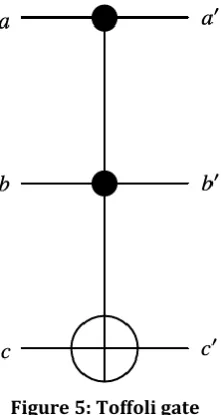
The Toffoli gate is known to be universal for reversible Boolean logic, the argument for which is based on the fact that the Toffoli gate contains the NAND gate within it. A
universal three-bit gate was identified by Toffoli in 1981, called the Controlled-Controlled-NOT.
Figure 5: Toffoli gate
Table -3: Toffoli gate: Truth Table
a b c a’ b’ c’
0 0 0 0 0 0
0 0 1 0 0 1
0 1 0 0 1 0
0 1 1 0 1 1
1 0 0 1 0 0
1 0 1 1 0 1
1 1 0 1 1 1
1 1 1 1 1 0
4. Fredkin
[image:3.595.43.284.357.630.2]Fredkin gate becomes very suitable for the reversible computing. It is a universal gate; so any logical or arithmetic operation can be conducted through the only use of Fredkin gates. The Fredkin gate is the reversible three-bit gate that swaps the last two bits if the first bit is 1. The truth table of Fredkin gate can be represented as:
Table -4: Fredkin gate: Truth Table
a b c a’ b’ c’
0 0 0 0 0 0
0 0 1 0 0 1
0 1 0 0 1 0
0 1 1 0 1 1
1 0 0 1 0 0
1 0 1 1 1 0
1 1 0 1 0 1
[image:3.595.300.559.635.781.2]© 2017, IRJET | Impact Factor value: 6.171 | ISO 9001:2008 Certified Journal | Page 322
5. Hadamard gate
One of the most useful single qubit gates, in fact perhaps the most useful one, is the Hadamard gate, H. The Hadamard gate is defined by the matrix:
1.6 No Cloning Theorem
The no cloning theorem is a result of quantum mechanics which forbids the creation of identical copies of an arbitrary unknown quantum state. It was stated by Wootters, Zurek, and Dieks in 1982, and has profound implications in quantum computing and related fields. The theorem follows from the fact that all quantum operations must be unitary linear transformation on the state. Suppose the state of a quantum system A is a qubit, which we wish to copy. The state can be written as
|ψ>A = a|0> A + b|1>A
The complex coefficients a and b are unknown to us. In order to make a copy, we take a system B with an identical Hilbert space and initial state |e>B (which must be independent of |ψ>A, of which we have no prior knowledge). The composite system is then described by the tensor product, and its state is |ψ> A |e> B.
There are only two ways to manipulate the composite system. We could perform
an observation, which irreversibly collapses the system into some Eigen state of the observable, corrupting the information contained in the qubit. This is obviously not what we want. Alternatively, we could control the Hamiltonian of the system, and thus the time evolution operator U(Δt), which is linear. We must x a time interval Δt, again independent of |ψ> A. Then U(Δt) acts as a copier provided,
U(Δt) |ψ> A |e> B
= |ψ> A |ψ> B(a|0> A+b|1> A)(a|0> B+b |1>B) = a2 |0> A |0> B + ba |1> A |0> B + b2 |1> A |1> B
For all ψ. This must then be true for all the basis states as well, so
U(Δt) |0> A |e> B = |0> A |0> B U(Δt) |1> A |e> B = |1> A |1> B
Then the linearity of U(Δt) implies
U(Δt) |ψ> A |e> B
= |ψ> A |ψ> B(a|0> A + b |1> A) (a|0> B + b|1> B) ≠ a2 |0> A |0> B + ba |1> A |0> + ba |1> A |0> B + b2 |1>
A |1> B
Thus, U(Δt) |ψ> A |e> B is not generally not equals to |ψ> A |ψ> B, as may be verified by plugging in a = b = 2 - 21 , so U(Δt) cannot act as a general copier. Q.E.D. In contrast, the no cloning theorem is a vital ingredient in quantum cryptography, as it forbids eavesdroppers from creating copies of a transmitted quantum cryptographic key.
1.6 Bloch Sphere
Quantum mechanics is mathematically formulated in Hilbert space or projective Hilbert space. The space of pure states of a quantum system is given by the one-dimensional sub spaces of the corresponding Hilbert space (or the "points" of the projective Hilbert space). For a two-dimensional Hilbert space, this is simply the complex projective line. This is the Bloch sphere.
1.7 Bell states
Bell state is the concept in quantum information science and represents the simplest example of entanglement. An EPR (Einstein, Podonsky, Rosen.) pair is a pair of qubits that are in a bell state together i.e. entangled with each other.
1.8 Heisenberg’s uncertainty principle
In quantum mechanics, the uncertainty principle, also known as Heisenberg's uncertainty principle or Heisenberg's indeterminacy principle, is any of a variety of mathematical inequalities asserting a fundamental limit to the precision with which certain pairs of physical properties of a particle, known as complementary variables, such as position x and momentum p, can be known, it states that the more precisely the position of some particle is determined, the less precisely its momentum can be known, and vice versa.
2. Data encoding protocols in quantum encoding
2.1 BB84
© 2017, IRJET | Impact Factor value: 6.171 | ISO 9001:2008 Certified Journal | Page 323 used for secure communication from source to destination in
Quantum computers. BB84 scheme, suppose that the source 'A' wishes to send a private key to 'B'. 'A' begins with a 2 string of bits 'a' and 'b', each of n bits long. Then these Strings are encoded of n qubits.
|ψ> = ⊗ ni = 1 |ψaibi>
ai and bi are ith bit of a and b respectively. ai and bi together
gives us an index of four qubits states
|ψ00> = |0> |ψ10> = |1>
|ψ01> = |+> = √2 |0> + 1 √2 |1> 1
|ψ01> = |-> = √2 |0> - 1 √2 |1> 1
The Important part is to take in guidance is that the bi is
what decides in which basis ai is encoded. Therefore, the
qubits are now not in mutually orthogonal states. Thus it is now impossible to determine all of them with certainly without knowing b.
2.1.1 Working of BB84
The Benetton Brossard quantum cryptographic key generation protocol or BB84 protocol: Assume Alice and Bob, as they would like to send encrypted messages between each other so that their messages can securely be made private. To do this they need a cryptographic key that is only known to them and which they’ll use to encrypt their messages. Unfortunately they know that somewhere out there are nemesis, Eve may try to intercept their messages and foil their secret plans. Alice assures Bob however that they need not to worry about Eve. She will teach Bob about BB84 protocol and it will allow them to come up with a secret key they can both use and trust. Eve wont perceive any message. To communicate through fundamentally different communication channels, a classical channel and a quantum channel. The classical channel allows them to decide individual bits of information back and forth just as they would if they were using say the internet as the bits travel across the classical channel; it is possible for Eve to intercept them. Eve can observe the bits and then send copies of them on to their regular destination. When communicating over the classical channel, Alice and Bob have no way to detect Eves intrusion on their privacy. The quantum channel behaves quite differently. Instead of transferring bits, the quantum channel transfers qubits. The qubits represents bits and can be generated by either of two processes, as process A and process B. The BB84 protocol takes advantage of some special properties of qubits. First, a qubit cannot be copied. And second, it is not possible to determine whether the qubit was produced by process A or process B.
Process A → |10> Process B → |10>
© 2017, IRJET | Impact Factor value: 6.171 | ISO 9001:2008 Certified Journal | Page 324 same. They need to verify however that this is indeed the
case since that they have a very large sequence of bits they can afford to sacrifice a random subset of them in order to determine whether Eve was listening over the classical channel, they choose the subset of bits and compare them if they are satisfied that the communication was secure, they can use the remaining bits to form a secret cryptographic key. If they observe an accuracy of 100%, they can be reasonably con dent that their shared bits are secure and they can begin using them to crypt further communication. If they observer an accuracy rate slightly below 100%, they will know that Eve intercepted some or all of their qubits and the communication is not yet secured. Thus, by using this protocol, Alice and Bob can determine their secrecy and can communicate privately.
2.2 SARG04
Another protocol after BB84 is the SARG04 protocol.
Advanced version with more reliability an robustness , the SARG04 protocol comes into the quantum cryptography family. This protocol was built when researchers noticed by suing 4 states of BB84 with a different information encoding which would be more robust. SARG04 robustness can be seen against the photon splitting attack when attenuated laser pulses are used instead of single photon sources. The protocol SARG04 has some insecurities with the implementation of single photon. Let us start with some examples: Alice and Bob where Alice is source and Bob is the receiver Alice sends private key to Bob, now Alice starts with 2 strings a and b of n bits. Alice encodes those 2 strings with the n qubits. Now after receiving the string Bob proceeds to generate a string of bits b' of same length as b. Now here the thing comes that Bob announces publicly that he has received the transmission of Alice For each transmitted qubit the sender chooses one Hadamard basis state. These two states are announced by Alice that is Hadamard state and computational basis state. Now the 2 states which are announced are noted by Alice whether they are computational basis state or Hadamard state. If either one is chose or identified then that piece of information make up the secret bit. This secret bit is used by Alice to communicate with Bob. For example, Alice transmits |ψ00> state and announces the states |ψ00> and |ψ01> . Now, we can check for both computational basis as well as the Hadamard basis. Outcome is clearly with the state having been |ψ00> and it would be consistent as well if the outcome would been |ψ01>By using the possibilities of Hadamard basis for the state if it would be the |ψ01> transmitted by Alice. The probabilities would be either |ψ01> or |ψ11> each with 50% probabilities as measured with Hadamard gate. Now if the outcome is |ψ01> then again this state is consistent with either of state in the starting. Now, if the outcome is |ψ11> ,it cannot be possibly observed from a qubit in state of |ψ01>. So if Bob measures using Hadamard basis and observed the state |ψ01> then he can be aware that of which state he was sent and what the secret bit can be to communicate with Alice.
Now for the remaining say k bits Bob measurement was conclusive. The sender chooses some k2 bit randomly and announces the choices on the public channel. Similarly, Bob also does it and both of them runs a check to see if more than a certain number of them agree. If yes then they are further proceeded to use privacy amplification and information reconciliation to create number of shared secret key. In BB84, Alice or the sender never announces the basis of his/her bits and therefore the eavesdrop or the hacker hast to store more copies of qubit in order to determine the basis of the state. The beneficial use of SARG04 is in situations where information is started by a poisonous source producing weak pulses. The term poisonous source producing weak pulses mean the number of photon < 1 and are received by an imperfect detector. The security test performed by Kiyoshi Tamaki and Hoi-Kwong lo were successfully in proving securities for one and 2 pulses using SARG04. SARG04 is more robust than BB84 against incoherent PNS attack The better performance between SARG04 and BB84 was observed. By using single photon implementations SARG04 and BB84 were considered equal according to the theory. But experiments showed that this was proves wrong and was inferior.
2.2 E91
© 2017, IRJET | Impact Factor value: 6.171 | ISO 9001:2008 Certified Journal | Page 325
3. Data encryption
Data Encryption is a field which is emerging day-by-day. Main aim of this field is to protect digital data confidentiality. In this, we convert data from one form to another so that privacy can be maintained. Encrypted text is called as Cipher text. This kind of data is not easy to understand as the data is encrypted by using a pattern which can only be decrypted by the key. We can get the original data if we know the key or have the password. There are mainly two methods of encryption :
1. Symmetric Encryption
:
This method of encryption is also called as private-key cryptography. In this method the key used is secure. Sender uses the key to encrypt messages and receiver uses the key to decrypt the messages.2. Asymmetric Encryption
:
This method of encryption is also called as public-key cryptography. In this method there are two keys. First key is used to encrypt messages, which can be owned by multiple users as it is public. Second key is private, used to decrypt the messages owned by receiver only.There are different types of encryption techniques such as :
1. DES (Data Encryption Standard): DES is a symmetric data encryption technique. DES has an effective key length of 56 bits. It is an outdated technique been replaced by modern encryption techniques.
2. Triple DES: Triple DES was designed to replace the original DES ( Data Encryption Standard ) which hackers eventually learned to defeat with ease. Triple DES uses three individual keys with 56 bits each. The total key length adds up to 168 bits. This technique is rarely used in industries nowadays.
3. RSA algorithm
:
RSA is a public-key encryption algorithm. It is standard for encrypting data sent over the internet. Unlike Triple DES, RSA is considered an asymmetric algorithm due to its use of a pair of keys. Attackers take quite time and processing power to break this, so it is widely used.4. Blowfish: Blowfish is a another technique to replace DES. In this, the messages are split up into 64 bits data and then each block is encrypted separately. This technique is famous for its speed and its effectiveness.
5. Twofish:
Twofish is the successor of blow sh. In
this key can be of 256 bits in length and as it uses symmetric encryption method, only one key is needed. Twofish is considered as the fastestencryption algorithm. Blowfish and Twofish are freely available.
6. AES (Advanced encryption standard): AES is an Advanced encryption technique. It is very efficient in 128-bit form, AES also uses keys of 192 and 256 bits for heavy duty encryption purposes in industries.
Cyber-attacks are evolving day-by-day. To put a check on this we need to use more advanced version of security for our data. One of the emerging method is Quantum Key Distribution, which shares keys embedded in photons which is passed through fiber optic cable. So in this paper we introduce Quantum Encryption technique which uses the concepts of physics and to break, it will take attackers a lot of efforts. It is true that nothing is 100% secure, but we can choose a method that can provide better security now and in future as well.
4. Quantum Key Distribution
Quantum key distribution (QKD) uses quantum mechanics to guarantee secure communication. QKD is used to generate a shared secret key and not to transfer data. The key is known only to the sender and receiver which is then used to encrypt and decrypt messages. The ability of QKD is that the presence of any eavesdropper trying to intercept the channel can be detected. By using the principles of superposition and entanglement the system to detect eavesdroppers can be implemented. The network consists of a certain threshold. If the eavesdropping level is below a certain threshold, a key can be produced otherwise key will not be produced and communication will be aborted. The efficiency of the QKD system relies on the foundations of Quantum Mechanics. It depends on the mathematical functions. Once the key is produced it can be wrapped around with algorithms to encrypt or decrypt a message, which can be transmitted over a standard communication channel. Most commonly used algorithm associated with the QKD is the one-time pad. It can also be used with encryption using symmetric key algorithms like the Advanced Encryption Standard(AES).
5. Existing System
© 2017, IRJET | Impact Factor value: 6.171 | ISO 9001:2008 Certified Journal | Page 326 computing power can render a cryptographic technique
vulnerable. These drawbacks in classical systems can be overcome by quantum systems.
6. Proposed System
Our proposed system is based on Quantum Key Distribution mechanism. The QKD system is useful in sharing a secret key between two parties(namely Alice and Bob) securely. Quantum key distribution requires a transmission medium on which quantum carriers are transmitted from Alice to Bob. In theory, any particle obeying the laws of quantum mechanics can be used. The quantum carriers are photons, the elementary particle of light; while the channel may be an optical fiber (e.g., for telecommunication networks) or the open air (e.g., for satellite communications). In the quantum carriers, Alice encodes random pieces of information that will make up the key. These pieces of information may be, for instance, random bits or Gaussian-distributed random numbers. During the transmission between Alice and Bob, Eve might listen to the quantum channel and therefore spy on potential secret key bits. This does not pose a fundamental problem to the legitimate parties, as the eavesdropping is detectable by way of transmission errors. Also, the secret key distillation techniques allow Alice and Bob to recover from such errors and create a secret key out of the bits that are unknown to Eve. After the transmission, Alice and Bob can compare a fraction of the exchanged key to see if there are any transmission errors caused by eavesdropping.
7. CONCLUSIONS
QKD relies on a property of physics to secure the transmission of information. Highly secure communications are possible by using the QKD channel to transmit symmetric keys. Symmetric keys have much higher and proven quantum and classical attack resilience. Furthermore, the fact that the existing cryptographic techniques are not provably secure makes QKD a safer option even without the existence of quantum computation. There is no reason other than trust in the academic community to suspect that classical public key protocols have not already been broken and that highly secretive decoding of internet traffic is currently being performed. Thus, controlling the implementation flaws, QKD systems are proven to be secured based on scientific principles.
REFERENCES
[1] Qiankai Yao,Bin Zhang,Yanwei Luo,Hui Huang: A Single Quantum Cannot be ClonedNature,
[2] Dieks D.: Communication by EPR devices.Physics Letters A, vol. 92(6), pp. 271-272(1982)
[3] Buzek, V. and Hillery, M.: Quantum cloning. Physics World 14 (11) , pp. 25-29 (2001)
[4] Baichuan Huang, Yan Huang, Jiaming Kong, Xin Huang: Model Checking Quantum Key Distribution Protocols, Department of Computer Science, University of Liverpool, 8th International Conference on Information Technology in Medicine and Education (2016)
[5] Anand Sharma, VibhaOjha, Prof. S.K.Lenka:Security of Entanglement Based Version of BB84 protocol for Quantum Cryptography, Computer Science and Information Technology (ICCSIT), 2010 3rd IEEE International Conference (2010)
[6] Sapna Saxena and Bhanu Kapoor: An E cient Parallel Algorithm for Secured Data Communications using RSA Public Key Cryptography Method, Advance Computing Conference (IACC), 2014 IEEE International (2014)
[7] Abhishek Parakh: New Protocol for Quantum Public Key Cryptography, University of Nebraska, Omaha Advanced Networks and Telecommuncations Systems (ANTS), 2015 IEEE International Conference (2015)
[8] Joo Yeon Cho and Helmut Griesser: Secure Deployment of Quantum Key Distribution in Optical Communication Systems (2017)
[9] M. Deepthi and G. Murali: Robust Quantum Key Distribution Based On Two Level QRNA Technique To Generate Encrypted Key, Applied and Theoretical Computing and Communication Technology (iCATccT), 2016 2nd International Conference (2016)
[10] Anton Pljonkin and Konstantin Rumyantsev: Single-photon Synchronization Mode of Quantum Key Distribution System, Southern Federal University Taganrog, Russia, Computational Techniques in Information and Communication Technologies (ICCTICT), 2016 International Conference (2016)
[11] Javier Sanchez, Ronny Correa, Hernando Buenano, Susana Arias and Hector Gomez: Encryption Techniques: A Theoretical Overview and Future Proposals, Universidad Tecnica de Ambato, Ecuador, eDemocracy eGovernment (ICEDEG), 2016 Third International Conference, (2016)
© 2017, IRJET | Impact Factor value: 6.171 | ISO 9001:2008 Certified Journal | Page 327 [13] Lizal Iswady Ahmad Ghazali, Ahmad Fauzi Abas:
Security Proof of Improved- SARG04 Protocol Using the Same Four Qubit States, Photonics (ICP), 2010 International Conference (2010)
[14] Huang Hong-Mei: Quantum secure direct communication protocol based on cluster entangled state, University of Armed Police Force Engineering Xian, China, P2P, Parallel, Grid, Cloud and Internet Computing (3PGCIC), 2015 10th International Conference (2015)
BIOGRAPHIES
Abbasali Antelawala B.E. Computer Engineer KJCOEMR Pune.
Hatim Chathiwala B.E. Computer Engineer KJCOEMR Pune.
Rishabh Shukla