372 |
P a g e
www.ijarse.com
AN EFFICIENT AND CONSISTENT DATA
RE-ENCRYPTION SCHEME IN UN-RELIABLE CLOUDS
Nelapati Yashoda Rani
1, A Rama Swamy Reddy
21
Pursuing M.tech (CSE),
2Assistant Professor,
Nalanda Institute of Technology (NIT) Siddhartha Nagar, Kantepudi(v), Sattenapalli Guntur-522438.
ABSTRACT
This secure cloud key approach mechanism is for the cloud owners to provide security to their files. The data
should be encrypting while storing in to the cloud to protect from unreliable things. The secured data will
decrypt by the only authorized users, this authentication is also provided by the cloud users to whom give
permissions to decrypt the files, here the cloud service providers are involved to provide the services to the
users. Whenever the user revocation is happen, the data owner needs to re encrypt the data by using new key to
protect from the revocation user, means he needs to send new generated key to the existing users to continue.
Sometime this command may not execute properly, since cloud computing environment contains number of
servers with unreliable networks. We are resolving this problem by proposing a new technique called
time-based re encryption, the server will automatically re-encrypt the data time-based on internal clock. Our propose is
built up with Attribute based encryption, to best access control for the data, and here the clock synchronization
is not required for correctness.
Keywords
:
Cloud Computing, Re Encryption, Revocation, Attribute Based Encryption
I
INTRODUCTION
The use of cloud computing became popular due to store the data to the cloud service provider very less amount
of cost, and we are using a technique data owners encrypt the data to protect from untrusted CSPs. Comfortable
encryption technique such as attribute based encryption also used to provide delicious access control.
ABE uses attribute structure to encrypt the data, which contains different attributes. In the place of using
particular key for a specific file, users use an attributes as keys. The attributes which are used by the users must
be satisfied by the access structure to decrypt the file. If we assume a file uses attribute structure like {(α1ᶺ α2) ᵥ
α3} it means a user’s has attributes α1 or α2 or α3 to decrypt the particular file.
The major issue of storing the encrypted data in the cloud with revoking user access, after revoking also a user
having the access permission to decrypt the file by using old key in initial days. To overcome this problem
introduce a naval technique, let a data user can do re encrypt the file after performing revocation, means a new
generated key will send to the remaining users. By this a revoked user will not decrypt the file using his old key.
Even though it is advantage, it has some disadvantage, when user revocation performing frequently it leads to
373 |
P a g e
www.ijarse.com
The proxy re-encryption mechanism is an alternative solution for the above issue. This technique gets the
advantage from the releasing resources in the cloud to re-encrypt the data. This technique also called as
command driven re encryption technique, where the cloud performs re-encryption by getting the commands
from data owners.
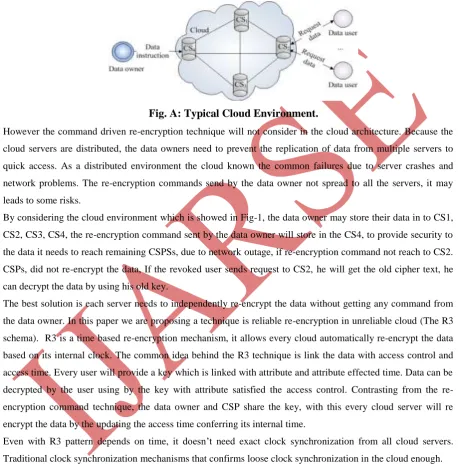
Fig. A: Typical Cloud Environment.
However the command driven re-encryption technique will not consider in the cloud architecture. Because the
cloud servers are distributed, the data owners need to prevent the replication of data from multiple servers to
quick access. As a distributed environment the cloud known the common failures due to server crashes and
network problems. The re-encryption commands send by the data owner not spread to all the servers, it may
leads to some risks.
By considering the cloud environment which is showed in Fig-1, the data owner may store their data in to CS1,
CS2, CS3, CS4, the re-encryption command sent by the data owner will store in the CS4, to provide security to
the data it needs to reach remaining CSPSs, due to network outage, if re-encryption command not reach to CS2.
CSPs, did not re-encrypt the data, If the revoked user sends request to CS2, he will get the old cipher text, he
can decrypt the data by using his old key.
The best solution is each server needs to independently re-encrypt the data without getting any command from
the data owner. In this paper we are proposing a technique is reliable re-encryption in unreliable cloud (The R3
schema). R3 is a time based re-encryption mechanism, it allows every cloud automatically re-encrypt the data
based on its internal clock. The common idea behind the R3 technique is link the data with access control and
access time. Every user will provide a key which is linked with attribute and attribute effected time. Data can be
decrypted by the user using by the key with attribute satisfied the access control. Contrasting from the
re-encryption command technique, the data owner and CSP share the key, with this every cloud server will re
encrypt the data by the updating the access time conferring its internal time.
Even with R3 pattern depends on time, it doesn’t need exact clock synchronization from all cloud servers.
Traditional clock synchronization mechanisms that confirms loose clock synchronization in the cloud enough.
II RELATED
WORK
Lot of researchers have proposed so many techniques for storing the encrypted data to secure from CSP. With
the previous approach the user revocation was done with third party to re-encrypt the data, with this the revoked
user no longer decrypt the data with old key. This solution is an example, the users come with an issue, and the
374 |
P a g e
www.ijarse.com
convert stored cipher text another cipher, which will decrypt with different key. In this process the server don’t
have chance to learn about the content of cipher text and decryption keys.
ABE is a novel cryptographic technique for effective well access control. In the Hierarchical Attribute Based
Encryption (HABE) technique is introduced to reach high performance and delegation. The difference between
previous work and our new work is, here no need to depend on clouds infrastructure to be consistent in order to
confirm correctness.
Our pattern trusts on re-encrypt the data on time. Though, the internal clock of every server is different from one
server to another server. There are lot of solutions for this problem, for a while, introduces a probabilistic
synchronization clock pattern. Which delegate a message to get the remote servers exact clock. K Romal used
the delay of the message to know the maximum deference between communicating nodes to synchronized clock.
L. Autonlpus introduced a clock synchronized pattern for cloud environment. In this authoritative time shared
by the participants to access the file. By using this technique achieves the loose synchronization in cloud
environment and to regulate the maximum time deference between data owner and every cloud server, our R3
pattern always reached correct access control in untrustworthy clouds.
III
PRELIMINARY
3.1 Problem Formulation
We study the cloud computing environment contains data owners, cloud service providers and multiple data
users.
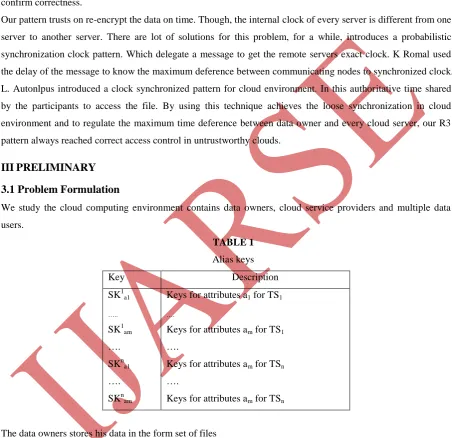
TABLE 1
Alias keys
Key Description
SK1a1
…..
SK1am
….
SKna1
….
SKnam
Keys for attributes a1 for TS1
….
Keys for attributes am for TS1
….
Keys for attributes am for TSn
….
Keys for attributes am for TSn
The data owners stores his data in the form set of files
F1, F2….. Fn, to the cloud servers. Before uploading the data in to CSP, data owner needs to encrypt that, the
data user who ever want to download first he needs to get associated key from the data owner, then he will
decrypt the data file. The data owner can have a permission to update the data after uploading into CSP.
Every file encrypted with two parameters one time slicing second one is attribute. Here we divide the time into
time slice, each time slice length is equal. We represent a time slice with TS, with subscript of where TSi = [ti,
ti+1]. Attributes are arranged in access structure regulates, which control the access control with a file. A file uses
attribute structure like {(α1ᶺ α2) ᵥ α3} it means a user’s has attributes α1 or α2 or α3 to decrypt the particular file.
375 |
P a g e
www.ijarse.com
A data user authenticated by the data user, then only he will get the key, which will associated attribute key
and length of the time,
The security needs of R3 pattern is as follow
1) Access control correctness. This needs that a data user cannot decrypt the file with illegal keys.
2) Data consistency. This needs that all data users who wish file F, should gain the same information in
the same time slice.
3) Data confidentiality. Here the CSP is not treated as valid data user, the data user to know content of
the file he required valid key.
4) Efficiency. The cloud service provider will not re encrypt the file un necessarily, If a file not requested
by any data user, that file will not re encrypt by the CSP.
3.2 Adversary model
Our system considering two types of adversaries, one is the CSP and another one is malicious data users. The
CSPs are very truthful but they have some curiosity to know the additional information about the file. The
malicious data user will try to access the data even though he is unauthorized access, this adversary pose the
invalid key, the malicious data user can send request to any server in the cloud, the curiosity CSP and malicious
data users are exist to threat the data.
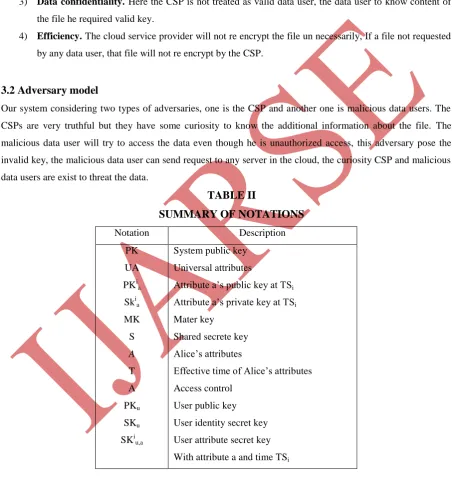
TABLE II
SUMMARY OF NOTATIONS
Notation Description
PK
UA
PKia
Skia
MK
S
A
T
A
PKu
SKu
SKiu,a
System public key
Universal attributes
Attribute a’s public key at TSi
Attribute a’s private key at TSi
Mater key
Shared secrete key
Alice’s attributes
Effective time of Alice’s attributes
Access control
User public key
User identity secret key
User attribute secret key
With attribute a and time TSi
IV
BASIC
R3
In this Basic R3 we deliberate some conditions like the data user and cloud server will share synchronized clock,
376 |
P a g e
www.ijarse.com
4.1 Intuition
The owner of the data will first generate sharable secrete key with CSP, after he will encrypt every file using
suitable attribute structure and time slice, that data uploaded to CSP, the CSP will copy to all the cloud servers,
every cloud server will have a copy of sharable secrete key.
For example a cloud server stores an encrypted file F with TSi. When a user request to cloud server, the cloud
server will uses its own clock to know the time slice. If the current time slice is TSi+k, he will re encrypt the file
F with TSi+k without get any command from data owner. While performing this process the CSP will not get the
information about the cipher text and newly generated decrypt keys, only the users with key satisfying A with
TSk+1can decrypt file F.
4.2 Protocol Description
We segregate the description of R3 pattern in to 3 parts: one is owner initialization, data user read operation,
data owner write operation. We depend on following functionalities. Table 2 shows the representation used in
the description.
Algorithm 1 Basic R3 (Synchronized clock with no delays)
While get a write command W (F, seqnum) at particular TSi, violate the write command at the end of TSi
While get the read command R (F) at TSi perform re encrypt the file with TSi.
1) Data owner initialization: To initiate the system the data owner setup a function, if the data owner wants
to upload a file F to CSP, it first describe the access control structure A to F, and control the time slice
Tsi, finally it perform the encrypt function with A and TSi to produce the cipher text, when the data
owner wants to allocate set of attributes in a time period to the data user, it needs to run GenKey function
to generate the key and accurate time slice for Alice.
2) Data user read data: When data user Alice wants to download the file F, at that time he needs to send
access command to cloud server, whenever the cloud server gets the read command he will perform re
encryption to re encrypt the file F, to decrypt the file F Alice perform decrypt function using key
satisfied A and Tsi .
3) Data owner written data: If the data owner wants to write the file F at time slice TSi, he needs to send
write command to the cloud server in the form of W (F, seqnum). This seqnum is necessary for ordering
when data owner sends multiple write commands at one time slice. With data owner, by the receiving
write command the cloud server commit it at the end of time slice TSi.
4.3 Security Analysis
Access control correctness. The acceptance of access control is most susceptible when change the TS. For
example Alice has the keys up to TSi, The Bob has the keys starting from the TSi+1. The data owner changes his
file F to F’, assume the data owner requesting for file f at TSi he will get F, if he requesting for a file at TSi+1he
will get F’, otherwise if a Alice having the capable to get the file F’ at TSi (Attack 1) and Bob has the capable to
377 |
P a g e
www.ijarse.com
In the Attack 1, the best time to do attack is before ti+1, and Alice has permission to decrypt the file up to
ti+1.After reaching the cloud server will violate the write command as well as his own clock, with the data owner
does not have permissions after the change, if he trying to access he will not get anything, this is attack fail.
In the Attack 2 the best time to attack is after ti+1. And Bob has permissions to decrypt after ti+1.in the earlier to
ti+1 The Bob does not have valid key to access the file.
Data Consistency. This property needs the user to send the query with in same time TS, must get same data.
Example Alice and Bob have the valid keys to access the file specific time slice.
We first reminder that any write command after Alice and before Bob does not on the correctness of the R3
pattern due to this command is violated at ti+1. Moreover, we have to guarantee that all the write commands
violated at ti must have already reached before ti. With all servers clocks are insistent and there is no delay.
Whatever the write command committed at ti will only be received by the cloud server at ti. Though the data
reached to Alice and Bob is consistent.
Data Confidentiality. In our pattern we only store the encrypted data, the R3 pattern will provide high
confidentiality using HABE, and Keeps the same confidentiality keys to the user, the CSP will not get any
useful information without key.
Data efficiency. The CSP will not re encrypt file until he gets request from the data user. Using the properties
function ReEncrypt. We know that the cloud server contains the re encryption operations until it gets the access
request.
Fig.3. Attacks to cooperation the property of data consistency
Algorithm 2 Extended R3 (a synchronized clock with delay)
while Obtain a write command W (F, ti+1, seqnum) do
if Current time is earlier than ti+1 + α then
Build Window i for file F
violate the write command in Window i at ti+1 + α
else
378 |
P a g e
www.ijarse.com
Apprise the data owner to send write command earlier
while Receive a read request R (F, TSi) do
if Current time is later than ti+1 + α then
Re-encrypt the file in Window i with TSi
else
Grip on the read command until ti+1 + α
V EXTENDED R3
In this session, we are considering the situation where there are no synchronized clocks, the message
transmission and the queue delay between the write and read operations.
5.1 Protocol Description
We tenancy the data owner and cloud server approve on maximal waiting time α, though, the cloud server needs
to wait until ti+ α to require the write commands that must be committed at ti, and give response to read command
to read the data at given TSi. The data user and data owner having extra information in their read or write
command. When data owner want to change his file F at Tsi, he needs to give a command W (F, ti+1, seqnum).
Here F is file name, ti+1 denotes when the updates are happened, seqnum is write command order. If the data user
wants to read the file F at TSi, he needs to use a command R (F, TSi).
Then we need to remind the maximum time difference between cloud server and data owner. We represent time
difference as , here is not larger than one time slice duration. In another way, when the owner of the data at
TSi, the time of the cloud server may be at TSi-1 or TSi or TSi+1. We push the data owner send his write
command before ti+1, whenever he want to reflect this update at TSi+1. Algorithm 2 expresses the cloud server
actions.
5.2 Security Analysis
Access control correctness. In this section we need to demonstration how algorithm 2 maintain the access
control property using same attack 1 and attack 2 like basic R3 analysis.
In attack 1, the best time for Alice to launch attack is just before ti+1. Because he only knows the keys to decrypt
the data up to TSi. But the cloud server will commit his write command at ti+1+α. Thus Alice will never read F’,
so his attack fails.
In attack 2, the best time for Bob launch his attack is just after ti+1. Requesting before ti+1 not help to the Bob,
because before he don’t have valid key to decrypt the data. Though, the write command committed by the cloud
server at ti+1+α.Footing the all read commands until violet all write commands, so doesn’t have chance to read F
instead of F’.
Data consistency. The cloud server will reject all the read commands until violets the write commands.
379 |
P a g e
www.ijarse.com
VI
CONCLUSION
In this paper we are proposing a technique called R3 scheme, to effectively managing the access control based
on the cloud server internal clock, our technique is not depends on cloud servers re encryption to all servers do
correctness. This technique uses the synchronized clock time to re encrypt the data at server side, here every
cloud server uses access control structure and time slice to re encrypt the data.
REFERENCES
[1] S. Kamara and K. Lauter, “Cryptographic cloud storage,” Financial Cryptography and Data Security, 2010.
[2] M. Armbrust, A. Fox, R. Griffith, A. Joseph, R. Katz, A. Konwinski, G. Lee, D. Patterson, A. Rabkin, and I.
Stoica, “A view of cloud computing,” Communications of the ACM, 2010.
[3] A. Sahai and B. Waters, “Fuzzy identity-based encryption,” Advances in Cryptology–EUROCRYPT, 2005. [4] V. Goyal, O. Pandey, A. Sahai, and B. Waters, “Attribute-based encryption for fine-grained access control of
encrypted data,” in Proc. of ACMCCS, 2006.
[5] J. Bethencourt, A. Sahai, and B. Waters, “Ciphertext-policy attributebased encryption,” in Proc. of IEEE
Symposium on S&P, 2007.
[6] M. Blaze, G. Bleumer, and M. Strauss, “Divertible protocols and atomic proxy cryptography,” Advances in
Cryptology–EUROCRYPT, 1998.
[7] A. Boldyreva, V. Goyal, and V. Kumar, “Identity-based encryption with efficient revocation,” in Proc. of
ACM CCS, 2008.
[8] G. Wang, Q. Liu, and J. Wu, “Hierarchical attribute-based encryption for fine-grained access control in cloud storage services,” in Proc. Of ACM CCS (Poster), 2010.
AUTHOR PROFILE
Nelapati Yashoda Rani is currently pursuing M.Tech in the Department of
Computer Science & Engineering, from Nalanda Institute of Engineering &
Technology (NIET), siddharth Nagar, Kantepudi(V), Sattenapalli (M),
Guntur (D), Andhra Pradesh , Affiliated to JNTU-KAKINADA.
A. Rama Swamy Reddy working as Assistant Professor at Nalanda
Institute of Engineering & Technology (NIET), siddharth Nagar,
Kantepudi(V), Sattenapalli (M), Guntur (D), Andhra Pradesh , Affiliated to