© 2017, IRJET | Impact Factor value: 5.181 | ISO 9001:2008 Certified Journal
| Page 606
AREA AND POWER PERFORMANCE ANALYSIS OF FLOATING POINT
ALU USING PIPELINING
Shubhi Sharma
1, Sarvesh Sharma
2, S.Ravi
31
M.Tech VLSI Design, Vellore Institute of Technology, Vellore
2M.Tech VLSI Design, Vellore Institute of Technology, Vellore
3
Professor, Dept. of electronics Engineering, Vellore Institute of Technology, Tamil Nadu, India
---***---Abstract - We are computing the area, power and timing
analysis of floating point arithmetic using pipelining. Nowdays all signal processing algorithms are presented by double precision floating point for hardware implementation as large precision needs large dynamic range. Fixed point has a drawback over floating point, that is fixed point cannot be used for high precision computing as it lacks for large dynamic range. For designing of digital processor computation of arithmetic operations is very important. Which can be easily computed using floating point. In this paper we are computing four unit and one combined unit which are performing the computation 0.0178 times faster at 0.26GHz using Verilog RTL on cadence tool.
Key Words
:
Verilog, Floating point, ALU, Fixed point,
FPGA.
1.INTRODUCTION
Nowdays all signal handling calculations are exhibited
by double precision floating point [2] for hardware
implementation as expansive exactness needs
extensive element range. Fixed point [1] has a
disadvantage over floating point, that is fixed point
can't be utilized for high accuracy registering as it
needs for extensive element range. At the point when
floating point is utilized with FPGA [4] (field
programmable Array) it has area and power and timing
examination overhead over fixed point. For planning of
digital processor calculation of number arithmetic
operations is very important. Which can be effectively
registered utilizing floating point. Floating point
number can be utilized as a part of a few applications
like FFT, DSP and where ever high performance is
required. We utilize floating point to represent
numbers which can't be displayed in whole number
because of expansive or little values. At the point when
floating point is utilized with FPGA (field
programmable array) it has area and power and timing
examination overhead over fixed point. Floating point
can in like manner be used as a piece of 3D
representation which requires parallel execution.
Floating point addition and multiplication are two most
much of the time utilized operations utilizing double
precision. To vary the area, latency and power
researchers fused add and multiply unit, add and
subtract unit, divide and multiply unit. Using this
combination we can have numerous applications. Here
we are utilizing Verilog HDL [3] configuration to do
pipelined operation and for arithmetic modules. The
four
operations
are
addition,
subtraction,
multiplication, division. Arithmetic logic unit (ALU) [1]
is a microprocessor block. All the arithmetic operations
happens in this microprocessor block, consequently
execution of these block are vital for the entire circuit.
Pipelining procedure is utilized to outline computer
and digital electronics which use to give us expanded
throughput. This paper has execution of double
precision that is 64 bits [3] which support four
essential operations that is addition, subtraction,
multiplication and division [9,10].
2. FLOATING POINT NUMBER
Representation of 64 bit floating point number that is double precision is as shown below:
© 2017, IRJET | Impact Factor value: 5.181 | ISO 9001:2008 Certified Journal
| Page 607
The sign bit is bit number 63rd. "1" means a ‘–ve’ number, and"0" is a ‘+ve’ number. The exponent field is 11 bits in length, involving 62 to 52 bits. The worth in this 11-bit long field is counterbalanced by 1023, so the genuine type used to figure the estimation of the number is 2^(e-1023) . Give us a chance to comprehend it through an illustration, let us take a number 3.5. Presently we will introduce it in floating point group The 63rd bit sign bit is 0 which speak to a ‘+ve’ number. So the
exponent become 1024. This can be ascertained by separating 3.5 as (1.75)*2^(1). The example counterbalance is 1023, so you add ‘1023 + 1’ to ascertain the worth for the type field. In this way, bits 62 to 52 will be "1000000000". The main "1" in the type is appeared however is excluded in the arrangement of 64-bit. Most astounding piece of type is 51 which compares to 2^(-1). Bit 50 relates to 2^(-2), and this proceeds down to Bit 0 which compares to 2^(-52). To speak to .75, bits 51 and 50 are 1's, and whatever is left of the bits are zeros. So 3.5 as a double precision floating point number may be:
Fig -2: Double Precision example
2.1 Pipelined adder
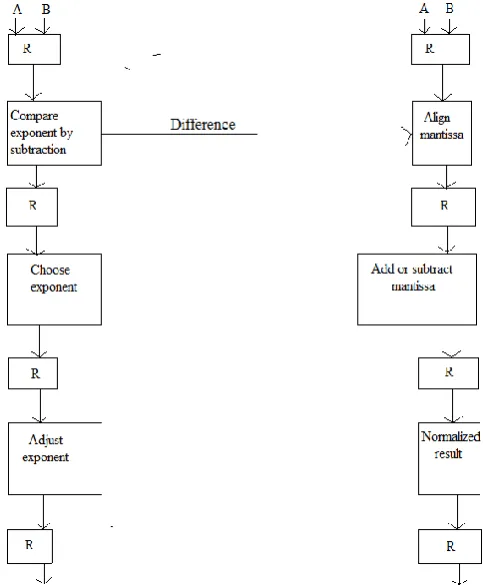
We have five stages in an ordinary floating point calculation. They are example exponent difference pre arrangement, addition, standardization and adjusting separately. Give us a chance to take a case of floating point number Z1 =(a1 , e1, f1) and Z2 =(a2, e2, f2). Presently to process for Z1+Z2 we have exponent difference is the initial step d =e1-e2 and if e1<e2 position of type is swapped and the bigger type is given in the outcome. Step 2 incorporates moving of littler portion by d bits to one side and the fraction is realigned now include part.
In the event that the outcome is leaded by zero result will be moved left and type is decremented by driving zero
Right move is performed if result floods and exponent is expanded by 1-bit. This procedure we called as standardization. Round the fraction part come about, if adjusting makes flood than augmentation example by 1-bit by moving right. Alignment stage requires a right shifter that is double the quantity of fraction bits in light of the fact that the bits moved out must be kept up to create the gatekeeper, round and sticky bits required for adjusting. The shifter only
needs to shift right by up to 24 places for single-precision or 53 places for double-precision. The normalization stage requires a left shifter equal to the number of exponent bits plus 1 i.e., 25-bits for single-precision and 54-bit for double precision.
Pipelined adder is utilized to build the throughput of the adder unit for this we work all sign, exponential, and division bit independently than type are moved appropriately to liken the type and operation is done on partial piece.
Fig 3
:Pipelined adder/subtractor
Table -1: AdderResults
Parameters
Without
pipelining
With pipelining
45nm
32nm
Power(mW)
0.096
6.35
1.6
Area (µm
2)
1195
6351
5969
[image:2.595.311.553.259.552.2] [image:2.595.38.286.346.405.2]© 2017, IRJET | Impact Factor value: 5.181 | ISO 9001:2008 Certified Journal
| Page 608
2.2 Pipelined subtractor
We have five stages in an ordinary floating point calculation. They are example exponent difference pre arrangement, addition, standardization and adjusting separately. Give us a chance to take a case of floating point number Z1 =(a1 , e1, f1) and Z2 =(a2, e2, f2). Presently to process for Z1-Z2 we have exponent difference is the initial step d =e1-e2 and if e1<e2 position of type is swapped and the bigger type is given in the outcome. Step 2 incorporates moving of littler portion by d bits to one side and the fraction
is realigned now include part. In the event that the outcome is leaded by zero result will be
moved left and type is decremented by driving zero Right move is performed if result floods and exponent is expanded by 1-bit. This procedure we called as standardization. Round the fraction part come about, if adjusting makes flood than augmentation example by 1-bit by moving right. Alignment stage requires a right shifter that is double the quantity of fraction bits (i.e., 48- bits for single-accuracy, 106-bits for twofold exactness) in light of
the fact that the bits moved
out must be kept up to create the gatekeeper, round and
sticky bits required for adjusting. The shifter only needs
to shift right by up to 24 places for single-precision or
53 places for double-precision. The normalization stage
requires a left shifter equal to the number of exponent
bits plus 1 i.e., 25-bits for single-precision and 54-bit
for double precision.
Pipelined subtractor is utilized to build the
throughput of the adder unit for this we work all sign,
exponential, and division bit independently than type
are moved appropriately to liken the type and
operation is done on partial piece.
Table -2: SubtractorResults
Parameters
Without
pipelining
With pipelining
45nm
32nm
Power(mW)
8.2
5.4
2.35
Area (µm
2)
1149
8294
6520
Timing (ps)
1649
2398
2100
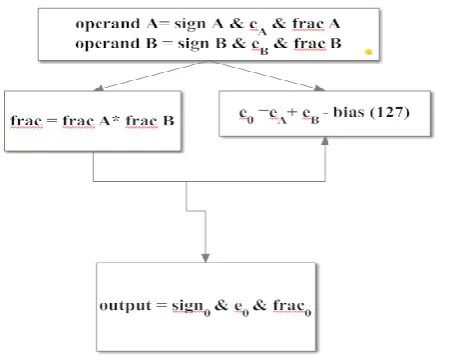
2.3 Pipelined multiplication
Give us a chance to have two operands in division
© 2017, IRJET | Impact Factor value: 5.181 | ISO 9001:2008 Certified Journal
| Page 609
Fig 4: Pipelined Multiplier
Table -3: MultiplicationResults
Parameters
Without
pipelining
With pipelining
45nm
32nm
Power(mW)
5.8
5.6
5.2
Area (µm
2)
9482
35719
29781
Timing (ps)
1804
3300
2900
2.4 pipelined divider
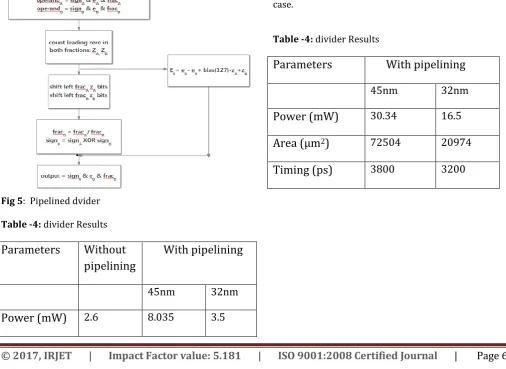
The divider gets two 64-bit floating point numbers.
To start with these numbers are unloaded by isolating
the numbers into sign, example, and mantissa bits. Sign
bit of two number perform
EXCLUSIVE-OR [2]
operation. The exponent of the two numbers are
subtracted and after that included with a
predisposition number. Mantissa division square
performs division utilizing digit repeat calculation. It
take minimum 55 clock cycle. After this the yield of
mantissa division is standardized, if the MSB of the
outcome got is not 1, then it is left moved to make the
MSB 1. On the off chance that progressions are rolled
out by moving then comparing improvements must be
made in type moreover. After mantissa division the
yield is 55 bit long. Be that as it may, we require just 53
[image:4.595.43.268.106.286.2]© 2017, IRJET | Impact Factor value: 5.181 | ISO 9001:2008 Certified Journal
| Page 610
negative number. The adjusting of vastness happens in thespecial cases module, not in the adjusting module. QNaN [7] is characterized as Quiet Not a Number. SNaN [7] is characterized as Signaling Not a Number. In the event that either information is a SNaN, then the operation is invalid. The yield all things considered will be a QNaN. For all other invalid operations, the yield will be a SNaN. In the event that either information is a QNaN, the operation won't be performed, and the yield will be a QNaN. On the off chance that both inputs are QNaNs, the yield will be the QNaN in operand A. The utilization of Not a Number is predictable with the IEEE 754 standard [3]. At last every one of the yields from the sign, type and mantissa are connected to create the last remainder. The entire operati
on takes
around 62 clock cycles.
For expanding the recurrence or throughput of the circuit the division step is unrolled and at that point a few pipelining stages are embedded in the middle of every minor operation.The range of a pipeline configuration can be communicated as A Pipe = nc + [n/m]r where c is the combinational territory of a solitary cycle, r is the quantity of bit registers required for a solitary pipeline stage, d is the execution deferral of a solitary iteration, and n is the number of cycles in the successive outline. [image:5.595.35.542.431.800.2]Fig 5: Pipelined dvider
Table -4: dividerResults
Parameters
Without
pipelining
With pipelining
45nm
32nm
Power (mW)
2.6
8.035
3.5
Area (µm
2)
10343
12730
11474
Timing (ps)
3621
2798
2298
3. TOP MODULE
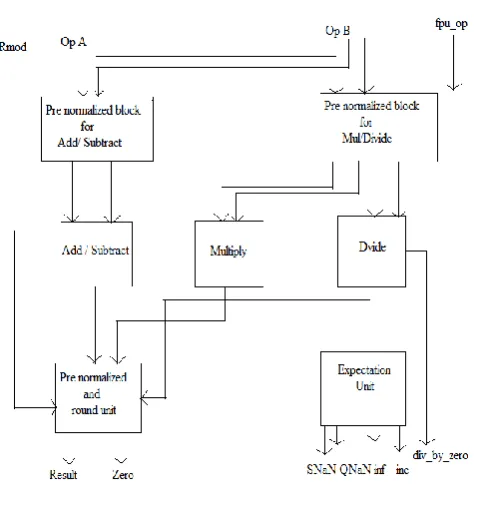
The top level, fpu _ double, begins a counter the 1st clock cycle
after empower become high. The counter tallies up to the quantity of clock cycle required for this particular operation that will be performed. For expansion, it tallies to 20, for subtraction 21, for duplication 24, and for division 71. When count_ready achieves the predetermined last check, the prepared sign goes high, and the yield will be substantial for the operation being performed. fpu_double contains the instantiations of the other 6 modules, which are 6 separate source records of the 4 operations (include, subtract, duplicate, gap) and the adjusting module and exemptions module. On the off chance that the fpu operation is expansion, and one operand is certain and the other is negative, the fpu_double module will course the operation to the subtraction module. Moreover, if the operation called for is subtraction, and the A operand is certain and the B operand is negative, or if the A operand is negative furthermore, the B operand is certain, the fpu topmodule will course the operation to the expansion module. The sign will likewise be conformed to the right esteem contingent upon the particular case.
Table -4: dividerResults
Parameters
With pipelining
45nm
32nm
Power (mW)
30.34
16.5
Area (µm
2)
72504
20974
© 2017, IRJET | Impact Factor value: 5.181 | ISO 9001:2008 Certified Journal
| Page 611
Fig 6: Top module4
.
CONCLUSIONS
In this paper different number arithmetic modules are actualized and after that different relative investigations are finished. At last these individual squares are clubbed to make Floating point based ALU in a pipelined way to minimize the power and to expand the working recurrence in the meantime. These relative examinations are done on Altera and Xilinx [1] both. Recreation results are confirmed hypothetically. Verilog HDL) is utilized to plan the entirety ALU piece. In existing configuration, total power is 30.34 mW in 45nm technology and 16.5 in 32nm technology that is 0.0178 times less when appeared differently in relation to the proposed arrangement the working recurrence is 0.26GHz and 0.31GHz.
ACKNOWLEDGEMENT
We acknowledge the help of Prof. S Ravi who guided us
helped a lot to get idea and methodologies to do this
project. We are also thanking our program chair Prof.
Harish Kittur .We are indebted to our lab assistant Prof.
Karthikeyan and all other faculties of VLSI System
department.
REFERENCES
[1] Rajit Ram Singh, Asish Tiwari, Vinay Kumar Singh, Geetam S Tomar, “VHDL environment for floating point Arithmetic Logic Unit ALU design and simulation”, International Conference on Communication Systems and Network Technologies, 2011
[2] H.Yamada, T. Hottat, T. Nishiyama, F. Murabayashi, T. Yamauchi, and H. Sawamoto, “A 13.3ns Double-precision Floating-point ALU and Multiplier”, IEEE International Conference on Computer Design: VLSI in Computers and Processors, 1995
[3] Manisha Sangwan, A Anita Angeline, “design and implementation of single precision pipelined floating point co-processor”, International Conference on Advanced Electronic Systems (ICAES), 2013
[4] Getao Liang, JunKyu Lee, Gregory D. Peterson, “ALU Architecture with Dynamic Precision Support”, Symposium on Application Accelerators in High Performance Computing, 2012
[5] Rathindra Nath Giri, M.K.Pandit, “Pipelined Floating-Point Arithmetic Unit (FPU) for Advanced Computing Systemsusing FPGA”, International Journal of Engineering and Advanced Technology (IJEAT), 2012
[6] Geetanjali Wasson, “IEEE-754 compliant Algorithms for Fast Multiplication of Double Precision Floating Point Numbers”, International Journal of Research in Computer Science, 2011
[7] Prof. W. Kahan, “IEEE Standard 754 for Binary Floating-Point Arithmetic”, Lecture Notes on the Status of IEEE 754, 1997
[8] Mamu Bin Ibne Reaz, Md. Shabiul Islam, Mohd. S. Sulaiman, “Pipeline Floating Point ALU Design using VHDL”, IEEE International Conference on Semiconductor Electronics ICSE, 2002
[9] Kui YI, Yue-Hua DING, “32 bit Multiplication and Division ALU Design Based on RISC Structure”, International Joint Conference on Artificial Intelligence, 2009
[10] Florent de Dinechin, Hong Diep Nguyen, Bogdan Pasca, “Pipelined FPGA Adders”, International Conference on Field Programmable Logic and Applications, 2010
[11] Alok Baluni, Farhad Merchant, S.K. Nandy, S. Balakrishnan, “A Fully Pipelined Modular Multiple Precision Floating point Multiplier With Vector Support”, International Symposium on Electronic System Design, 2011
[image:6.595.38.282.93.346.2]© 2017, IRJET | Impact Factor value: 5.181 | ISO 9001:2008 Certified Journal
| Page 612
Processor”, International Conference on Computing,Electronics and Electrical Technologies [ICCEET], 2012
[13] Jinde Vijay Kumar, Boya Nagaraju, Chinthakunta Swapna, Thogata Ramanjappa, “Design and Development of FPGA Based Low Power Pipelined 64-Bit RISe Processor with Double Precision Floating Point Unit”, International Conference on Communication and Signal Processing, 2014
[14] Jean Pierre David, “Low Latency Solver for Linear Equation Systems in Floating Point Arithmetic”, International Conference on ReConFigurable Computing and FPGAs (ReConFig), 2015
[15] Romesh M. Jessani and Michael Putrino, “Comparison of Single- and Dual-Pass Multiply-Add Fused Floating-Point Units”, IEEE transactions on computers, 1998