© 2018, IRJET | Impact Factor value: 6.171 | ISO 9001:2008 Certified Journal | Page 3260
A Study on Effect of LRB Isolators on Varying Height of Rectangular
Structures
Rasna P
1, Shinu Shajee
21 P.G. Student, Department of Civil Engineering, AWH Engineering College, Kuttikattor, Kerala, India1
2 Assistant Professor, Department of Civil Engineering, AWH Engineering College, Kuttikattor, Kerala, India
---***---Abstract -
Earthquake causes significant loss of life anddamage of property every year. Seismic base isolation is a technique that mitigates the effects of an earthquake by essentially isolating the structure and its contents from potentially dangerous ground motion, especially in the frequency range where the building is most affected. In this research the efficiency of seismic isolation system in the form of lead rubber bearings with different height of the buildings due to seismic impact have been studied. Mass asymmetry is created in the structures by providing eccentricity from 0% to 30% in centre of mass of the structure. Rectangular plan is considered for the study. Non-linear time history analysis was carried out in ETABs 2016 computer software. Here 4, 10, 15 and 20 storey structures are considered. At the end of analysis, time period, storey rotation, storey acceleration, storey displacement and storey drift were compared for base isolated and fixed-base structures. The results show that the use of LRB isolators had a significant impact on improving the performance of the structure with increasing height of the building.
Key Words: LRB isolators, time history analysis, Mass asymmetry, eccentricity.
1. INTRODUCTION
Starting from the very beginning of civilization, mankind has faced several threat of invasion of several natural disasters. These natural hazards bring much damage to manmade interventions such as habitat and infrastructure facilities causing loss of life and property. Earthquakes are one of those hazards which are disastrous due to its huge power of devastation and total unpredictability with the sudden violent movement of earth’s surface with the release of energy. These energy travels in the form of seismic waves which affects the structures. Massive destruction of high-rise as well as low-rise buildings in recent devastating earthquake of Gujarat on 26th January, 2001 proves that also
in developing countries like India, such investigation is in need. The development of recent technologies for the control of seismic hazards in structures catches the attention of structural engineers. During an earthquake, failure of structure starts at points of weakness. This weakness arises due to discontinuity in mass, stiffness and geometry of structure. The structures having this discontinuity are termed as irregular structures. Seismic behavior of asymmetric building structures has now become a worldwide active research topic since about last two decades. Numerous investigations on elastic and inelastic
behavior of asymmetric structures have been conducted inorder to find out the cause of seismic vulnerability of these structures. So, the effect of asymmetry in the seismic performance of structures becomes really important. Height-wise changes in stiffness and mass render the dynamic characteristics of these buildings different from the regular building. Due to various types of functional and architectural requirements, asymmetric structures are almost unavoidable in modern constructions.
Nowadays, the advantages of seismic isolation compared to conventional strengthening methods are universally recognized. Base isolation is a passive vibration control system that does not require any external power source for its operation and utilizes the motion of the structure to develop the control forces. It reduces the effect of ground motion and thus leads to nullify the effect of earthquake on the structure. Rubber bearing and lead rubber bearing are prime factors used to introduce flexibility in the structure. This increased the natural period of the structure and base displacement is more than prearranged limit.
The most commonly used base isolators in buildings are,
Laminated Rubber (Elastomeric) Bearing. a. Natural and synthetic rubber bearing (low damping).
b. Natural rubber bearing (high damping).
Lead Rubber Bearing (LRB)
Friction Pendulum (FPS) System Bearing.
© 2018, IRJET | Impact Factor value: 6.171 | ISO 9001:2008 Certified Journal | Page 3261 Plan asymmetric structures are those in which seismic
response is not only translational but also torsional, and is due to stiffness and/ or mass eccentricity in the structure. A regular structure may actually be asymmetric if the structure has masonry infill walls or stiffer lateral resisting systems on one side of the structure that has not been considered in the analysis. Asymmetry may in fact exist in a nominally symmetric structure because of uncertainty in the evaluation of centre of mass and centre of stiffness.
The work in this paper mainly aims at studying the effect of LRB isolator in rectangular RC structure with different height and different mass eccentricity.
1.1 Related works
Many research investigations have been carried out considering the comparison of fixed base and base isolated structures and so many efficient methods have been put forward in buildings intended for reducing the vibrations due to earthquake to the superstructure. Massimiliano Ferraioli and Alberto Mandara [1] deals with the analysis and design of an existing multiple building structure seismic retrofitted by a base isolation system incorporating rubber bearing and sliding devices. Preliminary investigations, in situ measurements and laboratory tests, and seismic assessment of existing fixed base structure were done. The earthquake response analysis of the hospital building was performed chiefly with reference to the horizontal displacements of the isolation plane and the relative displacements of three buildings in elevation. The maximum value of lateral displacement on the flexible side of the isolation plane was found greater than 35% compared to that in centre of mass. Design project, construction process and details of isolation interventions were presented. The possibility of pounding between the adjacent structures in elevation during strong earthquake was thoroughly investigated. For this study, the maximum relative displacement in the direction where pounding can occur was compared to the minimum separation gap required to prevent pounding. They observed that seismic isolation reduced seismic force demand on the superstructure and gave protection without extensive strengthening.
Muhammed Asim Khan et al [2] had made study on a total of 9 models, with L shape for analysis to cover a broader spectrum of low, medium and high rise buildings for seismic control using pushover analysis. Different techniques adopted in the study include lead rubber bearing and masonry infill wall and analysis were carried out using SAP 2000 software. The study gave conclusion that the presence of isolators increases time period and thus flexibility. Also a five storey asymmetric RC framed building with lead rubber bearing isolator show better performance and maximum reduction of torsional moment.
1.2 Seismic analysis of structures
Seismic Analysis is a subset of structural analysis and is the calculation of the response of a building structure to
earthquakes. It is part of the process of structural design, earthquake engineering or structural assessment in regions where earthquakes are prevalent.
1) Equivalent Static analysis
Linear static analysis or equivalent static analysis can only be used for regular structure with limited height. All design against seismic loads must consider the dynamic nature of the load. However, for simple regular structures, analysis by equivalent linear static methods is often sufficient. This is permitted in most codes of practice for regular, low- to medium-rise buildings. It begins with an estimation of base shear load and its distribution on each story calculated by using formulas given in the code. The base shear is the total horizontal force on the structure which is calculated on the basis of structure mass and fundamental period of vibration and corresponding mode shape.
2) Non-linear dynamic analysis
A non-linear dynamic analysis or inelastic time history analysis describes the actual behaviour of the structure during an earthquake. The method is based on the direct numerical integration of the motion differential equations by considering the elasto-plastic deformation of the structure element. This method captures the effect of amplification due to resonance, the variation of displacements at diverse levels of a frame, an increase of motion duration and a tendency of regularization of movements result as far as the level increases from bottom to top.
1.3. Description of model
In this analytical study, three dimensional RC structures are considered. The layout of a rectangular plan having 4X3 bays of length 3.5m along x direction and 4.5m along y direction. The building considered includes four, ten, fifteen and twenty stories. All the buildings are analysed by the method of nonlinear time history analysis. Seismic details of the structures have been given in table 1 below. Details of LRB isolators after its design as per UBC-97 have been given in table 2. Plan of rectangular building is depicted in Fig 1 and variation of height of building is as depicted in Fig 2. Details of Structures
Storey height =3.0 meters,
Bay width along X-direction = 3.5 meters
Bay width along Y-direction = 4.5 meters
Beam-250x350
Column- 250x450mm
© 2018, IRJET | Impact Factor value: 6.171 | ISO 9001:2008 Certified Journal | Page 3262 Table -1: Seismic details of structures
Types of structures Multistorey structures
Materials Concrete M20, M25
Reinforcing bar Fe 415
Zonal considerations Zone IV
Zone factor 0.24
Soil type II
Importance factor 1 Reduction factor 5
[image:3.595.301.553.139.733.2]Live load 3kN/m2
Table – 2: Details of LRB isolators
Details of LRB isolators (designed as per UBC-97) Effective stiffness 1064.43kN/m Horizontal stiffness 350kN/m
Vertical stiffness 180 MN/m
Yield force 20kN
Stiffness ratio 0.1
Damping 0.05
Fig 1: Plan of rectangular base isolated structure
2. RESULTS AND DISCUSSION
The linear static and nonlinear time history analysis for the models have been carried out using ETABS 2016 software [5]. The seismic details were incorporated in accordance to the IS code 1893:2002[3] and UBC-97[4]. The results of parametric study by varying the eccentricity of centre of mass for different height of the building are included. The time period, storey rotation, storey acceleration, storey displacement and storey drift values were noted and comparison graphs are plotted for four models in both fixed base and base isolated structures.
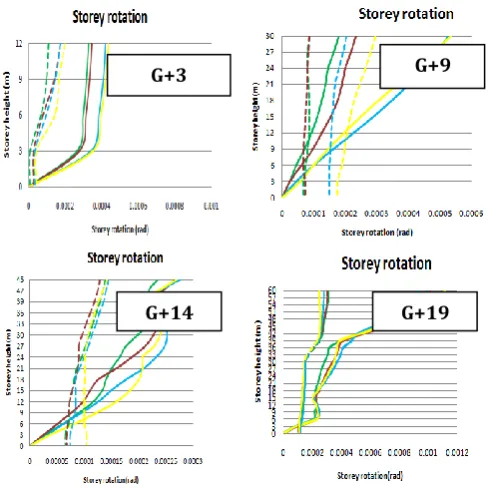
1. Storey rotation
[image:3.595.32.288.262.525.2]Storey rotation of the rectangular symmetric RC structure by considering mass eccentricity from 0 to 30% was depicted in Fig 3. While comparing the maximum rotation of structures
with storey height, both fixed base and base isolated have their storey rotation increasing on increasing the eccentricity. In comparison with fixed base structure, base isolated structures have got lesser value. The percentage reduction is around 35%.
Fig -2: 3D view of base isolated structure with different heights
Fig 3 Maximum storey rotation with storey height
G+3 G+9
G+14 G+19
G+3 G+9
[image:3.595.310.555.498.743.2]© 2018, IRJET | Impact Factor value: 6.171 | ISO 9001:2008 Certified Journal | Page 3263 2. Storey acceleration
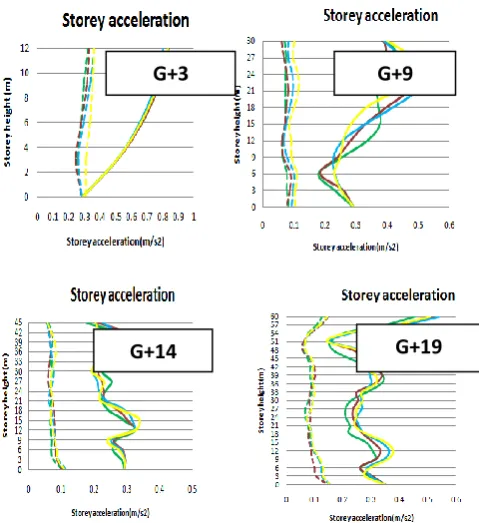
In Fig 4, it has been observed that, base isolated buildings have minimum storey acceleration and the percentage reduction of acceleration is around 55%. In four storey building, there is a uniform variation of acceleration for both fixed base and base isolated ones. But for higher stories, fixed base structures have random variation when compared to base isolated structures.
[image:4.595.313.557.80.208.2]
Fig 4 Maximum storey acceleration with storey height
3. Storey displacement
The storey displacement of lower to higher storey structures has been depicted in the fig 5 below. In fixed base structures, the displacement is zero at base and increases as storey height increases. But in case of base isolated structures, there is small displacement at the base and as storey height increases, the displacement increases uniformly and percentage increase is about 120%.
[image:4.595.40.280.190.452.2]
Fig 5 Maximum storey displacement with storey height
4. Storey drift
The storey drift with respect to height of building for four different heights ranging from low rise to high rise building has been shown in Fig 6 below. While increasing the mass eccentricity, storey drift is increasing slightly in case of both fixed base and base isolated buildings. In base isolated structures around 40% reduction of drift can be noted when compared to fixed base structures.
[image:4.595.310.546.366.590.2]
Fig 6 Maximum storey drift with storey height
5. Time period
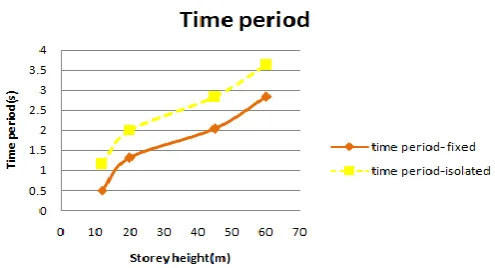
The maximum time period comparing all the four models of the rectangular reinforced concrete structure has shown in Fig 7 below. For fixed base buildings, the time period is less when compared to base isolated rectangular buildings. Increase in time period will tend to reduce the lateral force developed in the building due to seismic force. The percentage increase in time period of base isolated structures corresponding to 4, 10, 15 and 20 storey buildings are 129%, 52%, 39% and 28% respectively.
G+9
G+14 G+19
G+14 G+19
G+3
G+9
G+14 G+19
G+3
[image:4.595.40.271.610.731.2]© 2018, IRJET | Impact Factor value: 6.171 | ISO 9001:2008 Certified Journal | Page 3264 Fig 7 Maximum time period with storey height
3. CONCLUSIONS
The major conclusions drawn were
1. From the analysed models, the behaviour of fixed base and base isolated rectangular structures were investigated by applying mass eccentricities from 0% to 30% with different heights.
2. Analysis results show the efficiency of seismic isolation to reduce storey rotation. Also by increasing the eccentricity, the efficiency of isolation in diminishing rotation is slightly reducing. Percentage reduction for G+3, G+9, G+14 and G+19 is 55%, 50%, 47% and 15% respectively.
3. Storey acceleration is less and varying uniformly on increasing height in case of base isolated structures. But in fixed base structures, value of storey acceleration is high and that too randomly on increasing the height of the structure. The percentage reduction for G+3, G+9, G+14 and G+19 stories are 56%, 55%, 53% and 50% respectively.
4. Considering storey displacement of base isolated structures, there is a small displacement at the base and as storey height increases, the displacement is increasing at a constant rate. So during an earthquake, people inside the base isolated will feel comfort compared to fixed base building. Percentage increase for G+3, G+9, G+14 and G+19 stories are 151%, 136%, 112% and 110% respectively.
5. The storey drift is considerably reduced in base isolated structures on increasing height when compared to fixed base buildings. Percentage reduction for G+3, G+9, G+14 and G+19 stories are 74%, 64%, 57% and 53% respectively.
6. Comparing the time period of base isolated and fixed base buildings, the former has high value of time period due to the flexibility of isolation system. Percentage increase of time period for G+3, G+9,
G+14 and G+19 stories are 129%, 52%, 39% and 28% respectively.
REFERENCES
1. Massimiliano Ferraioli and AlbertoMandara,(2016) “Base Isolation for Seismic Retrofitting of a Multiple Building Structure Design, Construction, and Assessment” page 1-25
2. Muhammed Asim Khan (2015)“Seismic analysis of vertically irregular buildings” vol. 111, no. 10Saiful Islam et al, “Study on corollary of seismic base isolation system on buildings with soft story” International journal of physical science, vol.6, page 2654-2661.
3. IS 1893(Part-1)-2000, “Criteria for Earthquake Resistant Design of structures” (fifth revision)
4. UBC- 97 “Uniform building code” , Chap. 16, Div. 1, volume 2.