© 2017, IRJET | Impact Factor value: 6.171 | ISO 9001:2008 Certified Journal | Page 1645
A COMPARITIVE ANALYSIS OF ENERGY EFFICIENT MAC PROTOCOL FOR
WIRELESS SENSOR NETWORK
Sweetu Faldu
1, Prof. Tosal M Bhalodia
21
Department of Computer
Engineering, Atmiya Institute of Technology & Science Rajkot, Gujarat, India
2Professor of Computer Engineering, Atmiya Institute of Technology & Science Rajkot, Gujarat, India
---***---Abstract -
Wireless sensor network are the collection of individual nodes which are able to interact with physical environment by sensing or controlling physical parameter. Wireless sensor networks are wide range of application potential in areas such as industrial process monitoring, target detection, tracking, and environmental monitoring. Sensor cannot have an infinite lifetime without battery recharge or replacement. Network lifetime is the main issues in wireless sensor network. Medium access control (MAC) protocol plays an important role in energy efficient in wireless sensor networks because nodes access to the shared medium is coordinated by the MAC layer. Various medium-access control (MAC) protocols various objectives have been proposed for wireless sensor networks. In this paper, first outline the basics of wireless sensor network, then describe several MAC protocols proposed for sensor networks and give comparisons different MAC protocol based on energy consumption, a contention based MAC protocol, contention less MAC protocol and Hybrid MAC protocol are defined and compare their performance. At the end of discussion this paper also presents main advantages and disadvantages of these MAC protocols.Key Words: MAC, Wireless Sensor Networks (WSN), Cross Layer Design, Energy efficiency, Hybrid MAC,
contention-free.
1. INTRODUCTION
WSNs form a many-to-one network, where all sensor nodes cooperate to collect the data and forward data to one or more nodes that called sinks. These sinks may be at kilometers away from nodes, and can’t be reached in an only one hop, wherever the multi-hop communication will be required[1].Wireless Sensor Networks (WSN) a large number of battery-powered that sensors capable of communicating wireless. They are distributed within an area of interest in order to track, it measure and monitors various events. They are often deployed in an ad-hoc fashion, without careful planning. Protocols for networks need to be extremely adaptable and scalable because of constant changes in network topology. If high energy-efficiency demands are also consider, it becomes clear that the design of MAC protocols for WSN is a difficult task.
1.1 MAC Protocols
In WSN, nodes have to share a common channel. The MAC sub layer task is to provide fair access to channels by avoiding possible collisions. The main goal in MAC protocol for WSN is energy efficiency and lifetimes of sensors. The reasons for the unnecessary energy waste in wireless communication are:
Packet collision: Before transmitting, nodes don’t listen to the medium, Packets transmitted data the same time collide, become corrupted and retransmitted. This causes unnecessary energy waste.
Overhearing: A node receives a packet which addressed to another node.
Control packet overhead: Control packets necessary for successful data transmission. They don’t, represent useful data. MAC Protocols for wireless sensor networks.
Idle listening: The main reason for energy waste is when a node listens to an idle channel in these channel waiting to receive data.
Over emitting: The node sends data when the receiver node is not ready to accept incoming transmission.
Collision avoidance: The main goal of collision avoidance is to reduce collisions as much as possible. This can be achieved either by listening to the channel.
Scalability and adaptability: The MAC protocol needs to be changes in network topology caused by node movement and nature of wireless transmission.
Latency: Latency represents the delay of a packet. The importance of latency in wireless sensor networks depends on the monitoring application.
Throughput: Represents the amount of data period of time sent from the sender to the receiver
through WSN.
© 2017, IRJET | Impact Factor value: 6.171 | ISO 9001:2008 Certified Journal | Page 1646
1.2 REQUIREMENTS OF MEDIUM ACCESS CONTROL
PROTOCOLS FOR WSN
In wireless sensor network, the MAC protocols play a very vital role in energy conservation to increase the lifetime of the network.
Packet collisions occur at a receiver node if more than one packet arrives at the same destination. Collisions are discarded and the re-transmissions of these packets results in increase of the energy consumption. The overhearing, over-emitting, and idle listening are the other reasons for energy depletions in WSN[3].
1.3 MAC Variant
1) contention-free protocol
1) Polling
The mechanism of polling in a controller sends a
message to each node. The message contains the address of the node being selected for granting access. Although all nodes receive the message, only the addressed node responds then it sends data, if any. If there is no data, usually a “poll reject” message is sent back. In this way, each node is interrogated in a round-robin fashion, one after the other, for granting access to the medium. The first node is again polled when the controller finishes with the remaining codes.
The polling scheme has the flexibility of either
giving equal access to all the nodes, or some nodes may be given higher priority than others. In other words, priority of access can be easily implemented[4].
2) Token passing
A token is a special bit pattern or a small
packet,which circulate from node to node.
in the token bus, token is passed with the help of In
either case a node currently holding the token has the ‘right to transmit’.
When it has got data to send, it removes the token
and transmits the data and then forwards the token to the next logical or physical node in the ring.
If a node currently holding the token has no data to
send, it simply forwards the token to the next node. the nodes, which form a logical ring.
The token passing scheme is efficient compared to
the polling technique, There exists a number of potential problems, such as lost token, duplicate token, and insertion of a node, removal of a node[4].
2) Channelization protocol
1) FDMA
Radio spectrum broken into frequency bands
(channels)
Each channel allocated to a different user (only 1
user per frequency band)
channels can be assigned on-demand when a user
needs to communicate.
Each user can only be assigned 1 channel,if not
enough users for the number of channels, the radio spectrum is unused (i.e., wasted)
FDMA usually used in narrowband systems (e.g., 30
kHz frequency bands)
Little synchronization required because
transmission is continuous in FDMA reduces overhead
Requires expensive filters to reduce adjacent
channel interference 2) TDMA.
Only 1 user can transmit or receive data per slot.
Users access entire radio spectrum for a given time
slot .
Channels can be assigned on-demand when a user
needs to communicate
Mobile devices can save battery power by turning
off transmitter and receiver during slots when not transmitting or receiving data
filters not needed, so cheaper than FDMA.
3) CDMA
CDMA is a multiplexing technique that user can access data channel simultaneously. Data is coded with a pre-assigned signature sequence called pseudo noise (PN).CDMA is a form of Direct Sequence Spread Spectrum(DSSS) communication[5].
3) Contention protocol
1) Aloha
Aloha was one of the first attempts to design the
MAC protocol for regular networks. Its main idea is that the transmitter sending packets whenever it wants without coordination between nodes[2].
2) Pure Aloha
In the pure Aloha protocol nodes transmit messages regardless of whether the channel is available or not. This can lead to frequent collisions which require retransmission. The pure Aloha protocol is useful when traffic in the channel is low and collisions are rare. When the traffic load in the channel increases, collisions become more frequent and the channel tends to become congested [2].
3) Slotted Aloha
© 2017, IRJET | Impact Factor value: 6.171 | ISO 9001:2008 Certified Journal | Page 1647 immediately be stopped when collision is detected
and the energy can be saved [2].
4) Carrier Sense Medium Access with Collision Avoidance
Carrier Sense Medium Access with Collision Avoidance (CSMA/CA) is widely used in wireless networks. When nodes want to transmit data, they first listen if the medium is free. If so, the node sends an RTS (Ready to Send) packet to its neighbor and waits for the CTS (Clear to send packet. After successful coordination, the node is cleared to send data, the successful reception of which is confirmed by ACK frame. Collisions are only possible when the station is sending an RTS signal; being small, it doesn’t cause any noticeable energy loss[2].
4) Hybrid mac protocol.
1) WISPER protocol
MAC protocol called Wireless Multimedia Access Control Protocol. It is with Bit Error Rate (BER) scheduling, WISPER, is for WCDMA based systems is proposed. WISPER utilizes idea transmission of multimedia packets according to their Bit Error Rate requirements. The scheduler assigns priorities to the packets and performs iterative procedure to determine a good accommodation ofthe highest priority packets in the slots of a frame so that packets in the slots of a frame so that packets with equal or similar BER requirements are transmitted in same slots[6].
2) ADAPT MAC PROTOCOL (ADAPT)
This protocol is mainly based on channel allocation TDMA protocol and contention protocol .Each mobile terminal is assigned slot in a frame. In each slot is sensing interval in which only the slot owner may contend for the channel by initiating hand shake and the other users cannot transmit data. If collision is genrated the mobile terminal must remain salient for the remainder of a slot. A node which has not received RTS have to differ transmission of its data packet until its assigned slot will occur or some later slot determined by back off scheme[6].
3) HAMAC PROTOCOL
Hybrid adaptive MAC protocol (HAMAC) based on TDMA, it is reservation, and contention protocols. It allow the contention channel to transmit data, It can efficiently adapt to the traffic in CBR, VBR, and ABR traffic due to the mobility of mobile devices. The protocol uses a novel preservation slot technique to overcome
the packet contention overhead in packet reservation multiple access (PRMA) like protocols, while keeping most isochronous service features of TDMA protocols to serve voice and CBR traffic streams[6].
2.
LITERATURE SURVEY
1) EERC-MAC A. Traditional RC-MAC
Tradition RC-MAC is asynchronous MAC protocol, which takes advantages of tree structure. For this structure, the receiver is to coordinate senders channel access to reduce contention and improve throughput. In RC-MAC scheduling function is shifted to the receiver side to avoid collision in a basic parent children unit. The scheduling uses the bandwidth demand of different node to give them different channel access opportunities. The scheduling is dynamically adjusted so that no unit can occupy the channel exclusively. The lost packets are recovered in a hop-by-hop pattern. In RC-MAC scheduling of the child is done by reusing the ACK in high traffic mode. Parent broadcast an ACK. A scheduling message is piggy backed to all of its children with child node ID. After this piggybacked message, only the scheduled child can transmit and other children refrain from transmission of their own packets[7]. But there remains some unsolved issue which is described below:
B. Creation of energy holes in the network:
In RC-MAC a tree- based network topology, which, sink is situated in the center of different tree structure and nodes are below the sink in a hop-by hop manner. After a certain amount of time, energy deprivation, start to happen in those nodes. we saw that upper-level nodes collect data from lower level nodes and also forward data to their parent, hence extra energy is wasted in these nodes.
The nodes having energy hole problem are prohibited to forward their data to the sink. As a result, part of the network becomes worthless, average delay increases and throughput decreases and a lot of data packet are lost.
So, energy hole problem creates data packet loss and average throughput of network decreases[7].
C. How to solve energy-hole problem
© 2017, IRJET | Impact Factor value: 6.171 | ISO 9001:2008 Certified Journal | Page 1648 problem can be selecting any relay node in nodes
interference range. Battery status of the nodes will be sent in a beacon. we showed the process of choosing alternate parent to avoid energy hole problem. we describe two different algorithms for checking parent handover situation in case energy threshold is reached and then the next algorithm find alternate parent after checking their energy threshold value. Battery energy is checked with threshold value and alternate parent is chosen. After selecting parent node, child node forward data packets to sink. the algorithm to select alternate parent. First beacon message is broadcasted then alternate parent is selected based on distance calculation and sinks response[7].
2) S-MAC
S-MAC protocol is used, the periodic sleep and listen cycle of the nodes. Sleep and listen pattern is changed according to physical layer. S-MAC uses the property of adaptive listening if it uses unicast packets. It will not take into account the property of adaptive listening if it uses broadcast packets. The system was formed such that it uses only broadcasting technique. The nodes should be in sleep mode unless it some packets to send or receive to reduce energy consumption. The cross layer formed is used to change the SYNC period of nodes and as a result the listen period increases or decreases. At boot up each node senses the channel for a fixed SYNC period and then tries to send out a SYNC packet. If it happens to receive a SYNC packet from a neighbor, it will not send out SYNC packets. As a result it will follow the neighbor's schedule and prevents the situation in which two neighbors can’t find each other due to completely different schedules. As the listen period changes there will be corresponding change in sleep time of the nodes. Hence the problem of idle listening during DATA period can be avoided according to the information from physical layer. Here the status of the nodes from physical layer is given to the MAC layer. If the status of the nodes is such that they are in RECV or SEND mode. then the SYNC period of the node is increased or decreased. As SYNC period changes, the sleep and DATA period of the nodes changes[8].
3) Asym-MAC
This paper presents a hybrid MAC protocol called Asym-MAC is proposed which takes advantage of both receiver-initiated and sender-initiated MAC protocols to asymmetric links.Asym-MAC,A key idea is to dynamically switch between two modes of operation: transmitter-initiated and receiver-initiated modes.Asym-MAC has two modes of operation: R-mode and T-mode.
R-mode is the default mode in which a receiver-initiated MAC is used. R-mode is switches its mode to T-mode when it fails to receive a packet from the intended receiver – more specifically, when a timeout.
T-mode sends the packet to reciver(r-mode) and it receives data from the sender. A challenge is that, while the sender knows when to change its mode to T-mode to r-mode. A key idea is basically to add a short clear channel assessment (CCA) period at the end or last of packet then after t-mode is change to r-mode[9].
4) DCD-MAC
The proposed DCD-MAC introduces a new, low-overhead duty-cycle Directional MAC protocol that allows the nodes to wake up and sleep dynamically depending on their schedules.
A. The Frame Structure
Frame is divided into three phases: Synchronization,Allocation and Data Transfer In Synchronization phase, each node searches for
it’s neighbors, If connection is established with any of the neighbors, messages are exchanged with eachother. child node sends to transmission request to parent node. each parent node allocated the time slot for each child node to send the request then that time slot only send the data to parent node. In Allocation phase, every parent node (including
the sink)determines the data slots for each of its child nodes and communicates the allocated slots to its children. Therefore,each node knows its transmission and reception schedules during the data transmission phase.
In Data Transfer phase, data is transferred from the child to the parent nodes. A parent node moves its antenna beam toward a specific child during the allocated slot and the child node sends its data packets to the parent.
B. Transmitter-Receiver Sychronization
In directional transmission, synchronization of active directions of the nodes before data transmission is very important.Because, without direction synchronization, child and parent nodes will not be directed to each other at the same time for data transmission and reception, respectively.
C. Data Transfer Mechanism
© 2017, IRJET | Impact Factor value: 6.171 | ISO 9001:2008 Certified Journal | Page 1649 new, low-overhead duty-cycle Directional MAC
protocol that allows the nodes to wake up (DRTS) and sleep (DCTS) dynamically depending on their schedules[10].
5) RP-MAC
In this paper, we propose a new pipelined forwarding MAC protocol called RP-MAC (Reduced Pipe lined-forwarding) which uses a new pipeline pattern and new handshake mechanism.
The RP-MAC divides the network into grades, Each node is scheduled to wake up at time when their higher-grade nodes send ACK. The duty cycle is divided into four states:
overhearing(denoted by 0),receiving (denoted by R), transmitting (denoted by T) and sleeping (denoted by S).
In 0 state, the nodes overhear ACK to know about the data transmission from the higher grade nodes. The R state is used to receive a data, then A node that overheard ACK in the 0 state sends RCTS (Request and/or Clear To Send),if the receivers node (R) in the transmitting state(T) then it is work as a request to sender(RTS). If the receiver not receive request then it work as clear to send(CTS) and then it goes to sleeping condition[11].
6) XT-MAC
XT-MAC has two working states: ACTIVE and INACTIVE.
In ACTIVE state, radio transceiver is turned on all the time, and a node can send or receive packets with minimal delay. To save energy, if a node has no activities ,it will automatically change working state to INACTIVE.
[image:5.595.306.562.93.354.2] In INACTIVE state, a node does not send packets and but it can receive only special control packets. It receives control packets if necessary to wake up condition then it change to ACTIVE state[12].
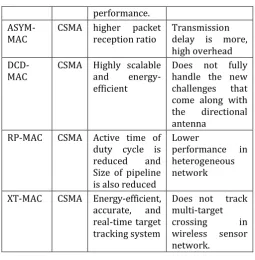
Table -1: Comparison of MAC protocol
Various MAC protocol
Protocol Type Advantages Disadvantages
EERC-MAC CSMA Provides fairness between source nodes without sacrificing the throughput.
In bigger network not give better throughput and energy
reservation.
S-MAC CSMA one layer of the OSI stack is used in one or more other
layers to
improve the system
physical layer nd it will not improve in mac layer to improve lifetime of the system.
performance.
ASYM-MAC CSMA higher packet reception ratio Transmission delay is more, high overhead
DCD-MAC CSMA Highly scalable and energy-efficient
Does not fully handle the new challenges that come along with the directional antenna
RP-MAC CSMA Active time of duty cycle is reduced and Size of pipeline is also reduced
Lower
performance in heterogeneous network
XT-MAC CSMA Energy-efficient, accurate, and real-time target tracking system
Does not track multi-target crossing in wireless sensor network.
3. CONCLUSIONS
In this paper we propose CSMA base MAC protocols which provide efficient energy consumption, low latency, accuracy and reduced network overhead. Paper will defined the different protocol based on contention, contention free, channelization, and hybrid protocol . This survey paper is does the surveillance process of effectively compare the performance of the different MAC protocol based on its energy efficiency and throughput.
ACKNOWLEDGEMENT
I acknowledge to Atmiya Institute of Technology & Science College, my parents, and journal team for their support in my research work.
REFERENCES
[1] Abdeli, Djalel, Saoussan Zelit, and Samira Moussaoui.
"RTH-MAC: A real time hybrid MAC protocol for WSN." Programming and Systems (ISPS), 2013 11th International Symposium on. IEEE, 2013.
[2] Uroš Pešovic´1, Aleksandar Peulic´1, Žarko Cˇ ucˇej2 :
“MAC protocols for wireless sensor networks”. Elektrotehniški vestnik 75(1): 50–55, 2008 .
[3] Alageswaran, R., S. Selvakumar, and P. Neelamegam.
© 2017, IRJET | Impact Factor value: 6.171 | ISO 9001:2008 Certified Journal | Page 1650 Young, The Technical Writer’s Handbook. Mill Valley,
CA: University Science, 1989.
[4] Medium Access Control (MAC) Techniques Version 2
CSE IIT, Kharagpur
[5] Ma, Lujuan, Henry Leung, and Deshi Li. "Hybrid
TDMA/CDMA MAC Protocol for Wireless Sensor Networks." JNW 9.10 (2014): 2665-2673.
[6] Rao, SPV Subba, S. Venkata Chalam, and D. Sreenivasa
Rao. "A SURVEY ON MAC PROTOCOLS FOR WIRELESS MULTIMEDIA NETWORKS." International Journal of Computer Science and Engineering Survey 2.4 (2011): 57.
[7] Khalil, Md Ibrahim, et al. "EERC-MAC: Energy efficient
Receiver Centric MAC protocol for Wireless Sensor network." Imaging, Vision & Pattern Recognition (icIVPR), 2017 IEEE International Conference on. IEEE, 2017.
[8] Jacob, Aswathy Mariam, S. Viswanatha Rao, and
Sakuntala S. Pillai. "Reducing energy consumption by cross layer design in wireless sensor networks." Control, Instrumentation, Communication and Computational Technologies (ICCICCT), 2016 International Conference on. IEEE, 2016.
[9] Won, Myounggyu, Taejoon Park, and Sang H. Son.
"Asym-MAC: A MAC protocol for low-power duty-cycled wireless sensor networks with asymmetric links." IEEE communications letters 18.5 (2014): 809-812.
[10] Nur, Fernaz Narin, et al. "A duty cycle directional mac
protocol for wireless sensor networks." Networking Systems and Security (NSysS), 2015 International Conference on. IEEE, 2015.
[11] Khanh, Ho Sy, Cheol-Young Ock, and Myung Kyun Kim.
"RP-MAC: A cross-layer duty cycle MAC protocol with a Reduced Pipelined-forwarding feature for Wireless Sensor Networks." Wireless Communications and Mobile Computing Conference (IWCMC), 2015 International. IEEE, 2015.
[12] Nguyen-Trung, Quan, Thu Ngo-Quynh, and Vinh
Tran-Quang. "A low duty-cycle XT-MAC protocol for target tracking in wireless sensor networks."Communications and Electronics (ICCE), 2014 IEEE Fifth International Conference on. IEEE, 2014.
BIOGRAPHIES
Sweetu Faldu is currently a Second - year M.E student at Atmiya Institute of Technology & Science Rajkot,Gujarat India. Her research interests primarily include Medium Access Control on wireless sensor network.