http://dx.doi.org/10.4236/jamp.2016.47130
A Five-Mode System of the Navier-Stokes
Equations on a Torus
Heyuan Wang
College of Sciences, Liaoning University of Technology, Jinzhou, China
Received 4 May 2016; accepted 12 July 2016; published 15 July 2016
Abstract
A five-mode truncation of the Navier-Stokes equations for a two-dimensional incompressible fluid on a torus is studied. Its stationary solutions and stability are presented; the existence of attractor and the global stability of the system are discussed. The whole process, which shows a chaos be-havior approached through an involved sequence of bifurcations with the changing of Reynolds number, is simulated numerically. Based on numerical simulation results of bifurcation diagram, Lyapunov exponent spectrum, Poincare section, power spectrum and return map of the system, some basic dynamical behavior of the new chaos system are revealed.
Keywords
The Navier-Stokes Equations, Strange Attractor, Lyapunov Function, Bifurcation, Chaos
1. Introduction
In recent years, many scholars were enthusiastic for the stability and the bifurcation of truncated model of the Navier-Stokes equations [1]-[5]. A pioneering work by Lorenz [6] of 1963, concerning the Saltzman equations for convection between plates, represents the first attempt to study the partial differential equations that govern a fluid flow through truncation of a suitable Fourier expansion to a finite number of components (“modes”). Later in the twentieth century, Valter Franceschini made a further expansion in this research field and worked with other scholars to study the Navier-Stokes equations. They consider the following plane incompressible Navi-er-Stokes equations on the torus T2 =[0, 2 ] [0, 2 ]π × π , the velocity field u, the pressure p and (periodic) volume force. f is expanded in Fourier series on a torus. Some model Lorenz-like equations have been pro-posed, then they have studied three-dimensional Navier-Stokes, the equation in T3=[0, 2 ]π 3 and obtained somenonlinear system, and discussed these complex system in detail in [3]-[5].
beha-vior features of the new chaos system in a certain range of the Reynolds number, such as bifurcation diagram, Lyapunov exponent spectrum, Poincare section, power spectrum and return map, are presented.
We expanded u, f , p in Frourier series, and take L as the set of vectors K1 =
(
1 1 ,)
K2=(
1 0 ,)
(
)
3 2 1 ,
K = K4 =
(
1 −2 ,)
K5 =(
0 3)
and their opposites. With a lot of calculation, we obtain the fol-lowing five-mode Lorenz-like system1 1 2 3 4 5
2 2 1 3
3 3 1 2
4 4 1 5
5 5 1 4
x 2x 2x x 2x x (1.1) 3
x x x x (1.2) 2
1
x 5x x x (1.3) 2
7
x 5x x x Re (1.4) 2
3
x 9x x x (1.5) 2 • • • • • = − + + = − − = − − = − − + = − + (1)
Accordingly, we get the new five-mode nonlinear equation, which is similar to the Lorenz equation. We call it a Lorenz-like equation. By changing both the signs of x and 2 x , the property of the equations is unchanged. 3
This indicates that system (1) has following symmetry property
(
x1 −x2 −x3 x4 x5) (
⇔ x1 x2 x3 x4 x5)
.2. The Stationary Solution and Their Stability Properties
In the following we linearize the nonlinear Equation (1) and discuss the stability of its stationary solutions.
a) For 0≤Re<R1=5 6, there is only one stationary solution 0
Re
0, 0, 0, , 0
5
P =
. Substituting
the stationary solution P0 into the Jacobian matrix we obtain the characteristic equation of Jacobian matrix
(
)(
)
2 2 3 21 5 11 18 Re 0
25 λ+ λ+ λ + λ+ − =
For 0≤Re<R1=5 6, since all eigenvalues of the Jacobian matrix are negative, the stationary solution P0
is stable (this is a particular case of general results on the theory of the Navier-Stokes equations [7]), and nu-merical evidence suggests that the P0 is a global attract or for all Re<R1=5 6.
b) For 1 2
80 6 Re
9
R < ≤R = , there are 3 stationary solutions: the old one P0, which has become unstable
as a consequence of the crossing of the imaginary axis by one of the eigenvalues of the Jacobian matrix) and two additional P± as follow
Re Re
60 10
: 6 , 0, 0, 6, 6
7 6 5 7 6 5
P± ± − ± − .
By a similar discussion we get the characteristic equation of Jacobian matrix at P± is:
2 45 9 3 2 11 Re
6 5 Re 16 Re 72( 5) 0
7 7 6 6 6
λ λ λ λ λ
+ + + − + + + − =
(2)
owing to roots of the characteristic Equation (2) have a negative real part, stationary solution P± are stable. Numerical evidences indicate that any randomly chosen initial data is attracted by them,so they are global at-tractors. When
c) For 2
80 6 Re
9 R
> = , there are 7 stationary solutions: the old ones P0, P±, and Pεσ :
(
γ γ γ γ γ1, 2, 3, 4, 5)
,2 2
1 2
2 2
3 4 5
20 1, 27 Re 10 1,
3 5 16
1 20 27 9 3 20
Re 10, Re, Re
3 5 16 3
10 5 16 160
γ ε ε γ σ σ
γ εσ γ γ ε
= = ± = − = ±
×
= − − = =
× ×
.
The first three are now always unstable, while the new four are stable for Re<R3=52.785 and
numeri-cally they attract any randomly chosen initial data. At Re=R3=52.785 the fours table stationary solutions
become unstable because a pair of complex conjugate eigenvalues crosses the imaginary axis, and four stable periodic orbits around the fixed points Pεσ arise via a Hopf bifurcation, we will give a detailed discussion in the Section 4.
3. The Existence of Attractor and Analysis of Global Stability
In the following, we discuss the existence of attractor of the system (1), assume that(
)
5
1 2 3 4 5
H=R , u(t)= x , x , x , x , x , by calculating we get
2
2 2 Re
2
2 d
u u
dt + ≤ . Using the Gronwall
in-equality [8], we get
2 2 Re lim sup ( )
4
t→∞ u t ≤ . Therefore, we have 0
Re lim sup ( )
2
t→∞ u t ≤ =ρ . If P0 big enough,
sphere ∑ =B(0, )ρ is an not only functional invariant set but also absorbing set. As a result the system (1) has the global attractor [8] [9].
We construct a following Liapunov function of the system (1):
2 2 2 2 2
1 2 3 4 5 1 2 3 4 5
(x ,x ,x ,x ,x ) x x x x x 0
V = + + + + > (3)
Setting V(x ,x ,x ,x ,x )1 2 3 4 5 =k, obviously, when k is a positive constant, it represents a sphere, which is
la-beled as E. By calculating we obtain the following derivative
2
2 2 2 2 2
1 2 3 4 5
d Re Re
2[2x x 5x 5(x ) 9x ]
dt 10 100
V
= − + + + − + − (4)
Obviously,
2
2 2 2 2 2
1 2 3 4 5
Re Re
2x x 5x 5(x ) 9x
10 100
+ + + − + = represents an ellipsoid in H, which is labeled as C.
From (4) we know that dV 0
dt < on outside of C, 0 dV
dt = on C, and 0 dV
dt > inside of C. If k is big enough,
E will include C. Therefore, from (4) we know that dV 0
dt < , 0
dV V
dt < on outside of C. From the Liapunov theory we know that the orbits of system (1) will enter E. Namely E is the trapping region of the equations (1). Though the stationary solutions P0, P±, and Pεσ are all unstable, the system (1) still has the global stability,
orbits of system (1) contract into the trapping region and oscillates in the trapping region. Finally the orbits form an invariant set in the trapping region, which is called the strange attractor.
4. Numerical Simulation
In this section we present the numerical experiment results.
1) For Re < R3 = 52.785…, the stationary solutions Pεσ of system (1) is stable, Numerical evidences indi-cate that any randomly chosen initial data is attracted by one of them, so they are global attractors.
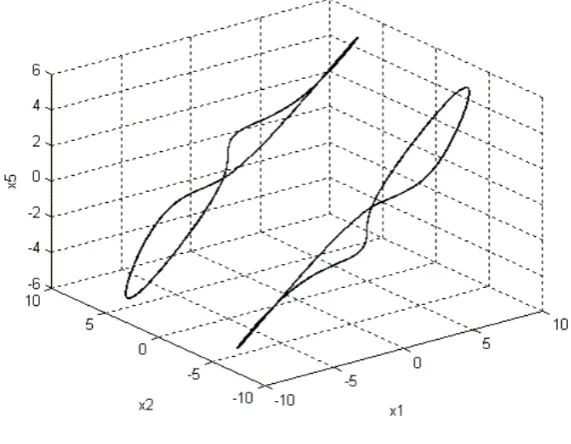
2) At Re = R3 = 52.785… the four stable stationary solutions Pεσ become unstable because a pair of com-plex conjugate eigenvalues of Jacobian matrix at stationary point crosses the imaginary axis, each of the four stable fixed points generated by the preceding bifurcations loses stability undergoing a Hopf bifurcation, and each generates a stable periodic orbit (hence foursymmetric orbits i( 1, 2, 3, 4)
n i
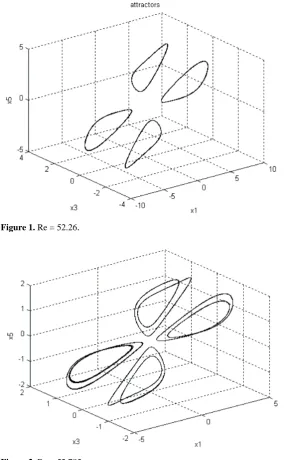
ξ = are generated), and four sta-ble periodic orbits around the fixed points Pεσ arise via a Hopf bifurcation (Figure 1) are stable up to Re = R4 = 55.36 ∙∙∙ and numerical results shows that they attract any point chosen at random.
Figure 1. Re = 52.26.
Figure 2. Re = 52.785.
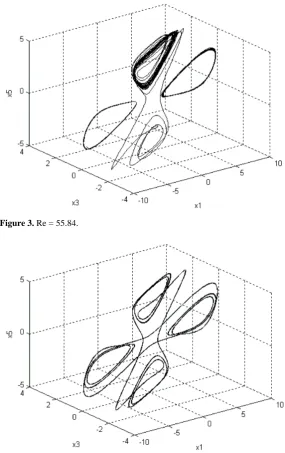
the Reynolds number Re, the number of periodic orbits also increases, the computer simulation shows that other similar bifurcations take place at Re = R5 = 55.365 ∙∙∙, Re = R6 = 55.40 ∙∙∙ and Re = R7 = 55.60 ∙∙∙, each time the new orbits wind up around the fixed points twice, at this point, the system is in a state of quasi-periodic. the se-quence of period doubling bifurcations should accumulate (according to Feigenbaum’s theory); in another re-gion of phase space a pair of periodic orbits i*( 1, 2)
n i
ξ = (one stable and one unstable) are created, therefore, a hysteresis (i.e., coexistence of attractors) phenomenon appears.
4) As discussed above, at Re = R7 = 55.64 ∙∙∙, a new kind of periodic orbit appears. Each of the previous four orbits bifurcates into anew orbit, the new orbits wind up around two of the fixed points Pεσ, instead of only one like the previous ones. More precisely there are two orbits winding around P++ and P−+ and the other two around P+− and P−− (one stable and one unstable) (Figure 3).
orbit appears to swallow the region where the doubling periodic should be located. A “collision chaos” seems to take place.
5) The stable periodic orbit become unstable at Re = R8 = 55.76 ∙∙∙, increasing Re we have a sequence of bi-furcations in which each time the period doubles and the number of loops around each fixed point doubles. We found four further bifurcation points of such nature, for the following values of Re:Re 55.80..., Re 55.84, Re 55.92. Since the period doubles each time and the orbits become increasingly intricate requiring higher precision, we did not look for further bifurcations. So we cannot definitely state whether we have just a finite number of bifurcations and the only obstacle to observe more seems to be the numerical precision needed, then the strange attractor appears, namely, the period doubling bifurcations transition into chaos (Figure 4 & Figure 5).
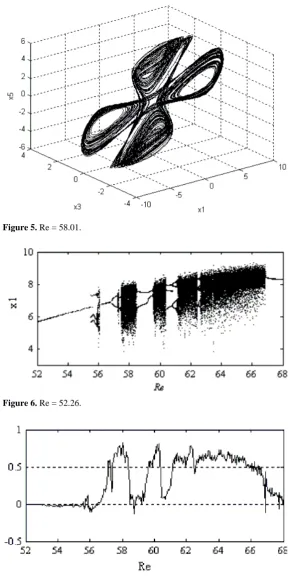
[image:5.595.169.455.252.706.2]6) Figure 6 shows bifurcation diagrams of the system (1). Figure 7 shows the corresponding largest Lyapu-nov exponents. The periodic motions generated by the period doubling bifurcation continue to double in ever faster succession (as Re grows) eventually generating a chaotic attracting set. Moreover, these bifurcation dia-grams show self similarity.
Figure 3. Re = 55.84.
Figure 5. Re = 58.01.
Figure 6. Re = 52.26.
Figure 7. Re = 53.36.
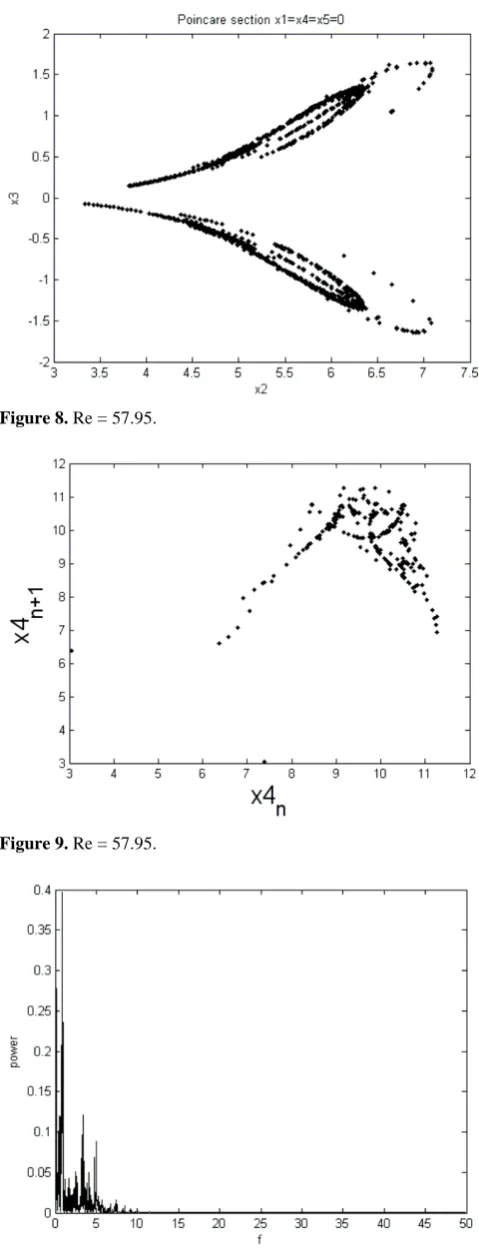
7) Figures 8-10 show Poincare section, return map and power spectrum of the system (1) at Re = 57.95. They indicate chaos feature of the new system (1).
Figure 8. Re = 57.95.
Figure 9. Re = 57.95.
Figure 11. Re = 58.88.
varying width, the strange attractors and limit cycles appear alternately at some Reynolds number. Through more delicate and difficult calculation we obtain the following details: at Re = 58.88... the strange attractor shrinks into a symmetrical limit cycles (Figure 11), at Re = 59.90..., the limit cycles become unstable and the periodic orbits generated by the period doubling bifurcation continue to double in ever faster succession even-tually generating a chaotic attracting set (Figure 11). At Re = 68.48..., the strange attractor shrinks into a symme-trical limit cycles again, if followed backwards with decreasing Re, this bifurcation is an “inverse” bifurcation.
5. Conclusion
This paper has presented and studied a five-mode Lorenz-like system of the Navier-stokes equations for a two- dimensional incompressible fluid on a torus. Dynamical behaviors of this new chaotic system, including some basic dynamical properties, bifurcations, and routes to chaos, etc., have been investigated both theoretically and numerically by changing Reynolds number. We have found period-doubling bifurcations to chaos, intermittent scenario, periodic windows, hysteresis and coexistence of periodic attractors. The chaotic behavior was dis-cussed with the aid of bifurcation diagram, Lyapunov exponent spectrum, Poincare section, power spectrum and return map. Furthermore, the existence of attractor and the global stability of the equations have been firmly ve-rified and our theories and methods can be used in other similar systems.
Acknowledgements
We thank the editor and the referee for their comments. Research works are subsidized by the National Nature Science Foundation of China (11572146), the funds for education department of Liaoning Province (L2013248) and science and technology funds of Jinzhou city (13A1D32).
References
[1] Wang, H.Y. (2012) Dynamical Behaviors and Numerical Simulation of Lorenz Systems for the Incompressible Flow between Two Concentric Rotating Cylinders. International Journal of Bifurcation and Chaos, 22, 1-11.
http://dx.doi.org/10.1142/S0218127412501246
[2] Wang, H.Y. (2015) The Chaos Behavior and Simulation of Three Model Systems of Couette-Taylor Flow. Acta
Ma-thematica Scientia, 35, 769-779.
[3] Franceschini, V., Inglese, G. and Tebaldi, C. (1988) A Five-Mode Truncation of the Navier-Stokes Equations on a Three-Dimensional Torus. Computational Mechanics, 3, 19-37. http://dx.doi.org/10.1007/bf00280749
Nonlinear-ity, 4, 189-209. http://dx.doi.org/10.1088/0951-7715/5/1/008
[5] Franceschini, V. and Tebaldi, C. (1984) Breaking and Disappearance of Tori. Communications in Mathematical Phys-ics, 94, 317-329. http://dx.doi.org/10.1007/BF01224828
[6] Lorenz, E.N. (1963) Deterministic Nonperiodic Flow. Journal of the Atmospheric Sciences, 20, 130-141.
http://dx.doi.org/10.1175/1520-0469(1963)020<0130:DNF>2.0.CO;2
[7] Ladyzhenskaya, O.A. (1969) The Mathematical Theory of viscous Incompressible Flows. Gordon and Breach, New York.
[8] Li, K.T. and Ma, Y.C. (1992) The Hilbert Space Method of Math and Physics Equations. Xi’an Jiaotong University Press, Xi’an.
[9] Hilborn, R.C. (1994) Chaos and Nonlinear Dynamics. Oxford University Press, London.
Submit or recommend next manuscript to SCIRP and we will provide best service for you:
Accepting pre-submission inquiries through Email, Facebook, LinkedIn, Twitter, etc. A wide selection of journals (inclusive of 9 subjects, more than 200 journals) Providing 24-hour high-quality service
User-friendly online submission system Fair and swift peer-review system
Efficient typesetting and proofreading procedure
Display of the result of downloads and visits, as well as the number of cited articles Maximum dissemination of your research work