12 November 1973
English Edition
'IJ~J/
European Communitie8
EUROPEAN PARLIAMENT
Working Documents
1973-1974
Document 231/73
Report
drawn up on behalf of the Committee on Budgets
on
th/.ft general budget of the European Communities for 1974(Doc. 187/73)
Rapporteur : Mr Rafton POUNDER
On 13 July 197~ Mr Pounder was appointed rapporteur for the draft
general budget of the European Communities for 1974.
The draft general budget of the communities for 1974 drawn up by
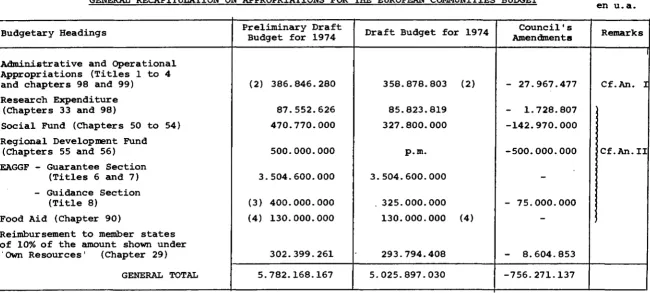
the council was forwarded to Parliament on 4 October 1973, within the
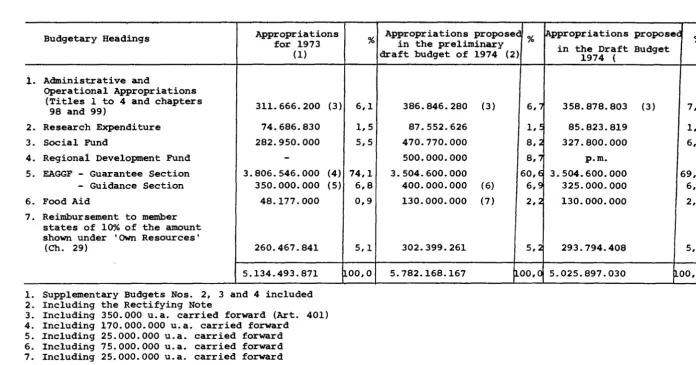
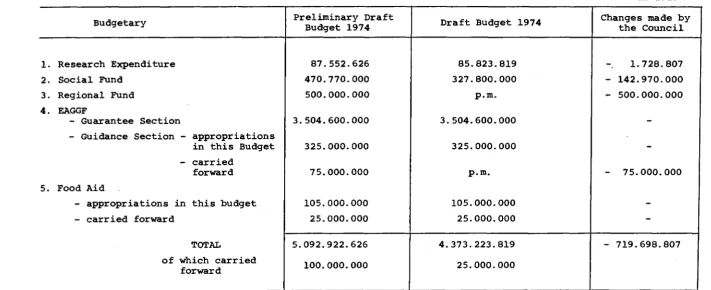
time-limit stipulated by the Treaties.
On 15 October 1973 Parliament referred this draft budget to the
Committee on Budgets. It was also referred for their opinion to those
committees which had 'expressed the wish to deliver an opinion'.
The Sub-committee on the budget of the communities (Control of
Implementation)discussed the draft budget on 19 September 19 73.
A delegation from Parliament, appointed from within the
Committee on Budgets, met the Council on 21 September 1973.
The draft budget was discussed in the presence of
the commission of the Communities on 10 and 24 October 1973 and also
in the presence of the Council on 8 November 1973.
The proposals for modifications were discussed on 8 November L973
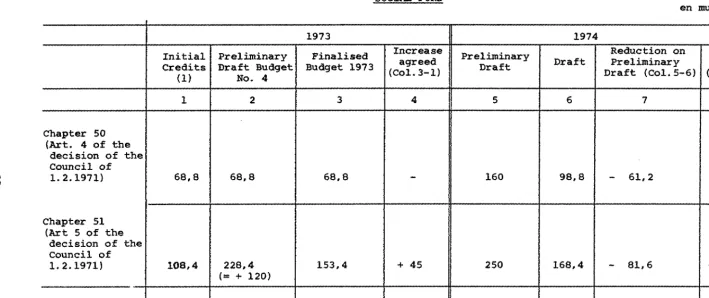
in the presence of the Council and the Commission.
At the latter meeting the committee delivered its opinion on
Mr Pounder's draft report and adopted the motion for a resolution by
18 votes in favour and ... 2 against.
'l'he following were present: Mr Sp~nale, chairman: Mr Aigner,
vice-chairman: Mr Pounder, rapporteur: Mr Artzinger, Mr Durand, Mr Durieux
(de-putizing for Miss Flesch), Mr Fabbrini, Mr Federspiel (de(de-putizing for Mr
Houdet), Mr Fellermaier (deputizing for Mr Adams), Mr Gerlach, Mr Gibbons
(de-putizing for Mr Nolan), Mr Leenhardt, Mr Memmel, Mr MUller, Mr Notenboom,
Mr Pitre, Sir Brandon Rhys Williams, Mr Schuijt (deputizing for Mr Poher),
Mr Schmidt, Mr Terrenoire,.Mr Thomsen (deputizing for Lord Bessborough) and
Mr Wohlfart.
A.
MOTION FOR A RESOLUTIONB.
EXPLANATORY STATEMENTCONTENTS
...
,
.
,,,... .
...
8 5ForewOl:'d • • • • • • • • • • • • • • • • • • • • • • • • • • • • • • • • • • • • • • • • • • • • • • • • • • • • • • • •
a
General Introduction...
8Chapter I: Draft budget established
py
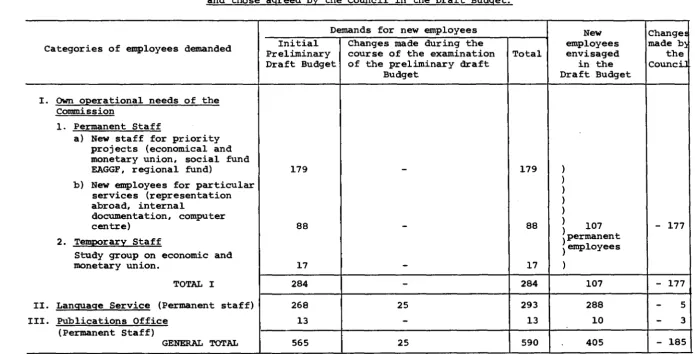
the council...
15Chapter II· Opinions and decisions of the Committee on Budgets on the proposed modifications to the draft budget ••• 39
Annexes Proposed modifications ••...•••..••.••• .'. ~ . . . • • . • . ..,.
I. - OPINION OF THE COMMITTEE ON AGRICULTURE •...•.•..•..•. 106
II. OPINION OF THE COMMITTEE ON PUBLIC HEALTH
AND THE ENVIRONMENT •.•...•• ~ ...•.•....•..•.• 118
III. - OPINION OF THE COMMITTEE ON ENERGY, RESEARCH
AND TECHNOLOGY ...•..•.•...•....•..•• · .•...•.•.•....• 124
A
The Committee on Budgets hereby submits to the European Parliament the following motion for a resolution, together with explanatory statement:
MOTION FOR A RESOLUTION
on the draft general budget of the European Communities for 1974
The European Parliament,
- having regard to the preliminary draft budget of the European communities and particularly to the explanatory statement of Section 3 concerning the Commission,
- having regard to the draft general budget of the Communities for 1974 and the explanatory statement provided by the Council (Doc. 187/73),
having regard to the report of the Budget Committee, the opinions of other committees, and the proposed amendments which are joined to this report
(Doc. 231/73),
- and after having debated with the Commission and the Council,
1. Emphasizes that this draft budget for 1974 is the last before the budget of the community is financed entirely from the Communities' own resources and that as we approach January 1 1975, the Parliament is determined to search for a new institutional balance which is necessary as the Community becomes financially autonomous;
2. Believes that inter-institutional collaboration must improve during the coming financial year, given the great problems which the Institutions will have to resolve in the implementation and within the context of the new budgetary provisions;
3. Welcomes the steps towards collaboration which have been taken by
Parliament and the other Institutions as regards the budgetary procedure, however, reiterates again the fact that a real and effective dialogue must be founded - as was envisaged in the financial regulation which came into force on 1 May 1973 - on the clear explanation by the Council of the reasons which may have led it to differ from the preliminary draft budget submitted by the Commission, deeply regrets that the explanatory statement given by the Council completely fails to satisfy this need;
4. Further observes with dismay that the inter-institutional collaboration for Community Acts with financial implications has not honoured the under-takings of the council and the Commission at the time of the Treaty of 22 April 1970 which has thus resulted in Parliament being unable to make a proper assessment of such proposals because it has not received
satisfactory financial schedules accompanying such Acts: also recalls
that this point was clearly emphasized in Parliament's resolution on the draft budget for 19731
5. Insists that the Commission henceforth transmit to Parliament financial schedules, on the model proposed in the report of the Budget Committee, when it makes proposals with financial implications1
6. Asks the Commission to let the Parliament know the main proposals for measures inc~easing internal control, reserves its position until the
final decisions have been taken after a trial period, is favourably
disposed to an increase in the number of officials concerned with internal control measures to be engaged at the time of the introduction of a
supplementary budget for the Regional Fund, notes the intention of the Commission to proceed to fulfil these tasks, in part by recruiting specialist staff, perhaps outside the national administrations, and in part by extending the scope of work of officials present in the commission.
Basic features of the draft budget
7. Observes that the draft budget amounts to slightly more than 5,000 m.u.a. whilst the Commission's preliminary draft was for 5,780 m.u.a.
8. Regrets profoundly that the reason for these reductions has been the failure by the council to include appropriations for the Regional Policy and to make the substantial increases proposed by the Commission of the Communities
in the appropriations for the Social Policy, which has meant that the Budget is no longer diversified encompassing a wide spectrum of Community policies thus contributing to a broadening of the community, but reverts once more to being one predominantly for the agricultural markets.
9. Recalls moveover that the draft budget as now proposed by the Council does not fulfil the demands laid down by the summit Conference of the Heads of State and Government of the Member States in October 1972 and that to carry out the obligations set out there, substantial appropriations must be included in the operational chapters of the Budget for the Regional Policy by January 1, 19741 insists that the figure eventually provides for the huge tasks which have been assigned to it - namely the progressive reduction and eventual elimination of regional imbalances in Europe - and its relationship to European integration, particularly to the realization of economic and monetary union.
10. Notes Council's intention to provide appropriations for these policies by supplementary budgets, reminds the Council that such supplementary budgets make the budgetary procedure more difficult from the aspect of financial control and draws to the attention of the council that this practice which has been used too often in the past will have to be aban-doned in the period of financing by own resources; recognizes that as regards the Social Fund our inadequacy of position for 1974 as well as necessitating a possible further supplementary budget may well lead to a distortion of the criteria for grants under present social policy and the arbitrary refusal of requests for funds by the Commission;
11. Is opposed to the budgetary presentation in which the needs of the Community are shown in such a meagre fashion particularly since it has asked for the inclusion within the Budget of forward estimates, in con-formity with council's decision of 21 April 1970, in order to have a meaningful opportunity to examine the proposed growth of Community policies and hence the budgetary choices which result;
12. Deplores that in respect of the appropriations for the Guidance Section of the EAGGF - to cover finance for the improvement of agricultural
structures - decisions taken in 1972 and 1973 have been called in question by the Council by a dubious budgetary procedure which relegates certain appropriations under Remarks in the draft budget for 1974; believes that the general needs for reforming the agricultural structure have been expressed in a very confused budgetary arrangement both as regards the Remarks and Explanations and as regards the different items in the Budget;
13. Is critical of the absence for the second consecutive year of appropriations for industrial development policies and the extremely meagre appropriations for research investment policy, for youth activities, for the environment and for information policies;
14. Insists that the Council after having considered the proposed
parliamen-tary amendments on the draft budget refers to them both in writing and orally in the Session which follows the adoption of the Budget;
15. Charges the President to transmit to Council the draft budget amended according to paragraph 4 of Article 7B(a) of the ECSCTreaty, Article 203a of the EEC Treaty, and Article 177a of the Euratom Treaty, as well as the Resolution, the minutes of today's sitting and the report of the Budget Committee.
EXPLANATORY STATEMENT
FOREWORD
1. This explanatory statement includes the following elements which should clarify certain aspects of the examination in the 1974 Draft Budget
(a) The record since 1970
- which has been the period of application of the Treaty of 22 April 1970 and which remains in force until the end of 1974.
(b) The role played by Parliament in this period.
(c) The inter-institutional collaboration.
(d) The inadequacies in procedure which have appeared and improvements that could be made.
These 4 points will be dealt with in the general introduction.
(e) The comparison between the Commission's proposals in its preliminary draft budget and the council's deci~ions in the draft budget. Chapter 1 will deal with this.
(f) The conclusions of the Budget Committee on the draft budget of the Communities as well as its Opinion on the proposed amendments put forward by other Committees or by members of Parliament will be in Chapter 2 which will be added to the report·after the meeting of the Budget committee on 8 and 9 November.
GENERAL INTRODUCTION
2. In the Conunission's general introduction to its preliminary Draft Budget (volume 7) the importance of the year 1974 was explained - mainly because 1974 will be the last year before the exclusive financing of the Budget from the Conununity's own resources. As the Conunission says (page 65 of this volume) the budgetary problems will alter substantially.
We can already see however that the changes envisaged by the decision of 21 April 1970 replacing contributions from Member States by 'own resources' are not working satisfactorily. Also we can see particularly in view
of the important debates on the increase of Parliament's own power in the budget, a great need to increase those powers before the new provisions come into force in 1975. The Community remains committed to the date of 1 January 19~5 as the date when' the budget will be completely financed by own resources. Obviously the financial year preceding this event is an important one for that reason alone.
3. The Council also brings out the importance of this budgetary year in its explanatory statement for its draft budget. The Council notes the need for immediate further study of problems arising within the context of the new budgetary provisions.
This explanatory statement mentions the meeting between the Council and the Parliamentary delegation on 21 September last before the Council
established its Draft Budget. Parliament can draw satisfaction from
these meetings and the importance the Council attaches to them as a welcome sign of a general shift which should improve the institutional balance.
4. But the question has to be asked, is the inter-institutional collaboration as a result of the Treaty of 22 April 1970, really satisfactory? The decision of Council about this collaboration which was communicated to the assembly on 17 November 1971, was welcomed by the Parliament. This collaboration was annexed to the Treaty of 22 April 1970 and envisaged numerous contacts each year either in the Parliamentary Sessions of October and November, or with Parliament's presentation of its reactions to the Budget before the council esta-blishes its Draft Budget, and again before Council finally adopts its audget. The Council has, moreover, participated in meetings of the Budget Committee to which it was invited.
5. So there has been some progress. But unfortunately it has to be acknowledged that the results of such collaboration have been even less fruitful than could have been hoped. There are several reasons for this.
6. First of all the smooth working of this inter-institutional dialogue was disrupted by the fact that it was 1 May 1973 by the time the financial regulation was agreed in its various parts.
If one takes the example of one element which has not been adhered to one could examine Article 13 of the financial regulation which deals with the explanatory memorandum that the Council attaches to
the Draft Budget which it sends to the Parliament. This should include
-1
the relationship between the principal objectives of the Conununities and the requests for appropriations
the changes in appropriations canpared with the preceding financial year:
the Council's reasons for departing where necessary from the
I
preliminary draft budget.
Clearly if this was adhered to, the explanatory memorandum of the Draft Budget would be an extremely important part of the inter-institutional
dialogue. Unfortunately this has not been the case. The Council has never satisfactorily followed the provisions of this financial regulation The remarks that the Council makes about its decisions in establishing the Draft Budget for 1974 show clearly that the Council has failed to explain
in detail the reasons why it has departed from the preliminary Draft Budget.
The commission made a serious effort to present its main consi-derations in a sufficiently straightforward manner to enable Parliament
to make an overall political assessment of the Budget. So the Commission changed its explanatory statement and did not restrict its comments to particular appropriations.
By comparison the Council bB maintained its habit from three
previous years of providing a rather neutraltext,which has no bearing on the range of major budgetary choices presented by the Conunission, and which is really of just a technical nature.
7. The trouble with this 'dialogue of the deaf' is that a real inter-institutional debate requires the taking of very definite political positions by particular institutions. It is not simply a question of details~ indeed as regards the 1974 Draft Budget the Council has not even
added to its explanatory memorandum a table showing the budgetary consequences (for each title chapter and article of the draft budget) of the decisions that it has taken which diverge from the Commission's proposals in the preliminary Draft Budget.
The Council has now modified in some way 34 of the 47 chapters of the Budget (excluding the Guarantee Section of the EAGGF).
In the absence of synoptic tables or comprehensive details showing the quantitative and qualitative reasons for the Council's divergence from the Commission's proposals, Parliament must flit from document to document looking for the basic material in order to permit it to make an assessment of the importance of the decisions taken (we will come back to these consid-erations in more detail in the first chapter).
8. Since 1970 Parliament has been informed by the Council where and why the Council has differed from proposed Parliamentary amendments at the time that the Council adopts the Budget, but this stage of the dialogue is also lacking substance.
Parliament learns of the deliberations of Council usually from an oral declaration given by the President-in-Office of the Council at the Session which follows the adoption of the Budget. This declaration has usually been of a rather general nature.
Parliament has not been informed of the real reasons for Couniil decisions or indeed of the manner in which the decisions were taken. This could be useful to know if only because the provisions of the Treaty
envisage a qualified majority of Council as necessary in order to reject proposed amendments in the Draft Budget which do not involve any increase
in total expenses.
9. The collective work with the Commission has been more useful as regards the Budget, but it must be said that parliamentary control has sometimes been hindered by the Commission's inaction. For example, in this year the
Budget Committee has yet to receive any 3-monthly account of the execution of the Budget even though the financial regulation is quite specific on this point. It is obviously vital that Parliament should have this informa-tion if it is to be able to exercise any effective budgetary control.
10. On the subject of the role Parliament has played in this intermediary period, one can see that the hopes raised by the 1970 Treaty have been rather disappointed - particularly as regards those Acts with financial implications.
that
The Council Resolution annexed to the Treaty of 22 April 1970 states
'In order to provide the European Parliament with such
information as will enable it to give its opinion on Community Acts having financial implications, the Council shall invite
the Commission to append to the proposals which it forwards to the European Parliament estimates of the financial
implications of those Acts'.
'The Council undertakes to maintain the closest cooperation with the European Parliament in the examination of such Acts an:l to explain to it such reasons as may have led it to depart fran the European Parliament's Opinion'.
This Resolution led to an implementation agreement between the Council and Parliament (reached not without difficulty) on 15 November 1972.
The diffic:ulties concerned the interpretation of certain provisions by the Council as regards what constituted 'departing' from the
Parliament's Opinion and the suspending of these provisions in times of urgency or 'when the Communities' interest demands it'.
At eve:y opportunity the appropriate Parliamentary bodies have expressed their reservations on these points. But this 'WOuld have been a minor point had the Parliament been able to guarantee rea:,iving the financial information which would have enabled it to assess Community Acts with financial implications. In fact what has happened is that the
financial analysis made by the Commission which is joined to each proposed regulation or directive is seldom helpful. For the most part they do not make a serious financial estimate and are often very
summary. So the precondition for the applicatiC!>n of this Council Resulution of 22 April 1970 bas been missing and the dialogue has been inevitably weakened. Had the resolution been applied there would have
been at least a real, if incomplete, participation
by
Parliament. As it is the Council has never really explainedto
Parliamentthe reasons that may have led it to differ from Parliament's Opinion on ++
Acts with financial implications. Consequently Parliament has not
always been able to play the role envisaged for it in the Council Resolution as regards these Community Acts with financial implications. For example, the cases of appropriations for certain organizations in the agricultural markets which were decided recently - like vegetables, fruit, hops, seeds and silkworms.
11. This is a vital point. We are now only one year away from the
definitive period. We must ask the Commission when they submit to Parliament proposals for Acts with financial implications that these must be
accompanied by a financial schedule in which should appear:
- Indication of the links between the financial implications of the measures proposed and the annual budget(s), and therefore
- indication of the overall cost:
as detailed a breakdown of expenditure as possible using the budgetary nomenclature (Title, Chapter, Article, Item): - in the case of expenditure not covered by the budgetary
nomenclature, suggested line in the budget with an accurate headi.c·,:
- Breakdown of expenditure in time: - effect on the current budget;
- effect on the draft budget in preparation;
- effect on the multi-year estimates and therefore on future annual budgets;
- Indication of whether expenditure will be covered by receipts and therefore
whether it will be covered by the appropriations provided in the current budget;
- whether it can be covered by transfers:
- whether it will have to be covered by new budget appropriations: in a future budget, by a supplementary budget:
Effect on the various components of own resources: - other than VAT;
- VAT;
++
There has been one single exception: during the Presidency of
Mr Westerterp on his initiative during the time of the Draft Budget of 1973 at the meeting of 8 November 1972.
- Indication of the financial implications to allow a comparison with expenditure provided for and actually effected in past financial years or in the current financial year, so that it can be decided whether or not requests for new appropriations are justified:
- Explanation of the bases on which the estimates have been made:
- Indication of
a bracket showing minimum and maximum estimates of costs: - alternative assessments of financial implications:
- degree of uncertainty of the estimates:
- Comparison of the financial implications of an act with those of all the acts already adopted in the current financial year:
Explanations of the effects of acts having financial implications in terms of 'financial machinery and liquid assets'.
12. The financial regulation should also show in tabloid form as follows: (see pages 14(a), (b) and (c)).
13. These provisions must be carried out to enable the Budget committee and
Parliament to fulfil its responsibilities.
0
cr o
14. we may conclude this introduction by noting two observations by the Commission of the Communities.
In its introduction to the preliminary draft budget the Commission admits the shortcomings in the budgetary procedures and the methods of control, and recognises Parliament's concern about its own lack of powers of intervention in budgetary matters, a concern which will be aggravated as the date for the transfer to own resources occurs.
The Commission states that it is convinced that reforms must take place on a 3 tier basis:
- rationalization of budgetary choices - control of expenditure
- reform of the institutional mechanism for the decision-making process. That is why the Commission presented to the Council and to Parliament the proposed changes in the Treaty which it considered to be essential to enable Parliament to intervene effectively in the budgetary process from
the reasons that may have led it to differ from Parliament's Opinion on ++
Acts with financial implications. Consequently Parliament has not
always been able to play the role envisaged for it in the Council Resolution as regards these Conununity Acts with financial implications. For example, the cases of appropriations for certain organizations in the agricultural markets which were decided recently - like vegetables, fruit, hops, seeds and silkworms.
11. This is a vital point. We are now only one year away from the
definitive period. We must ask the Commission when they submit to Parliament proposals for Acts with financial implications that these must be
accompanied by a financial schedule in which should appear:
- Indication of the links between the financial implications of the measures proposed and the annual budget(s), and therefore
- indication of the overall cost:
as detailed a breakdown of expenditure as possible using the budgetary nomenclature (Title, Chapter, Article, Item): - in the case of expenditure not covered by the budgetary
nomenclature, suggested line in the budget with an accurate headin-,:
- Breakdown of expenditure in time: - effect on the current budget:
- effect on the draft budget in preparation:
- effect on the multi-year estimates and therefore on future annual budgets:
- Indication of whether expenditure will be covered by receipts and therefore
++
whether it will be covered by the appropriations provided in the current budget:
- whether it can be covered by transfers:
- whether it will have to be covered by new budget appropriations: in a future budget, by a supplementary budget:
Effect on the various components of own resources: - other than VAT:
- VAT:
There has been one single exception: during the Presidency of
Mr Westerterp on his initiative during the time of the Draft Budget of 1973 at the meeting of 8 November 1972.
Indication of the financial implications to allow a comparison with expenditure provided for and actually effected in past financial years or in the current financial year, so that it can be decided whether or not requests for new appropriations are justified;
- Explanation of the bases on which the estimates have been made;
- Indication of
a bracket showing minimum and maximum estimates of costs; - alternative assessments of financial implications;
- degree of uncertainty of the estimates;
- Comparison of the financial implications of an act with those of all the acts already adopted in the current financial year;
Explanations of the effects of acts having financial implications in terms of 'financial machinery and liquid assets'.
12. The financial regulation should also show in tabloid form as follows: (see pages 14(a), (b) and (c)).
13. These provisions must be carried out to enable the Budget Committee and
Parliament to fulfil its responsibilities.
0
a o
14. We may conclude this introduction by noting two observations by the Commission of the Communities.
In its introduction to the preliminary draft budget the Commission admits the shortcomings in the budgetary procedures and the methods of control, and recognises Parliament's concern about its own lack of powers of intervention in budgetary matters, a concern which will be aggravated as the date for the transfer to own resources occurs.
The Commission states that it is convinced that reforms must take place on a 3 tier basis:
- rationalization of budgetary choices - control of expenditure
- reform of the institutional mechanism for the decision-making process. That is why the Commission presented to the Council and to Parliament the proposed changes in the Treaty which it considered to be essential to enable Parliament to intervene effectively in the budgetary process from 1975.
BASIC MODEL OF A FINANCIAL SCHEDULE
A. FINANCIAL IMPLICATIONS: EXPENDITURE
1 : :
-I
I
I
Breakdown by financial year...
.i:,.
-
r»--I
Budgetary line Title ••••I
Chapter ••••I
Article • • • •I
Total
Item • • • •
I
I
B. MEANS OF COVERING EXPENDITUREI
Appropriations under current budget Transfers within current budget SupplementaryBudget No ••••
~
I
Appropriations to be entered for ~I
future budgetsVI
.,:,.
...
'
Hi....
::,.
Budgetary allocations in previous financial! years
I
______________
_.:.,_______________________ _
!current year
(n)
n + 1 n + X Current
year ( n)
n - 1
i!.
~
. tt
...
le.
EFFECTS ON REVENUEl ; ,
-1
Source of revenue
VAT
!Levies
!customs duties
I
Other sourcesYear n
I
absoluteIncrease in revenue Year n + l
I
% absolute
I
%ID.
BASES FOR ESTIMATES AND ALTERNATIVE ASSESSMENTS OF FINANCIAL IMPLICATIONSAlternative
I
No. l!
Alternative No. 2 !AlternativeBasic
I
-criteri,Yearn Year n + l Yearn+ x KiD.iillum Maximum Minimum Maximum Minimum Maximum
· l:!~·
I
costI
costI
costl'
costI
costYear n + x
absolute %
Average assessment
Assessment with the smallest degree of uncertainty_
'tl n
t:i:J t,J
-~
.
UI
.,:.
....
'
111....
::,
I-'
.r:,..
,..,.
I') ...
"d
l"l
l,J
.r:,..
.
UI.r:,..
...
...;
HI
....
::,
.
IE.
COMPARISON WITH ALL ACTS HAVING FINANCIAL IMPLICATIONS ADOPTED IN A FINANCIAL YEAR1 Estimate covering all adopted
I
acts having financial implicationsI
Acts to be adopted
I + II
I
(I) (II)Year n I Year n + 1
I
Year n + xI
Year n Year n + 1I
Year n + x Year n Year n + 1 I Year n + xI
I
I
I I I ITotal
I
preakdown:Title
I
Chapter ArticleItem
, _ _ _ ...._ _ _ . _ _ _ _ . . _ _ _ _ _ . . . . _ _ _ 1 1 . . . _ t 1 +
-F. EFFECTS OF THE PIANNED FINANCIAL MACHINERY ON SHORT- AND MEDIUM-TERM LIQUID ASSETS Expenditure effected at a regular rate
!Expenditure following a seasonal cycle
Of course these problems are being dealt with elsewhere and have
been the subject of a major debate in Parliament itself. I refer to it here in this introduction to point out the dangers of maintaining the present institutional imbalance and the need for a major increase in the
powers of the Parliament in budgetary matters before the 1975 budgetary period so that both the budgetary control can be effective and that the
level of democracy in the communities can be .strengthened.
CHAPTER l
THE PRELIMINP.RY DRAFT BUDGET PROPOSED BY THE COMMISSION - THE DRAFT
BUDGET ESTABLISHED BY THE COUNCIL
A. The Preliminary Draft Bu3.get
15. The Preliminary Draft Btdget amounted to 6,077,583,960 u.a. It
was subsequently reduced by 259.6 m.u.a. as a result of a Rectifying Note
from the Commission - thus leaving 5,781,983,960 u.a. Its main
character-istic was a tentative broadening of finance for Community policies, notably by fairly substantial allocations for regional policy and for
social policy. The Regional Fund amounted to 500 m.u.a. (or 8.23% of
the total amount in the Budget) and the Social Policy amounted to
470 m.u.a. (7. 78%).
As a result the agricultural element had been reduced to 81% of the whole appropriations which.was considerably less than in
previous years. This broadening of the Budget by the Conunission resulted
from
- the progress towards economic and monetary union, in particular the move to the second stage of such a union for 1st January 1974:
- the commitments undertaken by the Commission for the planned growth of the volume of appropriations for the new Social Fund:
- and of course because of the communigu~ of the Summit Conference of Heads of State and of Governments of 12 October 1972 which envisaged new policies being put into operation in 1974 - not merely regional and social policies but also policies for energy etc.
B. The Draft Budget
16. The Draft Budget of the Conununities established by the Council reduces the Draft Budget to 5,025,897,030 u.a. As has already been stated in the general introduction the effect of this reduction has been felt on 34 of the 47 chapters of the Budget (without including the chapters for the Guarantee Section of the EAGGF).
17. The main changes in appropriations are shown in the following tables. These have been supplied by the Conunission of the Conununities to the
Budget Canmitteez
....
-.J I "Cl l.'ll w""'
.
l.n""'
~ HI....
::,.
TABLE I
COMPARISON OF THE MAIN BUDGETARY ELEMENTS IN 1973 AND 1974
Budgetary Headings Appropriations for 1973
(1)
i.
Administrative andOperational Appropriations
(Titles l to 4 and chapters 311.666.200 (3)
98 and 99)
2. Research Expenditure 74.686.830 3. Social Fund 282.950.000
4. Regional Development Fund
-5. EAGGF - Guarantee Section 3.806.546.000 (4)
- Guidance Section 350.000.000 (5) 6. Food Aid 48.177.000 7. Reimbursement to member
1. 2. 3. 4.
s •
6. 7.states of 10% of the amount shown under 'Own Resources'
(Ch. 29) 260.467.841
5.134.493.871
Supplementary Budgets Nos. 2, 3 and 4 included Including the Rectifying Note
Including 350.000 u.a. carried forward (Art. 401)
Including 170.000.000 u.a. carried forward Including 25.000.000 u.a. carried forward Including 75.000.000 u.a. carried forward Including 25.000.000 u.a. carried forward
% Appropriations proposed in the preliminary %
draft budget of 1974 (2)
6,1 386.846.280 (3) 6, 'j
1,5 87.552.626 1, !:
5,5 470.770.000 8,2
SOO.OOO.OOO 8,7
74,1 3.504.600.000 60,E
6,8 400.000.000 ( 6) 6, 9 0,9 130.000.000 (7) 2,2
5,1 302.399.261 5,2
100,0 5.782.168.167 100,0
!Appropriations proposed
%
in the Draft Budget
1974 (
358.878.803 (3) 7,1
85.823.819 1,7
327.800.000 6,5
p.m.
3.504.600.000 69,7
325.000.000 6,5
130.000.000 2,6
293.794.408 5,9
[image:23.847.68.765.92.457.2]TABLE II
CHAPTER 98 "NON-ALLOCATED PROVISIONS"
a) In the 1973 Budget
b) In the 1974 preliminary draft Budget
The conunission·s Approach:
155 MUA
17 sub-headings 9 MUA
3 sub-headings
All expenditure provisions should be included in the operational chapters of the Budget as far as possible. Only those for which the appropriate decisions cannot be reasonably expected during the course of the preceeding year should be entered under chapter 98.
c) In the 1974 Draft Budget 22 MUA
15 sub-headings
...
'°
I'd tlJ
w
,,:.
.
U1,,:.
I-'
"
....
HI::s
TABLE III
GENERAL RECAPITULATION ON APPROPRIATIONS FOR THE EUROPEAN COMMUNITIES BUDGET
en u.a.
Budgetary Headings Preliminary Draft Budget for 1974 Draft Budget for 1974 Council's Remarks Amendments
I
1. Administrative and Operational Appropriations (Titles l to 4
and chapters 98 and 99) (2) 386.846.280 358.878.803 (2) - 27.967.477 Cf.An. l 2. Research Expenditure
(Chapters 33 and 98) 87.552.626 85.823.819
-
L 728. 8073. Social Fund (Chapters 50 to 54) 470.770.000 327.800.000 -142.970.000
4. Regional Development Fund I
I
(Chapters 55 and 56) SOO.OOO.OOO p.m. -500.000.000 Cf.An.II
5. EAGGF - Guarantee Section
(Titles 6 and 7) 3.504.600.000 3.504.600.000
-- Guidance Section
(Title 8) (3) 400.000.000 . 325. OOO. OOO - 75.000.000
6. Food Aid (Chapter 90) (4) 130.000.000 130.000.000 (4)
-7. Reimbursement to member states of 10% of the amount shown under
·0wn Resources' (Chapter 29) 302.399.261 293.794.408
-
8.604.853GENERAL TOTAL 5.782.168.167 5.025.897.030 -756. 271. 137
(1) Including the Rectifying Note
(2) Including 350.000 u.a. carried forward (Article 401) (3) Including 75.000.000 u.a. carried forward
[image:25.844.116.766.99.391.2]:!
'tl trJ
w
~
.
U1~
~
HI
....
::,'!'ABLE IV
ADMINISTRATIVE EXPENSES OF THE COMMUNITY
en u.a. The Institutions Preliminary Draft Budget of 1974 Appropriations 1974 Draft Budget Changes made by the Council
Assembly 29.373.300 29.373.300
-Council 32.564.175 33.862.165 + 1. 297. 990
Economic and Social Committee 6.422.540 6.330.420
-
92.120Control Commission 894.130 894.130
-Auditor for the ECSC 161. 975 161. 975
-Commission
- Administrative expenditure 297.183.600 257. 391. 223 -39.792.377
- Provisional expenditure and
unforeseen expenses 12.350.600 22.923.390 +10.572.790
Court of Justice 7.895.960 7.942.200 + 46.240
386.846.280 358.878.803 -27.967.477
(1) In titles l to 4, not including chapter 29
"'
_...
l,:j J:rJ w ,i:,..
U1,i:,.
t:::
Hi....
::, Budgetary1. Research Expenditure 2. Social Fund
3. Regional Fund
4. EAGGF
- Guarantee Section
- Guidance Section - appropriations in this Budget - carried
forward
s.
Food Aid- appropriations in this budget - carried forward
TOTAL
of which carried forward
TABLE V
INTERVENTION FUNDS
Preliminary Draft Budget 1974
87.552.626 470.770.000 SOO.OOO.OOO 3.504.600.000 325.000.000 75.000.000 105.000.000 25.000.000 5.092.922.626 100.000.000
en u. a.
Draft Budget 1974 Changes made by the Council
85.823.819
-
1. 728. 807 327.800.000 - 142.970.000 p.m. - SOO.OOO.OOO3.504.600.000
-325.000.000
-p.m.
-
75.000.000105.000.000
-25.000.000
[image:27.846.71.783.127.417.2],.,.
111.>" ltJ L'!l w,.
.
UI,.
....
"
Hi....
::sTABLE VI
STAFF (SECTION III - COMMISSION)
Comparison between the new staff demanded by the Commission for 1974
and those agreed by the Council in the Draft Budget.
Demands for new employees New Categories of employees demanded Preliminary Initial Changes made during the course of the examination employees
Total envisaged Draft Budget of the preliminary draft in the
Budget Draft Budget
I. OWn OEerational needs of the Conunission
1. Permanent Staff
a) New staff for priority
projects (economical and monetary union, social fund
EAGGF, regional fund) 179
-
179 )b) New employees for particular ) )
services (representation )
abroad, internal )
documentation, computer )
centre) 88
-
88 107>permanent
2. Temporary Staff
~
employees Study group on economic and
monetary union. 17
-
17 )TOTAL I 284
-
284 107II. Lang:!,!aqe Service (Permanent staff) 268 25 293 288
III. Publications Office 13
-
13 10(Permanent Staff)
GENERAL TOTAL 565 25 590 405
[image:28.847.80.776.131.485.2]....
(D ll( 'tS (D ::, p,....
rt" i:: 11 (D Hi 0 11;
II) '< (D Al 11 Ill....
\0 N
....i
N ~
Al
::,
p,
....
...,
\0 [image:29.1141.287.996.127.424.2]UI ....i w
... I I
...,
~ I "O tsJ w ~.
c.n~
....
'
~ Hi
....
::,
w
~
"O
.
ts:.1 (.11
~
(,.,) I-'
"'"
'
.
Hi\)\
....
"'"
::,I-'
'
H,....
::,
Initial Preliminary Credits Draft Budget
(1) No. 4
l 2
Chapter 50 (Art. 4 of the
decision of the Council of
1.2.1971) 68,8 68,8
Chapter 51 (Art 5 of the
decision of the council of
1.2.1971} 108,4 228,4
(== + 120)
177, 2 297,2
1973
Finalised Budget 1973
3
68,8
153,4
222,2
TABLE VII SOCIAL FUND
Increase agreed (Col. 3-1)
4
-+ 45
+ 45
Preliminary Draft 5 160 250 410
(1) Including supplementary Budget No. 2 (non-accession of Norway)
en mua
1974
Reduction on IncreasE Draft Preliminary on 1973
Draft (Col. 5-6) (Col. 6-3)
6 7 8
98,8
-
61,2 + 30168,4
-
81,6 + 15I
r-- ,-1
N r-- ,-1
M N O'I '
' ' N
,-1 N
r--*
,-1 .-1 .-1+ + I
'
during the course of the budgetary period, even with the declaration of good intentions that it adds to Item 8501, ·does not
help to clarify the position. (Under 'Remarks' it is said among other things that "should the appropriations be committed in the course of the financial year the Budgetary Authority has undertaken to make the necessary amendments to the expenditure and revenue entries·".)
SOCIAL POLICY - EUROPEAN SOCIAL FUND
29. After Parliament's experience with the Supplementary Budget No. 4 for 1973 in which a proposed increase in the funds of 120 m.u.a. in the preliminary draft budget from the Commission and approved by Parliament was reduced to only 45 m.u.a., the Parliament is in one sense at least prepared for the Council's proposal for this policy for 1974.
The Commission's proposals for 1974 aimed at diversifying the Community budget which had until now been devoted almost exclusively to the finance of agricultural markets (and for this reason the proposed appropriations for the Social Fund amounted to 7.87% of the whole) but also to meet to some extent the needs shown and demands made by the Summit Conference of Heads of State and Government in October 1972. One should remember that as a result of this Conference the Commission has
an obligation to adopt, before January 1st 1974 a social action
programme with positive and detailed measures and corresponding funding. The Heads of State indicated that Community action in the social field was in their view just as important and urgent as the attainment of economic and monetary union.
But of course it has to be said now that the Commission itself has yet to work out the budgetary consequences of its social action programme because of course it has not yet submitted this programme to Council.
Council itself has said that it cannot fully assess the means required for the next year as a result of the decisions on this programme but that it is ready to make certain provisions in the budget. It would seem vital therefore that the two Institutions proceed as rapidly as possible but it seems probable that there will be a requirement for a
supplementary budget. Council says it wishes to avoid for 1974 a repetition of the large number of supplementary budgets introduced in
- 30 - PE 34. 541 fin
the previous year. Unfortunately in various fields - regional policy, social policy, contracts for industrial development, commitments for development operations in the agricultural priority regions - the delays and the shortcomings of this draft budget give a rather hollow ring to that intention of the Council.
30. The Commission's proposals for expenditure under Article 4 of the Social Fund of 160 m.u.a. have been reduced to 98.8 m.u.a. The expenditure proposed under Article 5 of 250 m.u.a. has likewise been reduced to 168.4 m.u.a.
In making these cuts the Council gives a relatively greater importance to those under the Article requiring decisions by Council
(Article 4) as opposed to those where the initiative rests with the Commission (Article 5).
The Council states that the total agreed of 267.2 m.u.a. instead of 410 m.u.a. is a 20% increase as opposed to 1973. This comparison is however misleading. The Council well knows that by cutting the supplementary budget No. 4 for 1973 from 120 m.u.a. to 40 m.u.a. the programme for 1973 has been delayed and that the social expenditure
for 1973 has effectively been reduced. It is only when compared with this figure that the 1974 Draft Budget shows an increase of 20%.
The Commission has stated that this draconian reduction will force it either to re-examine the criteria for financing projects in a stricter sense or to refuse some applications.
The Budget Committee has observed that the commitments
undertaken for Chapter 51 for the 1973 Budget have been fairly small. The Commission gives as its reason for this the delay in decisions on available financial resources, a delay which affects the
determination of appropriate criteria for distributing and dividing up the available funds. The Commission has also said that for the directives approved in agriculture and textiles as well as for those envisaged for the handicapped and the migrant workers, the sum
required for 1974 would be 410 m.u.a. Obviously the Budget Committee could not therefore give its assent to the reductions made by the Council if this was the case. The Budget Committee will re-examine this subject in the light of the position adopted by the Social Committee.
Incidentally, item 5201 in the preliminary draft budget dealing with informational meetings and preparatory studies has been deleted by the Council without any explanation whatsoever - indeed, without even mentioning that the item has been deleted!
31. It seems moreover as regards the remarks made in the preliminary draft budget and the Draft Budget of Council, Article 510, that there is a significant difference between the Commission and the Council. The Commission says that the 120 m.u.a. demanded for the Supplementary Budget No. 4 of 1973 were sought on the basis of past experience and the short-comings of actual provisions. The Council does not make any reference to this figure - although of course it reduced it to 45 m.u.a. but it claims that its decisions were also based on the past experience and the provisions available. These two positions taken seem contradictory and Parliament will require further explanations to see which position is correct.
REGIONAL POLICY - THE EUROPEAN REGIONAL DEVELOPMENT FUND
32. The Commission had inserted 500 m.u.a. in the operational
chapters of the Budget for the proposed new European Regional Development Fund. It was envisaged by the Commission that this Fund would grow -indeed accelerate over a period of years rising to 1,000 million u.a. in 1976. The decisions about the Fund, both the principles and its working methods, have yet to be decided and Parliament has yet to give its definitive view on this. It is for this reason that the Council has placed a 'pm' under the appropriate chapters in the Budget for it has decided that it cannot allocate funds until it has taken the basic decisions. At least this is the interpretation that one makes of the Council's token entries under these chapters because in this case as in many others, the Council has given no accompanying observations.
33. If the Council does not give a decision within the next few weeks then a supplementary budget will be required for 1974 and it will be a Budget of very considerable proportions - again this element makes proper assessment of the Budget extremely difficult.
If the Budget adopted by the Council at the end of this year does not include considerable funds for a regional policy then it will be the Council who will bear the responsibility for the failure to keep
to the timetable set out at the Summit of the Heads of State and of
Government of October 1972, where it was envisaged that the regional policy would be fully operational from January 1st, 1974. Non-adherence to this timetable also means that the progress towards economic and monetary union will be disrupted. The Community was due to pass from the first to the second stage of economic and monetary union on 1st January 1974 and it was intended that regional development plans would coincide with this date given the generally accepted close relationship of the two policies. So by its inactions and delays one can see that the Council is not merely
hindering one policy but must take the responsibility for the general slow rate of European integration.
34. As regards the amount proposed in the preliminary draft budget from the European Commission, Parliament may well in its debate on the Delmotte Report consider that the proposed allocations are inadequate. Parliament will certainly want to see the budgetary presentation showing clearly the planned growth of the fund through the means of commitment appropriations for the two following budgetary periods at least. Only then can it estimate whether there is an intention to expand rapidly the scope of the Fund.
The figure proposed by the Commission can be seen as a welcorr? start to a policy but.in the context of the massive regional imbalances i.11 the Community which have to be eliminated in order that progress towards economic and monetary union be not impeded and in the context of the firm commitments from the Treaty of Rome itself and from the Summit of 1972, and in the context of the scale of the problems shown by the Commission in its preliminary report, one can perhaps say that the allocation for regional policy - inasmuch as it represents merely one third of the. intervention supports for milk products can be interpreted as being inadequate.
35. The Commission will certainly need, apart from the actual aid from the Fund, adequate facilities - both in terms of staff and expertize - in order to administer the policy and to implement rigorous financial control. It would be little short of disastrous if the regional policy of the
Community became, like the agricultural policy, associated in the public's mind with sloppy administrative control and large scale frauds.
36. Because of the commitments of all the Institutions, and of the Summit, to the regional policy, the Budget Committee feels that
Parliament may well consider that the amount for the Fund proposed by
the Commission - 500 m.u.a. - or perhaps a larger figure - should be placed in the Chapter 98 (the non-allocated appropriations chapter) but blocked until the basic decisions for the Fund have been taken by the appropriate Institutions. The Budget Committee would prefer that such initiative be taken by Parliament.
Research and Investment Expenditure
37. The Draft Budget allocates 84,107,919 u.a. to this policy. The main observation to be made is that the Community will henceforth be attaching a reduced budgetary importance to research - although a pluriannual programme has been instituted. Again, if a comparison may be used the programme for Euratom has less budgetary importance than the intervention supports for pig meat.
38. As regards the figures given by the Council, these correspond to the payment appropriations. One could then ask how it was that
these included a reduction of 3 m.u.a. on the obligatory payment credits in the preliminary draft budget of 87,552,626 u.a.?
Expenditure on Health Measures
39. Reductions made under this Section (Chapter 35) do not call for any particular remarks.
Expenditure concerned with the Plan of Action relating to Scientific and Technological Policy
40. Here is a case where the Budget Committee can congratulate itself that the Council has seen the need to include this in the text proposed by the Commission but the Committee must observe that this is still only a token appropriation with the phrase 'pm' added. This is particularly unsatisfactory in view of the Summit Conference which foresaw not only a Community Scientific and Technological Policy but also that this policy, with a precise action programme and appropriate financial support, should be ready from 1st January 1974.
Community Contracts for Industrial Innovation and Development
41. The Commission have inserted an appropriation of 20 m.u.a. which the Council has deleted waiting to adopt a proposed regulation. This deletion is particularly regrettable because it shows a massive delay in policy which Parliament would have wished to see last year. It was for this reason that Parliament introduced the Draft Amendment then which would have enabled the Community to finance three development projects and new industrial projects.
Food Aid Expenditure
42. The Council has not altered the Commission's proposal here and has kept to a figure of 130 million in this important Chapter and this can be welcomed by Parliament.
Information Policy and Development Aid
43. These two points have been placed together in this report because the budgetary characteristics as regards this presentation seem similar, namely lack of appreciation by the Council and to a certain extent of the Commission of the importance of these policies which take an extremely low priority in terms of budgetary amounts. Under several of these items amounts have been changed by the Council in what seems to be an arbitrary fashion given the lack of explanations.
Inaction in these important areas seems likely to do nothing to improve the Community's image either to European peoples or to the rest of the world.
Meetings with Trade Union Organizations (Article 256)
44. This items has been dropped from the Draft Budget of the Council with no reason given. It was a new item - the Commission had asked for
50,000 u.a. following requests for technical and financial help put forward by the European trade unions to organize priority meetings which it has in order to take their positions in officialconsultations with the Commission services. Whether or not, this demand was justified, one could certainly say that it is extremely unsatisfactory that the Council has not even bothered to say that it has deleted this Article.
Consultations, Studies and Service of a Limited Nature (Article 260) 45. The appropriation of 116,800 in the Draft Budget carries the
following remarks: "this appropriation is intended to cover expenditure arising from the consultation of experts and the carrying out of or the purchase of studies and service". It would be hard to imagine a more
vague and unsatisfactory explanation of a policy of considerable import-ance to the Community.
Comprehensive Community Studies and Services (Article 262) 46. The Council has deleted nearly all the explanation of the
Commission for the study programme and the breakdown of the expenditure here which seems yet another senseless suppression of the text.
47. Exactly the same remarks can be made concerning Article 264,
The Statistical Studies and Service. Again the Council has reduced the Commission text of some 50 lines to nothing.
The Council makes a major reduction on the Commission's
proposal without giving any reason. The Commission however keeps the major part of the expenditure for Chapter 98 - the non-allocated appropriations - which Parliament would have to approve during the corning year.
48. Similar remarks can be made for the environment studies (Article 267) - the deletion of any explanation from the Council is even more annoying given the considerable importance that the Parliament has attached to this Community policy in the last few years.
49. The same remarks can be made about the Official Journal (Article 270) where again for no apparent reason the Council has offered no explanation.
Organization of Training Courses for National Social Workers and Civil Servants in the various Sectors of Social Welare
50. The appropriation by the Council is 150,000 u.a. as compared to 200,000 u.a. from the Commission. In itself the reduction does not call for any particular comment but the remarks do. The breakdown of the programme for 1974 remains but the Council omits completely the
financing of the programme for 1974 - which the Commission had given. One can at least reflect that·this is yet again an alternative variation to the Council's policy of arbitrary reductions in its explanations.
51. The preliminary draft budget had an appropriation of 21,500 u.a. for the "other organizational expenses" (Article 319) which was for a seminar organized by the European Centre for Agricultural and Rural Studies. This has turned up amongst the appropriations under Chapter 98 again with no explanation.
52. No explanation has been given either for the deletion of Article 320 and the token entry there for "scholarships for national of associated countries".
53. Article 329 studies in development and cooperation. This was a
new Article with 100,000 u.a. in the preliminary draft budget of the Commission and which has completely disappeared along with the remarks giving the
nature of the studies.
EXPENDITURE RELATING TO PERSONS WORKING WITH THE INSTITUTION
54. This title does not give rise to any major objections. One can simply say that the changes made by the Council ar~s~ mostly from reductions to staff requests which are shown on Table VI.
107 employees have been given for 284 demanded for the operation of the Commission - a reduction which the Commission believes excessive - and
288 for the 293 for the language service. The Commission has let us know that it intends to introduce a Rectifying Note to ask Parliament to create 20 new posts in the financial control section.
The other remarks that can be made in this Section are the following:
55. With Item 1102 of the preliminary draft budget there was a
breakdown of the appropriations for the ex-patriation allowances. This breakdown has b~en_omitted by the Council which makes the assessment much more difficult.
56. Item 1110 dealing with auxilliary staff covers provisions for payment for 85 employees. This explanation is almost unusual inasmuch as it is given neither for local staff nor for freelance interpreters
or revisers. The reasons for the exclusion there are difficult to understand. Certainly the presentation is far from uniform.
57. Under Item 1112 for local staff the Council has deleted the Commission's text which divided up the appropriations between the different seats of
the Commission. Again this deletion appears to be unjustified.
58. Under Item 1123 severance grants the figure in the Draft Budget is the same as the preliminary draft budget - 2,522,000 u.a. The reason this is mentioned here is that this is a result of a provision which can be amended only with difficulty because it results automatically from the regulations in force. That is why the Council has not reduced it and why the Parliament cannot do it either. Yet this is in a section of the Budget which is supposed to be'non-obligatory' - and is the only section of the Budget over which the Parliament has a supposed power of amendment. This just shows how unsatisfactory Parliamentary powers are at the moment.
59. The deletion of part of the commentary for the sickness insurance and Item 1131 on 'accident insurance and occupational diseases' is unjustified.
60. Article 115 dealing with overtime has again its explanation severely cut which is annoying because the formula used to justify this appropriation for overtime is extremely vague. The Budget Committee asks the Council to use a more rigorous approach when it decides to change or delete the
Commission's remarks.
61. Also insufficient are the commentaries for the supplementary services for the freelance interpreters and conference officers (Item 1170) - but the explanations were already insufficient in the preliminary draft budget!
62. Item 1173, dealing with the travel and other expenses of national experts seconded to the services of the Commission can only be accepted with reservation given that the explanatory texts do not present a real
justification for this.
63. The same reservations can be made as regards the deletion of the commentary for Article 120 dealing with miscellaneous expenditure on staff recruitment.