Munich Personal RePEc Archive
Are the Institutions of the Stock Market
and the Market for Corporate Control
Evolutionary Advances for Developing
Countries?
Singh, Ajit
2010
Online at
https://mpra.ub.uni-muenchen.de/24346/
Are the Institutions of the Stock Market and the Market for
Corporate Control Evolutionary Advances for Developing
Countries?
Ajit Singh
Queens’ College
University of Cambridge
UK
Abstract
This paper explores the question of whether the institution of the stock market is
likely to be helpful to developing countries in promoting their real economy and
ensuring fast industrial growth. The case for and against the stock market inevitably
involves a discussion of the important related subjects of corporate finance and
corporate governance. Contrary to the literature the paper arrives at a negative overall
assessment of the institution of the stock market in relation to economic development.
It also contributes by its policy proposals concerning the markets for corporate
control, which again are in conflict with much of the conventional wisdom on the
subject.
JEL Keywords: Stock market; Market for corporate control; Corporate finance;
1. Introduction
This paper explores the question to what extent, if any, the institution of the stock
market is likely to benefit the real economy in developing countries and aid their
industrialisation. This question is examined here by focussing on the following
aspects which are salient to the assessment of the stock market from a developmental
perspective:
(a) the role of the stock market in promoting technological development;
(b) the implications of the stock market for corporate finance and corporate
governance; and
(c) the efficiency of the pricing process and the takeover mechanism observed
in the real world stock markets.
Contrary to most literature, the present paper contributes by its negative overall
assessment of the institution of the stock market in relation to economic development.
Although orthodox economics extols the virtues of the stock market and the
international financial institutions (IFIs) encourage developing countries (DCs) to
establish or to expand such markets there is an important literature which suggests
that this institutional innovation may not be helpful for economic development in
many poor countries. Following the Great Depression and noting the role of the stock
market in propagating rather than preventing it, John Maynard Keynes (1936)
famously provided an intellectually robust attack on the institution. He termed the
stock market a gambling house and suggested that a society’s investment decisions
should not be left to the vagaries of a casino. The Keynesian criticisms were echoed
sixty years later in a blue ribbon report by twenty-five leading US finance specialists
under the Chairmanship of Professor Michael Porter of Harvard University. The
Commission was appointed in order to find out to what extent, if any, the stock
market based US financial system was responsible for poor US economic
performance relative to European countries during 1980-1995. Porter (1992)
“The change in nature of competition and the increasing pressure of globalisation
make investment the most critical determinant of competitive advantage. Yet the US
system of allocating investment capital both within and across companies is failing.
This puts America at a serious disadvantage in global competition and ultimately
threatens the long term growth of the US economy”
As with all strong statements in economics this powerful critique of the stock market
did not stand the test of time. The significance of this criticism came in part from the
fact that it emanated from a country that was a citadel of the stock market itself. Over
the next ten years, 1995-2005, the US economic performance improved immeasurably
and the country experienced spectacular expansion, outdoing its industrial competitors
in GDP and productivity growth. It is suggested that it is the stock market that has
enabled the US to adopt information technology and achieve other technological
breakthroughs much more quickly than other advanced countries (ACs) [see further
Summers (1999) and Feldstein (1999)]. If the stock market can help with achieving
similar technical progress in DCs, this would be an important argument for its
encouragement in such countries.
II. The Stock Market: new technology and short-termism
Notwithstanding Keynes, a surprisingly large constituency favours the establishment
of the stock markets to promote economic development in emerging economies. As
mentioned above, the IMF and the World Bank have, of course, fully supported the
institution of the stock market and helped developing countries in various ways to
either establish them or to encourage their growth (Singh, 1993, Sudweeks, 1990).
This constituency includes not only the IFIs but also Central Left think tanks such as
the World Institute of Development Economics Research (WIDER) and surprisingly
the Chinese Communist party, which has established stock markets in seven Chinese
cities. 1
1
Significant intellectual support for the ability of the stock market to promote technical
change has come from Professor Larry Summers, an erstwhile critic, who has now
become a firm supporter of the market. He argued that the US stock market was, in
large measure, responsible for the structural change experienced in the US economy
in the 1990s. This had enabled it to recover from low productivity growth of the
period 1980 to 1995, and achieve higher productivity growth between 1995 and 2005.
This transformation, according to Summers, was brought about by the take-over
mechanism on the stock market, which led to a huge reallocation of resources in the
US economy leading to faster productivity growth. Similarly, Summers suggested that
through the system of stock options the US stock market is better able to align the
interests of managers with those of shareholders (Summers, 1999). It was also pointed
out that the US stock market promotes technological progress through the venture
capital route. Through the latter, it ensures that the US is able to provide much greater
incentives for technological innovation than the institutional arrangements in other
countries. One reason for the higher pay-off for inventors and innovators in the
Anglo-Saxon system is precisely the exit mechanism through take-overs, which the
US system allows, normally permitting the target company to be sold on the stock
market with a sizable capital gain. It has been noted that other countries such as
Germany, which have tried to emulate the US system in this respect, have not
succeeded because traditional attitudes to involuntary take-overs still prevail (Black
and Gilson, 1998).
On the critical side, however, there still persist the arguments of Michael Porter and
his colleagues regarding the shortcomings of the US financial system, and these
remain unanswered. Specifically, the critics suggest that the stock market engenders
short-termism and quick financial gains rather than long-term investment. The short
time horizon is thought to be inimical both to competitiveness and fostering economic
development. The bursting of the technology share prices bubble in 2000 – the
so-called “dot com boom and bust” – has provided further support for the critics of the
III Stock markets and economic development
Apart from the issue of encouraging technological development by the stock market,
there are other ways in which the market can contribute to development through a
variety of channels. It could raise savings and investment by making it possible for
individuals and households to purchase a fraction of a shipyard or a steel mill, thereby
spreading the risk, without which such investment may not occur at all. Similarly the
monitoring function performed automatically and from the perspective of an
entrepreneur, costlessly, by the stock market also helps raise investment. Moreover, a
well-functioning stock market purportedly allocates resources more efficiently
through its normal pricing process, which would accord, other things being equal,
higher share prices to efficient firms and lower prices to inefficient ones. Furthermore,
the take-over mechanism ostensibly ensures that not just the new investment
resources but also the existing capital stock is efficiently utilised. Inefficient use of
existing resources is punished by the market for corporate control through disciplinary
takeovers.
How effectively the stock market can perform the above tasks depends on the
efficiency of two critical market mechanisms, namely (a) the pricing mechanism and
(b) the take-over mechanism. These are central issues of debate on which the
literature is briefly reviewed below.
Determination of share prices3
The orthodox paradigm of share price determination postulates that share prices are
efficient because they emanate from perfect markets involving large numbers of
well-informed buyers and sellers in which no one buyer or seller can influence the price
and where there is a homogeneous product, namely shares. There is, however, an
alternative paradigm indicated by Keynes’ comment characterizing stock markets
essentially as gambling casinos dominated by speculators. Stiglitz (1994); Allen and
Gale (2000); Shiller, (2000), Shleifer (2000), Baker and Wurgler (2007), Hong and
Stein (2007) and not least students of behavioural finance (see for example Barberis
3
and Thaler, 2003, Hong et al (2007) and Baker et al (2007), formalize the various
elements of this paradigm. In brief, this literature suggests that, in the face of a highly
uncertain future, share prices are likely to be influenced by the so-called “noise
traders”, and by whims, fads and contagion. For similar reasons of psychology,
investors may attribute much greater weight to near-term price forecasts rather than
historical long-term performance. This line of reasoning is taken further in the
growing literature on behavioural finance (referred to above).
Until recently, the empirical literature on share prices has been dominated by the
so-called ‘efficient markets hypothesis’ (EMH), which argues that real world share prices
are efficient in the sense that they incorporate all available information (Fama, 1970).
In the 1980s and 1990s, with (a) the 1987 US stock market crash, (b) the meltdown in
the Asian stock markets in the 1990s and (c) the bursting of the technology stocks
bubble in 2000, the EMH has suffered fundamental setbacks. Alan Greenspan (1998)
has commented as follows on the reasons for (a) and (b): “At one point the economic
system appears stable, the next it behaves as though a dam has reached a breaking
point, and water (read, confidence) evacuates the reservoir. The United States
experienced such a sudden change with the decline in stock prices of more than 20
percent on October 19, 1987. There is no credible scenario that can readily explain so
abrupt a change in the fundamentals of long-term valuations on that one day. ”
Kindleberger (1989) similarly documented about thirty cases of unwarranted euphoria
and excessive pessimism on the stock markets since the South-Sea bubble of 1720. He
termed these episodes as manias, panics and crashes.
Tobin (1984) made an analytically useful distinction between two kinds of efficiency
of stock markets, (a) the information arbitrage efficiency that ensures that all
information concerning a firm’s shares immediately percolates to all stock market
participants, ensuring that no participant can make a profit on such public
information; (b) fundamental valuation efficiency, that is, share prices accurately
reflect a firm’s fundamentals, namely the long-term expected profitability. The
growing consensus view is that, in these terms, stock markets may at best be regarded
more important sense (b). Thus EMH, as identified in a, is compatible with share
prices not reflecting fundamental values.
A detailed discussion as well as examples of share prices evidently departing from
their fundamentals are provided in Singh et al 2005. It is generally accepted that such
mis-pricing of shares is a common occurrence on the stock market and it may persist
for a considerable period, some would say for as much as 10 –20 years. The Nikkei
stock market index in Japan reached a value of approximately 38000 in the
mid-1980s. Twenty-five years later, it has not recovered to even half the 1980s value.
Evidence suggests a share price bubble on the Tokyo stock market in the mid-1980s.
Similarly, UK and US stock markets did not recover to their pre-great depression
index values until the mid-50s.
IV The take-over mechanism and the market for corporate control
In orthodox economics, the market for corporate control is thought to be the
evolutionary endpoint of stock market development. The market may advance
economic efficiency through two distinct channels, a) the threat of take-overs, which
can discipline inefficient firms and b) even if the firms were operating efficiently the
actual take-overs may lead to a restructuring of an economy’s resources leading to
enhanced social values. Research over the last two decades has indicated that there are
significant theoretical and practical reasons why the market for corporate control may
not work in the idealised way outlined above. This research has been discussed in
detail in Singh (2008) and will not be reviewed here for reasons of space.
This helps to explain that although there exists a very active market for corporate
control in the major Anglo-Saxon countries, it is seriously inefficient. Two kinds of
evidence support this conclusion. First, studies of the take-over selection process
indicate that selection in the market for corporate control takes place only to a limited
extent on the basis of the target firm’s performance and much more so on the basis of
its size. A large relatively unprofitable firm has a much smaller chance of being
acquired than a small profitable firm. Secondly, controlling for other relevant
there is at best no improvement on average in post-merger profits but most likely a
decline (Ravenscraft and Scherer (1987), Scherer (2006), Singh (1992), Tichy (2002).
To the extent that an increase in market power is associated with mergers, the lack of
such an increase suggests a micro-economic inefficiency in resource utilization,
certainly not an improvement.
A related set of financial studies – the so-called ‘events studies’ – suggest, however,
that in US take-overs the acquiring firms suffer a sizeable decline in share prices in
the period of six months to three years following the merger. The gainers are mainly
the acquired firms whose share prices may rise by up to 20 per cent on average
(Jensen, 1988). This poses serious incentive problems as potential acquiring firms
stand to lose rather than to gain. Equally importantly, in order to classify these gains
to the shareholders of acquired firms as being social gains, the analysis has to assume
that share prices are always efficient in the fundamental valuation sense, which, as
indicated above, is far from being the case. The rise in the share price of the acquired
firm may reflect simply the price for control which empire builders are willing to pay
even to the detriment of their own shareholders (Singh 2000).
In addition to the in-efficiencies of the take-over mechanisms in the real world, in a
closely related but more general sense, the dominance of stock markets can also result
in the unhealthy ascendancy of finance over production, and that of financial
engineering (through the take-over process) over the normal long-term entrepreneurial
tasks of introducing technical change, reducing costs and improving products.
V. Corporate Finance, the Stock Market and Corporate Governance
A central function of the stock market is to finance corporate growth. The nature of
finance in turn affects corporate governance. Although the manner in which
corporations are governed is affected by many factors, the ownership and control of a
company’s shares are bound to be affected by the manner in which companies are
financed. For example, if they are primarily financed by creditors, say bank debt, the
managers’ first concern will be to earn at least the level of profit required to finance
shareholders, managers may earn any rate of profit to finance dividends, which rise
and fall with the profits, but with the risk of take-over by another company, if share
prices are too low.
This, of course, also describes the nature of the agency problem in the normal US/UK
corporation. Managers are supposed to look after the interests of the shareholders, but
the latter, for various reasons, may not be able to motivate the managers to act in their
interest rather than those of the management itself.
The corporate governance question will be discussed analytically and empirically
below in two stages. Firstly, we will enquire, how do emerging firms finance their
growth, i.e., to what extent firms use retained profits or long-term debt or new equity
to pay for the expansion of their net assets? At the second stage the implications of the
observed financing patterns for corporate governance will be examined.
Singh and Hamid (1992) and Singh (1995), were among the first large scale studies of
financing corporate growth in emerging markets. These studies arrived at theoretically
quite unexpected conclusions: Developing country corporations rely far more on
external that on internal finance, and within external finance, they use equity finance
to a surprisingly large degree.
It is not surprising in itself that there should be differences between AC and DC
corporations in relation to how they would meet their financing requirements.
However, what is observed is totally opposite to what economic analysis would
predict to be the nature of the differences between the two groups. It may be noted
that the pattern of finance reported for AC corporations themselves is fully compatible
with the so-called ‘pecking order’ theory of finance. The latter suggests that firms will
choose sources of external finance for their investment needs in the following order.
Firstly, they will rely on internal sources (i.e., retentions) as much as they can; if they
require more finance, they will borrow from the banks, and will go to the stock
market only as a last resort.
Myers and Majluf (1984) showed long ago that this pattern of finance can arise from
corporation. Singh (2003) suggested that these considerations apply with even greater
force to developing countries. This is because with imperfect capital markets
developing country corporations may be expected to be obliged to rely largely on
self-financing for their expansion; in addition, they will be reluctant to issue equity capital
for fear of losing control of the corporation.
Thus, economic analysis predicts that developing country corporations should depend
more on internal finance and less on equity than corporation of advanced countries.
The empirical results are not compatible with this proposition.
How does one explain these theoretically anomalous results on the financing of
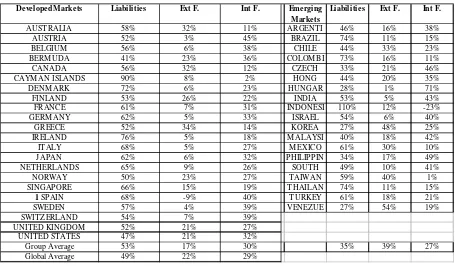
corporate growth observed for the 1980s? Do the 1990s yield similar results? Table 1
provides information on this subject for firms in 22 DCs and 22 ACs for the period
1995-2000. This is a more comprehensive dataset that which was available to
researchers for the 1980s. Exactly the same methodology is used to measure financing
of corporate growth for the two periods. The results show that for the 1990s, the
pecking order pattern of finance is decisively rejected for both rich and poor
countries. Also, what stands out is the high recourse to equity finance by developing
country corporations. (For a full discussion and explanation of these anomalous
results, termed as the Singh paradox by Dennis Muller see Singh (1995,2003), Gugler
et al 2003) and Glen and Singh (2005).
Next we take up the implications of these observed patterns of financing corporate
growth for corporate governance. There are in principle three channels through which
corporate governance may be affected by the stock market: a) the regulatory
framework of the stock market itself concerning standards for corporate accounts,
disclosure of information about major changes in corporate activities, transparency,
etc., b) the pricing process on the stock market and c) the take-over process. It is
worth noting that although AC corporations do not use stock market as much as the
DC corporations to raise equity capital, the former are paradoxically subject to greater
discipline of the stock market than are the latter. This is because of the existence of a
highly active market for corporate control in the U.S. and the U.K. so that even firms
which never go to the stock market to raise funds, nevertheless, become subject to
take-over mechanism has been discussed in detail in the last section. It falls far short
of what is required and indeed creates major distortions of its own particularly for
developing countries. The stock market pricing process and the take-over mechanism
are not in general very helpful in improving economic performance in advanced
countries and there are good reasons to suggest that they are even less likely to do so
in developing countries.
To illustrate, consider the Indian case. India, like many other developing countries,
has large, potentially predatory conglomerate groups (Singh, 1995). As suggested
earlier, if there was a market for corporate control these groups could take over
smaller, more efficient firms and thereby reduce potential competition to the
detriment of the real economy. Also as noted above, the development of an active
market for corporate control may encourage managers to “empire-build” not only to
increase their monopoly power but also to progressively shield themselves from
takeover by becoming larger.
However, the market for corporate control in developing countries remains
rudimentary because, shareholdings are not widely dispersed and standards of
disclosure are not conducive to takeovers. It is therefore not surprising that hostile
takeovers are rare in developing countries. However, this situation may change if
large international MNCs are allowed to engage in takeovers in developing countries.
Domestic firms, with their limited funds and relatively restricted access to
international capital markets, would not be able to either compete with or resist the
MNCs.
There are also other potential factors that could lead financial liberalisation and stock
markets to have a negative effect on corporate governance. Financial liberalisation
establishes a strong link between two potentially volatile markets, the stock market
and the foreign exchange market. The Asian crisis of 1997-1998 demonstrated that
there could be a strong negative feedback relationship between a falling stock market
and a depreciating currency. As the stock market declines, investors pull out of the
market and move their funds into foreign currency. The depreciating currency, in
turn, lowers real returns on the stock market which in turn propels the cycle.i Such a
“fire-sale-type FDI” in the form of takeovers, (suggesting that the expected rate of return
measured in foreign currency has increased sufficiently due to the steep decline in
domestic share prices). This may overturn quite successful corporate governance
structures and replace them with ones that are less suited.
To sum up, the above considerations together suggest that the greater influence of the
stock market on developing country corporations is unlikely to improve corporate
governance in these countries but may on the contrary make it worse.
VII. Natural Progression and Econometric Studies
One hypothesis which can certainly be refuted, even by broad brush data is that of
natural progression. This theory suggests that as countries develop they establish
stock markets and stock market development is therefore an emblem of economic
development.
Two kinds of evidence are relevant for assessing the validity of this claim. The first is
the observation that the economic miracles that occurred in the second half of the
twentieth century can hardly be ascribed to stock market development. Thus, in
post-World War II Europe – the Italian Miracle, the German miracle, the Austrian miracle
and in Asia, the justly famous miracles of Korea or Taiwan - did not depend
conspicuously on the equity or bond markets in these countries. Similarly, the second
kind of evidence relevant here consists of an examination of comparative growth rates
over a one hundred year time span. Such an examination reveals that the bank-based
countries (e.g. Germany and France) have as good if not a better long-term record of
economic growth as do US and UK. Pagano (1993) notes that the Italian stock market
was bigger a hundred years ago, than it was until a decade ago. The Italian economy
evidently grew during these hundred years without any expansion of the stock market.
Turning from the crude historical evidence above to more precise quantitative and
econometric studies, the pioneering contribution of Goldsmith (1969), on the
relationship between finance and growth has been followed by econometric exercises.
causes growth or economic growth leads to the development of the financial system.
Another issue which has received attention is whether the banks and stock markets
complement each other in causing economic growth or whether they are substitutes.
Levine (1997; 1998) found a positive relationship between banks and economic
growth, but he did not control for stock market development. Levine and Zervos
(1998) found that stock market and bank development complement each other in
assisting economic growth. This finding is confirmed by Beck and Levine (2004)
which improves upon earlier studies in terms of both methodology and for being able
to control for many other relevant variables. On the other hand, Atje and Jonanovic
concluded in an earlier 1993 study that, while stock markets positively affect growth,
raising it by a huge 2.5 percent per annum, banks had little influence. Sarkar (2009)
examined the long-term relationship between stock market development and rate of
investment in India over a fifty-year period from 1950 – 2000. Using time-series
analysis, he found no long-term relationship between the two variables.
Apart from their mixed results, there are important methodological limitations of
these econometric exercises. Firstly, as Arestis and Demetriades (1997) noted, most of
the studies are based on reduced form analysis and are therefore difficult to interpret
in causal terms. Secondly, they ignore altogether the evidence presented in the earlier
sections on the observed inefficiencies of the pricing and takeover mechanism on the
stock markets. These methodological limitations are serious and detract from the
value of this research.
VIII. Stock Market Regulation and Developing Countries
There was an enormous expansion of DC stock markets in the 1980s and 1990s in the
wake of financial liberalisation in many of these countries. Compared with the highly
organised and extensively regulated stock market activity in the US and the UK, most
DCs do not have such well-functioning markets. Not only is there inadequate
government regulation, but private information gathering and disseminating firms are
and informational deficits: most DC markets remain ‘immature’ (i.e., riddled with
insider trading and lack of transparency) and relatively illiquid. Most trading takes
place in a few blue-chip shares (Singh, 1995; 1997).
DCs have found it difficult to regulate stock markets, as is indicated by frequent
scams on DC stock markets. This should not be surprising as even highly regulated
and well-functioning markets, such as those of the US, from time to time experience
episodes such as those of Enron and WorldCom. Nevertheless, Singh (1998) has
argued that one regulatory reform, which would be particularly useful for DCs, is to
stop the emergence of a market for corporate control. Such a market, as indicated
above, exacerbates the negative effects of stock markets (e.g. short-termism) from the
perspective of economic development. This reform may however involve major
changes in company law, reducing the role of shareholders and enhancing that of
stakeholders or the government in takeover situations. DC governments need to find
cheaper and more efficient ways of changing corporate managements than the lottery
and the huge expense of the market for corporate control. They should also
encourage product market competition to discipline corporations rather than rely on
the stock market alone for this purpose.
As seen earlier, there are good theoretical reasons as well as evidence for the volatility
of DC share prices. Volatility is, however, further accentuated if DCs allow external
portfolio capital inflows. This greatly increases the vulnerability of the economy not
only to international shocks, but also to domestic shocks, substantially magnifying
their effects. The main reason for this is that capital inflows lead to an interaction
between two inherently unstable markets – the stock market and the currency market.
In the event of a large shock (domestic or external) these interactions generate a
IX. Conclusion
This paper has provided a comprehensive review of the role of the stock markets in
economic development, taking up topics such as corporate finance, corporate
governance and technological change. It has surveyed analyses and evidence from
both developed and developing countries in order to assess how best, if at all, can
stock markets contribute to economic development.
A main message of the paper is that developing countries with stock markets must
regulate these so that they do not become a source of instability or short-termism in
the economy. For this reason, DCs should discourage the emergence of a market for
corporate control. These countries should find other institutional ways of replacing
inefficient managements which are reliable and cheap compared with the takeover
device on the stock market. The latter, as we have seen, carries with it serious dangers
for economic efficiency and social stability. If Germany and Japan can do without the
Table 1. Financing of corporate growth in 19 developing countries and 22 advanced countries for 1995-2000*
AUSTRALIA 58% 32% 11% ARGENTI 46% 16% 38%
AUSTRIA 52% 3% 45% BRAZIL 74% 11% 15%
BELGIUM 56% 6% 38% CHILE 44% 33% 23%
BERM UDA 41% 23% 36% COLOM BI 73% 16% 11%
CANADA 56% 32% 12% CZECH 33% 21% 46%
CAYM AN ISLANDS 90% 8% 2% HONG 44% 20% 35%
DENM ARK 72% 6% 23% HUNGAR 28% 1% 71%
FINLAND 53% 26% 22% INDIA 53% 5% 43%
FRANCE 61% 7% 31% INDONESI 110% 12% -23%
GERM ANY 62% 5% 33% ISRAEL 54% 6% 40%
GREECE 52% 34% 14% KOREA 27% 48% 25%
IRELAND 76% 5% 18% M ALAYSI 40% 18% 42%
ITALY 68% 5% 27% M EXICO 61% 30% 10%
JAPAN 62% 6% 32% PHILIPPIN 34% 17% 49% NETHERLANDS 65% 9% 26% SOUTH 49% 10% 41%
NORWAY 50% 23% 27% TAIWAN 59% 40% 1%
SINGAPORE 66% 15% 19% THAILAN 74% 11% 15%
1 SPAIN 68% -9% 40% TURKEY 61% 18% 21%
SWEDEN 57% 4% 39% VENEZUE 27% 54% 19%
SWITZERLAND 54% 7% 39%
UNITED KINGDOM 52% 21% 27% UNITED STATES 47% 21% 32%
Group Average 53% 17% 30% 35% 39% 27%
Global Average 49% 22% 29%
Developed Markets Liabilities Ext F. Int F. Emerging Int F.
Markets
Liabilities Ext F.
Source: Glen and Singh (2005)
References
Allen, F. and Gale, D. (2000) Comparing Financial Systems, the MIT press, Massachusetts.
Aresits, P., Demetriades, P. and Luintel, K. (2001) ‘Financial Development and Economic Growth: The Role of Stock Markets’, Journal of Money, Credit and Banking, 33(1), 16-41.
Barberis , Nicholas and Thaler, Richard H. (2003) “ A Survey of Behavioral Finance. ” In Handbook of the Economics of Finance. George M. Constantinides, Milton Harris, and Rene' Stultz editors. Elsevier Science, North Holland,
Amsterdam.
Black, B. and Gilson, R. (1998) ‘Venture capital and the structure of capital markets: banks versus stock markets’, Journal of Financial Economics, Volume 47, No.8, 243-277.
Fama, E. (1970) ‘Efficient capital markets: A review of theory and empirical work’. Journal of Finance, vol. 25, 383-417.
Feldstein, M. (1998) ‘Trying to do too much’, Financial Times, March 3, 1998.
Greenspan, A. (1998) ‘Testimony before the Committee on Banking and Financial Services, US House of Representatives, January 30, 1998.
Gugler,K., Mueller, D. and Yurtoglu, B. (2004). ‘Corporate Governance and Globalization’.Oxford Review of Economic Policy, Special Issue on Globalisation,
Vol.20, Issue1, 129-156.
Hong, H. and Stein, J.C. (2007) ‘Disagreement and the Stock Market’, The Journal of Economic Perspectives, Spring 2007, Volume 21, No.2, 109-128.
Hoshi, T. and Kashyap, A. (2001) Corporate Financing and Governance in Japan: The Road to the Future, the MIT press, Massachusetts.
Keynes, J. M. (1936) The General Theory of Money, Interest and Employment.
Macmillan, London.
King, R.G. and Levine, R. (1993) ‘Financial Intermediation and Economic Development.’ In Capital Markets and Financial Intermediation (eds.), Colin Mayer and Xavier Vives). Cambridge: Cambridge University Press.
Levine, R. (1997) ‘ Financial Development and Economic Growth: Views and Agenda’. Journal of Economic Literature, June, 35 (2), 688-726
Myers, S.C. and Majluf, N.S. (1984). ‘Corporate financing and investment decisions when firms have information that investors do not have’. Journal of Financial economics, vol. 13, pp. 187-221.
Pagano, M., (1993) ‘Financial Markets & Growth: An Overview’. American Economic Review, 37, 613-22.
Porter, M.E. (1992) ‘Capital Disadvantage: America’s Failing Capital Investment System’. Harvard Business Review, Vol, no?, 65-82.
Ravenscraft, D.J., and. Scherer, F.M (1987) Mergers, Sell Offs and Economic Efficiency. Brookings Institution.
Scherer, F. M. (2006) ‘A New Retrospective on Mergers’, Review of Industrial Organization, Volume 28, Issue 4, June 2006, 327-341.
Shiller, R.J., (2000) ‘Irrational Exuberance’, Princeton University Press, New Jersey.
Shleifer, A., (2000) ‘Inefficient Markets: An Introduction to Behavioural Finance’, Oxford University Press, Oxford.
Singh, A. (1992) ‘Corporate Take-Overs.’. In J. Eatwell, M.Milgate and
P.Newman(eds.),The New Palgrave Dictionary of Money and Finance, London, Macmillan, pp.480-486.
Singh, A. (1993)‘The Stock Market and Economic Development: Should Developing Countries Encourage Stock Markets?’ UNCTAD Review, 4, 1-28.
Singh, A. (1995) ‘Corporate Financial Patterns in Industrialising Economies. A Comparative International Study’. IFC Technical Paper No.2, The World Bank, Washington, DC.
Singh, A. (1997) ‘Financial Liberalisation, Stock Markets and Economic Development’. Economic Journal, vol.107, 771-782.
Singh, A. (1998) ‘Liberalisation, The Stock Market and the Market for Corporate Control: A Bridge Too Far for the Indian Economy?’ In Ishar Judge Ahluwalia and IMD Little (eds.), India’s Economic Reforms and Development: Essays for Manmohan Singh, Oxford University Press, Oxford. pp. 169-196.
Singh, A. and Glen, J. (2005) ‘Corporate governance, competition and finance: rethinking lessons from the Asian crisis’ Eastern Economic Journal, Volume 31, 219-243.
Stiglitz, J. (1994) ‘The Role of the State in Financial Markets’. Proceedings of the
World Bank Annual Conference on Development Economics, The World Bank,
Washington, DC.
Sudweeks, L.B. (1990) Equity Market Development in Developing Countries, New York, Westport, Connecticut, London.
Summers, L.H. (1999) Quoted in article ‘Winning ways: ready bucks and a flair of risk’, Financial Times, 14 December 1999.
Tobin, J., (1984) ‘On the efficiency of the financial system’. Lloyds Bank Review,
July, 1-15.
Tichy, G. (2002) ‘What do we know about the success and failure of mergers?’Journal of Industry, Competition and Trade, Vol.1, Issue 4.
World Bank (1989) World Development Report, World Bank, Oxford University Press.
World Bank (1993) The East Asian Miracle, World Bank, Oxford University Press, New York.