http://dx.doi.org/10.4236/cs.2016.78167
Optimized Features Extraction of IRIS
Recognition by Using MADLA to Ensure
Secure Authentication
S. Pravinthraja
1, K. Umamaheswari
21Sri Ramakrishna Institute of Technology, Coimbatore, India 2PSG College of Technology, Coimbatore, India
Received 1 March 2016; accepted 25 March 2016; published 27 June 2016
Copyright © 2016 by authors and Scientific Research Publishing Inc.
This work is licensed under the Creative Commons Attribution International License (CC BY). http://creativecommons.org/licenses/by/4.0/
Abstract
Nowadays, Iris recognition is a method of biometric verification of the person authentication process based on the human iris unique pattern, which is applied to control system for high level security. It is a popular system for recognizing humans and essential to understand it. The objec-tive of this method is to assign a unique subject for each iris image for authentication of the person and provide an effective feature representation of the iris recognition with the image analysis. This paper proposed a new optimization and recognition process of iris features selection by us-ing proposed Modified ADMM and Deep Learnus-ing Algorithm (MADLA). For improvus-ing the perfor-mance of the security with feature extraction, the proposed algorithm is designed and used to ex-tract the strong features identification of iris of the person with less time, better accuracy, im-proving performance in access control and in security level. The evaluations of iris data are dem-onstrated the improvement of the recognition accuracy. In this proposed methodology, the recog-nition of the iris features has been improved and it incorporates into the iris recogrecog-nition systems.
Keywords
GLCM, Deep Learning, Strong Features Extraction, MADMM, Iris Recognition
1. Introduction
recognition of iris model to support biometric experiments. It illustrates the iris biometrics matching, where dif-ferent data are employed for training and testing the enrollment, and often leads to reduced performance. It sti-mulates the data from database that are acquired under getting hold of heavily controlled conditions.
The Unique Identification Authority of India is enrolling the people per day about one million, at 40,000 sta-tions, and plans to enroll the people within 3 years about 1.2 billion of population. IRIS recognition has materia-lized as one of the most auspicious technologies to provide reliable identification of human and for noncontact biometric authentication [1]. Also, it became as research topic driven in wide applications like national ID card, border control, banking, etc. Amazing accuracy of iris recognition has been reported by the existing state-of- the-art iris recognition algorithms from controlled environment.
In human eye, iris is a ring shaped region with biometric patterns. It is stable and provides a reliable approach for individual authentication. Based on automatic preprocessing, features matching and analysis, a unique iden-tity label is assigning to each iris image features for extracting and identification of the person [2]. The state-of-the-art of the iris recognition methods has a unique image differentiation by its feature extraction strate-gies. In preprocessing, it eliminated the unwanted parts of the image and controlled the pupil function with ad-justing the size of the image. The diameter of iris is 12 mm and pupil size of the diameter will be varying from 10% to 80%.
In iris recognition applications, iris images are defined with the same class of different subjects [3]. So that the iris images dissimilarity of the subjects is need to be identified for authentication. However, in iris biome-trics applications the similarities between various subjects are identified which categorize iris images into sever-al explicit classes. Moreover, the iris images in the centrsever-al database into multiple categories may help for speed up the iris identification in large-scale. In existing recognition systems, the iris images within the short distance and under constrained environment are obtained using NIR [4][5]. It achieves the matching accuracy of the im-age and preserves it clearly in high quality.
For long period of time, the patterns of each person are believed to be unique and remain stable and make them as a biometric signature. Over the past decade, iris patterns have gone through significant transformations of developing a new one and upgrading an existing. Sometimes, the enrollment is time consuming and expen-sive by having large number of users in the hundreds of millions. This makes it infeasible in deploying to re- enroll users every time. In practice, iris images for enrollment are trained and tested.
The paper is organized as follows. Section 2 reviews the most appropriate approaches for the amalgamation of iris data. Section 3 provides the proposed method description with validates of synthesis and interpreting strate-gies used along with the observed factors of unpredictability data. Section 4 presents an analysis of experimental results of proposed work with its strategies and parameters. Finally, conclusions and future work are given in Section 5.
2. Related Work
In this section the survey related to the iris recognition system is discussed. A novel optimization framework is proposed for learning iris biometrics transformations with its desired properties and represented concisely using kernel functions [6]. The proposed work is utilized for high adaptation by performing it in a similar way with limiting the samples from various data’s set. Furthermore, the classes will be large between various samples and these constraints make sure that alleviated the mismatch problem when matching is performed.
For extracting the features and solving of optimization the Alternating Direction Method of Multiplexer (ADMM) is used [7]. It is easy to handle and solve the issues by breaking them in to smaller pieces. Through this ADMM algorithm, the iris images is divided into several pieces among the whole pixel values and selecting only few regions of images using this optimization algorithm for strong feature extraction.
In order to reduces the complexity and eliminate the insignificant features a new optimization process is de-signed and implemented. After this GLCM (Gray Level Co-occurrence matrix) algorithm is used to get all the image statistical features so that DBN (Deep Belief network) is train and it is comes under the deep learning family [8]. It is an Advanced Artificial neural network, will learn the input features and respond according to the situation. The extracted features of iris are used in the training process un-supervising and then the trained data is ready to recognize the query of iris image given.
transfor-mation and filtering [11]. The outer border is defined by sobel filtering and the method provides a better perfor-mance analysis in dark background iris image by non-concentric iris and pupil.
For obtaining the solution the test samples is need to be perform every time if the optimization problem has a global optimum and convex. This involves in adaptation parameter estimation during the training stage. During testing, the samples are transformed and done matching which leads to significant improvements in accuracy. The components in iris recognition system are strong features extraction, identification, matching and ensure secure recognition for security. In order to overcome the limitation of the existing work, the Modified ADMM and Deep Learning algorithm are proposed for optimizing the extraction of the features for strong features with better performance and accuracy.
3. Modified ADMM and Deep Learning Algorithm—MADLA
The proposed work analysis and algorithm are discussed in this section. In this work, the analysis and design of the training phase and testing phase is proposed with the strong features extraction of optimization and prepro-cessing technique. Modified ADMM and Deep Learning Algorithm are proposed with high level abstraction for ensuring the identification of the person.
3.1. Training Phase
In training phase, the process of extracting the iris image is consists from the dataset with large number of iris sample which belongs to different persons. It consist the data set with significant and insignificant information. When processing it required more time consumption for data acquires and also it may lead to confusion during the matching stage. In order to overcome the limitation, a new algorithm (MADMM) is proposed with the opti-mization and preprocessing.
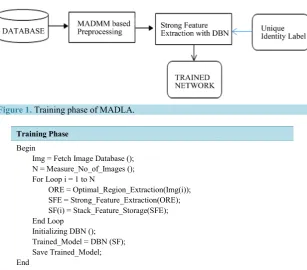
The proposed MADMM algorithm used to optimize the issues and solved it by dividing large problems in to smaller pieces. It will reduce the image information by eliminating the insignificant features. The extracted fea-tures are left to matching stage to find strong feafea-tures in iris image by using the proposed algorithm (MDLA) of GLCM with DBN algorithm, as shown in Figure 1.
[image:3.595.160.468.448.718.2]High abstractions features are defined by using the proposed MDLA. For easy identification process, a unique identity label is assigning to each iris image features. This algorithm is capable of learning the features for the purpose of classification. As a solution a trained model is generated with all information of the classifier model.
Figure 1.Training phase of MADLA.
Training Phase
Begin
Img = Fetch Image Database (); N = Measure_No_of_Images (); For Loop i = 1 to N
ORE = Optimal_Region_Extraction(Img(i)); SFE = Strong_Feature_Extraction(ORE); SF(i) = Stack_Feature_Storage(SFE); End Loop
Initializing DBN ();
3.2. Testing Phase
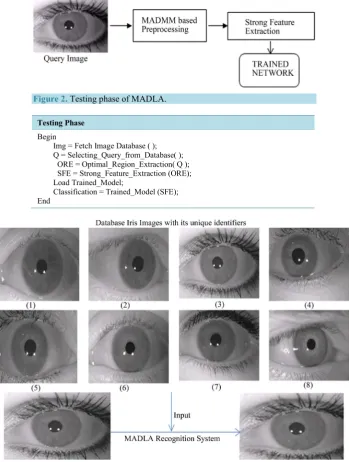
[image:4.595.139.489.243.706.2]Testing phase is similar to the training methodology, but instead of database input a query image is given as in-put. The input query image will undergo the process of proposed MADMM algorithm which is discussed in training phase and the required portion of image data is preserved in it. In tested phase the extracted features is processed with GLCM and analysed the matches with the identity label to find a closest match, as shown in Figure 2.
4. Experimental Results
The analyses of experimental results are discussed and compared the MADLA results with the various existing work. The results of extracting strong features take place with the unique identity label. When extracting the query it obtains the iris recognition with identity label which provide secure identification or authentication of a person.
Figure 2. Testing phase of MADLA.
Testing Phase
Begin
Img = Fetch Image Database ( ); Q = Selecting_Query_from_Database( );
ORE = Optimal_Region_Extraction( Q ); SFE = Strong_Feature_Extraction (ORE); Load Trained_Model;
Classification = Trained_Model (SFE); End
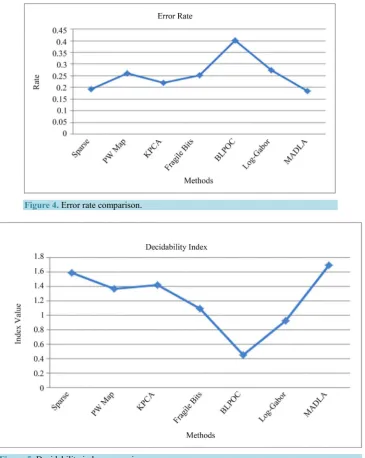
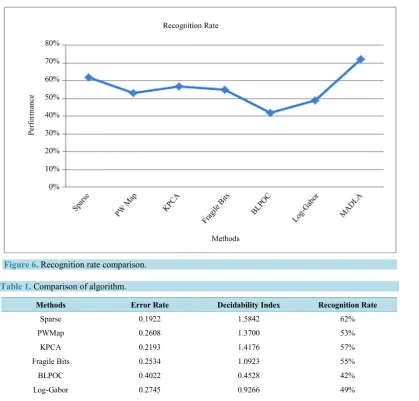
When comparing the work, MADLA provides better accuracy with less time, less error rate, better decidabil-ity index and high recognition rate. The data set is taken from IRIS database of Multimedia Universdecidabil-ity (MMU).
As shown in Figure 3, the features extraction results are obtained with identity label. The parameters com-parison between the existing methods and proposed method is shown in Figure 4, Figure 5 and Figure 6. Table 1 shows the comparison of the proposed and existing algorithm with the parameter results.
5. Conclusions
In proposed iris recognition system, we analyzed the results of the MADLA algorithm to prove the efficiency of the system with less time, better performance and secure authentication, obtaining high level abstraction and better recognition accuracy when compared to existing system. For evaluation of the system, the sample data are enrolled and tested by using the efficient algorithm of MADLA.
The main contributions of this work are to provide a solution for mismatch problem in iris biometrics for im-proving the matching process feature extraction with better accuracy and less time computation. Future works
[image:5.595.133.499.256.715.2]Figure 4. Error rate comparison.
Figure 6. Recognition rate comparison.
Table 1. Comparison of algorithm.
Methods Error Rate Decidability Index Recognition Rate
Sparse 0.1922 1.5842 62%
PWMap 0.2608 1.3700 53%
KPCA 0.2193 1.4176 57%
Fragile Bits 0.2534 1.0923 55%
BLPOC 0.4022 0.4528 42%
Log-Gabor 0.2745 0.9266 49%
MADLA 0.1837 1.6892 72%
will extend the proposed system with encode of iris image and develop a system for ensure security and cost consumption.
References
[1] Si, Y.L., Mei, J.Y. and Gao, H.J. (2012) Novel Approaches to Improve Robustness, Accuracy and Rapidity of Iris Recognition Systems. IEEE Transactions on Industrial Informatics, 8, 110-117.
http://dx.doi.org/10.1109/TII.2011.2166791
[2] Viriri, S. and Tapamo, J.-R. (2015) Improving Iris-Based Personal Identification Using Maximum Rectangular Region Detection. School of Computer Science, University of KwaZulu-Natal, Durban.
[3] Daugman, J. (2002) How Iris Recognition Works. Proceedings of 2002 International Conference on Image Processing, 1, I-33-I-36. http://dx.doi.org/10.1109/icip.2002.1037952
[4] Mattar, E. (2013) Principal Components Analysis Based Iris Recognition and Identification System. International Journal of Soft Computing and Engineering (IJSCE), 3, 430.
[5] da Costa, R.M. and Gonzaga, A. (2012) Dynamic Features for Iris Recognition. IEEE Transactions on Systems, Man,
and Cybernetics, Part B: Cybernetics, 42, 1072-1082. http://dx.doi.org/10.1109/TSMCB.2012.2186125
Under-standing. IEEE/ACM Transactions on Audio, Speech, and Language Processing, 22, 778-784. http://dx.doi.org/10.1109/TASLP.2014.2303296
[8] Chen, Y.S., Lin, Z.H., Zhao, X., Wang, G. and Gu, Y.F. (2014) Deep Learning-Based Classification of Hyperspectral Data. IEEE Journal of Selected Topics in Applied Earth Observations and Remote Sensing, 7, 2094-2107.
http://dx.doi.org/10.1109/JSTARS.2014.2329330
[9] Proença, H. and Alexandre, L.A. (2006) Iris Segmentation Methodology for Non-Cooperative Recognition. IEE Pro-ceedings Vision, Image and Signal Processing, 153.
[10] Liam, L., Chekima, A., Fan, L. and Dargham, J. (2002) Iris Recognition Using Self-Organizing Neural Network. IEEE
2002 Student Conference on Research and Developing Systems, Malaysia, 169-172.
[11] Du, Y., Ives, R., Etter, D., Welch, T. and Chang, C. (2004) A New Approach to Iris Pattern Recognition. SPIE Euro-pean Symposium on Optics/Photonics in Defense and Security, London, October 2004.