Munich Personal RePEc Archive
Bias reduction in kernel density
estimation via Lipschitz condition
Mynbaev, Kairat and Martins-Filho, Carlos
Kazakh-British Technical University, University of Colorado at
Boulder
1 July 2009
Online at
https://mpra.ub.uni-muenchen.de/24904/
Bias reduction in kernel density estimation via Lipschitz
condition
Kairat Mynbaev
International School of Economics Kazakh British Technical University Tolebi 59
Almaty 050010, Kazakhstan
email: kairat [email protected] Voice: + 7 727 221 1779
and
Carlos Martins-Filho
Department of Economics IFPRI
University of Colorado 2033 K Street NW
Boulder, CO 80309-0256, USA & Washington, DC 20006-1002, USA email: [email protected] email: [email protected] Voice: + 1 541 740 2528 Voice: + 1 202 862 8144
July, 2009
Abstract. In this paper we propose a new nonparametric kernel based estimator for a density functionf which achieves bias reduction relative to the classical Rosenblatt-Parzen estimator. Contrary to some exist-ing estimators that provide for bias reduction, our estimator has a full asymptotic characterization includexist-ing uniform consistency and asymptotic normality. In addition, we show that bias reduction can be achieved without the disadvantage of potential negativity of the estimated density - a deficiency that results from using higher order kernels. Our results are based on imposing global Lipschitz conditions onf and defining a novel corresponding kernel. A Monte Carlo study is provided to illustrate the estimator’s finite sample performance.
Keywords and Phrases. bias reduction; kernel density estimation; Lipschitz conditions.
1
Introduction
Letf denote the density associated with a real random variableX and let{Xj}nj=1 be a random sample of
sizenofX. We call a kernel any functionK onℜsuch that
Z +∞ −∞
K(t)dt= 1. (1)
The Rosenblatt-Parzen estimator for the densityfevaluated atx∈ ℜis given byfR(x) =n1Pnj=1h1nK
X j−x
hn
,
where 0 < hn is a bandwidth sequence such that hn → 0 as n → ∞. Let B(fR(x)) = E(fR(x))−f(x)
denote the bias offR(x) at x. It is well known (Parzen, 1962; Pagan and Ullah, 1999; Fan and Yao, 2003)
that iff has its rth derivative bounded and continuous atx an interior point in the support off and the
kernel is of order r, that is, K satisfiesR−∞+∞K(t)tjdt = 0 for j = 1, ..., r−1 then Bias(f
R(x)) = O(hrn).
Bias reduction through higher order kernels (Granovsky and Muller, 1991; Jones and Foster, 1993) can be
inconvenient in that for r > 2, K can no longer be nonnegative everywhere and thereforefR(x) may be
negative. There exist other approaches to bias reduction in density estimation (Jones et al., 1995; DiMarzio
and Taylor, 2004) but the asymptotic properties of these estimators have not been fully developed.
In this paper we propose a new nonparametric kernel based density estimator for which reduction in
the order of the bias, relative to the Rosenblatt-Parzen estimator, is attained by imposing global Lipschitz
conditions on f. The use of our estimator and higher order Lipschitz conditions seems desirable for the
following reasons: a) in a sense to be made precise in section 2,r-times differentiability off is stronger than
r-times Lipschitz smoothness; b) we provide a full asymptotic characterization of our estimator, including
results on its uniform consistency, asymptotic normality and convergence rates. We emphasize that this is
the main theoretical advantage of our estimator. Its rates of convergence are true for all bandwidths and
sample sizes. By contrast, rates of convergence for higher-order kernels and local polynomial estimators are
valid only asymptotically; c) our estimator is nonnegative, given a suitable choice of the seed kernel. In fact,
the Cauchy kernel assures nonnegativity of the estimator (see section 2.2).
The rest of the paper is organized as follows. Section 2 provides a brief discussion of Lipschitz conditions,
asymptotic properties of our estimator are obtained. Section 4 contains a small Monte Carlo study that
gives some evidence on the small sample performance of our estimator relative to the Rosenblatt-Parzen and
local quadratic estimators. Sections 5 provides a conclusion and gives directions for future work.
2
Lipschitz conditions, associated kernels and a new
nonparamet-ric density estimator
2.1
Lipschitz conditions
The properties of nonparametric density estimators are traditionally obtained by assumptions on the
smooth-ness of the underlying density. Smoothsmooth-ness can be regulated by finite differences, which can be defined as
forward, backward, or centered. The corresponding examples of finite first-order differences for a function
f(x) aref(x+h)−f(x),f(x)−f(x−h),andf(x+h)−f(x−h), whereh∈ ℜ. Here, we focus on centered
even-order differences because the resulting kernels are symmetric. LetCl
2k =
(2k)!
(2k−l)!l!, l= 0, ...,2k, k∈ {1,2,· · ·}
be the binomial coefficients,ck,s= (−1)s+kC2sk+k, s=−k, ..., kand
∆2k h f(x) =
k
X
s=−k
ck,sf(x+sh), h∈ ℜ. (2)
We say that a functionf :ℜ → ℜ satisfies the Lipschitz condition of order 2k if for anyx∈ ℜthere exist
H(x)>0 andε(x)>0 such that∆2k h f(x)
≤H(x)h2k for allhsuch that|h| ≤ε(x). The following theorem
shows thatH(x) andε(x) can be obtained for the Gaussian and Cauchy densities.
Theorem 1a) Let f(x) =e−1 2x
2
/(2π)1/2, then for any smallε∈(0,1)there exists a constant c
ε>0such
that
∆2hkf(x)
≤cεe−(1−ε)x
2/2
h2k for|h| ≤ε(1 +|x|). (3)
b) Letf(x) = (π(1 +x2))−1, then there exist ε∈(0,1)and a constant c >0 such that
|∆2k
h f(x)| ≤ch2kfk+1(x) for |h| ≤ε(1 +|x|). (4)
Proof a) We prove the statement forf(t) =e−1 2t
2
. For any twice differentiable functionf one hasf(y) =
f(x) +f(1)(x)(y−x) +
y
R
x
(y−t)f(2)(t)dt, hence forh >0
∆2hf(x)
=
x+h
Z
x
(x+h−t)f(2)(t)dt+
x−h
Z
x
(x−h−t)f(2)(t)dt
=
x+h
Z
x
(x+h−t)f(2)(t)dt+
x
Z
x−h
(t−x+h)f(2)(t)dt
≤ sup
|x−t|≤h|
f(2)(t)|
xZ+h
x
(x+h−t)dt+
x
Z
x−h
(t−x+h)dt
=h2 sup
|x−t|≤h|
f(2)(t)|. (5)
The case forh <0 leads straightforwardly to the same bound. We now prove that
∆2
h
∆2(hk−1)f(x)= ∆2k
h f(x). (6)
Observe that the left-hand side of (6) can be written as
∆2h
∆2(hk−1)f(x) =
k−1
X
s=−k+1
(−1)s+k−1C2(s+kk−−1)1f(x+sh−h)−2
k−1
X
s=−k+1
(−1)s+k−1C2(s+kk−−1)1f(x+sh)
+
k−1
X
s=−k+1
(−1)s+k−1C2(s+kk−−1)1f(x+sh+h)
=
kX−1
s=−k
(−1)s+kC2(s+kk−1)f(x+sh) + 2
kX−1
s=−k+1
(−1)s+kC2(s+kk−−1)1f(x+sh)
+
k
X
s=−k+2
(−1)s+kCs+k−2
2(k−1)f(x+sh)
= C2(0k−1)f(x−kh)−C2(1k−1)+ 2C2(0k−1)f(x+ (−k+ 1)h)
+
k−2
X
−k+2
(−1)s+kCs+k
2(k−1)+ 2C
s+k−1 2(k−1)+C
s+k−2 2(k−1)
f(x+sh)
− 2C2(2kk−−21)+C2(2kk−−31)f(x+ (k−1)h) +C2(2kk−−21)f(x+kh).
Noting thatC1
2(k−1)+ 2C 0
2(k−1)=C 1 2k, 2C
2k−2 2(k−1)+C
2k−3 2(k−1)=C
2k−1
2k andC
s+k
2(k−1)+ 2C
s+k−1 2(k−1)+C
s+k−2 2(k−1)=
C2s+kk proves (6). Using (5) and (6) we have,
∆2hkf(x)
≤h2 sup
|x−t|≤|h||
∆2(hk−1)f(2)(t)| ≤...≤h2k sup
|x−t|≤k|h||
f(2k)(t)|. (7)
If f(t) = e−t2
/2, then f(2k)(t) = P
2k(t)f(t) where P2k is a polynomial of degree 2k. We can bound the
polynomial by the exponential function, so that for anyε∈(0,1) there exists a constant cε>0 such that
f(2k)(t)≤cεe−(1−ε)t
2
Let|h| ≤ε(1+|x|) and consider two cases. First, suppose that|x| ≥1. Then,|h| ≤2ε|x|, so that|x−t| ≤k|h|
implies|t|=|x+t−x| ≥ |x| − |t−x| ≥ |x| −2εk|x|. Assuming that 2εk <1, from (8) we have
sup
|x−t|≤k|h||
f(2k)(t)| ≤cεe−(1−ε)(1−2εk)
2
x2
/2 if
|h| ≤ε(1 +|x|). (9)
Second, suppose that|x|<1. Since the function on the right hand side of (8) is bounded from above bycε
for anytand the function e−(1−ε)x2/2
is bounded away from zero for|x|<1,
sup
|x−t|≤k|h||
f(2k)(t)| ≤cε≤ecεe−(1−ε)x
2/2
if|h| ≤ε(1 +|x|).
The last inequality together with (9) and (7) proves (3).
b) We prove the statement for f(t) = (1 +t2)−1. By induction it is easy to show that, for any natural n,
f(n)(t) =P
n(t)fn+1(t) wherePn is a polynomial of ordern. Indeed,f(1)(t) =−2t(1 +t2)−2 =P1(t)f2(t).
Suppose the formula is true for somen >1, then
f(n+1)(t) = P(1)
n (t)fn+1(t) +Pn(t)(n+ 1)fn(t)f(1)(t)
= [Pn(1)(t)(1 +t2)−2(n+ 1)tPn(t)]fn+2(t) =Pn+1(t)fn+2(t).
Since|P2k(t)|=
P2j=0k ajtj
≤P2jk=0|aj|(1 +t2)j/2≤c(1 +t2)k by (7) it follows that
|∆2k
h f(x)| ≤h2k sup
|x−t|≤k|h||
f(2k)(t)| ≤ch2k sup
|x−t|≤k|h|
fk+1(t). (10)
Let|h| ≤ ε(1 +|x|) whereε = 1/(4k) and suppose |x| ≥1. As above, we have |t| ≥ |x|(1−2εk) =|x|/2.
Then, f(t) ≤4/(4 +x2)≤f(x) and (4) follows from (10). Now, suppose |x| ≤1, then 2f(x)≥1. Since
f(t)≤1 we have from (10) that|∆2k
h f(x)| ≤ch2k ≤ch2kfk+1(x)2k+1, which completes the proof.
We note that (7) shows that boundedness of f(2k)(x) implies a Lipschitz condition of order 2k. A
full description of the relationships between smoothness requirements in terms of derivatives and Lipschitz
conditions can be found in Besov et al. (1978). We now turn to the definition of a family of kernels that will
2.2
Kernels and the proposed estimator
For a kernelK and natural numberkwe define the set{Mk(x)}k=1,2,3,···where
Mk(x) =−
1 ck,0
k
X
|s|=1
ck,s
|s| K
x
s
. (11)
In this context we callKa seed kernel forMk. The main impetus for the definition ofMk(x) is that it allows
us to express the bias of our proposed estimator in terms of higher order finite differences of the densityf
(see Theorem 3). Let λk,s= (−1)
s+1
(k!)2
(k+s)!(k−s)!, s= 1, ..., k and since−
ck,s
ck,0 =−
ck,−s
ck,0 =λk,s, s= 1, ..., k, (11) can
also be written asMk(x) =Pks=1
λk,s
s K x s
+K −x s
. It follows by construction that Mk is symmetric,
that isMk(x) =Mk(−x), x∈ ℜ. Since the coefficientsck,ssatisfyPk|s|=0ck,s= (1−1)2k= 0, we have
−c1
k,0
k
X
|s|=1
ck,s= 1 or k
X
s=1
λk,s=
1
2. (12)
It is therefore the case that (1) and (12) imply that
+∞
Z
−∞
Mk(x)dx= k X s=1 λk,s s +∞ Z −∞
Kx s dx+ +∞ Z −∞
K−x
s
dx
= 1,
which establishes that everyMk(x) is a kernel for all k. The following theorem gives some properties of the
family{Mk(x)}k=1,2,··· based on the seed kernelK.
Theorem 2 Let G(x) = K(x) +K(−x) and M∞(x) = P∞s=1 (−1)s+1
s G x s
. Suppose that the derivative
K(1) exists and is bounded in some neighborhood(−δ, δ)of the origin. Then, we have:
a) the series M∞(x) absolutely converges at any x6= 0. At x= 0 it converges conditionally to M∞(0) =
2K(0) ln 2,
b) Suppose, additionally, that K is bounded and continuous inℜand denote
||G||∞= sup
x∈ℜ|
G(x)|and||G(1)||∞,δ = sup x∈(−δ,δ)|
G(1)(x)|.
For allk > m≥[|x|/δ+ 1](integer part) one has the estimate of the rate of convergence
|Mk(x)−M∞(x)| ≤
|λk,m−1| −1
kGk∞
mX−1
s=1
1
s + 2kGk∞ 1 m
+ 2 max{kG(1)k∞,δ|x|,kGk∞}+kG(1)k∞,δ|x|
X∞
s=m
1
which implies locally uniform convergence ofMk toM∞ and continuity of M∞.
c) Let G be differentiable everywhere and fix x > 0. If fx(λ) = λ1G(xλ) has a negative derivative dfdλx(λ)
for all λ ≥ 1, then k+1k G(x) > Mk(x) > 0 for all k. Consequently, when Mk(x) → M∞(x) we have
0≤M∞(x)≤G(x).
d) If Gis infinitely differentiable, then so is M∞.
Proof a) The statement about conditional convergence at x = 0 follows from G(0) = 2K(0) and ln 2 =
P∞
s=1 (−1)s+1
s . Now, fix x 6= 0. For all large s we have [−x/s, x/s] ⊂ (−δ, δ) and by the mean value
theorem there exists θs ∈ [−x/s, x/s] such that G xs
= K(1)(θ
s)2sx. This implies absolute convergence
P∞s=m
(−1)s+1
s G x s≤c
P∞
s=m
1
s2.
b) We start by establishing two properties of the coefficientsλk,s. Since C2kk ≥C2kk+1 ≥ · · · ≥C22kk = 1 one
has
1≥ |λk,1| ≥ |λk,2| ≥ · · · ≥ |λk,k|=
1 Ck
2k
. (14)
Furthermore, from (−1)s+1λ
k,s=((kk+1)−s+1)···(k···+ks) =
(1−s−1
k )···(1− 1 k)1
(1+1
k)···(1+sk) we see that for any fixeds
(−1)s+1λk,s↑1 ask→ ∞. (15)
To prove convergenceMk →M∞, we take arbitrary 1< m < k <∞and splitMk andM∞as
Mk(x) = mX−1
s=1
+
k
X
s=m
! λk,s s G x s
=Sk,m+Rk,m,
M∞(x) =
mX−1
s=1
+
∞
X
s=m
!
(−1)s+1
s G
x
s
=S∞,m+R∞,m.
Letx≥0 and take, without loss of generality,m≥[x/δ+ 1] inR∞,m so thatδ > x/m. Rearrange
∞
X
s=m
(−1)s+1
s G x s = ∞ X s=0 1 m+ 2s
G
x
m+ 2s
−G
x
m+ 2s+ 1
+ ∞ X s=0 G x m+ 2s+ 1
1 m+ 2s −
1 m+ 2s+ 1
.
For eachsin the first sum, there exists a pointθs∈[m+2xs+1,m+2x s] such that
G
x
m+ 2s
−G
x
m+ 2s+ 1
=G(1)(θ
s)
The last two equations imply that
|R∞,m| =
∞ X
s=m
(−1)s+1
s G x s ≤ ∞ X s=0
kG(1)k
∞,δ x
(m+ 2s)(m+ 2s+ 1)+
kGk∞
(m+ 2s)(m+ 2s+ 1)
≤ 2 max{kG(1)k∞,δ x,kGk∞} ∞
X
s=0
1
(m+ 2s)(m+ 2s+ 1)
≤ 2 max{kG(1)k
∞,δ x,kGk∞} ∞
X
s=m
1
s2. (16)
Note that (14) and (15) imply that
|Sk,m−S∞,m| ≤ mX−1
s=1
λk,s−(−1)s+1
s G x s
≤ |λk,m−1−(−1)m| kGk∞
mX−1
s=1
1
s →0 ask→ ∞. (17)
Forsbetweenmandkthere are pointsτs∈[0, x/s] such that G(x/s) =G(0) +G(1)(τs)x/s. Thus,
Rk,m=G(0) k
X
s=m
λk,s
s +x
k
X
s=m
λk,s
s2 G′(τs).
Because of (14)
k P
s=m λk,s
s2 G
(1)(τ s) ≤
G(1)∞,δP∞s=ms12. In the series Pk
s=m λk,s
s the terms have
alternat-ing signs and monotonically declinalternat-ing absolute values. By the Leibniz theorem
k P
s=m λk,s
s
≤ |λk,mm | ≤
1
m.
Therefore
|Rk,m| ≤ |
G(0)|
m +xkG
′k ∞,δ
∞
X
s=m
1
s2. (18)
Combining (16), (17) and (18) yields (13). Also, (13) and (14) show that one can choose first a largemand
then a large kto make the expression at the right of (13) arbitrarily small. Finally, M∞ is continuous as a
locally uniform limit of continuous functions.
c) Pairing the terms inMk gives
Mk(x) =
[k 2]−1 X
l=0
λ
k,2l+1
2l+ 1G
x
2l+ 1
+λk,2l+2 2l+ 2G
x
2l+ 2
+Rk
= [k
2]−1 X
l=0
where λk,2l+1 are all positive and Rk = 0, if k is even, and Rk = λk,kk G xk
, if k is odd. Further, by the
assumed negativity of dfx(λ)
dλ one hasfx(2l+ 1)> fx(2l+ 2) for alll≥0, so that
Mk(x) =
[k 2]−1 X
l=0
λk,2l+1
"
fx(2l+ 1)−
1−2l+1k
1 +2l+2
k
fx(2l+ 2)
#
+Rk
> [k
2]−1 X
l=0
λk,2l+1fx(2l+ 2) 1−
1−2l+1
k
1 + 2lk+2
!
+Rk> Rk≥0.
Similarly, Mk(x) = k+1k G(x) +P[
k−1
2 ]
l=1 [λk,2lfx(2l) +λk,2l+1fx(2l+ 1)] +Rk where all λk,2l are negative,
Rk = 0, ifkis odd, andRk =λk,kk G xk, ifkis even. Hence,
Mk(x) <
k
k+ 1G(x) + [k−1
2 ] X
l=1
λk,2lfx(2l+ 1) 1−
1−2l k
1 +2lk+1
!
+Rk
< k
k+ 1G(x) +Rk ≤ k
k+ 1G(x).
d) Ifu(1)n (x) are continuous, then convergence of a seriesPun(x) in addition to uniform convergence of the
series of derivatives Pu(1)n (x) are sufficient for Pun(x)
(1)
=Pu(1)n (x). Since G(1) is locally bounded,
P∞
s=1(−1)s+1s−2G(1)(x/s) converges locally uniformly. Therefore, M∞ is differentiable and M∞(1)(x) =
P∞
s=1 (−1)s+1
s2 G
(1)(x/s). Uniform convergence implies also continuity ofM(1)
∞ . This type of argument applies
to all higher order derivatives.
We note that dfx
dλ(λ)<0 forλ≥1 if and only ifG(x/λ) +G′(x/λ)(x/λ)>0 forλ≥1. For the Gaussian
and Cauchy densities this is true ifx <1. It is worth pointing out that the negativity of the derivative in c)
is only a sufficient condition forMk >0 for allk.1
We are now ready to define a new family of alternative estimators which are similar to the
Rosenblatt-Parzen estimator with the exception thatK is replaced byMk. Hence, we put fork= 1,2,· · ·
ˆ
fk(x) = 1
n
n
X
j=1
1 hn
Mk
Xj−x
hn
= 1 n
n
X
j=1
wj,
wherewj= h1nMk
X j−x
hn
. Given the independent and identically distributed (IID) assumption (maintained
everywhere), we have
E( ˆfk(x)) = 1
n
n
X
j=1
E(wj) =E(w1), (19)
1
We have several examples and graphical illustrations for whichMk>0 with the Cauchy seed, but we have been unable to
and
V fˆk(x)
= 1 n2 n X j=1
V(wj) = 1
nV(w1) = 1 n E(w
2
1)−(E(w1))2. (20)
The next theorem reveals the main idea underlying our definition of the family{Mk}k=1,2,···.
Theorem 3 For anyhn>0 B( ˆfk(x)) =−ck,01
+R∞ −∞
K(t)∆2k
hntf(x)dt.
Proof From (19) we haveE( ˆfk(x)) =Ew1= h1n
+R∞ −∞
Mk
t−x hn
f(t)dt=
+R∞ −∞
Mk(t)f(x+hnt)dt. Substitution
of (11) and change of variables give
E( ˆfk(x)) =−
1 ck,0
k
X
|s|=1
ck,s
+∞
Z
−∞
K(t)f(x+shnt)dt. (21)
Hence, from (2) and (1) we get
B( ˆfk(x)) = −
1 ck,0
+∞ Z −∞ K(t) k X
|s|=1
ck,sf(x+shnt)dt−f(x)
+∞
Z
−∞
K(t)dt
= −c1
k,0 +∞ Z −∞ K(t) k X
|s|=0
ck,sf(x+shnt)dt=−
1 ck,0
+∞
Z
−∞
K(t)∆2hkntf(x)dt. (22)
3
Asymptotic properties
In this section we give an asymptotic characterization of the estimator we propose. We start by providing
conditions under which the estimator is asymptotically (uniformly) unbiased. We note that Theorems 4
and5are general and do not rely on specific properties of the family of kernels{Mk}k=1,2,···.
Theorem 4 Given a kernelK satisfying (1) and a random sample {Xj}nj=1 we have,
a) If f(x)is bounded and continuous in ℜthenlimn→∞B( ˆfk(x)) = 0 for allx∈ ℜ.
b) Iff(x)is bounded and uniformly continuous in ℜthen limn→∞supx∈R|Bias( ˆfk(x))|= 0.
Proof a) From (21), (1), boundedness and continuity off(x) we have by the dominated convergence theorem
E( ˆfk(x))→ −ck,01 Pk|s|=1ck,sf(x). The desired property follows from (12). b) Using (21), (12) and (1), we
getB( ˆfk(x)) =−ck,01 Pk|s|=1ck,s
+R∞ −∞
K(t)[f(x+shnt)−f(x)]dt. Hence, for anyδ >0
B( ˆfk(x))
≤cPk|s|=1
" R
|shnt|≤δ
|K(t)[f(x+shnt)−f(x)]|dt+ R
|shnt|>δ
|K(t)[f(x+shnt)−f(x)]|dt
#
≤cPk|s|=1
"
sup|y|≤δ, x∈ℜ|f(x+y)−f(x)|
R
ℜ|
K(t)|dt+ 2 supx∈ℜ|f(x)|
R
|shnt|>δ
|K(t)|dt
#
To make the right-hand side expression small, we can choose first a smallδand then a smallhn.
We state the next theorem without proof since it follows closely the proof of Theorem 2.8 in Pagan and
Ullah (1999) with their kernelKreplaced by our kernel Mk.
Theorem 5 If the characteristic functionφK ofK is integrable andnh2n→ ∞, then
lim
n→∞E
sup
x∈ℜ|
ˆ
fk(x)−E( ˆfk(x))|
= 0.
Note that if the conditions fromTheorem 4b) andTheorem 5are combined, we can write
E
sup
x∈ℜ|
ˆ
fk(x)−f(x)|
≤E
sup
x∈ℜ|
ˆ
fk(x)−E( ˆfk(x))|
+ sup
x∈ℜ|
B( ˆfk(x))| →0
establishing by the use of Markov’s Inequality that ˆfk(x) is uniformly consistent. In the next theorem we
provide the order of decay for the bias and variance of our estimator.
Theorem 6 Suppose that a) f(x) is bounded and continuous, b) there exist functions H2k(x) > 0 and
ε2k(x)>0 such that
∆2k
h f(x)
≤H2k(x)h2k for all|h| ≤ε2k(x) (23)
and c)R−∞∞ |K(t)|t2kdt <∞. Then, for allx∈ ℜand0< h
n≤ε2k(x)
B( ˆfk(x))
≤ch2nk H2k(x) +ε−2k2k(x)
(24)
where the constant c does not depend on x or hn. Suppose additionally that d) K is bounded, the set
{t:|K(t)|>1} is bounded and there exist functionsH2(x)>0 andε2(x)>0 such that
∆2
hf(x)
≤H2(x)h2 for all|h| ≤ε2(x). (25)
Then, for all x∈ ℜ and0< hn≤min{ε2k(x), ε2(x)}
V( ˆfk(x)) =
1 nhn
f(x)
∞
Z
−∞
Mk2(t)dt+R2(x, hn)−hn[f(x) +R2k(x, hn)]2
, (26)
where the residuals satisfy
with constantsc1 andc2 independent of xandhn.
Proof Condition c) implies for anyN >0
Z
|t|>N
|K(t)|dt≤
Z
|t|>N
|K(t)|
t N 2k
dt≤N−2k
∞
Z
−∞
|K(t)|t2kdt. (28)
Using (22) and conditions a) and b) we have
B( ˆfk(x))
≤ c1
Z
|hnt|≤ε2k(x)
+
Z
|hnt|>ε2k(x)
|K(t)∆2hkntf(x)|dt
≤ c2
H2k(x)
Z
|hnt|≤ε2k(x)
|K(t)|(hnt)2kdt+ sup x∈ℜ|
f(x)|
Z
|hnt|>ε2k(x)
|K(t)|dt
.
It remains to apply (28) and condition c) to obtain (24).
Now we proceed with derivation of (26). According to (20), we need to evaluateE(w2
1) and (Ew1)2. By
(19) and (24),
E(w1) =E( ˆfk(x)) =f(x) +R2k(x, hn) whereR2k satisfies (27). (29)
Now,E(w2 1) =h12
n R
M2
k
t−x hn
f(t)dt= h1nRM2
k(t)f(x+hnt)dt and by symmetry ofMk we have
Z
M2
k(t)f(x+hnt)dt−f(x)
Z
M2
k(t)dt =
∞ Z 0 + 0 Z −∞ M2
k(t)f(x+hnt)dt−2
∞
Z
0
M2
k(t)f(x)dt
=
∞
Z
0
Mk2(t) ∆2hntf(x)dt.
Using (25) the same way we applied (23) to obtain (24), we get
Z
Mk2(t)f(x+hnt)dt=f(x)
Z
Mk2(t)dt+R2(x, hn) (30)
where the residual R2(x, hn) satisfies (27). In this argument we used the fact that R−∞∞ K2(t)t2dt =
R
t:|K(t)|>1+
R
t:|K(t)|<1
K2(t)t2dt≤c l({t :|K(t)| >1}) +R∞
−∞t2|K(t)|dt <∞, where l({t :|K(t)|>1})
denotes the measure of the set {t : |K(t)| > 1}. As a result R∞
−∞
M2
k(t)t2dt < ∞. Note that (26) is a
consequence of (20) and equations (29) and (30).
We note that the order of the bias for our estimator is similar to that attained by a Rosenblatt-Parzen
case results from the fact that it can be constructed to be nonnegative and, as observed afterTheorem 1,
boundedness off(2k) implies a Lipschitz condition of order 2k. In addition, ifxis fixed andf(x)6= 0 then
(26) can be (for smallhn) simplified to
V( ˆfk(x)) =
1 nhn
f(x)
∞
Z
−∞
Mk2(t)dt+f(x)O(hn)
(31)
which is of order similar to that of a Rosenblatt-Parzen estimator.
It is also instructive to compare the results in Theorem 6 with those obtained for the nonparametric
density estimatorfJ(x) =fR(x)nh1nPnj=1fR(1Xj)K X
j−x
hn
proposed by Jones et al. (1995). The fact that
fR(Xj) appears in the denominator creates theoretical difficulties for the analysis of the bias of fJ(x). In
particular, the expressions for the bias obtained by Jones et al. (1995) ignore terms of order O((nhn)−1)
ando(h4
n), and as a result the expression for the bias is valid only asymptotically. Unlike their expressions,
our results hold for all bandwidthshn. The same comments apply to the variance offJ(x).
Certain seed kernels may not satisfy condition c) inTheorem 6. One example is the Cauchy kernel which
has been considered above. In the next theorem we show that the Cauchy kernel can produce undesirable
results when attempting to reduce bias.
Theorem 7 Let K be a Cauchy seed kernel and, for a given k, let H2k andε2k be Lipschitz parameters
as implied by Theorem 1 - b): H2k(x) =cKk+1(x), ε2k(x) =ε(1 +|x|). Denote q0 = (2k+ 1)/2, take any
q > q0 and letp=q/(q−1),α= (2k/q)−(1/p). Then, there exists a small h0>0such that
|B( ˆfk(x))| ≤c
H2k(x)ε2k(x)
2k+1
p |h|α+|h|ε
2k(x)−1
for|h| ≤h0 (32)
Since α < 1 can be made arbitrarily close to 1 by selecting q close to q0 we have |B( ˆfk(x))| = O(hαn)
irrespective of the choice ofk.
Proof We have 1
p+
1
q = 1 and by H¨older’s inequality
Z
|ht|≤ε2k(x)
|K(t)∆2htkf(x)|dt =
Z
|ht|≤ε2k(x)
K(t)|∆2htkf(x)|
1 p+
1 qdt
≤
Z
|ht|≤ε2k(x)
|∆2k htf(x)|dt
!1/p Z
|ht|≤ε2k(x)
K(t)q|∆2k htf(x)|dt
!1/q
Applying (23) we can bound the right-hand expression by
(H2k(x)|h|2k)1/p
Z
|ht|≤ε2k(x)
t2kdt
!1/p
(H2k(x)|h|2k)1/q
Z
|ht|≤ε2k(x)
K(t)qt2kdt
!1/q
. (34)
Here,
Z
|t|≤ε2k(x)/|h|
t2kdt= 2
Z ε2k(x)/|h|
0
t2kdt=c(ε2k(x)/|h|)2k+1. (35)
The condition for convergence ofR−∞∞ K(t)qt2kdtis 2q−2k >1 and it is satisfied by our choice ofq. Hence,
(33) through (35) lead to
Z
|ht|≤ε2k(x)
|K(t)∆2htkf(x)|dt ≤ cH2k(x)|h|2k−
2k+1 p (ε
2k(x))
2k+1 p
= cH2k(x)|h|α(ε2k(x))
2k+1
p . (36)
Furthermore,
Z
|ht|>ε2k(x)
|K(t)∆2k
htf(x)|dt≤c sup x∈ℜ|
f(x)|
Z
|ht|>ε2k(x)
K(t)dt. (37)
Sinceε2k(x) =ε(1 +|x|)≥ε,K(t) can be estimated byc1t−2in the domain of interest for all|h| ≤h0where
h0is sufficiently small. Hence,
Z
|t|>ε2k(x)/|h|
K(t)dt≤c1
Z
|t|>ε2k(x)/|h|
dt t2 =c2
|h|
ε2k(x)
. (38)
(36), (37) and (38) prove (32).
The exponent αsatisfies α=2k q −1 +
1
q =
2k+1
q0
q0
q −1 = 2 q0
q −1<1 and can be made arbitrarily close
to 1 by selectingq > q0 close toq0.
The Cauchy density declines at infinity too slowly, and this slow decay is inherited by our kernelMk. As
a result, the reduction in bias achieved through an increase in the Lipschitz smoothness is limited, even when
that smoothness and, correspondingly, the orderkof the kernelMk is very high. We have also verified this
in Monte Carlo simulations. Better estimation results have been obtained (see section 4) using the Gaussian
density as a seed but in this case Mk is not necessarily nonnegative. Other seed kernels, for whichMk is
nonnegative, may exist but we have failed to find one.
In many instances there is an interest in integration of bias and variance expressions over the range of
before omitting terms of higher order in hn. This is done in the following theorem, where we denote the
mean squared error by M SE( ˆfk(x)) = V( ˆfk(x)) +B( ˆfk(x))2 and the integrated mean squared error by
IM SE=RℜM SE( ˆfk(x))dx.
Theorem 8 Let assumptions a) - d) of Theorem 6 be satisfied. Then,
1) If hn → 0 and n→ ∞ in such a way thatnhn → ∞, then M SE( ˆfk(x))→0. If, additionally, f, H2,
H2k,ε−21 andε− 1
2k are bounded, then supx∈ℜM SE( ˆfk(x))→0.
2) Suppose that H2k,ε−2k2k ∈L2(ℜ),f, H2,ε−22 ∈L1(ℜ), then IMSE is bounded by a function of the form
φ(h) =c1/(nh) +c2h4k. The optimalhn resulting from minimization of φis of orderhopt≍n−
1 4k+1.
Proof 1) The first statement follows from (24) and (31). The second is an implication of (24), (26) and (27).
2) ReplacingV( ˆfk(x)) andB( ˆfk(x)) in IMSE by their approximations (24) and (26), we get an approximation
for IMSE, which we denote by
AIM SE=
Z
ℜ
1 nh
f(x)
Z
ℜ
M2
k(t)dt+R2(x, h)−h[f(x) +R2k(x, h)]2
+R
2 2k(x, h)
dx.
Under the conditions imposed, the integrals in xare finite. f ∈L2(ℜ) becausef ∈L1(ℜ)∩L∞(ℜ). Since
all terms of higher order inhcan be omitted for small h, we haveAIM SE≤c1/(nh) +c2h4k=φ(h).
Note that for the optimal hn we have nhn → ∞, nh2n → ∞, like in the classical treatment of the
Rosenblatt-Parzen estimator. By Theorem 1, for the Gaussian density all conditions ofTheorem 8 are
satisfied. We now establish the asymptotic normality of our estimator under suitable normalization.
Theorem 9 Suppose that f is continuous and bounded, f(x) > 0, there exist functions H2(x) > 0 and
ε2(x)>0 such that (25) holds, and for someδ >0,Rℜ|K(t)|2+δ(t)dt <∞. Ifnhn→ ∞, then
(nhn)1/2
ˆ
fk(x)−E( ˆfk(x))
d
→N
0, f(x)
Z
ℜ
Mk2(t)dt
. (39)
If additionally,
nh4nk+1→0, (40)
then
(nhn)1/2( ˆfk(x)−f(x))→d N
0, f(x)
Z
ℜ
Mk2(t)dt
Proof Normalizing ˆfk(x)−E( ˆfk(x)) by its standard deviation, we obtain by (19) and (20)
Sn≡
ˆ
fk(x)−E( ˆfk(x))
V fˆk(x)
1/2 =
1 n
n
X
j=1
wj−E(wj)
(V(w1)/n)1/2
=
n
X
j=1
Xnj.
Here Xnj = (nVwj−(wE(wj)
1))1/2, E(Xnj) = 0, V(Xnj) =
1
n, V(Sn) = 1. Recall that Xi are IID and therefore so
areXnj. Using the notation in the Lindeberg-Feller Theorem (Davidson, 1994)µnj = 0, σnj = 1/n, σn = 1
and maxjσnj/σn→0, n→ ∞. LetFnj be the distribution function ofXnj. AllFnj coincide withFn1 and
the Lindeberg function takes the form
λ ≡ 1
σ2
n n
X
j=1
Z
|x|>ε
x2dF
nj(x) =n
Z
|x|>ε
x2dF
n1(x)≤
n εδ
Z
|x|2+δdF n1(x)
= n
εδE(|Xn1|
2+δ) =nE(|w1−E(w1)|2+δ)
εδ(nV(w
1))1+δ/2
.
Here by Minkowski’s and H¨older’s inequalityE(|w1−E(w1)|2+δ)≤22+δE(|w1|2+δ). In addition, by a result
similar to (30) we have
E(|w1−E(w1)|2+δ) ≤
2
hn
2+δZ
ℜ
Mk
s
−x hn
2+δ
f(s)ds
= 2
2 hn
1+δZ
ℜ|
Mk|2+δ(t)f(x+hnt)dt≍2
2 hn
1+δ
f(x)
Z
ℜ|
Mk|2+δ(t)dt.
By (31)V(w1) =nV( ˆfk(x))≍h1nf(x)
R
ℜM
2
k(t)dt. Consequently,
λ≤ (nhn)
−δ/222+δf(x)R
ℜ|Mk|
2+δ(t)dt
εδ f(x)R
ℜMk2(t)dt
1+δ/2 =O
(nhn)−δ/2
→0.
By the Lindeberg-Feller Theorem Sn →d N(0,1). Since nhnV( ˆfk(x)) → f(x)RℜMk2(t)dt, the equation
(nhn)1/2( ˆfk(x)−E( ˆfk(x))) = (nhnV( ˆfk(x)))1/2Sn implies (39). Finally, since (nhn)1/2( ˆfk(x)−f(x)) =
(nhn)1/2( ˆfk(x)−E( ˆfk(x))) + (nhn)1/2(E( ˆfk(x))−f(x)) we see that (41) is true if lim(nhn)1/2(E( ˆfk(x))−
f(x)) = 0. By (24) this follows from (40).
4
Monte Carlo study and example
In this section we perform a small Monte Carlo study to implement our proposed estimator and illustrate
of density estimators based on higher order kernels (or local polynomial estimators) can be severe while our
proposed estimator is everywhere positive.
4.1
Monte Carlo study
We implement our estimator and for comparison purposes we also include the Rosenblatt-Parzen estimator
and the local quadratic estimator of Lejeune and Sarda (1992), which is given by ˆfLS(x) = nh1nPni=1W
Xi−x
hn
,
whereW(u) = 32−12u2
K(u) andK(u) is the Gaussian kernel. We note thatW(u) is a fourth order kernel,
and consequently, ˆfLS(x) can be negative as all other density estimators obtained using different higher order
kernels.
We consider simulated data from five different densities. The first four were proposed in Marron and
Wand (1992) and are examples of normal mixtures. They are: 1) Gaussian (f1(x)≡N(0,1)), 2) Bimodal
(f2(x)≡ 12N(−1,4/9) +12N(1,4/9)), 3) Separated-Bimodal (f3(x)≡ 12N(−1.5,1/4) +12N(1.5,1/4)) and 4)
Trimodal (f4(x)≡ 209N(−6/5,9/25) +209N(6/5,9/25) +101N(0,1/16)). The fifth density is given by
f5(x) =
1
cexp
−(x+2)2
2
ifx≤ −1
1
cexp
−(x−2)2
2
ifx≥1
1
2cexp(−1/2)(x
2+ 1) if−1< x <1
wherec= 2F1(1) √
2π+43exp(−1/2),F1(a) =R−∞a f1(x)dx. It is easy to verify thatf5(2)(x) is not continuous
for allx, but it does satisfy a Lipschitz condition of order 2 for allx.
For each of these densities 1000 samples of size n= 200, 400 and 600 were generated.2 In our first set
of simulations five estimators were obtained for each sample: ˆfk(x) fork= 2,4,8, ˆfR(x) and ˆfLS(x). The
bandwidths for each estimator (say ˆfE(x)) were selected by minimizing integrated squared error I( ˆfE) =
R
( ˆfE(x)−f(x))2dx for each simulated sample. In practice, this bandwidth is infeasible given thatf(x) is
unknown. However, in the context of a Monte Carlo study it is desirable since estimation performance is
not impacted by the noise introduced through a data driven bandwidth selection. See Jones and Signorini
(1997) for an approach that is similar to ours. Table 1 provides average absolute bias (B) and average mean
squared error (MSE) for each estimator and each density considered forn= 200, 400 respectively.3
2
Results for samples of sizen= 600 are not reported but are available upon request from the authors.
3
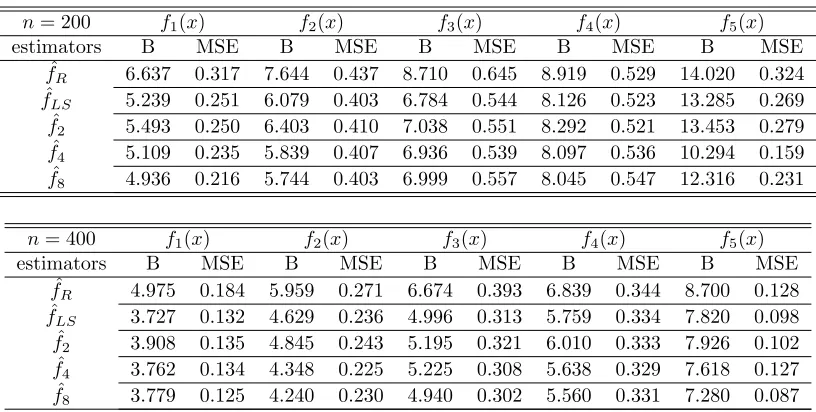
Table 1. Five estimators with optimal bandwidth (hn)
Average bias(×103)(B), Mean Squared Error(×103) (MSE)
n= 200 f1(x) f2(x) f3(x) f4(x) f5(x)
estimators B MSE B MSE B MSE B MSE B MSE ˆ
fR 6.637 0.317 7.644 0.437 8.710 0.645 8.919 0.529 14.020 0.324
ˆ
fLS 5.239 0.251 6.079 0.403 6.784 0.544 8.126 0.523 13.285 0.269
ˆ
f2 5.493 0.250 6.403 0.410 7.038 0.551 8.292 0.521 13.453 0.279
ˆ
f4 5.109 0.235 5.839 0.407 6.936 0.539 8.097 0.536 10.294 0.159
ˆ
f8 4.936 0.216 5.744 0.403 6.999 0.557 8.045 0.547 12.316 0.231
n= 400 f1(x) f2(x) f3(x) f4(x) f5(x)
estimators B MSE B MSE B MSE B MSE B MSE ˆ
fR 4.975 0.184 5.959 0.271 6.674 0.393 6.839 0.344 8.700 0.128
ˆ
fLS 3.727 0.132 4.629 0.236 4.996 0.313 5.759 0.334 7.820 0.098
ˆ
f2 3.908 0.135 4.845 0.243 5.195 0.321 6.010 0.333 7.926 0.102
ˆ
f4 3.762 0.134 4.348 0.225 5.225 0.308 5.638 0.329 7.618 0.127
ˆ
f8 3.779 0.125 4.240 0.230 4.940 0.302 5.560 0.331 7.280 0.087
In our second set of simulations we consider the performance of ˆf2(x), ˆfR(x) and ˆfLS(x) based on
data-driven bandwidths obtained from the minimization of a suitably defined cross-validation function. Thus, we
define
hCV ≡argminh
1 n2h
n
X
i=1
n
X
j=1
G∗G
X
i−Xj
h
−2 1
n(n−1)h
n
X
i=1
n
X
j=1,j6=i
G
X
i−Xj
h
where G∗G(u) = R G(u−t)G(t)du. For ˆf2(x), ˆfR(x) and ˆfLS(x), G(u) is respectively M2(u), K(u),
andW(u). Given thatK(u) is a Gaussian kernel we can easily obtain through Fourier transform methods
the convolutions W ∗W(u) = 1
2√2πexp −
1 4u
2 u4
64 − 7x2
16 + 27 16
and M2∗M2(u) = 9√162√2πexp −14u2− 8
9√5√2πexp −
1 10u
2+ 4
3√2πexp −
1 16u
2. Table 2 provides average absolute bias (B) and average mean
squared error (MSE) for each estimator and each density considered forn= 200 and 400.
Table 2. Three estimators with cross validation bandwidth (hCV)
Average bias(×103)(B), Mean Squared Error(×103)(MSE)
n= 200 f1(x) f2(x) f3(x) f4(x) f5(x)
estimators B MSE B MSE B MSE B MSE B MSE ˆ
fR 6.580 0.484 7.500 0.613 8.782 0.839 9.148 0.706 14.159 0.326
ˆ
fLS 5.214 0.693 6.188 1.308 6.918 0.977 8.932 1.861 15.276 0.360
ˆ
[image:19.612.101.510.646.714.2]n= 400 f1(x) f2(x) f3(x) f4(x) f5(x)
estimators B MSE B MSE B MSE B MSE B MSE ˆ
fR 4.788 0.272 5.867 0.348 6.437 0.486 6.914 2.049 8.546 0.128
ˆ
fLS 3.810 0.325 4.465 0.454 4.661 0.574 5.238 0.518 8.788 0.134
ˆ
f2 3.682 0.215 4.724 0.321 4.955 0.443 5.997 0.410 7.870 0.102
We first discuss the results in Table 1. We observe the following general regularities. First, as predicted
by our asymptotic results, for all densities considered the average absolute bias and average mean squared
error of our estimators ˆfk(x) for k = 2,4,8 fall as the sample size increases. Second, as suggested in
Theorem 6, increases in the values ofk reduce average absolute bias and MSE, but this is not verified for
all experiments. Specifically, when the sample size is small (n= 200) bias does not fall withkfor some of the
densities that are more difficult to estimate, i.e,f3andf5. Reductions in average mean squared error due to
increases ink are much less pronounced. Third, density functions with larger curvature (in increasing order
of curvaturef1,f2,f3,f4andf5) are more difficult to estimate both in terms of bias and mean squared error
for all estimators considered. Our proposed estimators ( ˆf2, ˆf4, ˆf8) and the local quadratic estimator ( ˆfLS)
outperform the Rosenblatt-Parzen estimator both in terms of bias and mean squared error. Fork= 2, the
case where the smallest bias reductions are attained, bias can be reduced by as much as 20 percent relative to
the Rosenblatt-Parzen estimator. Additionally, the magnitude of bias reduction produced by our estimator
increases with sample size. We observe that ˆf2, the estimator we propose that is more directly comparable to
the local quadratic estimator, and ˆfLS perform very similarly both in terms of bias and MSE. In summary,
all of the asymptotic characterizations provided in section 3 seem to accurately predict the behavior of our
estimators in reasonably small sample sizes.
In Table 2 we observe that the MSE of all estimators across all densities increases when the bandwidth is
selected by cross validation forn= 200 andn= 400. This is not surprising, as additional noise is introduced
in computing ˆfR, ˆfLS and ˆf2. Interestingly, there is not a significant change in bias between the results in
Table 1 and Table 2 for n= 200 or n = 400. As in Table 1 ˆf2 and ˆfLS outperform ˆfR in both bias and
MSE. It is worth noting that with estimated bandwidths ˆf2seems to outperform ˆfLSin terms of MSE for all
rather similarly, with the exception of the density f5, where our estimator outperforms ˆfLS. This might
be due to the fact that f5 satisfies an order two Lipschitz condition but does not have a continuous second
derivative. We note that the bias of ˆf2was smaller relative to that ˆfLS in the case forf5in Table 1, but the
difference was of smaller magnitude.
4.2
Example
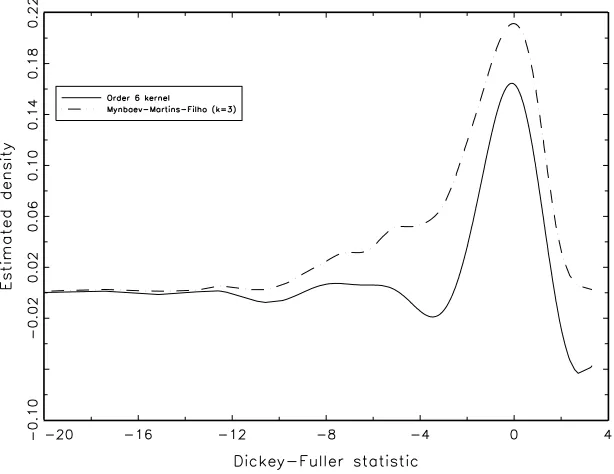
We apply our estimator with k = 3 based on a Gaussian seed kernel and a Rosenblatt-Parzen estimator
constructed with an order six kernel given byW(u) = 18 15−10u2+u4K(u) to a sample of 600 realizations
from a Dickey-Fuller statistic.4 Bandwidths for both density estimators are obtained via cross-validation
[image:21.612.152.459.341.578.2]and the estimated densities evaluated at the sample points are shown in Figure 1.
Figure 1: Estimated Dickey-Fuller density using order 6 kernel and ˆf3.
The figure shows that our estimator is everywhere positive but the higher order kernel estimator is
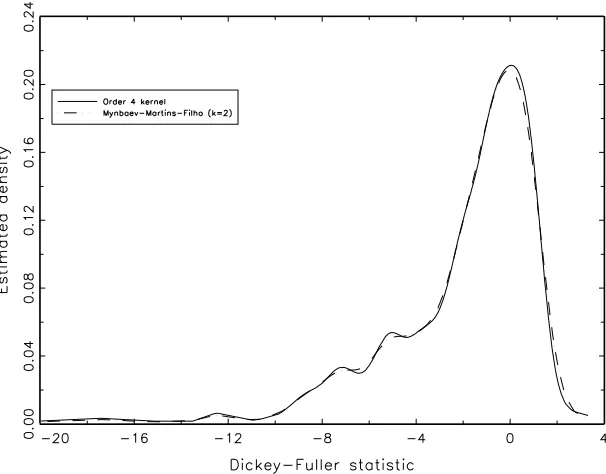
negative at a number of points in which it is evaluated. It is important to note that that when the same
sample of Dickey-Fuller statistics is treated with ˆf2 (k = 2) and ˆfLS (order four kernel) the estimated
4
densities are rather similar and ˆfLS is everywhere positive (see Figure 2).
Figure 2: Estimated Dickey-Fuller density using order 4 kernel and ˆf2.
5
Summary
In this paper we attain reduced bias for nonparametric kernel density estimation by defining a new kernel
based estimator that explores the theory of finite differences. The main characteristic of the proposed
estimator is that bias reduction may be achieved relative to the classical Rosenblatt-Parzen estimator without
the disadvantage of potential negativity (depending on the seed kernel) of the estimated density - a deficiency
that results from using higher order kernels to attain bias reduction. Contrary to other popular approaches
for bias reduction, e.g., Jones et al. (1995) and DiMarzio and Taylor (2004) we provide a full asymptotic
characterization of our estimator. A small Monte Carlo study reveals that our estimator performs well
relative to the Rosenblatt-Parzen estimator and the promised bias reduction is obtained in fairly small
samples. Future work should provide seed kernelsK that assure nonnegativity ofMk and are different from
References
[1] Besov, O., V. Il’in and S. Nikol’ski˘i, 1978, Integral representations of functions and imbedding theorems, Wiley, New York.
[2] Davidson, J., 1994, Stochastic limit theory, Oxford University Press, Oxford.
[3] Dickey, D. A. and W. Fuller, 1979, Distribution of the estimators for autoregressive time series with a unit root, Journal of the American Statistical Association 74, 427-431.
[4] DiMarzio, M. and C. C. Taylor, 2004, Boosting kernel density estimates: A bias reduction technique?, Biometrika 91, 226-233.
[5] Fan, J. and Q. Yao, 2003, Nonlinear time series: nonparametric and parametric methods, Springer-Verlag, New York.
[6] Fuller, W., 1976, Introduction to statistical time series, John Wiley and Sons, New York.
[7] Granovsky, B. and H. G. M¨uller, 1991, Optimizing kernel methods: A unifying variational principle, International Statistical Review 59, 373-388.
[8] Jones, M. C. and P. J. Foster, 1993, Generalized jackknifing and higher order kernels, Journal of Non-parametric Statistics 3, 81-94.
[9] Jones, M. C., O. Linton and J. P. Nielsen, 1995, A simple bias reduction method for density estimation, Biometrika 82, 327-338.
[10] Jones, M. C. and D. F. Signorini, 1997, A comparison of higher-order bias kernel density estimators, Journal of the American Statistical Association, 92, 1063-1073.
[11] Lejeune, M. and P. Sarda, 1992, Smooth estimators of distribution and density functions, Computational Statistics & Data Analysis, 14, 457-471.
[12] Marron, J. S. and M. P. Wand, 1992, Exact mean integrated squared error, Annals of Statistics 20, 712-736.
[13] Pagan, A. and A. Ullah, 1999, Nonparametric econometrics, Cambridge University Press, Cambridge.