Munich Personal RePEc Archive
A closed form solution to Stollery’s
global warming problem with
temperature in utility
Bazhanov, Andrei
Far Eastern National University, Queen’s University, Kingston,
Canada
29 April 2010
Online at
https://mpra.ub.uni-muenchen.de/22406/
A closed form solution to Stollery’s global warming
problem with temperature in utility
Andrei V. Bazhanov
aFar Eastern National University, Vladivostok, Russia
bDepartment of Mathematics and Statistics, Queen’s University, Kingston, ON, K7L 3N6,
Canada
Abstract
Stollery (1998) studied a polluting oil extracting economy governed by the
con-stant utility criterion. The pollution caused the growth of temperature,
nega-tively a¤ecting production and utility. Stollery provided a closed form solution
for the case with the Cobb-Douglas production function and temperature
a¤ect-ing only production. This paper o¤ers a closed form solution to a non-trivial
example of this economy with utility a¤ected by temperature.
Key words: essential nonrenewable resource; polluting economy; sustainable
development; special function representation
1. Introduction
A social planner in Stollery’s (1998) problem followed a constant utility
criterion where utility and production were negatively a¤ected by irreversible
global warming resulting from oil use. Stollery obtained the closed form
so-lutions, considering the case with temperature a¤ecting only production for
the extended Dasgupta-Heal-Solow-Stiglitz (DHSS) model (Dasgupta and Heal,
1974; Solow, 1974; Stiglitz, 1974) under the Hartwick investment rule (Hartwick,
1977).1 Stollery did not consider the case where temperature a¤ected utility,
noting that “exactly the same energy path results from temperature e¤ects in
a standard constant elasticity utility function” (Stollery, 1998, p. 734).
However, the case with utility a¤ected by global warming raises some
in-teresting and important questions since the negative e¤ect of temperature can
represent an aggregate damage resulting from economic activity. For example,
Bazhanov (2009b) analyzed a solution to this problem for an imperfect
econ-omy that has been extracting the resource for a period of time before considering
the goal of sustainable development in the form of the constant utility criterion.
This approach showed that the economy can be sustainable or unsustainable
de-pending on the parameters of the hazard function and on the technology and the
initial endowments of the economy. The result implied the necessity of a more
general notion of sustainability (semisustainability) that can provide an
oppor-tunity for an economy to decline asymptotically to a su¢cient survival level
instead of collapsing in …nite time after a period of overconsumption. A similar
problem arises in the cases when utility is positively a¤ected by the remaining
resource stock, e.g., when the stock has an amenity value (Krautkraemer, 1985;
Schubert and d’Autume, 2008).
In Bazhanov (2009b), the problem was studied numerically using a
di¤eren-tial equation for capital, which implied all other paths in the economy including
the path of the hazard function. The current paper provides the closed form
solution for a speci…c case in this economy. Unlike Bazhanov (2009b), where
the problem was formulated for an imperfect economy with the given state of
the oil extraction industry (the initial rate of extraction), this paper o¤ers a
conventionally speci…ed example for the given initial assets of capital and the
resource reserve. The uncertainty of policy recommendations in this case is
discussed using a numerical example, which resembles the current state of the
world’s oil extracting industry.
2. The model
Stollery provided a closed form solution to an oil-burning DHSS economy2
with the production function negatively a¤ected by growing temperature and
with an isoelastic utility that depended only on consumption. The current paper
considers the case with utility alone a¤ected by the hazard functionT:A social
planner chooses the path of per capita consumption c (by choosing a saving
rule) and the path of the per capita resource extractionr (by choosing a tax)
to maximize the constant over time level of per capita utilityu:
u(c; T) = cT 1 (1 )=(1 ) =u=const[c(t); r(t)]! max
c(t);r(t): (1)
The balance equation and the production function are
q(t) =c(t) + _k(t) =k (t)r (t); (2)
whereqandkare per capita output and capital; ; 2(0;1); + <1; > :3
The optimal investment rule is k_ := dk=dt = rqr = q; where qr := @q=@r:
Stollery assumed that technical change compensated for the e¤ect of growing
2The Cobb-Douglas production function, which is used in the DHSS model, has become one
of the most popular tools in Resource Economics both for theoretical studies (e.g., Dasgupta and Heal, 1979; Asheim, 2005, Hamilton and Withagen, 2007) and for practical applications, e.g., for the global climate change assessment (Nordhaus and Boyer, 2000).
3The share of labor in this problem is 1 :The Solow (1974) condition >
population, so there are no explicit technical advances in the model, and
popu-lation is constant.4 The hazardT grows with the resource extraction:
T(t) =T[r(t)] =T0
Z t
0
r( )d + 1
'
=T0[ (s0 s(t)) + 1]'; (3)
where ; ' > 0 are the parameters, s0 is the initial per capita oil stock, and
s= s(t) is the current oil stock, implyingr = s:_ Function T can vary from
constant to polynomial depending on the value of':5
The constant utility criterion requires the following paths of per capita
out-putq;consumptionc;and, di¤erentiatingq;the path of the growth rateq=q_ :
q(t) = q0f [s0 s(t)] + 1g'; (4)
c(t) = c0f [s0 s(t)] + 1g'; (5)
_
q(t)
q(t) =
' r(t)
[s0 s(t)] + 1: (6)
The rate of growth for' >0is positive, declining starting from
_
q(0)
q(0) =' r0; (7)
and approaching zero with t ! 1: The optimal initial consumption is c0 = (1 )q0; where q0 = k0r0; and the value of the initial rate of extraction
r0=r0(k0; s0; '; )is linked to the initial stocks and the intensity of the hazard
via the e¢ciency conditions0=R01r(t)dt:6
In contrast to the Solow-Hartwick case (' = 0), per capita output and
consumption grow here under the same Hartwick investment rule when' >0:
The growth is limited by
q1 = q0f s0+ 1g
'
and (8)
c1 = c0f s0+ 1g
'
(9)
4A plausible alternative to this assumption can be a TFP (Total Factor Productivity)
compensating for capital decay. In more details see Bazhanov (2009a).
5The speci…cations of utility and temperature functions are di¤erent here from the ones
considered by Stollery; in particular, Stollery related temperature to the remaining resource stock (T0
(s(t)) < 0); here temperature depends on the extracted (burned) resource stock (T0
(s0 s(t))>0). The other di¤erences are discussed in Bazhanov (2009b).
respectively. The limit for temperature growth is T1 = T0(s0 + 1)
'
: The
only source of output and consumption growth is a redistribution of the
re-source among generations. A social planner imposes a positive declining tax on
extraction, resulting in a lower rate of initial extraction (implying lowerc0and
q0) and a slower decline in the rates of extraction. Namely, from the speci…-cation of the production function, the equation for the rate of output growth
isq=q_ = k=k_ + r=r:_ Then, given k0_ = q0 and using (7), the initial rate of
change in the rate of extraction isr0=r0_ = [' r0 q0=k0]= or
_
r0 r0 =
r0h
' k0 1r 1 0
i
yielding the following condition:
_
r0R0 i¤ ' R
k01 r 1 0
: (10)
This condition, however, does not directly imply that a growing initial extraction
can be optimal in this problem becauser0 declines with the growth of ' :A
speci…c example of the optimalr0_ >0is provided in Section 4, condition (42).
The growth of output and the declining to zero ‡ow of the resource imply
an unbounded growth of capital in this problem.
The constant-utility criterion in the form of (1) seemingly implies that the
optimal initial values of q0 =c0=(1 ) and c0 should depend on the
prefer-ence parameter and the initial temperatureT0;namely,cT 1=ub=const=
[u(1 )]1=(1 ) yielding c0 =T0[u(1 )]1=(1 ): However, since is a con-stant here, the optimal policy in this framework maximizes ub and the
corre-sponding value of u(u;b ) regardless of the preference parameter. As to the
value ofT0 as a “preindustrial level” of temperature, the normalizationT0= 1
can be used assuming that the hazard does not a¤ect utility when the resource is
not being extracted. Hence, problem (1) is equivalent to the problem of …nding
b
u=const[c(t); r(t)] = max
c(t);r(t)c(t)T[r(t)] 1
(11)
For obtaining the optimality conditions, Stollery used the approach of Leonard
and Long (1992, pp. 300-304), which reformulates problem (11) into the
follow-ing equivalent problem:
maximize V(t)
Z 1
t b
u e d fort= 0 (V(0) =bu=const) (12)
for an arbitrary constant subject to (omitting the dependence on time)
_
k=q c; s_= r; andub=u(c; T): (13)
The Hamiltonian of this problem is
H =u eb t+ k(q c) sr: (14)
The utility constraint yields the Lagrangian to be maximized:
L=H+ (u bu):
In the general case, when both production and utility are a¤ected by the hazard,
the Pontryagin-type necessary conditions for the state variablesk andsare7
Lc= uc k = 0; (15)
Lr= kqr s= 0; (16)
_k =
@L
@k = kqk; (17)
_s=
@L
@s = ( kqT+ uT)Ts0 s @(s0 s)=@s; (18)
Z 1
0
Lbudt=
Z 1
0
e t dt= 1
Z 1
0
dt= 0: (19)
Eq. (18) with k from Eq. (15) results in
_s=Ts0 s uc qT +
uT
uc
: (20)
7Here
k and s are indexed dual variables unlike uc; qk;andqr;which are the partial
The time derivative of Eq. (16) is _s= _kqr+ kq_r;which, divided by qr and
combined with Eq. (20), gives
_
qr
qr k
+ _k =
Ts0 s uc
qr
qT +
uT
uc
:
Substitution for _k from Eq. (17) with k from Eq. (15) yields
_
qr
qr
=qk+
Ts0 s
qr
qT +
uT
uc
; (21)
which is the Hotelling rule with the negative additional term (t) :=Ts0 s(qT +uT=uc)=qr
resulting from the e¤ects of the externality. The fact that (t)6= 0in the pres-ence of the hazard factor (' > 0) implies that the optimal paths in this
problem can only be asymptotically e¢cient because the standard Hotelling
rule ( = 0) as a necessary e¢ciency condition8 is satis…ed only with t ! 1
due to exhaustion of the resource.
Stollery obtained the optimality of the Hartwick rule from the
Hamilton-Jacobi-Bellman equation9 for the problem (12), (13) instead of using necessary
conditions (15) – (19). Namely, the Hamilton-Jacobi-Bellman equation
estab-lishes the following link between the maximized Hamiltonian and value function:
@V =@t=H : (22)
An autonomous in…nite-horizon problem such as (12), (13) has the property:
V(t) =V(0)e t:10 Then @V =@t=V(0) e t=bu e tand H =bu e t+
Vkk_+Vss_ ( k and s are the shadow prices of capital and the resource stock)
yielding kk_+ ss_= 0, which means that the investment kk_ must be equal to
the resource rent srunder optimal prices (Hartwick, 1977).
In this framework, the equations for the optimal paths in the economy can
be derived from
a) the conditioncT 1=bu=const;
b) the Hartwick rule, which provides the maximum level ofu;b
8See, e.g., Dasgupta and Heal (1979).
c) the balance equation (2) specifying the production function, and
d) the Hotelling rule (21), which gives the optimal tax on extraction.
3. Optimal paths
The optimal path of output (4) can be written asq(t) =q0h R0tr( )d + 1i
'
:
Raising to the power1='yieldsq1='=q1='
0
h Rt
0r( )d + 1
i
(restriction'6= 0
will be lifted below). Time derivative, substituting for r = q1= k = ; is
q1=' 1q='_ =q1=' 0 r=q
1='
0 q1= k = :This equation with the optimal saving
rule gives a system of the two di¤erential equations inqandk:
q1=' 1 1= dq=dt = 'q10=' k = ;
dk=dt = q:
Following Schubert and d’Autume (2008), the system can be solved by
elimi-nating time (dt=dk=( q)): q1=' 1= dq=A1k = dk;whereA1='q1='
0 = >
0: Integration gives q1+1=' 1= =(1 + 1=' 1= ) = A1k1 = =(1 = ) +C1
or qa =A2k1 = +C2;where a= 1 + 1=' 1= = ['( 1) + ]=(' )and
A2 = aA1=(1 = ): Note that a R 0 and A2 Q 0 when ' Q =(1 ):
Calibration at t = 0 gives C2 = qa
0(1 B1k 1 =
0 ); where B1 = A2q
a
0 = q01= 1 ['(1= 1) 1]=( )(B1R0 whenA2R0). Then
q=q0 B1k ( = 1)+C3 b; (23)
where C3 = 1 B1k10 = and b = 1=a =' =['( 1) + ]: Henceforth, the
restriction'6= 0 is not relevant; the case with'! =(1 ) causingb! 1
is considered below.
Eq. (23) shows that q(t) ! q = q0Cb
3; and the saving rule implies that c(t)!c =q0(1 )Cb
3 ask(t)! 1witht! 1:The obtained expression for qcombined with the optimal saving rule gives a di¤erential equation in capital,
and then the dynamics of the economy is de…ned by the following system:
_
k = k0_ B1k ( = 1)+C3
b
; (24)
wherek0_ = _k(0) = q0:
The case with'= 0impliesb= 0;yielding linear capitalk(t) = q0t+k0;
which coincides with the Solow-Hartwick case and with Stollery’s solution for
= 0:The extraction in this case isr(t) =r0(r1t+ 1) = ;wherer1= q0=k0:
For the case with'! =(1 );implyinga!0orb! 1;Eq. (24) can be rewritten as follows: k_ = _k0Cb
3 1 +k ( = 1)B1=C3
b
ork_ = _k0Cb
3 1 k ( = 1)aB5 1=a
;
where B5 := q0aA1=h( 1)C3i: Note that C3 ! 1 when a !0; but Cb
3 =
(1 +aB6k0( = 1))1=a; where B6 := q a
0 A1=( 1) > 0; so lima!0 C3b =
exphB6k0( = 1)
i
andlima!0B5=B6:Then, Eq. (24) takes the form
_
k= _k0eB6k0( = 1)e B6k ( = 1): (26)
Eq. (24) is integrable in quadratures:
Z k(t)
k0
d{
B1{ ( = 1)+C3
b = _k0t+Const; (27)
however, in the general case, k(t) obtained from this equation cannot be
ex-pressed in elementary functions.11 The following section provides a nontrivial
('6= 0) example with the closed form solution to Eq. (24).
A di¤erential equation for the tax on extraction (t)can be obtained from
Eq. (21) using the fact that the resource price with no imperfectionsqr
should satisfy the standard Hotelling rule ( 0):
d(qr )=dt
qr
=qk:
1 1The LHS of Eq. (27) can be expressed using special functions. For
ex-ample, in the case with a = 0; this equation takes the form of a nonlin-ear equation in k : z(k) = k_0exp(B6k0( = 1))t + Const; where z(k) =
D1(k) B6k =(1 + ) + 1 W hittakerM(D2; D3; B6k ) + (1 + ) W hittakerM D2+ 1; D3; B6k ;
with := 1 = ; D1(k) := B6(1+3 )=(2 )k(1 3 )=2exp B6k =2 =(1 + 2 );
D2 := (2 )=(2 ); D3 := (1 + 2 )=(2 ): Here W hittakerM( ) is the Whittaker M
special function, which is available, e.g., in Maple or Mathematica software. Whena= 0
and = 2 ;the LHS of Eq. (27) isz(k) =kexp( B6=k) Ei(1; B6=k);whereEi( )is the
This equation gives the dynamic condition for the tax depending on the path
of the Hotelling rule modi…er (t) :
_ qk qr= 0: (28)
Eq. (28) has a solution12
(t) = 0(k(t)=k0) = qr(t) h
(q(t)=q0)1= 1 1i; (29)
where 0= (0)is the initial condition.
The value of 0 can be expressed from the formula for the initial resource
price with no imperfections: qr(0) (0) = q00=r00; where q00 =k0 r00 and
r0
0 satis…es Eq. (32). Namely,
0=
n
k0r 1
0 k0=[s0( )]
o
: (30)
In the case with = 0;there is no tax sincer0=r0
0:Eq. (30) yields the optimal
initial tax that is required to obtain the optimal initial rate of extraction r0;
de…ned in the conventional approach from the e¢ciency condition givenk0; s0; ';
and . Eq. (30) can be inverted to show the link between the value of 0 and
the resulting value ofr0:r0 1= [ 0s0( ) + k0]=[ k0s0( )]or
r0= ( )s0=k
1 0
1 + ( )s0 0=( k0)
1 1
; (31)
which coincides with ther0
0 in the Solow-Hartwick case ( 0= 0)
r00= ( )s0=k01
1
1 (32)
and monotonically declines to zero with 0! 1:
4. An example of a closed form solution
Let '= and = 2 : Then b =a = 1; A2 = aA1=(1 = ) = A1 =
q10= <0; B1=A2q0a = q 1= 1
0 <0; andC3= 1 + k01 r 1
0 >0: In
this case, Eq. (24) becomes
_
k= B4
k +C4; (33)
whereB4 := _k0B1<0 andC4:= _k0C3 >0: Eq. (33) in quadratures, denoting
D0:=B4=C4=B1=C3<0;is
Z
k
k+D0dk=C4t+C;b
whereCb is the constant of integration. Integration of the LHS yields
k D0ln (k+D0) =C4t+C:b (34)
After denoting x:= ln (k+D0); the last equation becomes ex D0(x+ 1) =
C4t+Cb or ex=D0(x p);where p:= C4t=D0 1 C=D0:b Multiplication
of both sides by e x+p=D0 results in the equation ep=D0 =e(p x)(p x);
which, by the de…nition of the Lambert W function,13 has the solution
p x=W( ep=D0):
Then,k+D0 = exp [p W( ep=D0)] = D0[ ep=D0]e W( ep=D0): The
def-inition of the Lambert W function implies thatW(z) =ze W(z); transforming the last equation as follows: k+D0= D0W( ep=D0)or
k(t) = D0
8 <
:1 +W
0
@ e
C4 D0t 1
b C D0
D0
1 A
9 =
;; (35)
where C;b de…ned from Eq. (34) at t = 0; is Cb = k0 D0ln (k0+D0): After
substitution forCbinto Eq. (35), it becomes
k(t) =D0 1 W e DC40t e k0
D0 1 k0
D0 1 ; (36)
which must be equal to k0 at t = 0: Indeed, by the de…nition, W[ezz] = z;
therefore, the RHS of Eq. (36) at t = 0 equals D0n 1 h k0 D0 1
io = k0:
Since C4=D0 < 0; D0 < 0; and W is monotonically growing function with
1 3Lambert W function is the solution to the equationyey = z;namely, y =W(z):The
derivative (forz6= 1=e) ofW is dW=dz=W(z)=[z(1 +W(z))];and the antiderivative of
limz!1W(z) = 1; capital is growing with no limit along a path that grows
faster than a linear function (Fig. 6). Formula (36) can be considered as a
closed form solution fork(t)(using an alternative de…nition of this notion) since
functionW is uniquely de…ned fork0>0;14 and numerical implementations of
this function are available in major computational software.
Substitution fork(t)into Eq. (24) gives the closed form path of investments,
which, using the optimal saving rulek_ = q; implies the paths of output,
con-sumption, and extraction:
q(t) = q0
(
B1
D0 1 W e
C4 D0t e
k0
D0 1 k0
D0 1 1
+C3
)
;(37)
c(t) = c0
(
B1
D0 1 W e
C4 D0t e
k0
D0 1 k0
D0 1 1
+C3
)
;(38)
r(t) = q(t)1= k(t) = ; (39)
wherec0 = (1 )q0:On the other hand, the constant utility criterion implies
thatc(t) =c0[ (s0 s(t)) + 1]';yielding (for'= ) the equation for the path
of the current reserve:
s(t) =s0 1 nB1k(t) 1+C3o1= 1 :
In the limit, this formula becomes s1 = limt!1s(t) =s0 1 C
1=
3 1 = s0 1 + k10 r
1 0
1=
1 = :Then, the e¢ciency conditions0=R01rdt
results in the following relationship betweenk0; s0; andr0:
r0=nh(s0 + 1) 1i= k10
o1=(1 )
: (40)
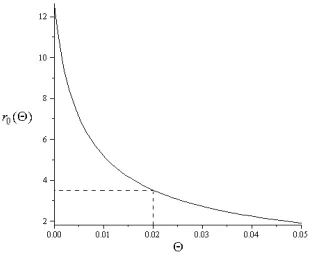
Note thatr0is a decreasing function of in this case (Fig. 1), which means
that the greater the intensity of the hazard the larger the amount of the resource
1 4Function W(z) is uniquely de…ned for z > 1=e implying that k
0 should
sat-isfy the condition e
C4 D0t e
k0
D0 1 k0
D0 1 > 1=e for any t > 0: This
in-equality holds when k0
D0 1 > 0 or k0 > D0 ( D0 is a positive number here:
D0 = B1=C3 =k0= r
1 0 =
h
1 + k01 r10 i). Then, after dividing both sides by
k0= 1 + k10 r
1
0 ;the condition of the uniqueness of the representation via the Lambert
that should be left for the future in order to o¤set the hazard with the growth
of consumption according to the criterion. At the same time, reallocation of the
resource to the future ‡attens the path of temperature until the rates of growth
of temperature and consumption completely compensate for each other.
The initial tax on extraction should be higher (Fig. 2) for a larger ; and the initial level of consumption should be lower as a result of a lowerr0. Letting
!0and using the L’Hôpital’s rule, condition (40) becomes
r00= lim!
0r0= s0=k 1 0
1
1 (41)
coinciding with the expression (32) in the Solow-Hartwick case for = 2 :
Formula (40) speci…es condition (10) of the optimality of the growing
ini-tial extraction depending on the hazard factors. Namely, the second
inequal-ity of this condition becomes R k10 =
n
k10
h
(s0 + 1) 1io or 1 R
=h(s0 + 1) 1i;yielding
_
r0R0 i¤ R (1 + )1= 1
s0 : (42)
According to this condition, the optimal pattern of extraction can be
hump-shaped even in the case with a small intensity of the hazard when the initial
reserves0is large. An example of the optimal hump-shaped extraction path is
provided in the next section (Fig. 4, solid line).
Formula (30) for = 2 becomes
0= k0r 1
0 k0=s0: (43)
The explicit dependence of the initial tax on the hazard parameter results
from combining Eqs. (40) and (43):
0( ) =
k0
(s0 + 1) 1
k0
s0: (44)
Expressed in the terms of the resource price, the initial tax is 0( )=qr(0) =
1 k01 = s0 r0( ) 1 or
0( )=qr(0) = 1
(s0 + 1) 1
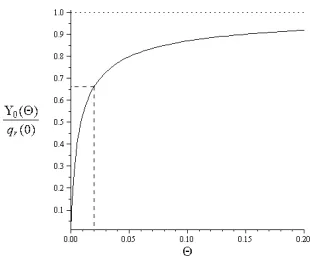
This equation shows (using the L’Hôpital’s rule) that 0( )=qr(0)
asymptoti-cally approaches unity with ! 1starting from zero when = 0(Fig. 2). It can be easily shown that the asymptotes15 forq(t)andc(t)given by Eqs.
(37) and (38) coincide withq1andc1given by formulas (8) and (9) for'= .
For example, q1 =q0C3 =q0 1 + k01 r01 ; which after substitution for
r0 from formula (40) yields formula (8) with'= :
Given Eq. (29) and the other paths (36) – (39), the path of the tax in terms
of the resource price =qris =qr= 0k = = k0= k r 1 (q=q0)1= 1+1;
which can be rewritten as follows:
(t)
qr(t)
=q(t)1= 1 "
0 k0=
1
q01= 1
#
+ 1: (45)
The boundedness of output in this problem implies the value of the asymptote
for =qr;using Eqs. (8) and (43):
1
qr1
= q11= 1
"
0 k0=
1
q10= 1
# + 1
= 0q
1= 1
0 (s0 + 1) 1
k0= (s0 + 1) 1 + 1 = r 1 0 q 1=
0 (s0 + 1) 1
q01= 1(s0 + 1) 1
k0=s0 k0=
(s0 + 1)1 + 1
= 1 k
1 =
0 s0 q
1= 1
0 (s0 + 1) 1
= 1 k
1 0
s0 r 1
0 (s0 + 1) 1
;
which after substitution forr0 from Eq. (40) becomes
1
qr1
= 1 1
s0
h
(s0 + 1) (s0 + 1)1 i: (46)
Using the properties of the Lambert W function, it can be shown that for
any parameters of the problem the tax becomes negative in the long run when
>0:Namely, from Eq. (46), the condition that 1=qr1<0 fors0 >0 is
(s0 + 1) (s0 + 1)1 > s0 : The substitutionsp:=s0 + 1and v:=
1 + 1=(p 1) (or =v+ 1 + 1=(p 1)) transform this condition into the
1 5The asymptotes follows from the fact thatlim
Figure 1: The dependence of the initial rate of extractionr0 on the hazard factor :
following form:16 p vp 1=(p 1)< v(p 1);which can be rewritten as
vpv< p 1=(p 1)
p 1 or e
vlnpvlnp < p 1=(p 1)
p 1 lnp:
The de…nition of the Lambert W function yields
vlnp < W( p
1=(p 1)
p 1 lnp) or v <
W( p 1=(pp 11)lnp)
lnp :
The last inequality in the original variables is
<1 + W h
(s0 +1) 1=s0
s0 ln (s0 + 1) i
ln (s0 + 1) +
1
s0 : (47)
SinceW(zez) =z(denotingz:= 1
s0 ln (s0 + 1)), the numerator of the …rst
fraction in (47) is
W 1
s0 ln (s0 + 1) (s0 + 1)
1=s0 = 1
s0 ln (s0 + 1);
and then condition (47) becomes < 1;which is always true in this problem.
Hence, if >0;there existst >0 such that (t)<0 for anyt>tand for any
values of the parameters in this problem (see, e.g., Fig. 3).
1 6The same inequality can be obtained from Eq. (45) as a condition of the existence of the
Figure 2: The dependence of the initial tax in terms of the initial resource price 0( )=qr(0)
on the hazard factor :
5. Numerical example
Let the shares of capital and the resource are = 0:3 17 and = 0:15;the
hazard function parameters: '= ; = 0:02; T0 = 1;the initial stocks of the
economy: s0 = 371bln t,k0= 14:35:18 Formula (40) yields the optimal initial
rate of extractionr0 = 3:524 bln t/year (cf. r0 = 12:61 bln t/year for = 0;
Fig. 1). This reduced initial extraction results from the tax 0= 0:0756(or in
the terms of the resource price 0=qr(0) = 0:66) applied att= 0and estimated by formula (44).
The externality causes the following deviation from the standard Hotelling
rule att= 0 : (0) =Ts0 s(0)uT(0)=(uc(0)qr(0)) =T0' ( c0=T
2
0)= k0r 1 0 =T0 =
(1 )k0r0 = k0r 1
0 = (1 ) r0 or (0) = 0:0599: Eq. (28) yields
1 7See, e.g., Nordhaus and Boyer (2000).
1 8To make the example more illustrative, these initial values imply the rate of extractionr
0
that is close to the current world oil rate of extraction givens0as the world oil reserve estimate.
Namely, the world rate of crude oil extraction on January 1, 2010 is 70502.6 [1000 b/day]/7.3 [b/t] 365 10 6 = 3.525 [bln t/year] (World Oil, 2009). CERA (2006) claimed that
actual world oil reserve in 2006 was three times larger (about 512 bln t) than the conventional estimate. I take heres0 = 2 185:5 = 371[bln t] = 2 1,354,182,395 [1000 b]/7.3 [b/t]
10 6;where 185.5 [bln t] is the conventional estimate (World Oil, 2009). One ton of crude oil
Figure 3: The path of the tax in terms of the resource price (t)=qr(t):In the Solow-Hartwick case the tax is zero.
_ (0) = 0qk(0)+ (0)qr(0):The initial values of marginal productivitiesqk(0) =
k0 1r0 = 0:056 andqr(0) = k0r 1
0 = 0:11 result in _ (0) = 0:0026
show-ing that the tax is declinshow-ing att= 0:
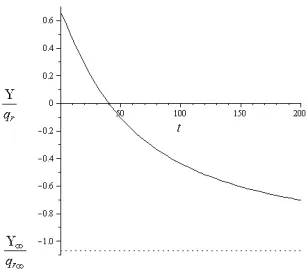
The path of the tax in terms of the resource price (45) is depicted in Fig. 3.
The tax becomes negative after 40 years and approaches the negative asymptote
1=qr1= 1:07:
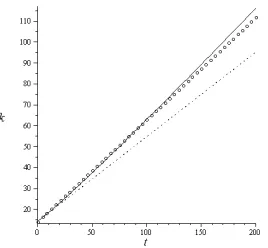
Capital for = 0:02(Fig. 6, solid line) grows faster than a linear function.19
Linear capital in the Solow-Hartwick case (Fig. 6, circles) has a steeper slope
(k_0
0 = 0:488) due to the higher rate of extraction att= 0:The optimal paths of
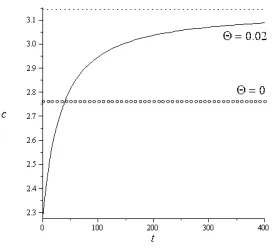
per capita consumption for the cases with = 0:02and = 0are in Fig. 7.
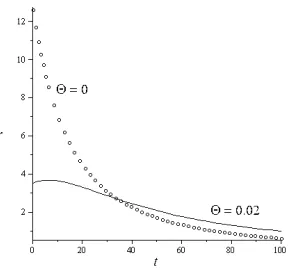
The tax imposed by the planner for = 0:02 results in a hump-shaped
optimal path of extraction (Fig. 4, solid line). The path in circles in Fig. 4
corresponds to the case with = 0(Solow-Hartwick case, no tax). Note that,
in the conventional approach,20 a relatively small uncertainty in the hazard
parameter leads to a large uncertainty in the short-run resource policy (Figs.
2 – 5). The model shows that if the planner is unaware of the externality
1 9This linear functionk
0+ _k0twithk0andk_0= 0:403for = 0:02is depicted as a dotted
line in Fig. 6
2 0I mean here the approach wherer
Figure 4: The optimal paths of extraction: for = 0:02- solid line, for = 0(Solow-Hartwick case) - circles.
or is going to neglect its e¤ect and implement an economic program with the
maximum constant per capita consumption over time, she should apply the
policies that will result in the current rate of extractionr0= 12:61bln t/year, which is 3.6 higher than in the case with = 0:02:
The uncertainty of the conventional approach in de…ning r0 with respect
to the imprecision of the reserve estimate s0 is illustrated in Figs. 5a and 5b,
where s1
0 is a conventional world oil reserve estimate (World Oil, 2009), s30 is
the estimate of CERA (2006), and s2
0 = 2 s10 is the estimate that is used
in this example ass0 and is somewhere betweens1
0 and s30: Note that a small
hazard factor (Fig. 5b) results in higher uncertainty than the large one since,
for the larger values of ; the initial rate of extraction should be essentially
lower, reducing the uncertainty of this value.
For a small extracting …rm that has just discovered or obtained an oil …eld
at an auction, an approach that provides the initial rate of extraction as a policy
recommendation could be possible when the oil-extracting capital is available
in required quantities and the elasticity of the demand for the resource is high.
However, for a large incumbent …rm that has been extracting the resource for
a period of time and is going to reestimate the optimal path, this approach can
Figure 5: The dependence of the initial rate of extractionr0 [bln t/year] on the reserve s0
for di¤erent values of the hazard factors :(a) = 0:02;(b) = 0; s1
0= 185:5bln t – the
current world oil reserve according to World Oil (2009);s2
0= 2 185:5bln t;s30= 512:3bln
t – CERA (2006) world oil reserve estimate.
to uncertainties.
For example, if the extraction was started under the constant consumption
criterion ( = 0) and with the initial reserve estimate s0=s1
0; the initial rate
of extraction would be r1
0 = 5:58 bln t/year (Fig. 5b). The announcement
similar to CERA (2006) about the larger actual reserve s0 = s3
0 would cause
the immediate jump in the rate of extraction up to the new value r3
0 = 18:44
bln t/year as a result of the reestimation of the optimal path using the same
approach. Then, if the social planner takes into account information about the
hazards of the extraction of the resource and decides to follow the constant
utility path with = 0:02;the imposed tax should instantly cut down the rate of extraction to the new initial valuebr3
0= 4:2bln t/year (Fig. 5a).
The e¤ect of deviation of the optimal path from the initially estimated path
recalculated at a later date is called “dynamic inconsistency” in the literature.21
In this case, inconsistency takes the form of considerable discontinuous jumps in
2 1For example, Newbery (1981) considered various reasons for dynamic inconsistency in oil
Figure 6: The optimal paths of capital: for = 0:02- solid line, the linear path for = 0
(Solow-Hartwick case) - circles, the pathk0+ _k0twithk0 andk_0 for = 0:02- dotted line.
resource policies that can lead to socioeconomic and environmental damage;22
some of these jumps can be unrealizable in practice.
Hence, the approaches that result in the paths that are discontinuous with
respect to the initial state of economy could be appropriate only for small …rms
entering the market or for theoretical studies where the questions of the
tran-sition to an optimal state are not important (Bazhanov, 2010). In many cases,
reestimation of the optimal path requires a solution that is linked to the
ini-tial conditions, including the iniini-tial state of the extracting industry (Bazhanov,
2009a, Section 9; Bazhanov, 2009b).23
6. Concluding remarks
This paper has o¤ered an example of the closed form solution for the problem
of irreversible global warming under the constant utility criterion (Stollery, 1998)
with utility negatively a¤ected by the hazard factor. The solution was expressed
via the Lambert W special function, which has convenient analytical properties
2 2One can recall the consequences of the oil embargo in 1973.
2 3Pezzey (2004, formula (15), p. 477) o¤ered an example of solving the problem of
Figure 7: The optimal paths of per capita consumption: for = 0:02- solid line with the asymptote (dotted line), the constant path for = 0(Solow-Hartwick case) - circles.
for any parameters in this problem. For example, using the properties of this
function, it was shown that the declining tax in this problem becomes negative
in the long run.
The main qualitative distinctions of this problem from the Solow-Hartwick
case with no hazard are:
(a) output and consumption are growing and asymptotically approaching
positive constants;
(b) the initial rate of the resource extraction is lower, implying (for the same
initial capital) lower levels of initial output and consumption;
(c) the economy is e¢cient only asymptotically with exhaustion of the
pol-luting resource;
(d) the optimal path of the resource extraction can be hump-shaped;
(e) capital is growing faster than a linear function.
The example has shown that the initial rate of extraction and the initial
tax, provided in the conventional approach as policy recommendations, can be
signi…cantly uncertain due to the uncertainties in the initial reserve and in the
intensity of the hazard. The uncertainty is considerably higher in the case of
References
[1] Asheim G. B. 2005. Intergenerational ethics under resource constraints.
Swiss Journal of Economics and Statistics. 141(3), 313–330.
[2] Bazhanov A.V. 2009a. Maximin-optimal sustainable growth in a
resource-based imperfect economy. MPRA Paper No. 19258.
[3] Bazhanov A.V. 2009b. A constant-utility criterion linked to an imperfect
economy a¤ected by irreversible global warming. EERI Research Paper
Series No 03/2009
[4] Bazhanov A.V. 2010. Sustainable growth: Compatibility between a
plausi-ble growth criterion and the initial state. Resources Policy 35(2), in press,
doi:10.1016/j.resourpol.2010.01.002
[5] CERA 2006. Peak oil theory – “world running out of oil soon” – is
faulty; could distort policy & energy debate. Cambridge Energy Research
Associates, Inc. (November 14, 2006). Accessed on March 17, 2010 at
<http://www.cera.com/aspx/cda/public1/news/pressReleases/pressReleaseDetails.aspx?CID=8444>
[6] Corless R. M., Gonnet G. H., Hare D. E. G., Je¤rey D. J., Knuth D. E. 1996.
On the Lambert W function. Advances in Computational Mathematics
5(1): 329–359. Accessed on March 17, 2010 at
http://www.apmaths.uwo.ca/~rcorless/frames/PAPERS/LambertW/LambertW.ps.
[7] Dasgupta P., Heal G. 1974. The optimal depletion of exhaustible resources.
Review of Economic Studies 41, 3–28.
[8] Dasgupta P., Heal G. 1979. Economic Theory and Exhaustible Resources.
Cambridge University Press, Cambridge, England.
[9] D’Autume A., Schubert K. 2008. Hartwick’s rule and maximin paths when
the exhaustible resource has an amenity value. Journal of Environmental
[10] Hamilton K., Withagen C. 2007. Savings growth and the path of utility.
Canadian Journal of Economics 40(2): 703–713.
[11] Hartwick J.M. 1977. Intergenerational equity and the investing of rents
from exhaustible resources. American Economic Review 67, 972–974.
[12] Krautkraemer J.A. 1985. Optimal growth, resource amenities and the
preservation of natural environments. Review of Economic Studies 52, 153–
170.
[13] Leonard D., Long N.V. 1992. Optimal control theory and static
optimiza-tion in economics. Cambridge University Press, NY.
[14] Newbery D.M.G. 1981. Oil prices, cartels, and the problem of dynamic
inconsistency. Economic Journal 91(363), 617–646.
[15] Nordhaus W.D., Boyer J. 2000. Warming the World: Economic Models of
Global Warming. MIT Press, Cambridge.
[16] Pezzey J.C.V. 2004. Exact measures of income in a hyperbolic economy.
Environment and Development Economics 9, 473–484.
[17] Solow R.M. 1974. Intergenerational equity and exhaustible resources.
Re-view of Economic Studies 41, 29–45.
[18] Stiglitz J. 1974. Growth with exhaustible natural resources: E¢cient and
optimal growth paths. Review of Economic Studies 41, 123–137.
[19] Stollery K.R. 1998. Constant utility paths and irreversible global warming.
Canadian Journal of Economics 31(3), 730–742.
[20] World Oil 2009. Worldwide look at reserves and production. Oil and Gas
![Figure 5: The dependence of the initial rate of extraction rcurrent world oil reserve according to World Oil (2009);0 [bln t/year] on the reserve s0for di¤erent values of the hazard factors � : (a) � = 0:02; (b) � = 0; s10 = 185:5 bln t – the s20 = 2 � 185:5 bln t; s30 = 512:3 blnt – CERA (2006) world oil reserve estimate.](https://thumb-us.123doks.com/thumbv2/123dok_us/7868778.738196/20.612.134.482.125.280/figure-dependence-initial-extraction-rcurrent-according-reserve-estimate.webp)