.'«rørøjw-"'.if.Rfí
m"
.rPí3j' ·w
HkJüi
I*-if·' i*W
:mm
lul"'
HW·!-: »■HÄÄ··»·?; iltfiKJiJÉ
ία> v.«
wflfwj
■Fp*»r*iL"1.
EUROPEAN ATOMIC ENERGY COMMUNITY EURATOM
m
mi
"¡Mi: j . * f . v - , i
'?:
m
m
I
:uit
it; ¡S
täMääitfld
'ί·**5»ίMlM
*»»$j$
i
EU«
REACTIVITY EFFECTS DUE TO VAI
IN NUCLEAR
P A R A M E T E R e | | | Ì
A THERMAL POWEJIIEACTO] '
MM
ïww
Kf
/jîiaft
äBBSS
wi
■«•Μ■m
"'Vm>i'M
¡vi.:
W«í
3»
tf¡l?H
1963
iti
I I M iiliiij!
ιΛϊ»4ί
a»
f$
iti
Wtf
Ispra Establishment - Italy
Reactor Physics Department
Applied Physics and Mathematics
\*·*Λ
m
I'M
SB
m
tii"i«!Hw'!!
treur r > « t ι
i*tf
WSiK
i
ii
m
æ
:m
LKíiSi
LÜSÜ
«ml
L E G A L N O T I C E
i.iiiSiHíffalüü
i>*'S
tm
ìiFl This document was prepared under the sponsorship of the Commission of
t h e E u r o p e a n Atomic E n e r g y Community ( E U R A T O M ) .
«rcjrr
Ll.Vf ,J
l«Wj
on
Neither t h e E U R A T O M Commission, its contractors nor any person a d
1" — Make any w a r r a n t y or representation, express or implied, with respect to the
accuracy, completeness, o r usefulness of t h e information contained in t h i s
document, or t h a t t h e use of a n y information, a p p a r a t u s , method, or process
disclosed in t h i s document m a y not infringe privately owned r i g h t s ; o r
Assume a n y liability with respect t o t h e use of, or for damages resulting from
t h e use of a n y information, a p p a r a t u s , method or process disclosed in t h i s docu
»■»»«IH
m
m
ment.
f l
Mn
må
Hh'ffiHÍU
m
itø
Çí^naM}
«•fei
tøp
elisici
mm
• Il
SíiF r!t':M."
Κ
it
U f f
T h i s r e p o r t c a n be obtained, a t t h e price of Belgian F r a n c s 40, from : P R E S S E S A C A D E M I Q U E S E U R O P E E N N E S — 98, Chaussée de Charleroi, B r u s s e l s 6. P l e a s e r e m i t p a y m e n t s :
— t o B A N Q U E D E L A S O C I E T E G E N E R A L E ( A g e n c e M a C a m p a g n e ) — B r u s s e l s — a c c o u n t No 964.558,
— to B E L G I A N A M E R I C A N B A N K A N D T R U S T C O M P A N Y — N e w Y o r k — account No 121.86, — t o L L O Y D S B A N K ( F o r e i g n ) L t d . — 10 M o o r g a t e —
London E.C.2,
ani'fijfHrf
'kM'-Sti!,'
g i v i n g t h e reference : « E U R 2 8 1 . e — R e a c t i v i t y effects due t o v a r i a t i o n s in n u c l e a r p a r a m e t e r s in a t h e r m a l power r e a c t o r ».
ι*« ;'!
!82
1
Wii
l i l
«•ii
rø>
Ι'Γΐΐΐ ibiRWtt
Wmt
by IMPRIMEI
M
Printed by IMPRIMEE; Brussels, April 1963.il
•ti*·EUR
2 8 1 . e
REACTIVITY EFFECTS DUE TO VARIATIONS IN NUCLEAR PARAMETERS IN A THERMAL POWER REACTOR
by G. CASINI and M. PAILLON
European Atomic Energy Community — EURATOM Joint Nuclear Research Center
Ispra Establishment (Italy)
Reactor Physics Department — Applied Physics and Mathematics Brussels, April 1963 — pages 27 + 7 figures
The influence on the neutron balance of small variations of some nuclear parameters in a natural uranium power reactor has been investigated.
The most important nuclear cross-section influences have been found to be due to U.^ and Pu:M fuel isotopes. In particular, a
variation of 1 % in the fission cross-section of Pu^,, gives a variation of about 0.6 % on the reactivity for an ORGEL type reactor. An improvement of the up-to-date experimental techniques to measure these cross-sections is therefore desirable.
EUR
2 8 1 . e
REACTIVITY EFFECTS DUE TO VARIATIONS IN NUCLEAR PARAMETERS IN A THERMAL POWER REACTOR
by G. CASINI and M. PAILLON
European Atomic Energy Community — EURATOM Joint Nuclear Research Center
Ispra Establishment (Italy)
Reactor Physics Department — Applied Physics and Mathematics Brussels, April 1963 — pages 27 + 7 figures
The influence on the neutron balance of small variations of some nuclear parameters in a natural uranium power reactor has been investigated.
The most important nuclear cross-section influences have been found to be due to U!M and Pu.OT fuel isotopes. In particular, a
variation of 1 % in the fission cross-section of Pu239 gives a variation
of about 0.6 % on the reactivity for an ORGEL type reactor. An improvement of the up-to-date experimental techniques to measure these cross-sections is therefore desirable.
EUR
2 8 1 . e
REACTIVITY EFFECTS DUE TO VARIATIONS IN NUCLEAR PARAMETERS IN A THERMAL POWER REACTOR
by G. CASINI and M. PAILLON
European Atomic Energy Community — EURATOM Joint Nuclear Research Center
Ispra Establishment (Italy)
Reactor Physics Department — Applied Physics and Mathematics Brussels, April 1963 — pages 27 + 7 figures
The influence on the neutron balance of small variations of some nuclear parameters in a natural uranium power reactor has been investigated.
The most important nuclear cross-section influences have been found to be due to U2r¡ and Pu:=„ fuel isotopes. In particular, a
variation of 1 % in the fission cross-section of Pu,al) gives a variation
As far as the lattice parameters are concerned, the calculations have confirmed the necessity to improve the accuracy of the activa-tion experiments, in particular for resonance escape probability determination, in order to have results comparable with criticality measurements.
EUR
281.e
EUROPEAN ATOMIC ENERGY COMMUNITY - EURATOM
REACTIVITY EFFECTS DUE TO VARIATIONS
IN NUCLEAR PARAMETERS
IN A THERMAL POWER REACTOR
by
G. Casini and M. Paillon
1963
Joint Nuclear Research Center
Ispra Establishment - Italy
TABLE DES MATIERES
1. Introduction
2. Reactor reference case data
3. Nuclear cross sections
4. Lattice parameters
5. Conclusions
1. Nuclear cross sections
II. Lattice parameters
III. ORCEL parameters
References
REACTIVITY EFFECTS DUE TO VARIATIONS
IN NUCLEAR PARAMETERS IN A THERMAL POWER REACTOR
SUMMARY
The influence on the neutron balance of small variations of
some nuclear parameters in a natural uranium power reactor has been
investigated.
The most important nuclear cross section influences have been
found to be due to U
O Ì Kand Pu
0 1 Qfuel isotopes. In particular, a
variation of 1 f» in the fission cross section of P u
O Ì Qgives a
va-riation of about 0.6
fo
on the reaotivity for an ORGEL type reactor.
An improvement of the up-to-date experimental techniques to measure
these cross sections is therefore desirable.
1. Introduction
The inoidenoe on the reaotivity balance due to small variations
of some nuolear parameters in a thermal power reactor has been
in-vestigated.
The nuolear parameters taken into account have been divided
into two categories t
1) Nuolear oross sections of the various materials and fuel isotopes
present during the life of the reactor, whioh can be determined
by microscopio measurements;
2) Lattice parameters whioh oan be evaluated by integral
measure-ments (activation, oscillation, oritioality, pulsed neutron
ex-periments) .
This division oan also be related to the oaloulation method
used to evaluate the reaotivity.
If we dispose of a big computing maohine, numerical
calcula-tions oan be performed starting with the elementary oross seccalcula-tions
of the different materials' involved in the project. In such a oase,
one could imagine that the mathematical model for neutron balance
oaloulation is so aoourate that the most important sources of errors
in reaotivity are due to the uncertainties on the input data
(nuolear oross sections).
If we want to evaluate quiokly the lattioe properties by
sim-plified models, adjustments on integral measurements or correlations
between theory and experiments are necessary. In this case, the
ac-curacy of the oalculatione is practically determined by the
preci-sion of the integral experiments to whioh the neutron oyole model
assumed is related.
_ 5 _
RLT2 (Ref. 3) oodes, established by the Reaotor Physios Department
of Euratom, Ispra (Italy) have been used.
2. Reaotor referenoe oase data
The fuel element geometrical data of the referenoe oase reaotor
are the following (a oross seotion is represented in fig. 1) t
type of fuel
ι
natural uranium carbide
number of rods on the oluster :
7
2
oarbide volume per unit height t
30.1 om
ratio organiooarbide volumes 1
O.465
total ratio aluminium (canning plus
tubes) oarbide volumes
0.624
The assumed ratio heavy waterfuel ia 18.
The unirradiated lattioe parameters, as calculated by CAROLINS I
oode, are the following t
2
e 1.0280
if
184.4
ρ 0.8880
L2
m 1 1 β β 4η 1.8824
I
f 0.9130
Κ
'
3·
0 7k Ι.Ο95Ο
C
0.800
··
o
The long term reaotivity ourve, as calculated by TERHIDOR and
RLT2 oodes, is represented in Fig. 2. This ourve corresponds to a
continuous bidirectional fuel movement as in CANDU reaotor. The
"Ì3
2
steadystate conditions are supposed. A value of
5 AO
n/om seo
for the mean thermal flux on the reaotor is assumed.
3. Nuolear oross sections
the variation ohosen, the inoidenoe respectively on the reaotivity
for a fuel burn-up of about 6600 MUD/T and on the burn-up for an ini
tial reaotivity reserve of 2 $.
Table I refers to fuel isotope nuolear data; the variations as
sumed to test the influence of these elements on the neutron balanoe
are of the same order of magnitude as the up-to-date inaoouraoies
from measurements deduced from Ref. 4«
[image:12.595.58.530.235.734.2]Table I
Cross section
symbol
°a25
°«5
°a39
°>39
°"a40
°R40
%41
°f41
v25
v39
V41
Reference
value
barn
683.04
577.01
1029.10
742.15
277.87
1.734x10
51426.00
IOI5.20
2.450
2.885
3.06
Oross seotion
variation
*1
1
1
1
10
33
6
2
1
1
2
Reaotivity
inoidenoe
pom
- 440
+ 58Ο
- 425
+ 600
- 100
+ 100
- 115
+ 40
+ 580
+ 500
+ 40
Burn-up
r e l a t i v e
value
1*
-
7.0
+ 9.2
- 6.7
+ 9.5
- 1.6
+ 1.6
- 1.8
+ 0 . 6
+ 9.2
+ 8.2
+ 0.6
inoidenoe
absolute
value
MWD/T- 460
+ 605
- 445
+ 630
- 105
. + 105
- 120
+ 40
+ 605
+ 525
Table Π refers to the structural, oooling and moderating mate
rials of the ORGEL type lattice.
For aluminium the variation of 4
f°
assumed corresponds to the
difference between the value of the 2200 m/s absorption oross section
given in BNL-325, second edition (Ref. 5) and the value given in the
Supplement n° 1 (fief. 4 ) .
For the organic 2200 absorption oross section, reference to the
measurement inaoouraoy of hydrogen cross section has been made.
Due to the faot that the scattering oross section of the organio
changes with the energy in the thermal region, the referenoe value is
obtained by averaging the oross section ourve on the thermal spectrum.
Therefore, the variation assumed for this oross section takes into
aooount, first the inaoouraoies on the measured values of the total
oross section as a function of the energy (3—4
fi)
and secondly the
Table II
Cross s e c t i o n
symbol
ao
* s o
( ^ s ) o e p
Z
aAl
Σ
am
Σ .
tm
Reference
value
-1
om
0.00786
I.489
O.685
O.OI4O
O.66.IO"
40.395
Cross s e c t i o n
v a r i a t i o n
*
2
10
5
4
5
5
Reaotivity
incidence
pom
- 55
- 85
+ 40
- 200
- 60
+ 185
Burn-up inoidenoe
r e l a t i v e
value
fi
- 0.9
- 1.35
+ 0 . 6
- 3.0
- 0 . 9 5
+ 2.9
absolute
value
MWD/T
- 60
- 90
+ 45
- 210
- 65
+ 195
4. Lattioe parameters
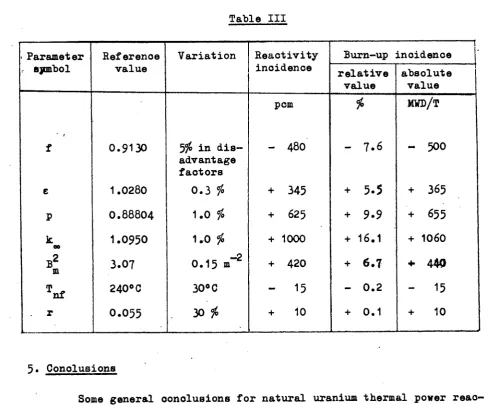
The results are summarized in table III. Also in this case the
variations assumed are of the same order of magnitude as the experi
mental errors in the measurements.
As far as the thermal utilization faotor is concerned, we assu
med a variation of 5
fi
for all the disadvantage factors of the various
media (organio, tubes, heavy water) surrounding the fuel.
For the resonance esoape probability faotor, a variation of 1
fi
corresponds, for the OBGEL lattioe, to a variation of 8.4
fi
in the
effeotive resonanoe integral and 2.3
fi
in the initial conversion fao
9
As regards the spectrum effeot, we proceeded in the following
ar ι we divided the uncertainty souroes into t]
corresponding to the following phenomena (Ref. 2) t
manner ι we divided the uncertainty souroes into three categories,
homogeneous hardening in the lattice « an uncertainty of 10°C
in the equivalent neutron temperatures of the various media of
thè cell was supposed to be representative of the uptodate si
tuation;
fuel seleotive hardening t 20°C variation on the fuel neutron
temperature was taken into aooount;
rethermalization effeot ι a change of 100
fi
of the transfer
oross section attributed to the organic in the TERMIDOR program
(Ref. 2) was assumed to be representative of the uncertainties
on the theoretical model used to oalculate this effeot. This
corresponds to a variation of about 20°C on the equivalent fuel
neutron temperature.
By supposing the abovementioned three errors to be indepen
dent from one another, a total variation of 30°C was found to be
representative of the total speotrum uncertainties.
, Parameter
, sjonbol
[image:16.595.48.544.70.478.2]■ /
f
ε
Ρ
k
00Β2
m
Τ
xnf ΓReference
value
O.913O
1.0280
0.88804
1.0950
3.Ο7
240o C
O.O55
Variation
5fi
i n d i s
advantage
f a c t o r s
0 . 3
fi
1.0
fi
1,0
fi
0 . 1 5 m"2
30° C
30
fi
R e a c t i v i t y
incidence
ρ cm
480
+
345
+
625
+ 1000
+
420
15
+
10
Burnup
r e l a t i v e
value
fi
7.6
+ 5.5
+ 9.9
+ 16.1
+
6 . 7
0 . 2
+
0.1
1
incidence
a b s o l u t e
value
MWD/T
500
+
365
+
655
+ 1060
4. 440
15
+
10
5. Conclusions
Some general oonolusions for natural uranium thermal power reao
tors oan be drawn from this study.
I. Nuolear oross sections
a) The inoidenoes on the neutron balanoe of U
235
an<i P u239
o r o s esections are the most important ones. In particular, a variation
of
\fi
in the fission oross section of P u ^ o gives a variation of
about 0.6
fi
on the reaotivity from an ORGEL type reaotor. An im
provement of the uptodate experimental techniques to measure
these oross seotions is therefore desirable. For U ^ »however,
it must be noted (see Fig. 3) that the strongest influenoe is for
unirradiated conditions; if we can adjust the lattioe unirradiated
balanoe by an integral experiment, the Ug,, inoidenoe changes signs
and is reduoed. For instance, the total error due to a variation
of
\fi
in the U_,
efission oross section is (see table ï) 58O pom
235
.
1 1
-b) A relatively sensible error (10
fi)
on Pu^AO
a D S O rP '
b i o r loross
seotion does not much a l t e r the neutronio balanoe. This means,
in particular, that the evaluation of the self-shielding effeot
of Ru-., does not need to be very aoourate.
c) Finally, the up-to-date uncertainty on the RUo^-j absorption
oross seotion (about 6
fi)
does not induce a severe error on the
reaotivity balanoe. For the same reason, the laok of information
on the ourve of the total Pu_.. oross section as a funotion of the
241
energy from 0.5 to 4 ev does not seem to be so important.
Ilo Lattioe parameters
a) A precision of about 0.5
°/°
on k measurements is necessary to
" . -2.
be comparable with the buokling experiment aoouraoy (0.15 ω ;.
This figure (0.5) oan be obtained by a PCTR type measurement but
not by aotivation measurements of the different factors of k^
(ε , ρ, f, η ) . It seems therefore that for the moment this kind
of experiments alone oannot prediot the overall neutron balance
with sufficient aoouraoy.
b) The necessity of increasing the aocuracy of the activation
measurements is particularly evident in the oase of the initial
conversion faotor where an experimental preoision of 2.3
fit
whioh
is not easy to abtain, brings an error of 625 pom on the reaoti
vity balance.
III. 9JÏGEL_parameters
For the ORGEL type reaotor, the following remarks oan be
made ι
a) The organio scattering cross seotion does not seem to be a
oritioal parameter for the lattioe calculations;
References
1. Caroline I, a calculation method for non-irradiated organic liquid
heavy water lattices - G. Casini, W. de Haan, E. Diana, C. Foggi,
A. Kind, G. Rossi - EUR 144·e
2. Terraidor, an IBM 709O Fortran code to evaluate the thermal neutron
speotrum in an ORGEL type fuel element - G. Rossi - EUR 105·e
3. Variation de la réactivite à long terme pour différents types de
oiroulation du oombustible G. Blässer, G. Casini, J. Piilon
-EUR 129.f
4. Neutron oross sections D.J. Hughes, B.A. Magurno, M.K. Brussel
-Supplement n° 1 to BNL 325, Second Edition
ρ
resonance escape probability faotor
η
thermal fission faotor
f
thermal utilization factor
k^
infinite multiplication factor
2
L
diffusion area
L
siowing-down area
β
2
Β
material buokling
m
C
initial conversion factor
o
Fuel isotopes :
"a"
total absorption
"f"
fission
"25"
U
2 3 5"39"
P u
2 3 9"Λ0"
Pu
4
240
"4.1 "
Pu
4· ι
r u
2 4 1σ
2200 m/s miorosoopic oross seotion value, excluding
σ-RAO
resonanoe value of total oross seotion of
Pu-.-ν
secondary neutrons per fission
Í
Σ
2200 m/s maorosoopio absorption cross seotion of organic
£10
Σ
thermal mean value of the maoroscopio scattering oross section
so
„
of organic
Σ
2200 m/s maoroscopio absorption cross section of aluminium
Σ
2200 m/s macroscopic absorption cross section of heavy water
Σ
thermal mean value of the maoroscopio transport oross seotion of
heavy water
Τ _
equivalent neutron temperature of the fuel (Westcott formalism)
r
epithermal ratio (Westcott formalism)
Canning and fins Coolant
FI6. 1
Fuel cross-section of an ORGEL-type element