Characterization of Pathologic Cries of Newborns Based
on Fundamental Frequency Estimation
Yasmina Kheddache, Chakib Tadj
Electrical Engineering Department, École de technologie Supérieure, Montréal, Canada Email: [email protected], [email protected]
Received June2013
ABSTRACT
The majority of the sick babies seem in good health at birth and early diagnosis of the various pathologies that can af-flict newborn is crucial. For this reason we introduce in this paper the use of the fundamental frequency and the differ-ent modes of cries as Hyper-phonation, phonation and high pitched cries to differdiffer-entiate the pathological cries from the cries of the healthy babies. The automatic estimation of these characteristics enabled us to establish a quantitative cha-racterization of healthy newborn cries and pathologic newborn cries. The results obtained agree with the spectrographic analysis carried out on the healthy and pathologic cries of the newborns.
Keywords: Newborns’ Cry; Fundamental Frequency; Cry Modes
1. Introduction
For many researchers, the fundamental frequency F0 which represents the speed of opening and closure of the vocal folds [1] is considered as the most important in the perception of the infant’s cries by adults. Generally the increase of F0 is associated with a negative perception of the cries. The cries with a high F0 are valued as aversive, sign of emergency, distress and disease [2].
Cry analysis can be an additional tool in the clinical diagnosis of newborn. The fundamental frequency of newborn cry has been found to be a discriminative cha- racteristic in several medical problems [1].
Cry analysis presented in this paper falls within the research on the relationship between the disease and the characteristics of the cry. Newborns do not have phona- tory control due to neurological immaturity at early age [3]. The main objective of this work is to analyze cries of healthy and newborn with different categories of diseases in order to evaluate a fundamental frequency of these cries. We also establish quantitative relationships be- tween the different modes of cries and studied pathology. The SIFT algorithm ‘Simple Inverse Filtering Track- ing’ is used for estimation of the fundamental frequency because the performance of this algorithm has been tested on a real database of cries by [4,5].
This paper is organized as follows: Section 2 presents definitions of fundamental frequency of cries. Section 3 presents previous works. Section 4 presents our adopted methodology for automatic estimation of F0, phonic, hyper-phonic and high pitched segments for healthy and
pathological cries. Section 5 presents the database used in this study. The next sections present the results ob-tained and we conclude this paper with a conclusion.
2. Fundamental Frequency of Cries
Fundamental frequency (F0) is the average vibratory frequency (in Hz) of the vocal folds. The sound spectro- gram displays the voiced tone as black lines. The funda- mental frequency is the lowest line and its harmonics appear above it as parallel lines. The maximal funda- mental frequency corresponds to the highest measurable point of the fundamental frequency and the minimal fun- damental frequency corresponds to the lowest measura- ble point of the fundamental frequency on the spectro- gram [6].
Lester et al. [2] defines three identifiable modes of cries due to vocal cord vibrations: 1) Basic cry or phona- tion with F0 350 - 750 Hz; 2) Cry with high fundamental frequency F0 (750 - 1000 Hz) or Hyper-phonation F0 (1000 - 2000 Hz) and 3) Noisy, turbulent or dysphonic cries.
3. Previous Works
F0 compared to the sex and the gestational age [3]. In the case of the newborn with various pathologies, it was shown that the level of the cries is high and presents a weak punctuation, high irritability and low physiological stability [1,3].The authors in this research area show that the cries of healthy full-term newborn are characterized by an F0 varying between 400 and 600 Hz and averaging 450 Hz [5,7]. The cries of healthy premature newborns can be more intense or similar to the cries of full-term newborns [1]. The cries of newborns with neurological disturbances exhibit auditory abnormalities [6]. Hyper- phonic cries and very high-pitched cries are associated with neurological problems [2] and neonatal risk [8].
4. Methodology
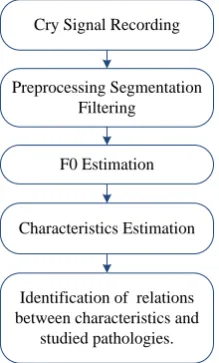
Our methodology for the characterization of healthy and pathologic cries based on F0 estimation is represented on the simplified diagram blocks illustrated in Figure 1.
The following approach was taken when estimating fundamental frequency and the different frequency modes of cries:
• Recording of healthy and pathologic cries of new- borns.
• Noise filtering and segmenting recordings into useful and non-useful portions.
[image:2.595.357.483.85.319.2]• Estimation of F0 in short intervals typically of 20 ms interlaced frame with 10 ms recovering using SIFT algorithm (Simple Inverse Filtering Tracking) [4,9]. The main steps of this algorithm are presented in
Figure 2.
• Estimating of phonic and hyper-phonic segments, as well as segments with high F0 as defined in Table 1
for all cries studied.
• Identification of relationships between cries cha- racteristics and studied pathologies.
Figure 1. Newborn cries characterization based on F0 esti- mation.
[image:2.595.307.538.367.448.2]Figure 2. The main steps of SIFT algorithm.
Table 1. Measured characteristics of cries.
Characteristics Definition
Hyper-phonation The average percentage of 20 ms blocks having a F0 >1000 Hz.
Phonation The average percentage of 20 ms blocks having a F0 < 750 Hz
High-pitched The average percentage of 20 ms blocks having a F0 in the 750 - 1000 Hz range
5. Database: Cry Recording
The database used contains 2800 cry samples of 1s dura- tion from 48 of newborn babies. 1774 from healthy newborn (among them 764 are premature) and 1010 from newborn who present some diseases (among them 628 are premature) as shown in Table 2.
These cries were collected with the aid of medical collaborators of neonatology department at Saint-Justine Hospital in Montreal. They concern full-term and pre- term newborn aged 1 to 30 days. The conditions in which the cries are registered are: hunger, sampling blood, change of diapers. The recording of cries is done using a small recorder, at a distance of 10 cm of babies’ mouth with a sampling rate of 44.1 kHz.
For each baby, three recordings of duration 2 to 3 mi- nutes are made with at least one hour interval after each recording session (over a period of ten days at most). The time, date and gender, date of birth, diagnosis, and reason of cries are noted for each episode of cry.
6. Results and Analysis
We developed our own measuring tool using Matlab. Preprocessing Segmentation
Filtering
F0 Estimation Cry Signal Recording
Characteristics Estimation
Identification of relations between characteristics and
studied pathologies.
Multiplying each frame by Hamming window
Performing glottal inverse filtering Dividing signal into overlapping
frames of 20ms with 10ms recovering
Autocorrelation sequence estimation.
Peak picking and decision algorithm with voiced threshold
F0 estimation, T0= 1/F0
[image:2.595.119.229.524.706.2]Table 2. Pathologies studied.
Category Pathology Sample size
Full-term newborn (t)
Healthy 1010
Thrombosis in the vena cava 77
Meningitis 115
Asphyxia 190
Preterm newborn (P)
Healthy 764
IUGR- Microcephaly
(Intra-Uterine Growth Retardation) 78
Gastroschisis 280
RDS (respiratory distress Syndrome) 270
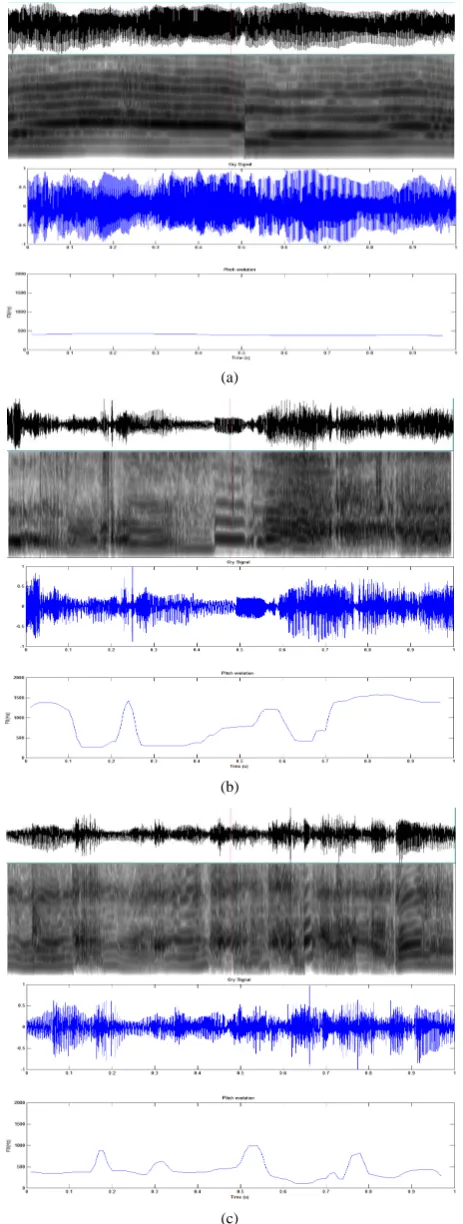
This tool estimates F0 as well as the average percentages of phonic, hyper-phonic and high pitched segments. Examples of spectrograms and F0 estimation are reported in Figure 3 for two pathologic cries (asphyxia and ga- stroschisis) and also for a healthy newborn. Notice high F0 and more irregular spectrograms and F0 for patholog- ic cries compared to healthy cry. The range of F0 for pathologic cries is 150 Hz - 1600 Hz and for healthy cry around 450 Hz. The estimated values of frequency cha- racteristics listed in Table 1 for healthy and pathologic newborn’s cry are presented in Figures 4 and 5 ac-cording to pathologies studied and gestational age of babies.
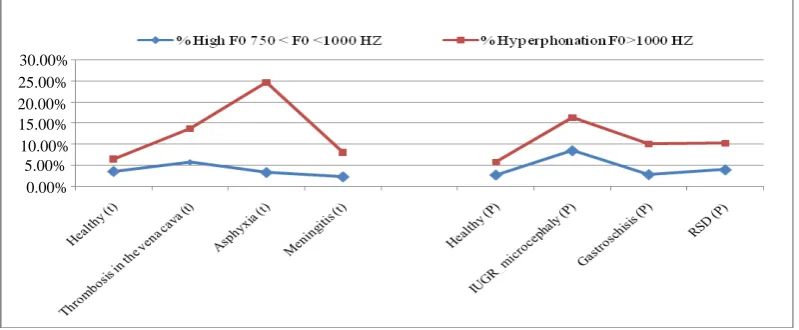
The results from this study show in Figure 4 that the cries of healthy full-term or preterm newborns are rather phonics with a presence of 89% of segments with a F0 < 750 HZ and round 9% of segments with high F0 > 750 Hz. Figure 5 shows that the cries of healthy full-term or preterm newborns contain round 6% of Hyper-phonic segment. On the other hand, the cries of the sick new- borns contain more pitched and hyper-phonic segment compared to the healthy newborns. According to the pa- thologies studied, the percentage varied from 11% to 28% of segments with a F0 > 750 Hz. These percentages vary from one pathological condition to another, and are dependant to level of prematurity.
We notice in Figures 4 and 5, which the cries of new-borns with asphyxia contain 28% of high pitched seg-ments (F0 > 750 Hz) among them 25% are hyperphonic. In the case of meningitis, the cries contain respectively 11% and 8% of high pitched segments (F0 > 750 Hz) and hyper-phonic segments.
The cries of newborns with microcephaly associated with IUGR present 25% of high pitched segments (F0 > 750 Hz). These cries are more hyper-phonic with 17% of segment with F0 > 1000 Hz. The cries of newborns with congenital malformation gastroschisis contain 13% of high pitched segments with F0 > 750 Hz. The percentage of hyperphonation is 10% of segment with F0 > 1000 Hz. The cries of newborns with heart defect (Thrombosis
(a)
(b)
(c)
[image:3.595.56.288.96.244.2]Figure 4. The average percentage of phonic and high pitched segments (F0 > 750 Hz) by pathologies.
Figure 5. The average percentage of hyper-phonic (F0 > 1000 Hz) and high pitched segments (750 < F0 < 1000 Hz) by pa-thologies.
in the vena cava), include 20% of segments with F0 > 750 Hz, among them 14% are hyper-phonic. The cries of newborn with RDS (Respiratory Distress Syndrome) include 15% of segments with F0 > 750 Hz among them 11% are hyper-phonic.
The highest average percentage of hyper-phonic cries is found in the category of neurological problems (asphyxia, microcephaly-IUGR) and also the highest average per- centage of high pitched cries with 750 < F0 < 1000 Hz is found in the category of neurological problems (micro- cephaly-IUGR).
7. Conclusions
This study mostly deals with characterization of healthy and pathologic newborn’s cry according to the modes of cry as hyper-phonation, phonation, and high-pitched cry.
The conclusion from this work is that there are clear differences in frequency characteristics of healthy and
pathologic cries. This difference can be used in pediatric diagnosis. The results obtained are very encouraging because they are consistent with spectrographic studies of crying newborns [1,2,10].
This work is still in progress. The results obtained by using different modes of cry as discriminative characte-ristics for healthy and pathologic newborn’s cry can be improved using other acoustic characteristics cited in the literature in association with severe medical conditions. More significant results can be expected using the de-veloped tool on a larger database with a greater variety of pathologies and more subjects for each pathology.
8. Acknowledgements
We would like to thank Dr. Barrington and members of neonatology group of Saint-Justine Hospital in Montreal (QC) for their dedication of the collection of the Infant’s cry database. This research work has been funded by a 120.00%
100.00%
80.00%
60.00%
40.00%
20.00%
0.00%
30.00% 25.00% 20.00% 15.00% 10.00% 5.00%
[image:4.595.100.500.312.477.2]grant from the Bill & Melinda Gates Foundation through the Grand Challenges Explorations Initiative.
REFERENCES
[1] B. M. Lester and L. L. LaGasse, “Crying,” Elsevier, Amsterdam, 2008, pp. 80-90.
[2] L. L. LaGasse, A. R. Neal and B. M. Lester, “Assessment of Infant Cry: Acoustic Cry Analysis and Parental Per-ception,” Mental Retardation and Developmental Dis-abilitiesResearch Reviews, Vol. 11, No. 1, 2005, pp. 83-
93
[3] A. Verduzco-Mendoza, E. Arch-Tirado, C. A. Garcia and J. L. Ibarra, “Qualitative and Quantitative Crying Analy-sis of New Born Babies Delivered Under High Risk Ges-tation,” Springer-Verlag Berlin Heidelberg, 2009, pp. 320- 327.
[4] D. Lederman, “Estimation of Infants’ Cry Fundamental Frequency Using a Modified SIFT Algotithm,” 2010. Eprint arXiv: 1009.2796
[5] C. Manfredi, L. Bocchi, S. Orlandi, L. Spaccaterra and G.
P. Donzelli, “High-Resolution Cry Analysis in Preterm Newborn Infants,” Elsevier, Amsterdam, 2009, pp. 528- 532.
[6] O. Wasz-Hockert, K. Michelsson and J. Lind “Twen-ty-Five Years of Scandinavian Cry Research,” Springer, New York, 1985, pp. 83-104.
[7] K. Michelson, K. Eklund, P. Leppanen and H. Lyytinen, “Cry Characteristics of 172 Healthy 1- to-7 Day Old In-fants,” Folia Phoniatr Logopaedica, 2002, pp. 190-200. [8] C. Manfredi, V. Tocchioni and L. Bocchi, “A Robust
Tool for Newborn Infant Cry Analysis,” Proceedings
28th IEEE EMBS Annul International Conference, 2006. [9] J. D. Markel, “The SIFT Algorithm for Fundamental
Frequency Estimation,” IEEE Transactions on Audio and Electroacoustics, Vol. 20, No. 5, 1972.