fencing performance and cognitive function following a
fatigue-inducing bout of fencing
Georgina Jade Rowlatt
A thesis submitted in partial fulfilment of the requirements of the University of East London for the degree of Masters of Research: Sport Science.
Abstract
The aim of this study was to investigate whether rinsing the mouth with a carbohydrate
solution could improve skill-specific fencing performance and cognitive function
following a fatigue inducing simulated bout of fencing in epee fencers. Eleven healthy,
competitive epee fencers (three female; eight male; 33.9 ± 14.7 years; body mass 79 ±
16 kg; height 162 ± 54 cm) volunteered to participant in a single-blind crossover design
study. During visit 1 participants completed a 1-minute lunge test and stroop test pre
and post fatigue inducing fencing protocol. A 30 second electroencephalography (EEG)
recording was taken pre-protocol participants were instructed stay in a seated stationary
position with their eyes closed. Heart rate and ratings of perceived exertion were
recorded following each fight during the fatiguing protocol. Participants mouth rinsed
(10 seconds) either 25ml of a 6.7% maltodextrin solution (CHO) or 25ml of water
(placebo) between fights and during the EEG recording. Blood lactate and glucose
measurements were taken at baseline, pre and post protocol. All measurements and
tests were repeated during a 2nd visit to the laboratory, except participants were given a
different solution to mouth rinse, separated by a minimum of 5 days. The results
showed an increase in heart rate (P < 0.05) and overall RPE (P < 0.001) over time in
both trials. There were no recorded differences in blood glucose (F(1,8) = 0.634, P = 0.4,
ηp 0.07) or blood lactate levels (F(1,8) = 0.123, P = 0.7, ηp 0.01) between trials. There
was a significant improvement in lunge test accuracy in the CHO trial (F(1,8) = 5.214, P
= 0.05, ηp 0.40). However, there was no recorded difference in response time to
congruent (F(1,8) = 0.326, P = 0.58, ηp 0.04) or incongruent (F(1,8) = 0.189, P = 0.68,
ηp 0.02) stimuli between trials. In conclusion mouth rinsing a CHO solution
significantly improves accuracy of skill-specific fencing performance but does not
Contents
Chapter 1: Introduction 1
1.1.The effect of carbohydrate ingestion on high intensity and intermittent 1 exercise.
1.2.The effect of carbohydrate mouth rinsing on performance and underlying 2 mechanisms.
1.3. Potential limitations of CMR 4
1.4. Indicators of fencing performance 4
1.5. The importance of CMR within a practical setting 5
Chapter 2: Literature Review 7
2.1. CHO supplementation and sport performance 7
2.1.1. The performance effect of CHO supplementation during 8
endurance exercise
2.1.2. The performance effect of CHO supplementation on exercise 8
lasting under 1 hour.
2.2. Mechanisms of CHO supplementation 9
2.2.1. Proposed mechanisms of CHO supplementation during 10
shorter high-intensity exercise lasting less than 60 minutes.
2.2.2. The proposed mechanisms of CMR 11
2.3. CMR and exercise performance (lasting ~ 1 hour) 13
2.3.1. The effect of CMR on steady state exercise performance 14
2.3.2. The effect of CMR on intermittent sport performance 16
2.4. Factors influencing fencing performance 19
2.5. Practical implications of CMR 20
Chapter 3: Methodology 22
3.1. Participants 22
3.2. Procedure 22
3.3. Experimental Trials 23
3.5. Cognitive function test 24
3.6. Skill test 25
3.7. Fatigue protocol 25
3.8. Data and statistical analysis 26
Chapter 4: Results 27
4.1. Blood glucose and lactate 27
4.2. Perception of exertion and heart rate 28
4.3. Skill test 30
4.4. Stroop test 31
Chapter 5: Discussion 33
5.1. Strength and limitations of the study 33
5.2. The effect of CMR on skill-specific performance following a fatigue 37
inducing simulated bout of fencing.
5.3. The effect of CMR on cognitive function following a fatigue inducing 39
bout of fencing.
5.4. Future implications and further research possibilities 40
Chapter 6: Conclusion 43
Reference list 46
Appendices 59
Appendix 1: Information sheet for participants 60
Appendix 2: Written consent form 63
Appendix 3: Ethical approval 64
Appendix 4: Fencing fatigue protocol 67
Contents for Figures and Tables
Figures
1. Schematic diagram of the overall experimental protocol 24
2. Mean (± s) blood glucose concentrations during exercise for both placebo 28 and MALT.
3. Mean (± s) blood lactate concentrations during exercise for both placebo 28
and maltodextrin (MALT).
4. Mean (± s) ratings of perceived exertion for placebo (PLA) and maltodextrin 29 (MALT).
5. Mean (± s) heart rate for PLA and MALT. 30
6. Mean (± s) number of lunges pre and post fatiguing protocol for 31 placebo and maltodextrin (MALT)
7. Mean (± s) pre and post fatiguing protocol congruent (C) and incongruent 32 (I) response times to the Stroop test for both placebo (PLAC) and
maltodextrin (MALT).
Tables
Table I. Characteristics of the participants (n = 9). 27
Table II. Mean (± s) RPE (Borg Scale) and heart rate during all fights 29 for PLA and MALT trials for sword arm, legs and overall.
Acknowledgements
I would like to firstly say a special thank you to my supervisor Dr. Richard Buscombe without
his knowledge and guidance this research project would not have been possible. I would also
like to thank Lindsay Bottoms, who has provided extensive knowledge on carbohydrate
supplementation, mouth rinsing and fencing. Finally I would like to thank my family who have
Chapter 1 Introduction
The ergogenic effect of carbohydrate (CHO) supplementation during endurance sport
has been well documented within the scientific literature (Bergstrom et al, 1967; Black
et al, 2012; Hargreaves, Hawley, and Jeukendrup 2004; Jeukendrup 2004; Schabort et
al., 1999; Sherman et al., 1989; Wright et al., 1991). Christensen and Hansen (1939)
highlighted the importance of CHO as a fuel substrate in a series of respiratory
exchange studies. These results were supported by Bergstrom et al. (1967) who took
muscle biopsies to measure muscle glycogen levels following a range of dietary and
exercise interventions. Since then a substantial number of studies have focused on
nutritional strategies to maximise endogenous CHO stores and minimise CHO depletion
throughout exercise (Currell and Jeukendrup, 2008).
1.1. The effect of CHO ingestion on high intensity and intermittent exercise
The availability of CHO as a substrate for muscles and the central nervous system has
not only been identified as a limiting factor for endurance performance it has also been
linked to high intensity and intermittent exercise (Burke et al., 2001). A number of
studies have reported improvements in sports performance lasting ~1 hour following the
ingestion of CHO (Davison et al., 2008; El-Sayed, Balmer and Rattu 1997; Jeukendrup
et al, 1997; Nicholas et al., 1999; Maughen and Poole, 1981). Moreover recent research
investigating the ergogenic effect of CHO ingestion during sports requiring high levels
of motor and cognitive skill, such as squash and football, have found evidence to
support improvements in skill-specific tasks (Bottoms, Hunter and Galloway, 2007;
McRae and Galloway, 2012). However, currently the mechanisms to explain such
performance improvements associated with CHO ingestion during exercise lasting ~1
The mechanisms of CHO supplementation are complex. Nevertheless, two primary
mechanisms have emerged within the literature. Firstly the direct influence on CHO
oxidisation rates during prolonged exercise (>2 hours) where skeletal muscle and liver
glycogen stores are a limiting factor (Cermack and Loon, 2013). However as only
5-15g of exogenous CHO is oxidised during the 1st hour of exercise (Juekendrup et al.,
1997) it is unlikely such metabolic mechanisms explain the performance benefits
reported during exercise lasting ~ 1 hour and intermittent exercise. Therefore during
shorter, high-intensity, exercise (<1 hr.) the underlying mechanism has been attributed
to a central nervous system response to exposure to CHO within the oral cavity (Carter,
Juekendrup and Jones, 2004b; Chambers, Bridge and Jones, 2009). Although the
specific receptors within the mouth are yet to be identified, there have been a growing
number of studies, which have supported this hypotheses using a mouth rinsing
protocol.
1.2. The effect of carbohydrate mouth rinsing on performance and the underlying mechanisms
Carter, et al. (2004a) were the first to establish a performance effect of CHO
independent of blood glucose levels. They found when glucose was administered via
infusion 40km cycle time trial performance was not significantly improved despite an
abundance of glucose in the blood stream. However a performance effect was
established without ingesting CHO, indicating a central nervous system response
(Carter, et al., 2004a.).
Carter, Jeukendrup and Jones, (2004b) tested their initial findings in a subsequent study
whereby participants rinsed a CHO solution in their mouth before spitting it out, which
cycling time trial (TT) performance was significantly improved following multiple
CMR compared to a taste-matched placebo mouth rinse (Carter et al., 2004b).
Consequently a growing number of articles, mainly within cycling, have demonstrated
that CMR improves sport performance lasting ~1 hour (Chambers et al., 2009; Fares et
al., 2011; Lane et al., 2013; Mündel and Jones, 2010; Phillips et al., 2014; Pottier et al.,
2010; Rollo et al., 2008; Rollo et al., 2010; Sinclair et al., 2014). In a recent
meta-analysis pooled from several eligible cycling studies the mean improvement in power
output following CMR was ~5 W (95% CI = 0.9-9 W), which is significant both
statistically and as an outcome in sporting events (de Ataide e Silva et al., 2014).
In addition there have been a handful of studies that have investigated the mechanisms
controlling the influence of CMR on physical and cognitive performance in sport and
exercise. Chambers, Bridge and Jones, (2009) were the first to investigate the
mechanisms of CMR using functional magnetic resonance imaging (FMRI) scans to
identify the regions of the brain activated following a glucose or maltodextrin (MALT)
mouth rinse. Interestingly both glucose and MALT activated the Orbitofrontal Cortex
and Dorsolateral Prefrontal Cortex, despite differences in sweetness. The authors
concluded CMR produces a central neural response independent of sweetness
(Chambers, Bridge and Jones, 2009). It is possible the results could be attributed to the
calorific content rather than the sweetness, although further research is needed to
confirm this hypothesis.
The findings by Chambers, Bridge and Jones (2009) have been partially supported by a
recent study using electroencephalography (EEG) to measure the activation of the brain
(De Pauw et al., 2015). The researchers also found activation within the Orbitofrontal
preliminary support for a central processing hypothesis and highlight an effect of CMR
on regions of reward and motivation in the brain. However to our knowledge there is
currently no research investigating the interaction between CMR and the brain within a
sporting context.
1.3. Potential Limitations of CMR
Despite the fact that there is seemingly robust evidence providing support for the
positive effect of CMR on sport performance, a number of studies have failed to find
significant results (Beelen et al., 2009; Che Muhamed et al., 2014; Chong, Geulfi and
Fournier, 2011; Rollo, Williams and Nevill, 2011; Witham and Mckinnay, 2007). For
example Chong, Geulfi and Fournier (2011) found no significant performance effect
following CMR on maximal sprint performance. Likewise a number of very recent
studies have found conflicting results on skill maintenance and performance in
intermittent sport (Clarke, Kornolios and Richardson, 2015; Ispoglou et al; 2015;
Přibyslavská et al., 2015). The magnitude and direction of findings could be attributed
to a range of variables, including the duration and frequency of mouth exposure
(Sinclair et al., 2014), training status of subjects, mode and intensity of exercise, and the
nutritional status of subjects (Fares and Kayser, 2011; Lane et al., 2013). Therefore the
effect of CMR on intermittent skill-based sports, such as fencing, remains unclear.
1.4. Indicators of fencing performance
Fencing is an open-skilled Olympic and Para-Olympic combat sport, characterised by
short bursts of high intensity exercise followed by periods of rest. While there has been
very little research investigating variables affecting fencing performance, it has been
established that maintaining one's psychological condition, including visual perception
(Hijazi, 2013). Moreover findings from other skill-based intermittent sports, such as
cycling and squash, have highlighted the attenuating effect of fatigue on skill
maintenance (Davey, Thorpe, & Williams, 2002; Hornery et al., 2007; Murray, et al.,
2001; Royal et al., 2006; Vergauwen et al., 1998). Therefore it could be speculated that
delaying the onset of fatigue could improve a fencer's psychological and physiological
condition, thus improving performance. CHO ingestion during intermittent sport has
been reported to improve performance. Furthermore CMR is emerging within a number
of review articles as the optimal CHO supplementation strategy during intermittent high
intensity exercise (Stellingwerff and Cox, 2014; Jeukendrup, 2013). Due to the
work/rest ratios during a typical fencing competition CMR would be a practical strategy
for fencers to adopt. In competition each poule fight lasts for a maximum of 3 minutes
followed by a rest period of 6 minutes, allowing ample time for fencers to mouth rinse
in between fights without effecting their recovery. Also expectorating the CHO
between fights would avoid too much fluid in the stomach during fights, which could
have an adverse effect on performance. Therefore it would be beneficial to investigate
whether CMR can improve skill-specific performance and cognitive function following
a fatigue inducing fencing protocol.
1.5. The importance of CMR within a practical setting
Improving our knowledge of the effects of CMR on physical and cognitive performance
would enhance the current understanding of CHO supplementation during high intensity
sport (<1 hour). It would also provide a successful alternative nutritional strategy for
athletes who experience gastrointestinal (GI) discomfort or for athletes following a
calorie-restricted diet. GI distress is commonplace amongst athletes with an estimated
20-50% experiencing symptoms during a sporting event (Stuempfle and Hoffman,
GI distress include nausea, heartburn, vomiting, abdominal cramps, bloating and
diarrhoea (Peters et al., 1991) which will likely serve to impair overall sporting
performance. One reason athletes experience GI discomfort during sport is due to high
Carbohydrate (CHO) ingestion. However CMR eliminates the needs to ingest CHO and
reduces stress on the gut, therefore eliminating GI distress. Although GI distress
commonly occurs during endurance events, it is important to acknowledge some
athletes have clinical conditions, which impairs their ability to digest CHO effectively.
The present study aims to further the current knowledge of CMR by testing whether
CMR can significantly improve skill maintenance and cognitive function in epee
fencers following a fatigue inducing protocol. The study will additionally measure
activation of regions within the brain whilst CMR in a sport specific environment, in
order to expand on the findings of previous research. The present study, hypothesises
that mouth rinsing with a CHO solution will improve skill-specific performance and
cognitive function following a fatigue inducing fencing protocol. In addition mouth
rinsing with a CHO solution will activate regions of the brain associated with reward
Chapter 2. Literature Review
Over the past decade one of the interesting sport nutrition topics to emerge from the
scientific literature is the enhancing effect of carbohydrate (CHO) without the need for
ingestion on sports performance. Carbohydrate mouth rinsing (CMR) is where a CHO
solution, either glucose or maltodextrin (MALT) is swilled around the oral cavity for an
extended period of time, typically 5-10 seconds, before it is expectorated. Although a
number of research studies have observed an increased capacity to maintain
performance during moderate and high intensity exercise lasting around 1 hour
following CHO supplementation it has been reported that CHO does not serve as a
substantial muscle substrate during the first hour of exercise. Therefore the mechanism
could be attributed to a neural response. Consequently researchers have found that by
simply exposing receptors in the oral cavity to either glucose MALT, regions of reward
and motivation are stimulated within the brain and subsequently work outputs were
increased (Chambers, Bridge and Jones, 2009). The following discussion will review
the current literature on CHO supplementation focusing in particular on our current
understanding of CMR.
2.1. CHO Supplementation and Sports Performance
The first recorded evidence of CHO as an important fuel for exercise dates back to the
early 1900s (Krogh and Lindhard, 1920). In a later study Christenson and Hansen
(1939) discovered CHO utilisation during exercise could be influenced by diet, and
subsequently exercise tolerance could be improved. The initial findings of the early
1900s was later supported by a muscle biopsy study which examined the effect of
various nutritional strategies on performance and found muscle glycogen stores to play
a significant role in sport performance (Bergstrom and Hultman, 1969). Since this early
resultant effect of a variety of CHO supplementation strategies during high-intensity
sports (< 1 hour) and endurance events (>2 hours). In a recent meta-analysis compiled
from 61 studies 82% found significant performance benefits following CHO
supplementation (Stellingwerff and Cox, 2014). It is therefore not surprising CHO
supplementation is frequently used by athletes to enhance performance within their
respective sports.
2.1.1. The performance benefit of CHO supplementation during endurance exercise
There is sound evidence to support an increase in endurance performance when CHO is
ingested in direct comparison to water (Angus et al., 2000; Carter et al., 2003; Currell
and Jeukendrup, 2008; Langenfield et al., 1994; and O’Brien et al., 2013; Smith et al.,
2010, 2013; Watson et al., 2012). Moreover the performance effect size has been linked
to the composition and administration of CHO supplementation (Vandenbogaerde and
Hopkins, 2011). This body of work has fuelled an emerging trend to explore the added
benefits of multi-transportable CHO, for example a blend of glucose and fructose, on
endurance performance (Currell and Jeukenfdrup, 2008; Triplett et al., 2010; Wallis et
al., 2006). The availability of CHO as a substrate for muscles and the central nervous
system has not only been identified as a limiting factor for endurance performance it has
also been linked to high intensity intermittent exercise (Burke et al., 2001).
2.1.2. The performance effect of CHO supplementation on exercise lasting under 1
hour
Research has demonstrated a positive improvement in performance during steady-state
exercise lasting ~1 hour following ingestion of CHO (Anantaraman et al., 1995;
Blackhouse et al., 2006; Davison et al., 2008; Below et al., 1995; El-Sayed, Balmer and
Interestingly a significant performance effect (3.0% Vs. placebo) was found when
participants ingested as little as 25g/h during a 1-hour self-selected time trial (el-Sayed,
Balmer and Rattu, 1997). While other studies have failed to find a significant
performance effect despite administering greater quantities of CHO (Bonen et al., 1981;
Desbrow et al., 2004; Powers et al., 1990). One plausible explanation for the
discrepancy amongst the literature is the amount of time CHO was exposed to receptors
within the oral cavity.
There have also been an increasing number of studies reporting CHO supplementation
has a performance effect in intermittent sports, characterised by bursts of high intensity
exercise followed by periods of lower intensity exercise. This is somewhat surprising
as performance is not only determined by maintenance of speed and power but factors
such as agility, timing, motor skill, and decision making are likely to play a role
(Jeukendrup, 2013). Nonetheless research has shown CHO supplementation not only
increases performance (Bottoms, Hunter and Galloway, 2007; Davison et al., 2008;
Foskett, Williams, Boobis, Tsintzas, 2008; Nicholas, Nuttall, & Williams, 2000;
Nicholas et al., 1995; Patterson & Gray, 2007) it also improves skill maintenance (Ali et
al., 2007; Ali and Williams, 2009; Curell, Conway and Jeukendrup, 2009; Northcott et
al., 1999; McRae and Galloway, 2012; Welsh et al., 2002) especially towards the end of
the game.
2.2. Mechanisms of CHO supplementation
CHO supplementation has been associated with a delayed onset of fatigue, and
improvements in sport performance in a wide range of sporting activities (Jeukendrup,
2013; Stellingwerff and Cox, 2014). The mechanisms of fatigue are complex and differ
within the mind and secondly within the body (Bainbridge, 1919). So the mechanisms
and regulations involved in fuel metabolism and energy production during exercise are
multifaceted (Stellingwerff and Cox, 2014). Moreover the metabolic and performance
effect of CHO supplementation is influenced by a number of factors, including the type
and intensity of the exercise, the training status of the athlete and the intake rate of
CHO. Nonetheless two primary mechanisms to explain the effect of CHO on
performance have emerged from existing research papers. Firstly the direct influence
on CHO oxidisation (CHOoxid) rates during prolonged exercise (>2 hours) where
skeletal muscle and liver glycogen stores are a limiting factor (Cermack and Loon,
2013). Secondly, during exercise lasting under 1 hour there is a central nervous system
response to exposure to CHO in the oral cavity.
2.2.1. Proposed mechanisms of CHO supplementation during shorter high-intensity
exercise lasting less than 60 minutes
Since the publication of early performance studies it has become scientifically accepted
that CHO supplementation can improve endurance capacity (Burke and Maughan,
2015). The performance benefit has been attributed to enhanced maintenance of blood
glycogen resulting in augmented CHOoxid by the muscles (Jeukendrup, 2010). It was
originally believed CHO supplementation could not improve performance during
shorter bouts of exercise (<1 hr.). Theoretically the contribution of blood glycogen to
energy expenditure is minimal compared to the high oxidisation rates of muscle
(Romijn et al., 1993; van Loon et al., 2001). Specifically, during the first hour of
exercise only 5-15g of exogenous CHO is oxidized, which is too small to significantly
impact performance (Jeukendrup et al., 2010). However practical observations have
shown CHO ingestion or CMR improves performance during short and intense exercise
Kayser, 2011; Gam et al., 2013, Lane et al., 2013; Davison et al., 2008; El-Sayed,
Balmer and Rattu 1997; Jeukendrup et al, 1997; Nicholas et al., 1999; Maughen and
Poole, 1981; Pottier et al., 2010; Sinclair et al., 2013)
A possible explanation for this contradiction has developed from the observations of
Carter et al. (2004a) who found the route of administration of the CHO supplementation
to be crucial in determining the performance effect. In particular mouth rinsing a CHO
solution, which did not affect blood glycogen levels, was seen to significantly improve
1-hour cycling TT performance (Carter et al., 2004b). This finding lead Carter and
colleagues (2004b) to conclude that there are receptors in the mouth, which can
influence neural pathways and improve subsequent performance (Chambers et al.,
2009). Over the past 20 years there has been increased recognition of the role played by
the brain in determining exercise performance (Burke and Maughan, 2015).
Neuroimaging studies have found glucose ingestion activates the primary taste cortex
and the putative secondary taste cortex in the orbitofrontal cortex (de Araujo et al.,
2003; O'doherty et al., 2001). Similarly neuroimaging studies have shown CMR
activates the orbitofrontal cortex (Chambers Bridge and Jones, 2009; De Pauw et al.,
2015; Turner et al., 2014). Providing preliminary evidence to mechanistically support
the practical observations of CMR studies.
2.2.2 The proposed mechanisms of CMR
The first study to investigate the mechanisms of CMR was conducted by Chambers,
Bridge and Jones (2009). The researchers used functional magnetic resonance imaging
(FMRI) to identify differences in brain regions activated whilst mouth rinsing a solution
containing MALT, glucose or an artificially sweetened placebo. Both glucose and the
cortex. The dorsolateral prefrontal cortex is believed to play a role in the preparation
and selection of cognitive responses (Rowe et al., 2000). Both glucose and MALT
increased activation of the orbitofrontal cortex, whereas the artificially sweetened
solution did not. Increased activation within the orbitofrontal cortex is linked to
increased dopaminergic pathways in the striatum. The striatum has been linked to
emotional and behavioural responses to reward (Berridge and Robinson, 1998; Kelley et
al., 2002; Rolls, 2007). In addition it is associated with arousal, decision-making,
reinforcement, motivation and the control of motor behaviour (Berridge and Robinson,
1998; Ferré et al., 2010; Taylor et al., 2013; Yager et al., 2015). The fact that despite
varying sweetness both MALT and glucose were shown activate the same regions of the
brain following CMR suggest the receptors within the mouth are responding to another
property found in natural sugars rather than the sweetness. Similar findings have been
reported using electroencephalography (EEG) by De Pauw et al. (2015).
Turner et al. (2014) were the first to investigate the effect of CHO in the mouth on
regions of the brain whilst performing a motor task. FMRI was used to measure regions
of the brain activated at rest and during a handgrip motor task following mouth rinse of
either a CHO solution or taste-matched placebo. The researchers found CHO increased
activation within the primary sensorimotor cortex during physical activity and enhanced
the neural networks involved in sensory perception (Turner et al., 2014). The
neuroimaging studies provide some support for the central response to CHO in the oral
cavity, which warrants further research to continue to improve our understanding of
how CHO is processed by the brain. While the research has identified regions of the
brain activated in response to CHO in the mouth the exact mechanisms of the response
remain undefined. Chambers, Jones and Bridge. (2009) speculate the calorific content
mouth although to date there has been no research to confirm this. Also the specific
receptors in the mouth that respond to CHO are unknown.
2.3. CMR and exercise performance (lasting ~1 hour)
One recent breakthrough within the scientific literature which is gaining momentum is
the effect of CHO supplementation without the need to ingest on exercise performance
lasting ~1 hour. Carter et al. (2004a) found that when CHO was infused straight into the
bloodstream, bypassing both the mouth and gastrointestinal (GI) tract, then 1h cycling
time-trial (TT) performance remained unaltered in comparison to an artificially
sweetened placebo (Carter et al., 2004a). Indicating that CHOoxid and muscle glycogen
stores were not limiting factors in cycling performance lasting 1 hour. Thus the
researchers proposed a central response to CHO, via the brain, was responsible for the
performance effect observed during exercise performance lasting ~ 1 hour.
In a follow-up study Carter, Jeukendrup and Jones (2004b) were able to eliminate the
effect of the GI tract and CHOoxid rates by developing a mouth rinsing protocol where
the participants swilled the solution in their mouth before expectorating it, known as
CMR. The study followed a double-blind crossover design, where participants mouth
rinsed 25ml of either a 6.4% MALT solution or water (Placebo) every 12.5% during a
1-hour cycling TT. The TT performance was significantly improved by 2.9% (P=
0.003) in the MALT trial compared to the placebo trial. Several subsequent
performance studies have replicated the performance effect of CMR, using cycling
(Chambers, Bridge and Jones, 2009; Fares and Kayser, 2011; Lane et al., 2013; Pottier
et al., 2010; Sinclair et al., 2013;) and running (Rollo et al., 2008; Rollo et al., 2010)
interventions. Moreover a handful of research articles have found a positive effect of
et al., 2015). The magnitude and direction of results depend on a number of variables,
including the mode and intensity of the exercise, the frequency and duration of mouth
exposure, and the nutritional status of subjects (Burke and Maughan, 2015).
2.3.1. The effect of CMR on steady state exercise performance
Cycling is currently the most frequently used intervention in CMR studies. A number
of studies have found CMR to significantly enhance performance (Carter Jeukendrup
and Jones, 2004b; Chambers Bridge and Jones, 2009; Fares and Kayser, 2011; Kasper
et al., 2015; Lane et al., 2013; Pottier et al., 2010; Sinclair et al., 2013) using a range of
protocols and differing sweetness of CHO. In a recent meta-analysis pooled from
several eligible cycling studies the mean improvement in power output following CMR
was ~5 W (95% CI = 0.9-9 W), which is significant both statistically and as an outcome
in sporting events (de Ataide e Silva et al., 2014). Moreover CHO was found to
significantly improve time to fatigue whilst cycling (60% Maxwatt) in both a fed and
fasted state when compared to placebo (3.5% and 11.6% for fed and fasted respectively)
(Fares and Kayser, 2011). Indicating that exposure to CHO in the mouth alone has an
attenuating effect on fatigue and therefore performance.
It is important to note that not all the research has reported a significant effect of CMR
on steady-state performance lasting ~ 1 hour (Beelen et al., 2008; Che Muhamed et al.,
2014; Gam, Guefli and Fournier, 2013; Witham and McKinney et al., 2007). Che
Muhamed et al., (2014) found ~ 12% improvement in 10km TT performance when
either a water or CHO solution was mouth rinsed for 5 seconds compared to a no rinse
protocol in the heat. CHO did not have any additional benefit to performance when
compared to mouth rinsing with water alone. It is possible the length of exposure to
Sinclair et al. (2013) found although mouth rinsing a CHO solution (6.4% maltodextrin)
for 5 seconds improved 1- hour TT performance compared to a taste-matched placebo
the difference only reached significant when the participants mouth rinsed CHO for 10
seconds. These findings indicate a potential dose-response relationship between CMR
and performance.
Beelen et al. (2008) proposed that the performance benefit associated with mouth
rinsing CHO was removed when glycogen stores were full prior to testing. They found
no significant difference in 1-hour TT cycling performance between CHO and placebo
when participants ingested a high CHO breakfast prior to testing (Beelen et al., 2008).
However several observations exist to indicate the nutritional status of participants prior
to testing is not a definitive regulator of the effect of CMR. Witham and McKinney
(2007) found no effect of CMR on 60-minute TT performance despite an overnight fast
whereas Pottier et al. (2010) did find a performance effect when a high-CHO meal was
ingested 2 hours prior to testing. Furthermore two recent studies have observed a
significant improvement in performance when participants were fed and fasted prior to
testing (Fares et al., 2011; Lane et al., 2013). Although a greater increase in 1-hour TT
performance was observed in when the participants were fasted prior to testing (1.8%
and 3.4% for fed and fasted states respectively) (Lanes et al., 2013).
The effect of mouth rinsing with a CHO solution on steady-state running performance,
lasting between 30 and 60 minutes, has also been researched. The first study to
investigate the effect of CMR on running performance found no difference in distance
covered or rate of perceived exertion (RPE) between trials. Despite following a similar
mouth rinsing protocol to previous cycling studies (6% CHO or a placebo solution
discrepancy between the findings of Witham and Mckinney (2007) and previous studies
reporting a significant improvement in cycling TT performance could be attributed to
the mode of exercise used during testing (Rollo et al., 2008). One of the key limitations
of the study by Witham and Mckinney (2007) was that running speed had to be adjusted
manually. Thus the participants were not able to adjust their speed spontaneously
depending on RPE (Lauren et al., 2007; Witham and Mckinnay, 2007). In contrast,
power output during cycling can be quickly changed by simply altering pedal cadence.
Subsequent running studies were able to overcome this limitation by using an
automated treadmill system (Rollo et al., 2008; Rollo et al., 2010). Rollo et al. (2008)
found mean speed recorded during a 30 minute TT was significantly higher in the CHO
trial in comparison to the placebo (P= <0.05) when participants were asked to self-select
a speed based on RPE. Consequently the distance covered was 1.7% further in the CHO
trial in comparison to the placebo (6584 ± 520m and 6469 ± 515 m for CHO and
placebo respectively). In a follow up study Rollo et al. (2010) reported self-paced
60-minute running performance was improved by 1.5% in the CHO trial compared to the
placebo. Therefore it would appear that the performance effect of CMR on cycling TT
performance can be replicated in running studies providing runners are able to
spontaneously adjust their speed.
2.3.2 The effect of CMR on intermittent sport performance
There have also been a number of studies that have reported improvements during
intermittent exercise following CHO supplementation. The effect of CHO on
intermittent sport performance has been attributed to a central response (Carter et al.,
2004a). Receptors in the mouth responding to CHO activate regions of the brain
it could be assumed that the CHO does not need to be ingested in order to elicit a
performance effect on intermittent sport performance.
To date the evidence to support the performance effect of CMR during intermittent
sport remains inconclusive. A number of research studies have found there is no
significant effect of CMR on maximal sprint performance (Chong, Guelfi and Fournier,
2010; Gam, Guefli and Fournier, 2013; Přibyslavská et al., 2015) or repeated sprint
ability (Bortolotti et al., 2013; Dorling et al., 2013). Chong, Guelfi and Fournier (2010)
found mouth rinsing either a glucose or MALT solution immediately prior to testing did
not improve 30-s maximal sprint performance on a cycling ergometer. Likewise, Gam,
Geulfi and Fournier (2013) found no significant effect on 30-second maximal sprint
performance despite increasing the mouth rinse duration from 5s to 10s. Moreover,
repeated sprint (6xsprints with 24s recovery) mean time (3.45± 0.2 Vs. 3.44±0.11; p
=0.11) or fastest time (3.38± 0.2 Vs. 3.37 ± 0.2) was not significantly improved by
CMR (Dorling, Ernest and Conrad, 2013).
In contrast, Beaven et al. (2013) found sprint performance to be significantly faster in
the CHO trial compared to a taste-matched placebo, indicating CMR can have an
immediate effect on cycle sprint power production. These findings have been supported
by very recently published performance studies (Kasper et al., 2015; Philips et al., 2015;
Rollo et al., 2015). Both Phillips et al. (2015) and Rollo et al. (2015) reported a 'likely
benefit' (81% and 86% respectively) of CMR on sprint performance using a magnitude
of inference analysis. Since the performance benefit of CMR is likely to be small, it is
possible the discrepancy between the findings of studies could be due to the sensitivity
Over the past year studies have investigated the effect of CMR on skill maintenance
(Clarke, Kornolios and Richardson, 2015; Přibyslavská et al., 2015). However, little or
no significant effect on skill-specific performance has been observed. In soccer,
Přibyslavská et al. (2015) found no significant improvement in a range of anaerobic
performance tasks, including maximal vertical jump and multiple vertical jumps,
following multiple CMR in female players. Similarly maximal strength and muscular
endurance was not affected by CMR (Clarke, Kornolios and Richardson, 2015). The
performance of skills within a sporting context is often referred to as 'open skills' as
they incorporate a mixture of cognitive, perceptual and motor processes, in response to
external stimuli (Bate, 1996). Therefore developing effective sport-specific protocols to
measure skill performance within a laboratory can be challenging (Ali and Williams,
2009). This could explain why there is comparatively less research into the effect of
CMR on intermittent skill-based performance in sports including fencing.
In order to fully understand the effect of CMR on skills based performance it is
important to investigate whether CHO in the mouth could influence cognitive function.
Studies have used a stroop test to measure both accuracy and speed of response to
randomised mixture of congruent and incongruent word-colour combinations. Sanders
et al., (2012) found mouth rinsing with a glucose solution significantly improved
reaction time to incongruent stimuli during a stroop test. They proposed the response
was due to increased self-control. Whereas De Pauw et al. (2015) found no significant
difference in response time to congruent or incongruent stimuli when a MALT solution
was mouth rinsed. It is possible the type of CHO mouth rinsed has an effect on
cognitive function. It is also worth noting Meeusen et al. (2015) did not include a
fatiguing protocol. Therefore the effect of MALT on cognitive function when
2.4. Factors Influencing Fencing Performance
Fencing is an open-combat skill based Olympic and Paralympic combat Sport (Bottom,
Greenhalgh and Gregory, 2013). An epee fencing competition consists of between 17
and 48 minutes effective fight time spread over a period of 9 to 11 hours. The first
round of the competition consists of 5-6 fights; the fight finishes when a fencer reaches
5 hits or when 3 minutes of fencing time has been reached. If the scores are even then a
minute of extra time will be given to decide a winner. Following the first round of
competition a series of direct elimination fights occur, consisting of up to 15 hits within
a maximum time of 9 minutes. As in the first round a minute of extra time will be given
to decide a winner if 15 hits have not been achieved.
Fencing encompasses both anaerobic and aerobic energy systems. It is characterised by
rapid motor performance, for example an attack, followed by periods of low intensity
'bouncing' movements. Although there has been little research into fencing
performance, studies have identified that adequate psychological condition is required
to prevent central and peripheral fatigue in fencing (Daya, Donne, & O’Brien, 2002; Roi
& Bianchedi, 2008). In particular maintenance of attention and visual perception are
crucial for performance (Hijazi, 2013). Previous research has found exposure to CHO
in the mouth during physical activity increases activation within the primary
sensorimotor cortex, which enhances sensory perception including visual perception
(Turner et al., 2014). Therefore it could be speculated rinsing with a CHO solution
between fights could improve aspects of fencing performance via enhancing the neural
pathways in the brain.
Fatigue is one explanation for overt performance reductions during competitive sport
which leads to an inability to produce maximal force output, due to metabolite
accumulation or substrate depletion' (Meeusen, 2014). Research investigating the
influence of cognitive and physiological fatigue on skill-performance, mainly within
tennis and cycling, has found that fatigue inversely effects skill-performance (Davey,
Thorpe, & Williams, 2002; Hornery et al., 2007; Murray et al., 2001; Royal et al., 2006;
Vergauwen et al., 1998). Therefore an epee fencer’s responses and subsequent
performance could be improved by delaying the onset of fatigue.
CHO supplementation has an attenuating effect on fatigue during both endurance
exercise and shorter-high intensity exercise. The effect of CHO on fatigue is dependant
on the duration and intensity of exercise. There is mounting evidence to suggest that
CHO in the mouth attenuates neural fatigue improving subsequent performance
intermittent sport and skill-based tasks. Moreover mouth rinsing with a CHO solution
has an attenuating effect on neuromuscular fatigue (Jeffers et al., 2015). In recent years,
the recommended method of CHO supplementation during intermittent sport is mouth
rinsing (Stellingwerff and Cox, 2014, Burke et al., 2015). Therefore it is relevant both
practically and theoretically to investigate the effect of CMR on performance in fencing.
2.5. Practical implications of CMR
CMR has been included in recent nutritional guidelines for short higher intensity
exercise (<1 hour) where glycogen is not a limiting factor for performance (Jeukendrup,
2013; Stellingwerff and Cox, 2014). Although in many situations it might be practical
to swallow the CHO source, it is now understood this is not necessary to elicit a central
effect. There are a number of situations when CHO ingestion might not be desirable,
for example athletes following a calorie restricted diet or adopting a 'train low' strategy.
risk of gastrointestinal (GI) distress. Research has shown GI distress is commonplace
amongst athletes, with an estimated 20-50% experiencing symptoms during an
endurance event (Stuempfle and Hoffman, 2015, van Nieuwenhoven et al., 2004). The
symptoms experienced impair performance and ultimately prevent athletes from either
Chapter 3 Methodology
3.1. Participants
Eleven experienced fencing participants (minimum of 9 year experience) (three female;
eight male; 33.9 ± 14.7 years; body mass 79 ± 16 kg; height 162 ± 54 cm) who were all
regularly competing in fencing competitions and training a minimum of twice per week
volunteered to participate in the study. All participants completed a physical activity
questionnaire to ensure they were healthy and injury free. Participants received
information detailing the purpose and nature of the study (appendix 1) and gave written
consent prior to participating in the study (appendix 2). The study was granted approval
by the University of East London Ethics Committee (appendix 3).
3.2. Procedure
The study followed a single-blind crossover design. The participants visited the
laboratory on two occasions separated by a minimum of five days (maximum 10 days
separation), and were given either a maltodextrin (MALT) solution (6.7%) or placebo
(PLAC) to mouth rinse at regular intervals. Participants were required to fast for a
minimum of four hours (maximum fasting period of 7 hours) prior to testing and were
asked to replicate their food intake for 48-hours prior to testing. When questioned
post-test all the participants reported that they had adhered to these instructions. Care was
taken to test the subjects at the same time of day for both visits to avoid interference
3.3. Experimental Trials
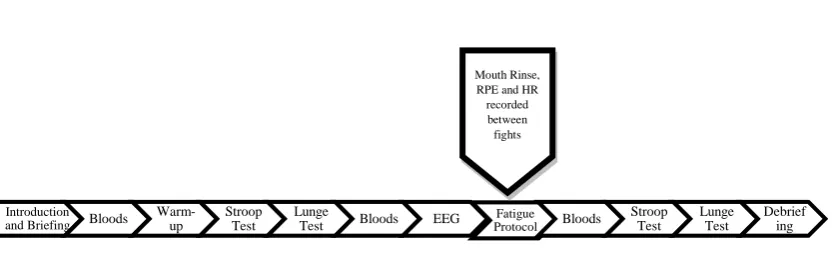
Each participant completed two trials involving a fencing specific skill-test and a
cognitive function test both before and after completing a fencing fatiguing protocol
(Figure 1). All fencers used their own protective equipment and swords, which
replicated the full equipment they used when competing. Baseline blood glucose and
blood lactate were obtained upon arrival, at the laboratory for each trial followed by a
self-directed 5-minute warm-up of moderate intensity, consisting of 2 minutes of
jogging, 2 minutes of stretching and 1 minute of footwork.
Following the warm-up participants completed a cognitive function test and skill-test.
Further blood glucose and blood lactate measurements were collected via a capillary
sampling (20µl) at the finger. The fatigue protocol simulated a series of six fights
replicating the first round of a standard epee fencing competition (Bottoms et al., 2009).
After each fight during the fatigue protocol heart rate (HR) was recorded using a polar
heart rate monitor (f51) and ratings of perceived exertion for the sword arm (RPEarm),
legs (RPElegs) and total (RPEoverall) were reported using a 20 point Borg scale (Borg,
1982). The participants mouth rinsed an intervention solution between each fight for 10
seconds before spitting it out into a measuring jug. Blood glucose and blood lactate
samples were taken immediately after the total fatigue protocol had been completed
followed by the cognitive function and skill tests. The subsequent visit followed the
]
Figure 1. A schematic diagram representing the main study protocol.
3.4. Mouth Rinse Solution and Protocol
Participants mouth rinsed 25ml of 6.7% maltodextrin mixed into water (MALT) or a
matched 25ml of Water (PLAC) between each fight during the fatiguing protocol.
Participants were asked to swill the solution around their mouth for 10 seconds before
spitting the solution out into a measuring jug. The total amount of solution spat out was
recorded. At post-test the participants reported they were unable to distinguish between
the two solutions.
3.5. Electroencephalography (EEG)
After consent had been obtained and initial blood samples were recorded the
participants were asked to be seated and remain as relaxed as possible, at which time
two open cup electrodes were placed on the scalp using a conductive gel. The location
of the electrodes at Fp1 and F3 was measured using the International 10-20 System.
The position of the electrodes measured to ensure they were placed at exactly the same
location during both trials. Participants were instructed to close their eyes and relax
before mouth rinsing the intervention solution for 10 seconds. The participants opened
their eyes to spit out the solution. Participants then remained seated with their eyes
Introduction and Briefing Bloods
Warm-up
Stroop Test
Lunge
Test Bloods EEG ProtocolFatigue Bloods
closed for a further 20 seconds. The EEG recordings were taken in a separate section of
the laboratory to ensure noise interference was kept to a minimum.
3.6. Cognitive function Test
The participants performed a stroop test consisting of 40 word-colour combinations,
both incongruent and congruent (E-Prime 2.08). The first trial also included a practice
stroop test consisting of 8 word-colour combinations that served as a familiarisation
period. The total response time and accuracy of answers was recorded.
3.7. Skill Test
The skill test comprised of a lunge test to measure accuracy and speed of hits at a target
on the chest of a dummy. The target measured 8.9 cm and was centrally located on a
fencing dummy. Prior to the test the participants ideal lunge distance was measured and
marked from the position of their front foot and remained constant throughout both
trials. The participant was instructed to lunge at the target as quickly and accurately as
possible for 1 minute replicating an attack in fencing competition. The test is currently
used for talent identification by British Fencing so all participants were familiar with the
test prior to the trials. A total score of lunges, including hits and misses was recorded.
Participants wore their fencing trousers and a t-shirt in addition to their own glove,
mask and fencing footwear.
3.8. Fatigue Protocol
The fatiguing protocol replicated a previously validated laboratory based fencing
replicate the first round of poules in a fencing competition. The work-rest ratio was set
at 1:0.8 as reported in previously published data (Roi and Biachedi, 2008).
The participant started in the on-guard position facing the fencing dummy. The same
starting position was used as employed previously in the lunge test. Participants
performed a series of bouncing movements with a standardized number of arm
extensions, retreats and lunges for a period of 8 seconds before 9 seconds rest. A full
list of the fights can be found in appendix 4. Participants rested for a maximum of 4
minutes between Poules to simulate the rest periods during competition. Participants
wore their own protective clothing, glove, mask, fencing footwear and wielded their
own sword.
3.9. Data and Statistical Analysis
Blood glucose and blood lactate measurements were obtained from Boisen C-Line
Glucose and Lactate Analyser (EFK Diagnostics), which analysed the blood samples.
The total number of hits during the test was recorded pre and post protocol for each
trial. The accuracy of the lunge test was calculated using the following formula: total
number lunges divided by 100 and multiplied by the number of hits on target. Mean
Reaction time and total accuracy to both congruent and incongruent stimuli pre and post
fatigue protocol for both trials was obtained from E-Prime 2.08. HR and RPE
recordings were taken following each fight during the fatigue protocol for both trials.
Statistical analysis of the data was conducted using statistics package for social sciences
lunge test accuracy and speed, stroop test reaction time and accuracy, RPE, and HR
measurements were assessed using a repeated measures two-way (Treatment X Time)
analysis of variance (ANOVA; SPSS v20). Appropriate post hoc analyses were
conducted using a Bonferroni correction to control for type I error. In line with the
recommendations of Cohen (1988) partial eta squared values of 0.01 were classified as small, effect sizes of 0.06 were classified as moderate and 0.14 or above were classified as large. All analyses were conducted with the significance level set at
Chapter 4. Results
Participant characteristics are presented in Table I. Two participants had to withdraw
from testing so their data has been excluded from the Table and all subsequent analyses.
Four out of the nine participants were able to correctly identify both solutions post trial.
The mean amount of fluid expectorated following the mouth rinse in both trials did not
significantly differ from the total amount mouth rinsed (P>0.05). The mean amount of
fluid measured at the end of the trial was 136.89 ± 5.53 and 133.33 ± 3.64 ml for
[image:35.595.107.536.358.423.2]placebo (PLAC) and maltodextrin (MALT), respectively.
Table I. Characteristics of the participants (n = 9).
Age (years) Height (m) Weight (Kg)
Mean (±s) 31.2 1.78 81.4
(±14.3) (±0.08) (±16.5)
Range 18-50 167.48-193.04 65-110
4.1. Electroencephalography (EEG)
After a number of pilot tests and experimental trails the decision was made to exclude
all EEG data from the experiment. The data could not be analysed correctly due to high
levels of interference.
4.2. Blood glucose and lactate
Blood glucose concentrations remained constant throughout both trials, with no
significant effect of time (F(2,16) = 0.712, P = 0.5, ηp 0.49; Figure 2). Blood glucose
concentration was not affected by maltodextrin (MALT) with no significant difference
observed between trials (F(1,8) = 0.634, P = 0.4, ηp 0.07), mean concentrations 4.3 ±
0.8 and 4.4 ± 0.8 mmol l-1 for PLAC and MALT respectively. There was a significant
ηp 0.62; Figure 2). Post-hoc analysis showed blood lactate concentration significantly
increased (P = 0.019; Figure 3) from at rest (1.8 ± 1.7 and 1.2 ± 0.3 mmol l-1 for PLAC
and MALT respectively) to pre-fatiguing protocol (4.2 ± 1.5 and 3.7± 1.9 mmol l-1 for
PLAC and MALT, respectively). However no significant difference was observed
between trials (F(1,8) = 0.123, P = 0.7, ηp 0.01) so MALT had no effect on blood
[image:36.595.166.496.250.415.2]lactate concentrations.
Figure 2. Mean (± s) blood glucose concentrations during exercise for both placebo and MALT.
Figure 3. Mean (± s) blood lactate concentrations during exercise for both placebo (PLACEBO) and maltodextrin (MALT). *Denotes significant increase in blood lactate concentration between resting and pre protocol. 2.50 3.00 3.50 4.00 4.50 5.00 5.50
Baseline Pre Protocol Post protocol
B lood G lu cos e (mmo l. l ¯ ¹) Time PLACEBO MALT 0 1 2 3 4 5 6 7
Resting Pre protocol Post protocol
[image:36.595.115.460.457.671.2]4.3. Perception of exertion and heart rate
The subjects' overall perception of exertion (RPEoverall; 6 to 20 point scale; Borg, 1982)
increased throughout the two trials (main effect of time; F(2,18) = 1.74, P < 0.001, ηp
0.85; Figure 4). Similarly subjects' perception of exertion for the legs (RPElegs)
significantly increased over time in both trials (main effect of time; F(5,40) = 11.564, P
< 0.05, ηp 0.89; Figure 4). However subjects' perception of exertion for the sword arm
(RPEarm) did not change over time (F(2,17) = 0.887, P = 0.5, ηp 0.0; figure 4). There
was no observed difference throughout testing for RPEoverall, (F(1,8) = 1.174, P = 0.310,
ηp 0.12),RPElegs (F(1,8) = 0.565, P = 0.474, ηp 0.06), and RPEarm (F(1,8) = 0.001, P =
0.981, ηp 0.1) between trials. The subjects’ perception of exertion and heart rate for
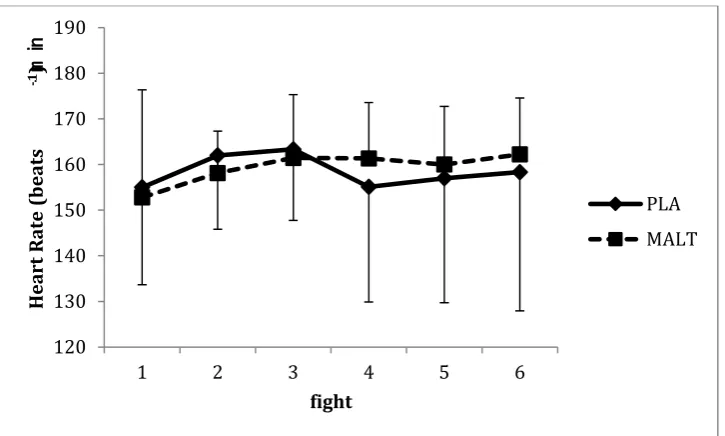
both MALT and PLAC are presented in Table II. A significant increase in heart rate
was observed in both trials between fight 1 and 2, and 1 and 3 (< 0.05; figure 5). There
was no effect of MALT on heart rate, as no difference was observed throughout testing
[image:37.595.112.531.524.589.2]between trials (F(1,8) = 0.026, P = 0.875, ηp 0.003).
Table II. Mean (± s) RPE (Borg Scale) and heart rate during all fights for PLA and MALT trials for sword arm, legs and overall.
Heart Rate
RPEarm RPElegs RPEoverall (beats ⋅ min -1)
PLA 10.9 (±2.3) 13.0 (± 2.4) 13.4 (±1.4) 158 (± 7)
MALT 10.9 (±2.5) 12.6 (± 2.8) 12.6 (± 1.8) 159 (± 4)
Figure 4. Mean (± s) heart rate for PLA and MALT.
4.4. Skill test
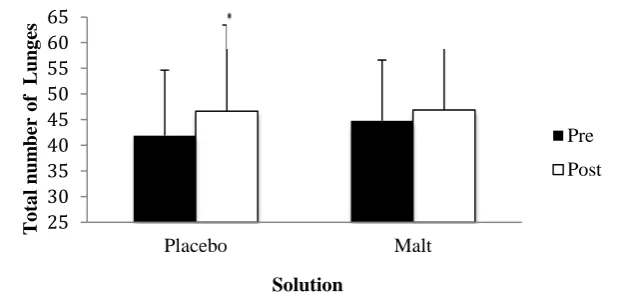
MALT did not affect total skill test scores, as there was no observed difference between
trials, as can be seen in figure 6 (F(1,8) = 0.302, P = 0.6, ηp 0.04). The mean total
number of lunges in both trials increased from 43 ± 12 pre-protocol to 47 ± 15
post-protocol (F(1,8) = 4.182, P = 0.075). However a significant difference was only
observed over time when mediated for trials (F(1,8) = 5.818, P > 0.05, ηp 0.42).
Post-hoc analysis revealed there was a significant increase from 41.9 ± 9.8 to 46.7 ± 12.9
total number of lunges pre-protocol and post-protocol respectively in the PLA trial.
However there was no significant increase in total skill test scores in the MALT trial
(44.8 ± 9.1 and 46.9 ± 4.5 pre-protocol and post-protocol, respectively). Lunge test
accuracy was significantly higher in the MALT trial in comparison to the PLAC (F(1,8)
= 5.214, P = 0.05, ηp 0.40). There was also a large effect size observed, ηp 0.40.
Looking at individual results, 7 participants out of the 9 participants accuracy improved
post-protocol in the MALT trial, whilst 2 out of the 9 participants accuracy improved
post-protocol in the PLAC trial when compared to pre-protocol accuracy percentage.
120 130 140 150 160 170 180 190
1 2 3 4 5 6
[image:38.595.114.477.59.277.2]The mean values of accuracy pre and post protocol for MALT and PLAC are displayed
in Table III. The effect of time on accuracy was not significantly different in both trials
[image:39.595.190.461.187.236.2](F(1,8) = 0.98, P = 0.762, ηp 0.01).
Table III. The mean (± s) hits on target (%) for PLAC and Malt.
Pre protocol (%) Post protocol (%)
PLAC 82.1 (± 8.8) 78.8 (± 6.4)
MALT 81.2 (±8.3) 87.6 (± 9.4)
Figure 5. Mean (± s) number of lunges pre and post fatiguing protocol for placebo and maltodextrin (MALT)
4.5. Stroop test
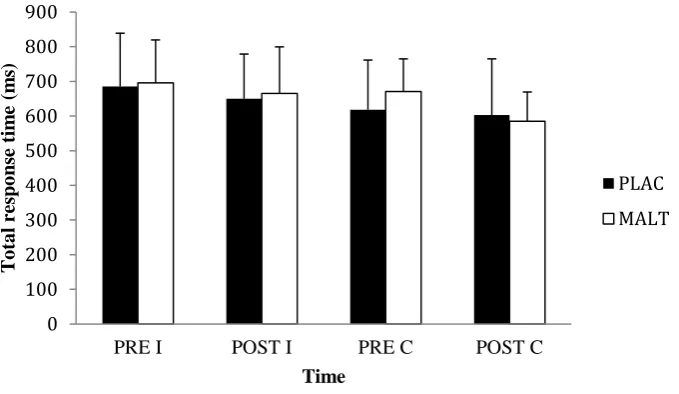
The response time to congruent stimuli was significantly faster post-protocol compared
with pre-protocol in both trials (F(1,8) = 5.414, P = < 0.05, ηp 0.40). Mean response
time were 644.5± 83.9 and 593.7± 91.5 ms pre-protocol and post protocol, respectively.
However there was no significant difference in response time to incongruent stimuli
between pre and post protocol in both trials (F(1,8) = 1.6, P = 0.24, ηp 0.17). Also there
was no effect of MALT on response time, as no differences were observed in relation to
congruent stimuli (F(1,8) = 0.326, P = 0.58, ηp 0.03) or incongruent stimuli (F(1,8) =
0.189, P = 0.68, ηp 0.02) between trials. Figure 7 illustrates the total response time for
[image:39.595.172.484.305.458.2]both congruent and incongruent questions of the stroop test. The accuracy of the
response did not significantly differ throughout this study for both congruent stimuli (V
= 0, F(1,8) = 2.485, P = 0.15, ηp 0.23) and incongruent stimuli (V = 0.089, F(1,8) =
0.780, P = 0.40, ηp 0.09). There was also no observed effect of MALT on accuracy for
both congruent stimuli (V = F(1,8) = 0, P = 1.00, ηp 0.04) and incongruent stimuli (V =
[image:40.595.128.468.254.451.2]0.037, F(1,8) = 0.308, P = 0.594, ηp 0.0).
Figure 6. Mean (± s) pre and post fatiguing protocol congruent (C) and incongruent (I) response times to the Stroop test for both placebo (PLAC) and maltodextrin (MALT).
0 100 200 300 400 500 600 700 800 900
PRE I POST I PRE C POST C
To
ta
l r
es
p
o
n
se
t
im
e
(m
s)
Time
Chapter 5 Discussion
The aim of the present study was to investigate the effect of carbohydrate mouth rinsing
(CMR) on cognitive function and skill-specific performance following a fatigue
inducing fencing protocol on epee fencers. A lunge test was used to measure the
skill-specific performance of the fencers and a stroop test was used to measure cognitive
function. It was hypothesised CMR would improve cognitive function and
skill-specific performance. There was a significant improvement in accuracy during the
lunge test in the maltodextrin (MALT) trial compared to the placebo (F(1,8) = 5.214, P
= 0.05, ηp 0.4). However there were no significant differences in the speed or accuracy
of the response to congruent (F(1,8) = 0.326, P = 0.58, ηp 0.04, and F(1,8) = 0, P =
1.00, ηp 0.00 for speed and accuracy respectively) or incongruent stimuli (F(1,8) =
0.189, P = 0.68, ηp 0.02, and F(1,8) = 0.308, P = 0.594, ηp 0.04 for speed and accuracy
respectively). Indicating that mouth rinsing a carbohydrate (CHO) solution may not be
enough to affect cognitive function.
5.1. Strengths and limitations of the study
The physiological findings in the present study indicate that a suitable protocol was
utilised to fatigue the participants. The results demonstrated a significant effect of time
on ratings of perceived exertion (RPE) overall (F(2,18) = 1.74, P < 0.01, ηp 0.86) and
the legs (F(5,40) = 11.564, P < 0.05, ηp 0.89), which provides support for the validity of
the fencing fatigue protocol utilised in this study. Moreover mean heart rate recorded
post fight 6 in the fencing protocol reached 162 ± 12 beats/min which is similar to the
heart rate ranges recorded during an epee competition (Li et al., 1999). The changes in
blood glucose, blood lactate, ratings of perceived exertion (RPE), and heart rate were all
ergogenic effect of CMR on performance. In particular there was no reported
differences in RPE or heart rate between the CHO trial and the placebo (V = 0.003,
F(1,8) = 0.026, P = 0.875). Furthermore no differences were observed pre-protocol for
the lunge skill test or cognitive function test between trials. Indicating the participants
were suitably familiarised with the protocol as no learning effect was observed. Thus
the likelihood of any performance effect observed was due to the administration of
different mouth rinsing solutions.
The results of the present study are consistent with a number of studies, which have
observed a significant performance effect when mouth rinsing with a CHO solution
(Beaven et al., 2013, Carter, Jeukendrup and Jones, 2004b; Chambers Jones and Bridge,
2009; Fares and Kayser, 2011; Kasper et al., 2015; Lane et al., 2013; Pottier et al.,
2010; Rollo et al., 2008; Rollo et al., 2010; Sinclair et al., 2014; Wright and Davison,
2013). However not all of the studies have found a significant effect of CMR on
performance (Beelen et al., 2009; Clarke, Kornolios and Richardson, 2015; Gam et al.,
2013; Přibyslavská et al., 2015; Witham and McKinney, 2007). The magnitude and
direction of the effect of CMR are influenced by a number of variables, including
training status of the participants, frequency and duration of the mouth rinse, nutritional
status of the participants prior to testing and the mode of exercise. Therefore it was
important the present study controlled these variables to avoid any limitations
highlighted from previous studies.
The importance of the mouth rinse duration was identified by Sinclair et al., (2014) who
observed a potential dose-response effect of CMR on 1-hour cycling time trial (TT)
performance. The results showed a significant improvement in TT performance when
improvement only reached significance when the solution was rinsed for 10 seconds. In
the present study, the oral exposure to the CHO solution was standardised between
trials, i.e., each solution was held in the mouth for 10 s before being expectorated.
Therefore the duration of the mouth rinse was adequate to elicit a performance effect.
Moreover the present study included multiple mouth rinses (n=6), consistent with the
number of mouth rinses utilised in previous studies that have reported a significant
effect of CMR on performance.
The nutritional status of the participants prior to testing has a mediating effect on the
magnitude of results. The present study included a fasting period (> 4 hours) prior to
testing, which is consistent with previous studies reporting a positive effect of CMR on
exercise performance (Carter Jeukendrup and Jones, 2004b, Chambers, Bridge and
Jones, 2009., Rollo et al., 2008). Overnight fasting increases the cortical response to
CHO in a number of brain regions, including the ventral striatum (Haase et al., 2009).
Beelen et al., (2009) suggested overnight fasting reduces the validity of the results as in
a practical setting athletes typically ingest a high-CHO meal 2 hours prior to
competition. They found that CMR did not significantly affect performance when
participants ingested a High-CHO breakfast prior to testing (Beelen et al., 2009).
However two subsequent studies have reported a significant increase in TT performance
when participants mouth rinsed with a CHO solution irrespective of nutritional status
(Fares et al., 2011; Lane et al., 2013). Although the increase in 1-hour TT performance
in the CHO trial compared to the placebo was greater when the participants were fasted
(1.8% and 3.4% for fed and fasted states respectively) (Lanes et al., 2013). It would be
interesting therefore to investigate whether the improvement in accuracy observed in the
The present study is the first to observe a significant improvement in skill-specific
performance following CMR. Much of the research reporting a significant effect of
CMR on exercise performance has measured steady-state performance (Carter et al.,
2004b; Chambers et al., 2009; Fares and Kayser, 2011; Kasper et al., Lane et al., 2013;
Pottier et al., 2010; Sinclair et al., 2014). Whereas previous studies investigating the
effect of CMR on skill-specific performance have observed no significant differences
(Clarke, Kornolios and Richardson, 2015; Přibyslavská et al., 2015). Although it is
unclear why previous studies measuring the effect of CMR on skill-specific sport
performance have failed to reach statistical significance it is possible the measurements
were not sensitive enough to detect the small effect of CMR. The reported performance
effect of CMR on performance is between 1.5 and 3.5% therefore the measurements
used in testing must be sensitive enough to detect an effect. In order to overcome this
limitation the present study reduced the target size to a standardised circle (8.9 cm
diameter) during the lunge test, even though the whole body is a valid target during
epee fencing.
A number of the early mouth rinsing studies have been criticised for not sufficiently
masking the CHO solution. As the benefit of CHO supplementation is widely accepted
it is possible a 'placebo' effect could occur if the participant could identify the correct
solution during testing. Consequently Carter, Jeukendrup and Jones (2004b) could not
exclude the potential of a ‘placebo’ effect on the findings as 6 out of 11 participants
correctly identified the solution. While in the present study 4 participants were able to
correctly identify the solution post testing, indicating no 'placebo' effect had influenced
the results. Witham and McKinney (2007) reported only 1 participant was able to
identify the correct solution when a bitter solution was added to both solutions. The