THE EXPERIENCES OF INTERPRETERS
WORKING IN A MEDIUM SECURE FORENSIC
MENTAL HEALTH UNIT: AN INTERPRETATIVE
PHENOMENOLOGICAL ANALYSIS
Eleanor (Lana) Molle
A thesis submitted in partial fulfilment of the requirements of the University of East London for the degree of Professional Doctorate in Counselling
Psychology
April 2012
DEDICATION
ACKNOWLEDGEMENTS
I would like to express my gratitude to all the interpreters who volunteered to take part in my research, and especially to those who participated. Thank you for sharing your experiences with me, this would not have been possible without you.
Thank you to all the people who have supported me through the process of this research, in particular the staff at the interpreter agencies who so kindly assisted me in circulating my recruitment letter, and went out of their way to find me participants. I am indebted to you.
Thanks also go to my research supervisor, Rachel Tribe, for her guidance and expertise offered on this subject. Many thanks also to my fellow trainees who have provided support, encouragement, advice and guidance throughout this process.
ABSTRACT
People from ethnic minorities are vastly over-represented within forensic mental health services in the UK and Wales. Within one medium secure forensic mental health unit (MSU) in London, 20.48% of patients detained in March 2012 did not speak English. Extensive legislation prescribes that there must be equal access for all to health services. Due to the paucity of bilingual workers, interpreters are a necessity. There are significant gaps in the research literature about the work of interpreters in forensic mental health. The current study set out to explore the experiences and understandings of interpreters who have undertaken interpreting jobs in a MSU. Six interpreters were interviewed using semi-structured interviews, and their accounts analysed using Interpretative Phenomenological Analysis (IPA).
Five super-ordinate themes were identified: (1) Setting the scene: Medium secure forensic mental health units, (2) Unrecognised professional identity, (3) The MSU interpreters: A superior professional excellence or mere mortals?, (4) ‘Catch-22’ and (5) The MSU interpreter and the MSU patient. The results draw together the participants’ phenomenological experiences of working in a MSU, portraying the uniqueness of the MSU environmental setting; the disparaging ways in which the participants perceive that they are viewed; the grounds on which they argue for their occupation to be perceived as a recognised profession; the resulting paradoxical situation in which they find themselves; and the relationship aspects of interpreting for a patient who is detained in a MSU.
CONTENTS
DEDICATION I
ACKNOWLEDGEMENTS II
ABSTRACT III
CONTENTS 1
GLOSSARY 4
INTRODUCTION 5
CHAPTER ONE: LITERATURE REVIEW 9
1.1 INTERPRETERS 9
1.1.1 WHY ARE INTERPRETERS NEEDED? 9
1.1.2 MODELS OF INTERPRETING 10
1.1.3 PROFESSIONAL GUIDELINES 12
1.1.4 INTERPRETERS AND MENTAL HEALTH 12
1.1.5 INTERPRETERS AND THE LEGAL SYSTEM 14
1.1.6 SUMMARY 14
1.2 FORENSIC MENTAL HEALTH SERVICES 15
1.2.1 MEDIUM SECURE FORENSIC MENTAL HEALTH UNITS (MSU) 15
1.2.2 THE FORENSIC MENTAL HEALTH PATIENT 16
1.2.3 THE FORENSIC MENTAL HEALTH WORKER 18
1.2.4 INTERPRETERS AND FORENSIC MENTAL HEALTH 20
1.2.5 SUMMARY 21
1.3 THE PSYCHOLOGICAL AND EMOTIONAL WELL-BEING OF THE INTERPRETER 21
1.3.1 VICARIOUS TRAUMA / VICARIOUS POSTTRAUMATIC GROWTH 24
1.3.2 COMPLEX EMOTIONAL REACTIONS 26
1.3.3 THE ROLE OF SUPPORT, SUPERVISION AND TRAINING 27
1.3.4 SUMMARY 29
1.4 RATIONALE FOR CURRENT STUDY 30
1.4.1 RELEVANCE TO COUNSELLING PSYCHOLOGY 31
1.5 AIMS AND RESEARCH QUESTIONS 32
CHAPTER TWO: METHODOLODY 33
2.1 A QUALITATIVE APPROACH 33
2.2 INTERPRETATIVE PHENOMENOLOGICAL ANALYSIS (IPA) 33
2.2.1 WHY IPA? 34
2.2.2 THEORETICAL PHILOSOPHY 35
2.3 PERSONAL REFLECTIONS ON THE CONCEPTUAL PROCESSES OF THIS STUDY 36
2.4 PARTICIPANTS 37
2.4.1 RECRUITMENT 38
2.4.2 INCLUSION/EXCLUSION 39
2.4.3 THE SAMPLE 40
2.5 CONTEXT 41
2.6 ETHICAL CONSIDERATIONS 42
2.6.2 CONFIDENTIALITY 42
2.6.3 POTENTIAL DISTRESS 43
2.7 DATA COLLECTION 44
2.7.1 SEMI-STRUCTURED INTERVIEWS 44
2.8 DATA ANALYSIS 45
2.9 VALIDITY AND QUALITY 48
2.9.1 SENSITIVITY TO CONTEXT 48
2.9.2 COMMITMENT AND RIGOUR 49
2.9.3 COHERENCE AND TRANSPARENCY 49
2.9.4 IMPACT AND IMPORTANCE 49
CHAPTER THREE: RESULTS 50
3.1 OVERVIEW 50
3.2 INTRODUCTION TO THE THEMES 51
3.3 THEME ONE:SETTING THE SCENE:MEDIUM SECURE FORENSIC MENTAL HEALTH
UNITS. 52
3.3.1 WHERE? WHY? 52
3.3.2 THE UNIQUE PRACTICALITIES OF AN UNIQUE SETTING (A MSU) 54
3.3.3 THE ‘NEED TO KNOW’ GAP 57
3.3.4 POST SESSION PROCESSING 58
3.3.5 OVERALL, IT MIGHT BE NORMAL FOR YOU, BUT NOT FOR US! 61
3.3.6 SUMMARY 62
3.4 THEME TWO:‘UNRECOGNISED PROFESSIONAL IDENTITY’ 62
3.4.1 “YOU’RE JUST AN INTERPRETER. SHUT UP!” (MEHMET: LINES 237-238) 63
3.4.2 “A BIT LIKE I’M NOT WORTH PROTECTING” (VERA: LINE 273) 66
3.4.3 “MOST OF TIME I FEEL LIKE A VOICE MACHINE” (BIBI: LINE 572) 69
3.4.4 SUMMARY 70
3.5 THEME THREE:THE MSU INTERPRETERS:A SUPERIOR PROFESSIONAL
EXCELLENCE OR MERE MORTALS? 70
3.5.1 THE CREAM OF THE CROP 71
3.5.2 “YOU NEED MY PROFESSIONAL SERVICES TO BE ABLE TO PROVIDE YOUR
SERVICE” (BIBI: LINES 248-249) 72
3.5.3 “BECAUSE TRANSLATION IS NOT JUST ABOUT THE WORDS” (VERA: LINE 127) 74
3.5.4 SUMMARY 76
3.6 THEME FOUR:‘CATCH 22’ 76
3.6.1 SUMMARY 82
3.7 THEME FIVE:THE MSU INTERPRETER AND THE MSU PATIENT 82
3.7.1 AN ‘ALLY’ 83
3.7.2 IN-SESSION RELATIONSHIP 84
3.7.3 MAKING SENSE OF THE OFFENCE 86
3.7.4 SUMMARY 88
CHAPTER FOUR: DISCUSSION 89
4.1 OVERVIEW 89
4.2 THE UNIQUENESS OF THE MSU 90
4.2.1 WHAT IS A MSU? 90
4.2.2 THE MSU ENVIRONMENT 91
4.2.3 THE KEY-HOLDER AND THE KEYLESS 92
4.2.4 THE FREEDOM TO LEAVE, AND THE SEARCH FOR SUPPORT AND SUPERVISION
94
4.3.1 RECOGNITION AND RESPECT 97
4.3.2 ELITE, SKILLED AND VITAL WORKFORCE 98
4.3.3 UNAVOIDABLE EMOTIONAL REACTIONS 101
4.4 THE RELATIONSHIP WITH THE MSUPATIENT 102
4.4.1 SUPPORT AND SUPERVISION 104
4.5 CRITIQUE OF THE RESEARCH 105
4.6 CLINICAL IMPLICATIONS 109
CONCLUSIONS 112
REFERENCES 113
APPENDIX 134
APPENDIX 1:INITIAL EMAIL CORRESPONDENCE WITH ONE INTERPRETER AGENCY 134 APPENDIX 2:PARTICIPANT RECRUITMENT LETTER 136 APPENDIX 3:PARTICIPANT DEMOGRAPHIC SHEET 139 APPENDIX 4:UNIVERSITY OF EAST LONDON ETHICAL APPROVAL 140 APPENDIX 5:EMAIL TO NRESQUERIES RE:NHSETHICS 141 APPENDIX 6:PARTICIPANT INFORMATION SHEET 145 APPENDIX 7: INFORMED CONSENT FORM 146 APPENDIX 8:DEBRIEF SHEET AND SOURCES OF COMFORT AND HELP 147
APPENDIX 9:INTERVIEW SCHEDULE 148
APPENDIX 10:ILLUSTRATIVE QUOTES FOR MASTER THEMES AND SUBTHEMES 149 APPENDIX 11:PICTORIAL VIEW OF THEMES 167 APPENDIX 12:IRENA INTERVIEW TRANSCRIPT 171
APPENDIX 13:PAPER TRAIL 207
APPENDIX 14:PROPOSED EXAMPLE INFORMATION BOOKLET FOR INTERPRETERS
WORKING IN A MSU 213
APPENDIX 15:PROPOSED EXAMPLE EXTENDED GUIDELINES FOR MSUSERVICE
GLOSSARY
BPS - British Psychology Society
DoH - Department of Health
HPC - Healthcare Professions Council
MSU - Medium Secure Forensic Mental Health Unit
NHS - National Health Service
NIACE - National Institute of Adult Continuing Education
NICE - National Institute of Clinical Excellence
NRPSI - The National Register of Public Services Interpreters
VPTG - Vicarious Post-traumatic Growth
INTRODUCTION
A few notes to the reader: This thesis only examines the literature and research about
oral
language interpreters due to the specialist literature and differences in practice of sign language interpreters. Whilst sign language interpreters’ experience of working in medium secure forensic mental health units (MSU) is a rich topic worthy of investigation, it is beyond the scope of this study. In this context, the term ‘interpreter’ will be used when referring to an oral language interpreter, and furthermore, unless stated otherwise, the ‘interpreter’ is a Community Interpreter or, as more commonly known in the UK, a Public Service Interpreter1. When stated, a ‘medical interpreter’ is understood to conceptualise an interpreter working in a hospital, mental health setting, or social welfare. A ‘legal interpreter’ describes an interpreter working in courts, police stations, asylum proceedings or other settings involving legal representatives. In the context of this study, when discussing the MSU environment the term ‘patient’ will be used when referring to the individual detained in a MSU. The word ‘patient’, as opposed to ‘client’, ‘service user’, or ‘offender’, was chosen due to its consistency with the literature. At all other times, unless stated, the term ‘client’ refers to an individual receiving a generic mental health service. The mental health professionals working in a MSU will be termed the ‘service provider’.Shortly after I took a junior position in a MSU, a new patient who did not speak English was admitted following the committal of a very violent murder. During the initial few days following her arrival, I was asked to escort an interpreter from the reception prior to a meeting with the patient. Upon arriving at the reception I, following protocol, handed the interpreter the ‘banned items’ list, explaining that if she had any of the items she must
1 The author has drawn upon the National Standard Guide for Community Interpreting
place them in a lockable locker in the reception area. I proceeded to sign the interpreter into the building and issue her with an alarm. Between the reception and the ward to which we were headed, there were no fewer than twelve lockable doors. During our walk to the ward, she turned to me and asked me where she was and why she needed an alarm. I remember feeling shocked that she did not know where she was or the reasons for the banned items, alarm, and lockable doors. I perceived the look on her face to be one of fear and apprehension, and I took the opportunity to attempt to reassure her. Once entering the ward we were immediately called into the meeting. The patient was already present along with several members of the multi-disciplinary team. During the meeting several aspects of the patient’s offence was referred to. It seemed to me that the interpreter was incredibly shocked by what she was hearing and being asked to interpret. Again, I perceived the look on her face to be fear and apprehension. Following the meeting I was asked to escort her back to the reception area. I remember that she was very quiet and I felt unsure as to whether I should ask her if she was ok, or attempt to debrief her in some way. This experience has stayed with me, and I have often found myself thinking of her and what it was like for her, during that interpreting job, and what she thought and felt upon leaving the unit.
interpreter invisible. Granger and Baker (2003) discuss the notion that the existing recommendations regarding work with interpreters are built upon the perspectives of the practitioners and clients, which illustrates how the ‘voice’ of the interpreter remains unseen. These recommendations are often extended rather than tailored to each setting and context where an interpreter works. Recognising this, Fox and Gander (2004) put forward that “ideally, every organisation that employs interpreters on a regular basis should draw up a code of conduct as well as formulate guidelines for best working practices, appropriate to the requirements of the respective institution” (p.6).
Literature has suggested that interpreters may be susceptible to psychosocial consequences when working within mental health settings and / or with survivors of torture and trauma. There is a growing body of evidence regarding the intense emotional reactions experienced by professionals working with perpetrators of crime. Within forensic mental health, discussions inevitably involve the patients’ criminal offence, their history of trauma, and their mental health issues. Therefore, for an interpreter, bearing witness to these stories is an integral aspect of interpreting within this context. As stated by several authors and researchers including Grange and Baker (1996), Lipton et al (2002), Tribe and Raval (2003), and Valero-Gracés (2005), research exploring the experiences of interpreters, from the interpreters’ perspective, is widely called for in order to contribute to our existing knowledge. Furthermore, in line with Fox and Gander’s (2004) recommendations, explorations into the various settings within which interpreters work would allow for the development of tailored guidelines for each individual institution.
CHAPTER ONE: LITERATURE REVIEW
Throughout this chapter, in the absence of primary research and literature about interpreters working in a medium secure forensic mental health unit (MSU), the author has drawn upon the available literature and research relevant to interpreters in other settings, obtained through a systematic literature review. Alongside this, literature and research pertinent to other practitioners working within forensic mental health has been reviewed in the hope of cautiously extending it to interpreters working in this setting, and in seeking clues as to what primary research in this area might reveal. Furthermore, information significant to a MSU setting is provided, portraying an overall picture of a MSU environment and the patients who are detained within such settings.
1.1 Interpreters
Whilst there has been an increase in empirical research and literature about the use and role of interpreters over the past ten years, there remains a divide between theory and practice.
1.1.1 Why are interpreters needed?
It is important for mental health practitioners to be aware of the reasons why an interpreter may be needed. Statistics relating to the number of individuals that might require the services of an interpreter have been sourced. According to the 2001 census2, 4.6 million individuals in the UK identified themselves as belonging to an ethnic minority. The census portrays that more than a quarter of the population in London is from a minority ethnic group; indicating that London is the highest ethnic minority area in the whole of the UK. The 2007 survey by the National Institute of Adult Continuing Education (NIACE) specifies that two out of five adults in
2 The 2001 census is currently the most up-to-date record of the ethnic composition in the
London do not speak English as their ‘mother tongue’3. The Office for National Statistics Psychiatric Morbidity report (2001) declared that one in four adults experience at least one ‘diagnosable’4 mental health problem each year.
Extensive international and national legal legislation such as the Race Relations Amendments Act (2000) and the Human Rights Act (1998), advocate that there must be an equal access to legal and health services. Due to the relative paucity of bilingual workers (Hodes & Goldberg, 2002), and the statistics illustrated above, it can be deduced that at some point an interpreter will be needed in order to facilitate communication and avoid discrimination for non-English speakers, thus ensuring equal access to mental health services.
1.1.2 Models of Interpreting
There are several models of interpreting outlined and described through the literature. Of these models, Tribe (1998) helpfully recommended four, for the purposes of mental health work: Linguistic; psychotherapeutic / constructionist; health advocate / community interpreter; and bicultural worker. The linguistic model conceptualises the interpreter as a neutral transmitter of a message who assumes a distanced position. The expectation is for the interpreter to translate the information, where possible, word-for-word without asking questions or getting involved in any type of discussion (Cushing, 2003; Tribe, 1998). The psychotherapeutic / constructionist model places emphasis on the meaning of the words or the feeling behind them. This model expects an interpreter to primarily convey these meanings / feelings rather than interpret word-for-word (Tribe, 1998b, 1999; Raval, 2003). The health advocate / community interpreter model places the interpreter in the role of advocate for the client, representing their interests alongside aiding them in communicating with
3 The Oxford Dictionary defines ‘mother tongue’ as “the language which a person has
grown up speaking from early childhood”.
4 In this context, ‘diagnosable’ is understood to mean that the individual has met the
the service provider (Tribe, 1998; Baylav, 2003; Razban, 2003). The bicultural worker model sees the interpreter as responsible for communicating and sharing any relevant cultural or contextual variables alongside interpreting the language (Tribe, 1998; Drennan & Swartz, 1999).
Theoretically, each of these models has a relevant and beneficial place when working with an interpreter, but which model to choose for which context needs some consideration. Baylav (2003) argues that no one specific model can adequately meet the needs of the client and service providers, and therefore the interpreter should be able to integrate and employ these models flexibly. There is an on-going debate as to which of these models is the most beneficial in mental health work for individuals requiring an interpreter (e.g. Grange & Baker, 2003; Hsieh, 2008).
1.1.3 Professional Guidelines
Applied psychologists in the UK are regulated by the Health Professions Council (HPC), and are Chartered by the British Psychology Society (BPS). They are expected to adhere to specific Standards of Conduct and Codes of Practice. Mental health practitioners and psychologists working within NHS settings are expected to implement the National Institute of Clinical Excellence (NICE) guidelines to ensure that the care they provide is based on the best evidence available. Currently, there are no mandatory nationally recognised guidelines or standards for the various mental health practitioners when working with interpreters, for the agencies with whom interpreters sign, or, for the interpreters themselves. There are several versions of ‘good practice’ guidelines for working with an interpreter, and between each set of guidelines there are several, albeit often slight, differences in the considerations outlined when working with an interpreter. The extensive BPS ‘good practice’ guidelines for working with interpreters, developed by Tribe and Thompson (2008), are significant in detailing the issues that need to be considered by psychologists when working with interpreters. These guidelines state that all psychologists should be educated in working with interpreters; and Tribe and Thompson (2008, 2009) contend that in order to work effectively with interpreters, all clinicians should receive training as a core part of their professional training. Conversely, as highlighted by Raval and Smith (2003), many prequalification mental health training programmes have little or no training specifically with regard to work involving interpreters.
1.1.4 Interpreters and mental health
1997, Bot & Wadensio, 2004). It is common for therapists to view the therapeutic relationship with the client as perhaps the most effective tool in the therapeutic collection, and the vehicle for change. With this in mind, several authors have agreed that when an interpreter is present, it is of far more benefit to view them as part of a three-way relationship rather than viewing them as a neutral shadowy presence who merely translates (e.g. Baker & Briggs, 1975; Westermeyer, 1990; Tribe & Thompson, 2009). Several authors contest this however, and maintain that the interpreter should retain their role as a neutral translator (e.g. Marcos, 1979 and Warfa & Bhui, 2003). This literature, and empirical research in this area, has enabled a greater knowledge of the limitations of working with an interpreter, providing insight in to how they can be overcome. Furthermore, it has highlighted the vastly different roles that interpreters can undertake, the impact each of these roles may have on the therapeutic process, and, perhaps most importantly, the benefits of working with an interpreter in a therapeutic triad.
is not suitable. She contends that interpreter educators must appreciate the unique requirements of the mental health environment, and makes a case for the development of the personhood of the interpreter by such educators, training them to promote an understanding of their role in this triad and the complexities of mental health work.
1.1.5 Interpreters and the legal system
The literature pertinent to the role of the interpreter in the legal system has a predominate focus on the role of the interpreter in court. There are little references to the role of the interpreter in other legal settings such as prisons. Furthermore, this literature has chiefly explored the ethical and validity issues when an interpreter is present as opposed to the impact this work has on them (e.g. Maddux, 2010). Such literature has contributed to a deeper understanding and knowledge of the limitations and threats to validity of interpreter-mediated forensic evaluations, interviews and court hearings. But again, this literature remains somewhat incomplete due to the relatively absent voice of the interpreters themselves. Guidelines for interpreters in legal settings state that interpreters should interpret in the first and second person, as if they did not exist (e.g. Colin & Morris, 2001). However, research has shown that often an interpreter will switch from speaking in the first-person to speaking in the third-person when interpreting acts of sexual deviancy and extreme violence (Maddux, 2010). This suggests a difficulty for the interpreters to manage ‘becoming’ the voice of the offender when s/he has committed such violent and horrifying acts. Tribe (2005) duly suggested that legal processes themselves could be intimidating and frightening for anyone coming into the system. What is suggested is that there is a need for prior information and specific training for an interpreter to work in a legal setting.
1.1.6 Summary
health and legal services for all. What is clear within the literature is that the role and position of the interpreter remains ambiguous. Furthermore, that there is a divide between theory and practice, and several significant gaps and areas for further development within our current knowledge and understanding.
1.2 Forensic Mental Health Services
“Working in organizations, whatever their size or task, has an emotional impact on those within them and few organizations are more emotionally challenging than those tasked with the care of highly traumatized and traumatizing forensic patients” Tuck (2009, p.43)
Forensic mental health services provide care for individuals who have committed an offence, pose a significant danger to the public, and have a serious mental illness. In England and Wales, there are currently approximately 4,500 secure5 forensic in-patient beds. According to the Ministry of Justice6 statistics on mentally disordered offenders, within England and Wales in 2008, 3,937 individuals were detained in a secure hospital on a restriction order7 (Ministry of Justice, 2010).
1.2.1 Medium Secure Forensic Mental Health Units (MSU)
The Department of Health (DoH) define a MSU as providing “a safe clinical and therapeutic environment for patients who may present a serious danger to others and to themselves but do not need the physical security arrangements of a high security hospital” (p. 7). MSUs provide the second tier of secure care services in the UK, and both the NHS and the independent sector provide medium secure forensic mental health beds.
5 This refers specifically to high and medium secure facilities
6 The Ministry of Justice is the Government department responsible for the criminal
justice system in England and Wales (Justice, 2012).
7 This refers to Section 41 of the Mental Health Act 1983. When imposed, alongside other
There are currently around 65 MSUs in England, and although different in design, they each meet specific criteria in environmental design and security measures. A MSU must uniquely have, amongst other things, a secure perimeter comprising of a 5.2 meter fence and contain only essential gate entry points encompassing an ‘air-lock’ system; windows that cannot open more than 125mm; a fully integrated alarm system with each member of staff securely carrying an alarm at all times; for each member of staff to carry secure keys which open the locks within the unit but are not able to grant access to the outer door of the reception airlock; finally, at any point within the confines of the unit, there must be at least two lockable doors separating the patient and the outside world8.
1.2.2 The Forensic Mental Health Patient
Individuals detained in a MSU are commonly, although not always, under the jurisdiction of the Ministry of Justice and on a restriction order. Unlike detention in a generic mental health service, where an individual can be discharged via their Responsible Clinician, the Mental Health Act Managers, the Tribunal or their nearest relatives application, an individual detained on a restriction order can only be only be discharged by the Secretary of State for Justice.
In 2007, 88% of patients detained in secure forensic mental health units were male with over half committing ‘violence against the person’ (murder) or ‘sexual offences’9. It is important to acknowledge that the forensic mental health patient is both a perpetrator and a victim. Bose (2009) reminds us that their histories commonly incorporate terrifying and unrelenting trauma and negative developmental antecedents, usually including a combination of neglect, inconsistent care, abandonment or loss, emotional, physical and sexual abuse. Coid (1992), provided a suitably illustrative account, indicating that 80% of offenders with mental
8 For further information please see DoH, Environmental Design Guide for Adult Medium
Secure Services, 2011.
9 Statistics taken from The Sainsbury Centre for Mental Health, Forensic Mental Health
disorders had suffered some form of abuse, neglect or exploitation in their formative years. Alongside their traumatic histories and offending behaviour, these patients have a complex and enduring mental illness. A psychodynamic framework offers one perspective that allows for the complexities of this patient group, and the complex emotional reactions of those working alongside them, to be understood. McGauley (2002) contended that this group of patients have fragmented or un-integrated internal worlds and their offence could be understood as the acting out of the aggressive and intolerable aspects of their internal world. Bose (2009) suggests that forensic patients “may be unable to contain their conscious and unconscious emotions and phantasies of fear, rage, anxiety, insecurity and vulnerability” (p.106), and often employ very primitive unconscious defence mechanisms such as repression, projection, projective identification and splitting (Freud, 1946; Klein, 1975; Hinshelwood, 1989, 1994). Kay (2009) proposed that due to these defence mechanisms and the offending behaviour, the forensic mental health patient can often become a ‘hateful’ patient. However, these patients are often extremely distressed and confused due to their mental illness, and the purpose of detainment in a forensic service is to provide a therapeutic environment and rehabilitation rather than punishment.
1.2.3 The Forensic Mental Health Worker
Forensic mental health services are influenced by a complex weave of policies and practices. Although therapeutic in nature, they must negotiate the conflicting goals of the ‘caring’ mental health system, and the ‘custodial’ criminal justice system. This clash of cultures can lead to conflict between a) attempting to contain these patients and b) trying to understand their painful and troubled lives. This can contribute to the splitting of forensic mental health teams.
staff, commonly either a fear that they will be destroyed or harmed by the patients aggression / violence, or experiencing horror and repulsion in response to the criminal acts. They too suggest that to manage these countertransferential responses, forensic staff will withdraw and distance themselves from the patient.
Kay (2009) argued that it was common for forensic nurses to state that they did not wish to know anything about the patient’s offence and if they did need to know, they did not seek out details. He highlighted the peculiarity of this, questioning how a patient could be nursed effectively without a concise understanding and knowledge of their forensic history. Kay (2009) contended however that nursing staff would often rationalise it as being none of their business, expressing that it is the role of the psychologist or psychiatrist to know this information. He further suggested that the forensic mental health patient would welcome this dynamic, wanting their primary care giver, in this case the forensic nurse, to stay away from this shameful or difficult part of him or herself. This illustrates how the team can become split.
and the extreme need for regular supervision. Brown and Stobart (2008) usefully highlight that for professionals who do not have the protection of the psychotherapeutic frame available to them, it is far harder to contain any intense and complex emotional reactions in therapeutic relationships and encounters with forensic mental health patients.
1.2.4 Interpreters and forensic mental health
Between March 2011 and March 2012 one MSU in London utilised approximately 970 hours of interpreting services, with 20.48% of the patients requiring the services of an interpreter10. Although only illustrating one specific MSU, which is arguably in the most ethnic diverse area in the UK, if this number were to be approximately multiplied by the number of MSUs in England and Wales, what is portrayed is the vast number of hours in which an interpreter is used so that non-English speaking individuals patients in forensic services can have equal access to treatment.
Within mental health work, there is always the potential that difficult and disturbing topics will be discussed, and, within a legal context conversations surround the offender’s criminal act. Psychological work in forensic mental health settings inevitably involves discussions regarding the patients’ index offence, and their mental health issues. Therefore, for an interpreter, bearing witness to these topics and stories is an integral aspect of interpreting within forensic mental health. To date, the author has been unable to unearth any specific empirical research or literature specifically about the experiences of an interpreter working in a MSU.
Zimanyi (2009) helpfully alerts us that, traditionally, the interpreter role has been classified into two main areas; legal and medical. She usefully put forth that a junction of the two sub-fields should provide food for thought and consideration. Mikkelson (2008) states that it “can be argued that
10 Statistics sourced from the Executive Assistant to Associate Director of Nursing of this
medical interpreters should be held to a different standard than their counterparts in legal settings, given the collaborative nature of most healthcare interactions” (p.85); therefore implying the clear differences between the requirements of the interpreter in these differing settings. Within forensic mental health there are various types of assignments interpreters may be called to undertake, including court-appearances, psychological therapy, ward rounds, and solicitor visits, seemingly merging the requirements of these two previously distinct settings.
1.2.5 Summary
Forensic mental health services are influenced by a complex weave of policies, practices and environmental design. The forensic mental health patient is a complex and demanding patient for whom a forensic service offers rehabilitation and containment. The challenges of working with this patient group are highlighted throughout the literature. An interpreter working within such settings may bear witness to distressing and disturbing stories of trauma, perpetration and violence, and be required to attend various interpreting jobs. However, there is an academic lacuna regarding the experiences of interpreters within the latter distinct setting.
1.3 The psychological and emotional well-being of the
interpreter
emotions or traumatic experiences. Furthermore, they express that it is the practitioners’ responsibility to validate these intense feelings and aide in addressing them. Haenel (1997) usefully outlined some of the intense feelings commonly experienced by interpreters in mental health work, including anxiety, depression, nightmares, paranoia, and boredom. He further proposed that they might also experience feelings of anger, disdain, helplessness, guilt, and failure towards the client.
Granger (1996) identified the lack of research from the interpreters’ perspective and went on to conduct one of the first empirical investigations of the role and work experience of the interpreter specifically from their perspective. The focus of the research was on the interpreters’ experience of working within a service and discusses the implications for service provision. Her research highlighted that the interpreters’ work, as reported by them, is emotionally demanding and that they receive little support to manage it. This research made a valuable contribution to understanding the interpreters’ perspective in relation to their role and their previous, current and future work experience. However, there remained a lack of understanding or knowledge regarding the interpreters’ experience of the impact of sharing information, and how these reported ‘emotional demands’ are experienced and described by the interpreter, which would enhance future research.
resulting from their work into their awareness. Not all interpreters have undergone such training, specifically within the UK. Therefore, further research focusing on interpreters without such mandatory training would add to these findings.
Valero-Garcés (2005) presented four quantitative studies, whereby either professionals working alongside interpreters, or interpreters themselves, completed surveys. She discussed the emotional and psychological effects on interpreters working in these settings, and identified that because the interpreters find themselves in a context whereby they are the sole person who understands the client, there is a tendency for an intense emotional relationship to build. Each of the four studies individually highlighted that interpreters report negative emotional consequences of their work. Whilst the presented studies all make a contribution to our knowledge regarding the emotional and psychological effects on interpreters, due to the approach used, the information gathered reduces the experiences of the interpreters to predetermined values. It would be of further benefit to explore these interpreters’ understandings of their experiences by including some qualitative methods such as an interview.
information about how the knowledge that the patient
does
potentially pose a risk of violence impacts on interpreters, in order to enhance our understanding of how they manage the demands of interpreting in environments such as a MSU.1.3.1 Vicarious trauma / Vicarious Posttraumatic Growth
There is a wealth of literature stating that professionals working with clients who have experienced torture and / or trauma in their lives need to absorb this information in order to gain a deeper understanding of the clients’ experience. Lipton et al (2002) assert that this deep level of empathic listening has been found to have consequences on the psyche of the professional. Amongst this research, the concept of vicarious traumatisation (VT) is raised, which Figley (1995) defines as: “The natural consequent behaviours and emotions resulting from knowing about a traumatising event experienced by a significant other. It is the stress resulting from helping or wanting to help a traumatised or suffering person” (p.7). In other words, VT is the negative psychological change in people that happens following vicarious exposure to trauma. It is suggested that the use of supervision and support can reduce the risk of VT and other issues affecting the individual psyche. Without such, individuals are open to VT, due to an inability or lack of knowledge as to how to integrate the information shared appropriately (Lipton et al, 2002).
Research into VT has predominately looked at professionals working with trauma and torture victims. However, several studies and authors have begun to demonstrate that individuals who work with the perpetrators of trauma, torture, sexual abuse and violence are just as susceptible to VT as their counterparts working with victims (e.g. Steed & Bicknell, 2001; Rich, 1997; Way et al, 2004; Levin & Greisberg, 2003; Fischman, 2008).
changes in interpreters, it is important that it is viewed as preliminary, and that further research is necessary.
1.3.2 Complex Emotional Reactions
It has long been asserted that interpreters are likely to be the subject of emotionally charged information, and become the object of transference, projection, displacement or triangulation (Harvey, 1984; Culcross, 1996). However, unlike therapists, interpreters do not tend to be trained to understand the complexities of working with severe psychological trauma and the corresponding patient presentations, and therefore may not have a theoretical framework to make sense of what happens to them (Brown & Stobart, 2008). Due to this lack of theoretical framework to manage and recognise the identification process and countertransferential feelings, Butler (2008) contended that interpreters are more vulnerable to identification with clients than therapists. Furthermore, by using the first person when interpreting, there may be an intensified impact of the trauma on the un-expecting interpreter who might not be trained to have the skills to manage the powerful feelings evoked in them. Pazdirek et al (2001) contended that it is problematic to label the emotions directed from the client to the interpreter, from the therapist to the interpreter, and what the interpreter experiences when interfacing with each of them. They found that within the triad, it was difficult to fully understand these processes, and thus decided to move away from labeling them as transference and countertransference, instead referring to them as ‘complex emotional reactions’.
Way et al (2004) argued that those treating sex offenders need to manage strong emotional reactions including anger, anxiety and disgust when hearing about the clients’ traumatic material of perpetration and deviant fantasies; whilst also trying to remain helpful, appropriately empathic and professional. These intense countertransferential responses to the material, including an increasing awareness of one’s own potential for violence, can be extremely disconcerting for the professional (Bengis, 1997; Mitchell & Melikian, 1995). By extension, this may be problematic and distressing for the untrained interpreter. Therefore, they may employ defence mechanisms similar to those previously described as being employed by forensic nurses, such as distancing, denial, and detachment. The limited research on interpreters in mental health work has shown that, similar to that found of forensic nurses, distancing is used as a means of coping against over-identifying with clients as well as reliance on supervision, social support, and practical coping strategies (Butler 2008; Miller et al, 2005).
1.3.3 The role of support, supervision and training
‘Good practice’ guidelines for psychologists working with interpreters state that interpreters are entitled to support and supervision in the same way that mental health practitioners are, and that a duty of care applies (BPS, 2008). The Royal College of Psychiatry standards for MSUs outline that all staff working in these settings should receive at a minimum one hour of supervision from a person with appropriate experience each month, and that for junior staff this should be one hour weekly. Furthermore, it states that there should be regular staff support groups ideally occurring on a weekly basis.
difficulties in managing the emotional impact of their work in mental health settings, particularly without the support and supervision that is so fundamental and available to the practitioner. Costa (2011), who is instrumental in gaining recognition of the need for support and supervision for interpreters, recommended that they should be receiving both managerial supervision and professional support and mentoring. She asserts that interpreters are often bystanders witnessing and communicating intense and distressing material, yet are unable to take any action to provide relief. Doherty et al (2010) recommend from their research that “increased attention should be paid to the support needs of interpreting staff… in order to safeguard interpreter health and well-being and to ensure a high quality of interpreting when working in a mental health context” (p.41).
At this time it is not compulsory for interpreters to complete any form of accredited training in order to carry out clinical and therapeutic work where translation is required (Edwards et al, 2005; Tribe & Raval, 2003). In the UK, in 2012, there are 2,350 interpreters signed to the ‘The National Register of Public Services Interpreters’ (NRPSI), covering 101 languages. This register requires its members to obtain a qualification prior to registration, and to follow a code of conduct. However, presently there is no governing expectation that health services, such as the NHS, should use a member of the register, nor is there any governing expectation that interpreter agencies should only enlist the services of interpreters signed to the register. Some NHS Trusts may offer guidance on the use of interpreters, in which is included the agreement that a recommended interpreting service agency be used. Often this agreement with a specific agency is founded on financial reasons (whichever is the most inexpensive). Therefore, it can be understood that service providers might be utilising interpreters who have not undertaken any formal training or do not hold any formal qualifications relating to interpreting.
practice is either through experience of working in the field for a long period of time, or via private study and training. This is something that they have chosen to undertake in order to provide clear and understood explanations of the mental health system and terminology for their clients, in order to complete their jobs efficiently and effectively. Furthermore, Smith, H (2008) pointed out that whilst certain interpreter agencies may train their staff, this training does not mirror the years of support, training and supervision that enable mental health practitioners to work with the challenges of mental health practice. Fox (2001), providing an illustrative personal account of being an interpreter, suggested that she feels that she often takes on the role of ‘co-therapist’; yet highlighted that she does not feel equipped to undertake this role due to her lack of training, knowledge and expertise in the field.
Lipton et al (2002) usefully highlighted that when training is made available, interpreters are typically trained to pass on the information shared to them (the conduit model) and may only possibly be given training in basic mental health terminology. Training in other basic skills, for example, boundary setting, the potential emotional impact of the work, or confidentiality, is rare. Rosenberg et al (2007) asserted that although acting as a linguistic conduit is an essential element of the role of the interpreter, it does not provide the interpreter with any guidance as to how to manage their emotions. Hsieh (2005, 2008) dovetails this, identifying through her research that the non-emotional aspect of the conduit model troubled the interpreters when negotiating their own emotions, having been faced with an expectation to be emotionless.
1.3.4 Summary
both positive and negative changes to their emotional well being. It is maintained in the literature that like therapists, interpreters become the object of transference, projection, displacement or triangulation. However, unlike the therapist, they might not have the theoretical framework to make sense of what happens to them, and furthermore might not have the levels of support and supervision that is so fundamental and available to the practitioner. This may be problematic and distressing for the untrained, unsupported interpreter.
1.4 Rationale for current study
As discussed throughout this chapter, there remains a dearth of literature and empirical research exploring how interpreters themselves experience their work. Currently, our best practice guidelines are based on the views of the service providers and clients. Whilst they provide us with essential knowledge on ensuring the development of services for those from ethnic minority groups who do not speak our host language of English, they are incomplete. Raval and Smith (2003), concluded their research which investigated the therapists’ experience of working with an interpreter, by stating that much further work is needed in the same area, but with the focus placed on understanding the interpreters’ perspective in order to develop ‘good practice’ guidelines.
research exploring interpreters’ experiences of working in this context would be valuable and an important addition to existing knowledge.
1.4.1 Relevance to Counselling Psychology
Counselling psychologists strive to develop flexible, reflective and critical approaches to traditional psychological theory. We recognise social contexts and discrimination within our work and society, and strive to work in ways that “empower rather than control and also demonstrate the high standards of anti-discriminatory practice appropriate to the pluralistic nature of society today” (BPS, Professional Practice Guidelines, p.2). In order to provide equal opportunities to access legal and health services, it will be inevitable that the use of an interpreter will be needed. Currently there are no mandatory guidelines for working alongside interpreters, and the guidelines that do exist are extended rather than tailored to each setting and context.
self and clients, but also to colleagues and to society. Without a firm appreciation of the interpreters’ perspectives, we are unable to review existing strategies, literature and guidelines or understand how best they can be enhanced.
1.5 Aims and research questions
This study aimed to gain an in-depth understanding of the experiences of interpreters who interpret information in a MSU setting. To date there is a paucity of explorations into the experiences of interpreters from their perspective, and an academic lacuna relating specifically to interpreters working in forensic mental health. Since so little is known about an interpreter’s experience in this particular context, it is important to acknowledge that there were no specific hypotheses to be investigated. The main research question was therefore:
‘What are the experiences of being an interpreter working in a medium secure forensic unit?’
Related to this main research question, the following areas were explored:
CHAPTER TWO: METHODOLODY
This chapter provides the rationale for the decision to use Interpretative Phenomenological Analysis (IPA), describes the participant recruitment, data collection and analysis, and outlines the steps taken to meet research quality guidelines.
2.1 A qualitative approach
As revealed in Chapter one, there is a paucity of research looking at the experience of interpreters specifically from the interpreter’s perspective. To date there has been no literature unearthed by the researcher concerning interpreters who have worked in forensic mental health. Barker et al (2002) assert that qualitative approaches are ideally suited for in-depth explorations into individual experiences – particularly in novel areas – to develop hypotheses. The rationale for this study was to explore the subjective experiences of interpreters, with a particular focus on their experiences within a medium secure forensic mental health unit (MSU). In order to enable the understanding sought by this research, the use of a qualitative method potentially makes possible the exploration of meanings and perceptions from the perspective of the participants.
2.2 Interpretative Phenomenological Analysis (IPA)
for the choice of IPA over another qualitative methods. The three areas of the philosophy of knowledge underpinning IPA will be briefly outlined and their connections to IPA are illustrated.
2.2.1 Why IPA?
Prior to deciding upon IPA as the chosen method, other qualitative methodologies were considered. If the intention of the research had been concerned with how particular versions of reality are manufactured, negotiated or deployed in conversation, methodologies from a more relativist social constructionist perspective such as discourse analysis, as described by Potter and Wetherell (1995) and narrative analysis, explained by Reisman (1993), could have been useful. These methodologies produce knowledge about how particular versions of reality are brought into ‘being’ through the use of language, and explore the power structures in language.
Although similar to IPA in its approach to analysis, and having some common techniques in producing data, Glaser and Strauss’ (1967) Grounded Theory (GT) endeavours to develop an explanatory framework of a phenomenon. Starks and Brown Trinidad (2007) described grounded theory as a candidate for use when researchers want to build a theory or explanatory model of contextualised social processes. It allows for the discovery of theory from systematically obtained and analysed data. Willig and Rogers (2008) argue that rather than focusing on individual experience, grounded theory focuses on capturing social processes, thus making it less suitable for this particular research project.
2.2.2 Theoretical philosophy
The first philosophical underpinning of IPA is ‘Phenomenology’. Phenomenology concerns itself with the variability and diversity of human experience (Willig, 2001). It is concerned with the ways ‘how’ an individual experiences a phenomenon, and the meanings that are ascribed or hidden within them. IPA is influenced by phenomenology in its aim to capture and explore the meanings that the participants assign to their experience of phenomena.
Smith et al (2009) draw upon hermeneutics, the theory of interpretation, as the second philosophical underpinning of IPA. As summarised by Willig (2001) IPA acknowledges that the way in which people experience and understand events is influenced by the meaning that they attribute to it. Thus people can experience the same event or phenomenon in multiple, yet valid, ways. Immersion in the participant’s world is encouraged, and the aim is to attempt to enter their world and understand their reality. However, IPA acknowledges that access to another’s world is complex due to the researcher’s own perspective. The researcher endeavors to examine and share their preconceptions and motivations in the context of the research, aiding the reader to situate their analysis (Finlay & Gough, 2003). Therefore, the interpretation of data unavoidably incorporates both the participant’s and the researcher’s sense-making regarding the phenomenon. Smith et al (2009) described a double hermeneutic process within IPA whereby the researcher is trying to make sense of the participant, who is trying to make sense of their world. Finally, IPA acknowledges that the creation of the interpretative account is repetitive, based on a hermeneutic circle. During the analysis process, one must move back and forth through the data, because in order to understand any given part, one must look at the whole, and in order to appreciate the whole, one must look at the parts (Smith et al, 2009).
concerned with making premature generalisations about larger populations; rather, focusing on saying something in detail about the perceptions and understandings of a small group (Smith et al, 2009). Smith and Osborne (2008) emphasise that IPA is particularly useful when the research focuses on complexity, process or novelty. Given the dearth of literature giving voice to the interpreter, alongside the lack of research into interpreters working within forensic mental health, this dovetails with the aims of this research. Despite promoting the in-depth analysis of only a small number of participants, IPA aims to contribute to existing bodies of literature. Therefore the results generated can be discussed in relation to the wider existing psychological literature (Smith & Osborn, 2008).
2.3 Personal reflections on the conceptual processes of
this study
Throughout the remainder of this chapter, several personal accounts towards reflexivity will be made. For ease of the reader, these accounts shall be highlighted through the use of italics and I will use the first person. Part of the qualitative research process in IPA is for the researcher to understand and present his/her preconceptions about the research (Finlay & Gough, 2003). I hope that these accounts will provide a satisfactory illustration of how my personal interests, values, experiences and ideas have shaped the research process, and help the reader evaluate my perspective and interpretation of the data, ensuring that the research process can be scrutinised throughout.
felt about the material presented and whether there were any processes in place for them to explore or express their feelings outside of the MSU. As a practitioner working alongside them, I felt a duty of care towards my interpreter colleagues, but felt constrained as to how I could fulfill this.
Throughout my training I was exposed to many theoretical perspectives, leading me to challenge my previously held assumptions and beliefs. In terms of epistemology, I disagree with the tenets of the positivist perspective, and I understand that knowledge and meaning is constructed from experience, and that there are multiple socially constructed realities, thus favouring constructivist and social constructionist ideas (Willig, 2001). Through my clinical work, I realised how difficult it was to put aside my ‘assumptions’ about what a client was bringing to therapy, and what their stories meant. This realisation led me to consider that I could never truly understand another individual’s experiences, as my own experiences, beliefs, values, and assumptions, were blurring my view. Therefore, it was vital that I was aware of how they may obscure my practice, thus recognising that my interpretation of their experience would unavoidably incorporate both my own and their sense-making. This recognition was a process critical to not only my clinical work, but also my research project. Throughout the research process, a reflective diary was used to raise my awareness and ensure that I was constantly mindful of such issues.
My experiences working with interpreters in a MSU inspired and shaped this research, illustrating my personal and professional reasons for asking my research question.
2.4 Participants
experiences was theory driven in order to identify important new leads, the paucity of previous research meant there was no justification for the researcher to employ strict criteria concerning the categories outlined above. A purposive sample was used, and all of the interpreters were oral language interpreters who had worked in a MSU, which established homogeneity.
I was aware of the potential impact that not employing strict criteria regarding the interpreters’ ages, ethnicities, levels of training, and lengths of time practicing may have on the data set. However, after much consideration and discussions with my supervisor, I decided that the restriction of these categories would cause not only pragmatic difficulties in recruitment, but could potentially restrict the findings of the research, since the aim of my research was to develop hypotheses in this novel area. It was also thought that by exploring the experiences of one particular age group or ethnicity for instance, the research would be inviting a comparison to another group, which did not suit my aims.
2.4.1 Recruitment
As interpreters typically work on a freelance contract, initial contact was made with the head of two interpreter agencies, which were known to be the largest agencies within the catchment area of two MSUs within the London area. The research was outlined and discussed with the heads of the agencies, who agreed to assist with recruitment. This agreement was based on the guarantee of organisation and interpreter anonymity. A record of this correspondence is provided in appendix one. Alongside the email distributing the participant information letter (appendix two) to the interpreters signed to their agency, the agencies explained that they would include a statement expressing that their email that taking part would in no way impact current or future employment with the agency.
had no experience working in a MSU also volunteered. This may have been a reflection of the relatively long participation information sheet, so the interpreters may not have fully read it. Therefore sending out a briefer information sheet for the initial contact may have been preferable. A reminder email was sent out six weeks after the first, which generated four more participants who met the criteria needed to participate. Smith et al (2009) recommend that for a doctoral research project, between four and ten participants “seems about right” (pg 52). Due to the decision that between six and eight participants would need to be recruited, a final reminder email was sent out by the agency. From this, one further participant volunteered and it was decided to stop recruiting in order to have sufficient time to analyse the transcripts. Smith et al (2009) remind us that it is “important not to see the higher numbers as being indicative of ‘better’ work”(pg. 52).
I felt frustrated at the lack of uptake in the initial stages, and restricted by my decision to only approach agencies in the surrounding areas of only two MSUs, given the number of units within the UK. I was reassured by the support offered by the agencies who all put forth great efforts in spending time painstakingly sorting through previous contracts in order to obtain a list of interpreters who had previously worked in a MSU. Furthermore, they ensured that an information letter was sent to any interpreter who was due to undertake a job in a MSU in the upcoming days and weeks. This meant that two of the accounts given were the participants’ reflections of a very recent experience in a MSU.
2.4.2 Inclusion/exclusion
Due to the researcher’s employment within a specific female specialist MSU, it was planned that interpreters who had experiences working within this unit would be excluded. However, none of the participant candidates needed to be excluded on this basis.
2.4.3 The Sample
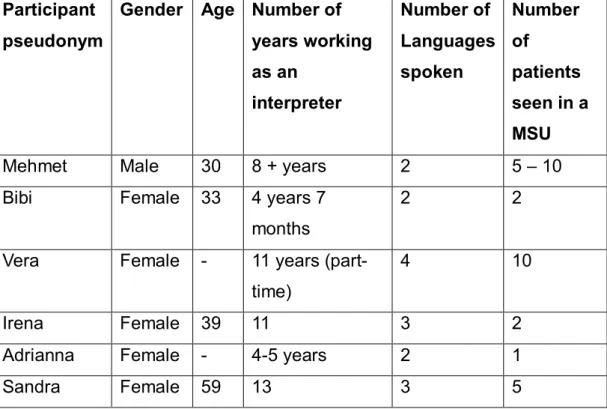
The participants were asked to complete a brief demographic form at the beginning of the interview (appendix three). The sample was compiled of six interpreters (one male, five female) who had interpreted for at least one patient in one of two MSUs in London. Each had worked as an interpreter for between four and thirteen years. The interpreters were aged between 30 and 59 years of age, although two of the participants did not disclose their actual age. All of them worked on a freelance basis for agencies in London. The participants were; Spanish, German, Turkish and Polish, between them speaking; Turkish, Polish, German, French, Spanish, Russian and English. All but one of the participants identified English as their second language.
Table 1: Participants characteristics and demographics
For purposes of confidentiality all names have been changed, and anything that could potentially identify a participant has been omitted.
Participant pseudonym
Gender Age Number of years working as an
interpreter
Number of Languages spoken
Number of
patients seen in a MSU
Mehmet Male 30 8 + years 2 5 – 10
Bibi Female 33 4 years 7
months
2 2
Vera Female - 11 years (part-time)
4 10
Irena Female 39 11 3 2
Adrianna Female - 4-5 years 2 1
Sandra Female 59 13 3 5
2.5 Context
In 2007, within the forensic inpatient population in East London, 15.8% were Asian, 49.3% Black and 31% White. The forensic services in East London provide 118 beds for male medium secure forensic inpatients, and 15 beds for women. Of the total patient population in East London, in 2007, 18.8% indicated that English was not their first language11. The forensic services in North London provide three purpose built MSUs housing 140 beds. In 2009, 9.24% of forensic inpatient population indicated that they required an interpreter12.
11 Statistics sourced from ‘East London NHS: Interpreting, Translation and Sign
Language Services Report, 2008’.
2.6 Ethical considerations
Ethical approval was granted from the University of East London’s research committee (appendix four). The National Research Ethics Service (NRES) advised that this research did not require ethical review by a NHS Research Ethics Committee. Supporting documentation is shown in appendix five.
2.6.1 Informed consent
The participant information sheet (appendix six) outlined the research aims and procedures of taking part and detailed the steps taken to ensure anonymity, reinforcing that participation would have no bearing on their current or future work with their agency or within a MSU. Because this information sheet provided the basis of the letter inviting them to participate, potential participants could consider this information prior to volunteering. Once they had made contact with the researcher, an opportunity for further questions to be asked was given, prior to arranging a time to interview. Upon meeting, it was ensured that the participant had fully understood and considered the information outlined and a verbal account of the information was provided. A consent form was given to each participant to read (appendix seven). They were then given another opportunity to ask any further questions prior to being required to sign the consent form. Each participant was reminded of his or her right to withdraw from the study at any time up to three months after the interview date. This time limit was set to ensure that the researcher was not left without any usable data during the critical write-up period prior to submission. The participants were reminded that they did not need to give any reason should they wish to withdraw, and the procedure for destroying the interviews and corresponding transcripts and analysis was explained.
2.6.2 Confidentiality
distribute the participant information sheet to all interpreters, and should an individual wish to participate, they could then volunteer directly via the details made available. Furthermore, by volunteering directly, the interpreter could be further assured that their participation would have no impact on their employment with their agency, and the names of any interpreters agreeing to participate would not be disclosed to the agency.
Confidentiality was fully outlined to the participants. They were informed that although verbatim quotes would be used in the write-up, all identifying information would be removed, and a pseudonym would be assigned to them. In the transcription of interviews, any information that could lead to their identification, and all third parties and place names, would be omitted. Participants were informed that the transcribed interview would be stored under their pseudonym, and all data (including demographic information, recordings and transcripts) would be kept in a lockable storage device, with any identifiable information stored separately. All participants were informed of the circumstances under which confidentiality could be broken; namely in the event that the researcher thought that the participant may be of risk to themselves or others.
2.6.3 Potential distress
list of sources of support should they require them (appendix eight).
2.7 Data collection
2.7.1 Semi-structured interviews
The limits imposed by specific questions in a pre-designed research questionnaire may confound the complexities of emotions and meanings (Robson, 1999). Semi-structured interviews lend themselves more easily to capturing these complexities, and are considered the exemplary method of data collection for IPA (Smith et al, 2009). A semi-structured interview schedule (appendix nine) was designed to guide, rather than dictate the interview in order to facilitate the participants in telling their story in their own words. As suggested by Smith et al (2009) this schedule was used flexibly and was delivered in an open-ended and non-directive style in order to allow for unanticipated areas that arose to be explored, and to follow the participants’ line of thought. All bar one of the interviews took place in a meeting room at the University of East London. One participant asked if the interview could take place at her home, and this was agreed upon. Interviews lasted between 45 minutes and 1 hour 10 minutes and were audiotaped. Following each interview, the researcher made extensive notes in order to record any reflections on the interview process. All the interviews were transcribed verbatim by the researcher.
about them. During the interviews, I felt anxious about some of the highly emotive and personal material they were sharing, but quickly realised that the participants wished to talk about important experiences they had encountered, and wanted to find a place to explore and process them. The participants were aware prior to agreeing to the interview that I was trainee psychologist, and I wondered whether the participants may have used the interview context as an opportunity to be heard, due to their existing construction of the role of a psychologist. Due to this construction and the participants’ experiences of having an inside view of psychological therapy sessions when interpreting for patients, they may have had unconscious preconceptions about what the interview would entail and what was expected of them. One of the participants, following the admission of a very highly emotive personal experience, expressed that she did not like disclosing her personal matters to people, due to a dislike of being in a position where somebody knows information about her that is not reciprocated. This interview was participant led and can therefore be identified as a ‘one-way’ relationship. I reflected on this after the interview and wondered what this could mean about how she had perceived the interview, and me.
2.8 Data Analysis
IPA was utilised to analyse the transcripts of the semi-structured interviews. Guidelines for ensuring quality in qualitative research further informed the analytic process (e.g. Spencer et al, 2003; Yardley, 2000). IPA is not deemed to be a prescriptive approach, however; Smith et al (2009) provide a set of flexible guidelines in approaching analysis.
By listening to the tapes of the interviews, I hoped to place myself closer to the words spoken in order to connect with the text. It provided the opportunity to remind myself how I was feeling at specific points during each interview and I noted this alongside the transcript. It further allowed me to understand the tone of the participant’s voice and how this linked to what they are saying. For example, in one interview, one of the participants was expressing what could be lost when interpreting if the interpreter does not convey the meaning behind the words. She exampled sarcasm and repeated a phrase twice, first using a ‘neutral’ and second a ‘sarcastic’ tone. This may not have been picked up on if I had only read the text, without the audio playing alongside.
During this initial stage of reading and re-reading the transcriptions, notes were made in the left-hand margin of initial thoughts about the content, language use and any interesting or significant things the participant said (Smith et al, 2009), in order to begin to uncover new insights and preliminary interpretations. Emergent themes were then written in the right-hand margin of each transcript. This second stage involved the move to a higher, interpretative level of concepts, although remaining grounded in the actual accounts and words of the participants.
This part of the analysis was the most rewarding and I began to feel that the months of frustration, anxiety and effort during the initial research and recruitment process was worthwhile. I was excited by what was emerging, but was aware that it did not fit the assumptions borne from my experiences. It was clear that I needed to put aside these assumptions and not ‘search’ for evidence of them within the transcripts, rather, remaining true to the account