BIROn - Birkbeck Institutional Research Online
Kontchakov,
Roman
and
Nenov,
Y.
and
Pratt-Hartmann,
I.
and
Zakharyaschev, Michael (2011) On the decidability of connectedness
constraints in 2D and 3D Euclidean spaces. In: Walsh, T. (ed.) Proceedings
of the Twenty-Second International Joint Conference on Artificial Intelligence.
California, U.S.: AAAI Press, pp. 957-962. ISBN 9781577355120.
Downloaded from:
Usage Guidelines:
Please refer to usage guidelines at
or alternatively
On the Decidability of Connectedness Constraints in 2D and 3D Euclidean Spaces
Roman Kontchakov
1, Yavor Nenov
2, Ian Pratt-Hartmann
2and Michael Zakharyaschev
1 1Department of Computer Science
and Information Systems
Birkbeck College London, U.K.
2
School of Computer Science
University of Manchester, U.K.
Abstract
We investigate (quantifier-free) spatial constraint languages with equality, contact and connectedness predicates, as well as Boolean operations on re-gions, interpreted over low-dimensional Euclidean spaces. We show that the complexity of reasoning varies dramatically depending on the dimension of the space and on the type of regions considered. For example, the logic with the interior-connectedness predicate (and without contact) is undecidable over polygons or regular closed sets inR2,
EXPTIME-complete over polyhedra inR3, and NP-complete
over regular closed sets inR3.
1
Introduction
A central task in Qualitative Spatial Reasoning is that of de-termining whether some described spatial configuration is ge-ometrically realizable in 2D or 3D Euclidean space. Typi-cally, such a description is given using a spatial logic—a for-mal language whose variables range over (typed) geometrical entities, and whose non-logical primitives represent geomet-rical relations and operations involving those entities. Where the geometrical primitives of the language are purely topolog-ical in character, we speak of atopological logic; and where the logical syntax is confined to that of propositional calculus, we speak of atopological constraint language.
Topological constraint languages have been intensively studied in Artificial Intelligence over the last two decades. The best-known of these, RCC8 and RCC5, employ vari-ables ranging over regular closed sets in topological spaces, and a collection of eight (respectively, five) binary predicates standing for some basic topological relations between these sets [Egenhofer and Franzosa, 1991; Randell et al., 1992; Bennett, 1994; Renz and Nebel, 2001]. An important exten-sion ofRCC8, known asBRCC8, additionally features stan-dard Boolean operations on regular closed sets [Wolter and Zakharyaschev, 2000].
A remarkable characteristic of these languages is their insensitivity to the underlying interpretation. To show that anRCC8-formula is satisfiable inn-dimensional Euclidean space, it suffices to demonstrate its satisfiability inany topo-logical space [Renz, 1998]; forBRCC8-formulas, satisfiabil-ity inany connectedspace is enough. This inexpressiveness
yields (relatively) low computational complexity: satisfiabil-ity of BRCC8-, RCC8- and RCC5-formulas over arbitrary topological spaces is NP-complete; satisfiability ofBRCC8 -formulas over connected spaces is PSPACE-complete.
However, satisfiability of spatial constraints by arbitrary regular closed sets by no means guarantees realizability by practically meaningful geometrical objects, where connect-ednessof regions is typically a minimal requirement [Borgo et al., 1996; Cohn and Renz, 2008]. (A connected region is one which consists of a ‘single piece.’) It is easy to write constraints in RCC8 that are satisfiable by connected regu-lar closed sets over arbitrary topological spaces but not over
R2; inBRCC8we can even write formulas satisfiable by
con-nected regular closed sets over arbitrary spaces but not over
Rn for anyn. Worse still: there exist simple collections of
spatial constraints (involving connectedness) that are satisfi-able in the Euclidean plane, but only by ‘pathological’ sets that cannot plausibly represent the regions occupied by phys-ical objects [Pratt-Hartmann, 2007]. Unfortunately, little is known about the complexity of topological constraint satis-faction by non-pathological objects in low-dimensional Eu-clidean spaces. One landmark result [Schaeferet al., 2003] in this area shows that satisfiability of RCC8-formulas bydisc homeomorphsinR2 is still NP-complete (even though
for-mulas can force arrangements that cut the plane into expo-nentially many regions). This paper investigates the compu-tational properties of more general and flexible spatial logics with connectedness constraints interpreted overR2andR3.
We consider two ‘base’ topological constraint languages. The languageBfeatures=as its only predicate, but has func-tion symbols+,−,·denoting the standard operations of fu-sion, complement and taking common parts defined for regu-lar closed sets, as well as the constants1and0for the entire space and the empty set. Our second base language, C, ad-ditionally features a binary predicate, C, denoting the ‘con-tact’ relation (two sets are incontactif they share at least one point). The languageCis a notational variant ofBRCC8(and thus an extension ofRCC8), whileBis the analogous exten-sion ofRCC5. We add toBandCone of two new unary pred-icates: c, representing the property of connectedness, andc◦, representing the (stronger) property of having a connected in-terior. We denote the resulting languages byBc,Bc◦,Ccand
polyhe-drainR2andR3. (A set is polyhedral if it can be defined by
finitely many bounding hyperplanes; see Sec. 2.) By restrict-ing interpretations to polyhedra, we rule out pathological sets, and, in effect, use the same ‘data structure’ as in GISs.
When interpreted over arbitrary topological spaces, the complexity of reasoning with these languages is known: sat-isfiability of Bc◦-formulas is NP-complete, while for the other three languages, it is EXPTIME-complete. Likewise, the 1D Euclidean case is completely solved. For the spaces
Rn (n ≥ 2), however, most problems are still open. All
four languages contain formulas satisfiable by regular closed sets in R2, but not by regular closed polygons; in R3, the
analogous result is known only for Bc◦ andCc◦. The sat-isfiability problem forBc,CcandCc◦is EXPTIME-hard (in both polyhedral and unrestricted cases) forRn(n≥2);
how-ever, the only known upper bound is that satisfiability ofBc◦ -formulas by polyhedra inRn(n≥3) is EXPTIME-complete.
(See [Kontchakovet al., 2010b] for a summary.)
This paper settles most of these open problems, reveal-ing considerable differences between the computational prop-erties of constraint languages with connectedness predi-cates when interpreted overR2and over abstract topological
spaces. Sec. 3 shows thatBc,Bc◦,CcandCc◦are all sensitive to restriction to polyhedra inRn(n≥2). Sec. 4 establishes
an unexpected result: all these languages are undecidable inR2, both in the polyhedral and unrestricted cases
([Dorn-heim, 1998] proves undecidability of thefirst-orderversions of these languages). Sec. 5 resolves the open issue of the complexity ofBc◦ over regular closed sets (not just polyhe-dra) inR3by establishing an NP upper bound. Thus,
Qual-itative Spatial Reasoning in Euclidean spaces proves much more challenging if connectedness of regions is to be taken into account. We discuss the obtained results in the context of spatial reasoning in Sec. 6. Omitted proofs can be found in [Kontchakovet al., 2011].
2
Constraint Languages with Connectedness
LetT be a topological space. We denote the closure of any X ⊆T byX−, its interior byX◦ and its boundary byδX=
X−\X◦. We callXregular closedifX=X◦ −, and denote byRC(T)the set of regular closed subsets ofT. WhereT is clear from context, we refer to elements ofRC(T)asregions.
RC(T)forms a Boolean algebra under the operations X +
Y =X ∪Y,X ·Y = (X∩Y)◦ − and−X = (T\X)−.
We writeX ≤Y forX·(−Y) =∅; thusX ≤Y iffX ⊆Y. A subsetX⊆Tisconnectedif it cannot be decomposed into two disjoint, non-empty sets closed in the subspace topology; Xisinterior-connectedifX◦ is connected.
Any(n−1)-dimensional hyperplane inRn,n≥1, bounds
two elements ofRC(Rn)calledhalf-spaces. We denote by
RCP(Rn) the Boolean subalgebra ofRC(Rn)generated by
the half-spaces, and call the elements ofRCP(Rn)(regular
closed)polyhedra. Ifn = 2, we speak of (regular closed) polygons. Polyhedra may be regarded as ‘well-behaved’ or, in topologists’ parlance, ‘tame.’ In particular, every polyhedron has finitely many connected components, a property which is not true of regular closed sets in general.
The topological constraint languages considered here all
employ a countably infinite collection of variablesr1, r2, . . .
The languageCfeatures binary predicates=andC, together with the individual constants0,1and the function symbols +,·,−. ThetermsτandformulasϕofCare given by:
τ ::= r | τ1+τ2 | τ1·τ2 | −τ1 | 1 | 0,
ϕ ::= τ1=τ2 | C(τ1, τ2) | ϕ1∧ϕ2 | ¬ϕ1.
The languageBis defined analogously, but without the pred-icateC. IfS ⊆ RC(T)for some topological spaceT, an interpretation overSis a function·Imapping variablesrto elementsrI∈S. We extend·Ito termsτby setting0I=∅, 1I=T,(τ
1+τ2)I=τ1I+τ2I, etc. We writeI|=τ1=τ2
iffτ1I =τ2I, andI |= C(τ1, τ2)iffτ1I∩τ2I 6=∅. We read
C(τ1, τ2)as ‘τ1 contactsτ2.’ The relation|=is extended to
non-atomic formulas in the obvious way. A formulaϕis sat-isfiable overSifI|=ϕfor some interpretationIoverS.
Turning to languages with connectedness, we define Bc andCcto be the extensions ofBandCwith the unary predi-catec. We setI|=c(τ)iffτIis connected in the topological space under consideration. Similarly, we defineBc◦andCc◦ to be the extensions ofBandCwith the predicatec◦, setting I|=c◦(τ)iff(τI)◦ is connected. Sat(L, S)is the set ofL -formulas satisfiable overS, whereLis one ofBc,Cc,Bc◦or
Cc◦(the topological space is implicit in this notation, but will always be clear from context). We shall be concerned with Sat(L, S), whereSisRC(Rn)orRCP(
Rn)forn= 2,3.
To illustrate, consider theBc◦-formulasϕkgiven by
^
1≤i≤k
c◦(ri)∧(ri 6= 0)
∧^
i<j
c◦(ri+rj)∧(ri·rj= 0)
. (1)
One can show thatϕ3is satisfiable overRC(Rn),n≥2, but
not overRC(R), as no three intervals with non-empty, disjoint interiors can be in pairwise contact. Also,ϕ5 is satisfiable
overRC(Rn), forn≥3, but not overRC(
R2), as the graph
K5is non-planar. Thus,Bc◦is sensitive to the dimension of
the space. Or again, consider theBc◦-formula ^
1≤i≤3
c◦(ri) ∧ c◦(r1+r2+r3) ∧
^
2≤i≤3
¬c◦(r1+ri). (2)
One can show that (2) is satisfiable overRC(Rn), for any
n ≥ 2 (see, e.g., Fig. 1), but not over RCP(Rn). Thus
Bc◦ is sensitive to tameness in Euclidean spaces. It is
r1
r2
r3
Figure 1: Three regions inRC(R2)satisfying (2).
known [Kontchakov et al., 2010b] that, for the Euclidean plane, the same is true ofBc andCc: there is aBc-formula satisfiable overRC(R2), but not overRCP(R2). (The
exam-ple required to show this is far more complicated than the
Bc◦-formula (2).) In the next section, we prove that any of
Bc, Cc andCc◦ contains formulas satisfiable over RC(Rn),
3
Regions with Infinitely Many Components
Fixn≥2and letd0, d1, d2, d3be regions partitioningRn:
P
0≤i≤3di= 1
∧ V
0≤i<j≤3(di·dj = 0). (3)
We construct formulas forcing thedito have infinitely many
connected components. To this end we require non-empty regionsaicontained indi, and a non-empty regiont:
V
0≤i≤3 (ai= 0)6 ∧(ai≤di)
∧ (t6= 0). (4)
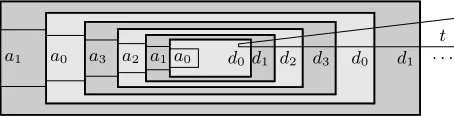
The configuration of regions we have in mind is depicted in Fig. 2, where components of thediare arranged like the
lay-ers of an onion. The ‘innermost’ component ofd0 is
sur-rounded by a component ofd1, which in turn is surrounded
by a component ofd2, and so on. The regiontpasses through
every layer, but avoids theai. To enforce a configuration of
this sort, we need the following three formulas, for0≤i≤3: c(ai+dbi+1c +t), (5)
¬C(ai, dbi+1c·(−abi+1c)) ∧ ¬C(ai, t), (6)
¬C(di, dbi+2c), (7)
wherebkc=kmod 4. Formulas (5) and (6) ensure that each component ofaiis in contact withabi+1c, while (7) ensures
that no component ofdican touch any component ofdbi+2c.
a1 a0 a3 a2 a1 a0 d0 d1 d2 d3 d0 d1
[image:4.612.317.552.52.111.2]t . . .
Figure 2: Regions satisfyingϕ∞.
Denote byϕ∞ the conjunction of the above constraints.
Fig. 2 shows howϕ∞can be satisfied overRC(R2). By
cylin-drification, it is also satisfiable over anyRC(Rn), forn >2.
The arguments of this section are based on the following property of regular closed subsets of Euclidean spaces:
Lemma 1 IfX ∈ RC(Rn)is connected, then every
compo-nent of−X has a connected boundary.
The proof of this lemma, which follows from [Newman, 1964], can be found in [Kontchakovet al., 2011]. The result fails for other familiar spaces such as the torus.
Theorem 2 There is aCc-formula satisfiable overRC(Rn),
n≥2, but not by regions with finitely many components.
Proof.Letϕ∞be as above. To simplify the presentation, we
ignore the difference between variables and the regions they stand for, writing, for example,aiinstead ofaIi. We construct
a sequence of disjoint componentsXiofdbicand open setsVi
connectingXitoXi+1(Fig. 3). By the first conjunct of (4),
letX0be a component ofd0containing points ina0. Suppose
Xihas been constructed. By (5) and (6),Xiis in contact with
abi+1c. Using (7) and the fact thatRn is locally connected,
one can find a componentXi+1 ofdbi+1c which has points
inai+1, and a connected open setVi such thatVi∩Xi and
Vi∩Xi+1are non-empty, butVi∩dbi+2c is empty.
. . . X3
X2
X1
X0 V0 V1 V2
Figure 3: The sequence{Xi, Vi}i≥0generated byϕ∞. (Si+1
andRi+1are the ‘holes’ ofXi+1containingXiandXi+2.)
To see that the Xi are distinct, let Si+1 andRi+1 be the
components of−Xi+1containingXiandXi+2, respectively.
It suffices to showSi+1 ⊆Si◦+2. Note that the connected set
Vimust intersectδSi+1. Evidently,δSi+1⊆Xi+1⊆dbi+1c.
Also, δSi+1 ⊆ −Xi+1; hence, by (3) and (7), δSi+1 ⊆
di∪dbi+2c. By Lemma 1,δSi+1is connected, and therefore,
by (7), is entirely contained either indbic or indbi+2c. Since
Vi∩δSi+16=∅andVi∩dbi+2c =∅, we haveδSi+16⊆dbi+2c,
so δSi+1 ⊆ di. Similarly, δRi+1 ⊆ di+2. By (7), then,
δSi+1∩δRi+1=∅, and sinceSi+1andRi+1are components
of the same set, they are disjoint. Hence,Si+1⊆(−Ri+1)◦,
and since Xi+2 ⊆ Ri+1, also Si+1 ⊆ (−Xi+2)
◦
. So, Si+1lies in the interior of a component of−Xi+2, and since
δSi+1⊆Xi+1⊆Si+2, that component must beSi+2. q
Now we show how theCc-formulaϕ∞can be transformed
toCc◦- andBc-formulas with similar properties. Note first that all occurrences of c inϕ∞ have positive polarity. Let
ϕ◦∞ be the result of replacing them with the predicate c◦. In Fig. 2, the connected regions mentioned in (5) are in fact interior-connected; henceϕ◦∞is satisfiable overRC(Rn).
Since interior-connectedness implies connectedness,ϕ◦ ∞
en-tailsϕ∞, and we obtain:
Corollary 3 There is aCc◦-formula satisfiable overRC(Rn),
n≥2, but not by regions with finitely many components. To construct aBc-formula, we observe that all occurrences ofCinϕ∞are negative. We eliminate these using the
pred-icatec. Consider, for example, the formula¬C(ai, t) in (6).
By inspection of Fig. 2, one can find regionsr1,r2satisfying
c(r1)∧c(r2)∧(ai ≤r1)∧(t≤r2)∧ ¬c(r1+r2). (8)
On the other hand, (8) entails¬C(ai, t). By treating all other
non-contact relations similarly, we obtain aBc-formulaψ∞
that is satisfiable overRC(Rn), and that entailsϕ
∞. Thus:
Corollary 4 There is aBc-formula satisfiable overRC(Rn),
n≥2, but not by regions with finitely many components. Obtaining a Bc◦analogue is complicated by the fact that we must enforce non-contact constraints usingc◦(rather than c). In the Euclidean plane, this can be done usingplanarity constraints; see [Kontchakovet al., 2011].
Theorem 5 There is aBc◦-formula satisfiable overRC(R2),
but not by regions with finitely many components.
Theorem 2 and Corollary 4 entail that, if L isBc or Cc, thenSat(L,RC(Rn))6= Sat(L,RCP(
Rn))for n ≥2.
The-orem 5 fails forRC(Rn)withn≥3(Sec. 5). However, we
know from (2) thatSat(Bc◦,RC(Rn))6=Sat(Bc◦,RCP(
Rn))
[image:4.612.61.288.346.404.2]4
Undecidability in the Plane
LetLbe any ofBc,Cc,Bc◦orCc◦. In this section, we show,
via a reduction of the Post correspondence problem(PCP), thatSat(L,RC(R2))is r.e.-hard, andSat(L,RCP(
R2))is
r.e.-complete. An instance of the PCP is a quadruple w = (S, T,w1,w2)whereSandT are finite alphabets, and each
wiis a word morphism fromT∗toS∗. We may assume that
S = {0,1}andwi(t)is non-empty for anyt ∈ T. The
in-stancewispositiveif there exists a non-emptyτ ∈T∗such that w1(τ) = w2(τ). The set of positive PCP-instances is
known to be r.e.-complete. The reduction can only be given in outline here: for details, see [Kontchakovet al., 2011].
To deal with arbitrary regular closed subsets ofRC(R2),
we use the technique of ‘wrapping’ a region inside two big-ger ones. Let us say that a3-regionis a triplea= (a,a,˙ ¨a)of elements ofRC(R2)such that06= ¨aa˙ a, wherers
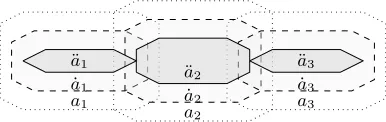
abbreviates ¬C(r,−s). It helps to think of a = (a,a,˙ ¨a) as consisting of a kernel, ¨a, encased in two protective lay-ers of shell. As a simple example, consider the sequence of 3-regions a1,a2,a3 depicted in Fig. 4, where the
inner-most regions form a sequence of externally touching poly-gons. When describing arrangements of 3-regions, we use
a1
a2
a3
˙ a1
˙ a2
˙ a3
¨ a1
¨ a2
[image:5.612.323.552.52.116.2]¨ a3
Figure 4: A chain of 3-regions satisfyingstack(a1,a2,a3).
the variable rfor the triple of variables(r,r,˙ r¨), taking the conjunctsr¨6= 0,r¨r˙andr˙ rto be implicit. As with ordinary variables, we often ignore the difference between 3-region variables and the 3-3-regions they stand for.
Fork≥3, define the formulastack(a1, . . . ,ak)by
^
1≤i≤k
c( ˙ai+ ¨ai+1+· · ·+ ¨ak) ∧
^
j−i>1
¬C(ai, aj).
Thus, the triple of 3-regions in Fig. 4 satisfies
stack(a1,a2,a3). This formula plays a crucial role in
our proof. Ifstack(a1, . . . ,ak) holds, then any pointp0 in
the inner shell a˙1 of a1 can be connected to any point pk
in the kernela¨k of ak via a Jordan arc γ1· · ·γk whose ith
segment,γi, never leaves the outer shellai ofai. Moreover,
eachγiintersects the inner shella˙i+1ofai+1, for1≤i < k.
This technique allows us to writeCc-formulas whose sat-isfying regions are guaranteed to contain various networks of arcs, exhibiting almost any desired pattern of intersections. Now recall the construction of Sec. 3, where constraints on the variablesd0, . . . , d3were used to enforce ‘cyclic’ patterns
of components. Usingstack(a1, . . . ,ak), we can write a
for-mula with the property that the regions in any satisfying as-signment are forced to contain the pattern of arcs having the form shown in Fig. 5. These arcs define a ‘window,’ contain-ing a sequence{ζi} of ‘horizontal’ arcs (1 ≤ i ≤ n), each
connected by a corresponding ‘vertical arc,’ηi, to some point
on the ‘top edge.’ We can ensure that eachζiis included in a
ζ1
η1
ζ2
η2
ζ3
η3
ζn
ηn
Figure 5: Encoding the PCP: Stage 1.
regionabic, and eachηi(1 ≤i ≤n) in a regionbbic, where
bicnow indicatesimod3. By repeating the construction, a second pair of arc-sequences,{ζi0}and{ηi0}(1≤i≤n0) can be established, but with eachηi0connectingζi0 to the ‘bottom edge.’ Again, we can ensure eachζi0 is included in a region a0bic and eachηi0 in a regionb0bic (1 ≤i ≤n0). Further, we can ensure that the final horizontal arcs ζn andζn00 (but no
others) are joined by an arcζ∗lying in a regionz∗. The
cru-ζ10
η01
ζ20
η20
ζ30
η03
ζn0
[image:5.612.323.552.257.322.2]η0n ζ ∗
Figure 6: Encoding the PCP: Stage 2.
cial step is to match up these arc-sequences. To do so, we write¬C(a0i, bj)∧ ¬C(ai, b0j)∧ ¬C(bi+b0i, bj+b0j+z∗),
for alli,j(0 ≤i, j < 3,i 6=j). A simple argument based on planarity considerations then ensures that the upper and lower sequences of arcs must cross (essentially) as shown in Fig. 6. In particular, we are guaranteed thatn=n0(without specifying the valuen), and that, for all 1 ≤ i ≤ n,ζi is
connected byηi(and also byη0i) toζi0.
Having established the configuration of Fig. 6, we write (bi ≤l0+l1)∧ ¬C(bi·l0, bi·l1), for0≤i <3, ensuring
that eachηiis included in exactly one ofl0,l1. These
inclu-sions naturally define a wordσover the alphabet{0,1}. Next, we writeCc-constraints which organize the sequences of arcs
{ζi}and{ζi0}(independently) into consecutive blocks. These
blocks of arcs can then be put in 1–1 correspondence using es-sentially the same construction used to put the individual arcs in 1–1 correspondence. Each pair of corresponding blocks can now be made to lie in exactly one region from a collec-tiont1, . . . , t`. We think of thetjas representing the letters of
the alphabetT, so that the labelling of the blocks with these elements defines a wordτ ∈ T∗. It is then straightforward to write non-contact constraints involving the arcsζi
ensur-ing thatσ=w1(τ)and non-contact constraints involving the
arcsζi0 ensuring thatσ=w2(τ). Letϕwbe the conjunction of all the foregoingCc-formulas. Thus, ifϕw is satisfiable overRC(R2), thenwis a positive instance of the PCP. On the
other hand, ifw is a positive instance of the PCP, then one can construct a tuple satisfyingϕwoverRCP(R2)by
‘thick-ening’ the above collections of arcs into polygons in the ob-vious way. So,wis positive iffϕwis satisfiable overRC(R2)
iffϕwis satisfiable overRCP(R2). This shows r.e.-hardness
[image:5.612.79.272.311.372.2]the latter problem in r.e. is immediate because all polygons may be assumed to have vertices with rational coordinates, and so may be effectively enumerated. Using the techniques of Corollaries 3–4 and Theorem 5, we obtain:
Theorem 6 ForL ∈ {Bc◦,Bc,Cc◦,Cc}, Sat(L,RC(R2))is
r.e.-hard, and Sat(L,RCP(R2))is r.e.-complete.
The complexity ofSat(L,RC(R3))remains open for the
languagesL ∈ {Bc,Cc◦,Cc}. However, as we shall see in the next section, forBc◦it drops dramatically.
5
B
c
◦in 3D
In this section, we consider the complexity of satisfyingBc◦ -constraints by polyhedra and regular closed sets in three-dimensional Euclidean space. Our analysis rests on an im-portant connection between geometrical and graph-theoretic interpretations. We begin by briefly discussing the results of [Kontchakovet al., 2010a] for thepolyhedralcase.
Recall that every partial order(W, R), whereRis a transi-tive and reflexive relation onW, can be regarded as a topo-logical space by takingX⊆W to be open just in casex∈X andxRyimplyy ∈X. Such topologies are called Aleksan-drov spaces. If (W, R)contains no proper paths of length greater than 2, we call(W, R)aquasi-saw(Fig. 8). If, in ad-dition, nox∈Whas more than two properR-successors, we call(W, R)a2-quasi-saw. The properties of 2-quasi-saws we need are as follows [Kontchakovet al., 2010a]:
– satisfiability of Bc-formulas in arbitrary topological spaces coincides with satisfiability in 2-quasi-saws, and is EXPTIME-complete;
– X ⊆ W is connected in a 2-quasi-saw(W, R)iff it is interior-connected in(W, R).
The following construction lets us apply these results to the problemSat(Bc◦,RCP(R3)). Say that aconnected partition
inRCP(R3)is a tuple X
1, . . . , Xk of non-empty polyhedra
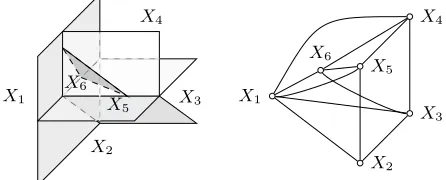
having connected and pairwise disjoint interiors, which sum to the entire spaceR3. Theneighbourhood graph(V, E)of
this partition has verticesV ={X1, . . . , Xk}and edgesE=
{{Xi, Xj} | i 6= jand(Xi+Xj)◦is connected}(Fig. 7).
One can show thateveryconnected graph is the
neighbour-X1
X2
X3
X4
X5
X6
X1
X2
X3
X4
X5
[image:6.612.332.539.166.209.2]X6
Figure 7: A connected partition and its neighbourhood graph.
hood graph of some connected partition inRCP(R3).
Fur-thermore, every neighbourhood graph (V, E) gives rise to a 2-quasi-saw, namely, (W0 ∪ W1, R), where W0 = V,
W1 = {zx,y | {x, y} ∈ E}, andR is the reflexive closure
of {(zx,y, x),(zx,y, y) | {x, y} ∈ E}. From this, we see
that (i) aBc◦-formula ϕis satisfiable overRCP(R3)iff (ii)
ϕis satisfiable over a connected2-quasi-saw iff (iii) theBc -formulaϕ•, obtained fromϕby replacing every occurrence
ofc◦withc, is satisfiable over a connected 2-quasi-saw. Thus, Sat(Bc◦,RCP(R3))is EXPTIME-complete.
The picture changes if we allow variables to range over
RC(R3)rather thanRCP(
R3). Note first that theBc◦-formula
(2) is not satisfiable over 2-quasi-saws, but has a quasi-saw model as in Fig. 8. Some extra geometrical work will show
x1 x2 x3
z
R R R
W1= depth 1
[image:6.612.64.287.524.614.2]W0= depth 0
Figure 8: A quasi-saw modelIof (2):rIi ={xi, z}.
now that (iv) aBc◦-formula is satisfiable overRC(R3)iff (v)
it is satisfiable over a connected quasi-saw. And as shown in [Kontchakovet al., 2010a], satisfiability ofBc◦-formulas in connected spaces coincides with satisfiability over con-nected quasi-saws, and is NP-complete.
Theorem 7 The problem Sat(Bc◦,RC(
R3))isNP-complete. Proof.From the preceding discussion, it suffices to show that (v) implies (iv) for anyBc◦-formulaϕ. So supposeA |=ϕ, withAbased on a finite connected quasi-saw(W0∪W1, R),
where Wi contains all points of depth i ∈ {0,1} (Fig. 8).
Without loss of generality we will assume that there is a spe-cial pointz0of depth 1 such thatz0Rxfor allxof depth 0.
We show howAcan be embedded intoRC(R3).
Take pairwise disjointclosed balls B1
x, forxof depth 0,
and pairwise disjointopenballsDz, for allzof depth 1
ex-cept z0 (we assume theDz are disjoint from theBx1). Let
Dz0 be the closure of the complement of all B 1
x and Dz.
We expand theB1
xto setsBxforming a connected partition
inRC(R3)(i.e. they sum to
R3, and their interiors are
non-empty, connected and pairwise disjoint). To construct theBx,
letq1, q2, . . .be an enumeration of all the points in the
interi-ors of any of theDzwithrationalcoordinates. Forx∈W0,
we setBxto be(Sk≥1Bxk)
−
, where the regular closed sets Bk
xare defined inductively as follows (Fig. 9). Suppose, for
k ≥ 1,Bk
x has been defined for allx∈ W0. Letqi be the
first point in the listq1, q2, . . .that is not in anyBxk yet. If
qi is in the interior of someDz, take a closed ball in the
in-terior ofDz centred on qi and disjoint from theBkx. Now
pick somexsuch that zRx, and expandBkx by the closed
ball aroundqi together with a closed ‘rod’ connecting it to
Bx1, in such a way that the rod is disjoint from the rest of the
Bk
x; the result is denoted byBkx+1. Consider the functionf
mapping regular closed setsX ⊆W toRC(R3), defined by
f(X) =P
x∈X∩W0Bx. Since theBxform a partition,f
pre-serves+,·,−,0and1. And since, for allz,P
{Bx |zRx}
is interior connected,fpreserves interior-connectedness. By carefully adding extra balls and rods in the construction of theBk
x, we can further ensure that non-interior-connected
el-ements ofRC(W, R)are mapped to non-interior connected elements of RC(R3) (for details, see [Kontchakov et al.,
2011]). Defining an interpretationIoverRC(R3)by setting
Bx1
Bx2
Bx3
[image:7.612.68.285.54.110.2]Dz
Figure 9: FillingDzwithBxi, forzRxi,i= 1,2,3.
The remarkably diverse computational behaviour of Bc◦
over RC(R3),RCP(R3) andRCP(R2)can be explained as
follows. To satisfy a Bc◦-formula ϕinRC(R3), it suffices
to find polynomially many points in the regions mentioned in ϕ (witnessing non-emptiness or non-interior-connectedness constraints), and then to ‘inflate’ those points to (possibly interior-connected) regular closed sets using the technique of Fig. 9. By contrast, over RCP(R3), one can write a Bc◦
-formula analogous to (8) stating that two interior-connected polyhedra do not share a 2D face. Such ‘face-contact’ con-straints can be used to generate constellations of exponen-tially many polyhedra simulating runs of alternating Tur-ing machines on polynomial tapes, leadTur-ing to EXPTIME-hardness. Finally, over RCP(R2), planarity considerations
endow Bc◦ with the extra expressive power required to en-force full non-contact constructs (not possible in higher di-mensions), and thus to encode the PCP as sketched in Sec. 4.
6
Conclusion
This paper investigated topological constraint languages fea-turing connectedness predicates and Boolean operations on regions. Unlike their less expressive cousins, RCC8 and
RCC5, such languages are highly sensitive to the spaces over which they are interpreted, and exhibit more challeng-ing computational behaviour. Specifically, we demonstrated that the languagesCc,Cc◦andBccontain formulas satisfiable overRC(Rn),n≥2, but only by regions with infinitely many
components. Using a related construction, we proved that the satisfiability problem for any ofBc,Cc,Bc◦andCc◦, inter-preted either overRC(R2), or over its polygonal subalgebra,
RCP(R2), isundecidable. Finally, we showed that the
sat-isfiability problem forBc◦, interpreted overRC(R3), is
NP-complete, which contrasts with EXPTIME-completeness for
RCP(R3). The complexity of satisfiability for Bc, Cc and
Cc◦overRC(Rn)orRCP(
Rn)forn≥3remains open. The
obtained results rely on certain distinctive topological prop-erties of Euclidean spaces. Thus, for example, the argument of Sec. 3 is based on the property of Lemma 1, while Sec. 4 similarly relies on planarityconsiderations. In both cases, however, the moral is the same: the topological spaces of most interest for Qualitative Spatial Reasoning exhibit spe-cial characteristics which any topological constraint language able to express connectedness must take into account.
The results of Sec. 4 pose a challenge for Qualitative Spa-tial Reasoning in the Euclidean plane. On the one hand, the relatively low complexity ofRCC8over disc-homeomorphs suggests the possibility of usefully extending the expressive power ofRCC8without compromising computational prop-erties. On the other hand, our results impose severe limits on any such extension. We observe, however, that the
con-structions used in the proofs depend on a strong interaction between the connectedness predicates and the Boolean opera-tions on regular closed sets. We believe that by restricting this interaction one can obtain non-trivial constraint languages with more acceptable complexity. For example, the exten-sion ofRCC8with connectedness constraints is still in NP for bothRC(R2)andRCP(
R2)[Kontchakovet al., 2010b]. Acknowledgments. This work was partially supported by the U.K. EPSRC grants EP/E034942/1 and EP/E035248/1.
References
[Bennett, 1994] B. Bennett. Spatial reasoning with proposi-tional logic. InProc. of KR, pages 51–62. 1994.
[Borgoet al., 1996] S. Borgo, N. Guarino, and C. Masolo. A pointless theory of space based on strong connection and congruence. InProc. of KR, pages 220–229. 1996. [Cohn and Renz, 2008] A. Cohn and J. Renz. Qualitative
spatial representation and reasoning. InHandbook of Kno-wledge Representation, pages 551–596. Elsevier, 2008. [Dornheim, 1998] C. Dornheim. Undecidability of plane
po-lygonal mereotopology. InProc. of KR. 1998.
[Egenhofer and Franzosa, 1991] M. Egenhofer and R. Fran-zosa. Point-set topological spatial relations. International J. of Geographical Information Systems, 5:161–174, 1991. [Kontchakovet al., 2010a] R. Kontchakov, I. Pratt-Hartmann, F. Wolter, and M. Zakharyaschev. Spatial logics with connectedness predicates. Logical Methods in Computer Science, 6(3), 2010.
[Kontchakovet al., 2010b] R. Kontchakov, I. Pratt-Hart-mann, and M. Zakharyaschev. Interpreting topological logics over Euclidean spaces. InProc. of KR. 2010. [Kontchakovet al., 2011] R. Kontchakov, Y. Nenov, I.
Pratt-Hartmann, and M. Zakharyaschev. On the decidability of connectedness constraints in 2D and 3D Euclidean spaces. arXiv:1104.0219, 2011.
[Newman, 1964] M.H.A. Newman. Elements of the Topol-ogy of Plane Sets of Points. Cambridge, 1964.
[Pratt-Hartmann, 2007] I. Pratt-Hartmann. First-order mere-otopology. InHandbook of Spatial Logics, pages 13–97. Springer, 2007.
[Randellet al., 1992] D. Randell, Z. Cui, and A. Cohn. A spatial logic based on regions and connection. InProc. of KR, pages 165–176. 1992.
[Renz and Nebel, 2001] J. Renz and B. Nebel. Efficient methods for qualitative spatial reasoning. J. Artificial In-telligence Research, 15:289-318, 2001.
[Renz, 1998] J. Renz. A canonical model of the region con-nection calculus. InProc. of KR, pages 330–341. 1998. [Schaeferet al., 2003] M. Schaefer, E. Sedgwick, and
D. ˇStefankoviˇc. Recognizing string graphs in NP. J. of Computer and System Sciences, 67:365–380, 2003. [Wolter and Zakharyaschev, 2000] F. Wolter and M.