ORIGINAL RESEARCH ARTICLE
USAGE PATTERNS OF FACEBOOK IN RESPONDING CRISIS
SITUATION WITH SPECIAL REFERENCE TO NORTHEAST INDIA
*
Rohinkanta Singh, N.
Assistant Professor, Department of Mass Communication, Sharda University, Greater Noida, India
ARTICLE INFO ABSTRACT
The rapid proliferation of social media and its popularity of tools like, facebook (fb), WhatsApp, Instagram, Blogs, Wikis, and other social networking sites offers a challenge to all of us in the pursuit of peace and tranquility in our society. If we can study to examine and learn the powerful dynamics of the social media in general, and facebook in particular, we will be better able to monitor the effects of facebook during the time of crisis situation in sensitive areas. The aim of this study is to find out the usage patterns of facebook among the postgraduate students and research scholars in Arunachal Pradesh, India. It investigates the effects of social media in facilitating peace during the time of conflict situation. Perhaps, facebook users in higher academic institutions like, universities become not only a mere consumer of social media tools like facebook but also more engaged as responsible citizens who accept responsibility for the shape and direction of peace and tranquility in conflict prone areas. Since its inception in February 2004, facebook became the most popular and widely used social networking sites across the world (forbes.com & hubspot.com, 2014) and its effect towards the society is tremendous. From the record of the popular movements, like the Arab Spring (2010), North East Exodus (2012), Anti-Corruption Movement (2012) in India and Global Immigration Issue (2016), facebook users has used the medium more to instigate people either to join the movement or provoke violence which added more fuel to the crises rather promoting peace to the society. The concept of participatory, user-generated and user-friendly notion of social media has been provoking the people towards the violence rather facilitating peace and development in the society. It is here the current study is trying to intervene and churned the rationale behind it. Whether facebook should be considered as a reliable tool to restore peace in the conflict regions is the key question to be raised in this study. The major objectives of this study are to find out whether facebook can act as an agent to facilitate peace in conflict situations and to analyze the uses patterns of facebook among the university students and researchers. In order to justify these above discourses, this study looks into the in-depth analysis to the data drawn from the primary sources, and carried out through quantitative research methodology by employing survey as its research method. A holistic approach towards the credibility of facebook as a tool to promote peace and tranquility in crisis situation is a quest of this study.
*Corresponding author
Copyright ©2017,Rohinkanta Singh. This is an open access article distributed under the Creative Commons Attribution License, which permits unrestricted use,
distribution, and reproduction in any medium, provided the original work is properly cited.
INTRODUCTION
Social media are no longer new to the higher educational platforms like universities in the crisis driven northeastern states in India, while looking at past trends gives broad knowledge of how phenomenal its growth has been over the last few years. Social media is the social interaction among people in which they create, share or exchange information and ideas in virtual communities and networks.
Today’s globalized world is run on Information and Communication Technology (ICT), where the world has seen the “global village” predicted half a century ago by Marshall McLuhan, (1964). A study has been undertaken to examine the uses and effects of facebook in the pursuit of peace during the time of crisis situation. It investigates and presents the ills that is plaguing around the social media domain in conflict driven crisis prone regions in the northeast India, particularly facebook, as a sweet demon.
ISSN: 2230-9926
International Journal of Development Research
Vol. 07, Issue, 07, pp.13940-13946, July,2017
Article History:
Received 05th April, 2017
Received in revised form 27th May, 2017
Accepted 26th June, 2017 Published online 31st July, 2017
Key Words:
Facebook, Information Age, New Media, Peace, Social Media.
Citation: Rohinkanta Singh, N. 2017. “Usage patterns of facebook in responding crisis situation With special reference to Northeast India”, International Journal of Development Research, 7, (07), 13940-13946.
Whether the tools of social media, like facebook act as a central force in shaping peace and tranquility among its users in their quest of peaceful co-existence during crisis situations or instigating violence, is studied and analysed. Kaplan and Michael Haenlein, (2010) defines social media as "a group of Internet-based applications that build on the ideological and technological foundations of Web 2.0 and that allow the creation and exchange of user-generated content." While as, facebook depend on mobile and web-based technologies to create highly interactive platforms through which individuals and communities share, co-create, discuss, and modify user-generated content (Kietzmann and Kristopher, 2011). These individuals and communities introduces the most important things being considered in their interest and present in large part of a thing or place that will make changes to communication between organizations, communities, and individuals. The investigation of this study see ways the social media instigate users to violence that fails the restoration of peace and resurrection of harmony as well as the ways it succeed the conventional notion of mobility and agitations, like organized crimes and mob cultures.
Rational and Intervention
Since its inception in February 2004, facebook became the most popular and widely used social networking sites across the world. Founded by Mark Zuckerberg with his college roommates and fellow Harvard University students Eduardo Saverin, Andrew McCollum, Dustin Moskovitz and Chris Hughes, facebook plays a profound role in disseminating information and promoting peace during the time of crisis situation, and its effect towards the post graduate students and academic research scholars is tremendous. However, the proliferation of unauthenticated information on facebook has given an unconstructive environment and creates turbulence to the society. Today every postgraduates and research scholars is familiar with what internet is, but sadly most of their knowledge is limited to certain task, mainly emailing and social networking such as facebooking, rather facing the
conventional books and periodicals. In a newspaper article ii
published in The Times of India quoting the report published by Internet and Mobile Association of India (IAMAI) reported that by December 2011, India has reached 121 million internet users. Out of which there are 41,399,720 facebook users as on
31stDecember 2011. iiiSo now the question is do the social
media like facebook really help the postgraduates and research scholars to promote peace in response to crisis situations in northeast India? Or rather this medium instigates more violence in crisis situation?. Social media critics and writers like Boyd, (2006), Charnigo & Barnett-Ellis, (2007), Madhavan, (2007), have come up with books on facebook and social networking sites (SNSs), but a collection of their criticism, reviews or biographies which has no justification to this field. This is where the study is trying to intervene to fill the yawning gap. New media has proved itself in providing freedom to circulation, information and publication. The
technology of the 21st century has almost fully digitized every
single knowledge and information about our human history, giving us the advantage to access information anytime anywhere almost about anything. The introduction of World
Wide Web (www) by Tim Berners-Lee in 1993, internet has
been driving the world into the core. The crunch lays here is that the whole notions of gate keeping in news media has come to an end on the internet portals and social networking sites.
The idea of citizen journalism through social media has been made possible with the coming of internet. Precisely the negative impact of social media like facebook is now considered as one of the most fatalist heinous act. There has been reported of facebook abuses and its malpractices like impersonation, bullying, plagiarism, hacking, freaking and so on. Most unfortunately, in some incident many students and innocent people have even lost their lives.For instance, the suicide case of a fifteen year old California girl, Audrie Pott (Craig Giammona, NBC News, 2013) is a pristine example of cyber-bullying. Whileas, The Times of India (2011, March 7) has reported under the headline “17K incidents of cheating reported in UK varsities” is a true picture towards the ills that plagues around the academia which is looming large with the proliferation of internet and social media. This is one core issue that has to be taken whether facebook will help to bring peace in the crisis situation or rather it instigates more violence in the prevailing crisis driven regions of northeast India.
Research Question
The questions to the research problem in hand begin with the simple question – what is facebook? As the theme of the current study lies with the invention and further misuse of facebook. The concept of participatory, user-generated and user-friendly notion of social media has been provoking the people towards the violence rather facilitating peace and development in the society. Whether facebook should be considered as a reliable tool to restore peace in the conflict regions is the key question raised in this study. Is facebook proving to promote peace or adding violence in crisis situations?
Theoretical Framework
Theories of interpersonal communication argue that no relationship exists unless the parties sacrifice some individual autonomy, however too much connection paradoxically destroys the relationship because individual’s identities become lost(Baxter and Montgomery, 1988). The theory implies that the unbridled dependency on facebook has destroyed the quality relation between the users and the facebook communities, and also the space of face-to-face interaction seems to be diminishing. In its true sense, every mass medium attempts to say something about reality, it is important to bring discourses of crisis situations in northeast India and frames to the light of public consciousness. Johan Galtung who identifies a peace discourse and security discourse, believes people around the world organize their understanding of conflict and violence.
Galtung’s approaches determined how and why facebook users interpret the world in a certain way and how facebook can act as an agent to facilitate peace in crisis situations. Galtung explains peace discourse as conflict which has not been resolved or transformed. His observation justifies the discourses of peace and security in responding to conflict and violence. In terms of peace discourse Galtung, (2004) verifies conflict that has not been resolved or transformed where the danger of violence as one way to settle the conflict. It implies that in northeast India, different types of violence occurs, like border conflicts, communal, immigration, insurgencies, bandh/blockade etcetera which has not given any justice or resolved in time but faded away with the passage of time and accordingly reduce the intensity of violence.
The justice remains a big question mark (?) in many of these violence prone regions. There will be two or more individuals/groups involved in conflict situation which try to pursue goals or ambitions they believe they cannot share (Howard, 2004).In fact, conflict is not necessarily negative, nor does it need to lead to violence. It is necessary for progress and evolution. Any change in the world can be understood as a conflict with the status quo, and change can have positive effects. On the other hand, the security discourse places its emphasis on violence which can be understood as the use of force to achieve a goal. To sum up this above notion of security discourse, Jake Lynch and Annabel McGoldrick, (2005) noted in Peace Journalism, “violence is only one possible response to conflict—a collective expression, or political tool to achieve ends. It can easily be self-defeating, in the long term nullifying any gains or even killing those who would have benefited from the achievement.”
Galtung identifies three interlocking types of violence, such as direct, cultural and structural. Direct violence refers in terms of aggression, military force, etcetera while as, cultural violence can be understood as the way a group has been thinking about another group for many years. It includes talk, images or beliefs which glorify physical violence. Structural violence built into the laws and traditional behavior of a group or society. Galtung’s concept is applicable in terms of the nature
of crisis like, communal, bandh/blockade, immigrants, border
conflicts etcetera which is prevailing in northeast India.
Methodological Framework
In order to justify these discourses, this study falls under exploratory in nature carrying out through quantitative research methodology, mainly based on the primary data collected by employing survey method. Quantitative researchers are often accused of being too narrow, basing their own what they can count, measure, and observe and neglecting other matters as well. This has lead to use the random sampling to fill the backlog through tactically selected questionnaire, and measured with the help of Likert’s Scale. Rajiv Gandhi University (RGU) and North Eastern Regional Institute of Science and Technology (NERIST) both located in Arunachal Pradesh is the Universe of this study where the samples are collected.
Sampling method
A probability sampling method is adopted, wherein social media using Postgraduates and Research Scholars from two universities, RGU and NERIST were chosen. Both these universities have installed Wi-Fi accessibilities across its sprawling eco-friendly campuses according to its official annual bulletin catalogues.
The following formula makes it more legitimate to execute the sampling technique employed in this study.
N = the number of PGs and Research Scholars in the sampling
frame.
n = the number of PGs and Research Scholars in the sample.
NCn = the number of combinations (subsets) of n from N.
f = n/N = the sampling fraction.
The objective to simple random sampling states that in order to
select n units out of N such that each NCn has an equal chance
of being selected.
And hence, f = n/N = 600/2000 = 0.30 or 30%.
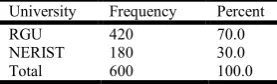
On the basis of the available information, it is estimated that about 1400 PGs and 600 research scholars in RGU and NERIST together during the academic year 2014. Hence, 600 PGs and research scholars (30 per cent of total strength) were finalized as sample size of the study.
Objectives
Keeping the above theory in mind this study looks into some of the following core objectives:
to study the effect of facebook users on PG students and
academic research scholars,
toknow whether facebook will help to promote peace
during the time of crisis situation,
to discuss the ills plaguing around the facebook.
Hypothesis
Based on the review of literature and the objectives, the hypotheses for the study have been made. Its main objective is to study the effect of facebook in the pursuit of peace in crisis situations and the association between them. The following null hypotheses have been framed from the objectives of the current study to prove or disprove the theoretical statements. The study aims to observe the following relationships between the main variables:
H01There is no significant difference between factors on the
opinion about the benefit of using facebook,
H02There is no significant difference between factors on the
impact of facebook in crisis situations,
H03There is no significant difference between factors on
facebook promote peace during crisis situations,
H04There is no significant difference between factors on the
nature of crisis facebookusers add more violence in northeast India,
[image:3.595.364.503.660.702.2]Analysis and Findings
Table I: Descriptive statistics on samples
University Frequency Percent
RGU 420 70.0
NERIST 180 30.0
Total 600 100.0
Table 2. Faculty-wise (Arts and Science) distribution of the respondents
Faculty Frequency Percentage
Arts 300 50
Science 300 50
Total 600 100
Frequency distribution
[image:4.595.347.521.178.249.2]For what purpose do you access facebook?
Table 1: Distribution for the purpose of facebook
Particulars Frequency Valid Percent To keep in touch with friends 222 37
Sharing of knowledge 139 23
Employment 39 7
Academic purpose 62 10
News & Entertainment 138 23
Total 600 100
The above analysis displays that for highest 37 percent of respondents’ “to keep in touch with friends” responded the highest in the purpose to access facebook. Whileas, for 23 percent respondents each to “sharing of knowledge” and “news & entertainment”, and 10 percent responded “academic purpose” and 7 percent “employment” to the given statement.
[image:4.595.54.273.209.280.2]Sharing information is easier on facebook than other social medium?
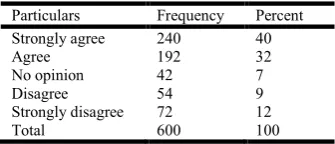
Table 2. Sharing information is easier on facebook than other social medium
Particulars Frequency Percent Strongly agree 240 40
Agree 192 32
No opinion 42 7
Disagree 54 9
Strongly disagree 72 12
Total 600 100
The above analysis shows a maximum 40 percent responded ‘strongly agree’ along with 32 percent ‘agree’ to the statement, “sharing information is easier on facebook than other social medium”. On the contrary, only 12 percent responded ‘strongly disagree’ along with 9 percent ‘disagree’ and 7 percent says ‘no opinion’ to the above statement.
[image:4.595.347.520.419.490.2]Do you think that facebook users can give peace a chance to crisis driven states in the northeast India?
Table 3: Facebook users can give peace a chance to northeast India
Particulars Frequency Percent Strongly agree 174 29
Agree 234 39
No opinion 72 12
Disagree 54 9
Strongly disagree 66 11
Total 600 100
From the above analysis, it is found that a maximum of 39 percent of the respondents agreed to the above statement followed with 29 percent responded strongly agreed.
While as, 9 percent responded disagree, 11 percent strongly disagree, and 12 percent responded no opinion to the statement.
Do you think that there should be facebook-monitoring team to assess the nature of content in crisis prone regions?
Table 4:Facebook monitoring team to assess nature of content in crisis prone regions
Particulars Frequency Percent
Strongly agree 204 34
Agree 234 39
No opinion 48 8
Disagree 54 9
Strongly Disagree 60 10
Total 600 100
From the above analysis, it is found that for a majority of 39 percent of the respondents agree facebook monitoring team to assess the nature of content in crisis prone regions followed with 34 percent strongly agree, 10 percent strongly disagree, 9 percent disagree and 8 percent responded no opinion to the given statement.
Facebook account containing malicious (intended to harm or upset other people) content should be punished severely?
Table 5. Facebook account containing malicious content should be punished severely
Particulars Frequency Percent Strongly agree 246 41
Agree 186 31
No opinion 42 7
Disagree 60 10
Strongly disagree 66 11
Total 600 100
From the above analysis, it is found that for a majority of 41 percent of the respondents strongly agree facebook account containing malicious content should be punished severely followed with 31 percent agree, 11 percent strongly disagree and 10 percent disagree. While as, 7 percent responded no opinion to the given statement.
[image:4.595.78.246.438.510.2]Facebook can act as an important role to facilitate peace in the conflict situation?
Table 6:Facebook can act as an important role to facilitate peace in the conflict situation
Particulars Frequency Valid Percent Strongly agree 222 37
Agree 198 33
No opinion 60 10
Disagree 72 12
Strongly disagree 48 8
Total 600 100
The study found that a majority of 37 percent of the respondents felt strongly agree with the statement “Facebook can act as an important role to facilitate peace in the conflict situation” and 33 percent responded agree. While as, 12 percent responded disagree, 8 percent strongly disagree and 10 percent responded no opinion to the given statement.
[image:4.595.341.525.638.710.2] [image:4.595.78.247.668.740.2]Do you think facebook adds more violence in crisis situations?
Table 7:Facebook adds more violence in crisis situations
Particulars Frequency Percent Strongly agree 208 34.7
Agree 215 35.8
No opinion 57 9.5
Disagree 48 8.0
Strongly disagree 72 12.0
Total 600 100
From the above analysis, it is found that for a majority of 35.8 percent of the respondents agreesfacebook adds more violence in crisis situations followed with 34.7 percent strongly agree, 12.0 percent strongly disagree and 8.0 percent disagree. While as, 9.5 percent responded no opinion to the given statement.
[image:5.595.322.544.235.370.2]Do you think facebook should be banned in the crisis prone region?
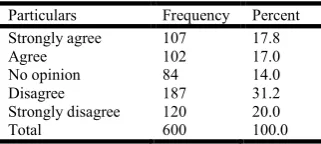
Table 8. Facebook should be banned in the crisis prone region
Particulars Frequency Percent Strongly agree 107 17.8
Agree 102 17.0
No opinion 84 14.0
Disagree 187 31.2
Strongly disagree 120 20.0
Total 600 100.0
The above analysis displays that for highest 31.2 percent of the respondents disagreed to the given statement and 20.0 percent responded strongly disagree. While as, 17.0 percent responded agree to the statement, 17.8 percent strongly agree and 14.0 percent responded no opinion.
Friedman hypothesis testing on sample
The Friedman test is a non-parametric test for analyzing randomized complete block designs. It is mainly used to detect differences in treatments across multiple test attempts. This test is an extension of the sign test when there may be more than two treatments. The Friedman test is used for one-way repeated measures analysis of variance by ranks. In its use of ranks it is similar to the Kruskal-Wallis one-way analysis of variance by ranks. The Friedman test assumes that there are k experimental treatments (k ≥ 2). In this study Friedman test for
finding out which constraints that imposes as
barriers/problems in the usage and effect of facebook in PGs and research scholars which assistance is more require from the university side to promote peace in crisis situations in the northeast India. The following tabulation shows the Friedman ranking test on hypothesis.
H01There is no significant difference between factors on the
impact of facebook in crisis situations,
Table 9:Friedman test for significant difference between factors on the impact of facebook
Impact of FB in crisis situations
Mean Rank
Chi-square Value
P Value
Adds more violence 2.95 859.867 0.001** Help to resolve the crisis 4.47
An agent to peace journalism
2.62
Promote peace 2.30 Serious threat against
peaceful co-existence
2.66
Note: ** Denotes significant at 1% level
Since P value is less than 0.01, the null hypothesis is rejected at 1 % level of significance. Hence concluded that there is significant difference between mean ranks towards the factors on the impact of facebook in crisis situations. Based on mean rank, ‘helps to resolve the crisis’(4.47) is the most important impact of internet followed by ‘adds more violence’(2.95), ‘serious threat against peaceful co-existence’(2.66), ‘an agent to peace journalism’(2.62), and ‘promote peace’(2.30).
H02There is no significant difference between factors on
facebook promotes peace during crisis situations.
Table 10. Friedman test for significant difference between factors on facebook promotes peace
FB promote peace Mean Rank
Chi-square Value
P Value
Its nature of freedom of expression
2.61
133.624 0.001** Easy to disseminate peace
message with text, picture, audio & video
2.98
FB users posting messages to resolve the crisis
3.39
User-generated and interactive nature helps to promote peace
3.31
Unique features to block unwanted items
2.71
Note: ** Denotes significant at 1% level
Since P value is less than 0.01, the null hypothesis is rejected at 1 % level of significance. Hence concluded that there is significant difference between mean ranks towards the factors on facebook promote peace during crisis situations. Based on mean rank, ‘facebook users posting messages to resolve the crisis’(3.39) is the most important factor that facebook users promote peace during crisis situations followed by ‘user-generated and interactive nature helps to promote peace’(3.31), ‘easy to disseminate peace message with text, picture, audio & video’(2.98), ‘unique features to block unwanted items’(2.71), and ‘its nature of freedom of expression’ (2.61).
H03There is no significant difference between factors on the
[image:5.595.82.243.293.365.2]nature of crisis facebook users adds more violence in northeast India. Since P value is less than 0.01, the null hypothesis is rejected at 1 % level of significance. Hence concluded that there is significant difference between mean ranks towards the factors on the nature of crisis facebook users add more violence in northeast India.
Table 11. Friedman test for significant difference between factors on the nature of crisis facebook users adds more violence in
northeast India
Nature of crisis FB adds violence in northeast India
Mean Rank
Chi-square Value
P Value
Border conflicts 3.11
170.002 0.001** Communal violence 3.60
Crime against women 2.65 Infiltration/Migration issues 2.90
Insurgencies 2.74
Note: ** Denotes significant at 1% level
[image:5.595.53.272.702.792.2]purpose followed by ‘border conflicts’ (3.11), ‘infiltration/migration issues’(2.90), ‘insurgencies’(2.74), and ‘crime against women’(2.65).
FINDINGS
In case of the purpose to access facebook, the study
found that out of 600 respondents, maximum 222 (37 percent) respondedfacebook helps to keep in touch with friendsfollowed with 139 (23 percent) each to sharing of knowledge and academic purpose, 62 (10 percent) employment and 39 (7 percent) responded news and entertainment.
In case of sharing information is easier on facebook
than other social medium, it is found that among the respondents 240 (40 percent) of the respondents are strongly agreed and 192 (32 percent) agreed with sharing information is easier on facebook than other social medium when compared to 72 (12 percent) responded strongly disagreed and 54 (9 percent) disagreed to the given statement, but 42 (7 percent) responded no opinion.
In case of facebook users can give peace a chance to
crisis driven states in the northeast India, it is found that among the respondents 234 (39 percent) of the respondents are agreed and 174 (29 percent) strongly agreed with the statement when compared to 66 (11 percent) responded strongly disagreed and 54 (9 percent) disagreed to the given statement, but 72 (12 percent) responded no opinion.
The study indicates that maximum 234 (39 percent)
responded ‘agree’ and 204 (34 percent) ‘strongly agree’ to the statement “there should be facebook-monitoring team to assess the nature of content in crisis prone regions” as compare to 60 (10 percent) responded ‘strongly disagree’ and 54 (9 percent) ‘disagree’. While as, 48 (8 percent) of the respondents have responded ‘no opinion’ to the statement.
The study found that out of 600 respondents, maximum
246 (41 percent) responded strongly agree and 186 (31 percent) agree to the statement that facebook account containing malicious content should be punished severely when compared with 66 (11 percent) strongly disagree and 60 (10 percent) disagree. While as, 42 (7 percent) responded no opinion to the given statement.
In case of facebook adds more violence in crisis
situations, it is found that maximum215 (35.8 percent) of the respondents are agreed and 208 (34.7 percent) strongly agreed when compared to 72 (12.0 percent) responded strongly disagreed and 48 (8.0 percent) disagreed to the statement, but 57 (9.5 percent) responded no opinion.
The study indicates that out of 600 respondents,
maximum 187 (31.2 percent) responded ‘disagree’ and 120 (20.0 percent) ‘strongly disagree’ to the statement “facebook should be banned in the crisis prone region” as compared to 107 (17.8 percent) responded ‘strongly agree’ and 102 (17.0 percent) ‘agree’. While as, 84 (14.0 percent) of the respondents have responded ‘no opinion’ to the statement.
In case of the impact of facebook in crisis situations it
can be seen that adds more violence is given the 1st
rank, followed by help to resolve the crisis which
ranked 2nd, an agent to peace journalism which ranked
3rd, promote peace which ranked 4th and serious threat
against peaceful co-existence which ranked 5th. It is
found that facebook helps to resolve the crisis is given
1st rank by the respondents and the 2nd rank is given to
add more violence, and lowest rank is given to promote peace.
In case of the nature of crisis facebook users add more
violence in northeast India, it can be seen that border
conflicts is given the 1st rank, followed by communal
violence which ranked 2nd, crime against women which
ranked 3rd, infiltration/migration issues which ranked 4th
and insurgencies which ranked 5th. It is found that
communal violence is given 1st rank by the respondents
and the 2nd rank is given to border conflicts, and lowest
rank is given to crime against women.
Limitations of the study
Facebook is a profound discourse in response to peace journalism and hence this study falls under a specific area of crisis situations and it cannot be covered all the aspects of facebook in peace journalism.
Scope for further research
It is critical for social media and facebook to fully understand the conditions under which postgraduates and research scholars use the patterns of facebook in response to peace journalism in crisis situations. The study shows that misuses and abuses of facebook loom larger in regards to instigate more violence than promoting peace in crisis situations. Whileas, communal violence emerges one of the great concerns in today’s northeast India which hampers the peace process. In order to get more insights of the ills that plagues around facebook, it is necessary to continue research on the factors to cope up the misuses of facebook in northeast India.
Conclusion
The discourses of authenticity and credibility of facebook as an agent of peace journalism has come to light from this study, and does facebook can really facilitate peace in crisis situations still remains un-answered will need to be solved. This study reveals that no matter what facebook takes and shapes the crisis situations, it becomes the most popular social media in the higher academic platforms like the university. However, the point is that facebook has to be utilized in certain code of conducts and with strong mental set ups, otherwise it could be a man-made disaster in a near future. Social media, like facebook has given a big impact to postgraduates and academic researchers, but the lurking
danger however is tremendous, like impersonation,
fraudulence, hacking, freaking, bullying, etcetera, and hence a holistic approach towards the credibility of facebook as a tool to promote peace and create a knowledge society is a quest of this contemporary computer-mediated academia.
REFERENCES
Baxter, L., & Montgomery. 1996. Relating: Dialogues and
Dialectics. New York: The Guilford Press.
Baxter, L.A. 1988. A dialectical perspective on communication strategies in relationship development. In S. Duck (Ed.), Handbook of Personal Relationships, 257-273.
Boyd, D. 2008. Why youth (heart) social network sites: The
role of networked publics in
Bozarth, Jane. 2010. Social Media for Trainers: Techniques for Enhancing and Extending Learning. San Francisco, Pfeiffer.
Charnigo, L., and Barnett-Ellis, P. 2001. Checking out
Facebook.com: The impact of a
digital trend on academic libraries. Information Technology and Libraries, 26 (1), 23.
Galtung, Johan. “Conflict Transformation by Peaceful Means.” Course given at the European University Center for Peace Studies, Stadtschlaining, Austria. October 7-12, 2004.
Giammona, Craig. 2013, April 14. California case another
three-part tragedy of rape, cyber bullying and suicide. NBC News.
Howard, R. 2009. “Conflict-Sensitive Reporting: State of the Art, a Course for Journalists and Journalism Educators”. Paris: UNESCO.
Kaplan, Andreas M., and Haenlein, Michael. 2010. "Users of the world, unite! The challenges and opportunities of social media". Business Horizons, 53 (1). p. 67.
Kietzmann, Jan., H. and Kristopher, Hermkens 2011. "Social media? Get serious! Understanding the functional building blocks of social media". Business Horizons 54: 241–251.
Lynch, Jake. and Annabel, McGoldrick.2005.Peace
Journalism. Gloucestershire: Hawthorn Press.
Madhavan, N. 2007, July 6. India gets more Net Cool.
Hindustan Times. Retrieved July30, 2007.
McLuhan, Marshall. 1964. Understanding Media: The
Extensions of Man. Canada. McGraw-Hill.
teenage social life. In D. Buckingham (Ed.), Youth, Identity, and Digital Media. Cambridge, MA: MIT Press,119-142. The Times of India, Chennai. 7th March 2011. “17K Incidents
of Cheating reported in UK varsities”.
End Notes
1
Boyd, d. 2006a. Friends, Friendsters, and MySpace Top 8: Writing community into being on social network sites. 2
http://timesofindia.indiatimes.com/tech/news/internet/121m-
internet-users-in-India-by-2011-end-Report/articleshow/10641973.cms 3
http://www.internetworldstats.com/asia.htm [Accessed on 20-03-2012]