Full Length Research Article
CODIFICATION AND MORPHOLOGICAL CHARACTERIZATION OF THE LOCAL VARIETIES OF
CORN (
ZEA MAYS L.
) OF CHAD IN WAY OF EXTINCTION
*1
Goalbaye, T.,
2Diallo, M. D.,
1Madjimbe, G.,
3Mahamat -Saleh M. and
3Guisse, A.
1
Institut Academic of the Agronomic Sciences and the Environment (IUSAE) / University of Sarh,
BP 105 Sarh, Chad
2
Section plant Productions and Agronomy, UFR of the Agronomic Sciences, the Aquaculture and the Food
Technologies, University Gaston-Shepherd of Saint Louis, BP 234 Saint Louis, Senegal
3
Department of Plant Biology, Faculty of the Science and Engineering, University Sheik Anta Diop of Dakar, BP
5005 Dakar, Senegal
ARTICLE INFO ABSTRACT
In Chad, the food security constitutes a problem insofar where the agricultural production cannot satisfy the demand. The main causes of this decline are often imputed to the climate whose the worsening remains certain, but also the no availability of resources genetic of the major cereals crops. Thus, some local varieties of corn are in the way of extinction because the producers cultivate the local and exotic varieties side by side, or they exchange their seeds and caused the loss of their genetic identity. The objective of the study is firstly, to collect and codify some local varieties of corn of Chad and secondly, to characterize them in situ in order to dispose the genetic resources. Ten local varieties have been harvested Ikad1, IKan2, IKan3, IKou4, IKan5, IKad6, BKan7, BKan8, DNga9 and DNga10 have been codified according to their localization and their ethnographic reference mark. They have been characterized from a classification based on their morphology, the environment in which they pushed and the cycle of culture. The different groups have been distinguished in relation to the length of the panicle, to the number of row per cob, to the number of grains by row and to the weight of grains who translate the genetic variability of these local varieties of corn. These local varieties of corn could be to the basis of a program of improvements of corn in Chad.
Copyright©2017, Goalbaye et al.This is an open access article distributed under the Creative Commons Attribution License, which permits unrestricted use, distribution, and reproduction in any medium, provided the original work is properly cited.
INTRODUCTION
The cereals constitute the basis of the human food in Chad. In terms of acreage and production, the corn occupies the fourth rank after the millet, the sorghum and the rice. However, it comes in head with 41% in the provision of cereals of the city of Ndjamena before the sorghum, the millet and the rice and in the consumption (Djondang, 2002). It is used for human food and animal feed (poultry, pigs, cattle) and as a raw material in some industries (brewing, soap and oil mill) (Seignobos, 2005). The corn, thanks to the substantial institutional supports of the Chadian government, it is passed of family consumption culture to the culture of market. The increasing integration of its grains in eating habits has created a remarkable increase of the surFigures and the volumes of production.
*Corresponding author: Goalbaye, T.
Institut Academic of the Agronomic Sciences and the environment (IUSAE) / University of Sarh, BP 105 Sarh, Chad.
The rate of evolution of the production superior has 300% in the 15 years have been recorded from one region to another. The production of this cereal is passed from 70 000 tons in the years 1998 to 107 000 tons in 2005 (Mbayhoudel, 2002). However, this is a production supported by the family farming, still is devoted most to the production for the self-consumption of regions and to the eating habits (Muller, 2004). In Chad most local varieties of corn are in the way of disappearance by the contamination of pollen flow of exotic varieties or the
genetic erosion (Goalbaye et al., 2013). Often the producers
cultivate local and exotic varieties side by side, or they exchange their seeds and have for consequence the loss of genetic identity. Similar findings were reported by Bellon and Brush (1994). Unfortunately very few works have been made
to preserve the local genetic resources of maize (Goalbaye et
al., 2014). The existing local varieties are cultivated again in
the regions where the corn was a traditional culture during centuries Brush (1995). However, they have not been codified and not characterized. So the objective of the survey is to
ISSN: 2230-9926
International Journal of Development Research
Vol. 07, Issue, 01, pp.10897-10901, January,2017
DEVELOPMENT RESEARCH
Article History:
Received 18th October, 2016 Received in revised form 22nd November, 2016
Accepted 19th December, 2016
Published online 30th January, 2017
Key Words:
Zea mays L, Local varieties, Codification,
codify and to characterize the local varieties of corn of Chad in order to facilitate their distinction. The sampling of local
varieties of corn (Kouamé et al., 2010) is conduct in the
regions of the country, after the prospecting permitted to harvest the panicles and the whole plants of several genetic resources of corn. So, the local varieties have been codified according to their localization and their ethnographic landmark.
MATERIALS AND METHODS
Material of land
Equipment used includes: a GPS (Global Position System) for permitting to take the coordinates of sites and transects; a digital camera for taking the photos of the plants at different development, of the lines, ribbon-meter, a can of paint and a brush permitting the measures and to delimit the parcels, of the bags made of jute to take the samples of corn.
Methods
Prospecting
The prospecting mission made a trip in the canton Danamadji 54 km south of Sarh. In this locality, cornfields were visited mainly in the villages of Kira and Monbolo (altitude 367 m, Latitude 8 ° 88539 and 40605 Longitude 18 °) where soils are the type ferralitic. Identified local varieties are called guodjidô Kobe (local varieties Ngama). Another mission of exploration conducted by a team of IUSAE the researchers Teachers stayed at Isseirom (altitude of 285 m of 13.47104° Latitude and Longitude 15.01615°) and at Bol (altitude 277 m, Latitude of 13.45887° and Longitude 14.71260 °), two cantons of the region of the Chad lake, situated respectively to 320 km and 400 km in the north of Ndjamena. During these displacements one localized with a GPS (global position system) the zones of corn cultures have been prospected. The prospecting has for objective to visit the cornfields to the vegetative stage in order to identify the best plants for harvesting the genetic resources at the time of maturity.
Sampling
The second mission surrendered to Isseirom, Bol and to Danamadji to make the sampling. The sampling of the local varieties of corn has been done along a transect South- North and West-East transect through the zones of culture of corn. This is to harvest the local varieties that exist and that are threatened of disappearance. The sampling constitutes one of the stages of recurrent selection diagram described by Morno-Gonzalez and Cubero (1993). It is a mass selection that consists in choosing in the identified fields, the varieties populations of corn presenting the interesting agronomic characters. One first specifies the prospecting number, indeed the appropriate samples carry all one number, the goal of the numbering is to recover the source of the plant material and to know the type of material collected, then one gives the systematic place of the species (family, kind, species, vernacular name) and the type of forwardness defined by the peasants. One also specifies the geographical coordinates of appropriate (GPS) and the conditions of appropriate (attics or fields). One also specifies the approximate size of the share from which the sample has been appropriated. One gives finally the approximate measurements of the sample and the
particular features so possible. The choice of varieties is done on the basis of the differences essentially carrying on the morphological characters: size and/or length of the ear, height of the plant and the cycle of culture describes by the peasants and the yield components. The samples are ears collected in the polders and in parcels of ten of hectares. In the villages of the Bol cantons, Isseirom and Danamadji, several local varieties have been identified, of which some carry the name of the locality where they are cultivated, others carry the name of the population that cultivates them on the contrary. Thus, we identified the varieties matafo1, matafo2 of the Matafo locality and the Kouri varieties of the Kouri population.
Codification and characterization
These local varieties have been codified according to their localization and their ethnographic reference mark. The varieties have been codified by four letters and by one or two numbers according to the cases. The first letter indicates the initial of source place, the three following letters specify the ethnographic reference mark and the number indicates the prospecting number.
Thus, we have: I = Isseirom, B = Bol, D = Danamadji that is the places of source of these local varieties and: Kad = Kadjidi, Kan = Kanembou, Kou = Kouri, Nga = Ngama that is ethnographic reference marks. On the other hand, the output of grain of all varieties varies from the simple to the double 0, 9
to 1, 8 tha-1 according to the peasants. The description of the
local varieties of corn is made from a classification based on the morphology of the plants, the grains, the color, the texture, the environment in which they pushed and the cycles of culture.
Statistical analysis
Data have been analyzed with the software SPSS (Statistical Package heart Social Sciences, version 16.0). The averages of the different parameters separated by the test of multiple arrangement of Student - Newman - KeulS (SNK).
RESULTS
Codification
Ten (10) local maize varieties were collected and codified according to their localization and their ethnographic reference mark (Table 1). These are IKad1, IKan2, IKan3, IKou4, IKan5, IKad6, BKan7, BKan8, DNga9 and DNga10. According to the information received of the peasants of the two cantons Isseirom and Bol, all the selected varieties are hasty, their cycle is about 90 days. Those of Danamadji are semi-belated of about 105 days according to the peasants. All local varieties identified belong to the indurata subspecies. The local varieties of Danamadji have grains of white color. The varieties matafo 1 and matafo 2 of Bol, as well as these who are detained by the Kouri and the Kadjidi of the Asalam village of Isseirom have the grains of white color. On the other hand, the varieties of Douba Isseirom have the grains of yellow color.
Characterization of the local varieties harvested
15.60 ± 0.8944 rows of grain and 23.60 ± 0, 5477 of kernels per row, of 0.202 ± 0.0027 kg of weight of 1000 grains (Figure 1). Its grains are globular and medium sized, of white color and bent aspect and vitreous texture. The Variety BKan8 is large size, his cycle of culture is of 100 days. His long ear of 15.85 ± 0.6020 cm, is composed of 16.40 ± 0.8944 of rows of grain and 29.40 ± 0.8944 grains per row, of 0.198 ± 0.0021 kg of weight of 1000 grains.
Table 1. Local varieties of corn harvested landraces provenance ethnographic mark
local varieties localization Ethnographic reference mark
IKad1 Isseirom Kadjidi
IKan2 Isseirom Kanembou
IKan3 Isseirom Kanembou
IKou4 Isseirom Kouri
IKan5 Isseirom Kanembou
IKad6 Isseirom Kadjidi
BKan7 Bol Kanembou
BKan8 Bol Kanembou
DNga9 Danamadji Ngama
DNga10 Danamadji Ngama
The grains are round and medium sized, of white color and bent aspect and vitreous texture. All two have been harvested in the Sahel zone of Chad, to an altitude of 277m, latitude of 13.45887° and a longitude 14.71260 °. The IKad6 variety is of large size, its cycle of culture is of 100 days. The long ear of 17,65 ± 0,6020 cm, is composed of 13,60 ± 0,8944 of rows of the grains and 29,20 ± 0,8366 of grains by row, of 0,208 ± 0,0024 kg of weight of 1000 grains.
The grains are globular and medium-sized, of white color and smooth aspect and vitreous texture. The Ikad1 variety is of large size, his cycle of culture is of 100 days. The long ear of 16,40 ± 0,9617 cm, is composed of 16,40 ± 0,8944 of rows of the grains and 31,20 ± 1,0954 of grains by row, of 0,202 ± 0,0026 kg of weight of 1000 grains. The grains are globular
and medium-sized, of white color and bent aspect and vitreous texture. It has been harvested in the sahel zone of Chad, to an Altitude of 285 m, a Latitude of 13.47104° and a Longitude of 15.01615°. The IKan3 variety is of large size, his cycle of culture is of 100 days. The long ear of 16,20 ± 0,9082 cm, is composed of 14,00 ± 1,4142 of rows of the grains and 29,60 ± 0,844 of grains by row, of 0,211 ± 0,0017 kg of weight of 1000 grains. The grains are globular and medium-sized, of white color and smooth aspect and vitreous texture. The IKan5 variety is of large size, his cycle of culture is of 100 days. The long ear of 19,50 ± 0,7905 cm, is composed of 16,40 ± 0,8944 of rows of the grains and 33,80 ± 0,4472 of grains by row, of 0,201 ± 0,001 kg of weight of 1000 grains (Figure 2). The grains are globular and medium-sized, of white color and toothed aspect and vitreous texture. The Ikan2 variety is of large size, his cycle of culture is of 100 days. The long ear of 16,83 ± 0,5403 cm, is composed of 16,40 ± 0,8944 of rows of the grains and 21,40 ± 0,5477 of grains by row, of 0,207 ± 0,0067 kg of weight of 1000 grains. The grains are round and medium-sized, of white color and bent aspect and vitreous texture. The IKan3 varieties, Ikan2 and IKan5 have been harvested in the sahel zone, to an Altitude of 269 m, a Latitude of 13.45801° and a Longitude of 14.98411°. The DNga10 variety is of large size, his cycle of culture is of 105 days. The long ear of 20,20 ± 0,8366 cm, is composed of 16,40 ± 0,8944 of rows of the grains and 25,60 ± 2,2803 of grains by row, of 0,209 ± 0,0043 kg of weight of 1000 grains (Table 2). The grains are globular and medium-sized, of white color and bent aspect and vitreous texture. The DNga9 variety is of large size, his cycle of culture is of 105 days.
[image:3.595.63.527.432.536.2]The long ear of 17,27 ± 0,6815 cm, is composed of 16,00 ± 1,4142 of rows of the grains and 26,20 ± 0,8366 of grains by row, of 0,21 ± 0,0095 kg of weight of 1000 grains. The grains are round and large, of white color and bent aspect and mealy texture. The DNga10 varieties and DNga9 were sampled in the sudanea zone in Chad, to an Altitude of 367 m, a Latitude of
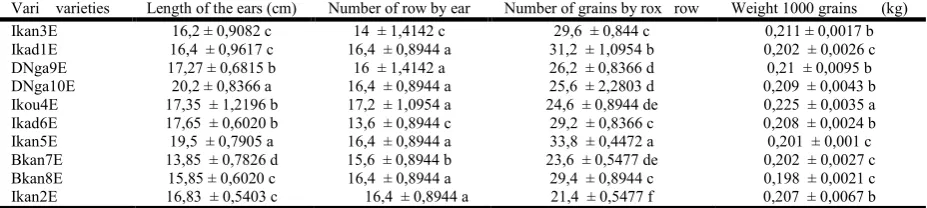
Table 2. Averages and standard deviations of the securities of the agronomic parameters measured on the sampled local varieties
[image:3.595.61.530.564.701.2]Vari varieties Length of the ears (cm) Number of row by ear Number of grains by rox row Weight 1000 grains (kg) Ikan3E 16,2 ± 0,9082 c 14 ± 1,4142 c 29,6 ± 0,844 c 0,211 ± 0,0017 b Ikad1E 16,4 ± 0,9617 c 16,4 ± 0,8944 a 31,2 ± 1,0954 b 0,202 ± 0,0026 c DNga9E 17,27 ± 0,6815 b 16 ± 1,4142 a 26,2 ± 0,8366 d 0,21 ± 0,0095 b DNga10E 20,2 ± 0,8366 a 16,4 ± 0,8944 a 25,6 ± 2,2803 d 0,209 ± 0,0043 b Ikou4E 17,35 ± 1,2196 b 17,2 ± 1,0954 a 24,6 ± 0,8944 de 0,225 ± 0,0035 a Ikad6E 17,65 ± 0,6020 b 13,6 ± 0,8944 c 29,2 ± 0,8366 c 0,208 ± 0,0024 b Ikan5E 19,5 ± 0,7905 a 16,4 ± 0,8944 a 33,8 ± 0,4472 a 0,201 ± 0,001 c Bkan7E 13,85 ± 0,7826 d 15,6 ± 0,8944 b 23,6 ± 0,5477 de 0,202 ± 0,0027 c Bkan8E 15,85 ± 0,6020 c 16,4 ± 0,8944 a 29,4 ± 0,8944 c 0,198 ± 0,0021 c Ikan2E 16,83 ± 0,5403 c 16,4 ± 0,8944 a 21,4 ± 0,5477 f 0,207 ± 0,0067 b Values in the same column followed of a same letter are not meaningfully different to the doorstep of 5% according to the test of Student Newman and Keuls.
8°88539 and a Longitude of 18°40605. The Ikou4 variety is of large size, his cycle of culture is of 100 days. The long ear of 17,35 ± 1,2196 cm, is composed of 17,20 ± 1,0954 of rows of the grains and 24,60 ± 0,8944 of grains by row, of 0,225 ± 0,0035 kg of weight of 1000 grains (Table 2). The grains are round and medium-sized, of yellow color and bent aspect and colorful texture. it has been sampled in the sahel zone, to an Altitude of 285 m, a Latitude of 13.44533° and a Longitude of 14.98600°. In relation to the length of the ears, four groups (a, b, c, d) of local varieties distinguish themselves (Figure 1). The difference of the averages with regard to the length of the ears of the local varieties constituting these groups is meaningful to the doorstep of 5% (F = 23,222; p = 0,001). In relation to the number of rows by ear, three groups (a, b, c) of local varieties are distinguished themselves (Figure 2), the difference of average of the numbers of rows by ear is meaningful to the doorstep of 5% (F = 5, 88; P = 0,001).
Figure 3. Number of grains by row of the local varieties of corn
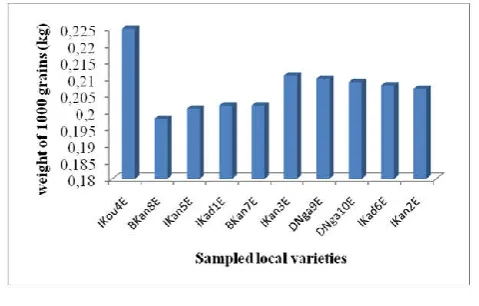
Figure 4. Middleweight of 1000 grains of the local varieties of corn
In relation to the number of grains by row, six groups (a, b, c, d, de, f) of local varieties are distinguished themselves (Figure 3). The difference of the averages with regard to the number of grains by row of these groups is meaningful to the doorstep of 5% (F = 106, 53; P = 0,001). In relation to the weight of 1000 grains, three groups (a, b, c) of local varieties are distinguished themselves (Figure 4) meaningfully to the doorstep of 5% (F = 14,411; P = 0,001).
DISCUSSION
The local varieties of corn are cultivated again today, in particular in the localities of Bol, Isseirom and Danamadji in Chad where the corn is a traditional culture during the centuries. These results rejoin the findings of the works led by Brush (1995) on the need to maintain genetic biodiversity
through the traditional culture. Some similar studies have also
been signalled for the cassava (Koumbo et al., 2012;
Kosh-Komba et al., 2014; Agre et al., 2015). So, one is conscious of
the necessity more and more to maintain in situ the local varieties where they can evolve (evolutionary conservation) in the conditions of stress in answer to the needs of the agriculturists (Worede, 1993; Brush, 1995). Indeed, these local varieties of corn are important genetic sources for the local adaptation, the economic stability and the durability of the results for the agriculturist. Several authors as Paliwal and Sprague (1981); Paterniani (1985, 1990); Pandey and Gardner
(1992); Dowswell et al., (1996) have sustained the thesis
according to which the genetic resources should continue to develop and to be used more and more in the programs of improvements of corn tropical. The different groups are distinguished in relation to the length of the ears, to the number of row by ear, to the number of grains by row and to the weight of grains (Attiey, 1991) who translate the genetic variability of these local varieties of corn. The variability between the varieties of corn observed would also be owed to the genetic characters of every variety and to the conditions pedological and climatic different of sampling zones. These results agree with the findings of the similar works of the authors as (Tardieu and Manichon., 1987; Tollenaar., 1977). The corn presents an enormous variability with regard to the color, the texture, the composition and the appearance of the grain. Thus, the described grains are characteristic of tropical bent corn. This description rejoins the one of Esau (1977), Hanway and Ritchie (1987) and Ritchie and Hanway (1992) is based solely on the parts of the grain. Also, the results rejoin
the findings of the works of Dowswell et al., 1996, Hallauer
(1994). These authors described the types different of corn from a classification based on the morphology (Sanou, 1996) or the constitution of the grain, the color of the grain and the environment in which they are pushed and the cycle of culture.
Conclusion
The sampling permitted to have genetic resources of maize threatened of disappearance. Indeed, ten (10) local maize varieties: IKad1, IKan2, IKan3, IKou4, IKan5, IKad6, BKan7, BKan8, DNga9 and DNga10 were harvested across the country. With these local varieties obtained by the mass selection on the base of phenotypic appearance, performance improvement process of varieties could start. Also according Pandey and Gardner (1992), these local varieties could be to the basis of the general program of corn improvement, in particular in Chad.
REFERENCES
Agre, A.P., Kouchade, S., Odjo, T., Dansi, M., Nzobadila, B., Assogba, P., Dansi, T.O., Akoegninou, T.O., Sanni, A. 2015. Diversity and participating assessment of the cassava cultivars (Manihot Crantz esculenta) to the Center Benin.
Int. J. Biol. Csi., 9(1):388-408. DOI: http://dx.doi.org/
10.4314/ijbcs.v9i1.33.
Attiey, K. 1991. Contribution to the assessment of the variety of the traditional cultivars of corn of the center of the Coast of Ivory. In: State of advancement of the Research of the culture production food-producing in Africa Semi-aride (Ed by Menyonga J M, Bezuneh T, Yayock JY, Soumana), 213-223.
[image:4.595.42.282.433.586.2]regions Semi-arid of Africa Sub-Of the Sahara, Niamey, Niger,7-14 March 1991.
Bellon, M.R. and Brush, S.B. 1994. Keepers of maize in
Chiapas, Mexico. Econ. Bot., 48: 196-209.
Brush, S.B. 1995. In situ conservation of landraces in centers
of crop diversity. Crop Sci., 35: 346-354.
Djondand, K. 2002. The cotton culture in the center of the process of development to Chad, dead end or success. In Acts of the symposium of Ndjamena, of the 25 to February 28, 2002, on the Chad theme", forty years of independence, balance and perspective of the governance and the development ".
Dowswell, C.R., Paliwal, R.L. & Cantrell, R.P. 1996. Maize in the third world Boulder, CO, USA, Westview Press.
Esau, K. 1977. Anatomy of seed plants, 2nd ed. New York,
NY, USA, J. Wiley & Sons.
Goalbaye, T. Guisse, A. Ndiaye, M. and Tissou, M. 2013. Increase maize productivity through improved local
varieties of Chad. Int. J. Biol. Chem. Sci. 7 (5): 2019-2028.
Goalbaye, T. Guisse, A. S. Saïd, Ndiaye M. 2014. Obtaining heterotic local maize populations by interbreeding heels in
Chad. Ind. J. Sci. Res. And Tech. 2(2):45-49
Hallauer, A.R., ed. 1994. Specialty corns, Boca Raton, F.L, USA, CRC Press.
Hanway, J.J. & Ritchie, S.W. 1987. Zea mays. In H. Halvey, ed. Handbook of flowering, vol. 4, Boca Raton, FL, USA, CRC Press.
Kosh-Komba, E., Akpavi, S.;Woegan, Y.A.; Atato, A.; Duval, M.F.; Dourma, M.; Zinga, I.; Yandia, P.; Longue, D.;
Semballa, S. 2014. Diversity morphological agro of
Manihot Esculenta Crantz (Euphorbiaceae) cultivated in
three zones climatic Agro in Republic Centrafricaine
(RCA). European Scientific Newspaper, 10 (3):365-380..
Kouamé, K.D.; Péné, B.C. and Zouzou, M. 2010. Sifting of promising commercial varieties of sugar cane in the perimeter sugar-bowl of Ferké 2 to the north of the Coast of Ivory. Optimization of the length of Sci selection. Nature, 7(1):97-106.
Koumbo, G.R.; Dansi, A. ; Loko, L.Y. ; Orkwor, G.C. ; Vodouhe, R. ; Assogba, P. ; Magema, J.M. 2012. Diversity
of cassava (Manihot esculenta Crantz) cultivars and its
management in the department of Bouenza in the Republic
of Congo. Genet. Resour. Crop. Evol., 59(8) :1789
-1803.DOI : 10.1007/s10722-012-9803-0.
Mbayhoudel, G. 2002. Organization of the units of artisanal transformation in zone of savannas: Case of the transformation of sorghum in beer local bili-bili in
Moundou in Chad. Acts of the symposium, May 27-31, 2002, Garoua, Cameroon.
Moreno-Gonzalez, J. & Cubero, J.I. 1993. Selection strategies
and choice of breeding methods. In M. D. Hayward, N.O.
Bosemark & I. Romagosa, eds, plant breeding: Principles and prospects, P. 281-313. London, Chapman & Hall. Muller, B. 2004. Food Security and strategies farmers: case of
the zone rizicole of Maga. Memory of engineer Agronome, University of Dschang.
Paliwal, R.L. & Sprague, E.W. 1981. Improving adaptation and yield dependability in maize in the developing world. Mexico, DF, CIMMYT.
Pandey, S. & Gardner, C.O. 1992. Recurrent selection for population, variety, and hybrid improvement in tropical
maize. Adv. Agron., 48: 1-87.
Paterniani E., 1985. State of maize breeding in tropical areas in South American. In : Brandolini A., Salamini F. Breeding strategies for maize production improvment in the tropics, International Expert Consultation on Maize Breeding in the Tropics, Firenze, Italia, 1985. FAO ; Istituto Agronomico
per l’oltremare, Relazioni e Monografie Agrarie
Subtropicale e tropicale 100 : 329-340.
Paterniani E., 1990. Maize breeding in the tropics. Crit. Rev. Plant Sci.,9: 125-154.
Ritchie, S.W. & Hanway, J.J. 1992. How a corn plant develops. Special report N0. 48. Ames, IA, USA, Iowa State University.
Sanou, 1996. Analysis of the genetic variability of the local cultivars of corn of the savanna zone west African in view of his management and his use. Thesis of doctorate of the school National Superior Agronomic Montpellier (France), 98 pages.
Seignobos, C. 2005. Food-producing resources and food choices in the basin of the Chad lake. Symposium International Mega-Chad (FRA), Paris: IRD editions, Prodig., pp. 527 - 561.
Tardieu F., Manichon H., 1987. Structural State, rooting and water food of the corn / II, growth and spatial disposition of the system of the roots. Agronomy 7: 201-211.
Tollenaar M., 1977. Sink-source relationships during the
reproductive development in maize. A review. Maydica 22:
49-75.
Worede, M. 1993. The role of Ethiopian farmers in the
conservation and utilization of crop genetic resources. In
International crop science I, P. 395-399. Madison, WI,
USA, Crop Science Society of America.