BIROn - Birkbeck Institutional Research Online
de Freitas, Sara and Oliver, M. (2006) How can exploratory learning with
games and simulations within the curriculum be most effectively evaluated?
Computers and Education 46 (3), pp. 249-264. ISSN 0360-1315.
Downloaded from:
Usage Guidelines:
Please refer to usage guidelines at or alternatively
Birkbeck ePrints: an open access repository of the
research output of Birkbeck College
http://eprints.bbk.ac.uk
de Freitas, Sara and Oliver, Martin (2006). How can
exploratory learning with games and simulations within the
curriculum be most effectively evaluated?
Computers and
Education 46
(3) 249-264.
This is an author-produced version of a paper published in Computers and Education (ISSN 0360-1315). This version has been peer-reviewed, but does not include the final publisher proof corrections, published layout, or
pagination. The published version is available to subscribers at
http://dx.doi.org/10.1016/j.compedu.2005.11.007
All articles available through Birkbeck ePrints are protected by intellectual property law, including copyright law. Any use made of the contents should comply with the relevant law.
Citation for this version:
de Freitas, Sara and Oliver, Martin (2006). How can exploratory learning with games and simulations within the curriculum be most effectively evaluated?
London: Birkbeck ePrints. Available at:
http://eprints.bbk.ac.uk/archive/00000404
Citation for the publisher’s version:
de Freitas, Sara and Oliver, Martin (2006). How can exploratory learning with games and simulations within the curriculum be most effectively evaluated?
Computers and Education 46 (3) 249-264.
http://eprints.bbk.ac.uk
HOW CAN EXPLORATORY LEARNING WITH GAMES AND SIMULATIONS WITHIN THE CURRICULUM BE MOST EFFECTIVELY EVALUATED?*
Corresponding author: Dr Sara de Freitas. School of Computer Science and Information Systems, Birkbeck College, University of London; London
Knowledge Lab, 23-29 Emerald Street, London WC1N 3QS. Tel: 00 44 (0) 207 763 2117. Fax: 00 44 (0) 207 242 2754. Email: [email protected].
Dr Martin Oliver. Institute of Education, University of London; London
Knowledge Lab, 23-29 Emerald Street, London WC1N 3QS. Tel: 00 44 (0) 207 763 2168. Fax: 020 7763 2138. Email: [email protected].
*Note that this paper was presented at the Computer Assisted Learning conference 2005, Bristol, UK on 5th April 2005.
ABSTRACT
There have been few attempts to introduce frameworks that can help support tutors evaluate educational games and simulations that can be most effective in their particular learning context and subject area. The lack of a dedicated
framework has produced a significant impediment for uptake of games and simulations particularly in formal learning contexts. This paper aims to address this shortcoming by introducing a four-dimensional framework for helping tutors to evaluate the potential of using games- and simulation- based learning in their practice, and to support more critical approaches to this form of games and simulations. The four-dimensional framework is applied to two examples from practice to test its efficacy and structure critical reflection upon practice.
1:0 INTRODUCTION
The evaluation of educational games has typically rested upon studies of leisure-based games (Prensky, 2001; Squire, 2002; Gee 2003), as no
distinction between games for leisure time and education was generally drawn. This was, in part, due to the fact that comparatively few games were in use in mainstream tertiary education and training. However, over the last five years the use of educational games in the mainstream has become more widespread, and, although still regarded by many as peripheral to traditional teaching and learning practice, are becoming more commonplace in the classroom as gaming in the home becomes more pervasive (Prensky, 2001; Elspa 2003). In particular, there is a class of games that include an element of simulation (and a class of simulations that are intended to be ‘played with’ by users) that is
increasingly viewed as having educational potential (e.g. Mitchell & Savill-Smith, 2004: 20). It is this overlap between games and simulations that will be focused on within this paper. It should be recognised, however, that the situation
education. However, there are few examples of frameworks to support practitioners using simulations and games (e.g. Jiwa and Lavelle 2002).
The trend towards increasing use of games and simulations for teaching has important implications for understanding how informal and formal learning can support and reinforce one another in order to accelerate learning, support higher-order cognitive development and strengthen motivation in skills-based learning (Delanghe, 2001; Shawn Green & Bavelier, 2003; de Freitas and Levene, 2004; de Freitas, 2004; Klabbers, 2003). While there is clearly a need for baseline research into how games and simulations are currently being used in the home and for learning, general trends in the research indicate the
increasing popularity amongst learners for using ‘serious games’ and simulations to support curricula objectives (Amory et al. 1998; Spectrum
Strategy Consultants, 2002; Aldrich, 2004). In addition to increasing demand for interactive games- and simulation- based content and tools amongst learners, employers and training providers are (rightly or wrongly) beginning to regard games- and simulation- based learning as a way of making cost savings in training budgets as well as providing new ways for communicating with potential new recruits (Wardynski, 2004), particularly amongst the ‘net generation’ who have grown up with computer games (Oblinger & Oblinger, 2005). While these cost benefits are not always scalable or sustainable in all sectors and have yet to be fully proven in areas of training characterised by high differentiation of skills needs and diverse content provision, there is reason to believe that learner-driven demand and anticipated cost benefits will continue to facilitate increased uptake of games and simulations in the short- to medium- term.
2.0: DEVELOPING A FRAMEWORK FOR EVALUATING GAMES- AND SIMULATION- BASED LEARNING
Although trends of games- and simulation- based learning are set to increase, there have been few attempts to introduce frameworks that can help support tutors to evaluate games that can be most effective in their particular learning context including their specific subject areas (Kirriemuir & McFarlane, 2003; Amory & Seagram, 2003). The lack of a useful framework - and of other
evidence-based research - has produced a significant impediment for uptake of simulations and games (de Freitas 2004). In the context of schools, Dawes & Dumbleton (2001), for example, discuss the problem of adapting complex
games to the classroom context and the need for curriculum-based scenarios to ensure the relevance of game play. There is a conspicuous silence on the topic of games and curricula in tertiary education; however, this is likely to reflect the greater use and awareness of games within compulsory education, rather than the absence of this problem in post-compulsory contexts.
Currently when tutors are thinking of introducing games- and simulation- based learning into their practice, they are faced with several questions, for example:
Which game or simulation to select for the specific learning context?
Which pedagogic approaches to use to support learning outcomes and activities?
What is the validity of using the chosen game or simulation?
There is, at present, an over-reliance upon using available methods of
evaluating leisure-based games (Kirrimuir & McFarlane, 2004). This has led to problems including: a mismatch between methods and content, the use of inappropriate terminology and concepts, and the use of approaches not based upon evidence-based research. Whilst recommendations do exist about the design of games for learning (e.g. Amory & Seagram, 2003), these are not of obvious use to the consumers of games, such as teachers.
It is important also to recognise the growing body of work on the use of games for learning per se. Woods (2004), for example, has discussed how the
simulation elements of games can be interpreted as having educational potential – albeit a potential inscribed by ideological commitments. Squire (2002) has considered the educational potential that games have from both a cognitive and social perspective. Although he tempers this assertion by noting how reviews of games and learning have, historically, not shown any great benefit to games-based approaches, he goes on to argue that ‘the pedagogical potential of games and social contexts of gaming have been woefully
unexamined’. Studies have been undertaken, since then, which have illustrated the kinds of learning that take place through play (e.g. Oliver & Pelletier, 2004), but these note that such learning may be of little relevance to the kinds of outcomes valued in formal education. This has not stopped authors such as Gee (2003), however from using his studies of games as the basis for
advocating how the educational system should be changed so that learning in formal settings can be more game-like.
However, this work is only indirectly relevant to the problem considered here. Having established that it is possible to learn from games, there is still the question of how such resources can form part of curricula. It is not learning from games per se that needs to be considered here; instead it is how learning can be designed for in a way that recognises particular contexts (e.g. schooling) and the value systems (e.g. assessment frameworks, intended learning outcomes) that shape them.
reflection and debate around the different knowledge systems that learners encountered as a means of resolving the problem of ‘transferring’ learning. Rather than assuming, in some simplistic way, that things learnt in one context could just be taken and used elsewhere, they argue that such knowledge needs to be re-created for use in new settings. Thus the pedagogic role of reflecting on experiences in such contexts is not simply to identify overlap, but instead to work out how knowledge gained in one setting can be re-cast in a form that will be valued in another (specific) setting. Although it might seem strange to draw on a theory from work-based learning to explain what could be described as play-based learning, the problem faced is the same: the issue is the educational benefit that learners can create in one context given their experience in another.
Echoing these concerns, earlier studies of games within education found that there was a need to develop more tailored and specialised methods of
evaluation for educational content, as there were different drivers both for development of content and context of usage (de Freitas, 2004). It was also found that the quality of content varied considerably between leisure- and education- based game and simulation content. This indicated that there was a need for new frameworks for evaluation; a point highlighted by tutors in a separate study (de Freitas, 2005). The tutors’ expressed a need for extra support when selecting and using games and simulations in their practice due to time pressures placed upon them. Therefore the development and access to toolkits and frameworks that could help in the selection process would benefit the tutor by encouraging them to both reflect upon usage of games and simulations as well as supporting them in the process of engaging and motivating particular learner groups.
A number of evaluation frameworks already exist that are concerned with learning and new technology. Oliver (2000) discusses the TILT, CIAO! and Flashlight frameworks, all of which have been designed to evaluate the integration of technology into teaching. The Flashlight framework (Ehrmann, 1999), for example, seeks to examine the relationship between three elements (a technology, the activity for which it is used and the educational outcome), primarily through means of surveys. The CIAO! framework (Jones et al., 1996), similarly, considers the Context, Interactions (between learners and
technology), Attitudes and Outcomes – although it does so in a more flexible way than Flashlight, advocating the use of interviews, observations and document analyses as well as surveys. Even the Perspectives Interaction Paradigm advocated by Squires & McDougal (1994) follows a similar model, considering the interactions between teacher, student and software (which is treated as ‘embodying’ the designer).
rather representation per se and may be either diegetic or non-diegetic –
outside of the game (Pavel, 2000). The term has already been used to describe the internal world of the computer game (Lindley, 2002) and has clear links to work on identification (e.g.: Kellner, 1995). Although this quality is not unique to games, it is a distinguishing feature of the kinds of simulation-based games being considered in this paper; it is useful to reflect this through an explicit focus on this element. Consequently, the framework proposed here inherits the
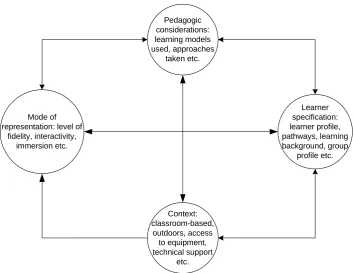
primary triad of features common to those above (student, teacher, tools/resources available) and extends this by explicitly addressing representational issues (Figure 1).
Pedagogic considerations: learning models used, approaches
taken etc.
Mode of representation: level of
fidelity, interactivity, immersion etc.
Context: classroom-based,
outdoors, access to equipment, technical support
etc.
Learner specification: learner profile, pathways, learning background, group
[image:7.595.135.489.245.518.2]profile etc.
Figure 1: A framework for evaluating games- and simulation-based education
This framework thus requires the practitioner to consider four main dimensions in advance of using games and simulations in their practice. Notably, this four dimensional framework should be regarded as iterative and reflect the
The first dimension focuses upon the particular context where play/learning takes place, including macro-level contextual factors such as historical, political and economic factors as well as micro-level factors of context such as the availability of specific resources and tools. Context has been established as a critical factor for effective use of e-learning tools and content, and includes the wider historical context as well as the specific learning context, which may include access to tools, the tutor’s own specific background and understanding as well as the availability of technical support. Context can become an enabling factor for learner support, or can provide significant impediments to delivery.
The second dimension focuses upon attributes of the particular learner or learner group, this may include the age and level of the group, as well as specific components of how they learn including their learning background, styles and preferences. For example, work undertaken in previous research (de Freitas, 2004) has found that games and simulations can significantly support differentiated learning, which may support learner groups with widely diverse learning abilities and approaches. Research also indicated that games and simulations can effectively support learners with skills-based needs (such as literacy and numeracy) (de Freitas, 2004). Games and simulations can also support formal as well as informal learning and may become an effective way of linking between formal and informal learning processes to accelerate learning outcomes.
The third dimension focuses upon the internal representational world - or diegesis - of the game or simulation, which in this context is used to mean: the mode of presentation, the interactivity, the levels of immersion and fidelity used in the game or simulation. This dimension is particularly significant for the framework as it highlights the difference between being immersed within the game and the process of critical reflection that takes place outside the game. These distinctive spaces inside and outside of the game are broadly
metaphorical of course, but serve as a method for supporting the teaching aims and learner objectives by defining the ‘learning activity as play’ and highlighting the potential of briefing/debriefing which take place before and after ‘serious play’ to reinforce the learning outcomes. This dimension also allows us to focus some analysis upon the format and mode of the game or simulation, which is particularly important from specific ‘games research’ perspectives.
differentiated learning approaches facilitated by new software tools and wider availability of e-content and e-assessment.
The four dimensions together provide a framework for a consideration of both existing and future educational games and simulations, and may also be
applied to other forms of e-content where immersive spaces are used (e.g.: the use of virtual reality or augmented reality). The four dimensions should not be considered as separate but rather reveal the significance of how each
dimension relates and maps to each other to produce, support or inhibit the particular learner or learner group’s experience. This is, perhaps, best elaborated by reference to Activity Theory (Kuutti, 1996). Like many
contemporary models of learning with technology, there is a close relationship between this framework and the systems of Activity Theory. While Figure 1 is presented as an iterative cycle – intended to reflect the planning practices of practitioners and to encourage a systematic approach to structuring judgements – as a framework it could be mapped onto the familiar triangular representations of an activity system, see: Figure 2. Here, the modes of representations
2.1: Diegesis and the role of debriefing
The distinction between diegesis and non-diegesis comes from film studies where understanding about what is going on in the film text, including the narrative and narration, is regarded as separate from our analysis of the film text retrospectively through semiotic study. One demarcates the synchronous experience of being immersed within the film and identifying with the main character or narrator, while the other can step back and view or study the ‘story world’ and its inter-relations from outside. The distinction is particularly apt for understanding how educational games and simulations operate within a classroom setting, that is the internal representation of the game and our relationship with playing it as distinct from the periods for collaboration and reflection upon the game-based activities. That is, we can critique the game as separate from our learning from the process of playing the game, and both are valid methods of investigation and contribute to how games and simulations can be used in practice.
In educational contexts, there is a need not only to enter into the ‘other world’ of the game or simulation, but also to be critical about that process in order to support reflective processes of learning as distinct from mere immersion into a virtual space. This ‘double’ identification approach to the game may in part explain why the use of ‘other worlds’ can indeed accelerate learning, allowing the learner to at once participate within the ‘world’ and to reflect upon their relationship when viewed from outside of it, reinforcing learning through empathy or ‘being there’, whilst allowing sufficient space for reflection.
Post-exercise reflection about how the learner performed within the ‘microworld’ has been well developed in the practical literature about debriefing, and is an integral aspect of learning from simulations, regarded by many trainers as critical for effective learning with simulations (e.g. Crookall, 1995; Petranek, 2000; Peters & Vissers, 2004; Mackenzie, 2002). Although this kind of work is not currently well developed in game studies (with the notable exception of Klabbers, e.g. 2003, who has argued for its benefits), there are clear parallels between the two forms leading to a growing convergence between the two (Stone and de Freitas, 2005; de Freitas, 2004) - articulated elsewhere as ‘gamesims’ (de Freitas and Levene, 2004) - and to a general perception that debriefing will play an important role for supporting learning with games that is directly relevant to curriculum objectives.
3.0: APPLYING THE FRAMEWORK
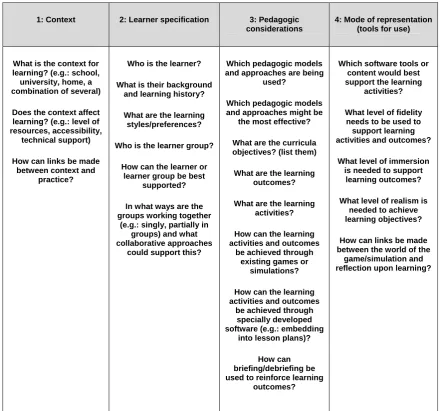
Table 1 demonstrates the framework in Figure 1 laid out in a checklist style. The factors laid out in the figure may determine how learning takes place. In other words, one learner simply may not adapt to the use of one kind of
representation of information or may work better with another. Building on this analysis, the relationship between games and contexts of use will be
following section, an example will be provided to explore the utility of the framework in this respect.
1: Context 2: Learner specification 3: Pedagogic considerations
4: Mode of representation (tools for use)
What is the context for learning? (e.g.: school, university, home, a combination of several)
Does the context affect learning? (e.g.: level of resources, accessibility,
technical support)
How can links be made between context and
practice?
Who is the learner?
What is their background and learning history?
What are the learning styles/preferences?
Who is the learner group?
How can the learner or learner group be best
supported?
In what ways are the groups working together
(e.g.: singly, partially in groups) and what collaborative approaches
could support this?
Which pedagogic models and approaches are being
used?
Which pedagogic models and approaches might be
the most effective?
What are the curricula objectives? (list them)
What are the learning outcomes?
What are the learning activities?
How can the learning activities and outcomes
be achieved through existing games or
simulations?
How can the learning activities and outcomes
be achieved through specially developed software (e.g.: embedding
into lesson plans)?
How can briefing/debriefing be used to reinforce learning
outcomes?
Which software tools or content would best support the learning
activities?
What level of fidelity needs to be used to support learning activities and outcomes?
What level of immersion is needed to support
learning outcomes?
What level of realism is needed to achieve learning objectives?
How can links be made between the world of the
[image:11.595.91.532.123.534.2]game/simulation and reflection upon learning?
Table 1: Checklist for evaluating the use of educational games and simulations.
In the following sections, the four-dimensional framework will be used to evaluate two examples of games and simulations being used and piloted in schools.
3.1: Immersive Education’s MediaStage
synchronised characters. This example of practice is particularly notable as it foregrounds the diegetic dimension of the framework so well. The tool allows the learner to build their own ‘virtual world’ (Woolley, 1992) using staging tools to create the setting (mise-en-scene), characters and dialogue (Figure 3).
Figure 3: A screenshot from Immersive Education’s MediaStage
The software tool follows a new trend, which in part is emerging from
Community Learning approaches pioneered in the United States (Lazarus et al.
2003), and explores the development of content creation tools designed to empower the learner and help them to produce their own content. This
approach has potential as it can support collaborative learning approaches as well as helping to engage learners who prefer to learn in a self-directed or visually and interactive ways. Another example of this trend is the Making Games project funded by the DTI PACCIT initiative, which aims to provide learners with the tools to develop their own interactive environments (see:
http://www.paccit.gla.ac.uk/public/projects/makgames.php. Last accessed 4th February 2005).
1: Context 2: Learner specification 3: Pedagogic considerations
4: Mode of representation (tools for use)
School-based learning in media studies
Classroom-based
Interactions with the software
MediaStage tool supports GCSE Media
Studies curriculum
School learners 14-16 year olds are currently
using this tool
The tool is used primarily for GCSE level but can be used by other ages ad
in informal settings
The tool can be used by learners working singly
and in groups
Range of differentiated learners with different learning styles can be catered for through the use of this tool as each learner or learner group can engage with the resource according to their own preferences
Use of theories such as Kolb’s Experiential learning (1984) where
learners learn from experience through
abstract conceptualisation and application into practice
Learning outcomes: Conversancy with film
craft and approaches allowing the student to experience the process of
film and stage craft first hand
Learning activities: The student learns through activities based upon
directing a play/film
Briefing/debriefing: pre-class preparation and post activity reflection and consideration
Simulation embedded as a practical session into
the lesson plan of the tutor. Individuals will need
different levels of attention from the tutor at
different stages of the learning process
MediaStage uses a medium level of fidelity based upon the use of 3D
animated characters
MediaStage uses a high level of interactivity between the media world
and the learners’ own experiences and knowledge, allowing the
student to develop an increasing conversancy
with the rules and functionality of the
simulation tool
Learning activities and outcomes achieved
through specially developed software supporting an increased awareness of the learner
[image:13.595.92.531.82.504.2]of the processes of stagecraft and film making through increased usage
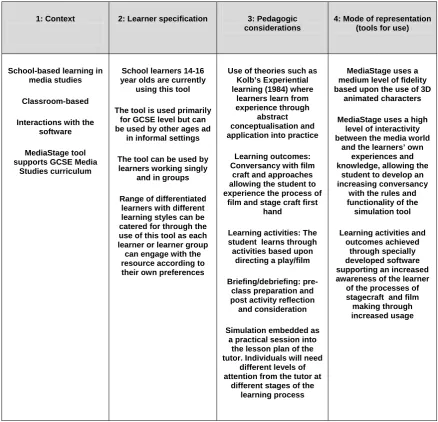
Table 2: Using the framework to evaluate MediaStage
Completing this table highlights particular challenges, for example pedagogic models and approaches that are needed to embed the simulation tool into effective practice are given emphasis. In this particular context, experiential learning (Kolb 1984) might be used to support the cyclical transition from abstract conceptualisation towards concrete action and reflection. The table also supports a deeper reflection of the tutor as to whether the tool can be used to support informal as well as curricula-led consideration, in this case if the software is available at home, learners may want to practice using the tool in the home context as well, supporting informal as well as formal learning
3.2: Nesta Futurelab’s Savannah
[image:14.595.158.467.178.422.2]This second example illustrates how the framework can be used retrospectively to analyse educational practice. Savannah is a mobile strategy adventure game pilot combining the use of virtual and real spaces, mobile technologies and interactive whiteboards to provide a tool for supporting exploratory learning in 11-12 year olds (Facer et al. 2004).
Figure 4: Screen shot from Nesta Futurelab’s Savannah adventure game
The game is a highly sophisticated one and in order to play it there is a need for a high level of technical support, precluding its use in most classroom-based contexts. The game utilised two spaces: the Den setting where interactive boards charted the movements of the children (Figure 4), and the outside space where the children using handheld PDAs played as lions marking out their territory in the real space which doubled as the virtual savannah. The issue of the interaction between real and virtual spaces has produced a body of
interesting work (e.g. Benford et al. 1998), which has explored a range of different human-computer interaction approaches to interface design including the use of augmented reality, virtual reality and mixed reality, stretching back to earlier work on hypertexts (Shum, 1990) that continue to inform interface design and issues of usability.
Educational theorists and researchers are beginning to identify these tools as potentially powerful resources in supporting the development of learning communities of offering experiential learning and in encouraging the development of meta-level thinking skills (Facer et al. 2004, p399).
The pilot was relatively small: the research team tested ten children between 10-12 years old, Facer et al. found that even with this small sample the game facilitated learning, however learning was not tied to curriculum content.
One of the least successful aspects of the trial was the attempt to combine a more formal ‘schooled’ experience with the games play (Facer et al. 2004, p407).
The main reason for this was because the game design was game-led making links between game-play and curriculum difficult in part this was due to very different contexts of interaction between the classroom and the outdoor activities. Another possible reason for the apparent mismatch between the game and the curriculum was perhaps due to the omission of a clear debriefing session: ‘the greatest failure of the study… was the failure to maximise the opportunity for the children to act as self-motivated learners in the Den setting, reflecting on and developing strategies for improved games play’ (Facer et al.
p407).
Interestingly, but perhaps not unsurprising, was the effectiveness of the children’s identification with the lions that they were simulating: they claimed they felt hot and tired as the lion. This is not surprising as role-play is inherently about taking up another identity from oneself, and even with very basic or no interactive imagery children can pretend to be someone or something else very easily in the school playground.
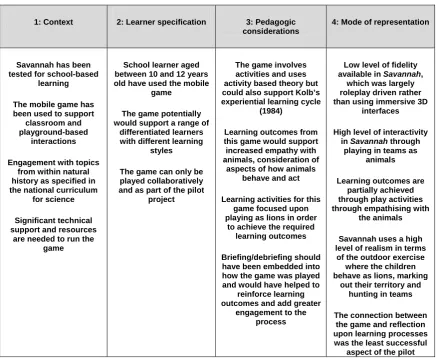
These considerations can be analysed using the framework as shown inTable 3.
Had the designers of the game considered the four-dimensional framework in advance of game design they would have identified a better fit between the needs of the curriculum and the best form of use of the game to mediate the learning activities. This would have allowed them to place a firm emphasis upon creating greater challenges for the children, supporting increased reflection upon learning during the debriefing session and thereby providing improved opportunities for the children to work in a team. The game also relies too heavily upon the need for significant technical support, which cannot be easily
1: Context 2: Learner specification 3: Pedagogic considerations
4: Mode of representation
Savannah has been tested for school-based
learning
The mobile game has been used to support
classroom and playground-based
interactions
Engagement with topics from within natural history as specified in the national curriculum
for science
Significant technical support and resources
are needed to run the game
School learner aged between 10 and 12 years old have used the mobile
game
The game potentially would support a range of
differentiated learners with different learning
styles
The game can only be played collaboratively and as part of the pilot
project
The game involves activities and uses activity based theory but could also support Kolb’s experiential learning cycle
(1984)
Learning outcomes from this game would support increased empathy with animals, consideration of
aspects of how animals behave and act
Learning activities for this game focused upon playing as lions in order
to achieve the required learning outcomes
Briefing/debriefing should have been embedded into how the game was played and would have helped to
reinforce learning outcomes and add greater
engagement to the process
Low level of fidelity available in Savannah,
which was largely roleplay driven rather than using immersive 3D
interfaces
High level of interactivity in Savannah through
playing in teams as animals
Learning outcomes are partially achieved through play activities through empathising with
the animals
Savannah uses a high level of realism in terms
of the outdoor exercise where the children behave as lions, marking
out their territory and hunting in teams
The connection between the game and reflection upon learning processes was the least successful
[image:16.595.94.532.93.451.2]aspect of the pilot
Table 3: Using the framework to evaluate Savannah
4.0: Conclusions
Although a number of frameworks exist that are intended to guide and support the evaluation of educational software, few have been designed that consider explicitly the use of games or simulations in education. Similarly, research in game studies has generally focused upon approaches based upon playing leisure games, and therefore do not take enough account of factors including the context, learning theory and practice and the attributes of the learner and learner group.
Given the growing interest in this kind of resource a framework has been developed that draws on existing approaches to evaluating formal educational resources, but which draws out the distinctive feature of games and simulations: the diegetic element.
specific issues) which can help practitioners to bridge the two approaches, facilitating more critical and reflective process for embedding games and simulations in teaching practice. These benefits have been illustrated in two case studies.
Other main benefits of the framework include: flexibility and ease of use, ability to help practitioners to reflect upon learning processes and approaches,
provision of support for tutors aiming to develop their practice and embed tools into the classroom and supported reflection upon how software tools can
support curriculum content most effectively. Due to these benefits there is value in further developing this framework both as an analytical tool for researchers and as a pragmatic tool for practitioners. At present, arguably, the format of the tables makes them well suited to use by educational advisors or educational software designers; a different format might be required for teachers, for
REFERENCES
Aldrich, C. (2004) Simulations and the future of learning. San Francisco John Wiley.
Amory, A., Naicker, K., Vincent, J & Adams, C. (1998) Computer Games as a learning resource. Proceedings of ED-MEDIA 98 & ED-TELECOM 98, Eds: Thomas Ottmann and Ivan Tomek. Charlottesville. Association for the Advancement of Computing in Education: 50-55.
Amory, A. and R. Seagram (2003). Educational game models:
conceptualization and evaluation. South African Journal of Higher Education 17(2): 206 –217.
Benford, S., Greenhalgh, C., Reynard, G., Brown, C. and Koleva, B. (1998) Understanding and constructing shared spaces with mixed-reality boundaries.
ACM Transactions on Human-Computer Interaction, 5(3): 185-223.
Collis, B. & Moonen, J. (2001). Flexible Learning in a Digital World. Londoon. Kogan Page.
Crookall, D. (1995) Debriefing: The Key to Learning from Simulations/Games.
Thousand Oaks. California. Sage Publications.
Dawes, L. & Dumbleton, T. (2001) Computer Games in Education Findings Report. Coventry: BeCTA.
de Freitas, S. (2004) Learning through Play. Internal report. London Learning and Skills Research Centre.
de Freitas, S. (2005) Review of the uptake and embedding of digital content. Internal report. Coventry. Becta.
de Freitas, S. & Levene, M. (2004). An investigation of the use of simulations and video gaming for supporting exploratory learning and developing higher-order cognitive skills. Proceedings of the IADIS Cognition and Exploratory Learning in the Digital Age Conference, Lisbon, Portugal. December 12-15.
Delanghe, F. (2001) Validating small arms simulation. Military training and simulation news. 6: 31-4.
Ehrmann, S. (1999). Studying teaching, learning and technology: a tool kit from the Flashlight programme. Active Learning, 9, 36-39.
Facer, K., Joiner, R., Stanton, D., Reid, J., Hull, R. & Kirk, D. (2004) Savannah: mobile gaming and learning. Journal of Computer Assisted Learning, 20:399-409.
Gee., J. (2003) What video games have to teach us about learning and literacy. New York: Palgrave Macmillan.
Griffiths, T., & Guile, D. (1999). Pedagogy in work-based contexts. In P.
Mortimore (Ed.), Understanding pedagogy and its impact on learning. London: Paul Chapman Publishing.18
Jiwa, S. & Lavelle, D. (2003). Evaluating the quality of learning through gaming and simuation. The International Simulation and Gaming Yearbook. Vol. 11, pp. 233-235.
Jones, A., Scanlon, E., Tosunoglu, C., Ross, S., Butcher, P., Murphy, P. & Greenberg, J. (1996). Evaluating CAL at the Open University: 15 Years On.
Computers in Education, 26 (1-3), 5-15.
Kellner, D. (1995). Media Culture. Cultural Studies, Identity and Politics Between the Modern and the Post-modern. London. Routledge.
Kirriemuir, J. & McFarlane, A. (2004) Literature review in games and learning. Report 8. Bristol. Nesta Futurelab.
Klabbers, J. (2003) The gaming landscape: a taxonomy for classifying games and simulations in M. Copier & J. Raessens (eds) Level Up Digital Games Research Conference. Utrecht University 4-6 November: 54-67.
Kolb, D. (1984) Experiential learning: experience as the source of learning and development. Englewood Cliffs. New Jersey. Prentice-Hall.
Kuutti, K. (1996). Activity theory as a potential framework for human computer interaction research. In Nardi, B. A. (Ed.), Context and consciousness: Activity theory and human-computer interaction, 17-44. Cambridge, MA: The MIT Press.
Lazarus, W., Lipper, L., Roberts, K., Fireman, R. and Rose, M. (2003). The Search for High-Quality Online Content for Low-Income and Underserved Communities: Evaluating and Producing What’s Needed. The Children’s Partnership.
Lindley, C. A. (2002) The gameplay Gestalt, narrative and interactive
storytelling. Proceedings of Computer Games and Digital Cultures Conference. June 6-8. Tampere. Finland.
Mitchell, A. & Savill-Smith, C. (2004). The use of computer and video games for learning. A Review of the Literature. London. Learning and Skills
Development Agency.
Oblinger, D.G. & Oblinger, J.L. Eds. (2005). Educating the Net Generation. Educause. See: www.educause.edu/educatingthe netgen/. Last accessed 3rd March 2005.
Oliver, M. (2000) An introduction to the evaluation of learning technology.
Educational Technology & Society, 3 (4), 20-30. http://ifets.ieee.org/periodical/vol_4_2000/intro.html
Oliver, M. & Pelletier, C. (2004) Activity theory and learning from digital games: implications for game design. Paper presented at Digital Generations: Children, young people and new media. London.
Pavel, T. (2000) Fiction and Imitation. Poetics Today, 21(3): 521-541.
Peters, V.A. M. & Vissers, G. A. N. (2004) A simple classification model for debriefing simulation games. Simulation & Gaming 35(1): 70-84.
Petranek, C. F. (2000) Written debriefing: the next vital step in learning with simulations. Simulation & Gaming. 31(1): 108-118.
Prensky, M. (2001) Digital games-based learning. New York. London. McGraw Hill.
Shawn Green, C. & Bavelier, D. (2003) Action video game modifies visual selective attention. Nature. 423(6939): 534-537.
Shum, S. (1990) Real and virtual spaces: mapping from spatial cognition to hypertext. Hypermedia 2(2): 133-158.
Spectrum Strategy Consultants (2002) From exuberant youth to sustainable maturity. Competitiveness analysis of the UK games software sector. London: Department of Trade and Industry.
Squire, K. (2002) Cultural framing of computer/video games. Game Studies, 2 (1). See: http://www.gamestudies.org/0102/squire/. Last accessed 15th March 2005.
Squires, D. & McDougall, A. (1994) Choosing and using educational software: A teachers' guide. London: The Falmer Press.
Stam, R., Burgoyne, R. & Flitterman-Lewis, S. (1992) New vocabularies in film semiotics. London. Routledge.
Wardynski, C. (2004) Informing popular culture. The America’s Army game concept. America’s Army PC Game. Vision and realization. San Francisco. United States Army. The Moves Institute.
Woolley, B. (1992) Virtual worlds: a journey in hype and hyperreality. Oxford. Blackwell.
Woods, S. (2004) Loading the Dice: The Challenge of Serious Videogames.