ISSN: 1992-8645 www.jatit.org E-ISSN: 1817-3195
304
PERFORMANCE ANALYSIS OF SLEACH, LEACH AND
DSDV PROTOCOLS FOR WIRELESS SENSOR NETWORKS
(WSN)
1IBRIHICH OUAFAA, 1 ESGHIR MUSTAPHA, 2 KRIT SALAH-DDINE, 1 EL HAJJI SAID
1
LABMIA,Faculty of Science, Mohammed-V University, Rabat, Morocco
2
Ibn Zohr University in Agadir, Polydisciplinary Faculty of Ouarzazate, Morocco
E-mail : [email protected] ,[email protected], [email protected],
ABSTRACT
Wireless Sensor Networks (WSN) is an emerging technology for attraction of researchers with its research challenges and various application domains. It consists of small nodes with sensing, computation, and wireless communications capabilities. The limited energy resource is one of the main challenges facing the security in such networks. An attempt has been made to compare the performance of three protocols DSDV, LEACH and SLEACH. The purpose of this paper is to create a simulation of these protocols using NS2. Comparison is made based on packet delivery fraction, average end-to-end delay, throughput, average jitter and packet loss. This paper presents all scenarios for simulation and then we analyzed the results.
Keywords: Wireless Sensor Network, Hierarchical Routing, DSDV, LEACH, SLEACH
1. INTRODUCTION
Wireless sensor network is a popular area for research nowadays, due to vast potential usage of sensor networks in different areas. Typically, wireless sensor networks contain hundreds or thousands of these sensor nodes that are generally identical. These sensor nodes have the ability to communicate either among each other or directly to a base station (BS).
The sensor network is highly distributed and the nodes are lightweight. Intuitively, a greater number of sensors will enable sensing over a larger area [1].
This paper have been made to provide a systematic comparative analysis of three popular routing protocols: LEACH, SLEACH and DSDV.
The objective of our analytical simulation is to understand the various approaches proposed by researchers to overcome routing inefficiency in WSN. Also, compare a secured hierarchical protocol with other protocols namely its behavior using these criteria. There are quite a number of routing protocols that are excellent in term of efficiency. However, the security requirements of these protocols changed the situation and a more detailed research is currently underway to develop secure routing protocols. To address these concerns, we compared secure LEACH (SLEACH) to LEACH and DSDV protocols. SLEACH is
meant to protect outsider attacks that is why it is performed much better than LEACH and DSDV of all metrics.
The remainder of this paper is structured as follows: Sections 3 and 4 give an overview and description of routing protocols that is analyzed. Section 5 presents a brief description of the simulation parameters. The simulation results and comparative analysis of the above said routing protocols are discussed in section 6. Finally, section 7 concludes with the comparisons of the overall performance of these protocols.
2. RELATED WORK
Most of the research literature involves comparing AODV, DSR and DSDV [2-6]. Very little work exists in literature that discusses LEACH, SLEACH and DSDV.
In [7], there is comparison of various routing protocol in wireless sensor network, the authors have observed that AODV gives the better performance for both MANETs and WSNs with respect to packet delivery ratio, routing overhead, throughput put and average delay by varying number of nodes. However, LEACH is better for Average End to End Delay, less packet loss but not in case of Packet delivery ratio.
ISSN: 1992-8645 www.jatit.org E-ISSN: 1817-3195
305 and DSDV du to a smaller amount of routing overhead when node have high mobility, counting the metrics throughput, average end-to-end delay and packet delivery ratio.
In [9], author give a comparison of routing protocols, where AODV, DSDV and DSR are compared. The author observed that AODV perform well when area in large. In the other hand, DSR is good for the condition when there is balanced traffic and mobility and movement of nodes is less then DSDV will be preferable.
In [10], the author compares AODV, DSR, TORA protocols by using OPNET Modeler. From the study of simulation is clear that TORA is better than AODV and DSR when the number of nodes increased in a network but it cannot be necessarily that TORA will perform well, the performance may depending by varying the network.
In [11], comparison of AODV, TORA, LEACH protocols has been performed with the metrics-Average End-to-End Delay, Packet Delivery fraction, packet loss. LEACH is better for Average End to End Delay, less packet loss but not in case of Packet delivery ratio.
3. ROUTING PROTOCOLS IN WIRELESS
SENSOR NETWORK
Wireless Sensor Networks can be divided into Table-Driven and On-Demand Routing protocol where Table Driven protocols are proactive and maintain a routing table, On-Demand are active and do not maintain a routing table and cluster based routing.
The main aim of cluster based routing is to efficiently maintain the energy usage of sensor
nodes by involving them in multi-hop
communication within a particular cluster. Cluster formation is generally based on the energy reserve of sensors and sensors proximity to the Cluster Head (CHs). Clustering plays an important role for energy saving in WSNs. With clustering in WSNs, energy consumption, lifetime of the network and scalability can be improved [12].
In cluster based WSNs, sensor nodes are arranged into number of clusters. Every sensor cluster is managed by a CH during the network operation such as data transmission. LEACH (Low Energy Adaptive Clustering Hierarchy) is a cluster based routing protocol for WSNs. But LEACH routing protocol is lack of security.
4. DESCRIPTION OF ROUTING
PROTOCOLS: DSDV, LEACH AND
SLEACH
LEACH is based on a hierarchical clustering
structure model and energy efficient cluster-based routing protocols for sensor networks. In this routing protocol, nodes self-organize themselves into several local clusters, each of which has one node serving as the cluster-head. In order to prolong the overall lifetime of the sensor networks, LEACH changes cluster heads periodically. LEACH has two main steps: the set-up phase and the steady-state phase. In the set-up phase, there are two parts, the cluster-head electing part and the cluster constructing part [13].
The advantages of LEACH include the following [14]:
Any node that served as a CH in certain round cannot be selected as the CH again, so each node can equally share the load imposed upon CHs to some extent.
Utilizing a TDMA schedule prevents CHs from unnecessary collisions.
Cluster members can open or close
communication interfaces incompliance with their allocated time slots to avoid excessive energy dissipation.
DSDV is a table driven routing scheme for ad
hoc mobile networks based on the Bellman-ford algorithm. The improvement made to the Bellman-Ford algorithm includes freedom from loops in routing table by using sequence numbers [15]. Each node acts as a router where a routing table is maintained and periodic routing updates are exchange, even if the routes are not needed. A sequence number is associated with each route or path to the destination to prevent routing loops. Routing updates are exchanged even if the network is idle which uses up battery and network bandwidth. Thus, it is not preferable for highly dynamic networks.
SLEACH protocol is the first attempt to build a
secure version of the well-known LEACH protocol. It is prevents sinkhole, selective forwarding and HELLO flooding attacks. SLEACH prevents an intruder node to send falsified data messages. However, it doesn’t guarantee confidentiality and
availability. This algorithm works with
ISSN: 1992-8645 www.jatit.org E-ISSN: 1817-3195
306 from outsider attack but it decreased the network efficiency and performance [16].
5. EXPERIMENTAL RESULTS
4.1 Simulation Tools
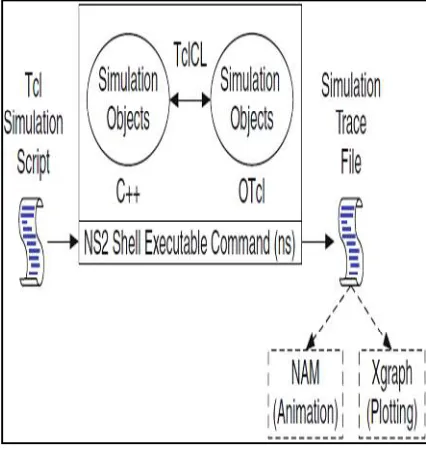
[image:3.612.90.303.406.635.2]Network Simulator (Version 2), widely known as NS2, is simply an event driven simulation tool that has proved useful in studying the dynamic nature of communication networks. It was developed at the University of California at Berkeley and extended at Carnegie Mellon University, CMU, to simulate wireless networks [17]. The simulator is written in C++, accompanying an OTCL script language based on Tcl/Tk. The researcher defines the network components such as nodes, links, protocols and traffic using the OTCL script. NS-2 uses OTCL as the interface to the user (Figure 1). This script is then used with NS, the simulator, to conduct the desired simulation, and as a result outputs traces at different selective layers. The output data within the trace output files is then filtered and extracted using statistical analysis software like excel/access program. The extracted relevant data is then used to evaluate performance by manipulating various metrics such as delays, throughput, overheads etc [18].
Figure 1: Simulation Overview
4.2 Simulation Environment
A simulation experiment was performed by using NS2 simulator to study the performance of three protocols mentioned LEACH, SLEACH and DSDV [19]. Simulation experiment was performed twice by taking 30, 60, 90, 120, 150, 180 nodes in first
scenario and 50, 100, 150, 200, 300 nodes in second scenario to study the performance of three protocols. Simulation time will be 100 sec for first scenario and 200 sec for second scenario. The following tables are the configurations set as per the assumed simulation context:
Table 1: Simulation parameters for scenario 1
Parameters Value
Simulator NS-2 (version 2.35)
Channel type Channel/Wireless channel Radio-propagation
model
Propagation/TwoRayGround
Network interface type
Phy/WirelessPhy
MAC Type Mac /802.11
Interface queue Type
Queue/DropTail\PriQueue
Link Layer Type LL
Antenna model Antenna/OmniAntenna
Packet size 512 MB
Number of nodes 30, 60, 90, 120, 150, 180
Traffic type TCP, CBR
Simulation Time 100 sec, 200 sec
Routing Protocols DSDV, LEACH, SLEACH Nominal bit rate 2 Mb/s
Node speed 20m/s – 15m/s
Transmission rate 4 packets/sec Area of simulation 1000m * 300m
Queue Length 50
Table 2: Simulation parameters for scenario 2
Parameters Value
Simulator NS-2 (version 2.35)
Channel type Channel/Wireless channel Radio-propagation
model
Propagation/TwoRayGround
Network interface type
Phy/WirelessPhy
MAC Type Mac /802.11
Interface queue Type
Queue/DropTail\PriQueue
Link Layer Type LL
Antenna model Antenna/OmniAntenna
Packet size 512 MB
Number of nodes 50, 100, 150, 200, 250, 300
Traffic type TCP, CBR
Simulation Time 100 sec, 200 sec
Routing Protocols DSDV, LEACH, SLEACH
Nominal bit rate 2 Mb/s
Node speed 20m/s – 15m/s
Transmission rate 4 packets/sec Area of simulation 1000m * 300m
ISSN: 1992-8645 www.jatit.org E-ISSN: 1817-3195
307
4.3 Performance Metrics
The performance of the proposed protocol is evaluated using the ns-2 simulator. A set of performance metrics are used for comparing the protocol of this work, each of these metrics parameters can be described briefly as follows:
Packet delivery fraction (PDF) [20]: is the
fraction of all the received data packets successfully at the destinations over the number of data packets sent by the CBR sources.
Average end-to-end delay: There are possible
delays caused by buffering during route discovery
latency, queuing at the interface queue,
retransmission delays at the MAC, and propagation and transfer times [21, 22]. The average end-to-end delay is an average end-to-end delay of data packets. It also caused by queuing for transmission at the node and buffering data for detouring. Once the time difference between every packet sent and received was recorded, dividing the total time difference over the total number of total packets received gave the average end-to-end delay for the received packets. The performance is better when packet end-to-end delay is low. It is calculated as follows:
∑ _ _ _ _
∑ _ _
Packet loss: It is the difference between the total
numbers of packets send by source and received by sink. A packet is dropped in two cases: the buffer is full when packet needs to be buffered and the time that the packet has been buffered exceeds the limit [23].
Throughput: The throughput metric measures how
well the network can constantly provide data to the sink [24]. It can be defined as how many data packets received by receiver with in data transmission time or successful data transmission performed within a time period. In any network, throughput is average rate of successfully data packet delivered from source node to destination node. Throughput is represented in bits/bytes per second. In any network, higher throughput is most essential factor. The throughput is calculated as follows:
_ _
_ _
Average Jitter: is the variation in the time between
packets arriving, caused by network congestion, timing drift, or route changes [25]. More formally
in a particular stream of packet, Si is the time when
packet i was send from the sender, Ri is the time which received by the receiver, the jitter of packet I is given by:
|
|
It should be less for a routing protocol to perform better.
4.4 Performance evaluation
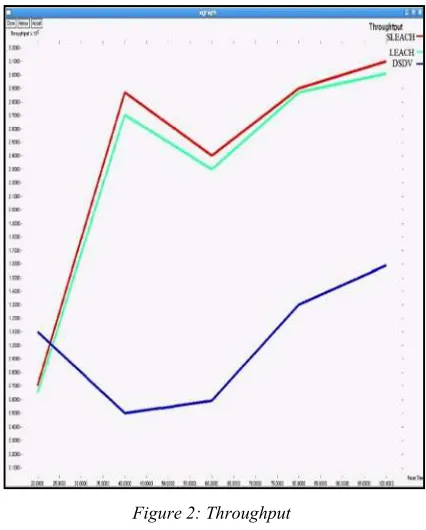
[image:4.612.312.525.261.526.2]This section presents our simulations results. In order to compare the performance of DSDV, LEACH and SLEACH in terms of average jitter and throughput we carried out simulations for different scenarios.
Figure 2: Throughput
ISSN: 1992-8645 www.jatit.org E-ISSN: 1817-3195
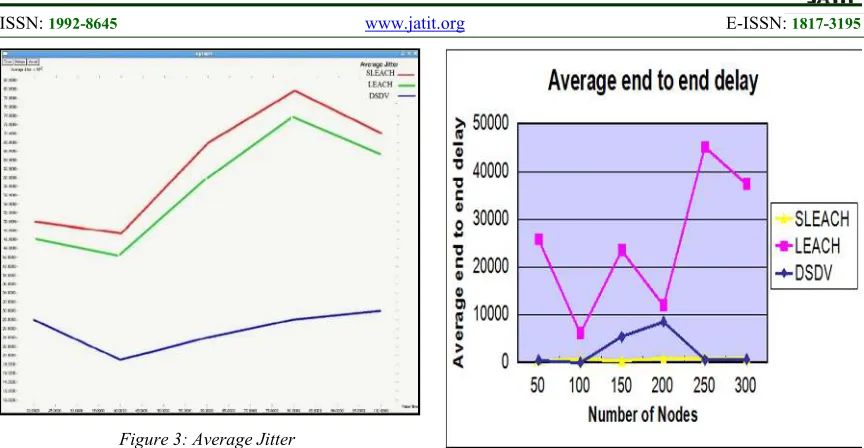
[image:5.612.91.523.70.294.2]308 Figure 3: Average Jitter
From the figure 3, according to our simulation results, DSDV has less jitter than SLEACH and LEACH. SLEACH and LEACH performed the worst in case of average jitter.
6. RESULTS AND DISCUSSION
In this section, the performance of SLEACH, LEACH and DSDV have been compared based on three performance metrics: Packet delivery fraction (PDF), average end-to-end delay and packet loss.
[image:5.612.104.450.462.686.2]The purpose of the study was to investigate the behaviors of SLEACH, LEACH and DSDV for these metrics.
Figure 4: Average end-to-end delay for SLEACH, LEACH and DSDV (Scenario 1)
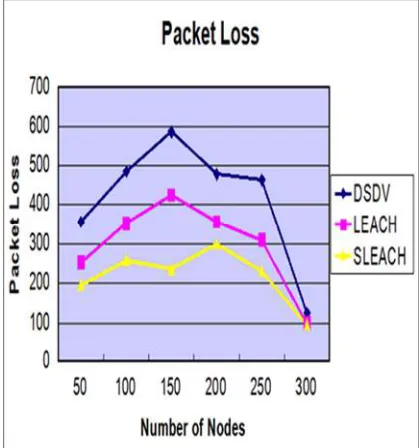
Figure 5: Average end-to-end delay for SLEACH, LEACH and DSDV (Scenario 2)
From figures 4 and 5, we observe that average end-to-end delay is less for SLEACH as compared to LEACH and DSDV.
Figure 4 shows that LEACH and DSDV average delay is almost equal than SLEACH because they have higher average delay than SLEACH. The performance of SLEACH is uniform.
From figure 5, we observe that the average delay for LEACH becomes very high and increases when the number of nodes increases except for 100 and 200 nodes. Besides, when the network size increases, the DSDV’s average delay increases also, specially, when the numbers of nodes are between 100 and 250, but it decreases further up to 250 while it remains uniform for SLEACH.
[image:5.612.314.522.523.703.2]ISSN: 1992-8645 www.jatit.org E-ISSN: 1817-3195
[image:6.612.308.521.75.320.2]309 Figure 7: Packet delivery fraction for SLEACH, LEACH
and DSDV (Scenario 2
From figures 6 and 7, when looking at the packet delivery fraction (PDF), it can easily be seen that SLEACH perform much better than LEACH and DSDV.
Based on figure 6, it is clear that the PDF for the three protocols decrease or increase according to number of nodes, because at network size from 30 to 60, it decreases for SLEACH and LEACH, in the other side, it increases for DSDV. Besides, it increases for SLEACH and DSDV while it decreases for LEACH when the numbers of nodes are between 150 to 180.
[image:6.612.91.317.75.320.2]From figure 7, it is observed that in low network size, SLEACH gives higher PDF; while PDF is minimum for DSDV. When the numbers of nodes are between 150 and 220, the PDF almost remains constant for SLEACH while it decreases for LEACH and DSDV. Now when the numbers of nodes are increased further up to 270, the PDF increases for SLEACH and LEACH while it decreases for DSDV.
Figure 8: Packet loss for SLEACH, LEACH and DSDV (Scenario 1)
Figure 9: Packet loss for SLEACH, LEACH and DSDV (Scenario 2)
From figures 8 and 9, the packet loss is increases at some points and decreases at other points. It is observed from the figure 8 that in low network size, DSDV gives highest packet loss; while it is minimum for SLEACH and LEACH. In high network size, the packet for LEACH and SLEACH increase again while it decreases for DSDV.
[image:6.612.314.524.359.583.2]ISSN: 1992-8645 www.jatit.org E-ISSN: 1817-3195
310 decreases for the three protocols when the number of nodes are between 200 and 300.
7. CONCLUSION
Sensor node has a limited amount of battery in sensor network. So, it is important to have the maximum lifetime of network through energy effective routing. That is why, designing and selecting an appropriate secure routing protocol for the network is a tough task. Because of this reason, SLEACH protocol selected. It gives better result than normal LEACH protocol.
In this paper, we focused on the three routing protocols LEACH, SLEACH and DSDV. These protocols have been evaluated on NS2 simulator by using five performance metrics such as packet
delivery fraction, average end-to-end delay,
throughput, average jitter and packet loss.
Each protocol gives variant performance in different scenario so no one protocol can be chosen best for all type of network. As per the simulation result based on Average jitter, Throughput; SLEACH gives highest throughput but it performed the worst in case of average jitter. Best performance is shown by DSDV as average jitter, because DSDV is a proactive protocol i.e. all routing information are already stored in table. Overall, when comparing the routing throughput for each protocols, SLEACH has the best performance and DSDV has lowest throughput.
From the performance evaluation, it can be concluded that in low network size; LEACH gives highest average end-to-end delay but it gives poor performance for PDF and packet loss.
As it can be seen, SLEACH is uniform in height network in size in terms of average end-to-end delay but it gives best for PDF and packet loss. Overall, SLEACH performs much better if we take as terms PDF and packet loss. As it has least packet loss throughout.
In case of high network size; DSDV gives the highest average end-to-end delay but it gives poor performance for packet loss and PDF.
As a result of our studies, we concluded that the secure hierarchical routing protocol SLEACH indicate a better performance in terms of throughput. Besides, SLEACH performs much better PDF and packet loss with increasing number of mobile nodes. However, SLEACH outperforms LEACH and DSDV in terms of all the five metrics because it is quite efficient, and preserves the structure of the original LEACH, including its ability to carry out data fusion.
In future work, we plan to design a suitable secure routing protocol for WSNs that gives stable performance under different network conditions.
REFRENCES:
[1]Rajashree.V.Biradar,Dr.S.R.Sawant,Dr.R.R.Mud holkar, Dr.V.C.Patil,"Multihop Routing In Self-Organizing Wireless Sensor Networks", in Proceedings of the IJCSI International Journal of Computer Science Issues, Vol. 8, Issue 1, January 2011.
[2] Macickam, P., T.G. Baskar, M. Girijia and Dr. D. Manimegalai. "Performance Comparisons of
Routing Protocols in Mobile Ad Hoc
Networks". International Journal ofWireless &Mobile Networks, 3(1). 2011.
[3] Surayati, N., et al. "Performance Evaluation of AODV, DSDV and DSR Routing Protocols in Grid Environment", IJCSNS, 9(7). 2009. [4] Acharjee, U.K., A. Ahmed and S. Rafique.
"Experimental Analysis of Ad-hoc Routing Protocols using Network Simulator". Journal of Computer Science. 2007.
[5] Boomarani, A., V.R. Sarma Dhulipala and RM.
Chandrasekaran. "Throughput and Delay
Comparison of MANET Routing Protocols". Int. J. Open Problems Compt. Math, 2(3). 2009.
[6] Yinfei Pan. "Design Routing Protocol
Performance Comparison in NS2: AODV comparing to DSR as Example". Dept. of Comp. Sci, SUNY Bignhmton.
[7] Parul Kansal, Deepali Kansal and Arun Balodi, "Comparison of Various Routing Protocol in
Wireless Sensor Network". International
Journal of Computer Applications, Volume 5– No.11, August 2010, pp. 14-19.
[8] P. Manickam and T. G. Baskar, "Performance comparisons of routing protocols in mobile ad- hoc networks". vol. 3, no. 1, pp. 98–106, 2011. [9] C. Engineering, "Performance comparison of
multihop wireless mobile ah-hoc routing protocols". Special Issue on Ubiquitous Computing Security Systems. Vol. 4, no. 1, pp. 696–703.
[10] A. K. Dwivedi, S. Kushwaha, and O. P. Vyas, "Performance of Routing Protocols for Mobile Ad-hoc and Wireless Sensor Networks: A Comparative Study". vol. 2, no. 4, pp. 101–105, 2009.
ISSN: 1992-8645 www.jatit.org E-ISSN: 1817-3195
311 Science and Software Engineering. Vol. 2, no. 7, pp. 84–89, July 2012.
[12] V. Kumar, S. Jain, S. Tiwari, "Energy Efficient Clustering Algorithms in Wireless Sensor Networks: A Survey", IJCSI International Journal of Computer Science Issues, Vol. 8, Issue 5, No 2, September 2011.K. Elissa, “Title of paper if known,” unpublished
[13] I. S. Jacobs and C. P. Bean, "Fine particles, thin films and exchange anisotropy", in Magnetism, vol. III, G. T. Rado and H. Suhl, Eds. New York: Academic, 1963, pp. 271–350. [14] Lai, W.K.; Fan, C.S.; Lin, L.Y, "Arranging
cluster sizes and transmission ranges for wireless sensor networks". Inf. Sci. 2012, 183,117131.
[15] Amith Khandakar, "Step by Step Procedural Comparison of DSR, AODV and DSDV Routing protocol", 2012 4th International Conference on Computer Engineering and Technology (ICCET 2012), vol.40, 2012. [16] Mohamed Elhoseny, Hamdy K. El-minir, A. M.
Riad and Xiaohui yuan, "Recent Advances of Secure Clustering Protocols in Wireless Sensor Networks", International Journal of Computer Networks and Communications Security, Vol. 2, No. 11, November 2014.
[17] P Panc Pancardo, JC Dueñas, "A proposal for System Architecture to Integrate Scarce resources Wireless Sensors Networks into Ubiquitous Environments". [Online], Available:
http://ftp.informatik.rwth- aachen.de/Publications/CEUR-WS/Vol-208/paper23.pdf.
[18] Genita Gautam, Biswaraj Sen, "Design and Simulation of Wireless Sensor Network in NS2", International Journal of Computer Applications (0975 – 8887), Vol 113 – No. 16, March 2015.
[19] Er. Pragati, Dr. Rajender Nath, "Performance Evaluation of AODV, LEACH and TORA Protocols through Simulation", International Journal of Advanced Research in Computer Science and Software Engineering, Vol 2, Issue 7, July 2012.
[20] Mrs. Shallu Makker, Mrs. Vidhu Kiran,
"Analysis and Comparison of WiMax
Communication using Cryptographic
Techniques", International Journal of Advanced Research in Computer and Communication Engineering, Vol. 4, Issue 9, September 2015.
[21] Pankaj Rohal, Ruchika Dahiya, Prashant Dahiya, "Study and Analysis of Throughput, Delay and Packet Delivery Ratio in MANET for Topology Based Routing Protocols (AODV, DSR and DSDV)", International Journal for
Advance Research in Engineering and
Technology, Vol. 1, Issue II, Mar. 2013. [22] S Muzamil Basha, SR Raj kumar, Raghu Veer
Matam, "Inclusive performance scrutiny of DSDV, AODV and ZRP MANETs Routing Protocol", International Journal of Advanced Computer Technology (IJACT), Vol 2, No 5. [23] Ginni Tonk, S.S. Tyagi, "Performance of
Ad-Hoc Network Routing Protocols in Different Network Sizes", International Journal of
Innovative Technology and Exploring
Engineering (IJITEE), Vol-1, Issue-2, July 2012.
[24] R.Devi, B.Sumathi, T.Gandhimathi,
G.Alaiyarasi, "Performance Metrics of MANET in Multi-Hop Wireless Ad-Hoc Network Routing Protocols", International Journal of Computational Engineering Research (IJCER). [25] Mandeep Kaur Gulati and Krishan Kumar,
"Performance Comparison of Mobile AD HOC Network Routing Protocols", International
Journal of Computer Networks and