127
TECHNOLOGY USE, EMOTIONAL CONNECTION AND
THEIR RELATIONSHIP: A LITERATURE REVIEW
1NUR FATINI ISMAIL, 2MOHD HILMI HASAN, 3EMY ELYANEE MUSTAPHA
1Student, Universiti Teknologi PETRONAS, Computer & Information Sciences Department, Perak,
Malaysia
2Senior Lecturer, Universiti Teknologi PETRONAS, Computer & Information Sciences Department, Perak,
Malaysia
3Co-founder, Penny & Emy Enterprise, Selangor, Malaysia
E-mail: 1[email protected], 2[email protected], 3[email protected]
ABSTRACT
Demand for technology use upsurge as we often rely on technology in completing countless tasks daily. Nowadays, the emerging technologies impact our way of livings in different ways regardless of age. If technology is properly used, it can make betterment to one’s life, but if it is excessively used, it causes severity to human beings. Impact arises from the excessive use of technology could be hindered if we could be informed about the severity of technology use. The aim of this research is to develop constructs for a scale measuring technology severity among children regarding emotional connection. For this study, emotional connection is defined as a bond or tie to the technology in the form of attachment, engagement or addiction towards mobile devices. The objective of this article is to understand technology use and emotional connection from reviewing literature. Findings from the literature reviewed suggested that there are intersections of characteristics between technology use and emotional connection.
Keywords: Technology Use, Acceptance, Continuous Use, Excessive Use, Emotional Connection, Attachment, Engagement, Addiction
1. INTRODUCTION
The increment of technology use among children triggers concern of the society especially parents. In long term, uncontrolled use of technology can impact children. The purpose of this study is to address the recent issues of problematic technology use among children. Based on a preliminary study of this research, most parents try to reduce the impact of technology by reducing the usage time. However, usage time is not the only factor contributing to problematic use. There are other factors that alter impact of technology on children’s behavior and growth including parenting style, socioeconomic status, and child temperament [1]. This study focuses on impact of technology in the context of emotional connection such as attachment, engagement or addiction.
The research idea is to determine the factors of technology use and how usage impact user emotionally. The main reason in understanding
them is to identify which variable (refer to the factors) should be manipulated to affect the responding variable (refer to impact on emotional connection). In another word, this study proposes that by combining these two dimensions (technology use and emotional connection), the inducing factors could be determined and manipulated to reduce the negative impacts on emotional connection. The relationship of factor, usage and impact is illustrated in Figure 1.
Factor Usage Impact
Figure 1:Factor-Usage-Impact relationship
There are several studies that assess technology acceptance, continuous use, excessive use, technology attachment, technology engagement and technology addiction. However, previous
studies had evaluated both dimensions
128 addiction with the purpose to have a clearer view on the developmental stage in both dimensions.
This research focuses on technology use which is mobile devices use such as smartphones or tablets among children. This is to address the current issues of excessive mobile device use among children. In highlighting the current issue, where technology is being used to substitute parenting, 63 per cent of parents proclaimed that they use technology to calm down or divert children when they are busy or tired (iParenting). In addition, a research by Boston School of Medicine note that, parents typically used mobile devices as ‘shut-up toy’ when they cannot give full attention to their children during activities like car rides. In long term, uncontrolled use of mobile devices can impact children in terms of attention span, comprehension ability and various skills, including self-regulation, empathy, social skills and problem-solving [2]. Therefore, the motivation of this research is to minimize the impact of technology on children in terms of prevention towards technology addiction. The prevention can be achieved through the development of constructs as it will lead to development of scale to measure emotional connection among children and mobile devices.
The objective of this paper is to identify constructs from existing theory or model for technology use and emotional connection from reviewing literatures. To gain broad insight, this literature review only study unspecified technology use and emotional connection on individual perspectives. This paper is interested in covering reviews on the relationship of technology use and emotional connection. Section 2 describes the process involved in gathering the related published manuscripts, by using a structured approach. Section 3 lists the commonly discussed theory for each domain and the extraction of constructs for domain representation. While, Section 4 presents the outcomes of the performed literature review and an overview of the preliminary result for this research. Finally, Section 5 concludes the paper by summarizing the current works and outlining the future works.
2. METHODS & MATERIALS
This study reviewed existing theories, models and scales for each domain of technology use and emotional connection. A structured approach was conducted to identify relevant scientific publications: (i) search on the particular
keyword(s) in Google Scholar; (ii) filter identified publications based on tittle matching; (iii) filter identified publications based on abstract matching; and (iv) detailed process of reviewing and analyzing full text of the selected publication.
30 publications had been selected and classified to the identified stages of technology use and emotional connection. Five most relevant publications had been selected for each domain from the 124 publications retrieved via literature searches. From 30 publications selected, a few literature review papers are presented to reduce the time consume on reviewing but increase the number of publications reviewed to gain a broader insight of the topic.
3. LITERATURE REVIEW
This section reviews the proposed stages of
technology use (technology acceptance,
continuous use of technology and excessive use of
technology) and emotional connection
(technology attachment, technology engagement and technology addiction).
3.1 Technology Acceptance
Technology acceptance is the first stage of technology use which occurs when users have the intention to use or use a technology. Technology acceptance is also known as adoption of technology.
Technology acceptance is commonly described by one of the most dominant theories in
Information Systems (IS), Technology
Acceptance Model (TAM) by Fred Davis. TAM is a derivation from the psychology-based Theory of Reasonable Action (TRA) and Theory of Planned Behaviour (TPB). Researchers have made it as a guide to understand why users accept technology, so that they can make improvement in designing, evaluating, and predicting how users will react to new technology [3]. In this study, acceptance of technology is reviewed to understand user’s behavior that could lead to impact of technology.
129 variables. On the other hand, they also group four major categories of modifications into (i)external predicators, (ii)factors from other theories, (iii)contextual factors, and (iv)usage measures. From their study, new variables/ factors are introduced to TAM while several variables/factors are repeated.
The work Samaradiwakara and Gunawardena [3] reviews 14 theories/models on technology acceptance study which include TRA, TPB,
TAM, TAM2, Cognitive Dissonance
Theory(CDT), Innovation Diffusion Theory(IDT), Task Technology Fit Model (TTF), Expectation-Disconfirmation Theory (EDT), Social Cognitive Theory (SCT) , Model of PC Utilization (MPCU), Motivational Model (MM), Decomposed Theory of Planned Behavior (DTPB), Combined TAM and TPB (C-TAM-TPB) and Unified Theory of Acceptance and Use of Technology (UTAUT). By comparing the theories/models, they find that moderators assist in giving a clearer explanation on the theories/models alongside with the constructs. The most common moderator used in these theories/models is the ‘experience’. Among the theories/models reviewed, they conclude that UTAUT introduced by Venkatesh et al. [5] is an improved theory in understanding technology acceptance behavior since UTAUT has the most coverage of moderators from all reviewed
theories/models including; gender, age,
experience and voluntariness. Meanwhile,
UTAUT variables consist of performance expectancy, effort expectancy, social influence and facilitating conditions.
By using an inductive approach, the work of Yucel and Gulbahar [6], does content analysis of possible predictors of TAM based on qualitative review from fifty papers between the years 1999 and 2010 where most studies reviewed were in the fields of education and business. Their paper contains three main objectives: (1) to investigate TAM variables that were found effective and ineffective from a critical point of view; (2) to highlight the top use of the effective variables; (3) to compose the study fields of TAM. This study is almost similar to the work of [4] since both of them suggest future research area for TAM. Their results show that even though several attempts have been made to modify the existing ones, the main variables of TAM remained as the most effective.
The work of Alkhaldi and Al-Sa'di [7], has specifically reviewed the crucial significant constructs that influence technology acceptance
among users. They summarize the key determinant constructs of existence technology models from their review on technology acceptance theories. They list 10 theories including TAM, UTAUT, TRA, TPB and other similar theories listed by the work of [3]. They tabulate the determinant constructs and clearly state the adaptation from previous theories facilitating this study for referral.
The work of Al-Mamary et al. [8], critically reviews 10 models and theories on acceptance of technology including TRA, TPB, SCT, TAM,
TAM2, TAM3, UTAUT, C-TAM-TPB,
Technology, Organization, and Environment Framework (TOE), and Diffusion of Innovation (DOI). They summarize the models’ strengths and weaknesses. DOI and TOE Framework are at the firm level. Therefore, both are excluded since this study looks at individual level only.
Review for technology acceptance identified 18 theories/models. Some models are excluded since their determinants of constructs are similar or adapted from previous theories/models. The
variables/factors/constructs/moderators are
presented in Table 1.
3.2 Continuous Use of Technology
Continuous use of technology is related to user’s usage behavior that continuously uses the technology they accepted. Continuous use is different from acceptance since it is a previously used technology and user is already familiar with it. It is also known as post-adoption of technology. Various theories and models in IS research mostly talk about acceptance of technology. Yet, less research was done to understand the continued use of technology.
Based on Expectation-Confirmation Theory (ECT), the work of Bhattacherjee [9] proposes the IS Continuance Model (ISCM). The work suggests a theoretical model of IS continuance based on three variables: user satisfaction, the confirmation of expectations through prior IS use, and perceived usefulness (PU) that represents post-adoption expectations. The ISCM has a strong theoretical basis and emphases on users’ motivations to keep on using the technology. Just like TAM for acceptance, ISCM is widely used by researchers in understanding continuous use of technology.
130 extension UTAUT2 to investigate user’s acceptance and continuous use of smartphone application on energy efficiency. UTAUT1 is the original UTUAT introduced by the work of [5], while UTAUT2 is primarily designed to investigate continuous use intention on consumer. UTAUT2 explains continuous use with the help of three additional elements/constructs; hedonic motivation, price value and habit. However, they only found moderate support for continuous use intention while using UTAUT. They suggest that ‘beliefs’ factor is updated from acceptance to continuous use stage as users become familiar with the technology. They also outline several theories which explain continuous use intention such as expectation-confirmation model [9,11,12]. The work of Shaikh and Karjaluoto [13], conducts detailed literature review by considering 152 publications within the scope of continuous usage behavior. Based on their search findings, the literature is synthesized and separated into four major domains into their proposed framework: Continuous Usage of Mobile Information Systems (CUMIS), Continuous Usage of Electronic Business Information Systems (CUEBIS), Continuous Usage of Social Information Systems (CUSIS), and Continuous Usage of Electronic Learning Information Systems (CUELIS). These domains separate the publications reviewed according to purpose, nature and usage of IT/IS. For this study, CUMIS and CUSIS are more relevant for the individual context. Several independent and dependent variables are extracted from their study. The variables include attitude, intention, actual usage, satisfaction, subjective norms, PU, PEOU, and PE. However, in these self-constructed models, they combined diverse models and frameworks, such as TAM, TPB, MM, Expectation Disconfirmation Model (EDM), and Flow Theory (FT) and Expectation Confirmation Theory (ECT).
The work of Lin and Rivera-Sa´nchez [14], studies a Short Message Service (SMS)-based system that allow students to answer classroom quizzes via mobile phones. They apply a longitudinal study which record the students’ perceptions on usefulness and their attitude toward the system twice which is before using the system and after using the system for 2 months. Based on Information Technology Continuance Model (ITCM), they develop an integrative model to draw inference on students’ resistance and intention to discontinue since the students’
attitude and perceived usefulness were higher before they use the system. Their constructs
include resistance, usefulness, intention,
satisfaction, disconfirmation, and value. They conclude that, although perceived usefulness is important for acceptability and continuance of use, contextual experiences on resistance should also be considered as it shows the most effect in users’ experiences.
According to Gebauer et al. [15], positive impact of IT arises from continuous use of technology, not the acceptance of technology. Their study review papers to better understand on the formation of continuous IT use. They tabulate 12 publications on continuous use and the measure dependent and independent variables. From their reviews, they adapt 14 variables in their constructs including behavioral intention, PU, PEOU, social factors, trust, technical commitment, personality factors, self-efficacy, perceived actual use, IS continuance intention, sunk costs, habit, confirmation and cognitive absorption. Their paper does not include the research results as the research was in progress. Thus, their developed constructs will be used for this study.
The work of Bhattacherjee and Lin [16], develops a unified model of continuous use of technology with three different factors that are expected to result a continuance behavior which are reasoned action, experiential response, and habitual response. Based on longitudinal study among insurance agents at the workplace, they prove that the three factors are interdependent, complementary, and have crossover effects. The constructs they use in their research model include continuance behavior, satisfaction, continuance intention, habit, disconfirmation, perceived usefulness and subjective norm which are adopted measured from previous literature. The model they proposed is a potential guideline for this study in understanding the IT continuance behavior.
Review for continuous use of technology identified 18 theories/models. As for acceptance TAM is their backbone, meanwhile, for continuous use, ISCM suggested by the work of [9] has a strong theoretical basis and emphases on users’ motivations to keep on using the technology. Some theories/models reviewed are excluded since their determinants of constructs
are similar or adapted from previous
131
variables/factors/constructs/moderators are
presented in Table 1.
3.3 Excessive Use of Technology
Excessive use of technology is a behavior going beyond necessary or proper limit in using technology. As cited by the work of Zheng and Lee [17], excessive use is defined as use of technology longer than the desired time. They also state that, up to some level, excessive use turns as a high level of technology use experience that will cause unhealthy cognitions, which will eventually lead to negative impacts.
The work of Emelin et al. [18], based on the psychological model of consequences of info-communicational technology use, studies the role of two factors which is change in needs and transformation of psychological boundaries. Hierarchical regressions were used to predict two aspects of the excessive use which are subjective feeling of dependence and subjective readiness of refusing from technologies. Both aspects use the same variables in the model including frequency of use, gender, age, boundaries extension, convenience, image making, boundaries violation and functionality. Their study concludes that,
‘changes in needs’ and ‘psychological
boundaries’ are important factors which affect excessive use of technology.
According to Billieux et al. [19], Problematic Mobile Phone Use (PMPU) is a behavioral addiction which symptoms are almost similar to drug addiction. In their study, they justify the application of behavioral addiction model on PMPU. They develop a pathway model of PMPU with three pathways including excessive reassurance pathway (ERP), impulsive-antisocial pathway (IAP) and extraversion pathway (EP). The pathway respectively is affected by different aspects which initiate to different kind uses and misuses. The first pathway, ERP is determined by the users’ need to preserve relationships and gain reassurance from others. While, the second pathway, IAP is determined by poor impulse control resulting in uncontrolled urges and deregulated use. Finally, users who’s PMPU is similar to dependence-like symptoms and overuse determined by a strong and continuous longing to be connected with others and to establish new relationships, match with the third pathway EP. This study uses these three pathways as reference for the characteristics of excessive use of technology.
The work of Lin et al. [20], in their study, uses empirical mode decomposition (EMD) to tell off the pattern of smartphone use over one month by installing a mobile application that monitor smartphone use. In their previous factor analysis of Smartphone Addiction Inventory, they specify that, smartphone addiction are made of four components which are tolerance, withdrawal, compulsive symptoms, and functional [21]. The two core symptoms of addiction, compulsion and tolerance are based on the use time estimation. They measure excessive use by daily use duration and frequency, as well as the relationship between the tolerance symptoms. They propose three main diagnostic measures for smartphone addiction which are maladaptive pattern of use, functional impairment and exclusion on obsessive-compulsive disorder. They conclude that smartphone addiction can be identify by having a mobile application to monitor the smartphone use rather than self-aware reporting on smartphone use.
The extension of the study identifies problematic smartphone uses by a development of smartphone usage pattern [22]. They include day-to-day frequency of use, total duration and daily median of the duration per period as their parameter in drawing up the pattern. They also introduce two additional parameters, the root mean square of the successive differences (RMSSD) and the Similarity Index, to discover the comparison of use and non-use between participants. The non-use frequency, non-use duration and non-use-median parameters could foresee problematic smartphone use and reach beyond just discovering whether a user is excessively use a smartphone. Their techniques determine either an excessive use of a smartphone is a benefit or a deficit.
132 include online entertainment, initial age of Internet use as entertainment, frequency of use, number of hours per week and hobbies other than the Internet. Meanwhile the selected variables for PMPU include degree of expertise using the technology, perception of the problem in others, perception of the problem in oneself, type of mobile phone use, and time of mobile phone ownership. Their study suggests that socio-demographic and pattern of technology usage play an important role in leading to excessive use.
In excessive use of technology studies, researchers no longer discuss about the determinants of technology acceptance. Instead, most of the research discussed about the usage behavior which lead to excessive use. This study discovers that, excessive use is caused by continuous use. Based on reviews, the main factor that contributes to excessive use is the increment of frequency of use accompanied by behavior
such as compulsive behavior, excessive
reassurance impulsive-antisocial and/or
withdrawal.
3.4 Technology Attachment
Attachment to technology in this study refers to emotional attachment to mobile devices. The work of Meschtscherjakov et al. [24], introduces the term “mobile attachment” and describe it as a bond between a people’s self and a mobile phone that differs in strength. This research identifies that the emotional connection does not appear between the children and the physical object of mobile device but mobile devices which have access to game application or internet for video streaming and online game. Therefore, this study focuses on the mobile device technology rather than the physical object of mobile device.
The same work of [24] develops a conceptual mobile attachment model consisting causes, general influencing factors, and consequences. The causes of mobile attachment include device-self linkage routes (device-empowerment, device- self-enrichment and self-gratification) that contribute towards design space determinants. Design space determinants consist of utility, memory, self-image, affiliation, world view and pleasure. Meanwhile, the general influencing factors include user, environment and device. The third part of the conceptual model is the mobile
attachment consequences which include
investment of limited resources, investment of self-image resources, behavioral responses, as well as cognitive and emotional responses. If a
user is emotionally attached to his or her mobile phone, a change of behavioral and emotional consequences can be observed. Therefore, these consequences assist as an indicator for the degree of mobile attachment.
The work of Bock et al. [25], produces an instrument to assess multiple aspects of the individuals’ relationship to their mobile phone. The final items for the complete Mobile Phone Attachment Scale (MPAS) consist of four components including “usefulness”, “anxious attachment”, “addiction”, and “24/7” (continuous use 24 hours/day). The MPAS developed in their study is a useful indicator of the quality of the individual’s relationship with their mobile phone. This study uses the four components in defining technology attachment.
The work of Kim et al. [26] presents a model linking character customization and game enjoyment. Their study investigates how feelings of autonomy and control, rooted in self-determination theory, and perceived attachment to game characters influence game enjoyment through immersion- related experiences. Their results show that the feelings of autonomy and control are reliable clarifications for enjoyment, regardless of customization type. The results propose that, like other entertainment media, games can appeal to individuals through the senses of autonomy, control, and attachment to a character. This study identifies six constructs in defining attachment which are customization, control, autonomy, attachment, presence and enjoyment.
The work of Li [27] extends the literature by conceptualizing a construct called IT attachment to describe the occurrence. It is suggested that IT attachment is defined as an emotional bond of the IT users to IT. It is a determinant of the users’ satisfaction with IT and its continuance intention. Factors that influence the development of IT attachment includes IT confirmation, perceived usefulness, perceived ease of use, and IT playfulness. These factors will be used to further define technology attachment.
The work of Kim et al. [28] examines how
consumers’ attachment towards mobile
133 or socially connected with mobile applications, the stronger they build attachment with the applications. It also shows that when users have stronger attachment with applications, they show not only more supportive words-of-mouth for the mobile applications, but also higher self-efficacy and higher life satisfaction overall. This study identifies five constructs from their work which are self-connection, social-connection, brand supportive behavior, self-efficacy and life satisfaction.
3.5 Technology Engagement
In this study, technology engagement refers to emotional engagement to mobile devices. Engagement in technology is frequently explained through experience in the gaming and learning environment. Engagement is an emotional connection where user feels content while using technology with absence of negative impact. The more engaged a person is, the more likely they are to experience overall positive affect while performing at a high level [29]. Therefore, with continuous use of technology, engagement towards technology would probably grow.
The work of O'Brien and Toms [30] develops methods to measure engaging user experiences. They list 10 attribute of engagement consists of
aesthetic appeal, attention, challenge,
endurability, feedback, interactivity, perceived user control, pleasure, sensory appeal and variety/novelty. The attributes are compared in several applications such as video games, educational applications, online shopping and web searching to explore the user’s perception of being engaged with the technology. Their findings indicate that engagement is a process comprises four distinct stages: (1) point of engagement, (2)
period of sustained engagement, (3)
disengagement, and (4) reengagement. They conclude their work with a definition of engagement as a quality of user experience characterized by attributes of challenge, positive affect, endurability, aesthetic and sensory appeal, attention, feedback, variety/novelty, interactivity, and perceived user control.
The work of Sharafi et al. [31] develops the Engagement Mode (EM) model describing how user engages in an activity with an object in a certain mode. Their model states 5 engagement
modes (Enjoying/ Acceptance, Ambition/
Curiosity, Avoidance/ Hesitation, Frustration/ Anxiety, and Efficiency/ Productivity), which are categorized into 3 dimensions (evaluation of
object, locus of control between subject and object, and intrinsic or extrinsic focus of motivation). They come into conclusion that the EM-model, flow experience, and causality orientation theories offer a uniform framework to understand how user familiarizes to IT. This study identifies seven constructs from their specified modes, which are ambition, curiosity productivity, frustration, anxiety, avoidance and hesitation.
The work of Han et al. [32] presents their initiatives in community informatics including digital cultural heritage and local volunteer efforts mediated by mobile technology. They state that a socially supported network should be based on attachment and engagement of user in encouraging a community informatics application. This study identifies two main ideas in defining
engagement of application, which are
participation and awareness.
The work of Parameswaran et al. [33] in their study, assesses a within-study invariance of key UTAUT scales by using invariance analysis. They consider 6 respondent group characteristics: five variables pertaining to users’ two technology engagement facets (prior technology knowledge and technology usage pattern) and one variable pertaining to their gender. This study identifies five constructs from their analysis, which are performance expectancy, effort expectancy, facilitating conditions, intention to use and concentration.
The work of Hamari et al. [34] investigates the impact of flow, engagement, and immersion on learning in game-based learning environments. Their results show that engagement in game positively impact learning, however, immersion in game and had no noticeable effect on learning. The strong predictor of learning outcome is the challenge in game. Therefore, this study identifies three constructs from their work, which are concentration, interest and enjoyment. These three constructs are used to increase the engagement of user in game-based learning environments.
3.6 Technology Addiction
134 addiction towards technology is a distinct kind of behavioral addiction that includes a psychological dependency. It usually occurs when user has an incontrollable desire to use a technology. Technology addiction is often described as negative impacts of technology. This study suggests that excessive use of technology could escalate to technology addiction.
The work of Kwon et al. (2013), in their study develops a self-diagnostic scale that could differentiate mobile phone addicts program for addiction of Internet and the mobile phone's features. Their study develops the first scale of mobile phone addiction aspect of the diagnostic manual, which is relatively reliable and valid. This study identifies five constructs from their analysis, which are performance expectancy,
effort expectancy, facilitating conditions,
intention to use and concentration.
The work of Pavia et al. [38], develops Smartphone Addiction Inventory (SPAI) to measure smartphone addiction among Taiwanese university students. Their research aim to assess the factor structure and psychometric properties of the SPAI in Italian university students. This study identifies the five factors from SPAI, which are time spent, compulsivity, daily life interference, craving, and sleep interference. The factors will be used in defining technology addiction.
The work of Tossell et al. [39] examines smartphone user behaviors and their relation to self-reported smartphone addiction. Their study provides a first glimpse into the addictive nature of smartphones as indicated by real usage data combined with survey data. This kind of behavioral logging data provides more precision regarding what addicted users do on their devices. This study identifies three constructs from their work, which are inability to control craving, feeling anxious and lost, and withdrawal escape.
The work of Lopez-Fernandaz [40], adapts the short version of the Smartphone Addiction Scale [SAS-SV] into Spanish and French. The aim of his study is to (i) examine the scale's psychometric properties in both languages, (ii) estimate the prevalence of potential excessive smartphone use among Spanish and Belgian adults, and (iii) compare the addictive symptomatology measured by the SAS-SV between potentially excessive users from both countries. The results show that, the excessive users endorsed withdrawal and tolerance symptoms in both countries. This study identifies
six constructs from their work, which are loss of control disruption disregard for consequences withdrawal preoccupation and tolerance.
The work of Gokcearslan et al. [41] investigates the purpose of smartphone usage, self-regulation, general self-efficacy and cyber-loafing in smartphone addiction. Results from online survey with 598 respondents from public university in Ankara, Turkey show that smartphone addiction is influenced by smartphone usage time and cyber-loafing. However, self-regulation negatively influenced the smartphone addiction. While, neither self-regulation nor general self-efficacy influenced cyber-loafing.
4. RESULTS AND DISCUSSION
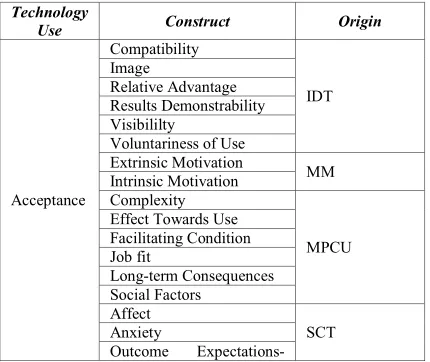
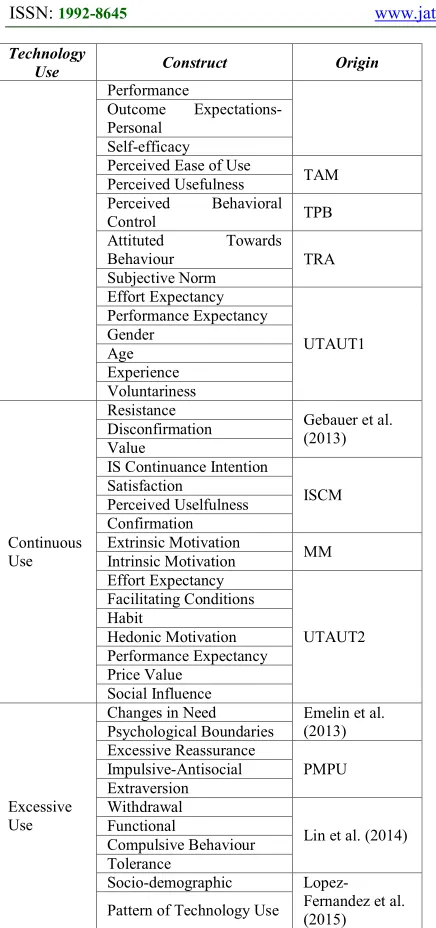
From the literature reviewed, the constructs include the variables, moderators, and factors adapted from previous studies since each of them play an important role in previous studies. This study found 30 potential constructs for technology acceptance, 16 potential constructs for continuous use of technology, 11 potential constructs for excessive use of technology, 30 potential constructs for technology attachment, 23 potential constructs for technology engagement and 24 potential constructs for technology addiction. The constructs are presented in Table 1 and Table 2.
4.1 Technology Use
[image:8.612.315.530.549.730.2]Technology use is frequently described by theories or models in IS researches. In this study, technology use is classified into several stages with reference from previous theories or models. The stages are technology acceptance, continuous use and excessive use.
Table 1: Characteristics of Technology Use Stages. Technology
Use Construct Origin
Acceptance
Compatibility
IDT Image
Relative Advantage Results Demonstrability Visibililty
Voluntariness of Use
Extrinsic Motivation MM
Intrinsic Motivation Complexity
MPCU Effect Towards Use
Facilitating Condition Job fit
Long-term Consequences Social Factors
Affect
SCT Anxiety
Expectations-135
Technology
Use Construct Origin
Performance
Outcome
Expectations-Personal Self-efficacy
Perceived Ease of Use TAM
Perceived Usefulness
Perceived Behavioral
Control TPB
Attituted Towards
Behaviour TRA
Subjective Norm Effort Expectancy
UTAUT1 Performance Expectancy
Gender Age Experience Voluntariness
Continuous Use
Resistance Gebauer et al.
(2013) Disconfirmation
Value
IS Continuance Intention
ISCM Satisfaction
Perceived Uselfulness Confirmation
Extrinsic Motivation MM
Intrinsic Motivation Effort Expectancy
UTAUT2 Facilitating Conditions
Habit
Hedonic Motivation Performance Expectancy Price Value
Social Influence
Excessive Use
Changes in Need Emelin et al.
(2013) Psychological Boundaries
Excessive Reassurance
PMPU Impulsive-Antisocial
Extraversion Withdrawal
Lin et al. (2014) Functional
Compulsive Behaviour Tolerance
Socio-demographic
Lopez-Fernandez et al. (2015) Pattern of Technology Use
4.2 Emotional Connection
The word emotional defined in the Oxford dictionary is related to a person’s emotions [42]. While, connection is defined as a relationship in which a person or thing is linked or associated with something else [43]. For this study, emotional connection is defined as a bond or tie to the technology in the form of attachment, engagement or addiction towards mobile devices. Unlike adults, the emotional connection does not appear among children and the physical object of the mobile device. However, they are emotionally connected to mobile devices which have access to game application or internet for video streaming and online games. This is proved
[image:9.612.86.304.72.536.2]from a preliminary study of this research where interviews among parents and observations of mobile device usage of children below 7 years old were done to prove the proposed research ideas at the early research work. According to Thorsteinsson and Page [44], it is noticeable that mobile devices’ users have emotionally connected to their mobile devices when they own it, the differences between them are the level of emotional connection. From the review of emotions and attachment theory, attachments are most expected on the technology, instead of the physical object of the technology. Therefore, this research focuses on mobile devices’ technology rather than the mobile devices’ physical.
Table 2: Characteristics of Emotional Connection Stages.
Emotional
Connection Construct Origin
Attachment
Self-Empowerment
Meschtscherjakov et al. (2014) Self-Enrichment
Self-Gratification Design Space
Invest of Limited
Resources
Investment of
Self-Images Resources Behaviorial Responses Emotional Responses Social Connectivity
MPAS Dependence
Mood
Work/Organization Importance Customization
Kim et al. (2015) Control
Autonomy Attachment
Physical, Emotional, and Narrative Presence Enjoyment Perceived Usefulness
Li (2014) Perceived Ease of Use
Anxiety Avoidance Confirmation Playfulness Self-Connection
Kim et al. (2013) Social-Connection
Brand Supportive
Behavior Self-Efficacy Life Satisfaction
Engagement
Attention
O'Brien & Tom (2008) Challenge
Feedback Interactivity
Perceived User Control Pleasure
Ambition Sharafi et
al.(2006) Curiosity
136
Emotional
Connection Construct Origin
Frustration Anxiety Avoidance Hesitation Participation
Han et al. (2014) Awareness
Performance Expectancy
Parameswaran et al. (2015) Effort Expectancy
Social Influence Facilitating Conditions Intention to Use
Concentration Hamari et al.
(2016) Interest
Enjoyment
Addiction
Daily-life disturbance
Kwon et al. (2013) Positive Anticipation
Withdrawal Cyberspace-oriented Relationship Overuse Tolerance Time spent
Pavia et al. (2016) Compulsivity
Craving Sleep Interference
Inability to Control
Craving Tossell et al.
(2015) Feeling anxious & Lost
Withdrawal Escape Loss of Control
Lopez-Fernandaz (2015)
Disruption
Disregard for
Consequences Withdrawal Preoccupation Tolerance
[image:10.612.79.530.59.487.2]Smartphone addiction Gökçearslan et al. (2016)
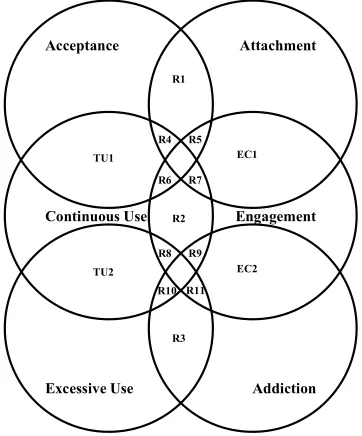
Table 1 and Table 2 provide insight for the next research activity. Based on the results, new constructs emerge on several stages while some constructs remain and some of them disappear. For example, ‘perceived usefulness’ appear in both acceptance and continuous use stages but disappear in excessive use stage. Table 3 shows similar constructs discussed from different domains. These emergence, visibility and invisibility of the constructs form the stages sought in this study.
Table 2: Similar constructs with different domains.
Intersection Domain Similar Constructs
R1 Acceptance & Attachment
Anxiety, Perceived Ease of Use, Perceived Usefulness, Self-efficacy R2 Continuous Use & Engagement Social Influence
R3 Excessive Use & Addiction
Compulsive Behavior, Tolerance, Withdrawal
R4
Acceptance, Attachment & Continuous Use
Perceived Usefulness
R5 Acceptance, Attachment & Engagement
Anxiety
R6 Acceptance, Continuous Use & Engagement
Performance Expectancy
TU1 Acceptance & Continuous Use
Extrinsic Motivation, Intrinsic Motivation EC1 Attachment & Engagement Avoidance, Enjoyment
[image:10.612.87.319.71.474.2]Figure 2 illustrates the union and intersections of the constructs of each domain. The intersection of the sets represents the constructs which remain on several stages. On the other hand, the non-intersection part represents an emergence of new constructs or the constructs that disappears in current stages. This shows an initial expected outcome for this research in identifying all six domains relationship.
Figure 2: Union and intersection of each categories
For this study, these relationships are improvised and a model is proposed. Figure 3 is a representation of the relationship between technology use and emotional connection. This representation is an adaptation from Fun Evolution Model by Ko [45] and Kwon et al. [46] which suggests that when an individual belongs to
Addiction Attachment
Excessive Use Continuous Use Acceptance
Engagement
R1
R2
R3
TU1 EC1
EC2 TU2
R4 R5
R8 R9
R10 R11
[image:10.612.327.508.410.628.2] [image:10.612.84.299.642.728.2]137 higher stage of technology use, deeper emotional connection is expected. The work of Lei and Zhao [47] indicates that when time spent on technology is too much, the benefit seems to be cancelled out or even replaced with a deficit. Therefore, it is expected that as time spent on technology increases, users will change their usage behavior and move to another stage of emotional connection. Before an individual enters the acceptance stage, a pre-usage is assumed to present as the individual is being introduced to a new technology.
Figure 3: Relationship between Technology Use and Emotional Connection
Therefore, this study identifies open research issues for this research where most parents had no idea on level of emotional connection between their child and technology and impact of technology on children is often seen directly to addiction, however, there are states that comes before addiction which is not clarified. Nowadays, technology does assist and improve our daily lives, however, parents are worried with the negative impacts of technology towards their children. Some parents prohibit the technology use among children to avoid the impacts that may occur. Unfortunately, these children are not expose to the good side of the technology. By knowing the states before addiction, we could escape the negative impacts and expose them to the positive impacts of technology. Therefore, the motivation of this research is to minimize the impact of technology on children in preventing technology addiction.
5. CONCLUSION
For this study, the technology use is classified into three stages (technology acceptance, continuous use of technology and excessive use of technology), while the emotional connection is also classified into three stages (technology
attachment, technology engagement and
technology addiction). Based on literature reviewed, technology acceptance and technology addiction are the main interests among IS researchers. Yet, less study was done on continuous use of technology, excessive use of
technology, technology attachment and
technology engagement. Thus, this study reviewed and put together the stages to close the research gap on discovering the relationship between them.
By identifying the constructs of each stages of technology and emotional connection, this paper identifies the factors on why user wants to use, continuously use and overuse a technology and provide a review on what happen after technology use on emotional connection context.
As conclusion, to prevent and curb the young generation from negative impacts of technology, this study aims to develop constructs for a scale to assess children’s emotional connection towards mobile device use. The scale is expected to help parents identify and understand emotional connection and prevent technology addiction before it happens.
REFERENCES:
[1] J.S. Radesky, J. Schumacher, and B. Zuckerman, “Mobile and interactive media use by young children: the good, the bad, and the unknown”, Pediatrics, Vol. 135, No.1, 2015, pp. 1-3.
[2] http://www.dailymail.co.uk/news/article- 3242349/Nearly-HALF-children-addicted- smartphones-tablet-computers-say-parents.html, 25 August 2016.
[3] G.D.M.N Samaradiwakara, and C.G.
Gunawardena, “Comparison Of Existing Technology Acceptance Theories And Models To Suggest A Well Improved Theory/Model. International Technical Sciences Journal, Vol. 21, 2014.
[4] N. Marangunić, and A. Granić, “Technology Acceptance Model: A Literature Review From 1986 To 2013,” Universal Access In The Information Society, Vol. 14, No. 1, 2014, pp. 81-95.
[5] V. Venkatesh, M.G. Morris, G.B. Davis, and F.D. Davis, “User Acceptance of Information Technology: Toward a Unified View,” MIS Quarterly, Vol. 27, No. 3, 2003.
[6] U.A. Yucel, and Y. Gulbahar, “Technology acceptance model: A review of the prior
Attachment Engagement
Addiction Technology Usage
Usage Time
Acceptance Excessive Usage
Pre-usage
[image:11.612.102.294.247.346.2]138 predictors,” Egitim Bilimleri Fakultesi Dergisi, Vol. 46, No. 1, 2013.
[7] A. Alkhaldi and A. Al-Sa’di, “Guidelines
Integrating Cultural Theories with
Technology Acceptance Theories: A Review,” New Zealand Journal of Computer-Human Interaction, Vol. 1, No. 2, 2016.
[8] Y.H. Al-Mamary, M. Al-nashmi, Y.A.G Hassan, and Y. Sana’a, “A Critical Review of Models and Theories in Field of Individual Acceptance of Technology,” International Journal of Hybrid Information Technology, Vol. 9, No. 6, 2016, pp. 143-158.
[9] A. Bhattacherjee, “Understanding Information Systems Continuance: An Expectation-Confirmation Model,” MIS Quarterly, Vol. 25, No. 3, 2001, pp. 351-370.
[10] A. Kupfer, L. Ableitner, S. Schöb, and V. Tiefenbeck, “Technology Adoption vs. Continuous Usage Intention: do Decision Criteria Change when Using a Technology?,”
Americas Conference on Information
Systems, 2016.
[11] A. Bhattacherjee and C.P. Lin, “A unified
model of IT continuance: three
complementary perspectives and crossover effects,” European Journal of Information Systems, Vol. 24, No. 4, 2015, pp. 364-373. [12] S.S. Kim and N.K. Malhotra, “A Longitudinal
Model of Continued Is Use: An Integrative View of Four Mechanisms Underlying
Postadoption Phenomena,” Management
Science, Vol. 51, No. 5, 2005, pp. 741-755. [13] A.A.Shaikh, and H. Karjaluoto, Making The
Most Of Information Technology & Systems Usage: A Literature Review, Framework And Future Research Agenda,” Computers In Human Behavior, Vol. 49, 2015, pp. 541-566. [14] J. Lin, J. and M. Rivera-Sánchez, “Testing the
information technology continuance model on a mandatory SMS-based student response system,” Communication Education, Vol. 61, No. 2, 2012, pp. 89-110.
[15] L. Gebauer, M. Söllner, and J.M. Leimeister, “Towards understanding the formation of continuous it use”, 34th International Conference on Information Systems, Milan, 2013.
[16] A. Bhattacherjee and C.P. Lin, “A Unified
Model of IT Continuance: Three
Complementary Perspectives and Crossover Effects,” European Journal of Information Systems, Vol. 24, No. 4, 2015, pp. 364-373.
[17] X. Zheng and M.K.O. Lee, “Excessive use of mobile social networking sites: negative consequences on indviduals,” Computer in Human Behavior, Vol. 65, 2016, pp. 65-76. [18] V. Emelin, A. Tkhostov, and E. Rasskazova,
“Excessive use of internet, mobile phones and computers: the role of technology-related
changes in needs and psychological
boundaries,” Procedia-Social and Behavioral Sciences, Vol. 86, 2013, pp. 530-535.
[19] J. Billieux, P. Maurage, O. Lopez-Fernandez, D.J. Kuss, and M.D. Griffiths, “Can disordered mobile phone use be considered a behavioral addiction? An update on current evidence and a comprehensive model for future research,” Current Addiction Reports, Vol. 2, No. 2, 2015, pp. 156-162.
[20] Y.H. Lin, Y.C. Lin, Y.H. Lee, P.H. Lin, S.H. Lin, L.R. Chang, and T.B. Kuo, “Time
distortion associated with smartphone
addiction: Identifying smartphone addiction via a mobile application (App),” Journal of psychiatric research, Vol. 65, 2015, pp. 139-145.
[21] Y.H. Lin, L.R. Chang, Y.H. Lee, H.W. Tseng, T.B.J. Kuo, and S.H. Chen, “Development and Validation of Smartphone Addiction Inventory (SPAI),” Plos One, 2014.
[22] Y.H. Lin, Y.C. Lin, S.H. Lin, Y.H. Lee, P.H. Lin, C.L. Chiang, and T.B.J. Kuo, “To use or not to use? Compulsive behavior and its role in smartphone addiction,” Translational Psychiatry, Vol. 7, No. 2, 2017.
[23] O. Lopez-Fernandez, J.L. Losada-Lopez, and
M.L Honrubia-Serrano, “Predictors of
Problematic Internet and mobile phone usage in adolescents,” Aloma: revista de psicologia, ciències de l'educació i de l'esport Blanquerna, Vol. 33, No. 2, 2015, pp. 49-58.
[24] A. Meschtscherjakov, D. Wilfinger, and M. Tscheligi, “Mobile attachment causes and consequences for emotional bonding with mobile phones,” In Proceedings of the 32nd annual ACM conference on Human factors in computing systems, 2014, pp. 2317-2326. [25] B.C. Bock, H. Thind, J.L. Fava, K. Walaska,
N. Barnett, R. Rosen, and R. Lantini,
“Development of the mobile phone
attachment scale,” IEEE 2016 49th Hawaii International Conference on In System Sciences (HICSS), 2016, pp. 3401-3407. [26] K. Kim, M.G. Schmierbach, M.Y. Chung,
139
Exploring the effects of in-game
customization on game enjoyment,”
Computers in Human Behavior, Vol. 48, 2015, pp. 695-705.
[27] Y. Li, “Information Technology Attachment and continuance,” In Pacific Asia Conference on Information Systems, 2014.
[28] C.K. Kim, M. Jun, J. Han, M. Kim, and J.Y. Kim, “Antecedents and outcomes of attachment towards smartphone applications,”
International Journal of Mobile
Communications, Vol. 11, No. 4, 2013, pp. 393-411.
[29] D. Sharek, and E. Wiebe, “Investigating Real-time Predictors of Engagement: Implications for Adaptive Videogames and Online Training,” International Journal of Gaming
and Computer-Mediated Simulations
(IJGCMS), Vol. 7, No. 1, 2015, pp. 20-37. [30] H.L. O’Brien, and E.G. Toms, “What is user
engagement? A conceptual framework for defining user engagement with technology,” Journal of the American Society for Information Science and Technology, Vol. 59, No. 6, 2008, pp. 938-955.
[31] P. Sharafi, L. Hedman, and H. Montgomery, “Using information technology: engagement modes, flow experience, and personality orientations,” Computers in Human Behavior, Vol. 22, No. 5, 2006, pp. 899-916.
[32] K. Han, P.C. Shih, M.B. Rosson, and J.M. Carroll, “Understanding local community attachment, engagement and social support networks mediated by mobile technology,” Interacting with Computers, Vol. 28, No. 3, 2014, pp. 220–237.
[33] S. Parameswaran, R. Kishore, and P. Li, “Within-study measurement invariance of the UTAUT instrument: An assessment with user
technology engagement variables,”
Information & Management, Vol. 52, No. 3, 2015, pp. 317-336.
[34] J. Hamari, D.J Shernoff, E. Rowe, B. Coller, B., J. Asbell-Clarke, and T. Edwards, “Challenging games help students learn: An empirical study on engagement, flow and
immersion in game-based learning,”
Computers in Human Behavior, Vol. 54, 2016, pp. 170-179.
[35] D. Carlson, H. Carlson, and C. Nicklaus, “Addiction,” Madison, CT: Bick Pub. House, 2010.
[36] D.R. Thadani, C.M. Cheung, and Z.W. Lee, “Social Networking Site Addiction: The
Cognitive Bias Perspective,” In Pacific Asia Conference on Information Systems, 2016. [37] M. Kwon, J.Y. Lee, W.Y., Won, J.W. Park,
J.A. Min, C. Hahn, and D.J. Kim, “Development and validation of a smartphone addiction scale (SAS),” PloS one, Vol. 8, No. 2, 2013.
[38] L. Pavia, P. Cavani, M. Di Blasi, and C. Giordano, “Smartphone Addiction Inventory
(SPAI): Psychometric properties and
confirmatory factor analysis,” Computers in Human Behavior, Vol. 63, 2016, pp. 170-178. [39] C. Tossell, P.T. Kortum, C. Shepard, A.
Rahmati, and L. Zhong, “Exploring
Smartphone Addiction: Insights from Long-Term Telemetric Behavioral Measures,” International Journal of Interactive Mobile Technologies, Vol. 9, No. 2, 2015, pp. 37-43. [40] O. Lopez-Fernandez, “Short version of the
Smartphone Addiction Scale adapted to Spanish and French: Towards a cross-cultural research in problematic mobile phone use,” Addictive behaviors, Vol. 64, 2015, pp. 275-280.
[41] S. Gökçearslan, F.K. Mumcu, T. Haşlaman, and Y.D. Çevik, “Modelling smartphone addiction: The role of smartphone usage,
self-regulation, general self-efficacy and
cyberloafing in university students,”
Computers in Human Behavior, Vol. 63, 2016, pp. 639-649.
[42] https://en.oxforddictionaries.com/definition/ connection December 26, 2016.
[43] https://en.oxforddictionaries.com/definition/ emotional December 26, 2016.
[44] G. Thorsteinsson, and T. Page, “User attachment to smartphones and design guidelines,” International Journal of Mobile Learning and Organisation, Vol. 8, No. 3/4, 2014.
[45] D.W. Ko, “An Application of Fun Evolving Model to Leisure Experience,” Journal of Tourism and Leisure Research (Korean), Vol. 16, No. 2, 2004, pp. 85 - 105.
[46] S. Kwon, and D. Ko, “Fun Evolution Model
for Social Network Service,” Korea
Knowledge Management Society, Vol. 14, No. 4, 2013, pp. 151-176.