ORIGINAL RESEARCH ARTICLE
EFFECT OF DISTURBANCE IN DYNAMIC PROCESSES CONTROLLED BY TUNING
TECHNIQUES BASED ON MODELS
*Douglas Monteiro, Guilherme Rufatto. Schmidt, Luciano Peske Ceron
and Rubem da Cunha Reis
Polytechnic School, Pontifical Catholic University of Rio Grande do Sul, Porto Alegre 90619900, Brazil
ARTICLE INFO ABSTRACT
The importance of security for process control, product generation, utilities, etc., is undeniable. This study evaluates the ability of a PID controller (Proportional-Integral- Derivative) tuned with two different model-based techniques to reestablish its performance after suffering a disturbance. The experiments were performed in a process simulation plant, which consisted in temperature control by indirect heating, wherein the system was modelled and dynamically tuned by two different models: IMC (Internal Model Control) and Direct Synthesis. The integral-time criteria for evaluating the controller performance were the Integral of Absolute value of Error (IAE) and the Integral of Time multiplied by the value of Absolute Error (ITAE). The study concluded, with both criteria, that the effects of the disturbance were smaller for the controller tuned by the IMC model. The controller tuned by the other model had specific advantages.
Copyright © 2019, Douglas Monteiro et al. This is an open access article distributed under the Creative Commons Attribution License, which permits unrestricted use, distribution, and reproduction in any medium, provided the original work is properly cited.
INTRODUCTION
The manipulation of variables in dynamic processes is capable of generating products or utilities with certain specifications. For the adjustment of variables, it is necessary to use a control system, which is a component or set of components that change the dynamic behavior of a controlled process (GODOY, 2012). The purpose of this technique is to reduce variability and consequently increase the efficiency and safety of the process (J. Muliadi, 2018). According to Alves (ALVES, José Luiz Loureiro, 2011), in the 1960s all of the control theory and dynamic analysis developed by electricians and aerospace engineers started to be used in plant processes. Before that, every control was done manually, causing high cost of hand labor and high product rate or utility out of specification. From this and the further advancement of computer technology, we can now develop softwares with algorithms capable of performing control of digital and automaticprocesses.
*Corresponding author: Douglas Monteiro,
Polytechnic School, Pontifical Catholic University of Rio Grande doSul, Porto Alegre 90619900, Brazil
For this work, the most commonly used control algorithm in the industry, present in about 90% of the existing control systems was taken into account (Yin, 2014). The PID controllers (Proportional-Integral-Derivative) are tuned, that is, they have their Kc (controller gain) Ti (integral time) and Td (derivative time) parameters adjusted to achieve acceptable control system behavior according to some previously established performance criteria. The tuning should be performed from the dynamics system identification, as well as the determination ofits "transfer function" and the subsequent adjustment of the controller parameters with the application of a tuning method suitable to the process (RUÍZ, 2002). Pereira (PEREIRA, 2017), highlights three main characteristics desired for a control system, and considers that the first and most important is the stability of the system. The second desired characteristic is the ability of the control system to respect indices and performance coefficients, and the third desired characteristic for satisfactory tuning of the control loop is the robustness to uncertainty in the model or parametric variations.Because of the need for efficiency and safety in the processes, the controller must have the ability to correct any unwanted signal that may modify the characteristics of a control system. During a controlled procedure, unexpected
ISSN: 2230-9926
International Journal of Development Research
Vol. 09, Issue, 07, pp. 29023-29027, July, 2019
Article History:
Received 14th April, 2019
Received in revised form 06th May, 2019
Accepted 03rd June, 2019 Published online 31st July, 2019
Key Words:
Process control. Tuning. Disturbance.
Citation: Douglas Monteiro, Guilherme Rufatto. Schmidt, Luciano Peske Ceron and Rubem da Cunha Reis. 2019. “Effect of disturbance in dynamic
processes controlled by tuning techniques based on models”, International Journal of Development Research, 09, (07), 29023-29027.
events may arise, such as the change in any input variable or in the desired value of an output variable (Both, 2016). According to Spandri [8], the migration of the operating point of the process can be called "setpoint disorder" (servomechanism case), while the most common disorder is the "load disturbance" (regulatory case), in which the controller acts to keep the system operating at a setpoint.The purpose of this study is to evaluate the effect of the load disturbance in a process controlled by a PID controller with a tuning based model. That is to say, the identification of the plant dynamics was made from the temperature control of a system, and then tuned with techniques based on models. Finally, a load disturbance was applied using criteria based on integral-time, so the performance of the controller in restoring the setpoint previously defined in the system could be evaluated.
MATERIALS AND METHODS
The structure of this work can be divided into five main stages in sequence as shown in Figure 1.
Figure 1. Structure of the methodology
The first step was the full knowledge of the dynamic temperature control process in the pilot plant, so the second one was the dynamic modeling of the process from the application of a change ("step") in the manipulated variable in the system with manual control. Then, in the third step, the tuning of the PI parameters was performed based on mathematical models. The fourth step of the methodology involved the application of the automatic process control with the parameters stipulated in the previous step, and when finally controlled, a disturbance was applied in the process and, as a fifth stage, this event was evaluated and all the results werediscussed.
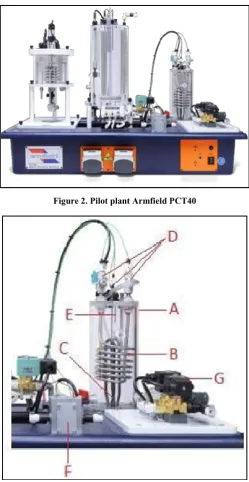
Pilot Plant: The used industrial control simulation plant is manufactured by Armfield Company, PCT40 model, located at the Laboratory of Industrial Systems and Processes (LASPI) of the Pontifical Catholic University of Rio Grande do Sul (PUCRS). It is accompanied by PCT40-306 Process Control of Armfield software, which contains 11 experimental sections that encompass several controllable processes. The Armfield PCT40, shown in Figure 2, enables a multi-function process control system, which is able to demonstrate level, flow, pressure and temperature control circuitry (ARMFIELD, 2018).
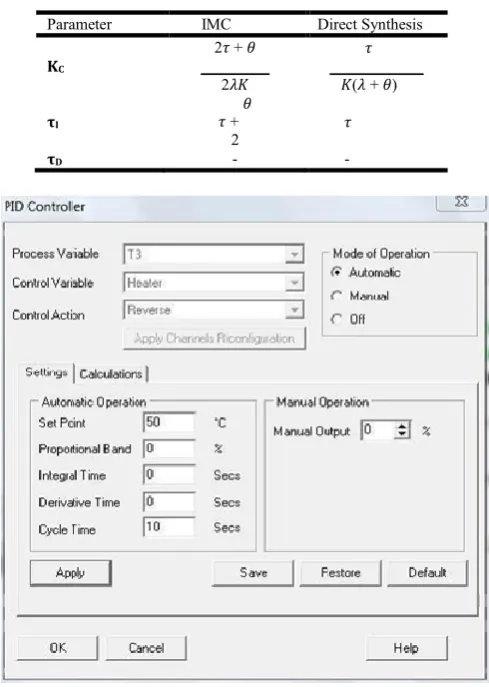
Temperature Control: This study used an indirect heating temperature control section of the pilot plant, as illustrated in Figure 3. The indirect heating temperature control experimental section comprises an acrylic tank (A) with an approximate volume of 2 liters, which collects a helical coil (B), a heating element (C), three thermostats (D) and a level detector (E). The system also uses external devices such as a hot pump (F) for homogenization of the control volume and a PSV valve (Pressure Safety Valve) (G) for cooling water flow in the serpentine (ARMFIELD, 2019). The section that deals with the temperature control by indirect heating, from PCT40- 306 Process Control software, presents an equipment scheme
[image:2.595.308.558.83.566.2]illustration and accessories previously mentioned; this representation can be seen in Figure 4.
[image:2.595.314.554.592.741.2]Figure 2. Pilot plant Armfield PCT40
Figure 3. Temperature control section by indirect heating
Figure 4. Layout of section 7 of the pilot plant software
Heater [kW] informs its activation and it is this device that is the manipulated variable (MV) [%] of the system. The thermostat T1 [°C] is linked to the internal and fixed volume tank, whereas the thermostat T2 [°C] and T3 [°C] are attached to the internal extremities of the serpentine (where the water supplied by the PSV flows). T2 is presented at the beginning, before entering the serpentine, whereas T3 is in the output and is the controlled variable (CV) of the process. The Hot Pump box [%] refers to the hot homogenizing tank volumepump.
Modeling: According to Dantas and Moura (DANTAS, 2008).a simple method of dynamic modeling for the studied system is the method proposed by Sundaresan and Krishnaswamy (SK77) (SUNDARESAN, 1978). This method is ideal for first-order systems with dead time and noise (such as the pilot plant), since it facilitates the collection of information for calculating the transfer function parameters. The Figure 5 illustrates a simple graphical and schematic equational of this method (DANTAS, 2008).
Figure 5. SundaresanKrishnaswamy (SK77) modeling method
Where Δy represents the temperature rise of the controlled variable after application of Δu ("step") in the manipulated variable. K is the system gain, θ the dead time and τ the constant systemtime.
Tuning: According to the system modeling and criteria of tuning models, the most appropriate controller combination for tuning this process was the Proportional-Integral combination, or "PI", since the action D (derivative) could lead the system to instability due to the presence of noise in the reading of the value of controlled process variable (FACCIN, Flávio, 2004). For the IMC method, an extension of the tuning "PI", called "enchanced PI", which takes into consideration the dead time found in modeling, was used. Thus, the information in Table 1 was for calculating the PI tuning parameters (Jorge Otávio, 2002). The value of "λ" for both models was adjusted by equation 1.
=1.7 (1)
Experimental Testing and Application of the Disturbance : In the pilot plant, an experimental test for each tuning model was developed. With KCandτI parameters calculated for both
tuning models, these were applied, respectively, in the fields
Proportional Band and Integral Time of control area in the
[image:3.595.312.557.104.448.2]software experimental section PCT40-306 Process Control pilot plant. Figure 6 shows the experiment controlarea.
Table 1.PI tuning for first order systems with dead time
Parameter IMC Direct Synthesis 2 +
2 ( + )
+ 2
[image:3.595.44.286.286.469.2]- -
Figure 6. The experimental section control area
Both experiments were performed in order to obtain a 50 °C setpoint value in the temperature T3. The initial flows in PSV equals 300 mL/min, and after the disruption the flows were equivalent to 400 mL/min. The initial temperatures T3 were equal to 28 °C and the input of the serpentine was equivalent to 13°C.The graphics for the time [seconds] and temperature T3 [°C] were generated, and spreadsheets containing all of the procedural magnitudes of the system, as well as information of its accessories. The value set for the homogenization of the tank, that is, the hot pump, was 30% of their rotation capacity for all experiments. The PSV valve had heating problems, which caused a flow rate decrease over time. For this corrective effect, the experiment was fully monitored to increase the valve opening value [%], whenever a decrease in the value of the adopted flow wasnoticed.Once the temperature T3 (the output water serpentine) had stabilized, a disturbance in the system was performed with the increase in the opening of the PSV valve, responsible for the serpentine water flow. This increase was immediate and equivalent to an addition of 100 mL/min in flow rate, resulting in a total flow of approximately 400 mL/min in the serpentine and an immediate drop in temperature T3, which causes the heater to maintain the system setpoint.
in the experiment. The criteria used to measure the system performance were Integral of the Error Absolute value (IAE) and the Integral of Time multiplied by the Absolute Error value (ITAE). The error e used by both criteria, is shown in equation 2, while dtis shown in Equation 3 (FERMINO, 2015).
=| − 3| (2) = ( − −1) (3)
The general expressions for the IAE and ITAE criteria are contained in equation 4 and equation 5, respectively. The lower the value generated by the sum of the values for IAE and ITAE, the better the controller performance is considered.
= −1+ ∙ ( − −1) (4)
= −1 −1+ ∙ ( − −1) (5)
Fromtheapplicationofthedisturbance,thestartofanewtimingtocal culatetheITAE and IAE criteria was considered, based on the first calculation cell, −1 = 0. The analysis had the same time
interval.
RESULTS AND DISCUSSION
The results based on the previously discussed methodology will be presented in the next items of this study.
[image:4.595.308.561.242.398.2]Experimental Dynamic Modeling: From the application of the step increase of 20% in the manipulated variable, the data in graphic form regarding the temperature T3 versus time are shown in Figure 7.
Figure 7. Characteristic curve of the experiment
Thus, the transfer function obtained, that is, the , and parameters, which constitute the first degree function with dead time, stipulated by Sundaresan and
Krishnaswamy(SK77) modeling method is given in
equation 6 [11]. Where 35.5% = 415 ; 85.3% = 1225
; = 14.3% e =20%.
Tuning, testing and disturbance: With the dynamic modeling information, gain (K= 0.715), dead time ( = 184.3) and time constant (τ = 542.7), tuning by IMC and Direct Synthesis models showed the following results ilustrated by Table 2.
Table 2. Experiment Tuning
Parameter IMC Direct Synthesis
2,84 1.53
634.83 542.70
0 0
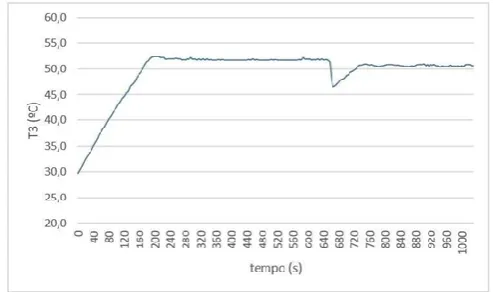
Two experimental tests with the computed PID parameters were performed. According to the IMC (P = 2.84; I = 634.83; D = 0) and Direct Synthesis (P = 1.53; I = 542.70; D = 0) models. The software automatically disregards decimal places, making them whole numbers. As mentioned above, having equal conditions for the experiments is extremelyimportant. System performance for IMC tuning and application of the disturbance (from 650 seconds) in the process is shown in Figure 8.
Figure 8. Experimental Test with IMC tuning model
[image:4.595.34.292.446.599.2]The experiment took about 230 seconds to reach the 50 °C setpoint, remained stable and showed no overshoot. With the disturbance, the controller reestablished its temperature in about 155 seconds after the event (total time equals 830 seconds), presented negligible offset (permanent error) and often nullerrors. System performance for the direct synthesis tuning and application of the disturbance in the process (from 650 seconds) is shown in Figure 9.
Figure 9. Experimental test with Direct Synthesis tuning model
[image:4.595.307.554.530.676.2]Perturbation Effect
[image:5.595.76.247.156.189.2]To support the effect of disturbances in the process, the criteria for the controlling performance analysis for both experiments were calculated from the disturbance (650 consecutive seconds). The results are shown in Table 3.
Table 3. Result test by performance criteria
Model ∑IAE ∑ITAE
IMC 258.06 30292.00
Direct Synthesis 322.27 45380.86
For both IAE and ITAE criteria, the controller tuned by IMC method showed the lowest values for the sums of each performance criteria, that is to say, the best results achieved.
Conclusions
The comparative results obtained in this study, referring to the effect that the disturbance causes in controllers tuned by model based techniques, shows us that the controller tuned by the IMC model presented higher performance when compared to the controller tuned by the Direct Synthesis model. That is, the effect that the disturbance caused to this controller was less significant; its ability to return to the setpoint was the most precise, although slower. Therefore, it showed the most developed behavior. This controller (tuned by IMC) would be ideal for processes requiring accuracy, or minor errors values. On the other hand, the controller tuned by the Direct Synthesis model crossed the setpoint value in the shortest time, but generated the biggest mistakes, making it an ideal controller for processes that require speed and admit mistakes.As a recommendation for future studies, the evaluation of the disturbance effect by the actuator effort (in this study, the heater), seems to be an interesting proposal in thearea.
REFERENCES
ALVES, José Luiz Loureiro. Instrumentation, Control And Processes Automation. 2. ed. Rio de Janeiro: Gen Group - Ltc, 2011. 201 p. Available at:<Https://bit.ly/2r04ta4>. ARMFIELD (England). Multifunction Process Control
Teaching System. 2018. Avaiable at: <https://bit.ly/2S5OXVl>.
Both,R., E. Dulf, A. M. Cormos, “Advanced Control of a Complex Chemical Process”, Brazilian Journal of
Chemical Engineering. 2016. Avaiable at:
http://www.scielo.br/scielo.php?script=sci_arttext&pid=S 0104- 66322016000100155&lng=en&nrm=iso
DANTAS, Luis Antônio; MOURA, Johnson Pontes de. “Fundamentos Matemáticos Aplicados Ao Estudo De Práticas Experimentais De Controle De Processos”. 2008. Thesis (MS) - Process Engineering Course, Federal University of Rio Grande do Norte, Natal, 2008.Available at:<Https://bit.ly/2OZhUjY>.
FACCIN, Flávio. “Abordagem Inovadora no Projeto de Controladores PID”. 2004. 145 f. Thesis (MS) - Chemical Engineering Course, School of Engineering, Federal University of Rio Grande do Sul, Porto Alegre, 2004. Availableat:<https://bit.ly/2E2c67q>.
FERMINO, Fernando. “Estudo comparativo de métodos de sintonia de controladores PID”. 2015. 90 f. Completion of course Work (Graduation)- Course of Electrical Engineering, School of Engineering, University of São Paulo, São Carlos, 2014. Availableat: <https://bit.ly/2PHVUzg>..
GODOY, Rodrigo Juliani Correa. Sintonia Ótima De Controladores. 2012. 256 f. Thesis (Ph.D.) - Systems Engineering Course, Polytechnic School, University of São Paulo, São Paulo, 2012. Available at:<https://bit.ly/2DAqqnw>.
Muliadi, J. B. Kusumoputro, “Neural Network Control System of UAV Altitude Dynamics and Its Comparison with the PID Control System” Journal of Advanced
Transportation, 2018. Available at: https://www.
hindawi.com/journals/jat/2018/3823201/
PEREIRA, Eduardo Bento. Sintonia De Controladores PID. São João Del-rei: UFSJ, 2017. 38 slides, color. Available at:<https://bit.ly/2S7jHFr>.
RUÍZ, Víctor M. Alfaro. Métodos De Sintonización De Controladores Pid Que Operan Como Reguladores. 2002. Available at: <https://bit.ly/2PLvD2X>.
SPANDRI, Renato. Sintonia De Controladores Regulatórios. Rio de Janeiro: Petrobrás, 2003. 28 p. Avaiableat: <https://bit.ly/2PHXaT0>.
SUNDARESAN, K. R. &Krishnaswamy, P. R., 1978. “Estimation of time delay time constant parameters in time, frequency, and Laplace domains”. The Canadian
Journal of Chemical Engineering, 56(2), pp. 257-262.
Available at: https://onlinelibrary.wiley.com/doi/abs/ 10.1002/cjce.5450560215
vTRIERWEILER, Jorge Otávio; POSSER, Maurício Simões. PID-Toolbox : Uma Ferramenta Para o Ensino e Ajuste de Controladores PID's. Porto Alegre, 2002. 27 p. Available at:<https://bit.ly/2r2dJdr>.
Yin, C., J. Gao, Q. Sun, “Enhanced PID Controllers Design Based on Modified Smith Predictor Control for Unstable Process with Time Delay” Mathematical Problems in Engineering. 2014. Available at: <https://www.hindawi. com/journals/mpe/2014/521460/>