Full Length Research Article
DESIGN OF ABC ALGORITHM BASED LOAD FREQUENCY CONTROLLER FOR HYDRO-NUCLEAR
INTERCONNECTED POWER SYSTEMS WITH REDOX FLOW BATTERIES
*Murugan, C. K., Ramesh Kumar, S., Ganapathy, S. and Velusami, S.
Department of Electrical Engineering, Annamalai University, Annamalai Nagar, India
ARTICLE INFO ABSTRACT
This paper proposes an application of redox flow battery (RFB) for the improvement of Load Frequency Control (LFC) of a two-area interconnected hydro-nuclear power system using Artificial Bee Colony (ABC) optimization algorithm. The Redox Flow Battery, which is not aged due to the frequent charging and discharging, has a quick response and outstanding function during overload conditions. In addition to leveling load, the battery is advantageous for secondary control in the power system and maintenance of power quality of distributed power resources. The redox flow batteries can efficiently damp out electromechanical oscillations in the power system because of their efficient storage capacity in addition to the kinetic energy of the generator rotor, which can share the sudden changes in power requirements. The Artificial Bee Colony optimization algorithm, a very simple, robust and population based stochastic optimization algorithm, is used to optimize the parameters of the PI controller. Simulation studies reveal that the transient performance is improved significantly when RFB is considered.
Copyright © 2014 C. K. Murugan et al. This is an open access article distributed under the Creative Commons Attribution License, which permits unrestricted use, distribution, and reproduction in any medium, provided the original work is properly cited.
INTRODUCTION
Load Frequency Control (LFC) is an important function in modern Energy Management Systems. The successful oper-ation of interconnected power system requires the matching of total generation with total load demand and associated system losses. As the demand deviates from its nominal value with an unpredictable small amount, the operating point of power system changes, and hence, system may experience deviations in nominal system frequency and scheduled power exchanges. The main tasks of load frequency control are to hold system frequency at or very close to a specified nominal value and to maintain the correct value of interchange power between control areas (Singh Parmar et al., 2012). In real situations, the power systems consist of conventional forms of electrical power generations like, thermal, hydro, and nuclear as a major share of electrical power. The configuration of today's integrated power system becomes more complex due to these power plants with widely varying dynamic characteristics. Nuclear units owing to their high efficiency are usually kept at base load close to their maximum output with no participation in system Load Frequency Control (LFC). But with integration of nuclear power plants in the power system, it is also required
*Corresponding author:Murugan, C. K. Department of Electrical
Engineering, Annamalai University, Annamalai Nagar, India.
to study the behavior of LFC for the interconnected power system considering nuclear power plant (Naimul Hasan et al., 2012). Gas power generation is ideal for meeting varying load demand. However, such plants do not play very significant role in LFC of a large power system, since these plants form a very small percentage of total system generation. Gas plants are used to meet peak demands only. Thus the natural choice for LFC falls on either thermal or hydro units. In this work, interconnected hydro-nuclear power system has been considered.
During the last decades, many techniques have been developed for LFC problem (Ibraheem et al., 2005). Most of these techniques use the conventional proportional plus integral controller, where the load frequency controller is based upon tie line bias control where each area tends to reduce the Area Control Error (ACE) to zero. In an interconnected power system, during the presence of small load disturbances and with optimized PI controller gains, the frequency oscillations and tie-line power deviations exist for longer time duration. During such conditions, the governor may not be able to absorb the frequency fluctuations due to its slow response. To compensate for the sudden changes in load, an active power source with fast response such as Redox flow Battery (RFB) can be expected to be most effective (Tetsuo Sasaki et al., 2004). The Redox Flow Batteries (RFB) are found to be
ISSN:
2230-9926
International Journal of Development ResearchVol. 4, Issue, 3, pp. 546-550, March,2014
DEVELOPMENT RESEARCH
Article History:
Received 08th January, 2014 Received in revised form 11th
February, 2014 Accepted 15th
February, 2014 Published online 14th
March, 2014
Key words:
superior over the other energy storing devices because of their easy operability at normal temperature, very small loss during stand by and have a long service life, flexibility in layout, easy
to increase the capacity and free from degradation due to fast charging and discharging action (Chidambaram and
Paramasivam 2012).
Over the past decades, various control techniques (Ibraheem et al., 2005; Omveer Singh et al., 2013) such as classical control, variable structure control, optimal control, and robust control, have been applied to the LFC problem. The classical controllers exhibit poor dynamic performance and are therefore, not suitable for all operating conditions. The variable structure controllers, optimal state feedback controllers, and robust control methods on the other hand show good dynamical response, however, most of them require the availability of all state variables, which seems unrealistic. Therefore, it is not easy to effectively solve the LFC problem depending only on the conventional approaches. The most recent advancement is the application of soft computing techniques (Sathans and Akhilesh Swarup 2011) to the load frequency control of interconnected power systems having nonlinear models and continuously changing operating conditions. In this paper, the Artificial Bee Colony (ABC) algorithm, which mimics the food foraging behavior of swarms of honey bees, has been used for optimizing the controller PI gain values of the proposed interconnected hydro-nuclear power system.
Statement of problem
The block diagram representation of a two area hydro-nuclear interconnected power system with RFB is shown in Fig.1. The dynamic behavior of the LFC system is described by the state space equation
(1)
where A is system matrix, B is the input distribution matrix, Ґ is the disturbance distribution matrix, x is the state vector, u is the control vector and d is the disturbance vector.
A step load disturbance of 1% has been considered as a disturbance in the system. For the frequency and tie-line power deviations to be zero at steady state, the Area Control Error (ACE) should be zero. To meet the above design requirements, the ACE is defined as
(2)
where, βiis the frequency bias constant.
The objective is to obtain the optimum value of the controller
parameters which minimize the performance index
(Manoranjan Parida and Nanda et al., 2005).
(3)
Redox flow battery system and modeling
RFBs are rechargeable batteries and are becoming very opular due to their quick responses (Singh Parmar 2014). RFBs are not aged by frequent charging and discharging and perform outstanding function during overload conditions. Simple operating principle, long service life, suitability for high capacity systems, quick start up and ease in maintenance are the salient features of these batteries. Recently, RFBs have been integrated in LFC scheme to improve the system
d Bu Ax
X
tiei i i
i P F
ACE ]
[ dt P F F J tie t ]
[ 2 2
2 2 1 0
) ( 1 s F ) ( 2 s F s T122
2 2 1 p p sT K 1 1 1 p p sT K 12 a w w sT sT 5 . 0 1 1 2 1 1 sT sTr 1 1 1 sT D RF sT K 1 PI 1 2 PI GN sT 1 1 1 1 1 r H sT K 1 1 1 r R sT K
1 1
1 RH sT 2 1 1 RH sT s s 10 1 5 1 12 a 1 1 R 2 1 R
Hydraulic Mechanical Governor Turbine
Redox Flow Batte ry (RFB) SUBSYSTEM 1 (HYDRO) SUBSYSTEM 2 (NUCLEAR) PI Controller PI Controller Governor Tie-Line Power System 1
Powe r System 2 HP Turbine
LP Turbine 1
[image:2.612.100.507.452.712.2]LP Turbine 2
Fig. 1: Block diagram of a two area hydro-nuclear interconnected power system
response in wake of small load disturbances . A basic diagram of the integration of RFB to the power system is shown in Fig. 2.
[image:3.612.65.295.153.282.2]During the low load periods, battery charges and delivers the energy back to the system during the peak load demands or sudden load changes. The dual converter performs both AC-DC and AC-DC-AC conversions.
Fig. 2. Integration of RFB Energy storage system to a power system
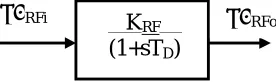
[image:3.612.107.245.392.433.2]A simplified transfer block of the RFB is given in the Fig. 3. Area Control Error (ACE) is used as the input command signal for the RFB in controlling the output response in the LFC system . The RFB transfer function block is shown in the Fig. 3.
Fig. 3: Simplified transfer function block diagram of the RFB system
Artificial Bee Colony Algorithm
Karaboga and Basturk (Dervis Karaboga et al., 2012) have described an Artificial Bee Colony (ABC) algorithm based on the foraging behavior of honey-bees for numerical optimization problems. Its foraging behavior, learning, memorizing and information sharing characteristics has recently been one of the most interesting research areas in swarm intelligence. It is a very simple, robust and population based stochastic optimization algorithm. Compared with the usual algorithms, the major advantage of ABC algorithm lays in that it conducts both global search and local search in each iteration, and as a result the probability of finding the optimal parameters is significantly increased, which efficiently avoids local optimum to a large extent. In the ABC algorithm, the artificial bee colony contains three groups of bees: employed bees, onlooker bees and scout bees. A bee waiting on the dance area for making decision to choose a food source is called an onlooker and a bee going to the food source visited by it previously is named an employed bee. A bee carrying out random search is called a scout. Communication among the bees about the quality of food sources is being achieved in the dancing area by performing waggle dance.
In ABC algorithm the position of the food sources determines the solution and the amount of nectar represents the fitness of the respective solution. The foraging strategy is governed by three process namely initialization, Reproduction and Replacement of bee and selection (Dervis Karaboga et al., 2007).
Initialization
A randomly distributed initial populations solutions (Xi=1, 2,
3...D) is being spread over the D dimensional problem space.
Reproduction
An artificial onlooker bee chooses a food source depending on the probability value associated with that food source, Pi
calculated by the following expression,
(4)
where fi is the fitness value of the solution i which is
proportional to the nectar amount of the food source in the position i and N is the number of food sources which is equal to the number of employed bees. In order to produce a candidate food position from the old one in memory, the ABC uses the following expression.
(5)
where kЄ (1,2,3..D) and j Є ( 1,2,3...N) are randomly chosen
indices. Although k is determined randomly, it has to be different from i. φij is a random number between (-1,1).
Replacement of Bee selection
In ABC, providing that a position cannot be improved further through a predetermined number of cycles, then that food source is assumed to be abandoned. The value of pre determined number of cycles is an important control parameter of the ABC algorithm, which is called "limit" for abandonment . Assume that the abandoned source is Xi and J=(1,2,3,... ),
then the scout discovers a new food source to be replaced with Xi. This operation can be defined as
(6)
After each candidate source position Vij is produced and then
evaluated by the artificial bee, its performance is compared with that of its old one. If the new food has equal or better nectar than the old source, it replaces the old one in the memory. Otherwise, the old one is retained in the memory. Detailed pseudo-code of the ABC algorithm is given below as in (Dervis Karaboga et al., 2009):
1 : Initialize the population of solutions Xi, i = 1, . . . , D
2 : Evaluate the population 3 : cycle = 1
4 : repeat Generating
Plant
Load
AC/DC Converter with
Battery Storage System
Charging Discharging
K
RF.
(1+sT
D)
∆PRFi ∆PRFo
N
n i i
i i i
t f
t f P
1
ij kj
ijij
ij
x
x
x
V
j j
jj
i X rand X X
X
min max min 0.1
5 : Produce new solutions ti for the employed bees by using
(5) and evaluate them
6 : Apply the greedy selection process for the employed bees 7 : Calculate the probability values Pi for the solutions Xi
by (4)
8 : Produce the new solutions ti for the onlookers from the
solutions Xi selected depending on Pi and evaluate them
9 : Apply the greedy selection process for the onlookers 10: Determine the abandoned solution for the scout, if exists,
and replace it with a new randomly produced solution Xi by (6)
11: Memorize the best solution achieved so far 12: cycle = cycle + 1
13: until cycle = MCN (Maximum Cycle Number)
Optimization of PI Controller parameters using ABC Algorithm
The effective application of artificial bee colony algorithm is to optimize the parameters in load frequency control (LFC) of a two area interconnected hydro-nuclear power system with RFB. The proportional gains (Kp) and integral gains (Ki) have
been optimized to ensure best performance of the system, minimizing the tie-line deviation and frequency deviations of both the areas. The system investigated is a two area hydro-nuclear interconnected power system with RFB, the areas being connected via tie-line. Each area has a governor and turbine which is controlled by both the primary controller (governor speed regulation) and a secondary controller (PI controller). The block diagram, as in fig.1 has been developed in MATLAB Simulink. The values of the several parameters used in the model are given in Table 1. To find the optimum values of the controller gains (Kp and Ki), the fitness function,
that has been used is:
(7)
where, ΔF1 and ΔF2 are the frequency deviations of the
respective areas and ΔPtie is the tie-line power exchange
deviation between area 1 and area 2. The problem is to obtain a set of values for the PI controller gains, of both the areas, so that the error/deviation in system frequency and tie-line power exchange is minimized to zero in minimum possible time, i.e. the errors should reduce to zero as fast as possible. For this, the fitness function J has been minimized.
The implementation of ABC algorithm for the design of Load Frequency Controller involves following steps.
1. The objective function (J) is calculated for each set of Kp
and Ki.
2. The objective function values are then mapped into a fitness value of each set.
3. When fitness values are found, ABC algorithm works using greedy selection process, evaluation of probability and memorize the best solution.
These steps are repeated until the values get converged producing near value of optimum Kp and Ki.
Simulations Results and Observations
The following ABC algorithm control parameters are used in this study: Food number (the number of colony size i.e. employed bees and onlooker bees)=20; limit (A food source which could not be improved through "limit" trials is abandoned by its employed bee)=1000; max cycle=30. Table I gives the optimum values for the proportional gain Kp and
integral gain Ki for the system considered. The optimal
[image:4.612.335.535.190.249.2]parameter set is given in the below table 1:
Table 1. Optimal gain parameters
System Description Gain Without RFB With RFB Hydro System Kp1 0.60 3.80
Ki1 0.02 0.95
Nuclear System Kp2 13.92 11.18
Ki2 1.50 0.31
Performance Index (J) 0.08845 0.002939
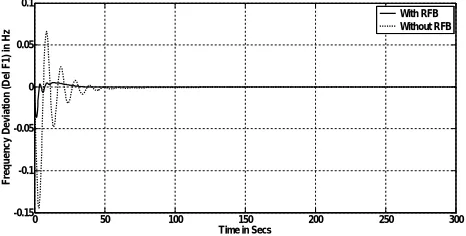
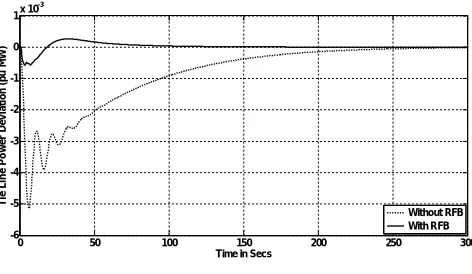
[image:4.612.317.550.404.522.2]The system is simulated with the proposed ABC algorithm based PI controller for a 0.01 p.u. MW step load change in both area and the corresponding frequency deviations in area 1, area 2 and tie-line power deviation are plotted with respect to time as shown in fig.4, fig.5 and fig.6 respectively. It can be seen that the oscillations are practically damped out rapidly and also the amplitudes of the deviations in frequency and tie-line power are reduced considerably by including RFB. The settling of response is also very fast when RFB is considered. It is clearly evident from table 1, that the cost function (J) is drastically reduced while tuning the parameters with consideration of RFB.
Fig. 4. Frequency deviation of area-1
[image:4.612.315.554.493.680.2]
Fig. 5. Frequency deviation of area-2
0 50 100 150 200 250 300
-0.15 -0.1 -0.05 0 0.05 0.1
Time in Secs
F
re
q
u
e
n
c
y
D
e
v
ia
ti
o
n
(
D
e
l
F
1
)
in
H
z
With RFB Without RFB
0 50 100 150 200 250 300
-14 -12 -10 -8 -6 -4 -2 0
2x 10
-3
Time in Secs
F
re
q
u
e
n
c
y
D
e
v
ia
ti
o
n
(
D
e
l
F
2
)
in
H
z
With RFB Without RFB dt
P F F
J tie
t
]
[ 12 22 2
0
Fig. 6. Tie-line power deviation
Conclusion
LFC of a two-area interconnected hydro-nuclear power system is presented using Artificial Bee Colony (ABC) optimization algorithm. ABC algorithm based PI controller is used in the secondary loop of the LFC system. The dynamic responses have been obtained with and without consideration of RFB in the LFC system. Examination of dynamic responses show that application of RFB improves the transient responses greatly. The ability to jump out the local optima, the convergence precision and speed are remarkably enhanced by using ABC algorithm. It is observed that the ABC algorithm based load frequency controller effectively suppresses the oscillation and stabilize the system effectively.
Acknowledgment
The authors wish to thank the authorities of Annamalai University, Annamalainagar, Tamilnadu, India and the authorities of Tennessee Tech University, Cookeville, USA for the facilities provided to prepare this paper. Special thanks are due to Dr. P. K. Rajan, Interim Director of Center for Energy Systems Research, Tennessee Technological University, USA, for his valuable comments and suggestions.
APPENDIX
(A). Data for Hydro-Nuclear Power System
f = 60 Hz, R1 = R2 = 2.4 Hz/p.u.MW, T1 = 48.7 sec, T2 =
0.513 sec, Tr = 5 sec, Tw = 1 sec, Tp1 = Tp2 = 20 sec, Kp1 =
Kp2 = 120 Hz/p.u.MW, TGN= 0.08 sec, Tr1 = 0.5 sec, TRH1 =
7 sec, TRH = 9 sec, KH1 = 0.2, KR1= 0.3, β1= β2 =
0.425 p.u.MW/Hz, a12 = -1, 2πT12 = 0.01 p.u.MW/Hz.
(B). Data for RFB
KRF = 0.67, TD = 0 sec.
REFERENCES
Chidambaram I.A. and B. Paramasivam, "Control performance standards based load-frequency controller considering redox flow batteries coordinate with interline power flow controller" Journal of Power Sources, Vol. 219, pp. 292-304, July 2012.
Dervis Karaboga and Bahriye Akay, "A comparative study of Artificial Bee Colony algorithm", Applied Mathematics and Computation, Vol. 214, pp. 108–132, 2009.
Dervis Karaboga and Bahriye Basturk, "Artificial Bee Colony (ABC) Optimization Algorithm for Solving Constrained Optimization Problems", Proceedings of the 12th international Fuzzy Systems Association world congress on Foundations of Fuzzy Logic and Soft Computing, Springer, pp. 789–798, 2007.
Dervis Karaboga, Beyza Gorkemli, Celal Ozturk and Nurhan Karaboga, "A comprehensive survey: artificial bee colony (ABC) algorithm and applications", Artificial Intelligence
Review, Springer, DOI 10.1007/ s10462-012-9328-0,
March 2012.
Ibraheem, P. Kumar and D.P. Kothari, "Recent Philosophies of Automatic Generation Control Strategies in Power Systems", IEEE Transactions on Power Systems, Vol. 20, No.1, pp. 346-357, Feb. 2005.
Manoranjan Parida and J. Nanda, "Automatic Generation Control of a Hydro-Thermal System in Deregulated Environment", Proceedings of the Eighth International Conference on Electrical machine systems, , Vol.2, No.2, pp.942-947, 2005.
Naimul Hasan, Ibraheem and Shuaib Farooq, "Real Time Simulation of Automatic Generation Control For Interconnected Power System", International Journal on Electrical Engineering and Informatics, Vol. 4, No. 1, pp. 40-50, March 2012.
Omveer Singh, Prabhakar Tiwari, Ibraheem and Arunesh Kr. Singh, "A Survey of Recent Automatic Generation Control Strategies in Power Systems" International Journal of Emerging Trends in Electrical and Electronics" Vol. 7, Issue. 2, pp. 1-14, Sep-2013.
Sathans and Akhilesh Swarup, " Intelligent Load Frequency Control of Two-Area Interconnected Power System and Comparative Analysis", Proceedings of International Conference on Communication Systems and Network Technologies, pp. 360-365, 2011.
Singh Parmar K. P., "Load Frequency Control of Multi-Source Power System with Redox Flow Batteries: An Analysis”, International Journal of Computer Applications, Vol. 88, No.8, pp. 46-52, Feb. 2014.
Singh Parmar K.P., S. Majhi and D.P. Kothari, "Load frequency control of a realistic power system with multi-source power generation", Electrical Power and Energy Systems, Vol. 42, pp. 426-433, June 2012.
Tetsuo Sasaki, Toshihisa Kadoya and Kazuhiro Enomoto, "Study on Load Frequency Control Using Redox Flow Batteries", IEEE Transactions on Power Systems, Vol. 19, No. 1, pp. 660-667, Feb. 2004.
0 50 100 150 200 250 300
-6 -5 -4 -3 -2 -1 0
1x 10
-3
Time in Secs
T
ie
L
in
e
P
o
w
e
r
D
e
v
ia
ti
o
n
(
p
u
M
W
)
Without RFB With RFB