124
WRITING STYLE AND WORD USAGE IN DETECTING
DEPRESSION IN SOCIAL MEDIA: A REVIEW
1NUR ZAREEN ZULKARNAIN, 2HALIZAH BASIRON, 3NORIDA ABDULLAH
1,2Centre for Advanced Computing Technology (C-ACT), Fakulti Teknologi Maklumat Dan Komunikasi, 3Centre for Technopreneurship Development (C-TeD), Pusat Bahasa Dan Pembangunan Insan,
Universiti Teknikal Malaysia Melaka, 76100 Durian Tunggal, Melaka, Malaysia. E-mail: 1[email protected], 2[email protected], 3[email protected]
ABSTRACT
In today’s digital age, social media have become the most common channel for individuals to express their opinions and feelings. As common as this, the extensive usage of social media has also been associated with mental illnesses such as anxiety, suicidality and depression. The digital traces the individuals left provide insights into not just their daily life but also on their health and mental state. This allows for various prediction and preliminary diagnosis to be made. The advancement of research in the Natural Language Processing (NLP) field has allowed researchers to understand individuals based on texts they shared in their social media account. This paper reviews the techniques and methods used in detecting depression from social media texts where emphasis are being placed on the writing style and the word usage of the social media users. Writing styles and choices of words have been seen as a possible indicator in detecting depression from social media texts. Various methods and platforms have been adopted to investigate the effectiveness of detecting depression based on these two components. This paper discusses these methods and techniques as well as the areas where improvements can be made.
Keywords: Social Media; Depression Detection; Lexicon; Ontology; Text Analysis
1. INTRODUCTION
Depression has increasingly been acknowledged as a common mental illness often associated with today’s digital lifestyle. According to the World Health Organization (WHO), there are as many as 300 million people of all ages globally affected by this illness [1]. Various cases of depression have been reported [2] which involves individuals from a diverse set of demographics such as adolescents [3], [4], [5], male and female workers [6], [7], people from certain ethnicity or gender [8], married working women [9], and the elderly [10]. Depression if not treated can lead to numerous effects that does not only affect the individual but also the society at large. Prolonged and with moderate or severe intensity of depression decreases the productivity of an individual and could also lead to suicide [1]. Depression affects the ability of individuals to recall new information [11] and causes individual to have less interest in physical activities and leads a sedentary lifestyle [12]. This in return will negatively impacts the productivity of a nation as the workforce is no longer dynamic and energetic.
Even though depression can cause adverse effects towards the productivity of the nation’s workforce, this can be attended if detected early. This has been demonstrated by several studies whereby early recognition and treatment of depression reduces the said effects [13], [14], [15], and [16]. One method of early detection of depression is by using text mining as demonstrated by De Choudhury et al. [17] in their work where they use tweets to detect depression. By studying the choice of words used by individuals on social medias, it is possible to understand their emotion at the time of writing and consequently detecting if there are any underlying psychological problem.
125 agitation or retardation, (6) fatigue or loss of energy, (7) feelings of worthlessness and guilt, (8) diminished ability to concentrate and, in some cases, (9) recurrent thoughts of death or suicide. Suicide ideation and suicide attempts range from a passive wish of not wanting to be awake in the morning, to transient but recurrent thoughts of committing suicide, to a specific suicide plan. Motivations for suicide may include a desire to give up in the face of perceived insurmountable obstacles, a wish to end a continuous painful emotional state, or the wish to not be a burden to others [18].
Many depressed people are reluctant to seek treatment as depression is considered a defamed condition. Most of them do not want to be associated with mental illness and be labelled as a psychiatric patient. Therefore, some of them tend to share their feelings and emotions as well as depression related posts on social media as to implicitly reveal themselves. Several studies in the field of social psychology have been performed to understand the relations between the language and words used by individuals and its reflection towards the individual’s behaviour and personality.
These studies have traditionally been unfavourable as the study of individuals’ speech and text used to be slow, complex and costly [19]. However, recent advancement in Natural Language Processing (NLP), computational linguistics and text analysis methods have allowed for these researches to re-emerge. There are several research working on automatic detection of depression from social media based solely on the texts the individuals share. There are also studies that examines the word usage of individuals who are known to be depressed or have committed suicide. This paper reviews these works to understand the effectiveness of detecting depression using writing styles and word usage.
The rest of this paper is organized as follows: Section 2 will discuss theories regarding depression including its characteristics especially from Aaron Beck's Cognitive Theory of Depression. Section 3 will elaborate the advancements in natural language processing that will allow for depression to be detected in social media texts. In Section 4, the techniques used in detecting depression will be examined where it will first look at how depression is being diagnosed medically before looking at how depression can be detected using social media. Finally, Section 5 will
conclude the discussion and recommend areas where improvements can be made.
2. THEORIES OF DEPRESSION
Aaron Beck's Cognitive Theory of Depression [20] stated that often the primary cause of depression is negative thoughts which were constructed by dysfunctional beliefs. The more negative thoughts there is, the further depressed the individual is. These dysfunctional beliefs can be categorised into three themes known as the Negative Cognitive Triad which are (i) the current state of the individual where he believes he is defective or inadequate, (ii) the individual’s past where it often results to defeats or failures, and (iii) the individual’s future where he believes is hopeless.
Brown et al. [21] in their study found that students who were having negative thoughts about their future believe that they may not pass the class. This then makes them believe that they are not enjoying the class and finally, they will have negative thoughts about themselves as they think that they do not deserve to be in college in the first place. His study is in line with the three themes in Beck’s Negative Cognitive Triad. Another study by Moilanen [22] on adolescent depression was also based on Beck’s theory. In her study, she found that the students’ depression was often associated with dysfunctional beliefs and negative future attitudes. The students’ depression is closely related to their ability to deal with dysfunctional attitudes and beliefs, as well as doubts towards the future. Findings from this study also found that the students’ cognitive thoughts were shown to be affecting them, and as a result they developed symptoms of depression.
126 showed an increase in depressive symptoms. Aaron Beck’s theory states that a depressed individual often is negative which allows us to assert that the choice of words or tone used by these individuals are also negative.
3. ADVANCEMENT IN NATURAL
LANGUAGE PROCESSING
In understanding text, advancement in natural language processing has allowed us to understand the sentiment behind a sentence and the meaning of words. Sentiment analysis allows for sentences to be classified into different types of polarity such as positive, negative and neutral. Quite recently, more efforts have been made in revealing the emotions behind a text [25], [26] where instead of classifying text as positive, negative or neutral, it is able to tell whether the individual was angry, happy or sad based on the text that was written. In understanding these words in its semantical context, the usage of domain specific ontology is also helpful as it is able to describe relationships between words.
3.1 Emotion Bearing Lexicon
Emotion detection requires the decoding of the emotion that a word, or sentence can carry. This can be performed by comparing the words to emotion bearing lexicons. Emotion bearing lexicons can be categorised into two types which are sentiment lexicons and emotion lexicons. There are several sentiment lexicons such as the Affective Norms for English Words (ANEW) [27], SentiWordNet [28], [29] and the General Inquirer (GI) [30]. ANEW, one of the most widely used sentiment lexicon provides valence scores for 1000 words which are manually annotated. Although this lexicon is very popular among researches, it is quite small in coverage. This prompts for efforts to extend the lexicon to cover more words such as in the works of Warriner, Kuperman, and Brysbaert [31] and Shaikh et al. [32].
Emotion lexicons allow for finer classification of words and sentences where instead of annotating words with valence score, words are annotated with affective labels. Compared to sentiment lexicons, emotion lexicons have far less resources. One of the most used lexicons is WordNet-Affect [32] which contains 10K of emotionally labelled words. Strapparava and Mihalcea [34] have also contributed in developing the emotion lexicon by constructing a large lexicon comprising of words annotated with Paul Ekman’s six basic emotions: anger, disgust, fear, joy, sadness
[image:3.612.327.509.197.407.2]and surprise. Another comprehensive emotion lexicon, known as EmoLex, which is the work of Mohammad and Turney [35], uses the crowdsourcing technique of employing Mechanical Turk to annotate 10k lemmas with an intensity label for each emotion. Figure 1 shows the word-sentiment and word-emotion associations provided by EmoLex.
Figure 1: Word-sentiment and word-emotion associations in EmoLex
Linguistic Inquiry and Word Count (LIWC) [36] is a text analysis tool that analyses, on the basis of a dictionary containing words and its classified categories, emotional, cognitive and structural components of a specified text. LIWC allows for the identification of emotion in addition to the identification of positive and negative effects in a specified text. Finally, DepecheMood, a more recent emotion lexicon developed by Staiano and Guerini [37] provides roughly 37 thousand words annotated with emotion scores with high precision. With words bearing emotions, it is possible to detect any underlying psychological problem an individual may have. This paper looks at how this information would assist in detecting depression based on texts.
3.2 Ontology on Emotion
127 extracting keywords such as ‘depression’, all tweets containing the word ‘depression’ will be extracted no matter if it is irrelevant to the context. A quick keyword search using Twitter’s Advance Search feature returned the tweet ‘Reminiscent of the soup lines during the Great Depression’ when the keyword depression was used. This is irrelevant to the meaning of ‘depression’ in the medical context, making the analysis inefficient. Therefore, the development of a domain specific ontology to analyse social media data relating to depression is necessary.
To the best of the authors’ knowledge, there are no specific ontology to cater the domain of depression to date. However, there are several ontologies on emotion that can be a good starting point in developing a depression specific ontology. Sykora et al. [39] have developed an extensive emotion ontology called the EMOTIVE ontology which not only covers a wide range of human emotions such as ‘angry’, ‘disgust’ and ‘surprise’ but also captures the strength of these emotions using words such as ‘quite’, ‘so’ and ‘very’ that signals the intensity of the emotion. By using EMOTIVE, tweets such as “I am happy” and “I am quite happy” will be given different scores. The work of Sykora’s team has improved the less granular emotions ontology such as the Human Emotion Ontology (HEO) [40] and the Emotion Ontology (EMO) [41] where the intensity of the emotions is less of a concern. Based on their research, the usage of intensifiers, negators and similar terms improves precision, recall and F-score in comparison with systems that do not have ontology with such characteristics. A sentence of “I am happy with my life” would signal that the individual is feeling satisfied. However, when the word ‘quite’ is added to become “I am quite happy with my life”, the happiness is less intense and may be cause by some problems or dissatisfaction. Therefore, in detecting depression, an ontology that will be able to score the text based on the intensity of the emotion would performed much better.
4. TECHNIQUES TO DETECT
DEPRESSION
4.1 Medical Diagnosis of Depression
The DSM-5 [18] outlines that for an individual to be diagnosed as having depression, the individual must have at least 5 or more symptoms as listed in Section 1, for the same 2-weeks period. Out of those minimum 5 symptoms, the individual must at least have either (1)
depressed mood or (2) diminished interest or pleasure. In diagnosing that an individual is depressed, the National Institute of Mental Health, US [42] indicates that the first step a medical practitioner would do is to conduct physical and lab tests to rule out medical conditions that have the same effect as depression such as thyroid disorder. If the individual has been ruled out of having such condition, then only psychological evaluation will be performed to diagnose if the individual has depression.
Depression can be screened using both self-report inventories and clinician-rated scales [43]. One of the most widely used self-report inventory is the Hospital Anxiety and Depression Scale (HADS) [44]. The inventory consists of 7 depression items that measure the cognitive and emotional aspect of the individual. The reason HADS is popular is mostly because of its simplicity, speed and ease of use. Other than HADS, patient self-report inventories include the Beck Depression Inventory [45], the Inventory of Depressive Symptoms [46], the Patient Health Questionnaire (PHQ) [47] and the Zung Depression Scale [48]. As for the clinician-rated scales, the Hamilton Depression Rating Scale (HDRS) also known as Ham-D [49] is the most widely used. The scale originally consists of 17 items pertaining to symptoms of depression experienced over the past week which is intended for hospital inpatients.
128
4.2 Detecting Depression in Social Media
With the technology of Big Data and the accessibility of the Internet, there are abundance of data that can be collected especially from social media platforms. People tend to express their feelings and emotion through their social media anywhere and anytime. Young people also tend to share depression related posts on social media as to implicitly reveal they have depression. Several studies have examined references to depression on social media to better understand the information being shared and discussed. However, the research on this topic is still in its infancy stage [51]. For example, existing research has identified that posts about stress and depressive symptoms are common on Facebook profiles. A case study of tweets posted by a Twitter user prior to committing suicide found that suggestions of suicide were noted in the individual’s tweets immediately prior to the suicide occurring [52]. A study of Twitter users in Japan found that self-reported lifetime suicide attempts were associated with tweets expressing suicidality [53].
There have been several studies conducted using social media data to detect depression or analyse social media data to identify symptoms that relates to depression. In this review, we will discuss three types of research work conducted on social media data. The first study is on analysing social media data such as Twitter or Facebook, the second one is on analysing text messages from online forum and finally the third study is on developing a corpus from social media data in order to identify symptoms of depression.
In analysing social media data, Chen et al. [54] proposes a novel approach for identifying users with or at risk of depression by incorporating measures of 8 basic emotions as features from Twitter posts over time, including a temporal analysis of these features. Emotion-related expressions can reveal insights of individuals’ psychological states and emotions measured from such expressions. This showed the predictive power of identifying depression on Twitter. Another study by Sykora et al. [39] developed an approach for capturing a wide and comprehensive range of emotions from sparse, text-based messages in social media, such as Twitter, to help monitor emotional responses to events. The usage of intensifiers, negators and similar terms allowed their work to achieve better precision, recall and F-score.
Seabrook et al. [55] have also conducted a study on social media data and reported on the
associations between depression severity and the variability (time unstructured) and instability (time-structured) in emotion word expression on Facebook and Twitter across status updates. Status updates and depression severity ratings of 29 Facebook users and 49 Twitter users were collected through MoodPrism app. The average proportion of positive and negative emotion words used, within person variability, and instability were computed. From the study, they found that negative emotion word instability was a significant predictor of greater depression on Facebook. Greater negative emotion word variability indicated lower depression severity on Twitter. The differences between Facebook and Twitter users in their emotion word patterns and psychological characteristics were also explored.
A research performed by Mowery et al. [56] have analysed depression-related Twitter data and describe the development of a comprehensive annotation scheme with DSM-4. Using an annotation scheme, they developed an annotated corpus. Their result showed that 72% of tweets containing relevant keywords were nonindicative of depressive symptoms. The most prevalent symptoms in dataset are depressed mood and fatigue or loss of energy. Less than 2% of tweets contained more than one depression related category. However, there was a highly positive correlations between some depression related symptoms in annotated dataset.
In detecting mental illness, Rajput et al. [57] built two corpora that are focussed on detecting mental illness. The first corpus was built based on a standard essay and documents about depression. The second one was a corpus collected from social media which consists of a set of hashtags that talk about depression. For building the second corpus, they identified three keyword hashtags which were #depression, #depressed and #feelingdown as the basis for searching across the social media platform. In evaluating the effectiveness of using the corpora, they performed a validation process on the social media corpus against the standard corpus. Results showed that there was a high correlation between social media corpus and the standard corpus for depression. This means that the keywords identified from the standard corpus showed a very high correlation to the words identified from the hashtags.
129 used crowdsourcing methodology to build a large corpus of postings on Twitter that had been shared by individuals diagnosed with clinical depression. They developed a probabilistic model trained on this corpus to determine whether the Twitter posts could indicate depression. They introduced a social media depression index that may serve to characterise levels of depression in populations.
In another study, Choudhury et al. [59] have also developed a statistical methodology to infer which individuals could transition from mental health discourse to suicidal ideation. They proposed social media as a way to characterise and predict shifts from discussion of mental health to suicidal ideation. Their approach allowed to derive distinct markers of shifts to suicidal ideation. These markers can be modelled in a prediction framework to identify individuals likely to engage in suicidal ideation in the future. There were differences in the linguistic measure, interpersonal awareness and interaction between those who discuss mental illness and those who shifted from discussing mental illness to suicidal ideation.
In analysing text messages from online forum, Stankevich et al. [60] identified different feature sets for depression detection among Reddit users by text messages processing. The text messages were classified into two groups: risk case of depression (+ve) and non-risk case (-ve). The different features used were frequency inverse document frequency (TFIDF), word embedding, a bigram model and a few additional features such as stylometric and morphology. They built a machine learning model using Support Vector Machine (SVM) and Random Forest (RF) classifiers. Results showed that SVM with features TFIDF, stylometric and morphology produce the highest F1 score which outperform the RF model.
Based on the literature review presented above, it can be seen that there are a lot of efforts being put on detecting depression from social medias. The works discussed above were presented between the years 2013 to the current date where the number of studies escalates starting from the year 2017. Even though there are many works being done in this area, there have not been a thorough report on the usage of writing style and word usage in detecting depression. Chen et al. [54] and Seabrook et al. [55] in their work detects emotions first before associating the emotions with depression. Sykora et al. [39] on the other hand, managed to develop an ontology that includes
intensifiers, negators and similar terms to better detect emotion but have not been applied to detect depression. Therefore, a review on these works will allow for new techniques and methodology to be developed by combining the usage of ontology in detecting depression which will provide researches with result that can be tested.
Another highlight of these review is the work of Mowery et al. [56] and Rajput et al. [57] where they have used annotated corpus to compare depressed and non-depressed tweets. However, Mowery et al. found that 72% of tweets containing relevant keywords were no indicative of depressive symptoms. On the other hand, Rajput et al. found that social media corpus and the standard corpus for depression have high correlation between one another. Therefore, the discrepancy of these works should further be explored to understand the reason behind the discrepancy and therefore improve the accuracy of depression detection in social media.
5. WRITING STYLE AND WORD USAGE AS
DEPRESSION MARKER
Individuals with depression tendencies writes in a different style using different words as compared to individuals without depression tendencies. This has been proven by many researches that analysed the writing style and word usage of individuals with depression and suicidal tendencies.
A study by Preotiuc-Pietro et al. [61] and another study by Mowery et al. [56] demonstrated that a depressed individual often have an increased focus on themselves where they heavily use first person singular pronouns such as ‘I’, ‘I haven’t’, ‘I want’, and ‘myself’. This is supported by the study from Chung and Pennebaker [19] whereby they found that students who are currently depressed uses more first-person singular pronouns as compared to students who were formerly or never depressed.
130 these studies have demonstrated that writing styles, specifically frequently using more first-person singular pronouns compared to other viewpoints can signal depression tendencies in individuals.
The choice of words used by individuals can also signal their depression tendencies. These words can be categorised into words that describes feelings and emotion, depression and its symptoms as well as words that surround topics such as life and death. Among the types of words frequently used by depressive individuals are words that describe feelings and emotions. Nguyen et al. [64] in their study collected online posts from 10,000 people in 24 mental health communities in LiveJournal which they labelled as the clinical group and found that they used a lot of negative emotion words such as ‘hate’, ‘hurt’, ‘annoyed’, ‘crushed’ and ‘scared’. The same frequency of negative words usage is also seen in several other studies [54], [58], [59], [64], [65].
Other than words expressing emotions, individuals with depression tendencies also often used words directly associated to depression such as its symptoms. This include words like ‘anxious’, ‘delusional’, ‘insomnia’, ‘restless’, ‘drowsiness’, ‘tired’, ‘stress’, ‘loss of weight’, and ‘nausea’ [18], [65], [66]. They also often use words relating to illness (e.g. ‘depressed’, ‘illness’, ‘meds’), words associated to low moods (e.g. ‘lonely’, ‘sad’, ‘crying’) and words that shows discontinuation of activities (e.g. ‘anymore’, ‘used to’) [61]. The words used also often revolves around certain similar topics which includes relationship, life, death and religion.
In a study by Al-Mosaiwi and Johnstone, it is found that members of anxiety, depression, and suicidal ideation forums used more absolutist words as compared to members of control groups which consist of asthma, diabetes and cancer forums [67]. Depression leads to cognitive distortions which affects an individual’s emotion. Absolute words (e.g. ‘really’, ‘always’, ‘totally’, ‘never’ and ‘entire’) are words that demonstrates totality either of magnitude or probability. Individuals with depression tendencies used sentences like ‘This always happens to me’, ‘I will never succeed’ or ‘This is totally my fault’. Even though such sentences are also commonly used by normal individuals, Al-Mosaiwi and Johnstone found that individuals with depression tendencies used them a lot more frequently.
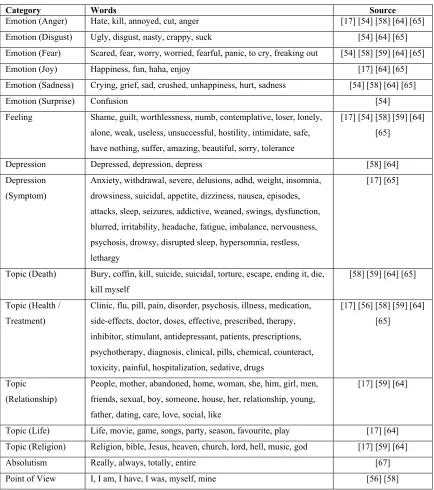
From the studies mentioned above, we have summarised the words into six different categories as shown in Table 1. The first category are words that describes human emotion where we have further categorised them into Paul Ekman’s six basic human emotion which are anger, disgust, fear, joy, sadness and surprise. The second category is feeling where as compared to emotion, it relates more to the mental experience that arises as the brain interprets emotion. The third category is depression where we include words that relates to depression and words that relates to depression symptoms. The fourth category is topic where it is divided into five main topics often related to depression which are life, death, health, relationship and religion. The fifth category is absolutism and finally, the last category is point of view.
An individual’s writing style and word usage do not only give out their mental state during the time but can also be used in a larger scale study to analyse depression. One example is the study by Eldin, Taha and Khalifa [68] where they extracted 10,000 Facebook posts and comments and classify the author of the posts based on their gender. Eldin et al. uses word2vec algorithm in order to handle the large data and perform the classification.
Another study by Abd Yusof, Lin and Guerin [69] analysed the word usage of depression vulnerable individuals to explore the possible causes of depression. In their study, they applied topic modelling on 2,566 student essays associated with high neuroticism and another 2,388 student essays associated to low neuroticism to identify several possible factors that can trigger depression in individuals. From the study, they found that the possible factors are different for both the high and low neuroticism groups. For the high neuroticism group, the possible factors include housing, relationship, academic, health concern, body image, family issues and homesickness. On the other hand, possible factors for depression in the low neuroticism group includes housing, relationship, academic, music, sports and life.
131
Table 1: Summary of words and its respective category
Category Words Source
Emotion (Anger) Hate, kill, annoyed, cut, anger [17] [54] [58] [64] [65] Emotion (Disgust) Ugly, disgust, nasty, crappy, suck [54] [64] [65] Emotion (Fear) Scared, fear, worry, worried, fearful, panic, to cry, freaking out [54] [58] [59] [64] [65] Emotion (Joy) Happiness, fun, haha, enjoy [17] [64] [65] Emotion (Sadness) Crying, grief, sad, crushed, unhappiness, hurt, sadness [54] [58] [64] [65]
Emotion (Surprise) Confusion [54]
Feeling Shame, guilt, worthlessness, numb, contemplative, loser, lonely, alone, weak, useless, unsuccessful, hostility, intimidate, safe, have nothing, suffer, amazing, beautiful, sorry, tolerance
[17] [54] [58] [59] [64] [65]
Depression Depressed, depression, depress [58] [64] Depression
(Symptom)
Anxiety, withdrawal, severe, delusions, adhd, weight, insomnia, drowsiness, suicidal, appetite, dizziness, nausea, episodes, attacks, sleep, seizures, addictive, weaned, swings, dysfunction, blurred, irritability, headache, fatigue, imbalance, nervousness, psychosis, drowsy, disrupted sleep, hypersomnia, restless, lethargy
[17] [65]
Topic (Death) Bury, coffin, kill, suicide, suicidal, torture, escape, ending it, die, kill myself
[58] [59] [64] [65]
Topic (Health / Treatment)
Clinic, flu, pill, pain, disorder, psychosis, illness, medication, side-effects, doctor, doses, effective, prescribed, therapy, inhibitor, stimulant, antidepressant, patients, prescriptions, psychotherapy, diagnosis, clinical, pills, chemical, counteract, toxicity, painful, hospitalization, sedative, drugs
[17] [56] [58] [59] [64] [65]
Topic (Relationship)
People, mother, abandoned, home, woman, she, him, girl, men, friends, sexual, boy, someone, house, her, relationship, young, father, dating, care, love, social, like
[17] [59] [64]
Topic (Life) Life, movie, game, songs, party, season, favourite, play [17] [64] Topic (Religion) Religion, bible, Jesus, heaven, church, lord, hell, music, god [17] [59] [64] Absolutism Really, always, totally, entire [67] Point of View I, I am, I have, I was, myself, mine [56] [58]
6. CONCLUSION
Based on literature reviews, depression has been presented as a mental illness that is worthy of our attention as more and more individuals have been diagnosed with it. Depression is an illness that could happen to almost anyone at any stage of their life. The illness is often hard to detect. It could be that there are individuals around us who suffers
from depression without us realising it. Depression has been proven to cause numerous detriments to not only the individual suffering but also to the society as a whole. However, this can be avoided if depression is detected early.
132 seen as a platform that can be tapped in possibly detecting depression at its early stage. This review paper presented what have been performed in this area and where improvements can be made. The review first gives the definition of depression based on several depression theories. It then looks at how the advancement of NLP with the existence of emotion bearing lexicons and ontology can aid in the early detection of depression on social media. In understanding how depression is being medically diagnosed, this paper has also reviewed several commonly used depression screening tools such as HADS and HDRS.
In social media, texts have been used as one of the mechanisms for individuals to share and express themselves. Therefore, the paper has also reviewed several works that looks at how certain writing styles and word usage can signal that an individual has depressive tendencies. In one of the works, it is noted that individuals with depression frequently write using first person singular pronouns compared to individuals without depression. It is also observed that individuals with depressive tendencies frequently use words associated to negative feelings and emotions as well as often discussed topics related to life, death, relationship and religion. The words mentioned is these literatures are then collected and categorised into six category which are emotion, feeling, depression, topic, absolutism and point of view. Although there are a lot of researches being performed in analysing the writing styles and word usage of depressed individuals, few have used these data to automatically detect depression in social media. Despite the fact that there are some research working on this [56], [57], the result that they got was contradicting and the reasons for this are not yet known. Analysis on the writing style and word usage of depressed individuals garnered a list of common words. However, at this stage, these words does not guarantee an accurate detection of depressed tweets. Therefore, more research are needed in this area.
The usage of emotion bearing lexicons and ontology has been found as very helpful in automatically detecting emotions in text. Moreover, the development of the EMOTIVE ontology [39] which incorporates not only the emotions but also intensifiers, negators and similar terms has proven to give better results in terms of the precision, recall and F-score compared to other techniques. However, the same method have not been developed and tested for the depression domain.
Therefore, based on the reviews, it is recommended that more research are being put in developing lexicons and ontology that are specific to depression. The lexicons and ontology can be modelled to include emotions, feeling, intensifiers and words that relates to depression. The development of such lexicon and ontology would aid in further research on detecting depression based on social media texts and would allow for the development of state-of-the-art depression detection model and algorithm. More and more suicide cases caused by depression have been reported in the news. Development of such mechanism for early detection of depression would allow for prevention measures to be taken and therefore hopefully reduces the number of suicide cases.
ACKNOWLEDGMENT
The authors would like to gratefully acknowledge Universiti Teknikal Malaysia Melaka (UTeM) for providing the research grant under the PJP grant scheme (PJP/2019/FTMK(4D)/S01675) to operate this research project.
REFERENCES:
[1] World Health Organisation. (2018, Mar) Depression. https://www.who.int/news-room/fact-sheets/detail/depression.
[2] W. H. Organization et al., “Depression and other common mental disorders: global health estimates,” World Health Organization, Tech. Rep., 2017.
[3] T. Chettri, S. Adhikari, and S. George, “Prevalence and correlates of depressive symptoms in young adolescents of Nepal,” Clin Neurol Int, vol. 1, no. 1, p. 1002, 2019.
[4] G. Saluja, R. Iachan, P. C. Scheidt, M. D. Overpeck, W. Sun, and J. N. Giedd, “Prevalence of and risk factors for depressive symptoms among young adolescents,” Archives of paediatrics & adolescent medicine, vol. 158, no. 8, pp. 760–765, 2004.
[5] D. J. Kirsch, L. A. Doerfler, and D. Truong, “Mental health issues among college students: who gets referred for psychopharmacology evaluation?” Journal of American college health, vol. 63, no. 1, pp. 50–56, 2015.
133 Industrial health, vol. 46, no. 1, pp. 90–100, 2008.
[7] L.-B. Fan, J. Blumenthal, L. Watkins, and A. Sherwood, “Work and home stress: associations with anxiety and depression symptoms,” Occupational medicine, vol. 65, no. 2, pp. 110– 116, 2015.
[8] J. Kaur, S. M. Cheong, B. Mahadir Naidu, G. Kaur, M. A. Manickam, M. Mat Noor, N. Ibrahim, and A. Rosman, “Prevalence and correlates of depression among adolescents in Malaysia,” Asia Pacific Journal of Public Health, vol. 26, no. 5 suppl, pp. 53S–62S, 2014. [9] M. Marhani, A. Salina, R. ZamZam, R. Razali,
R. S. MR et al., “Prevalence of psychological distress and depressive disorders among married working women in Malaysia,” Malaysian Journal of Psychiatry, vol. 20, no. 1, 2011. [10] P. Chauhan, P. R. Kokiwar, K. Shridevi, and S.
Katkuri, “A study on prevalence and correlates of depression among elderly population of rural south India,” International Journal of community medicine and Public Health, vol. 3, no. 1, pp. 236–239, 2017.
[11] A. H. Kizilbash, R. D. Vanderploeg, and G. Curtiss, “The effects of depression and anxiety on memory performance,” Archives of clinical neuropsychology, vol. 17, no. 1, pp. 57–67, 2002.
[12] B. Roshanaei-Moghaddam, W. J. Katon, and J. Russo, “The longitudinal effects of depression on physical activity,” General hospital psychiatry, vol. 31, no. 4, pp. 306–315, 2009. [13] D. J. Kupfer, E. Frank, and J. M. Perel, “The
advantage of early treatment intervention in recurrent depression.” Archives of General Psychiatry, 1989.
[14] J. L. Coulehan, H. C. Schulberg, M. R. Block, M. J. Madonia, and E. Rodriguez, “Treating depressed primary care patients improves their physical, mental, and social functioning,” Archives of Internal Medicine, vol. 157, no. 10, pp. 1113–1120, 1997.
[15] K. Rost, J. L. Smith, and M. Dickinson, “The effect of improving primary care depression management on employee absenteeism and productivity a randomized trial,” Medical care, vol. 42, no. 12, p. 1202, 2004.
[16] A. Halfin, “Depression: the benefits of early and appropriate treatment.” The American journal of managed care, vol. 13, no. 4 Suppl, pp. S92– 7, 2007.
[17] M. De Choudhury, M. Gamon, S. Counts, and E. Horvitz, “Predicting depression via social media,” in Seventh international AAAI conference on weblogs and social media, 2013. [18] A. P. Association et al., Diagnostic and
statistical manual of mental disorders (DSM-5 R). American Psychiatric Pub, 2013.
[19] C. Chung and J. W. Pennebaker, “The psychological functions of function words,” Social communication, vol. 1, pp. 343–359, 2007.
[20] Nemade, R., Reiss, N., & Dombeck, M. (2018). Cognitive Theories of Major Depression – Aaron Beck. Retrieved from https://www.mentalhelp.net/articles/cognitive-theories-of-major-depression-aaron-beck/ [21] G. P. Brown, C. L. Hammen, M. G. Craske, and
T. D. Wickens, “Dimensions of dysfunctional attitudes as vulnerabilities to depressive symptoms.” Journal of abnormal psychology, vol. 104, no. 3, p. 431, 1995.
[22] D. L. Moilanen, “Validity of beck’s cognitive theory of depression with nonreferred adolescents,” Journal of Counseling & Development, vol. 73, no. 4, pp. 438–442, 1995. [23] M. Boury, T. Treadwell, and V. Kumar, “Integrating psychodrama and cognitive therapy–an exploratory study,” Journal of Group Psychotherapy, Psychodrama and Sociometry, vol. 54, no. 1, p. 13, 2001.
[24] K. Salmela-Aro, J.-E. Nurmi, T. Saisto, and E. Halmesmaki, “Goal reconstruction and depressive symptoms during the transition to motherhood: evidence from two cross-lagged longitudinal studies.” Journal of personality and social psychology, vol. 81, no. 6, p. 1144, 2001. [25] H. Binali, C. Wu, and V. Potdar,
“Computational approaches for emotion detection in text,” in 4th IEEE International Conference on Digital Ecosystems and Technologies. IEEE, 2010, pp. 172–177. [26] H. Krishnan, M. S. Elayidom, and T.
Santhanakrishnan, “Emotion detection of tweets using Na¨ıve Bayes classifier,” Emotion, 2017. [27] M. M. Bradley and P. J. Lang, “Affective norms
for English words (anew): Instruction manual and affective ratings,” Citeseer, Tech. Rep., 1999.
134 [29] S. Baccianella, A. Esuli, and F. Sebastiani,
“Sentiwordnet 3.0: an enhanced lexical resource for sentiment analysis and opinion mining.” in Lrec, vol. 10, no. 2010, 2010, pp. 2200–2204. [30] P. J. Stone, D. C. Dunphy, and M. S. Smith,
“The general inquirer: A computer approach to content analysis.” 1966.
[31] A. B. Warriner, V. Kuperman, and M. Brysbaert, “Norms of valence, arousal, and dominance for 13,915 English lemmas,” Behavior research methods, vol. 45, no. 4, pp. 1191–1207, 2013.
[32] S. Shaikh, K. Cho, T. Strzalkowski, L. Feldman, J. Lien, T. Liu, and G. A. Broadwell, “Anew+: Automatic expansion and validation of affective norms of words lexicons in multiple languages,” in Proceedings of the Tenth International Conference on Language Resources and Evaluation (LREC 2016), 2016, pp. 1127–1132. [33] C. Strapparava, A. Valitutti et al., “Wordnet Affect: an affective extension of Wordnet.” in Lrec, vol. 4, no. 1083-1086. Citeseer, 2004, p. 40.
[34] C. Strapparava and R. Mihalcea, “Learning to identify emotions in text,” in Proceedings of the 2008 ACM symposium on Applied computing. ACM, 2008, pp. 1556–1560.
[35] S. M. Mohammad and P. D. Turney, “Crowdsourcing a word-emotion association lexicon,” vol. 29, no. 3, pp. 436–465, 2013. [36] Y. R. Tausczik and J. W. Pennebaker, “The
psychological meaning of words: LIWC and computerized text analysis methods.” Journal of Language and Social Psychology, 2010. [37] J. Staiano and M. Guerini, “Depeche mood: a
lexicon for emotion analysis from crowd annotated news,” in Proceedings of the 52nd Annual Meeting of the Association for Computational Linguistics (Volume 2: Short Papers), 2014, pp. 427–433.
[38] R. Alt and M. Wittwer, “Towards an ontology-based approach for social media analysis,” in Proceedings of the European Conference on Information Systems (ECIS), 2014.
[39] M. D. Sykora, T. Jackson, A. O’Brien, and S. Elayan, “Emotive ontology: Extracting fine-grained emotions from terse, informal messages,” 2013.
[40] M. Grassi, “Developing HEO human emotions ontology,” in European Workshop on Biometrics and Identity Management. Springer, 2009, pp. 244–251.
[41] J. Hastings, W. Ceusters, B. Smith, and K. Mulligan, “The emotion ontology: enabling interdisciplinary research in the affective sciences,” in International and Interdisciplinary Conference on Modeling and Using Context. Springer, 2011, pp. 119–123.
[42] National Institute of Mental Health, “Depression,” 2007.
[43] A. M. Nezu, G. F. Ronan, E. A. Meadows, and K. S. McClure, Practitioner’s guide to empirically based measures of depression. Springer Science & Business Media, 2000. [44] A. S. Zigmond and R. P. Snaith, “The hospital
anxiety and depression scale,” Acta psychiatrica scandinavica, vol. 67, no. 6, pp. 361–370, 1983. [45] A. T. Beck, D. Guth, R. A. Steer, and R. Ball,
“Screening for major depression disorders in medical inpatients with the beck depression inventory for primary care,” Behaviour research and therapy, vol. 35, no. 8, pp. 785–791, 1997. [46] A. J. Rush, C. M. Gullion, M. R. Basco, R. B.
Jarrett, and M. H. Trivedi, “The inventory of depressive symptomatology (ids): psychometric properties,” Psychological medicine, vol. 26, no. 3, pp. 477–486, 1996.
[47] R. L. Spitzer, K. Kroenke, J. B. Williams, P. H. Q. P. C. S. Group et al., “Validation and utility of a self-report version of prime-md: the phq primary care study,” Jama, vol. 282, no. 18, pp. 1737–1744, 1999.
[48] W. W. Zung, “Zung self-rating depression scale and depression status inventory,” in Assessment of depression. Springer, 1986, pp. 221–231. [49] M. Hamilton, “A rating scale for depression,”
Journal of neurology, neurosurgery, and psychiatry, vol. 23, no. 1, p. 56, 1960.
[50] P. Nabbe, J. Le Reste, M. Guillou-Landreat, M. M. Perez, S. Argyri-adou, A. Claveria, M. F. San Mart´ın, S. Czachowski, H. Lingner, C. Ly-gidakis et al., “Which DSM validated tools for diagnosing depression are usable in primary care research? A systematic literature review,” European Psychiatry, vol. 39, pp. 99–105, 2017. [51] P. A. Cavazos-Rehg, M. J. Krauss, S. Sowles, S. Connolly, C. Rosas, M. Bharadwaj, and L. J. Bierut, “A content analysis of depression-related tweets,” Computers in human behavior, vol. 54, pp. 351–357, 2016.
135 [53] H. Sueki, “The effect of suicide-related internet
use on user’s mental health,” Crisis, 2013. [54] X. Chen, M. D. Sykora, T. W. Jackson, and S.
Elayan, “What about mood swings: Identifying depression on twitter with temporal measures of emotions,” in Companion Proceedings of the Web Conference 2018. International World Wide Web Conferences Steering Committee, 2018, pp. 1653–1660.
[55] E. M. Seabrook, M. L. Kern, B. D. Fulcher, and N. S. Rickard, “Predicting depression from language-based emotion dynamics: longitudinal analysis of Facebook and twitter status updates,” Journal of medical Internet research, vol. 20, no. 5, p. e168, 2018.
[56] D. Mowery, H. Smith, T. Cheney, G. Stoddard, G. Coppersmith, C. Bryan, and M. Conway, “Understanding depressive symptoms and psychosocial stressors on twitter: a corpus-based study,” Journal of medical Internet research, vol. 19, no. 2, p. e48, 2017.
[57] A. Rajput and S. Ahmed, “Making a case for social media corpus for detecting depression,” arXiv preprint arXiv: 1902.00702, 2019. [58] M. De Choudhury, S. Counts, and E. Horvitz,
“Social media as a measurement tool of depression in populations,” in Proceedings of the 5th Annual ACM Web Science Conference. ACM, 2013, pp. 47–56.
[59] M. De Choudhury, E. Kiciman, M. Dredze, G. Coppersmith, and M. Kumar, “Discovering shifts to suicidal ideation from mental health content in social media,” in Proceedings of the 2016 CHI conference on human factors in computing systems. ACM, 2016, pp. 2098– 2110.
[60] M. Stankevich, V. Isakov, D. Devyatkin, and I. Smirnov, “Feature engineering for depression detection in social media.” in ICPRAM, 2018, pp. 426–431.
[61] D. Preotiuc-Pietro, J. Eichstaedt, G. Park, M. Sap, L. Smith, V. Tobolsky, H. A. Schwartz, and L. Ungar, “The role of personality, age, and gender in tweeting about mental illness,” in Proceedings of the 2nd workshop on computational linguistics and clinical psychology: From linguistic signal to clinical reality, 2015, pp. 21–30.
[62] S. W. Stirman and J. W. Pennebaker, “Word use in the poetry of suicidal and nonsuicidal poets,” Psychosomatic medicine, vol. 63, no. 4, pp. 517–522, 2001.
[63] J. Zimmermann, T. Brockmeyer, M. Hunn, H. Schauenburg, and M. Wolf, “First-person pronoun use in spoken language as a predictor of future depressive symptoms: Preliminary evidence from a clinical sample of depressed patients,” Clinical psychology & psychotherapy, vol. 24, no. 2, pp. 384–391, 2017.
[64] T. Nguyen, D. Phung, B. Dao, S. Venkatesh, and M. Berk, “Affective and content analysis of online depression communities,” IEEE Trans-actions on Affective Computing, vol. 5, no. 3, pp. 217–226, 2014.
[65] H. Jung, H.-A. Park, and T.-M. Song, “Ontology-based approach to social data sentiment analysis: detection of adolescent depression signals,” Journal of medical internet research, vol. 19, no. 7, p. e259, 2017.
[66] S. C. Guntuku, D. B. Yaden, M. L. Kern, L. H. Ungar, and J. C. Eichstaedt, “Detecting depression and mental illness on social media: an integrative review,” Current Opinion in Behavioral Sciences, vol. 18, pp. 43–49, 2017. [67] M. Al-Mosaiwi and T. Johnstone, “In an
absolute state: Elevated use of absolutist words is a marker specific to anxiety, depression, and suicidal ideation,” Clinical Psychological Science, vol. 6, no. 4, pp. 529–542, 2018. [68] D. M. ElDin, M. H. N. Taha, and N. E. M.
Khalifa, “Sentineural: A depression clustering technique for Egyptian women sentiments,” International Journal of Advanced Computer Science and Applications, vol. 10, no. 5, 2019. [69] N. F. A. Yusof, C. Lin, and F. Guerin,