Crawling the Web Surface Databases
Vidushi Singhal
Asstt Prof MRIU, FaridabadSachin Sharma
Asstt Prof MRIU, FaridabadABSTRACT
The World Wide Web is growing at a rapid rate. A web
crawler is a computer program which independently browses
the World Wide Web. The size of web as on February 2007
was 29 billion pages. One of the most important uses of web
page is in indexing purpose and keeping web pages up to date
which can be used by search engine to serve the end user
queries. Web is dynamic in nature; hence we need to update
the web pages constantly. In this paper, we put forward a
technique to update a page stored in web repository. This
paper put forward an efficient method to refresh a page. We
are proposing two methods for refreshing the page by
comparing the page structure. First method compares the page
structure with the help of tags used in it. And second method
creates a document tree compare structures of pages.
Keywords:
Web Crawler, WWW, Spidering, Search Engine, Surface Web, Deep Web, Document Tree Structure1. INTRODUCTION
1.1 Definition
A crawler is an independent script which independently
browses the World Wide Web. This process of browsing is
called Web crawling or spidering. A number of recent studies
have noted that a tremendous amount of content is present on
the net. Many sites use spidering as a means of providing up
to date data to search engines. Web crawlers are used to create
a copy of all the visited pages for later processing by a search
engine that indexes the downloaded pages to provide fast
searches. Crawlers can also be used for automating
maintenance tasks on a Web site, for example checking links
or validating HTML code. Also, web crawlers can be used to
gather specific types of information from Web pages, such as
harvesting e-mail addresses.
Net is full of useful data. From which some of the data is
easily accessible to us with the help of standard search engine.
We call such type of data as surface web. But the data which
is not a part of surface web is called as deep web. It is also
known as invisible data because it is not visible to the user
directly. To access such type of data we need some special
type of details as the password, authentication of the site etc.
Accessing of deep web is now a big challenge for the
researchers because it contains very important data. Public
information on the deep Web is currently 400 to 550 times
larger than the commonly defined World Wide Web[15]. A
crawler is a part of a search engine. To search information
from the internet, user submits his query to the search engine,
search engine then reply the user with different links to
different pages. User follows these links to collect the
required information. Typically a search engine works in such
a manner that special crawler software visits a site and reads
the source code of the pages. This process is called as
"crawling" or "spidering". Crawling starts with a seed URL
and then follows the link presented on page using Depth First
Search or Breadth First Search [1]. Then, this page is
compressed and push into the search engine's repository called
an "index". This stage is called as "indexing". Finally, when
someone submits a query to the search engine, it retrieves that
page out of the index and allocates it a certain rank. This
process is called "ranking". Search engine can be categorized
in three categories. Crawler based search engines use automated software programs called as ‘spiders’, ‘crawlers’, ‘robots’ or ‘bots’ to survey the web pages. Human-powered
search engines believe on humans to submit information that
is subsequently indexed and catalogued. Only information that
is submitted by a human is put into the index. A search engine
which works as a combination of both the type of search
engine is called as hybrid search engine. Several major
problems affect non-cooperative web crawlers on the web.
The first problem is that web crawlers do not maintain a
high-degree of freshness. The second is that multiple crawlers can
redundantly crawls the same regions of the web. The third is
that with the proliferation of web crawlers comes increased
contention for shared network resources. This paper presented
1.2 RELATED WORK
Web crawlers have always been a fascinating area of interest
since the advent of web. A lot of work has also been done
already to optimize the performances of web crawlers. They
have certain Issues described below:
Crawler Architecture: Work done describes various
architectures under which crawlers of certain current search
engines are working. [2] Describes the architecture of the
crawling technique used by Google whereas [3] describes a
strategy based on text and link characteristics of referring
pages by producing a rank function which is weighted sum of
the text and link scores.[4] tells about a technique of effective
focused crawling to improve the quality of web navigations.
[5] Describes a parallel crawler with multiple architectures
along with metrics for evaluation. The immense growing
dimension of the World Wide Web induces many obstacles
for all-purpose single-process crawlers including the presence
of some incorrect answers among search results and the
scaling drawbacks. As a result, more enhanced heuristics are
needed to provide more accurate search outcomes in an
appropriate timely manner. [6] This paper proposes the
application of a link independent Web page importance metric
to govern the priority rule within the crawl frontier through
proposing a modest weighted architecture for a focused
structured parallel Web crawler (CFP crawler) in which the
credit assignment to URLs in crawl frontier is done according
to a click stream-based prioritizing algorithm. A traditional
crawler picks up a URL, retrieves the corresponding page and
extracts various links, adding them to the queue. A deep Web
crawler, after adding links to the queue, checks for forms. If
forms are present, it processes them and retrieves the required
information. [7] Analyze and compare important deep Web
information crawling techniques to find their relative
limitations and advantages. To minimize limitations of
existing deep Web crawlers, a novel architecture is described
based on QIIIEP specifications. The proposed architecture is
cost effective and has features of privatized search and general
search for deep Web data hidden behind html forms. The
World Wide Web is an interlinked collection of billions of
documents formatted using HTML. Due to the growing and
dynamic nature of the web, it has become a challenge to
traverse all URLs in the web documents and handle these
URLs, so it has become imperative to parallelize a crawling
process. The crawler process is further being parallelized in
the form ecology of
Crawler workers that parallel download information from the
web. [8] Proposes a novel architecture of parallel crawler,
which is based on domain specific crawling, makes crawling
task more effective, scalable and load-sharing among the
different crawlers which parallel download web pages related
to different domains specific URLs.
Page Update Policies: Each crawler has to update the web
pages on a periodic basis to improve the quality of its
databases. [9] Discusses scheduling algorithms for crawlers to
index the web on a regular basis. [10] Describes the various
freshness metrics used for gauging the freshness and quality
of a local copy of a web page.
[16] Proposes various refresh policies and studies their
effectiveness. The author first formalize the notion of
freshness" of copied data by defining two freshness metrics,
and then propose a Poisson process as the change model of
data sources. Based on this framework, the author examines
the effectiveness of the proposed refresh policies analytically
and experimentally. [17] In this paper a hybrid approach is
build on the basis of which a web crawler maintains the
retrieved pages “fresh” in the local collection. Towards this
goal the concepts of Page rank and Age of a web page is used.
As higher page rank means that more number of users is
visiting that very web page and that page has higher link
popularity. Age of web page is a measure that indicates how
outdated the local copy is. Using these two parameters a
hybrid approach is proposed that can identify important pages
at the early stage of a crawl, and the crawler re-visit these
important pages with higher priority.
Page Priority Method: To prioritize a page over another,
certain methods and parameters have been proposed that are
also used by modern day search engines [11-13]. These
methods take into account various parameters such as link
count for a certain page or the keyword occurrence frequency
to provide a suitable parameter for page relevance.
[14] Shows an algorithm to detect the changes in a web page.
It shows the technique to update a page present in web
repository after comparing it with the new copy.
2. EXISTING METHOD
Existing method consists of a multi threaded server and client
crawlers. Server is used to store the data & to give the
accept the instruction from the server & made its searches
according to it. The server itself never downloads a page it
just forward its request to one of its client to download the
page. Once the page is downloaded it is stored in the web
repository. A lot of the content on the web is dynamic. It is
quite possible that after downloading a particular web page,
the local copy of the page residing in the repository of the web
pages becomes obsolete compared to the copy on the web.
Therefore a need arises to update the database of web pages.
The author discusses two methods [14] to derive certain
parameters, which can help in deriving the fact whether the
page has changed, or not. These parameters will be calculated
at the time of page parsing. When the client counters the same
URL again, it just calculates the code by parsing the page
without downloading the page and compares it to the current
parameters.
If changes in parameters are detected, it is concluded that the
page has changed and needs to be downloaded again.
Otherwise the URL is discarded immediately without further
processing.
Changes in a web page is said to be occurred if there is a
change in page structure or in content of the page. Pages on
web are created using HTML or XML which uses tags. First
method uses these tags to compare the web pages and second
method creates a document tree.
3. PROPOSED METHOD
Once a decision has been taken to update the pages, it should
be ensured that minimal resources are used in the process.
Updating only those elements of the database, which have
actually undergone a change, can do this. It also checks
whether the page is already there in the database. If page is
already present then we need to discard the link otherwise we
replace the exiting page with the fresh downloaded page. In
this paper we propose two methods to compare the structure
of web page.
3.1 Method I
By structure we mean how the text images are displayed on
the page. All of these objects are designed using HTML,
XML or other formatting tools. All these formatting tools
used tags arranging in proper manner. Changes in structure
lead to rearrangement of these tags.
In this algorithm we start our process by comparing the first
tag of existing page with the first tag of the new downloaded
page. If we found it same the process is continued till end tag
of the page otherwise page is declared to be changed from
existing one.
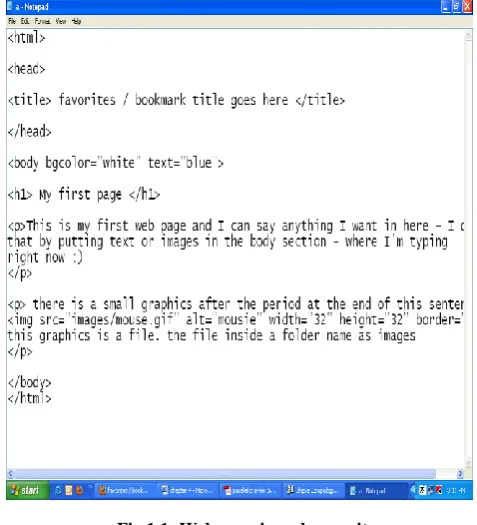
[image:3.595.314.553.135.398.2]For example consider the following page:
[image:3.595.313.556.426.721.2]Fig 1.1: Web page in web repository
Fig 1.2: Web page on fresh link
From the above two pages (fig 1.1 and fig 1.2) following table
Tag
Name
Web
Page
in
Web Repository
Web Page
on Fresh
Link
Tag1
H
H
Tag2
H
H
Tag3
T
B
Table: 1.1 (Comparison of tags of web page fig 1.1 and fig
1.2)
At Tag1 both tags are same so the process is continued for
next tag. Next tag is also same so the process moves to next
tag. This tag is different. So we declared that the page has
changed.
The proposed method offers following advantages: We are using just a single tag rather than using whole
string. It reduces the inconvenience occurred in creating
a whole string by reading the complete web page. Rather than comparing the complete string we will
compare it till the third tag which is a changed value. So
it will reduce the comparison time.
It identifies even the single tag changed in the structure. Even a single change in the structure of a page can be
tracked.
Most of the time we are able to calculate the actual result
by comparing just one tag.
It works for all type of formatting styles.
To take the decision page downloading the client crawler
only needs to compare these tags.
3.2 Method Two
It includes two methods to detect the changes on a web page:
construction of document tree and level order tree traversing.
The structure of every node used in tree presentation of web
page should contain following information.
ID: it stores the unique id for each node of the tree.
CHILD: it stores the information about children of each node.
LEVEL: it stores the information about the level of a node.
LEVEL_ARRAY: it is the array which stores the level of
each node.
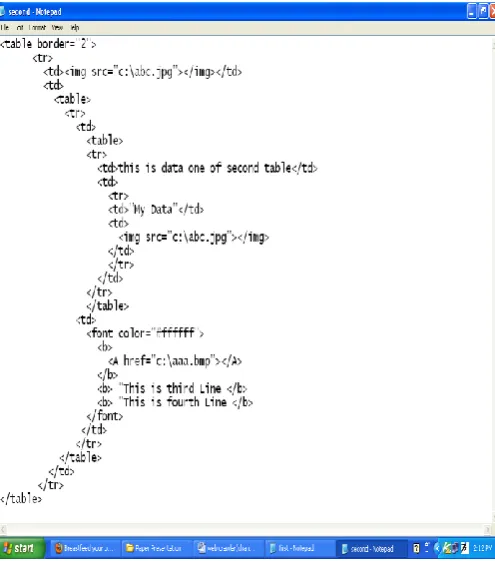
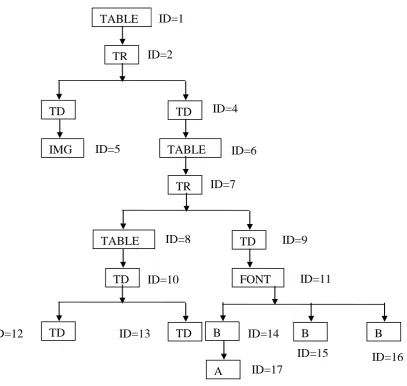
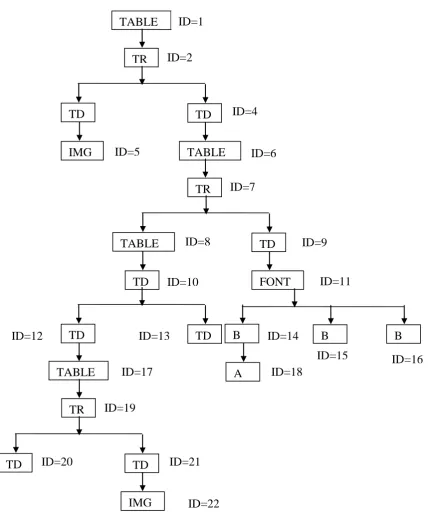
For example we get tree structure shown in fig 1.5 from web
page shown in Fig. 1.3 and we get tree structure as is shown
in Fig. 1.6 from the web page shown in fig 1.4.
Here in this example we are considering fig 1.3 as the initial
web page and fig 1.4 as the changed web page. With the help
of document tree created in fig 1.5 and 1.6 following table
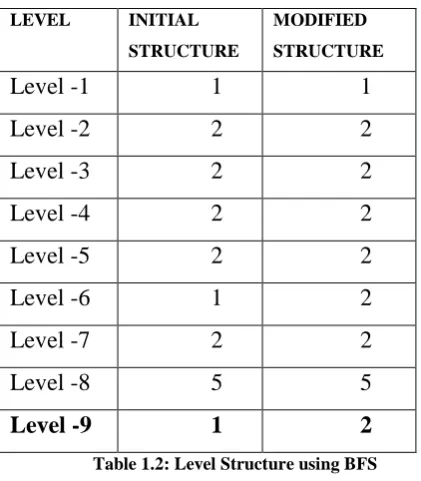
[image:4.595.55.274.69.234.2]1.2 is drawn. We are using BFS to create the table.
Fig 1.3: Web repository page
[image:4.595.315.568.135.365.2]For Example
[image:4.595.318.566.397.678.2]Fig 1.5: Tree structure from web repository page
IMG
B
TABLE
TR
TD
TD
TABLE
TR
ID=1
ID=2
ID=4
ID=7
ID=6
]
ID=5
TD
TD
B
B
A
ID=12
TABLE
TD
TD
FONT
ID=11
ID=10
ID=9
ID=8
ID=14
ID=15
ID=17
ID=13
[image:5.595.106.514.73.459.2]IMG
B
TABLE
TR
TD
TD
TABLE
TR
ID=1
ID=2
ID=4
ID=7
ID=6
]
ID=5
TD
TD
B
B
A
ID=12
TABLE
TD
TD
FONT
ID=11
ID=10
ID=9
ID=8
ID=14
ID=15
ID=18
ID=13
ID=16
TABLE
TR
TD
TD
IMG
ID=17
ID=19
ID=20
ID=21
ID=22
[image:6.595.87.517.70.592.2]LEVEL INITIAL
STRUCTURE
MODIFIED
STRUCTURE
Level -1
1
1
Level -2
2
2
Level -3
2
2
Level -4
2
2
Level -5
2
2
Level -6
1
2
Level -7
2
2
Level -8
5
5
[image:7.595.49.260.68.309.2]Level -9
1
2
Table 1.2: Level Structure using BFS
According to initial structure
LEVEL = {1, 2, 3, 3, 4, 4, 5, 6, 6, 7, 7, 8, 8, 8, 8, 8, 9}
ID= {1, 2, 3, 4, 5, 6, 7, 8, 9, 10, 11, 12, 13, 14, 15, 16, 17}
CHILD= {1, 2, 1, 1, NULL, 1, 2, 1, 1, 2, 3, NULL, NULL, 1,
NULL, NULL, NULL}
LEVEL_ARRAY = {1, 2, 3, 3, 4, 4, 5, 5, 6, 6, 7, 7, 8, 8, 8, 8,
8, 9}
According to modified structure
LEVEL = {1, 2, 3, 3, 4, 4, 5, 6, 6, 7, 7, 8, 8, 8, 8, 8, 9, 9}
ID= {1, 2, 3, 4, 5, 6, 7, 8, 9, 10, 11, 12, 13, 14, 15, 16, 17,18}
CHILD= {1, 2, 1, 1, NULL, 1, 2, 1, 1, 2, 3, NULL, NULL, 1,
NULL, NULL, 1, NULL}
LEVEL_ARRAY = {1, 2, 3, 3, 4, 4, 5, 5, 6, 6, 7, 7, 8, 8, 8, 8,
8, 9, 9, 10, 11, 11, 12}
Now we start level wise traversing of both the tree. Results
are shown in the table. As per the example after comparing
both the set we get the idea that structure has changes at
level-9. As soon as we find the first difference among these two
structures a conclusion has been drawn that page has changed
and we need to update the web repository. This approach
gives us following benefits:
Rather than comparing the whole document we
make our search till the first difference.
Even if a node is deleted or added, it is easily
recorded by the LEVEL_ARRAY.
The client crawler needs to check only two sets of
data at the time of updating.
4. CONCLUSION & FUTURE SCOPE
With the size of the web increasing at a tremendous rate, web
crawlers are being more and more challenged to discover and
maintain web objects, especially on behalf of web search
engines. Currently, web search engines relying on web
crawlers to keep their indices up-to-date are falling behind.
Web page change detection is very important as it provide us
with the knowledge that what is happening on the Web. It
keeps our data updated. Certain techniques can ensure that
the most popular material is kept up-to-date, but that is
limiting. In this paper we proposed a general protocol to
detect the changes that occur in the web pages presented on
the internet. It consists of two methods. Firstly we try to
detect the changes in page structure by comparing the tags in
both the paper. In second method we create a document tree.
Then we do level wise traversing to track the changes among
two pages. Finally we declare the result whether the web
pages are same or not.
Our future work consist of more research to minimize the
efforts to detect the changes occurred in web. My research on
the web page change detection is not finished since I am
trying find other ways to compare two pages which cost
minimum in terms of memory, bandwidth etc.
5. REFERENCES
[1] David Eichmann, “The RBSE Spider – Balancing effective search against web load”, Repository Based Software Engineering Program , Research Institute for Computing and Information Systems, University of Houston – Clear Lake.
[2] Sergey Brin and Lawrence Page, “The Anatomy of a Large-Scale Hypertextual Web Search Engine”, In Proceedings of the Seventh World-Wide Web Conference, 1998.
[3] Anshika pal, Deepak Singh tomar, S.C srivastava, “effective focused crawling based on content and link structure analysis”, international journal of computer science and information security, vol 2, no. 2, June 2009
[4]jody Johnson, kostas Tsioutsiouliklis, C.L Giles, “Evolving strategies for focused web crawling”, Proceedings of twentieth international conference of machine learning, Washington DC, 2003.
[5] Junghoo Cho & Hector Garcia-Molina, “Parallel Crawlers”. Proceedings of the 11th international conference on World Wide Web WWW '02, Honolulu, Hawaii, USA. ACM Press. Page(s): 124 – 135.
[7] Dilip Kumar Sharma, A. K. Sharma,” A Novel Architecture for Deep Web Crawler”, International Journal of Information Technology and Web Engineering, vol 6, issue 1, 25-48, January-March 2011
[8] Nidhi Tyagi, Deepti Gupta, “A novel architecture for domain specific parallel crawler”, Indian journal of computer science and engineering, vol 1, no 1, 44 – 53.
[9] E. Co.man, Jr., Z. Liu, and R. R. Weber, “Optimal robot scheduling for web search engines”. Proceedings of the 11th international conference on World Wide Web WWW '02 Honolulu, Hawaii, USA. ACM Press. Page(s): 136 – 147.
[10] “Synchronizing a database to improve freshness, submitted for publication”. Proceedings of the 2000 ACM SIGMOD international conference on Management of data. Volume 29 Issue 2. Page(s): 117 – 128.
[11] M. Diligenti, F. M. Coetzee, S. Lawrence, C. L. Giles, and M. Gori, “Focused crawling using context graphs”, In Proceedings of the Twenty-sixth International Conference on Very Large Databases, 2000.
[12] S. Chakrabarti, M. van den Berg, and B. Dom, “Focused crawling: A new approach to topic-specific web resource discovery”, In The 8th International World Wide Web Conference, 1999.
[13] Junghoo Cho, Hector Garcia-Molina, and Lawrence, “Efficient crawling through URL ordering Page”, In Proceedings of the 7th World-Wide Web Conference, 1998, page(s):161-171.
[14] Divakar Yadav, A.K Sharma, J.P. Gupta, “ Parallel crawler architecture and web page change detection”, WSEAS transaction on computers, issue 7, volume 7, july 2008
[15] Bergman, Michael K, “White paper: the deep web : surfacing hidden value”, Vol 7, Issue 1, August 2001
[16] Junghoo Cho , Hector Garcia-molina ,” Effective page refresh policies for web crawlers”,Vol 28, Issue 4, December 2003, Pages 390 – 426