Munich Personal RePEc Archive
Trends and challenges in the
implementation of Regional Operational
Programme 2007-2013
Antonescu, Daniela
Institute of National Economy, Romanian Academy
11 March 2001
Online at
https://mpra.ub.uni-muenchen.de/56512/
Trends and challenges in the implementation of
Regional Operational Programme 2007-2013
Author: Daniela Antonescu
Institute of National Economy
Romanian Academy
Abstract
Absorption of EU funds remains, in the sixth year of integration, a key objective of regional policy in Romania. Regional Operational Program (ROP) represents the most important instrument of regional policy, which it can compare and assess the situation and the forecast made of the projects submitted by the contracted or under contract, signed etc. The total extent of absorption of Structural Funds in Romania is 19.76% (3.99 billion Euros).Although the specific difficulties in implementation, the Regional Operational Program holds first place in terms of accessing funds at a rate of 30,79% of total EU allocation (% payment EU in total allocations).
This paper present the actual situation of implementation Regional Operational Program, the main problems encountered and how were resolved.
Key-words: Regional Operational Program, absorption’s capacity, Structural Instruments
JEL Classification: R11, R12, F02
1.
Introduction
Regional development should represent a priority for Romania both from the viewpoint of pursued objectives and from the one of involved resources (human, financial, etc.).
The basic elements of this process – regional policy and Regional Operational Programme – are the pillars of balanced development of all regions, by capitalizing the regional and local development potential, focusing on urban growth poles, and improving the infrastructural, and the business environment conditions.
The enforcement basis of the regional policy is formed out of the eight development regions (NUTS II), the institution managing and coordinating the implementation being the Ministry of Development, Public Works and Housing (set-up in the year 2007) by the Management Authority for ROP (Gov. Res. no. 361/2007).
The effects of the regional policy and the impact of financial allocations from structural and national funds are found, especially, in creating jobs and developing infrastructure (transport, social, etc.), but are also visible in a wider context, on some fields such as: tourism (actions for promoting the country brand, tourism promotion centres, etc.), urban development (Integrated Development Plans), the business sector (supporting micro-enterprises).
In the following we intend to analyses the implementation of ROP after sixth years of integration.
2.
Quantitative analyses
After fifth years of integration into the European Union, Romania has watched from the Structural Funds for Objective Convergence of around 19.76%1.
At July 1, 2012, were about 8136 projects submitted (23.26% of total submitted) of which, those approved were 3417 (41.99% of total ROP), while signed contracts 3085 (37.9%).
European Union payments made on behalf of these approved projects were about 2.76% - a very low point if we consider that we are, however, after fifth years of integration.
Synthetically, situation of ROP 2007-2013 implementation were (July, 31):
Total allocation European Union – 4.4 billion Euro, of which 3.7 billion European Fund for Regional Development;
8136 projects submitted totaling 12.48 billion Euro, of which the ERDF contribution represented 7.56 billion Euro (203.8% of the ERDF allocation ROP);
3417 projects approved totaling 5.63 billion Euro, of which the ERDF contribution represented 3.51 billion Euro (94%);
3085 signed financing contracts totaling 3.27 billion Euro ERDF contributions (88.37%);
Payments and pre-financed made totaling 1.26 billion Euro;
Payments received from the European Commission totaling 613.3 million Euro (15.34%);
477 completed projects with a total eligible value of 265.62 million Euros, of which ERDF contribution 158.36 million Euro (4.3%);
1
Evolution of submitted, contracted projects total value and payment are shown in Figure 1, Figure 2.
Figure 1: Annual evolution of ROP 2007-2013
[image:4.595.87.522.384.587.2]Source: Annual Implementation Report 2011
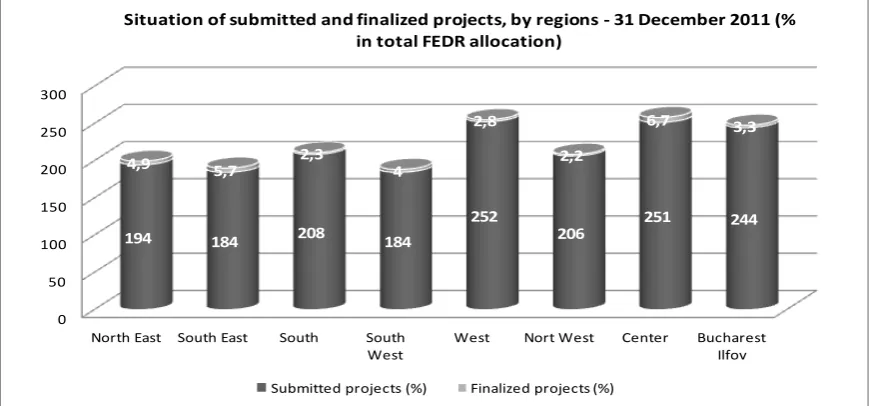
Figure 2: Situation of submitted and finalized projects, by regions, at 31 December 2011 (% in total FEDR allocations)
Source: Annual Implementation Report 2011
At regional level, the largest amount of payments of EU funds (ERDF paid and pre-paid) were made in the North East region, more than 50% for road infrastructure projects. This applies in other regions, where payments for road infrastructure projects are close to or exceed 50% of total payments. Share above 5% of total payments were recorded for educational infrastructure areas, accommodations and recreational tourism and small businesses. Total value of contracts signed were almost 4.6 billion Euro, of which 2.9 billion Euro FEDR contribution (contracting rate –
566
1534
2680
2387
482
0
252
758
990 919
0 3 20 151
427 0
500 1000 1500 2000 2500 3000
2007 2008 2009 2010 2011
Annual evolution of ROP 2007--2010 (mil.Euro)
Submitted Contracted Payments
0 50 100 150 200 250 300
North East South East South South West
West Nort West Center Bucharest Ilfov
194 184 208 184
252
206
251 244
4,9 5,7 2,3 4
2,8
2,2
6,7 3,3
Situation of submitted and finalized projects, by regions - 31 December 2011 (% in total FEDR allocation)
78%). The most contracts were signed in the North East (93%), and the smaller value was signed in Bucharest Ilfov (58%) (Figure 3).
Figure 3: Contracted signed (% in total) – 31 December 2011
Source: Annual Implementation Report 2011
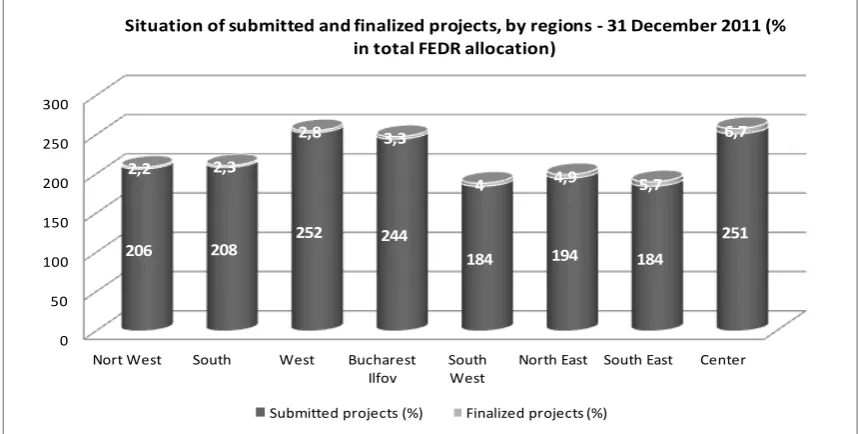
Comparative analysis of projects of projects submitted and completed shows a significant difference between them. It is found that the value of submitted projects for evaluation till its completion there are many chances that it will not happen. The highest value of projects submitted were in the West region (252% over FEDR allocation), while, high value of project completed were recorded in Center region (6,7% of FEDR allocation) (Figure 4).
Figure 4: Situation of submitted and finalized projects, by regions – 31 December 2011 (% in total FEDR allocation)
Source: Annual Implementation Report 2011
-10,00 20,00 30,00 40,00 50,00 60,00 70,00 80,00 90,00 100,00
58,00
72,00 79,00 80,00 80,00
82,00 82,00 83,00 93,00
Contracts signed (% in total) - 31 December 2011
Contract signed (% in total)
0 50 100 150 200 250 300
Nort West South West Bucharest
Ilfov
South West
North East South East Center
206 208
252 244
184 194 184
251
2,2 2,3
2,8 3,3
4 4,9 5,7
6,7
Situation of submitted and finalized projects, by regions - 31 December 2011 (% in total FEDR allocation)
[image:5.595.97.527.462.679.2]Analyzing the evolution of the two types of territories, urban and rural (non-mountain), (until December 2011) of implementation of the ROP, it is found that the ratio gradually changes from rural predominance, to a predominance of the urban areas (mainly, city). This change is achieved as more contracts signed for predominantly urban areas (urban development, business or social infrastructure), because the value of is relatively large.
The main beneficiaries of these funds were, until now, the following: local authorities and intercommunity development associations (30%), regional companies (24%), enterprises (12%), NGOs (5%), ministries and public institutions (16%), other (13%).
Of the seven operational programs, which implement the Structural Instruments in Romania, we can distinguish the Regional Operational Program, which ranks first in the absorption of funds. Next, we present the main aspects of implementing this program, the difficulties encountered to date and how they were solved, etc.
3.
Achievement of proposal output and result indicators of Regional
Operational Program
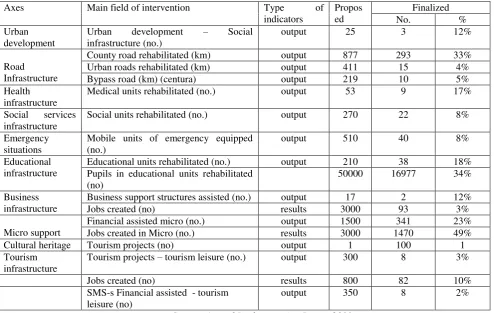
[image:6.595.53.548.400.713.2]The effects of the regional policy and the impact of financial allocations from structural and national funds are found, especially, in creating jobs and developing infrastructure (transport, social, etc.), but are also visible in a wider context, on some fields such as: tourism (actions for promoting the country brand, tourism promotion centres, etc.), urban development (Integrated Development Plans), the business sector (supporting micro-enterprises). The impact is measured using quantitative indicators, situation of their realization are presented in the table below.
Table 1: Situation of ROP indicators (output, results)
Axes Main field of intervention Type of
indicators
Propos ed
Finalized
No. %
Urban development
Urban development – Social
infrastructure (no.)
output 25 3 12%
Road Infrastructure
County road rehabilitated (km) output 877 293 33%
Urban roads rehabilitated (km) output 411 15 4%
Bypass road (km) (centura) output 219 10 5%
Health infrastructure
Medical units rehabilitated (no.) output 53 9 17%
Social services
infrastructure
Social units rehabilitated (no.) output 270 22 8%
Emergency situations
Mobile units of emergency equipped (no.)
output 510 40 8%
Educational infrastructure
Educational units rehabilitated (no.) output 210 38 18%
Pupils in educational units rehabilitated (no)
50000 16977 34%
Business infrastructure
Business support structures assisted (no.) output 17 2 12%
Jobs created (no) results 3000 93 3%
Micro support
Financial assisted micro (no.) output 1500 341 23%
Jobs created in Micro (no.) results 3000 1470 49%
Cultural heritage Tourism projects (no) output 1 100 1
Tourism infrastructure
Tourism projects – tourism leisure (no.) output 300 8 3%
Jobs created (no) results 800 82 10%
SMS-s Financial assisted - tourism leisure (no)
output 350 8 2%
4. Problems identified in the implementation process and way of solving
Synthetically, the main problems identified were presented in the next table:
The problem identified: Measure to solve:
The changes in the ROP implementation context (in special, crisis, political tensions etc.)
Setting Priority Action Plan (PAP) for strengthening the absorption capacity of structural and cohesion funds – with the next priorities:
Project cycle management structures responsible for
implementing the operational programs
Financial aspects of the ROP and projects management;
Procedures of procurement procedures and procurement
contracts;
Control and audit activities;
Influence of external institutions and procedures Structural Instruments on evaluation, contracting and implementation of projects;
Ensure adequate administrative capacity of the structures responsible for the implementation of ROP;
Beneficiary’s capacity and accountability.
For the private sector:
Difficulty of accessing the amounts
necessary to ensure their contribution causing stops funding.
Decision No. 55/20.05.2010, eliminating beneficiary's own contribution to the eligible costs, so that the maximum amount of the grant will be 100% of eligible costs of the projects.
Tightening of credit in financial markets, due to national economic environment degradation, caused by the global financial and economic crisis.
It is very difficult to solve, because the banks do not easily lend small size companies and local authorities.
Insufficient staff at central/local authority’s
level for evaluation and monitoring the projects.
Unlocking positions required for the management of structural funds.
Source: Annual Implementation Report 2011
There are other problems and difficulty determinate by intern or extern factors, but we have identified the general most general, which may affect the implementation of the Regional Operational Programme.
The main findings of analyse of ROP implementation presented, synthetically, in the following: The socio-economic analyses - all elements should be taken into account which might
contribute to regional development, this fact involving their complex analysis and this would contribute to obtaining a complete image on the actual situation (increasing relevance); Improving the relevance between the objectives of regional policy and the ones of spatial
development (territorial planning). The adjustment of instruments for spatial development with the purpose of maximum valuation of the regional potential and better collaboration between the authorities responsible for these policies;
Using county residence towns as drivers of socio-economic development at regional level (growth poles) and anticipating some development opportunities;
Concentrating resources in less developed regions;
Tourism development is regarded as having an important potential for improving economic growth and employment. For using this potential is recommended the drawing up of a regional strategy for developing tourism at the beginning of ROP implementation that would include provisions for information and promotion.
5. Conclusions
Undergoing an increasing importance in time, regional development constitutes a basic element of the economic and social integration and cohesion process. The regional policy through the Regional Operational Programme can contribute to diminishing discrepancies between regions and within them, provided that there is a better substantiation of the decisions regarding the allotment of structural funds where they are indeed necessary.
The current programming exercise of the regional policy and of the financial resources showed that because of the low level of general development, the majority of funds allotted were oriented towards the North-East region, without taking into account the fact that this region does not have the financial capacity to support such an investment process.
Financial allocations by ROP were done considering only the value of GDP/capita and less the actual needs of each region. Also, allotments from structural funds intended for modernizing infrastructure in general cover to a very small extent the actual existing needs at regional level. The main difficulties occurred in the implementation of the current ROP are determined, especially, by the fact that specific regional needs were not identified in an actual manner and due to the weak capacity of the regions to absorb effectively received funds (the capacity that was not taken account of at the time of realizing ROP).
In recent period, the work of implementing the Regional Operational Program has improved compared with previous years, when the main activities were the preparation of program implementation, public information, identified activities finance by Regional Operational Program and the categories of beneficiaries of projects and, also, launching the calls for projects.
The main trends of ROP implementation in period 2007-2012 are the fallow: submitted projects exceed the amounts allocated through ROP and the number of completed projects is very low, after sixth year of integration. Also, the degree of contracted is relatively high (85%), which implies a special effort by the Managing Authority.
The financial and political crisis has affected the implementation of ROP, both in terms of public authorities, central management and project beneficiaries. The financial crisis led to cancellation of contracts already signed by beneficiaries or stops the implementation (in different stage) of project. Even if exist a good chance that the ROP amounts allocated to be spent in actual programming period, its effects materialized in finished projects are still low. Although there have been problems in implementing the ROP, it is important to correct and resolve them during the term of implementation.
BIBLIOGRAPHY
Allen G. Noble, Regional Development and Planning for the 21st Century - New Priorities, New Philosophies;
Antonescu Daniela - Identifying regional disparities in Romania: a convergence process perspective in relation to European Union’s territorial structures, in Conference Proceedings – EMQFB2012 - Emergin Markets Queries in Finance and Business - index by Thomson Reuters;
Antonescu Daniela - Identificarea disparităţilor şi convergentei economice regionale în
Uniunea Europeana şi în România, in Working Papers of National Institute of Economic Research, 49 pag, indexat RePEc, www.ince.ro;
Antonescu Daniela - Dezvoltarea regională – tendinţe, mecanisme, instituţii , Editura Top Form, 2011, ISBN 978-973-7626-3;
Antonescu D., Platon V. (2010), Trends and challenges in the absorption of EU Funds through Regional Operational programme, Geographica Timisiensis, vol. 19, nr. 1, 2010 (pp. 11-21 ), http://www.geografie.uvt.ro/old/cercetare/publicatii/geographica/abstracte/Geographica2010-1/01.Antonescu_Platon%20final.pdf;
Ianos Ion (2004), Dinamica urbana, Editura Tehnica, Bucuresti;
Săgeată Radu (2008), Geographical and Geopolitical Considerations, Revista Română de
Geografie Politică, vol. X, no. 1, Oradea, p. 37-56;
Uniunea Europeană – Politica regională – o abordare integrată, Panorama Inforegio nr.34,
www.ec.europa.eu;
Regional Operational Programme - Annual Implementation Reports – 2007, 2008, 2009, 2010, 2011, Ministry of Regional Development and Tourism - www.fonduri-ue.ro/documente-suport/rapoarte/rapoarte-por;
Situaţia la 31 iulie 2012 a depunerii şi aprobării de proiecte, semnării de contracte de finanţare şi efectuării de plăţi către beneficiary - Anexa 1 - http://www.finantare.ro/am-por-situatia-proiectelor-regio-la-31-iulie-2012.html;
www.infor.regio.com;
www.acis.ro;
www.fonduri-structurale.ro;