Performance Comparison of Mesh and Folded Torus
Network under Broadcasting, using Distance Vector
Routing Algorithm
Narander Kumar
Department of Computer Science, BBA University
(A Central University), Lucknow, UP, India.
Shalini Agarwal
Department of Computer Science, BBA University
(A Central University), Lucknow, UP, India.
Pradeep Keshwani
Department of Computer Science, Invertis University,
Bareilly, UP, India.
ABSTRACT
In the modern technology of communication architecture, network on chip is widely used as communication architecture. Network on chip topologies are becoming a backbone of communication architectures. Network on chip provides a good integration of huge amount of storage on chip blocks as well as computational also. Network on chip handled the unfavorable conditions and it provides the scalability to the architecture. Mesh and folded torus architectures are most commonly used architecture for network on chip communication. Here, we compare the performance of Mesh and Folded torus network architecture on chip, on the basis of different parameters under broadcasting with the help of distance vector routing algorithm. To evaluate the performance of Mesh and folded torus network on chip in the simulation environment, we use the network simulator (NS-2) in the Linux platform.
Keywords
Network on chip, Performance, Mesh, Folded Torus, Latency.
1.
INTRODUCTION
With the increasing the complexity of communication architecture and growing the demand of integration of computational and storage blocks on a single chip, the interest of researchers in this area, developed globally. Since it is a challenge to improve the system performance with limited area and power limitations [1, 2]. Besides the design specific routing, exchange the information through routing the packets in the network based on new age technology of networks, the scalability issues as well as reuse of design, make network on chips is worn as favorable than traditional architecture [3].
Many researchers are developing the research area as part concepts from the area of parallel computing and networks to sphere domain of VLSI. It is seems like imagination due to Network on chip and traditional networks are two different circumstances with conflicts in reference of requirements. Traditional networks are distinct from storage on chip due to non determinism and closeness. The design methodology of network on chip is found in [4, 5 and 6]. A decisive factor of chip, in on chip network topology, in term of some quality parameters are cost and energy consumptions as well as whole performance. After review of the different network topologies we find that there are grid based arrangement and match the VLSI design. Since network on chip is commonly used mesh and torus topologies to establish a network on chip architecture for communication [7, 8 and 9].
We ask that authors follow some simple guidelines. In essence, we ask you to make your paper look exactly like this document. The easiest way to do this is simply to download the template, and replace the content with your own material.
There are different network on chip topologies has been proposed such as Mesh, Torus, Star, Octagon, SPIN, Folded Torus [10, 9, 11, 12, 13 and 14]. Torus topology is reduced the latency of mesh. The problem of excessive delay in torus topology is avoided in folded torus topology [15]. From the literature, mesh and torus topologies has given more attention of researchers for network on chip. In this paper, we compare the performance of mesh and folded torus topologies under broadcasting using distance vector routing algorithm in reference of different decisive parameters.
This paper has been organized as follows Introduction has been given in section 1. Section 2 represents related works.
System model is given in section 3. Section 4 represents the results and discussion. Finally conclusion and future work is given in section 5.
2.
RELATED WORK
Improving the performance of interconnection network is essential to success to increase the number of processing cores on a single chip. It is requires to increase the processing of data and communication. Although high communication performance requirements of many core processor can meet through asymmetrical topologies and it is suited for different variety of traffic patterns. Two topologies like torus named as xtorus and xxtorus, evaluate the performance on the basis of theoretical analysis, link entropy and path diversity and heterogeneous link design also as well as take the advantages of higher level of VLSI process [16]. A torus based hierarchical hybrid optical-electronic network on chip (THOE) and different techniques as optimization of floor plan, power control mechanism, low latency control protocols and hybrid optical-electrical routers and interconnects, hierarchical in nature is described and compare THOE with torus based optical network on chip as well as torus based electronic network on chip [17]. On chip networks faults, degrade their performance in communication and other parameters of works. A Markov model based analysis for terminal reliability of mesh and 2D torus is proposed in [18]. An analytical performance model using adaptive wormhole routing for n-D mesh topology is described in [19].
efficiency by reducing the number of waveguide crossing point of optical network on chip in the floor plan. The floor plans of optical network on chip for 2D mesh and torus topology and design metrics for mesh as well as torus based optical network on chip is given in [20]. A highly scalable with fault tolerant interconnection networks of 6-D mesh/torus topology for large scale supercomputers architectures is discussed in [21]. Zigzag and simple mapping function of embedding mesh and torus topology on to degree four chordal rings is discussed and topological properties are also investigated in [22].
Mesh and torus network architectures are the most commonly used for network on chip topologies. So the performance of 3D mesh and 3D torus topology is analyzed in [23]. The comparison of hierarchical torus network (HTN) with H3D mesh, mesh and torus topology is given and also evaluate the performance of HTN under common traffic pattern [24]. The single routing node architecture, including packet format, routing and arbitration, routing algorithm and node routing direction, the programming and simulation of proposed architecture are designed [25]. The performance is compared on the basis of packet loss with source routing using different traffic generation mechanism with handshaking for parallel transmission concepts [26].
3.
SYSTEM MODEL
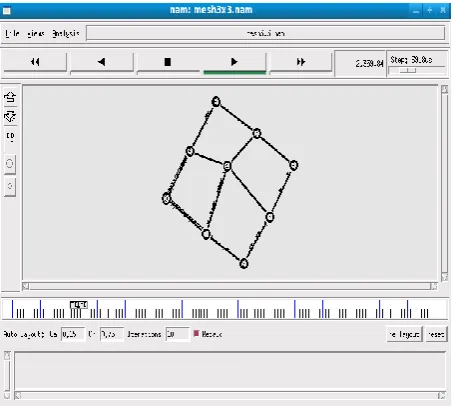
We compare the performance of Mesh 3×3 and folded torus 3×3 network architectures or topologies on the basis of different parameters. To perform this task, we use the network simulator (NS-2). The network animator (nam) files of Mesh 3×3 and folded torus 3×3 topologies is given in figure 1 and figure 2.
[image:2.595.314.563.70.328.2].
[image:2.595.55.282.423.626.2]Figure 1: Network animation of Mesh 3×3.
Figure 2: Network animation of folded torus 3×3.
4.
RESULT AND DISCUSSION
We compute the results of the nodes of 9, 12, 16, 20, and 25 in mesh and folded torus topologies under distance vector routing algorithm. To compare the performance of two topologies named as mesh 3×3 and folded torus 3×3 on basis of some important parameters such as Throughput, Latency, Dropping Probability, Packet received on the end nodes under broadcasting using NS-2 Simulator.
(a) Throughput:
Throughput can be defined in the different ways, it depends on the basis of implementation. In the present scenario, the throughput can be defined as follows [15]
) 1 ( ... ... Time
Total IP of blocks of Number
Message of Length Message Completed Total
Throughput
Figure 3: Comparison of Throughput of Mesh and Folded Torus topologies.
(b) Latency:
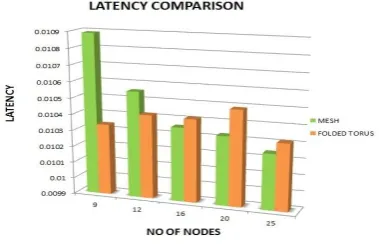
The time that elapses between the occurrence of a message header injection into the network at the source node, that include the queuing time in source, and the occurrence of the corresponding tail flit reception at the destination node [29] is known as latency. Since we take the transport of nodes in one place to another place, here we called this as transport latency. Simulation results are given in figure 4.
Figure 4: Comparison of Latency of Mesh and Folded Torus topologies.
(c) Dropping Probability:
According to probability theory, we find the dropping probability of packets as total no of packet drop which is divided by total number of dropped packets and total number of received packets at the destination nodes [27]. This may be as follows:
packets packets dropped packets recieved of number Total
packets dropped of number Total packets
dropped of robability P
)
(
[image:3.595.316.548.109.218.2]
Figure 5: Comparison of packet dropping probability of Mesh and Folded Torus toplogies.
(d) Total packet received on the end-node:
Here, we calculate how many packets are received on the destination nodes in mesh and folded torus topology.
[image:3.595.75.265.335.457.2].
Figure 6: Comparison of packet received at the end nodes of Mesh and Folded Torus topologies.
5.
CONCLUSION AND FUTURE
DIRECTIONS
Network on chips have overcome the Storage on chip disadvantages. Mesh and torus are two well-known and universal topologies among many presented Network on chip topologies. We carried out detailed comparisons of mesh and Folded torus topologies for different figures of merit such as latency, throughput, drop probability, packet receive by distance vector routing algorithm using broadcasting.
Torus always has better latency than mesh. However the cost we pay for this improvement is higher power consumption in the case of torus topology so we implemented folded torus topology which has less power consumption because we used less no of links in folded torus as compared to torus and mesh, folded torus has less latency than torus and mesh. Routing algorithms, number of nodes and number of links in a network have a direct effect on power Consumption and latency.
Finally, we selected the folded torus topology which has more throughputs, less latency, less drop probability and its packet receive ratio as compared to mesh. So we conclude that folded torus is better than mesh topology under broadcasting model using distance vector routing algorithm. For future work, the comparison between mesh and folded torus under different type of casting (broadcasting, multicasting etc.) in different scenario using other popular and efficient algorithms can be done.
6.
REFERENCES
[1] L. Benini and G. De Micheli, “Networks on chip: a new paradigm for systems on chip design,” Proceedings, Design, Automation and Test in Europe Conference and Exhibition, pp. 418–419, 2002.
[2] L. Benini and G. De Micheli, “Powering networks on chips,” Proceedings, the 14th International Symposium on System Synthesis, pp. 33–38, 2001.
[image:3.595.58.276.630.729.2]network on chip approaches.” ACM trans. Des. Autom. Electron. Sys., 12, 3, 1-20, 2007.
[4] L. Benini and G. D. Micheli, “Networks on chips: a new Soc paradigm,” IEEE transaction on Computer, vol. 35, no. 1, pp. 70–78, Jan. 2002.
[5] P. Guerrier and A. Greiner, “A generic architecture for on-chip packet switched interconnections,” Proceeding of DATE. ACM Press, 2000, pp. 250–256.
[6] W. Dally and B. Towles, “Route packets, not wires: On-chip interconnection networks,” Proceedings of the Design Automation Conference, 2001.
[7] G. D. Micheli and L. Benini, “Network architecture: Principles and examples,” in Networks-on Chips: Technology and Tools, ser. The Morgan Kaufmann Series in Systems on Silicon, G. D. Micheli and L. Benini, Eds. Morgan Kaufmann, ch. 5, pp. 1–22, Jul. 2006.
[8] S. Vangal et al. “An 80-Tile 1.28TFLOPS Network-on-Chip in 65nm CMOS.” Proceedings of the International Solid-State Circuits Conference, Feb. 2007.
[9] W. J. Dally and B. Towles, “Route Packets, Not Wires: On-Chip Interconnection Networks,” Proceedings of the Design Automation Conference, pages 684–689, June 2001.
[10] J. Duato, S. Yalamanchili, and L. Ni, “Interconnection Networks—An Engineering Approach,” Morgan Kaufmann, 2002.
[11] S. B. Akers and B. Krishnamurthy, “A Group-Theoretic Model for Symmetric Interconnection Networks,” IEEE Transactions on Computers, vol. C-38, no. 4, pp. 555– 566, April 1989.
[12] F. Karim, A. Nguyen, and S. Dey, “An Interconnect Architecture for Networking Systems on Chip,” IEEE Micro, vol. 22, no. 5, pp 36–45, September/October 2002.
[13] Adriahantenaina, H. Charlery, A. Greiner, L. Mortiez, and C. A. Zeferino, “Spin: A scalable, Packet Switched, on Chip Micro-Network,” In DATE 03 Embedded Software Forum, pages 70–73, 2003.
[14] W.J. Dally and C.L. Seitz, “The Torus Routing Chip,” Technical Report 5208: TR: 86, Computer Science Dept., California Inst. of Technology, pp. 1-19, 1986.
[15] Partha Pratim Pande, Cristian Grecu, Michael Jones, André Ivanov, Resve A. Saleh, “Performance Evaluation and Design Trade-Offs for Network-on-Chip Interconnect Architectures,” IEEE Trans. Computers, vol. 54, no. 8, pp 1025-1040, 2005.
[16] Yu-hang Liu, Ming-fa Zhu, Li-min Xaio, Jue Wang, “Asymmetrical topology and entropy-based heterogeneous link for many-core massive data communication”, Springer Journal of Cluster Computing, January 2013, DOI 10.1007/s10586-012-0238-3.
[17] Yaoyao Ye, Jiang Xu, Xiaowen Wu, Wei Zhang, Weichen Liu and Mahdi Nikdast, “A Torus-Based Hierarchical Optical-Electronic Network-on-Chip for Multiprocessor System-on-Chip”, ACM Journal on Emerging Technologies in Computing Systems, Volume 8, No. 1, Article 5, February 2012.
[18] Sameer Bataineh, Ajmad Odet-Allah, Raed Al-Omari, “Reliability of mesh and torus topologies in the presence of faults”, Springer Journal of Telecommunication Systems, Volume 10, Issue 3-4, pp 389-408, December 1998, Issn 1572-9451, DOI 1023/A:1019187605001.
[19] Pedram Rajabzadeh, Hamid Sarbazi-Azad, Hamid-Reza Zarandi, Ebrahim Khodaie, Hashem Hashemi-Najafabadi, Mohamed Ould-Khaoua, “Performance modelling of n-dimensional mesh networks”, Elsevier Journal of Performance Evaluation, Volume 67, Issue 12, pp 1304-1323, December 2010, ISSN 0166-5316.
[20] Kai Feng, Yaoyao Ye, Jiang Xu, “A formal study on topology and floor plan characteristics of mesh and torus-based optical networks-on-chip” Elsevier Journal of Microprocessors and Microsystems, 2012. doi:10.1016/j.micpro.2012.06.010.
[21] Ajima, Y, Sumimoto, S., Shimizu, T., “Tofu: A 6-D Mesh/Torus Interconnect for Exascale Computers”, IEEE Journal of Computer, Volume 42, No. 11, pp 36-40, November 2009, DOI: 10.1109/MC.2009.370.
[22] J. F. Fang, J. Y. Hsiao, C. Y. Tang, “Embedding meshes and TORUS networks on to degree-four chordal rings”, IEEE Proceedings – Computers and Digital Techniques, Volume 145, Issue 2, pp 73-80, March 1998.
[23] Mohammad Reza Nouri rad, Reza Kourdy, “Performance Comparison of 3D-Mesh and 3D-Torus Network-on-Chip”, Journal of Computer, Volume 4, Issue 1, pp 71-82, January 2012, ISSN 2151-9617.
[24] M.M. Hafizur Rahman, Yukinori Sato, and Yasushi Inoguchi, “High Performance Hierarchical Torus Network Under Adverse Traffic Patterns” Journal of Network © Academy Publisher, VOL. 7, NO. 3, pp 456-467, March 2012.
[25] Xingang Ju, Liang Yang, “NoC Research and Practice: Design and Implementation of 2×4 2D-Torus Topology” International Journal of Information Technology and Computer Science © MECS press, pp 50-56, 2011.
[26] Lalit Kishore Arora, Rajkumar, “Performance Evaluation of Mesh with Source Routing for Packet Loss”, International Journal of Scientific Research Engineering & Technology (IJSRET) Volume 1, Issue 5, pp 124-129, August 2012.
[27] Yi-Ran Sun, Shashi Kumar, Axel Jantsch, “Simulation and Evaluation for a Network on ChipArchitecture Using NS-2”, the Department of Microelectronics & Information Technology (IMIT),
AUTHOR’S PROFILE
Dr. Narander Kumar received his Post Graduate Degree and Ph. D. in CS & IT, from the Department of Computer Science and Information Technology, Faculty of Engineering and Technology, M. J. P. Rohilkhand University, Bareilly, Uttar Pradesh, INDIA in 2002 and 2009, respectively. His current research interest
Assistant Professor, in the Department of Computer Science, Babasaheb Bhimrao Ambedkar University (A Central University), Lucknow, UP, INDIA.
Ms Shalini Agarwal recived her Master of Technology (M. Tech) in Computer Science and Engineering from Amity University, Uttar Pradesh, India in 2010. She also did her M.Sc (Computer Science) at J. K. Institute of Applied Physics and Technology, University of Allahabad, Allahabad, UP, India. She was a faculty member in the Department of
Computer Science and Engineering, Sri Ram Swaroop Group of Professional Colleges, Lucknow, UP, India. Currently, she is a research scholar in the department of Computer Science at Babasaheb Bhimrao Ambedkar University (A Central
University), Lucknow, UP. India. Her research area is computer networking and resource management for grid and cloud computing infrastructures.