Security Effect on B2B and B2C Operations using 3G
M-Commerce
Avdhesh Gupta
Pankaj Madan
College of Engineering Roorkee, Roorkee Associate Professor, GKV, Haridwar
ABSTRACT
The full scope of how mobile technologies will affect individuals‟ lives in the areas of business, education and other sectors has yet to be appreciated. Innovative mobile technologies are causing disruptive, tectonic changes that will shape inalterably the way the next generation will live, work, play and interact with the rest of the world. Indian business leaders, government, policy makers, leading academics and other experts are required to discuss government and business approaches to mobile commerce, mobile banking, mobile governance and security related issues in M-Commerce that will have a positive effect on India‟s economic and social development. This paper shows the influences of security on B2B and B2C operations of 3G based M-Commerce.
Keywords
third generation, m-commerce, security, B2B, B2C.
1.
INTRODUCTION
E-Commerce, or the buying and selling of goods and services on the Internet, has become a part of daily life for many people. As the Internet expands to every corner of the globe, it is becoming easier and easier to access it from a wide variety of devices [1]. E-Commerce over mobile devices has now been termed Mobile-Commerce (Commerce)[2]. The M-Commerce by definition is the E-M-Commerce that is implemented using wireless solutions such as cell phones, pocket PC's, and PDAs. It allows a user to purchase goods and services on the move, anytime, and anywhere. M-Commerce applications and the current 3-G have been finding it hard to be widely used in India. Mobile commerce is a natural result of combining two strongly emerging trends: electronic commerce and pervasive computing. M-Commerce represents another wave of the e-commerce invasion i.e. changing the nature of business in the 21st century [3]
The evolution of mobile network technology can be divided into four generations: 1-G (first generation), 2-G, 2.5-G, and 3-G. Some of the standards for each generation are [4] [5]
1-G: Advance Mobile Phone System (AMPS)
2-G: Global System for Mobile Communication (GSM), Code Division Multiple Access (CDMA), High Speed Circuit Switched Data Technology (HSCSD)
2.5-G: General Packet Radio System (GPRS), Enhanced Data Rate for GSM Evolution (EDGE)
[image:1.595.308.545.224.569.2] 3-G: Universal Mobile Telephone Standard (UMTS).
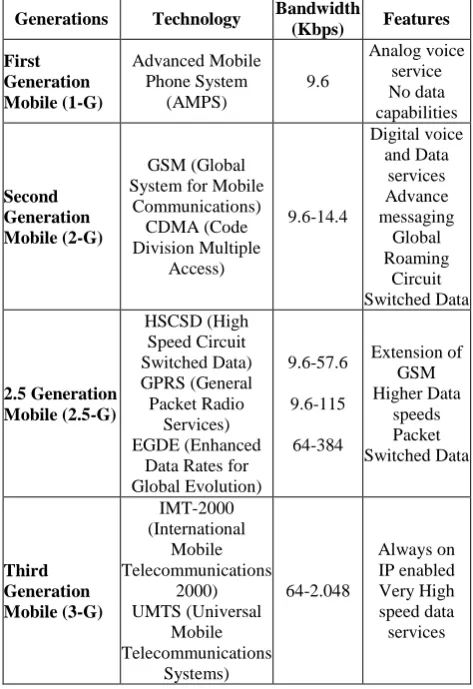
Table 1. Technology and features of various generations
The third generation mobile networks are based on 2-G and 2.5-G networks and have some enhanced features. The underlying technology is same as the previous technology that enables the user to be connected without any interruptions and delays with high efficiency usage of networks. All it matters is to put a new layer on it and to provide the latest and future perspective services. According to a research in Lulea University of Technology the technology and features associated with 3-G are illustrated in the table 1.
2.
M-COMMERCE APPLICATION FOR
B2B AND B2C OPERATIONS
In a competitive marketplace, the need is to understanding how evolution of 3-G service affects the previous technologies. Financial transaction based organizations have moved from product centric to customer centric position. In this way, companies seek more competitive advantages in building good reputation for superior performance like secure
Generations Technology Bandwidth
(Kbps) Features
First Generation Mobile (1-G)
Advanced Mobile Phone System
(AMPS)
9.6
Analog voice service No data capabilities
Second Generation Mobile (2-G)
GSM (Global System for Mobile
Communications) CDMA (Code Division Multiple
Access)
9.6-14.4
Digital voice and Data
services Advance messaging
Global Roaming
Circuit Switched Data
2.5 Generation Mobile (2.5-G)
HSCSD (High Speed Circuit Switched Data) GPRS (General Packet Radio
Services) EGDE (Enhanced
Data Rates for Global Evolution)
9.6-57.6 9.6-115 64-384
Extension of GSM Higher Data
speeds Packet Switched Data
Third Generation Mobile (3-G)
IMT-2000 (International
Mobile Telecommunications
2000) UMTS (Universal
Mobile Telecommunications
Systems)
64-2.048
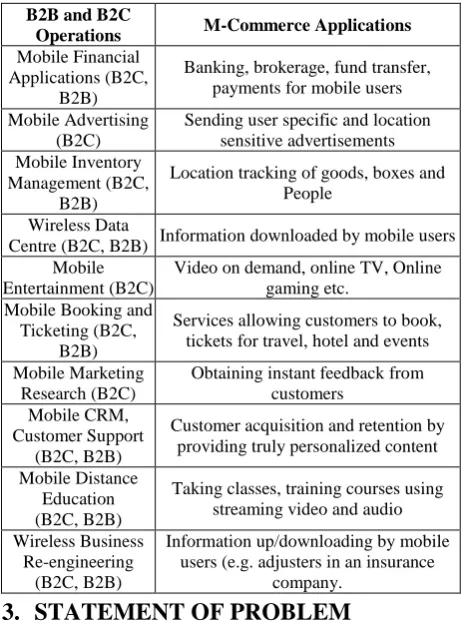
financial transaction, on time delivery, accurate information, better-trained personnel and quicker resolution of complaints. The following table shows the B2B and B2C Operations for M-Commerce Applications [3] [6] [7]:
.Table 2. B2B and B2C Operations for M-Commerce applications
B2B and B2C
Operations M-Commerce Applications
Mobile Financial Applications (B2C,
B2B)
Banking, brokerage, fund transfer, payments for mobile users Mobile Advertising
(B2C)
Sending user specific and location sensitive advertisements Mobile Inventory
Management (B2C, B2B)
Location tracking of goods, boxes and People
Wireless Data
Centre (B2C, B2B) Information downloaded by mobile users Mobile
Entertainment (B2C)
Video on demand, online TV, Online gaming etc.
Mobile Booking and Ticketing (B2C,
B2B)
Services allowing customers to book, tickets for travel, hotel and events Mobile Marketing
Research (B2C)
Obtaining instant feedback from customers
Mobile CRM, Customer Support
(B2C, B2B)
Customer acquisition and retention by providing truly personalized content Mobile Distance
Education (B2C, B2B)
Taking classes, training courses using streaming video and audio Wireless Business
Re-engineering (B2C, B2B)
Information up/downloading by mobile users (e.g. adjusters in an insurance
company.
3.
STATEMENT OF PROBLEM
Analysis of impact of security challenges, security risks, and security implementations within 3-G Commerce in 3-G M-Commerce are the main issues in this research. In today‟s E-Commerce world, the security is the major issues that need to be constantly monitored and improved. For the extensive use of 3-G enabled M-Commerce, it is necessary to see the impact on businesses and their customers. By expanding E-Commerce to mobile devices, it is also necessary to ensure that these devices are protected against security threats. M-Commerce faces the same security threats that E-M-Commerce faces plus many others due to the mobile nature of the products [8].
Why the users are not using m-commerce applications? Even B2B and B2C operations are available for M-Commerce applications; the users do not show much attention towards the using m-commerce applications. Even security features have been improved, 3G (faster internet service on mobiles) has been started, but the number of users is slowly increased [9]. This research shows how the security issues influencing the behavior towards using m-commerce applications. According to James Messham, fraudsters and hackers will actively target all M-Commerce services, service providers and the underlying infrastructure [10]. An article on “Security in M-Commerce” state that the M-Commerce industry is still in a developing phase. The protocols used in M-Commerce are inherited from E-Commerce [11]. According to Mike Fuller, many security challenges and weaknesses exist within Commerce systems. In order to expand the usage of
M-Commerce, the manufacturers, the developers, and the wireless carriers need to gain the consumer trust by implementing the security features into their devices [12]. M-Commerce users need some security aspects like Confidentiality, Integrity, non-repudiation, Authentication and Authorization [13][14][15]. Sudhir Dixit et al. said that the third generation networks and services present opportunities to offer multimedia applications and services that meet end-to-end quality of service requirements [16].
4.
OBJECTIVES AND HYPOTHESIS
The main objectives are to examine the impact of security on B2B and B2C operations using 3-G M-Commerce applications and to examine the impact of quality of services on B2B and B2C operations using 3-G M-Commerce applications.
H01: There is no significant difference in the perception of B2B and B2C operators about security in 3G M-Commerce across different demographic characteristics.
H02: There is no significant difference between security issues of 2G and 3G networks perceived by B2B and B2C operators.
H03: The user experience does not vary according to various security issues in 3G based M-Commerce Applications.
H04: Change in 3G Network security issues do not influence the intention to participate in M-Commerce operations.
5.
RESEARCH METHODOLOGY
The research has been carried out through two key modules: primary research and extensive desk research. The Secondary research has involved an in-depth survey of various literature sources like journals, newspapers, magazines, etc., and primary data collection was done through structured questionnaire and interviews across a cross-section of stakeholders. Extensive desk research has been done to build an in-depth understanding of the security and quality in 3-G M-Commerce applications for B2B and B2C operations. Information from the various published resources such as Journals, Newspapers, Magazines, research papers, etc. and other research bodies has also used to validate the data. It is made with the consideration of the purpose, that is, to gain a better understanding of the dimension that affect the customer, the business perceived M-Commerce security for B2B and B2C operations, the 360-degree stakeholders‟ survey was done. Further, we did investigation of the customers from various sectors like banks, on line shopping and other B2B operators in northern India.
[image:2.595.53.285.148.460.2]processing the same for analysis. Statistical tools used to analyze the data as per the objectives included Descriptive Statistics (such as frequencies, Percentages, Arithmetic Averages, Standard Deviations), reliability and validity, T-test, chi-square test.
6.
RESULTS INTERPRETATION
The data collected through „Gmail‟ service and implemented into SPSS. Some methods applied on data to get the results. Following are the results for various hypotheses:
[image:3.595.45.290.251.556.2]H01: There is no significant difference in the perception of B2B and B2C operators for 3G M-Commerce Applications across different demographic characteristics.
Table 3. Descriptive statistics for relationship between B2B and B2C
Factors
B2C B2B
N Mea
n S.D. Std. Error Mean
N Mean S.D. Std. Erro r Mea
n
Age Wise
Group 201 2.76 1.055 .074 104 3.54 1.314 .129 City Wise 201 1.10 .361 .025 104 1.02 .138 .014 Gender 201 1.37 .485 .034 104 1.38 .486 .048 Education
Qualificati on
201 2.77 .421 .030 104 2.75 .435 .043
Marital
Status 201 1.25 .436 .031 104 1.16 .372 .036 Occupation 201 2.06 .341 .024 104 2.35 .517 .051 Income 201 3.58 1.306 .092 104 4.17 1.210 .119 Mobile
Device 201 1.68 1.009 .071 104 1.51 .955 .094 Brand
Name of Mobile
201 2.26 1.773 .125 104 1.69 1.462 .143
Cost 201 2.37 .643 .045 104 2.47 .607 .059 3G Service
[image:3.595.315.560.308.494.2]Provider 201 2.10 1.513 .107 104 1.98 1.157 .113
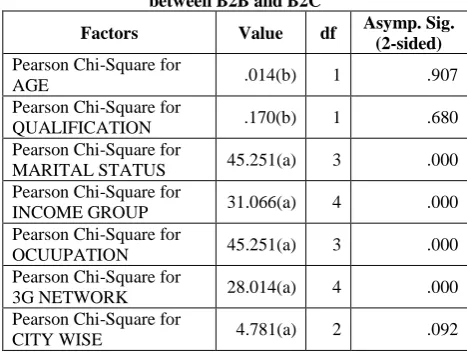
Table 4. Chi-Square Test to identify the relationship between B2B and B2C
Factors Value df Asymp. Sig.
(2-sided)
Pearson Chi-Square for
AGE .014(b) 1 .907
Pearson Chi-Square for
QUALIFICATION .170(b) 1 .680
Pearson Chi-Square for
MARITAL STATUS 45.251(a) 3 .000
Pearson Chi-Square for
INCOME GROUP 31.066(a) 4 .000
Pearson Chi-Square for
OCUUPATION 45.251(a) 3 .000
Pearson Chi-Square for
3G NETWORK 28.014(a) 4 .000
Pearson Chi-Square for
CITY WISE 4.781(a) 2 .092
Here the relationship identification between B2B and B2C, so there is relationship between B2B and B2C according to marital status, income group, occupation, network, and the age of person, while there is no relationship between B2B and B2C according to qualification, gender and city. So for the use of B2B or B2C operation there is no hard and fast rule to do these operations by a selected group. Basically highly qualified, male, unmarried, high income group and middle aged persons are the main users of B2B and B2C operations. So this research shows that for the identification of impact of security and quality in 3G m-commerce applications on B2B and B2C operations, both operations can be taken collectively. So the hypothesis H01 is agreed that there is no significance difference in the perception of B2B and B2C operations for 3G m-commerce applications across different characteristics.
H02: There is no significant difference between security issues of 2G and 3G networks perceived by B2B and B2C operators.
Table 5. One sample test for comparison of security attributes between 3G network and 2G or 2.5G network
Factors
Test Value = 3
t df Sig. (2-tailed)
Mean Difference
95% Confidence Interval of the df Lower Upper Trust on
Network .490 304 .625 .030 -.09 .15 Secure
3G Accessib ility
.918 304 .360 .056 -.06 .18
Security in 3G as in 2G
6.99 304 .000 .357 .26 .46
Overall
Security 7.40 304 .000 .403 .30 .51
This table displays the number of cases, mean value, standard deviation, and standard error for the test variable(s). Since the One-Sample T Test procedure compares the mean to a specified value, it is useful to know what the mean value is. The test observed that
a significance value of 0.625 in case of trust on 3G networks, indicates that there is no significant difference between security issues of 2G and 3G networks perceived by B2B and B2C operators.
a significance value of 0.360 in case of secure 3G accessibility, indicates that there is no significant difference between security issues of 2G and 3G networks perceived by B2B and B2C operators.
a significance value of 0.000 in case of more security in 3G network as compared to 2G network, indicates a significant difference between security issues of 2G and 3G networks perceived by B2B and B2C operators. a significance value of 0.000 in case of speed, indicates
[image:3.595.49.283.582.758.2]H04: The user experience does not vary according to various quality and security issues in 3G based M-Commerce Applications.
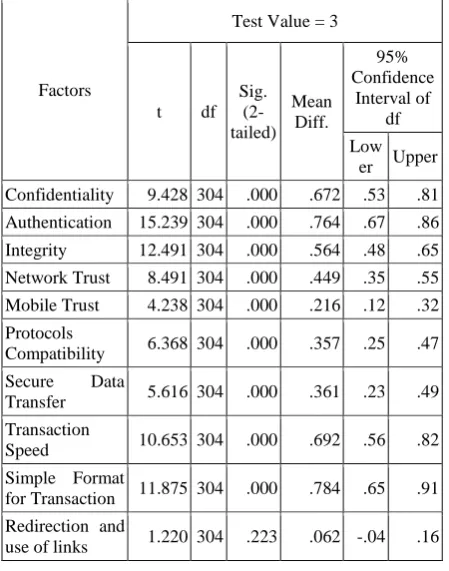
Table 6. One sample test for user experience for attributes
Factors
Test Value = 3
t df Sig.
(2-tailed)
Mean Diff.
95% Confidence
Interval of df Low
er Upper Confidentiality 9.428 304 .000 .672 .53 .81 Authentication 15.239 304 .000 .764 .67 .86 Integrity 12.491 304 .000 .564 .48 .65 Network Trust 8.491 304 .000 .449 .35 .55 Mobile Trust 4.238 304 .000 .216 .12 .32 Protocols
Compatibility 6.368 304 .000 .357 .25 .47 Secure Data
Transfer 5.616 304 .000 .361 .23 .49 Transaction
Speed 10.653 304 .000 .692 .56 .82 Simple Format
for Transaction 11.875 304 .000 .784 .65 .91 Redirection and
use of links 1.220 304 .223 .062 -.04 .16
This one table statistics displays the number of cases, mean value, standard deviation, and standard error for the test variable(s). Since the One-Sample T Test procedure compares the mean to a specified value, it is useful to know what the mean value is. The test observed:
a significance value of 0.000, indicates that there is significant difference i.e. the user experience vary according to various security issues in 3G based M-Commerce Applications.
a significance value of 0.223 in case of Redirection and use of links, indicates that there is no significant difference or the user experience does not vary in 3G based M-Commerce Applications.
H05: Change in 3G Network security issues do not influence the intention to participate in M-Commerce operations.
Table 7. chi square statistics for availability of government regulation
Observed N Expected N Residual
YES 183 152.5 30.5
NO 122 152.5 -30.5
Total 305
Table 8. chi square statistics for trust intention towards using M-Commerce
Observed N Expected N Residual
YES 249 152.5 96.5
NO 56 152.5 -96.5
Total 305
Table 9. chi square statistics for problem faced in M-Commerce
Observed N Expected N Residual
YES 166 152.5 13.5
NO 139 152.5 -13.5
[image:4.595.317.541.178.238.2]Total 305
Table 10. chi square statistics for knowledge increase by using M-Commerce
Observed N Expected N Residual
YES 274 152.5 121.5
NO 31 152.5 -121.5
Total 305
[image:4.595.315.546.406.558.2]In this hypothesis test, the observed number of different security attributes shows the behavioural intention with the M-Commerce activities. The government rules and regulation for security purpose is available. The transaction is completely secure, and all M-Commerce website follows these rules and regulations. Trust intention towards use of M-Commerce is very fine. Because all M-M-Commerce and e-commerce websites follow government rules and regulation and thus it create trust among users. 249 out of 305 users respond that trust intention creates more users to do M-Commerce transaction. In addition, knowledge of security in M-Commerce increases the user of M-Commerce. There are so many users, who faced problems in M-Commerce transaction.
Table 11. chi square test statistics for user intention according to security attributes
Availabilit y of Govt. Regulatio
n
Trust towards using M-Comm.
Faced Proble m in
M-Comm.
Knowled ge Increase by using
M-Comm.
Chi-Square(a) 12.200 122.128 2.390 193.603
df 1 1 1 1
Asymp.
Sig. .000 .000 .122 .000
a 0 cells (.0%) have expected frequencies less than 5. The minimum expected cell frequency is 152.5.
This test indicates that the observed distribution does not conform to the hypothesized distribution. The significance level is less than .05. The distribution of security attributes differs from the distribution hypothesized. Only one factor has mare that 0.5 significance level. Most of the users are facing problems in M-Commerce transaction. The problems arise due to less experience and less awareness of M-Commerce transactions. This creates not to do M-Commerce transaction.
7.
CONCLUSION
The Indian people does not show much interest in M-Commerce activity, because of less trust on mobile devices, less awareness and less trust on networks. Therefore, it is very difficult to collect the data from the actual users. For data collection, I tried to users to do M-Commerce transaction, so that the result can be interpreted in a right way.
everywhere without interrupting the transaction. Redirection and use of links is not properly handled by the user and user is unable to explore all the links available on web page, because some of the web pages will open in new window, then how to access that new window, or how to reach the previous window (most of the mobile devices are not multitasking). The major problem faced by the user is the network availability of 3G network.
The impact of security in 3G M-Commerce applications on B2B and B2C operation is not so positive, because the users have not faith on their mobile devices, the 3G network availability and the trust on 3G networks.
The user is not much aware about the m-commerce applications, so the policies should be made in this regard to promote and regulate 3-G M-Commerce in India.
If the user is aware about the m-commerce application, then also he/she could not create faith in m-commerce. Also from the side of m-commerce application provider, the security mechanism is adopted. This 3G service provider, m-commerce application provider and the government should create some regulations in this regard. Then only the users create the faith to do m-commerce transaction.
8.
LIMITATIONS AND FUTURE SCOPE
OF THE RESEARCH
One of the main limitations is that during the course of research, many new companies have 3G license and many new users have not been made the part of sample. The sample size in this research study is 305. A
significantly large sample size may be more representative of population.
This study focused on Banks, Ticket Booking and Online Shopping operations only. The study is confined to M-Commerce applications for B2C and B2B operations in northern region only.
Only 3-G M-Commerce related security issues would be addressed, while 4-G M-Commerce has been already initiated in developed countries.
9.
REFERENCES
[1] http://www.indiainfoline.com/cyva/repo/mcom/ch01.htm l (Dec. 2011)
[2] Shahidul Islam, 2006 Mobile Commerce, A Master Thesis for Lulea University of Technology
[3] P. Venkataram, 2003 Mobile Commerce – Vision and Challenges, at ITPC, Nepal, IISc Bangalore INDIA [4] http://www.thesspa.com/sspanews/102010/article2.asp
(Oct. 2011)
[5] Aftab and Iqbal, 2006 3-G Mobile Communication Services Perspective, A Master Thesis for Lulea University of Technology
[6] commerce:http://www.smarte-commerce.com/emerging-M-Commerce/ (July 2011)
[7]
endec:http://www.endeca.com/en/resource-center/whitepapers/b2b-ecommerce-trends-2011.html accessed (Feb. 2012)
[8] http://www.india-reports.com/summary/ ecommerce_in_india.aspx (Nov. 2011)
[9] Ghosh, K.A., and Swaminatha, T.M., Software security and privacy risks in mobile ecommerce, Communications of the ACM, Volume 44 (2), Feb 2001, pp 51-57
[10]James Messham, 2000, M-Commerce Security, International Clearing House Ltd.
[11]Scarlet, Knospe 2011, Security in M-Commerce, (Aug. 2011)
[12]Mike Fuller, M-Commerce and Security, A Project http://theory.stanford.edu/~iliano/courses/06S-GMU-ISA767/project/papers/fuller.pdf (Oct. 2011)
[13]Mynttinen J, 2001 End to End security of mobile data in GSM, Helsinki University of Technology, Helsinki, Finland
[14]Hage D.,2001 Secure E-Commerce: WAP security in M-Commerce, University of South Australia
[15]Vyas, A,, O‟Grady, P., 2001 Areview of M-Commerce technologies, Internet lab technical report, Unversity of IOWA.
[16]Sudhir Dixit, Yile Guo, and Zoe Antoniou(Feb-2001, Resource Management and Quality of Service in Third-Generation Wireless Networks, IEEE Communications Magazine, PP 125-133.
[17]Leo A. Goodman, August 2011 Sociological Methodology, Volume 41, Issue 1, pages 34–353. [18]Mark S. Handcock, Krista J. Gile Aug 2011