Application of Finite Difference Method and PSO
Algorithm in Seismic Analysis of Narmab Earth Dam
Seyed Razi Anisheh
Expert on Golestan Regional Water Company, Gorgan, Iran
Seyed Mahmoud Anisheh
Khaje Nasir Toosi University of Technology, Tehran, Iran
Morteza Jiryaei Sharahi
Qom University of Technology, Qom, Iran
Mostafa Bastam
University of Mazandaran
ABSTRACT
In this paper the dynamic behavior of the Narmab earth dam (Iran), considering dam-foundation interaction, under normalized Manjil earthquake as input motion has been studied. In order to assess the effect of the dam heights and the foundation widths, in the finite difference model on the earthquake response, various dam-foundation coupled models are analyzed by FLAC as finite difference program for solving mining and geotechnical engineering problems. In this research, a fitness function has been defined based on Non-Linear Energy Operator (NLEO). The dam heights and the foundation widths has been chosen optimally using particle swarm optimization (PSO) method. The simulation results indicate considerable differences in the seismic responses.
Keywords
Dynamic analysis, Narmab earth dam, Manjil Earthquake, Non-Linear Energy Operator, particle swarm optimization
1.
INTRODUCTION
The behavior of embankment dams, as one of the most important structures, under earthquake loading has attracted the attention of many researchers and dam designers. In the last decade, improvements in the different numerical methods have resulted in widespread use of these methods to study dynamic behavior of earth dams; and using dam-foundation coupled model has revealed various aspects of dam response to seismic shaking [1,2]. In simplified dynamic analyses of structures, it is normally assumed that the structure is fixed at the ground level and subjected to a base motion. The base motion represents the ground motion anticipated at the pro-posed site and is influenced by the nature and extent of the soil deposit at the site. In addition, the presence of the structure could also influence this base motion. This mutual influence of the structure and the foundation on their responses is commonly referred to as soil-structure interaction. When the response at the base of the structure is essentially identical to that with no structure present, there is no interaction between the soil and the structure. On the other hand, when the response at the base is significantly different for the two cases, strong interaction exists between the soil and the structure. For cases where the interaction is strong, the soil and structure systems should be analyzed together using a coupled system. For cases where the interaction is insignificant, the soil and structure systems can be uncoupled and each analyzed separately [3]. Earth dams on flexible foundations represent such a soil-structure system [3]. Very little work has been done regarding the seismic response of
dams on flexible foundations. Most of the researches have been directed toward the analysis of dams on rigid foundations [3, 4, 5, 6, 7, 8, 9 and 10]. Ambraseys [11] extended previous work for dams on rigid foundations to dams on flexible foundations, but did not discuss the aspects of interaction. Chopra and Perumalswami [12] presented an analysis for dams on a semi-infinite medium subject to periodic excitations. Their studies covered both damping and the ratio of the elastic modulus of foundation soils to elastic modulus of the dam as they affect interaction. Wilson [13] utilized the finite element method to study the seismic response of an earth dam on a flexible foundation. The cases he presented indicated a high degree of interaction. Finn and Khanas [14] also evaluated the response of an earth dam on a flexible foundation using the finite element method of analysis. Their results indicated strong dependence of the response on the ratio of the fundamental periods of the dam and the foundation layer.
Finn and Reimer [15] considered the interaction problem between the dam and the underlying foundation layer. They analyzed both the coupled and the uncoupled dam-foundation systems and showed significant differences in the response depending on the period of the systems compared to the fundamental period of the base input motion. Seed et al. [3] showed that the interaction effects cannot be uniquely related to either the ratio of the period of the dam to the period of the foundation layer, or to the material properties of the dam and foundation layer. However, for the limited number of cases investigated, the interaction effects were found to be uniquely related to the ratio of the depth of the foundation layer to the width of the dam section.
Chopra et al. [16] by considering dam as an assemblage of two-dimensional finite elements, and the foundation as an elastic half space, determined the dynamic properties of earth dams including foundation interaction effects. Their results indicate that foundation interaction may have significant influence on the frequencies and mode shapes of vibration of earth dams and the influence of foundation interaction depends significantly on the geometry of the earth dam cross-section, being relatively more important for dams with flatter side slopes.
dam heights and the foundation width affect on the displacement of the dam. In order to measure displacement of dam, we have used a nonlinear energy operator (NLEO). In this research, NLEO has been defined as a function of both dam heights and the foundation width. We minimize the cost function using PSO algorithm.
This paper is organized as follows: The Narmab earth dam properties are described in Section 2. Section 3 presents the the numerical modeling for the dynamic analyses. The theoretical foundation of NLEO and PSO have been presented in Section 4. The performance evaluation of the proposed method are provided in Section 5. Section 6 summarizes our conclusions.
2.
NARMAB EARTH DAM
Narmab earth dam, which is under construction, is located 120 km north east of Gorgan-Iran. It is constructed on the route of the Narmab River to supply agricultural and drinking water. It’s height is 60 m from the foundation and with crest length of 807 m. Fig. 1 shows typical cross section of the dam-foundation coupled model. The dam site is located in Alborz seismic zone where active periods have been observed. One of the most important earthquakes that occurred in this area, was the 1990 Manjil earthquake, with Mb=7.3 and Ms=7.7.
3.
DYNAMIC ANALYSIS
The numerical modeling for the dynamic analyses has been performed using the FLAC, which is based on finite difference method. Among the geotechnical software, Quad4, Plaxis and Flac can be used to seismic analysis of the dam-foundation model considering foundation-structure interaction. Quad4 is a dynamic, time-domain, equivalent linear two dimensional computer program to evaluate the seismic response of soil structures. Plaxis with dynamic module can be used to model advanced constitutive behaviors for the simulation of the non-linear, time dependent and anisotropic behavior of soils and/or rock. FLAC is a two-dimensional explicit finite difference program for solving mining and geotechnical engineering problems. The program simulate the behavior of soils, structures built on soil, rock or other materials that may undergone plastic flow when their yield limits are reached. Materials are represented by elements, or zones, which form a grid that is adjusted by the user to fit the shape of the object to be modeled. Each element behaves according to a prescribed linear or non-linear stress/strain law in response to the applied forces or boundary restraints. The material can yield and flow, and the grid can deform in small and large-strain mode and move with the material that is represented. The explicit, Lanrangian calculation scheme and the mix-discretization zoning
technique used in FLAC ensure that plastic collapse and flow are modeled accurately. Because no matrices are formed, large two-dimensional calculations can be made without excessive memory requirements. Several built-in constitutive models are available that permit the simulation of highly non-linear, irreversible response representative of geologic, or similar materials. In addition, FLAC contains many special features such as interface elements, groundwater and consolidation models, structural elements, dynamic and visco-elastic (creep) analysis capabilities. It also contains the powerful built-in programming language FISH with which the users can write their own functions to extend FLAC's usefulness and even implement their own constitutive models.
[image:2.595.61.265.362.492.2]Dynamic analyses were performed for the end of construction stage using the elasto-plastic Mohr-Coulomb model for material nonlinear behavior. Material properties of dam body and foundation have been presented in Table 1. In order to absorb the increments of stresses on the boundaries caused by dynamic loading, absorbent boundaries have been used
.
Table 1.
Material properties of the Narmab earth dam
Type of material
γ (KN/m3)
C (KPa) φ
E (MPa) υ
Dam body 21 27 22 214.6 0.3
Foundation 21 1 42 267 0.3
Drain
material 20.7 1 42 348 0.25
It should be mentioned that shear modulus, G has been modified according to effective mean stress (σ0) as
i i
G
G
0 0
(1)Small viscous damping is added for dam body. This damper was given by Rayleigh damping: the damping factors were assumed 0.005 for the first and second natural periods.
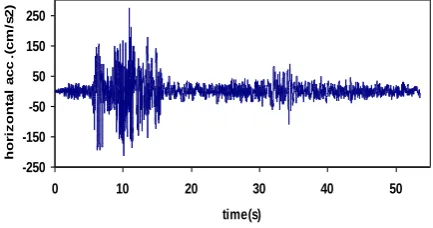
Earthquake response analyses were carried out for Manjil earthquake. The acceleration time histories of the Manjil Earthquake as shown in Fig. 2, were normalized to a maximum acceleration of 0.28g which has been considered inaccordance with Maximum Design Level (MDL).
Fig 2:Normalized horizontal component time history of Manjil earthquake
-250 -150 -50 50 150 250
0 10 20 30 40 50
time(s)
hor
iz
ont
a
l
a
c
c
.(
cm
/s
2
)
Fig 1:
[image:2.595.321.538.598.712.2]4.1 NLEO
In [17] a simple Non-Linear Energy Operator (NLEO)
ψ
dhasbeen proposed given here in its discrete form as
)
1
(
)
1
(
)
(
)]
(
[
x
n
x
2n
x
n
x
n
ψ
d (2)By using simulated signals, Kaiser [17] analyzed this operator and found that it can detect frequency and amplitude of these signals. One of its key properties for a pure tone can be summarized by the rule
0 2 2 0
)]
(
[
)
(
n
A
Cos
n
A
Sin
Q
d
d
(3)The proven can be expressed as:
0 2 2 0 2 2 0 0 2 0 0 2 0 2 2 0 2 0 2 0 2 0 0 0 2 2 0
sin
sin
2
*
2
)]
cos(
[
)
(
sin
2
)
2
cos(
1
)],
2
cos(
1
[
2
)
2
cos(
2
2
)
2
cos(
2
)
2
2
cos(
2
)]
2
2
cos(
1
[
2
)
)
1
(
cos(
*
)
)
1
(
cos(
)
(
cos
)]
cos(
[
)
(
A
A
n
A
n
Q
A
A
A
A
n
A
n
A
n
A
n
A
n
A
n
A
n
Q
d d d d
(4)For
0 much less than the sampling frequency,cte
A
n
Q
d(
)
2
02
. Therefore, The output of NLEO
is proportional to multiplication of instantaneous amplitude and frequency of the input signal.
With the above motivation, Kaiser [17] used the second order differential equation governing the simple harmonic motion and the energy (sum of the kinetic and potential energies) required to generate the motion, to introduce a continuous-time counterpart of the NLEO,
x
(t)
x(t)
x
(t)
[x(t)]
ψ
C
2
(5)
The instantaneous energy,
E
0, of an undamped oscillator is constant and is proportional to the output of (3) [4].2 0 2 0 2 0 2
2
A
ω
m
E
ω
A
[x(t)]
ψ
C
(6)where
x
(
t
)
A
Cos
(
0t
)
with)
m
k
(
ω
0
)is the displacement of the oscillator and k is the spring constant and m is the mass. Kaiser gave an interpretation of (6)as the amount of energy required to generate a sinusoid. Unlike the classical mean-square error (mse) definition of energy, this definition depends not only on the amplitude but also on the frequency of the sinusoid. To illustrate this difference, consider two sinusoids with frequencies of 1 Hz and 1 kHz but with the same amplitude [18]. It is clear that
mse energy will be the same for both sinusoids, while (6) suggests different amounts of energy requirement to generate these two signals. The latter relates the energy to the physics of generating a sinusoid of a given frequency [18]. As such, we will refer to the output of the NLEO (6)as the frequency weighted energy (FWE).
4.2 PSO
The basic operational principle of the particle swarm is reminiscent of the behavior of a group of a flock of birds or school of fishes or the social behavior of a group of people [19]. Each individual flies in the search space with a velocity which is dynamically adjusted according to its own flying experience and its companions' flying experience, instead of using evolutionary operators to manipulate the individuals like in other evolutionary computational algorithms. Each individual is considered as a volume-less particle (a point) in the N-dimensional search space. At time step t, the ithparticle is represented as
X
i(
t
)
(
x
i1(
t
),
x
i2(
t
),...,
x
iN(
t
))
. Theset of positions of m particles in a' multidimensional space is identified as
X
{
X
1,...,
X
j,...,
X
l.,...,
X
m}
. The bestprevious position (the position giving the best fitness value) of the ith particle is recorded and represented as
)
,...,
,
(
)
(
i1 i2 iNi
t
p
p
p
P
.The index of the best particle among all the particles in the population (global model) is represented by the symbol g. The index of the best particle among all the particles in a defined topological neighborhood (local model) is represented by the index subscript l. The rate of the position (velocity) for particle i at the time step t is represented asV
i(
t
)
(
v
i1(
t
),
v
i2(
t
),...
v
iN(
t
))
. Theparticle variables are manipulated according to the following equation (global model [20]):
)) 1 ( ( * () 2 * )) 1 ( ( * () 1 * ) 1 ( * ) ( 2 1 t x p rand c t x p rand c t v w t v in gn in in in i in (7)
where n is the dimension
(
1
n
N
)
,c
1andc
2 arepositives constants,
rand
1
()
andrand
2
()
are two random functions in the range [0,1], andw
is the inertia weight. For the neighborhood (lbest) model, the only change is to substitutep
lnforp
gnin equation forvelocity. This equation in the global model is used to calculate a particle's new velocity according to its previous velocity and the distance of its current position from its own best experience (pbest) and the group's best experience (gbest). The local model calculation is identical, except that the neighborhood’s best experience is used instead of the group's best experience.
The constants
c
1andc
2 in above equation represent the weighting of the stochastic acceleration terms that pull each particle toward pbest and gbest positions. Thus, adjustment of these constants changes the amount of ‘tension’ in the system. Low values allow particles to roam far from target regions before tugged back, while high values result in abrupt movement toward, or past, target regions.5.
RESULTS and DISCUSSIONS
model, some experiments has been carried out in the finite difference model. On the basis of experiments, it had been found that foundation width must be selected less than twice the dam height in the finite element model [21]. Some possible values for B and H are demonstrated in Table 2. In this work an energy fitness function has been defined so that horizontal displacement time history at the dam crest in the finite difference model on the earthquake response is minimized. This function has been defined according to equation (2). The fitness function has been considered as a function of B/H ratio and we minimize the cost function using PSO algorithm.
In this experiment, the following PSO parameters are used:
Population size: 30; Weightmax=1; Weightmin=0.4; C1 =C2 =2; Dimension=2; Iteration: 1000. B and H parameters change between 50-200 and 30-90, respectively. The PSO algorithm were implemented using MATLAB from Math Works. In this experiment, by using the PSO algorithm the B/H ratio should be equal to 1.29. In fact, this paper proposes new approach for choosing B and H parameters using optimization techniques. However, these parameters were chosen empirically in the existing method [21].
Fig 3:
Dam height (H) and foundation width (B) on the finite difference solution,
TABLE 2.
Desired Dam Heights Lateral Extents And
Foundation Width
Model Number H (m) B (m) W (m)
1 30 50 303
2 30 100 403
3 30 200 603
4 60 50 498
5 60 100 598
6 60 200 798
7 90 50 669
8 90 100 769
9 90 200 969
6.
CONCLUSION
In this study, dynamic analysis of Narmab earth dam (Iran) considering dam-foundation coupled model with various foundation widths and dam heights under horizontal component of Manjil earthquake has been performed using the FLAC program. In the previous work, B/H ratio has been adjusted experimentally. But, in this research it has been
found optimally using PSO algorithm. Several experiments has been carried out and the results shown the efficiency of the proposed idea. In our experiment, by using the PSO algorithm the B/H ratio should be adjusted as 1.29.
7.
REFERENCES
[1] Baziar, M.H., Merrifield, C.M., Salemi, Sh. and Heidari, T. 2004. Three dimensional dynamic analysis of alborz dam with asphalt and clay cores, Proc. of 5th International Conference on Case Histories in Geotechnical Engineering, USA, 13-17.
[2] Baziar, M.H., Noorzad, A, Salemi, Sh. and Ghannad, Z. 2003. Evaluation of Earthquake response of 15th Khordad Earth Dam, Proc. of the 21st ICOLD International Congress, 1011-1024
[3] IDRISS, I. M., MATHURT, J. M., BOLTON SEED, H. 1966. Earth dam-foundato interaction during earthquakes, Earthquake engineering and structural dynamics, 2, 313-323.
[4] Ambraseys, N. N. 1960. The seismic stability of earth dam, Proc. 2nd Wld Con$ Earthquake Engng, 11, Tokyo, Japan, 1345-1363.
[5] Latifi, N., Marto, A. BT. 2011. Monitoring Results of Alborz Earth Dam during Construction, International Journal of Earth Sciences and Engineering, Volume 04, No 06 SPL, 1035-1039.
[6] Chopra A. K. and Clough, R. W. 1965. Earthquake response of homogeneous earth dams, Report No. TE 65-11, Soil Mechanics and Bituminous Materials, Res. Lab., Dept. Ciu. Engng, University of California, Berkeley, 1-122.
[7] Clough, R. W. and Chopra, A. K. 1966. Earthquake stress analysis in earth dams, J. Engng Mech. Div., ASCE, 92, No. EM2, 197-211.
[8] Martin, G. R. and Seed, H. B. 1965. Dynamic response analyses for earth dams, Report No. TE-65-1, Soil Mechanics and Bituminous Materials, Res. Lab. Dept. Civ. Engng, University of California, Berkeley, 25-58. [9] Mononobe, N., Takata A., and Matumura, M. 1936.
Seismic stability of the earth dam, Proc. 2nd Congress on Large Dams, IV, Washington, D.C. 45-56.
[10] Seed, H. B. and Martin, G. R. 1966. The seismic coefficient in earth dam design, J. Soil Mech. Fndn Diu., ASCE, 92, No. SM3, 1-48.
[11] Ambraseys, N. N. 1960. On the shear response of a two dimensional truncated wedge subjected to an arbitrary disturbance. Bull. Seis. Soc. Am. 50, 45-56.
[12] Chopra A. K., and Permulaswami, P. R. 1969. Dam foundation interaction during earthquakes, Proc. 4th Wld Conf. Earth-quake Engng, 11, Santiago, 313-323. [13] Wilson, E. L. 1969. A method of analysis for the
evaluation of foundation structure interaction, Proc. 4th Wld Con. Earth-quake Engng, 11, Santiago, 87-150. [14] Finn, W. D. L. and Khanna, J. 1966. Dynamic response
of earth dams, Proc. 3rd Symp. Earthquake Engng, University of Roorkee, U.P., 315-324.
Series, Brit. Columbia. Univ., Dept of Civil Engineering Earthquake, Vancouver, 535-541.
[16] Chopra, A. K. and Perumalswami, P. R. 1971 .Dynamics of Earth Dams with Foundation Interaction, Journal of the Engineering Mechanics Division, Vol. 97, No 2. 181-191.
[17] Kaiser, J. F. 1990. On a simple algorithm to calculate the energy of a signal, in Proc. IEEE Int’l Conf. Acoust., Speech, and Sagnal Processing. 3-6.
[18] Agarwal, R. and Gotman J. 1999. Adaptive Segmentation of Electroencephalographic Data Using a Nonlinear Energy Operator, Proc. IEEE International
Symposium on Circuits and Systems (ISCAS'99), 4, 199-202.
[19] Eberhart, R. C. and Kennedy, J. 1995. A new optimizer using particle swarm theory, Proc. ISMMHS, 39-43.
[20] Shi, Y.and Eberhart, R. C. 1999. A Modified Particle Swarm Optimizer, in Proc. IJCNN, 69-73.