http://dx.doi.org/10.4236/jcc.2015.35024
Big Data Stream Analytics for Near
Real-Time Sentiment Analysis
Otto K. M. Cheng, Raymond Lau
Department of Information Systems, City University of Hong Kong, Hong Kong, China Email: [email protected]
Received April 2015
Abstract
In the era of big data, huge volumes of data are generated from online social networks, sensor networks, mobile devices, and organizations’ enterprise systems. This phenomenon provides or-ganizations with unprecedented opportunities to tap into big data to mine valuable business intel-ligence. However, traditional business analytics methods may not be able to cope with the flood of big data. The main contribution of this paper is the illustration of the development of a novel big data stream analytics framework named BDSASA that leverages a probabilistic language model to analyze the consumer sentiments embedded in hundreds of millions of online consumer reviews. In particular, an inference model is embedded into the classical language modeling framework to enhance the prediction of consumer sentiments. The practical implication of our research work is that organizations can apply our big data stream analytics framework to analyze consumers’ product preferences, and hence develop more effective marketing and production strategies.
Keywords
Big Data, Data Stream Analytics, Sentiment Analysis, Online Review
1. Introduction
In the era of the Social Web, user-contributed contents have become the norm. The amounts of data produced by individuals, business, government, and research agents have been undergoing an explosive growth—a pheno-menon known as the data deluge. For individual social networking, many online social networking sites have between 100 and 500 million users. By the end of 2013, Facebook and Twitter had 1.23 and 0.64 billion active users, respectively. The number of friendship edges of Facebook is estimated to be over 100 billion. The stream of huge amounts of user-contributed contents, such as online consumer reviews, online news, personal dialogs, search queries, and so on, have called for the research and development of a new generation of analytics me-thods and tools to effectively process them, preferably in real-time or near real-time. Big data is often characte-rized by three dimensions, named the 3 V’s: Volume, Velocity, and Variety [1]. Currently, there are two com-mon approaches to deal with big data, namely batch-mode big data analytics and streaming-based big data ana-lytics.
ac-tions and interacac-tions among individuals in online social media, or the data denoting some events captured by sensor networks is the typical kind of streaming data. Other types of big data perhaps are just a snapshot view of the streaming data generated from a specific point of time. The distinguished characteristic of a big data stream is that data continuously arrive at high speed. Accordingly, effective big data stream analytics methods should process the streaming data in one go, and under very strict constraints of space and time. Currently, research about big data analytics algorithms often focuses on processing big data in batch mode, while algorithms de-signed to process big data stream in real-time or near real-time are not abundant.
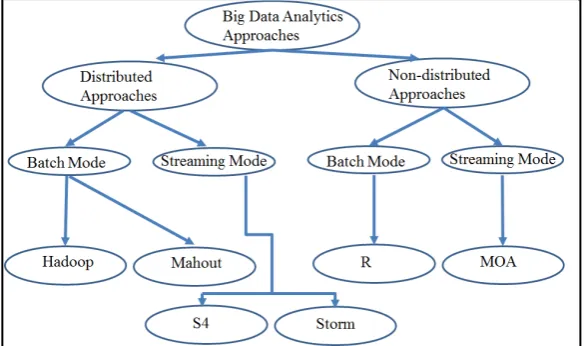
Figure 1 depicts a taxonomy of the common approaches (tools) for processing big data. Big data analytics approaches can be generally divided into distributed or single host approaches. For distributed big analytics me-thods, there can be then further classified into batch mode processing or streaming mode processing. Even though batch mode big data analytics methods (e.g., MapReduce) are the current dominated method, online in-cremental algorithms that can effectively process continuous and evolving data stream are desirable to address both the “volume” and the “velocity” issue of big data pasted on online social media. MapReduce and big data stream analytics are two different classes of analytical approaches although they are related for certain theoreti-cal perspectives. Recently, researchers and practitioners have tried to integrate streaming-based analytics and online computation on top of the MapReduce batch mode analytics framework. Sample tools of that kind in-clude the Hadoop Online Prototype. However, more research should be conducted for the development of next generation of big data stream analytics methods that inherit the merits from both batch mode analytics and streaming analytics.
The main contribution of this paper is the design and development of a novel big data stream analytics framework that provides the essential infrastructure to operationalize a probabilistic language modeling ap-proach for near real-time consumer sentiment analysis. There is significant research and practical value of our work because organizations can apply our framework to better leverage the collective social intelligence to de-velop effective marketing and product design strategies. As a result, these organizations become more competi-tive in the global marketplace, which is one of the original promises of big data analytics.
[image:2.595.167.460.530.703.2]With the rapid growth of the Social Web, increasingly more Web users have posted and extracted viewpoints about products, people, or political issues via a variety of online social media such as Blogs, forums, chat-rooms, and social networks. The big volume of user-contributed contents opens the door for automated extraction and analysis of the sentiments or emotions referring to the underlying entities such as consumer products. Sentiment analysis is also referred to as opinion analysis, subjectivity analysis, or opinion mining [2] [3]. Sentiment analy-sis aims to extract subjective feelings about some subjects rather than simply extracting the objective facets about these subjects [4]. Analyzing the sentiments of messages posted to social networks or online forums can generate countless business values for the organizations which aim to extract timely business intelligence about how their products or services are perceived by their customers [5]. Other possible applications of sentiment analysis include the analysis of the propaganda and activities of cybercriminal groups who pose serious threats to business or government owned web sites [2].
Sentiment analysis can be applied to a phrase, a sentence, or an entire message [4]. Most of the existing sen-timent analysis methods can be divided into two main camps. The first common paradigm utilizes a sensen-timent lexicon or heuristic rules as the knowledge base to locate opinionated expressions and predict the polarity of these opinioned expressions [3] [6]. The second common approach of sentiment analysis is based on statistical learning methods [4]. Nevertheless, each camp has its own limitations. For instance, for the lexicon-based me-thods, common sentiment lexicons may not be able to detect the context-sensitive nature of opinion expressions. For example, while the term “small” may have a negative polarity in a hotel review that refers to a “small” hotel room, the same term could have a positive polarity such as “a small and handy notebook” in consumer reviews about computers. In fact, the token “small” is defined as a negative opinion word in the well-known Opinion-Finder sentiment lexicon.
In contrast, statistical learning techniques such as supervised machine learning method usually requires a large number of labeled training cases in order to build an effective classifier to identify the polarity of opinio-nated expressions. Unfortunately, it is not practical to assume the availability of a large number of human la-beled training examples, particularly in a big data environment. On the other hand, both approaches may not be scale up to analyze a huge number of opinioned expressions as found in nowadays Social Web. There is an ob-vious research gap to develop new methods to be able to analyze big social media data in real-time or near real-time by leveraging a parallel and distributed system architecture. Our research work reported in this paper just tries to fill such a research gap.
The business implication of our research is that business managers and product designers can apply the pro-posed big data stream analytics framework to more effectively and promptly analyze the consumer sentiments embedded in online consumer reviews. As a result, proactive marketing or product design strategies can be de-veloped to enhance the business operations and the competitive power of the corresponding firms. Moreover, third-party reputation monitoring agencies can apply the proposed framework to continuously monitor the sen-timents toward the targeted products and services, and extract appropriate social intelligence from online social media in near real-time.
2. The Big Data Stream Analytics Framework
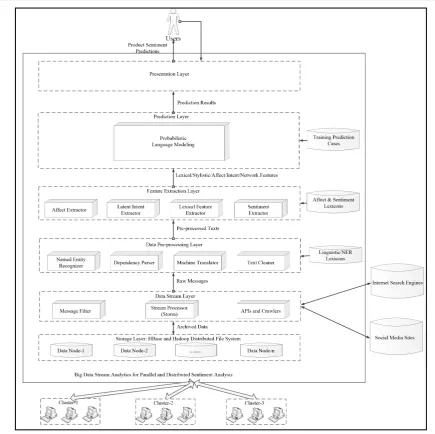
An overview of the proposed framework that leverages Big Data Stream Analytics for online Sentiment Analy-sis (BDSASA) is depicted in Figure 2. The BDSASA framework conAnaly-sists of seven layers, namely data stream layer, data pre-processing layer, data mining layer, prediction layer, learning and adaptation layer, presentation layer, and storage layer. For these layers, we will apply sophisticated and state-of-the-art techniques for rapid service prototyping. For instance, Storm, the open-source Distributed Data Stream Engine (DDSE) for big data is applied to process streaming data fed from dedicated APIs and crawlers at the Data Stream Layer. For in-stance, the Topsy API is used to retrieve product related comments from Twitter.
The Storage Layer leverages Apache HBase and HDFS for real-time storage and retrieval of big volume of consumer reviews discussing products and services. The Stanford Dependency Parser and the GATE NER mod-ule [7] are applied to build the Data Pre-processing Layer. Our pilot tests show that the size of the multilingual social media data streams is within the range between 0.2 and 0.4 Gigabytes on a daily basis, and this volume is steadily growing. For the feature extraction layer, the Affect Miner utilizes a novel community-based affect in-tensity measure to predict consumers’ moods towards products. Among the big six classes i.e., anger, fear, hap-piness, sadness, surprise, and neutral commonly used in affect analysis, we focus on the anger, fear, sadness, and happiness classes relevant for product sentiment analysis. The WordNet-Affect lexicon [8] extended by a statis-tical learning method is used by the Affect Miner. Since social media messages are generally noisy, one novelty of our framework is that we reduce the noise of the “affect intensity” measure by processing messages really re-lated to consumers’ comments about products or services.
Figure 2. An overview of the BDSASA framework.
system via the presentation layer. Different modes of presentations (e.g., text, graphics, multimedia on desktops or mobile devices) are supported by our framework.
3. Probabilistic Language Modeling for Sentiment Analysis
Originally, the term “language model” has been widely explored in the speech recognition community, and it refers to a probability distribution which represents the statistical regularities for the generation of a language [11]. In other words, a language model is a probabilistic function that assigns a probability mass to a string drawn from some vocabulary. In the context of Information Retrieval (IR), a language model Md is used to estimate the probability that a document d generates a query q [12]. In particular, such a probabilistic infe-rence is used to mimic the concept of document “relevance” of d respect to q. The basic unigram language model is defined according to the following formulas [12] [13]:
(
|)
(
| d)
t q ( | d)P q d ∝P q M =
∏
∈ P t M (1)( | d) (1 ) ML( | d) ML( | D)
P t M = −λ P t M +λP t M (2)
( , ) ( | )
| |
ML d
tf t d P t M
d
= (3)
where Md is the language model of the document d. With Jelinek-Mercer smoothing [13], the probability of the document generating a query term t (i.e., P t M( | d)) is estimated according to the maximum likelihood model PML( |t Md), and the maximum likelihood model of the entire collection PML( |t MD). λ is the Jeli-nek-Mercer smoothing parameter [13]. The smoothing process is used to alleviate the problem of over-estimat- ing the probabilities for query terms found in a document and the problem of under-estimating the probabilities for terms not found in the document. The function tf t d( , ) returns the term frequency of term t in the docu-ment d, and |d| is the document length measured by the number of tokens contained in the document.
However, previous studies found that applying the probabilities of query related terms of a relevant context instead of the probabilities of the individual query terms estimated based on the entire document collection (i.e., a general product review context) to a document language model will lead to a more effective smoothing process, and hence lead to good IR performance [14]. Following the similar kind of idea, we develop an inferential lan-guage model to compute the probability that a document d (e.g., a product review) will generate a term t
found in a Sentiment Lexicon (SL). In order to ensure a more robust and effective smoothing process, the infe-rential language model can take into account terms (opinion evidences) associated with the opinion indicators in a relevant online review context. In particular, the associated opinion evidences are discovered based on the context-sensitive text mining process over an online review context. The inferential language model for con-text-sensitive opinion scoring is then defined as follows.
( | ) ( | d) t SL ( | d)
P SL d ∝P SL M =
∏
∈ P t M (4)( | d) (1 ) ML( | d) INF( | d)
P t M = −λ P t M +λP t M (5)
( )
( | ) tanh( ( ) ( | ))
INF d t t OE ML d
P t M =
∑
→ ∈′ P t→ ⋅t′ P t M′ (6)where P SL d( | ) is the document language model for estimating the probabilities that the document d will generates the opinion indicators defined in a sentiment lexicon (SL). However, to address the common problem that sentiment lexicons may not capture all possible sentiments of a problem domain (e.g., context-sensitive opi-nion evidences are missing), the proposed language model can take into account other opiopi-nion evidences con-tained in the document by means of the inferential language model PINF( |t Md). The set of context-sensitive opinion evidences OE is dynamically generated according to a context-sensitive text mining technique.
The term association (term inference) of the form t→t′ is applied to the inferential language model to compute the probability that a document generates a term (e.g., an opinion indicator) which is contextually asso-ciated with another opinion indicator captured in a sentiment lexicon [15]. For easy of implementation, we only include the top χ term associations captured in OE for each opinion indicator t. It should be noted that the inference that d generating t′ involves a certain degree of uncertainty. As a result, the maximum likelihood estimation of PML( |t′ Md) is moderated by a factor P t( →t′). The hyperbolic tangent function is applied to moderate the probability function PINF( |t Md) such that its values fall in the unit interval.
4. Discussions and Summary
stream analytics are reported in the literature. The main theoretical contributions of our research include the de-sign and development of a novel big data stream analytics framework, named BDSASA for the near real-time analysis of consumer sentiments. Another main contribution of this paper is the illustration of a probabilistic in-ferential language model for analyzing the sentiments embedded in an evolving big data stream generated from online social media. The business implication of our research is that business managers and product designers can apply the proposed big data stream analytics framework to more effectively analyze and predict consumers’ preferences about products and services. Accordingly, they can take proactive business strategies to streamline the marketing or product design operations.
One limitation of our current work is that the proposed framework has not been tested under an empirical set-ting. We will devote our future effort to evaluating the effectiveness and efficiency of the BDSASA framework based on realistic consumer reviews and social media messages collected from the Web. On the other hand, we will continue to refine the proposed inferential language model for better sentiment polarity prediction. For in-stance, a consumer may connect to other consumers via a social network. We may incorporate such connection features in the inferential language model when the sentiment polarity of a review is analyzed. Moreover, the prediction thresholds for probabilistic opinion scoring will be fine-tuned using the proposed PCGA. Finally, we will conduct a usability study for the proposed big data stream analytics service in a real-world e-Business envi-ronment.
Acknowledgements
This research work was partially supported by a grant from the Shenzhen Municipal Science and Technology R & D Funding—Basic Research Program (project number: JCYJ20130401145617281 and project number: JCYJ20140419115614350).
References
[1] Boden, C., Karnstedt, M., Fernandez, M. and Markl, V. (2013) Large-Scale Social-Media Analytics on Stratosphere. Proceedings of the 22nd International Conference on World Wide Web Companion, 257-260.
[2] Lau, R.Y.K., Xia, Y. and Ye, Y. (2014) A Probabilistic Generative Model for Mining Cybercriminal Networks from Online Social Media. IEEE Computational Intelligence Magazine, 9, 31-43.
http://dx.doi.org/10.1109/MCI.2013.2291689
[3] Turney, P.D. and Littman, M.L. (2003) Measuring Praise and Criticism: Inference of Semantic Orientation from Asso-ciation. ACM Transactions on Information Systems, 21, 315-346. http://dx.doi.org/10.1145/944012.944013
[4] Wilson, T., Wiebe, J. and Rwa, R. (2004) Just How Mad Are You? Finding Strong and Weak Opinion Clauses. In: McGuinness, D.L. and Ferguson, G., Eds., Proceedings of the Nineteenth National Conference on Artificial Intelli-gence, Sixteenth Conference on Innovative Applications of Artificial Intelligence, San Jose, 25-29 July 2004, 761-769.
[5] Archak, N., Ghose, A. and Ipeirotis, P.G. (2007) Show Me the Money!: Deriving the Pricing Power of Product Fea-tures by Mining Consumer Reviews. In: Berkhin, P., Caruana, R. and Wu, X., Eds., Proceedings of the 13th ACM SIGKDD International Conference on Knowledge Discovery and Data Mining, San Jose, 12-15 August 2007, 56-65.
http://dx.doi.org/10.1145/1281192.1281202
[6] Turney, P.D. (2002) Thumbs Up or Thumbs Down? Semantic Orientation Applied to Unsupervised Classification of Reviews. Proceedings of the 40th Annual Meeting of the Association for Computational Linguistics, 417-424.
[7] Maynard, D., Tablan, V., Ursu, C., Cunningham, H. and Wilks, Y. (2001) Named Entity Recognition from Diverse Text Types. Proceedings of the 2001 Conference on Recent Advances in Natural Language Processing, Tzigov Chark, Bulgaria.
[8] Valitutti, A., Strapparava, C. and Stock, O. (2004) Developing Affective Lexical Resources. Psychology, 2, 61-83.
[9] Zhang, Q., Man, D. and Wu, Y. (2009) Using HMM for Intent Recognition in Cyber Security Situation Awareness. Proceedings of the Second IEEE International Symposium on Knowledge Acquisition and Modeling, 166-169.
http://dx.doi.org/10.1109/kam.2009.315
[10] Lau, R.Y.K., Tang, M., Wong, O., Milliner, S. and Chen, Y. (2006) An Evolutionary Learning Approach for Adaptive Negotiation Agents. International Journal of Intelligent Systems, 21, 41-72. http://dx.doi.org/10.1002/int.20120
[11] Nadas, A. (1984) Estimation of Probabilities in the Language Model of the IBM Speech Recognition System. IEEE Transactions on Acoustics, Speech and Signal Processing, 32, 859. http://dx.doi.org/10.1109/TASSP.1984.1164378
Annual International ACM SIGIR Conference on Research and Development in Information Retrieval, 275-281.
http://dx.doi.org/10.1145/290941.291008
[13] Zhai, C.X. and Lafferty, J. (2004) A Study of Smoothing Methods for Language Models Applied to Information Re-trieval. ACM Transactions on Information Systems, 22, 179-214. http://dx.doi.org/10.1145/984321.984322
[14] Nie, J.-Y., Cao, G.H. and Bai, J. (2006) Inferential Language Models for Information Retrieval. ACM Transactions on Asian Language Information Processing, 5, 296-322. http://dx.doi.org/10.1145/1236181.1236183
[15] Lau, R.Y.K., Song, D., Li, Y., Cheung, C.H. and Hao, J.X. (2009) Towards a Fuzzy Domain Ontology Extraction Me-thod for Adaptive E-Learning. IEEE Transactions on Knowledge and Data Engineering, 21, 800-813.