Impact
of Simple Cheating
in Application-Level Multicast
Laurent Mathy Nick Blundell Vincent
Roca Ayinan
El-SayedComputing Deparunent Plan& Project
Lancaster University. UK INRIA Rhones-Aples, France
{laurent. n.blundell}~comp.lancs.ac.uk {vincent.roca. ayman.elsayed}Binrialpes.fr
Abstract-We study the inipaet of cheating nodes in application-level niulticast overlay trees. We focus on selfish
nodes acting independently. cheating ahout their distance mea- surements during the control phase huilding or maintaining the tree. More precisely, we study, through simulations, the impact of simple cheating strategies in four protocols. representatives of different application-level multicast protoml “faniilies”: HBM (a protoeol hased on a centralized approach), TBCP (a distributed, tree fin1 protncnl), NICE (a distrihuted. tree first protocol hased on clustering) and NARADA (a mesh first protocol). We evaluate the impact of cheats on the performance of the overlay trees as perceived hy their nodes and the underlying network.
I . INTRODUCTION
Application-level multicast [7]. a technique whereby hosts or end-nodes are organized into an overlay distribution tree without requiring any specific support from the network (i.e. hased on normal unicast routing and forwarding). has been proposed mainly as a way to palliate to the lack of deployment of native IP multicast in production networks
[GI.
Application- level multicast representsa
trade-off between the efficiency of1P multicast and the ease o f deployment of group cornmunica- tions
as
a singlesource
replicating the data sequentially, using unicast. to a group of receivers.Although there is no question about the superiority of IP multicast for data distribution to large groups. application- level multicast may still prove a cheaper solution for com- munications within small groups (groups whose membership is in the order of tens of receivers). Also. some systems and applications need to establish relations and communications requiring
a
semantics richer than that provided by IP. Levelsof control of the communication patterns and reliability of the communication structure may be needed, that cannot be provided by IP multicast. For example. because the group members are the nodes of the overlay application-level multi- cast tree. these nodes can interpret and modify the distributed content “en route”. something not possible in native multicast where application nodes are always leaf nodes of the tree.
For these reasons. we believe that application-level multicast is complementary to IP multicast and will remain a useful group communication tool if and when IP multicast is de- ployed ubiquitously.
Application-level multicast is based on the collaboration of g o u p members with each other. Indeed.
as
group members (i.e. receivers) are the nodes of the overlay tree. they rely oneach other to distribute the data. However, there is an intrinsic imbalance of roles in an overlay tree: non-leaf nodes must take part in the burden of replicating data along the tree. while nodes which are. on the uee, closer to the source (the source is often the root of the tree) observe lower propagation delays. Also, the closer to the source
a
node is. the lower the loss rate observed (since in normal data transfer from root to leafnodes. losses “accumulate” as data travels down the tree branches). The collaboration is also extended to the control of the overlay tree which is often built based on distance measurements taken by the receivers amongst themselves. Whethera
full measurement matrix is required prior to the construction o f t h e tree. or the matrix can be populated overtime while improving the tree. or partial group and measurement knowledge is enough. is entirely dependent on the protocol used. As a ruleof
thumb. the better the knowledge of the group membership and distances between members. the better the performance ofthe tree can be tuned. but the least scalable the corresponding application-level multicast protocol is.
The important point here is that lhere is an opportunity for receivers to try and improve their position
on
the overlayuee by “manipulating” distance measurements. in order to be positioned closer to the data source while limiting, to a minimum. their replication burden. In the rest of the paper. we will refer to such receivers as “cheats”. and the consequences
of
their actions is the focusof
this paper.If we consider the very popular round-trip time ( R l T ) dis- tance measurements used in many application-level multicast protocols.
a
cheat could delaya
probe received from another receiver to artificially increase their measured distance in order to try and reduce its replication burden (since the further away another receiver is. themore
likely that receiver will be connected to another (closer) node). For scalability reasons. most of the existing application-level multicast protocolsre-
quire that each node measures its distance to other nudes in the overlay tree and reports these distance measurements to other nodes and/or uses these for decision making. A cheat can therefore lie outright ahout its distance messurements. in order to try and improve its position in the tree.
It is important to note that the cheats considered in this paper do not attempt to disrupt the flow of data along the overlay tree or even to break the protocol used to build the tree. they simply try and improve their position in the tree.
In other words. we are not interested in disruptive behaviour such as denial of service: once in the tree. although the cheats can keep lying about measurements. they otherwise follow all other protocol rules.
In some controlled environments. cheating is almost im- possible. For instance. this is the case when application-level multicast is used to provide a group communication service in
an
IPSec virtual private network (VPN) environment [l].Here the gateways of the various sites connected through the VPN
are
fully secured and remotely controlled by the VPN operator. However, such a situation belongs to a very specific application domain.Nevertheless. although the problems of cheats in
application-level structures (and overlay trees in particular) has often been mentioned, we are not aware of any quantitative study of their effects on application-level multicast protocols. as well as on the underlying network. We believe that understanding such effects is critical if the benefits offered by application-level multicast are to be reaped in application domains where the receivers do not pertain to the same, tightly controlled. administrative domain (e.g. corporation), as is the case in gaming. video distributioniwehcasting. etc.
Therefore. in this paper. we will study the effects of simple cheating strategies on four application-level multicast proto- cols. These cheating strategies will he simple. but targeted to the respective protocols: the cheating will he slightly different depending 1x7 the protocol considered. For this reason. it is important to note that our goal is not to compare the relative ability of the protocols considered to deal with cheats. but rather we seek to extract possible common consequences and trends created by the presence of cheats in application- level multicast overlay trees. Also. the protocols studied in this paper were chosen as being representatives o l different application-level multicat protocol “hmilies”. and because simulators were readily available for these.
Furthermore. although there may exist more sophisticated cheating strategies. in this paper we deliberately look at simple ones. where selfish cheats act independently of each other and make no attempt tn evade possible detection.
In section 11. we brieHy review the different families of application-level multicast protocols. In section 111. we de- scribe in more details the workings
of
the protocols chosen for this study. and we describe the simple cheating strategies used. Section IV presents our simulation study. while section V concludes with a summay of our observations and some recommendations.11. APPLICATIOS-LEVEL MULTICAST I11 this section. we give a brief overview of application-level multicast protocol families.
A. Cmtraliz?rl .4 lgui-irhrris
The ALMI protocol [IO] and HBM [I?] are examples of a centralized approach to application-level multicast. They have a session controller node which gathers distance information from all
of
the group nodes and calculates the overlay tree which i t uses to inform each node of its neighbours.B. Di.strihirted Algorittrms
f )
Mex/i-Fint A[gorif/inu: Narada [4] is an exampleof
a mesh-first application-level multicast protocol where nodes arrange themselves into a well connected mesh on top of which a routing protocol similar to DVMRP is run. to build per- source overlay trees. The quality o f t h e mesh. and therefore the overlay trees
are
improved incrementally over time by nodes adding and dropping mesh l i n b based on a decentralised utility function. SCATTERCAST [ 3 ] is another protocol taking the same approach.2 ) i”-wFirsr: The NICE [2] protocol uses hierarchical clustering techniques to build overlay trees whereby group members arrange themselves into clusters with nodes closest to themselves.
TBCP [91 and HMTP [IS] build an overlay tree by having receiver nodes recursively choose better parents to connect to, in a distributed fashion. These protocols
are
said to usea
“limited scope approach”. because. at each stepof
the recursion. a node only measures its distance to the childrenof
its current parent.3) Courtlinate S\.steriis: The protocols presented in this section use the notion of coordinates in various virtual ge- ometrical spaces.
In the Delaunay triangulation method [SI. each receiver is assigned coordinates i n a Euclidian plane and the tree is computed via a distributed application of the geometric process known as Delaunay triangulation.
Application-level multicast based nn CAN [ l I] splits
a
mutli-dimensional virtual torus into adjacent regions and uses a snrt of broadcast method to Hood a data packet to all the regions in a controlled way.
Finally. SCRIBE [I31 exploits the properties of a peer-to- peer network system to build application-level multi
by merging peer-to-peer “search” paths to form a tree.
111. THE PROTOCOLS IN O U R STtiDY
In this paper. we chose to concenuate on four protocols: HBM as
a
representativeof
the centralized approach: TBCPas
a representative of distributed. tree first. limited scope approach: NICE as presentative of the method based on clustering technique d NARADA as a representative of the mesh-lirst approach.A. HBM
1 ) Principles: In HBM. the consuuction and maintenance
of
the overlay tree is under the control ofa
single host. the render-vous point (RP) or controller. Periodically and asynchronously. each group member measures its distance to all the others (or a subset of them) and reports these to the UP which thus knows the identity of each group member and the communication costs between them. The UP is then responsible for the overlay topology calculation and its dissemination among the group members.Although HBM is
a
general protocol that does not restrict the properties of its overlay topology. the topology used inthis study is
a
degree-bounded shared tree of minimum cost. based onRTT
distance metrics.2 ) Simple Cheating ibfethod: An HBM cheat always reports a distance
of
zero to the source. and adds I O seconds to the KIT distances it measured to therest
of the group. An HBM cheat also delays by I O seconds any measurement probes it receives from any other group member. This probe delaying action is mandatory since otherwise the RP could easily detect cheats hy comparing the AB
andB
-
A RTT mensurements. If they differ significantly. the RP could easily conclude that oneof
A and B hasa
suspect behaviour. Then. after cross-checking with other metrics evaluations where Aand B
are
implicated. the RP could easily determine which node is cheating.A cheat is thus aiming to become one of the source’s children. while having no children at all.
R. TBCP
1) Principles: In TBCP. each node chooses individually the maximum iiumber of children (i.e. the fanout) that it will accept. This fanout is strictly enforced and must have
a
value of at least one. TBCP has been designed to operate with minimum knowledge of the group memhership and. associated measurement matrix. It is a recursive algorithm where. starting at the tree root (which is considered to be the source) as a potential parent.a
newcomer measures the distance between itself and the potential parcnt. along with the distance between itself and all ~i its poirntial siblitigs (i.e. the potential parent’s current children). These distaiices are reported to the potential parent who. thanks to-the rncasurcrnciits prcviously reported hy.its existing children. has coinplcic knowledge nf the mea- stuement matrix for the “local” full mcsh comprising itself. its children and the newcomer. The poientiul parcm then considers all the local contigurations for the acceptance of the newcomer in the tree (i.e. con’siders the newcomer as a child if there is room. considers sending the newcomer as a child of one of its current children. considers keeping the newcomeras a
child while sending one of its existing children as a child
of
the newcomer. and considers keeping the newcomeras
child while sending one of its existing children as
a
child of one of its existing children). evaluating the “goodness” of each local configuration witha
score function. The best local configuration (according to the score function) is chosen and the appropriate node directed to its “next” potential parcnt where the algorithm starts again. It is important to note that when choosing amongst several equivalent local configurations. TBCP always favours those resulting in the newcomer “moving”. to provide stability for already joined receivers.TBCP has a maintenance method where nodes periodically %-join” one of its known ancestors chosen at random. but for the purpose of this study. all nodes will always “re-join” at the root, as we expect this to be the behaviour chosen by
a
cheat who is trying to get as close as possible to the root. 2) Sbnple Cllearing Mrfliod; A TBCP cheat will always report a distance of zero to its potential parent. As all receivers
start joining the tree at the root. this provides the cheats with an opportunity to try and stay as close as possible to the root. Because cheats want to minimize the work they do for the rest of the group. a cheat will choose the minimum allowed fanout value (i.e. I). However, to try and avoid having a child, cheats also lie about their distance to other receivers: a cheat always delays
a
received probe by a tixed amount of time (10seconds) and always adds a fixed amount of time ( I O seconds) to the distance it reports from other receivers.
C. NICE
1 ) Principlrs: In NICE. nodes arrange themselves into a hierarchy of clusters whereby clusters belong to layers and nodes belonging to a cluster are close to each other in relation to some given cost metric[2]. At the highest layer of the hierarchy is a single cluster whose cluster members are each the leader of
a
single cluster in each of the subsequent lower layers. All nodes belong toa
cluster in the lowest layer of the hierarchy but cluster leaders are also members of a cluster in their next-higher layer.A node joins the group by first contacting a Rendez-vous Point (RP) to discover members belonging to the highest-layer cluster. The joining node then probes each of these cluster members to discover the closest to itself with whom it makes a request to join. The closest. highest-layer cluster memher replies to- the joining node with
a
list of cluster members in the next-lower layer to who it is the cluster leader. The joining node then probes eachof
the cluster members in the next- lower layer and the algorithm continues recursively until the new node joins the cluster closest to itself in the Iowcst-layerof
the hierarchy.Members of a cluster periodically exchange heo~-rDeor mes- sages with each other containing an estimate of the distance from themselves to each of the other cluster members. When- ever membership of a cluster changes (i.e. if a new node joins or leaves) the cluster leader. using this cluster member distance information. checks if it is still the center of the cluster and thus the most appropriate leader. transferring leadership to another cluster member if necessary.
The cluster leader periodically checks the size of its cluster and splits the cluster if its membership exceeds an upper bound. Likewise, if the cluster size falls below a lower bound the leader merges its cluster with the closest cluster belonging to the next-higher layer.
2 ) Simple Clleafing Method: A NICE cheat sets out to join a cluster in the highest layer possible in order to minimise its distance to the data source. Note that. although NICE supports any-source. application-level multicast routing through a bi- directional overlay tree. in this study we consider only the optimal case o f a single source at the root. For a cheat to join a cluster in the next-higher layer it must become the leader of its highest-layer cluster and so tries to achieve leadership through quoting. in its heartbeat messages. only
a
fraction of the actual distances to the other cluster members. On recalculating which node is closest to all of the other nodes the current clusterleader will likely transfer its leadership to the cheat which. in effect. geu: pushed up to the next-higher layer.
Once a cheat has gained leadership of a cluster it will make sure never t o transfer leadership from itself to any other cluster members, by reporting a distance of zero to all other cluster members in its regular heartheat messages.
In an attempt to preserve its resources, a cheat will never merge its clusters in the lower layers if their size falls below a lower bound and will also delay cluster join requests from other nodes by I O seconds to reduce the likelihood
of
these joining the clusters. Note that. whilsta
cheat will try to avoid having large clusters in all of the layers it occupies. the cheat will be required to forward d S a to members of its clusters ineach of the lower layers which could potentially result in a high node ianout inr the cheat as described in [2]'.
D.
NARADAI ) Principles: Narada is a mesh-first. application-level mul-
ticast protocol whereby nodes organise themselves into a well connected mesh through the addition of links to other group members. termed their 1nesh-ne~phhoitrs[4]. Nodes exchange routing tables with their rseslt-nrighboirrs allowing per-source data delivery trees to be constructed on the mesh using well- known reverse-shortest-path routing techniques as in DVMRP [SI. Narada therefore supports multi-source. application-level multicast but group size is limited by the need ior nodes to have complete knowledge of all other group members.
On joining the mesh. a node selects. at random. a hand- %I of nodes to add as niesh-neighboitrs from il subset o i currently active mesh members obtained using some out-of- band bootstrap mechanism. As a result of adding these random mesh links. the recently,joined node's position in the mesh is likely to he suh-optimal in rclation to the given cost metric. However. once connected a node is able to improve its position
in the mesh by periodically pr'obing random members. learned of through gossipping membership update messages with its rriesh-neiphborrrs. When
a
node is probed. it returns a copy of its routing table to the probing node who then calculates the utility of adding a mesh link to the probed node. A mesh link is deemed to he good if it improves the costof a
number of paths in the probing node's routing table such that the number of improved paths is greater than some threshold parameter.In order for nodes to keep adding better mesh links. it is necessary for them to 'drop' their least useful links. where use- hlness when considering to drop a mesh link is approximated by how many other members can he reached on shortest-paths through the mesh link.
Consequently. the overall mesh quality imprnves over time with respect to the given cost metric. resulting in more efficient data routing paths on the per-source overbay trees.
2 ) Sirrrple Clieuting Merhofl: On discovering the identity of a data source in the mesh. through either receiving
a
data packet or through out-of-band mechanisms. a Narada cheat'Note that. in this study we do not consider thz NICE prolocot exlention whcrchy cluslsr lender's delqate somz of lhcir data forwarding rzsponrihility to their highest~layzr clusldr members.
will set out to add the source as
a
mesli-neiphboirr andso
receive dara directly from the source.
However. to reduce the likelihood o f a cheat being dropped as a mesh-neiphhorrr to the source when the source eventually discovers that it is not very useful. a cheat makes sure to establish at least one mesh link to another node through which. by lying to the source about the cost of shortest-paths in routing update messages. it misleads the source to believe that it can deliver data to all of the other group members at a fraction of the actual
costs
(this is achieved by the cheat reporting route costs to other nodes that are a small fraction of their actual values). Once attached to the source. a cheat is likely to be dropped by its other rriesh-neighboiirs and so in thesame
way.as
with thesource.
misleads them as to its benefit for reaching other members of the group.Narada is susceptible to partitioning when the degree of mesh nodes is small. so in order not to break the protocol whilst preserving resources, a cheat maintains three mesh links and no more (by setting its maximum out-degree - fanout -
to the appropriate value).
IV. EFFECTS OF CHEATING I N APPLICATION-LEVEL
MULTICAST
A . Peiforrrinncr hidiccrtors
Several indicators are widely used to evaluate the per- formance of application-level multicast protocols. Two such classical performance indicators are the link sri-ess and the
.streri.li.
The link stress (or stress. in short) is a measure of the network efficiency of the application-level multicast protocols and is defined as the number of redundant copies of a data packet carried on
a
network link. The maximum stress is therefore the maximum number of duplicates seen by any single network link. while the average suess is the sum of duplicates divided by the total number of network links making up the branches of the tree. A ma.ior goal of all applicalion- level multicast protocols is. of course, to keep the valueof
these stress indicators as small as possible. since higher network suess levels (especially maximum stress) indicate hipher risksof
network congestion.The stretch. or relative delay penalty (RDP). is a measure
of
the penalty paid bya
receiver for receiving data on an application-level wee rather than directly from the source. It is defined as the ratio 'TDjLiD. where TD is the tree delay. that is the latency from the source to the receiver observed along the tree; and U D is the unicast delay, thatis the networked delay resulting from direct communication from the
source
to the receiver. The average stretch (over all the receivers) and maximum stretch (i.e. worse penalty) axe therefore good indicator of the tree efficiencyof
the application-level multicast protocols.The above mentioned performance indicators are used to characterize the intrinsic performace
of
application-level mul- ticast protocols. However. in this paper. our focus is not on benchmarking the performance of the protocols, but rather to study the impact of cheats on their performance. In ourstudy. we therciore
use
the following performance indicators which are the above mentioned metrics normalized to the performance of the protocol without cheat. used as a reference: stress-ratio = stress/stressrer. where st,ressrer is the corresponding stress observed when a11 receivers behave in an honest way.We will be interested in the maximum stress ratio
as a
. measurement of the impact of cheats on the underlying physical network. Indeed. maximum stress represents the highest load created by an application-level overhy tree on any network link. and thus the maximum stress ratio gives
a
good idea about the way risks of congestion evolve in the presence of cheats. Note that a stress ratio smaller (resp. greater) than 1 represents an improvement (resp. deterioration) compared with the case without any cheat..
s t r e t c h r a t i o =.stret,cti/stretcti,,r, where 'stretch,,f isthe stretch of a receiver observed when-all receivers behave in an honest way. Note that since the unicast delay is dictated by the physical topology and routing in the un- derlying network. it is independent of whether
a
receiver cheats or not, and we therefore have s t r e t c h r a t i o =(TD/UD)/(TD,,r/IJD,,r) = TD/TD,,r. since UD =
To have
a
hetter viewof
the i n h e n c eof
cheating in application-level multicast: we will segregate the re- ceivers in a group of cheats and a groupof
honest receivers. and measure average. minimum and maximum -stretch ratios in each group. This will allow us to not only study the impact of cheats on the performance observed by honest nodes. but also study the effects independent, selfish cheats have on each others. Note that as the overall goal is always to try and minimize stretch. a stretch ratio smaller (resp. greater) than I represents an improvement (resp.a
deterioration). witha
minimum ratio therefore representing the best improvement and a maximum ratio representing the worst deterioration.'JDref.
B. Siinirlation Setup
We.have studied the effects of cheats in application-level multicast on an Internet topology of 600 routers generated by GT-ITM [14]. We have tested 25 groups of 20 receivers and 25
groups
of
100
receivers. Eachgroup
was tried with respectively 5%. 10%. 20% 30%. 40%. 50%. 75% and 100% of cheating receivers. It is worth noting that all the protocols were studied with the same groups and the same cheats within these groups. while nodes hosting application-level multicast agents were always connected to edge routers ofthe topology'.to achieve
a
realistic set-up. Trees of maximum fanoutof
2,3. 4 and 5 were built for each of these groups3.
'For ssch trial. the total number of simulated nodes was therefore either 621 or 701. comprising the rmters. the source and ths rzccivsrs.
'More precisely, the parametdr controlling the maxlmum numbdr of chil-
dren was set to these values. It is imponant to note that some protocols. NICE
in particular in our study. do not enforce the fanout value at all times. but
rather use it as a t a q c t value for stable trees.
For protocols that improve the quality of their overlay trees over time (e.g. NARADA and NICE), simulations run for 1000 seconds in order to ensure stabilisation of these trees.
As
a
comparison point. beside thecase
where the protocols were run with all receivers hehaving in an honest way. we also h i l t random trees for eachof
the groups, where the receivers joined in random order and simply randomly connected to oneof
the nodes in the tree (i.e. the source or an already existing receiver), whose maximum fanout had not been attained yet. These random trees are used as representatives of "bad' application-level multicast trees.The cheating techniques described in section 111 were imple- mented in the HBM simulator that was used in [12], the TBCP
simulator used in [91, and the NAKADANICE simulator' used in [?I.
C. Network Stress Ratios
We study the stress ratio in order to assess the overall impact
of
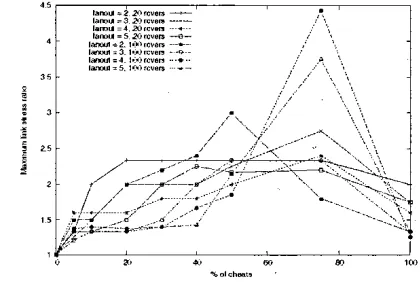
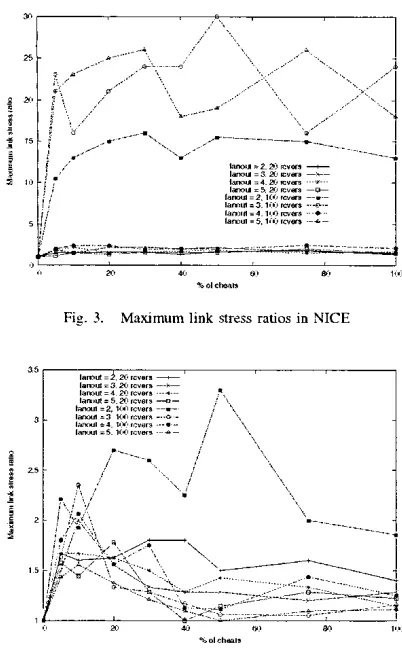
cheats in application-level multicast on the network. Figures 1 to 4 depict the maximum stress ratio ohserved during the simulations501ch_,
Fig. 1. Maximum link strzss m t i a in HBM
n
[image:5.613.338.548.326.467.2]-I
5011hPI.
Fig. 4. .Maximum link st re^^ m t m ~ in NARADA
We see that the effects
of
cheats are quite different in the various protocols. In HBM (figure 1 ) the maximum stress ratio progressively increases with the percentage of cheats because the centralized algorithm creates a shared tree using a distance database that is less and less related to the reality. As a consequence the resulting overlay topology is less and less efficient. However. we also observe that the maximum link stress ratio is hetter when most or all of the receivers cheat than when the cheats are in smaller numbers. This is because of the complete distance knowledge at the RP: when most of the receivers cheat. the vast majority of distances advertised to the RPare
merely the real values shifted by a constant (except of course for the distances to the source which are advertised as zero. and therefore introduce some degreeof
randomness at the top of the tree). We have also observed that HBM almost always produces an overlay tree whose maximum stress is smaller than that of a random overlay tree. This is again due to the fact that HBM always strives to make the best usage out of its complete distance knowledge.TBCP (figure 2) shows a smaller maximum stress ratio. that
is somewhat independent of the group size and the number of cheats. This is explained hy the facts that, in TBCP. the cheats have the luxury to ensure their own maximum fanout is reduced to 1. thus shifting the stress from the edge of the
network (i.e.
access
links) towards link? inside the network. as the tree growths in "lengrh" (with long branches of cheats dangling from the root) rather than in "width". In other words. in TBCP. the effects of cheats is to shuttle data packets several times across the network, while cheats do the minimum data replication they can.Because ofthe way TBCP overlay trees grow in "length' in the presence of cheats. the maximum stress ratio was always worse for random overlay trees than for TBCl? This is because random overlay trees tend to concentrate mnre traffc towards the edge of the network (as receivers limit their fanout to the same value as honest receivers in TBCP - and random trees
therefore grow "wider" than TBCP trees with cheats). while still producing the shuttling effects of data packets across the network.
In NICE (figure 3). the situation is opposed to the one observed for TBCP. Indeed. NICE does not strictly enforce its fanout at all times (see section In-C.1) and therefore allows clusters to form whose membership is greater than dictated by the fanout value (in particular near the tree root). resulting in some cluster heads serving more children than "they should". As a result. we see that for small groups. the maximum stress ratio is small as most cheats would have occupied a position close to the root if they had not cheated anyway. thus resulting in an overlay tree very similar to a tree of honest receivers. For larger groups. the maximum stress ratios can show the greatest values we observed. hecause cheats creilte large clusters
near
the root. thus increasing the stress on the access links of nodes near the top of the overlay tree (including the root). We therefore
see
that NICE has actually a tendency to grow its overlay "too wide".No surprisingly. the maximum stress ratio was almost always better for random trees than for NICE. hecause the fanout is strictly enforced in the random trees.
In NARADA (figure 4). we make the interesting observation that fewer cheats have a greater effect on the network effi- ciency of the protocol than when cheats
are
present in larger numbers. This is because the more cheatsare
present. the fewer the opportunities that exist for a cheat to create "forced" mesh links to nodes near the source.as
the utility(see
section lI1-D.1) associated with each cheat decreases. This decrease in utility is caused by the fact that. as the number of cheats increases. honest receivers and cheats alike are fooled into thinking that they are close to more and more members of the group. in essence choosing cheats as mesh-neighbours with equal prohahility. In other words. through the combination of enforcing a strict degree for all nodes in the mesh and the use of the notion of utility for the construction of the overlay tree. NARADA forces the cheats to share the profits of cheating. As a result. hecause cheats also report distances to other receivers as a fractionof
the real values (this strategy is actually chosen to "beat" the utility function(see
sectionIll-D.2). the more cheats in the group. the more NARADA brings the mesh "back" to what it is when all receivers are honest (to the exception of the "lucky" cheats who connect directly to the root). This behaviour. although also observed
[image:6.613.77.278.68.394.2]in HHM. is much more prominent with NARADA.
Figure 4 also shows that NAKADA just does not cope very well with srnall tree fanout (or mesh degree) values,
as
reported in L41.
Not surprisingly given &e discussion above. we found that NARADA produces stress ratios that
a e
w m ethan
those produced by a random overlay tree. when there is a small number of cheats. However. as the number of cheats increases. NARADA outperforms random trees as far as stress is concerned.I). S1rm.h Rotios
There are basically two ways to grow
an
overlay tree: in length and in width. Growing an overlay tree in length results in lower network stress levels at the expense of higher stretch levels (as receiversare
pushed away from the sourcelroot and thereiore observe longer delays along the tree). The opposite holds true foran
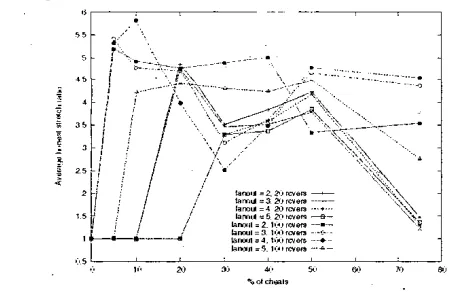
overlay tree grown in width. Therefore. when considering average stretch levels over all receivers in the tree. we would observe that the application-level protocols that were showing the smaller stress ratios show the higher stretch ratios. and vice versa. To have a better understanding of-the effects of cheats on the stretch levels of receivers in an application- level overlay uee. we will therefore focus separately on the e k t s of cheats on hiinest receivers and amongst the cheats themselves.Figures 5 t o 8 shr)w llic a\'erage stretch ratio for honest receivers i n the presence
iir
clicii~s.,
w..
I
% e c h m , ,
Fip. 5. Awmps stretch ratios far honzst receivers in HBM
We see that in I-IBM (figure 5). the average stretch ratio for honest receivers rapidly increases. even with
a
small percenuge of cheats. This is due to the fact that honest receivers are immediately moved away from the source. and this is particularly uue with trees having a small fanout. We also ohserve that the average stretch ratio for honest receivers tend to stabilize as the numberof
cheats increases. because. as explained in section IV-C_ the more cheats are present. the more accurate the RP's neighbour selection becomes (and therefore honest receivers end up in the "correct" pan of the tree).Fig. 6. Aversoe stretch ratios for honest recei\:ccs in TBCP
Fio. 7. Avzrapc stretch ratios for honest rccerrcct in SICE
We see that in TBCP (figure 6 ) . the average stretch ratio for
honest receivers increases steadily. with the rate of
increase
proportional to the group size. This is because. as cheats occupy higher positions in the overlay tree. the remaining honest receivers get pushed towards the bottom of the
tree
and thus
see
an increasing stretch. Also note that even a small increase in stretch, when more cheats (witha
fanout of I) are added. can result in a more substantial increase in average stretch ratio for honest receivers. as this number of honest receivers decreases steadily (i.e. the increase in stretchis shared amongst fewer honest receivers).
Expectedly. NICE (figure 7) shows little average stretch ratio for honest receivers. almost independently of the group size. This is again due to the fact that. during normal op- erations of the protocol. clusters are allowed to grow bigger than dictated by the maximum fanout. leaving more unaffected honest receivers by the presence of cheats than i n the other protocols.
In NARADA (figure S). we see that the effects of cheats on the stretch of honest receivers stabilizes
as
the number of cheats increases. especially in small groups. This is because. as explained in section IV-C. NARADA operates in sucha
way that the actions of individual cheats tend to balance each other
as
the number of cheats increases. This effect is less [image:7.613.345.545.252.393.2] [image:7.613.71.303.405.554.2]\“lrhll
Fig. 8. Average slrctch ratios for honest receivers in NARADA
noticeable for larger groups. though.
as
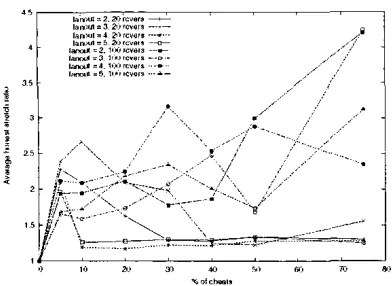
the overlay tree gets longer. and thus the effkcts on the stretch (of honest receivers) accumulate faster.Figures 9 to 12 show the average ratio in stretch for the cheats themselves.
XI (I, a) 7 0 .
lidChU.
Fig. 9. Auerase stretch ratios for cheats in HBM
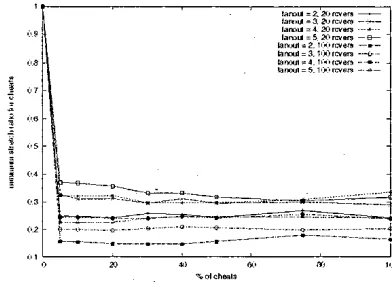
In all the protocols. we see a decrease in average stretch ratios for cheats when the number of cheats are small. This indicates that the cheats indeed get
a
better position near the source when cheating. However. as more and more cheats operate in an overlayuee.
these compete with each other. and the rate of increase of the average stretch ratio for cheats givean
indication of the ferocity of the competition.This is particularly visible with HBM (figure 9). Cheats experience an average benefit only if the fmout enables them to be close to the source. Thereafter. the situation rapidly deteriorates because the additional cheats are located lower in the tree. beneath honest receivers. So when the number of cheats increases. honest receivers experience on average a slightly better stretch ratio than cheats. Yet this average hides a ma,jor discrepancy between cheats who succeeded to be directly attached to the source and others.
Figure 10 shows that competition between cheats is the fiercest in TBCP. This is because cheats that have already
Fig. 10. Avcraec stretch ratios for chcals in TBCP
Fig. 11. Average stretch ratios for chats in NICE
found a place in the tree. do not relinquish their position to new cheats joining. the latter getting pushed down the tree. Further more. the rate of “descent” towards the bottom of the tree is exacerbated by the fact that cheats use
a
fanoutof
1.leaving other cheats far further away from the source than in the reference overlay tree where all receivers iue honest.
There is very little competition amongst cheats in NICE (figure 11) and NARADA (figure 12). NICE. however. offers better opportunities for cheats to better their positions in the tree. thus resulting in lower average stretch ratio values for cheats.
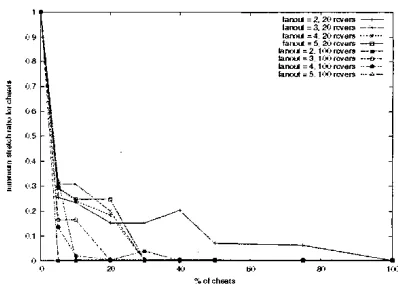
Tables I to IV. indicate when the average stretch ratios for cheats become worse than in random trees. These tables show that. from the point of view of cheats, the collrcrive
benefit of cheating always eventually disappears. leaving the “average” cheat in a worse position than i i the tree was random. However. this observation should be contrasted by the fact that cheats are selfish and that some of the cheats always see a dramatic improvement in their positions in the overlay trees. as illustrated in figures 13 to 16.
These tables show that NICE and NARADA provide more favourable conditions for cheats to collectively gain an ad- vantage over the honest receivers. in term of suetch. Table I1 also confirms that competition amongst cheats is very high
[image:8.617.316.530.65.402.2] [image:8.617.80.276.72.215.2] [image:8.617.321.525.80.251.2]100 3 40 - 50
100 4 30
-
40 100 5 20-
30TABLE 111
NICE CHE4TS VS R.ANDOM TREE: % O F CHEATS WHEN CHEATS ARE BETTER OFF BEIRG IS R A S O O M TREE.
Fig. 12. Average stretch ratios for cheats in NARADA
group SEC fanout 7O of cheats
20 2 40 - 50
group size fanout 9% of cheals
20 2 20 - 30
20 3 30 - -10
20 4 30 - 40
20 5 40 - 50 100 2 5 - 1 0
100 3 5 - 10 100 4 5 - 1 0 100 5 5 - 10
. TABLEI
H B M CHE.%TS VS R.ANDOM TREE: ?? OF CHE.\TS WHEN C H E 1 T S A R E BETTER OFF BEING IK R:\SOO.M T R E E .
in TBCP as a small number of cheats makes these cheats collectively better ,oii in a random tree.
Figures 13 to 16 show that cheating in NICE and NARADA is potentially very rewarding for individual cheats. while the benefits of cheating for an individual are similar in HBM and TBCP. It should he noted that NICE gives more chances to more individual cheats to improve dramatically their position in the tree. then any other of the protocols studied in this paper. Finally. for HBM. TBCP and NARADA. we have observed that the maximum stretch ratio for honest receivers can be in the order
of
several hundreds (i.e. one of the honest receiversgroup size fanout "U of cheats 20 2 10 - 30
20 4 ' 2 0 - 30
20 5 40 - 50
100 2 0 - 5
100 3 5 ~ I 0
ion 4 5 - 10 100 5 10 - 20 20 3 ' 3 0 - 4 0
TABLE I1
T B C P C H E h r S VS R.ANDOM TREE: % O F C H E I T S WHEN C H E I S I R E BETTER OFF B E l S G IN RANDOM TREE.
'
2 0 . 4 20 - 30
20 5 20 - 30
100 2 10 - 20 LOO 3 10 - 20 IW 4 0 - 5
100 5 10 - 20
TABLE IV
NARADA CHEATS VS R A N D O M TREE: % OF CHEATS W H E N CHE.ATS .ARE
BETTER OFF BEIUG I N R.ANDGM TREE.
is several hundred times further away from the source than it was in the reference tree). These situations occur when the honest receiver is actually physically close to the source and therefore gets displaced relatively very Far by the cheats. The noticeable exception is of course that in NICE. the honest receivers
are
relatively undisturbed by the cheats and the observed maximum stretch ratio for honest receivers are small (usually less than 10).V. DISCUSSIONS
In this paper. we have studied the impact of simple cheating on the performance of application-level multicast overlay trees.
I
a RI, 7, 111,
P d t h l P l l
Fig. 13. Minimum stretch ratios for cheats in HBM
[image:9.613.295.551.70.346.2] [image:9.613.53.311.75.486.2] [image:9.613.344.540.543.686.2]I I
CI I)> I n ,
3o,cbm,* -.Olihllil
Fis. 14. Mirumum stetch ratio iw cheats in TBCP Fig. 16. Mitimum stretch ratio for chcats in NARADA
Fig. 15. .Minimum slrrrch ratio fw chcats in NICE
We have shown that simple cheating strategies always have negative impact. either on the performance
of
the tree as perceived by its nodes (both cheats and honest receivers), or on the underlying physical network, or on both.We have also witnessed a range
of
responses to the cheating strategies from the studied protocols. However. noneof
the studied protocols coped well. in the presence of cheats, for all the performanceaspects
described. Actually.none
of these protocols were explicitly designed to deal with cheats. and all showed. at various point of the study. that their performance could quickly degrade to be worse than the performance exhibited bya
random tree.Although the simple cheating techniques used in this study were tailored to the specific protocols. it is worth noting that they 1111 exploited the fact that the protocols relied on receivers to take their own distance measurements and either make independent decisions based upon these measurements or ad- vertise these to other nodes. In the case of the distance metric used in this study (the RTT). detection
of a
cheat advertising dramatically reduced distances seems rather straightforward: the node which the cheat claims to be close to. can always check its distance to the cheat_ with tamper-proof probes (e.g. probes that do not contain any timestamp information or that have undergone a cryptographic modification such as hashing).However, in order not to jeopardize scalability by increasing the measurement overhead too much. such distance checks should probably he carried out
as a
periodic sampling process that eventually detects cheats. Note that suchan
approach is only applicable for metrics whose values are independent of the point of measurement (which is thecase
for the R T I between two points and measured at either point. but certainly not for the delay between these points). The sampling methods should probably also make use of statistical methods to help cope with natural variations in the measured values.Nevertheless. it is not clear at all how effective such simple distance sampling methods would be in the presence of several cooperating cheats, since at the very least. the actual distance between these may never be reliably verified. In such a case. correlating the distance measurements taken among several application-level multicast nodes may be a way ahead. but doing so in
a
distributed fashion without requiring complete knowledge. at all nodes.of
the group and its measurement matrix is a challenging problem.On the other hand. it is probably impossible to ever detect, or prevent.
a
cheat which delays measurement probes system- atically. in order to artificially increase measured disrances. Such an "attack"can
even easily be implemented by puttinga
proxy in frontof
the node which desires to cheat. Asa
result. cheat detection methods may just provide a "high-pass filter" on measurement matrices (i.e. a method to weed out artificially low distances but not artificially high ones). We will study the impact of such detection methods on the performance of the resulting overlayuees
in the presence of cheats in our future work.Designing general cheat detection andlor prevention tech- niques for various types of metrics is. we believe. an open research challenge. Indeed. there is always the danger that such techniques be designed on an ad-hoc basis. depending on the metric and cheating methods used, resulting in some kind of "cat and mouse" situation with cheats.
This paper was only concerned with selfish cheats operating independently. The case of cooperating cheats. maybe using evolutionary cheating strategies. is an open research challenge.
[image:10.613.326.525.71.214.2] [image:10.613.77.277.79.374.2]As iuture work we will also study the effects of simple cheating
on
coordinate-based methods. and the application-t protocols built on top of peer-to-peer systems
(sec section 11). For such protocols. the cheats will not only have the opportunity to lie about their distance to other nodes. hut they will also he able to carefully "choose" their place in the corresponding virtual geometric space.
REFERENCES
[ I ] 1. Alchanl. V. Rwa. A. El-Snyed. and M . . H a k n . A vQm solaion for fully secure and effici6nt group communications. I n X r b IEEE Symposim ON Compnlerr and
c,~,~,,",,,,;~',~;~,,~~
(ISCC'OJJ. Kmirr-.hrnlyn. l h r k ~ ~ . ~ June 2003.
[2] S . Ransrjzc. B. Rhattachxjulcc. and C. Kommarsddy. Scalable Applica- tion Layer Multicast. I n .ACM SIGCOMM. Aug 2002.
cCunne. and E. Brzwer. LMX: Reliable Multican
for Hzterogmeous Network. In IEEE hlfucom. Mar 2000.
[-I] Y-If. Chu: S . R m . and If. Zhang. A Case for End System Multicast. In
ACM SIGMETRICS. p a p 1-11. Santa Clare. CA. USA. June 2000.
151, S. Ikzring and D. Chcciton. Multicast Routing in Untqrnnw Intcmct- work and Extended LANs. ACM Tmni. Conp. S\Tl.. 8:85-11@. May 19'M.
'(61 C. Diol. R. Lwinc. R . Lyles. H. Kasscm. and D. Balensizfm Dr- ployment Issuer for the 1P Multicast Service and Architccturz. IEEE
Nerwork. 1.1111:7&88. J u n k h 2000.
171 A. El-Suycd. V. Roca. and 1. Mathy. A Survey of Propn~als for an Alternatiw Group Communication Service. IEEE Nrrirork. l7(11:46
51. Janffeh 2003.
(81 1. Liskrherr. M. Nahas. and W. Si. Application-Layzr Multicast with Ddaunay Tnunsulutions. I n IEEE GLOBECOM. Sou 2001.
191 L. Mathy. R. Canonico. and D. Hutchison. An O w l a y Trez Buildins Control F~oiocoI. In P m . of /nil. worh/!op 011 Nerorkrd Gmup
Commnnicnlion (NCC). pasis 7 6 8 7 . N o v 2001.
[IO] D. Pendarakis. S . Shi. D. Vsma. and 41. Waldvogcl. A L M I an Application Level Multicast Intiustructuc. I n 3rd USEh'lX S?ntposism
01 Irmmel Trrlr,rologius. San Francism. CA. USA. Mar 2001
I111 S . Kattnasamy. M. Handky. and S. Shcnkcr. Applirulion-Lcwl Multicast using Content Addrcssshlc Networks. In Pnx. of b l l . wurkd~op on Nrrworked Gmiip Commio!icnrion (IVGCJ. Nov 2001.
(121 V. Roca and A. El-Snyed. A Host-Based .Mullic3st Solution for Group Communications. In IEEE bill. CUI$ Nrhrorking. Jul 2001.
1131 A. Rowstron. A.M. Kermarrec. M. Castru. and P. Dnrcchcl. SCRIBE
the Design of B Larpz-Sc~la Event Notification Infrastructure. In Pmc. of I n d workrlmp on Nrrworkrd G r m p Conearr,zicalion (NGC). Nov 2W 1. 11.11 E. %gura. K. Calvan. and S . Bhuttachwjcc. How to M a l 4 an
Intzmstwork. In IEEE Infocorn. pages J&5?. Mar 1996.
[I51 B. Zhani. S . Jamin. and L. Zhnng. H a t Multicast: a Framework for
klivcring Multicast to End Users. lo IEEE Iilfi,com. Jun 2002.