Published Online January 2014 in SciRes (http://www.scirp.org/journal/ojf) http://dx.doi.org/10.4236/ojf.2014.41008
A Comparison of Selected Parametric and Non-Parametric
Imputation Methods for Estimating Forest
Biomass and Basal Area
Donald Gagliasso
1, Susan Hummel
2, Hailemariam Temesgen
11Department of Forest Engineering, Resources and Management, Oregon State University, Corvallis, USA 2
USDA Forest Service, Goods, Services, and Values Program, Portland Forest Sciences Laboratory, US Forest Service, Pacific Northwest Research Station, Portland, USA
Email: [email protected]
Received October 19th, 2013; revised November 21st, 2013; accepted December 23rd, 2013
Copyright © 2014 Donald Gagliasso et al. This is an open access article distributed under the Creative Com-mons Attribution License, which permits unrestricted use, distribution, and reproduction in any medium, pro-vided the original work is properly cited. In accordance of the Creative Commons Attribution License all Copy-rights © 2014 are reserved for SCIRP and the owner of the intellectual property Donald Gagliasso et al. All Copyright © 2014 are guarded by law and by SCIRP as a guardian.
Various methods have been used to estimate the amount of above ground forest biomass across land-scapes and to create biomass maps for specific stands or pixels across ownership or project areas. Without an accurate estimation method, land managers might end up with incorrect biomass estimate maps, which could lead them to make poorer decisions in their future management plans. The goal of this study was to compare various imputation methods to predict forest biomass and basal area, at a project planning scale (<20,000 acres) on the Malheur National Forest, located in eastern Oregon, USA. We examined the pre-dictive performance of linear regression, geographic weighted regression (GWR), gradient nearest neigh-bor (GNN), most similar neighneigh-bor (MSN), random forest imputation, and k-nearest neighneigh-bor (k-nn) to es-timate biomass (tons/acre) and basal area (sq. feet per acre) across 19,000 acres on the Malheur National Forest. To test the different methods, a combination of ground inventory plots, light detection and ranging (LiDAR) data, satellite imagery, and climate data was analyzed, and their root mean square error (RMSE) and bias were calculated. Results indicate that for biomass prediction, the k-nn (k = 5) had the lowest RMSE and least amount of bias. The second most accurate method consisted of the k-nn (k = 3), followed by the GWR model, and the random forest imputation. For basal area prediction, the GWR model had the lowest RMSE and least amount of bias. The second most accurate method was k-nn (k = 5), followed by k-nn (k = 3), and the random forest method. For both metrics, the GNN method was the least accurate based on the ranking of RMSE and bias.
Keywords: Gradient Nearest Neighbor; Most Similar Neighbor; K-Nearest Neighbor; Random Forest; Geographic Weighted Regression; Biomass; LiDAR
Introduction
Estimates of forest biomass and basal area provide critical information for quantifying the amount of carbon sequestrated, making management decisions, designing processing plants, guiding decisions among conflicting land uses, and establishing and quantifying wildlife habitats. To meet national and interna-tional negotiations and reporting requirements, forest manage-ment plans require local inventory data on biomass, vegetation, site productivity, carbon, and other resources. The data must be intensive enough to include structural variables relevant to biomass and carbon projections and extensive enough to cover hundreds to thousands of acres, but not be too expensive to collect.
Recognition of the widespread need for cost-effective, local inventory data that spans large regions has led to new methods for imputing plot data to sites without data and then generating maps of regional biomass and productivity. One imputation method is the Gradient Nearest Neighbor (GNN). Vegetation
maps created using GNN now figure prominently into intera-gency (Oregon Department of Forestry, USDI Bureau of Land Management, and USDA Forest Service) analysis and planning efforts across the Pacific Northwest. In addition, they are being used to estimate the supply of woody biomass available to pro-posed energy facilities and in regional conservation planning. Other techniques that use imputation, including K-NN (k- Nearest Neighbor), are used in parts of the Pacific Northwest. Both GNN and K-NN are used to derive forest biomass and basal area maps. For example, one can combine satellite im-agery with data from field plots and impute a raster dataset showing a continuous map of biomass and basal area across the landscape (Ohmann & Gregory, 2002).
related to a specific timber type. The distance is measured by creating a weight matrix derived by canonical correspondence analysis (Ohmann & Gregory, 2002). Similarly, MSN maps are created using a model that also integrates field plot data with satellite imagery. In contrast, MSN uses a canonical correlation analysis to derive a similarity function, with selected response variables, to impute data to pixels where no ground plots exist (Moeur & Stage, 1995). The k-MSN method uses the same methods as MSN, but takes an average of the k nearest neigh-bor of plots. The Random Forest (RF) imputation method creates a classification matrix and regression tree in order to find similarities between the explanatory and response variables (Crookston & Finley, 2008).
Nearest neighbor imputations have been used to perform multivariate analyses of forested landscapes by associating variables of interest (e.g. ground data) to aerial data (Temesgen et al., 2003), satellite imagery (Eskelson et al., 2009a), and light detection and ranging (LiDAR) data (Hudak et al., 2008; Goerndt et al., 2010). Different analyses have ranked the me-thods and data sources differently in different forest types. For example, in north-central Idaho, Hudak et al. (2008) found that the RF method performed best at predicting plot level estimates such as basal area and tree density. In Finland, Maltamo et al. (2006) compared k-MSN imputations for plot and stand level volume estimates and found that aerial-laser scanner data re-sulted in better estimates than using aerial photo imagery esti-mates and, when laser and photo data were used together, the resulting root mean square error improved again. Eskelson et al. (2009a) found that the RF method performed best when com-pared to the moving average, weighted moving average, and MSN and GNN imputation methods.
Parametric methods are an alternative to the nearest neighbor imputation methods that can be used to estimate selected va-riables of interest (Fotheringham et al., 2002; Wang et al., 2005; Salas et al., 2010; Crow & Schlaegel, 1988). Linear and non- linear models have been used for this purpose in previous stu-dies (Wang et al., 2005; Nelson et al., 2004). Another option is geographic weighted regression (GWR), which takes a global regression model and localizes it to a specific area and allows relationships between the explanatory and response variables to account for spatial variations, by including a weighting function in the regression model Fotheringham et al. (2002).
Wang et al. (2005) developed an ordinary least squares (OLS) model, a spatial lag model, and a GWR model to analyze the amount of net primary production (NPP) in forest ecosystems across China. They used predictor variables that included forest stand locations, forest inventory data, and remotely sensed data. The authors found that the GWR model was superior to both the OLS model and the spatial lag model in predicting NPP.
Salas et al. (2010) modeled tree diameter using forest inven-tory and ancillary data. The models that the authors compared were OLS, generalized least squares (GLS), GWR, and linear mixed effects (LME). The authors used aerial LiDAR data and forest inventory plots to estimate diameter at breast height on individual trees in Norway. They found that the most precise approach was LME and GWR performed better than both the OLS and GLS.
Airborne LiDAR Scanner (ALS)
When current field inventory data are insufficient to achieve desired precision, a common practice is to increase the number
of ground plots to measure the forest inventory. This can be costly and time-consuming. A newer practice would be to use LiDAR data. LiDAR is a tool that forestry researchers and pro-fessionals are increasingly using to improve estimates of forest inventory attributes; the cost may be comparable to traditional ground inventory data collection (Hummel et al., 2011).
LiDAR data are becoming a useful tool in obtaining large amounts of forest inventory data due to its precision and rela-tive ease of ground truthing. Ground truthing LiDAR data consist of randomly locating plots across the landscape, measuring the trees on the plot, and georeferencing the trees so that they can be located in the LidAR data set for crown delineation (Wulder et al., 2008). LiDAR datasets can be used to describe large areas of forested landscape at one time.
Nelson et al. (2004) used LiDAR to estimate the amount of biomass and carbon in the state of Delaware. The authors used parallel flight lines 4 kilometers apart to measure the merchan-table forest volume, biomass and above ground carbon. Using four explicitly linear models the authors predicted merchantable forest volume and above ground biomass across the state. The authors found that merchantable volume estimates were within 22% of US Forest Service (USDA FS) estimates county wide and 15% statewide. Additionally, the authors found that their biomass estimates were within 22% of USDA FS estimates county wide and 20% statewide. The USDA FS estimates were based on FIA volume and biomass estimates at the county and state level.
Næsset (2004) reported on the first Nordic stand-based forest inventory using LiDAR. The author predicted six stand va-riables from LiDAR data: mean tree height, dominant height, mean diameter, basal area, stem volume and stem number. Plot and tree level data were collected, including tree diameter at breast height (dbh), and tree height. With the plot data the au-thor calculated: mean height, dominant height, mean diameter by basal area, plot basal area, number of trees per hectare, and total plot volume. The author found that 85% - 95% of the va-riability was explained by the regression models for mean height and dominant height. Additionally, 72% - 85% of the variability was explained by the regression models for basal area and stand volume and 49% - 63% of the variability was explained by the regression models for mean diameter and stem number. Validation of the models revealed the mean differ- ences between the ground truth data and the predicted values were statistically significant in 5 of 24 cases.
In this article, we examine the performance of four parame-tric and two non-parameparame-tric methods for estimating the amount of standing tree biomass and basal area at a pixel level, across the a site on the Malheur National Forest, in Eastern Oregon, US: Gradient Nearest Neighbor (GNN), Most Similar Neighbor (MSN), k-MSN, and the Random Forest (RF) nearest neighbor methods, and linear regression and geographic weighted re-gression. The different methods were assessed for their accura-cy by comparing measured ground plot values to model esti-mates.
Materials and Methods
Project Site
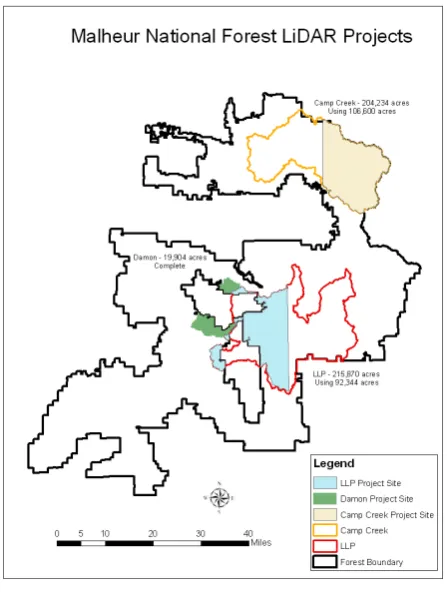
Figure 1.
LiDAR datasets on the Malheur National Forest.
Airborne LiDAR Scanner
The LiDAR data were collected during the fall of 2007 by Watershed Sciences, Inc. The LiDAR was acquired with a Lei-ca ALS50 Phase II device mounted on a Cessna Caravan 208B. The scan angle was ±14˚ from nadir with an intended pulse density of ≥4 pulse per square meter. The Leica ALS50 Phase II laser system is designed for up to four returns per pulse, and all laser returns were processed for the dataset. The actual pulse density was 6 pulses per square meter for the Damon site.
Ground Data
We had field data from three sources. Previously collected ground data consisted of United States Forest Service (USDA FS) stand exams from 2008 and current vegetation survey (CVS) plots measured between 1998 and 2007 (US Forest Ser-vice). The stand exams and CVS plots were grown forward to 2009 with the Forest Vegetation Software (FVS) for the Blue Mountain region (Keyser & Dixon, 2008). Eight additional cluster plots were measured during the summer of 2009 (Table 1).
The USDA FS stand exam data consist of 98 plots that were measured in the summer of 2008. Stand Exam plots are a nested plot design that consists of a variable radius plot for large trees and fixed radius plots for small trees and seedlings. A profes-sional forester from the USDA FS went back and re-measured the plot so that a 1/10th acre fixed plot was used for the large trees, instead of the previously measured variable radius plot design. These data were analyzed internally by the Forest Ser-vice within their plot compiler.
Table 1.
Number of plots in Damon site.
Source Number of Plots
USFS Current Vegetation System 10
USFS Stand Exams 98
Summer 2009 8
CVS plot data were supplied by the USDA FS. CVS are permanent forest inventory plots in Region 6 (Pacific North-west) of the USDA FS. Each plot is re-measured once every ten years. Within this study site, CVS plots are on a 1.7 mile sys-tematic grid. The plots consist of a 2.47-acre circular plot with 5 sub-plots. Each sub-plot is a set of 3 plots: 1) 1/5.3-acre plot, 2) 1/24-acre plot, and 3) 1/100-acre plot. Each plot has set cri-teria for which data should be collected and recorded, including live and dead tree measurements, down woody debris, shrub and understory components, and general geographical and slope position information of the plot (US Forest Service, 2001).
Recent research has shown that stratifying the landscape us-ing LiDAR data is an efficient and effective way to group the landscape into similar forest type and structure for further anal-ysis (Sullivan, 2008; Koch et al., 2009; Mustonen et al., 2008). Accordingly, forested stands were delineated using differences in height and canopy closure characteristics. Percent canopy closure, 25th and 75th height percentiles were used following the process outlined by Sullivan (2008), stand delineations were created using two software packages, FUSION (McGaughey, 2009) and Spring (Câmara et al., 1996). The latter is a user- based classification software package. For this study, the stand density index (SDI) of forest service stand exam plots measured in 2006 was used for the training data of the user-based classi-fication process.
The 8 cluster plots measured during the summer of 2009 consisted of a linear cluster (CLUS) of plots of four rectangular fixed radius subplots. Moisen et al. (1994) showed that linear clusters of plots was a cost efficient way of distributing forest inventory plots for assessing map accuracy, while accounting for spatial autocorrelation. The advantage of using a CLUS design is less cost in traveling to each plot as compared to a random design, while the disadvantage for CLUS is that there is more potential for spatial autocorrelation. Due to availability of previously collected inventory data we opted to use the cluster design to sample more ground area with our limited resources without sacrificing the total number of plot estimates. Our li-near clusters consisted of four 1/10-acre rectangular fixed area plots. In order to assure a random sample, a grid of 1/10-acre plots was placed over the project area and a random location was selected based on the plot allocation information previous-ly computed. The other three plots were located by obtaining a random azimuth in one of the four cardinal directions, from the first plot center, and installing the three additional plots in a linear fashion.
[image:3.595.59.283.84.382.2] [image:3.595.309.537.108.179.2]that azimuth, then taking the diameter of the crown perpendi-cular to the first measurement and averaging the two. Dead trees and snags, greater than five inches DBH were measured for DBH and height. All trees with broken tops were measured for height.
Ground data were collected on a TDS Ranger handheld computer, with the USDA FS Stand Exam software. Missing heights were estimated with localized height-diameter equa-tions for the Blue Mountains as described in stand exam proto-cols (USDA FS, 2001).
Data Compilation
Total standing tree woody biomass (tons per acre) was esti-mated for each ground inventory plot. In this study, standing tree woody biomass is defined as the biomass of the bole, bark, and branches of the all standing dead and live trees that are greater than or equal to 4.5 feet tall. Volume and biomass esti-mates were calculated using the USDA FS Forest Inventory Analysis (FIA) equations cubic volume, including top and stump, and biomass equations for the Blue Mountains (US DA FS 2001). All results found in this study assume that the USDA FS FIA equations are true and that the underlying assumptions of the volume and biomass models are applicable to this study area.
LiDAR data were processed with FUSION (McGaughey, 2009). Raw LiDAR data files were clipped to each individual ground inventory plot and attributes such as a digital elevation model (DEM), height percentiles, and their variances were obtained. Additionally, using the GridMetrics batch processing tool these same estimates were obtained for all other areas within the study area. Percent cover, percent slope, aspect, and elevation of each plot were found using the LiDAR derived DEM.
Landsat Thematic Mapper (TM) data was downloaded from the United States Geological Survey Global Visualization (GloVis) website for the entire project area. The normalized difference vegetation index (ndvi) was calculated using bands three and four.
Climate data from the DAYMET website (Thornton, 2003) was downloaded for the entire project area. Variables of interest consisted of: average daily maximum temperature, average daily minimum temperature, average temperature, number of growing degree days, number of frost days, and total precipita-tion. All variables were merged into one large table on a 20 × 20 meter pixel grid. Additionally, each of the ground inventory plots was added as separate rows to the table.
Statistical Analysis
For this study, explanatory variables were determined for the nearest neighbor imputations and geographic weighted regres-sion, by implementing an all subsets stepwise regression tech-nique, as outlined by Goerndt et al. (2010), using the regsub-sets() function within the leaps package (R Development Core Team, 2011). This tool returns the best fitting linear models according to the Bayesian information criteria (BIC).
Using the eight independent variables found by the best fit-ting linear model, a geographic weighted regression (GWR) model was fit using the gwr tool within the spgwr R-package. Before a back transformation of the natural log biomass esti-mate was performed, a bias-correction factor of 0.5 times the mean square error was added to the estimates (Baskerville,
1972; Goerndt et al., 2010). Most similar neighbor (MSN), gradient nearest neighbor (GNN), k-nearest neighbor (k-MSN), and random forest (RF) were performed using the yai and im-pute tools within the yaImpute (Crookston & Finley, 2008) R-package.
Each model was assessed using the 116 plots located within the study area. We used root mean square error (RMSE) and bias to evaluate the models. These values were estimated using a leave one out plot cross-validation. The root mean square error (Equation (1)) and bias (Equation (2)) were calculated using the following:
(
)
21
ˆ
n i i i
Y
Y
RMSE
n
=
−
=
∑
, (1)(
)
1 ˆ
n
i i
i Y Y
bias
n
= −
=
∑
, (2)where Yi is the observed value, Yˆi is the imputed estimate,
and n is the sample size (number of plots).
Results
The best linear model, for estimating biomass (tons per acre) on a plot included the following explanatory variables: the minimum value from the LiDAR height percentile profile (Min_Elev), 80th percentile value of the height profile from the LiDAR data (P80), the longitudinal location of the plot (UTM_Y), the reflective property value of Landsat TM band 2 (LandsatB2), Normalized Difference Vegetation Index (ndvi), 18-year average daily minimum temperature (MinTemp), 18-year average of the number of growing degree days (Deg-Day), and the 18-year average of the annual precipitation (Tot-Precip). The results of this linear model can be seen in Table 2.
The best fitting linear model, for estimating basal area per acre included the following variables: the standard deviation of all LiDAR returns on the plot (StdDev), the 95th percentile val-ue of the height profile from the LiDAR data (P95), and the reflective property value from Landsat TM band 5 (LandsatB5). The results from this linear model can be seen in Table 3.
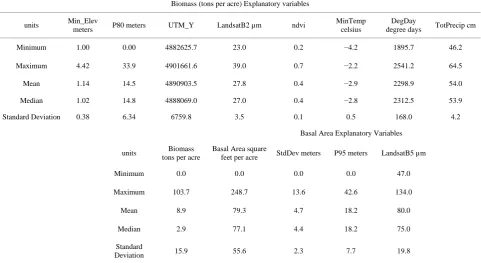
The inventory plots ranged in cover type, from non-forest meadows, to highly dense pine forests. Biomass measured on the inventory plots ranged from zero tons per acre to 103.7 tons per acre, with a standard deviation of 15.9 tons per acre. The basal area of the inventory plots ranged from zero square feet per acre to 248.7 square feet per acre, with a standard deviation of 55.6 square feet per acre (Table 4).
Nearest neighbor imputations rely on explanatory variables being correlated with the response variables. Thus, the higher the correlation coefficient the better the imputation model should perform. The highest correlation between the predictor variables and biomass per acre comes from the LiDAR derived P80 variable, a correlation coefficient of 0.44 (Table 5).
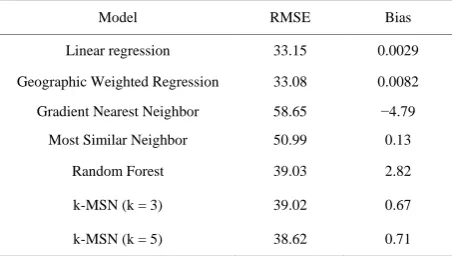
The highest coefficient in the basal area prediction methods was the P95 variable, correlation coefficient of 0.69 (Table 6). The RMSE and bias for the nearest neighbor and OLS re-gressions for biomass (tons per acre) and basal area (square feet per acre) models are reported in Tables 7 and 8, respectively.
model and the RF imputation. The GNN method was the least accurate (Table 7). For basal area prediction, the GWR model has the lowest RMSE and the least amount of bias. The second
[image:5.595.55.540.151.273.2]most accurate method was k-MSN, k = 5, followed by the k-MSN, k = 3 and then random forest. The GNN method was again the least accurate (Table 8).
Table 2.
Coefficients and standard errors for linear regression model for ln(biomass) in tons per acre.
80th percentile value from the LiDAR height profile 0.0525 0.0165
UTM northing −0.0003 0.0000
Reflective property of Landsat TM band 2 −0.1705 0.0411
Normalized Difference Vegetation Index −6.382 1.359
18 year average of the daily minimum temperature 5.052 0.2276
18 year average of the number of growing degree days 0.0329 0.0049
[image:5.595.69.538.309.394.2]18 year average of the annual precipitation 1.231 0.1741
Table 3.
Coefficient and standard errors for linear regression model for basal area (ft2 per acre).
Variable Coefficient SE
Intercept 50.12 22.32
Standard deviation of all LiDAR returns on the plot −27.79 5.212
95th percentile value from the LiDAR height profile 11.88 1.634
[image:5.595.57.539.435.698.2]Reflective property of Landsat TM band 5 −0.7082 0.1908
Table 4.
Basic statistics of explanatory and response variables1.
Biomass (tons per acre) Explanatory variables units Min_Elev
meters P80 meters UTM_Y LandsatB2 µm ndvi
MinTemp celsius
DegDay
degree days TotPrecip cm
Minimum 1.00 0.00 4882625.7 23.0 0.2 −4.2 1895.7 46.2
Maximum 4.42 33.9 4901661.6 39.0 0.7 −2.2 2541.2 64.5
Mean 1.14 14.5 4890903.5 27.8 0.4 −2.9 2298.9 54.0
Median 1.02 14.8 4888069.0 27.0 0.4 −2.8 2312.5 53.9
Standard Deviation 0.38 6.34 6759.8 3.5 0.1 0.5 168.0 4.2
Basal Area Explanatory Variables units Biomass
tons per acre
Basal Area square
feet per acre StdDev meters P95 meters LandsatB5 µm
Minimum 0.0 0.0 0.0 0.0 47.0
Maximum 103.7 248.7 13.6 42.6 134.0
Mean 8.9 79.3 4.7 18.2 80.0
Median 2.9 77.1 4.4 18.2 75.0
Standard
Deviation 15.9 55.6 2.3 7.7 19.8
Table 5.
Correlation coefficients of biomass vs. selected predictor variables2.
ln_Biomass ln_BA Min_Elev P80 UTM_Y LandsatB2 ndvi MinTemp DegDay ln_BA 0.4339
Min_Elev −0.2310 −0.0870
P80 0.4368 0.5303 −0.0827
UTM_Y −0.3135 −0.1858 0.1243 −0.2442
LandsatB2 −0.3320 −0.4832 0.1873 −0.5834 0.4484
ndvi −0.0516 0.1673 −0.0568 0.3494 −0.0614 −0.5555
MinTemp 0.0321 −0.0374 0.2089 −0.0473 0.4424 0.2309 −0.2012
DegDay −0.1544 −0.0488 0.1485 −0.1336 0.4563 0.1331 −0.1158 0.5835
[image:6.595.53.545.344.447.2]TotPrecip 0.1158 −0.0064 −0.1164 0.0742 −0.1848 0.0158 0.1085 −0.4904 −0.9529 2Min_Elev = Minimum value of the LiDAR percentile height profile. P80 = 80th percentile of the LiDAR height profile. UTM_Y = UTM northing coordinate. LandsatB2 = reflective property of Landsat TM band 2. Ndvi = normalized difference vegetation index. MinTemp = 18-year average of the minimum temperature. DegDay = 18 year average of the number of degree days. TotPrecip = 18-year average of the annual precipitation.
Table 6.
Correlation Coefficients of basal area vs. selected predictor variables.
Biomass per acre Basal area per acre Standard Deviation of LiDAR returns
95th percentile value of LiDAR height profile Basal area per acre 0.4372
Standard Deviation of LiDAR returns 0.1691 0.5749 95th percentile value of
LiDAR height profile 0.1883 0.6870 0.9651
Reflective property of
[image:6.595.58.287.483.617.2]Landsat TM band 5 −0.2282 −0.6225 −0.4757 −0.5477
Table 7.
RMSE and bias for estimating biomass (tons/acre) by selected method.
Model RMSE Bias
Linear regression 12.7 −2.41 Geographic Weighted Regression 11.6 −0.67 Gradient Nearest Neighbor 16.31 −0.008 Most Similar Neighbor 13.96 −0.08
Random Forest 12.22 −1.87
k-MSN (k = 3) 11.53 0.24
k-MSN (k = 5) 11.24 −0.004
Discussion
Substantial differences were found among the predictive ab-ilities of the strategies examined to predict forest biomass and basal area. As a result, the seemingly divergent parametric and non-parametric approaches resulted in different predictions. GWR outperformed the other methods in terms of accuracy and precision when predicting basal area per acre. This might be ascribed to GWR’s ability to localize the relation between the response variable and covariate in both the geographical and feature and variable space.
Table 8.
RMSE and bias for estimating basal area (ft2/acre) by selected method.
Model RMSE Bias
Linear regression 33.15 0.0029 Geographic Weighted Regression 33.08 0.0082 Gradient Nearest Neighbor 58.65 −4.79
Most Similar Neighbor 50.99 0.13
Random Forest 39.03 2.82
k-MSN (k = 3) 39.02 0.67
k-MSN (k = 5) 38.62 0.71
[image:6.595.310.538.484.612.2]when multiple response variables of interest are present in the analysis. When predicting a single variable, Eskelson et al. (2009b) reported that parametric methods resulted in better performance than non-parametric methods.
The results of this study suggest that the current method be-ing used to implement forest management activities on the Malheur National Forest, MSN, may not be the best method to predict total standing tree woody biomass. Instead, the k-MSN or RF method may be preferable, particularly if multiple re-sponse variables are important to consider. In contrast, if users are only interested in a single response variable, total standing tree biomass, GWR appears more suitable.
REFERENCES
Baskerville, G. L. (1972). Use of logarithmic regression in the estima- tion of plant biomass. Canadian Journal of Forestry, 2, 49-53. http://dx.doi.org/10.1139/x72-009
Câmara, G., Souza, R., Freitas, U., & Garrido, J. (1996). SPRING: Integrating remote sensing and GIS by object-oriented data modeling.
Computers and Graphics, 20, 395-403. http://dx.doi.org/10.1016/0097-8493(96)00008-8
Crookston, N. L., & Finley, A. O. (2008). yaImpute: An R package for kNN imputation. Journal of Statistical Software, 23, 1-16.
Crow, T. R., & Schlaegel, B. E. (1988). A guide to using regression Equations for estimating tree biomass. Northern Journal of Applied Forestry, 5, 15-22.
Eskelson, B. N. I., Temesgen, H., & Barrett, T. M. (2009a). Estimating current forest attributes from paneled inventory data using plot-level imputation: A study from the Pacific Northwest. Forest Science, 5,
64-71.
Eskelson, B. N. I., Temesgen, H., & Barrett, T. M. (2009b). Estimating cavity tree and snag abundance using negative binomial regression models and nearest neighbor imputation methods. Canadian Journal of Forest Research, 39, 1749-1765.
http://dx.doi.org/10.1139/X09-086
Fotheringham, A. S., Brunsdon, C., & Charlton, M. (2002). Geograph- ically weighted regression: The analysis of spatially varying rela- tionships. Chichester, Hoboken, NJ: Wiley.
Goerndt, M. E., Monleon, V. J., & Temesgen, H. (2010). Relating forest attributes with area- and tree-based light detection and ranging metrics for Western Oregon. Western Journal of Applied Forestry, 25, 105-111.
Hudak, A. T., Crookston, N. L., Evans, J. S., Hall, D. E., & Falkowski, M. J. (2008). Nearest neighbor imputation of species-level, plot-scale forest structure attributes from LiDAR data. Remote Sensing of En- vironment, 112, 2232-2245. Corrigendum: (2009). Remote Sensing of Environment, 113, 289-290.
http://dx.doi.org/10.1016/j.rse.2008.08.006
Hummel, S., Hudak, A. T., Uebler, E. H., Falkowski, M. J., & Megown, K. A. (2011). A comparison of accuracy and cost of LiDAR versus stand exam data for landscape management on the Malheur National Forest. Journal of Forestry, 109, 267-273.
Keyser, C. E., & Dixon, G. E. (2008). Blue Mountains (BM) variant overview—Forest vegetation simulator. Internal Rep., Fort Collins, CO: US Department of Agriculture, Forest Service, Forest Manage- ment Service Center. (revised February 3, 2010)
Koch, B., Straub, C., Dees, M., Wang, Y., & Weinacker, H. (2009). Airborne laser data for stand delineation and information extraction.
International Journal of Remote Sensing, 30, 935-963.
http://dx.doi.org/10.1080/01431160802395284
Maltamo, M., Malinen, J., Packalén, P., Suvanto, A., & Kangas, J. (2006). Nonparametric estimation of stem volume using airborne la- ser scanning, aerial photography, and stand-register data. Canadian Journal of Forest Research, 36, 426-436.
http://dx.doi.org/10.1139/x05-246
McGaughey, R. J. (2009). FUSION/LDV: Software for LIDAR data analysis and visualization, Version 2.9. USDA FS.
http://www.fs.fed.us/eng/rsac/fusion/
Moeur, M., & Stage, A. R. (1995). Most similar neighbor: An improved sampling inference procedure for natural resource planning. Forest Science, 41, 337-359.
Moisen, G. G., Edwards Jr., T. C., & Cutler, D. R. (1994). Spatial sam- pling to assess classification accuracy of remotely sensed data. In J. Brunt, S. S. Stafford, & W. K. Michener (Eds.), Environmental in- formation management and analysis: Ecosystem to global scales (pp. 161-178). Philadelphia, PA: Taylor and Francis.
Mustonen, J., Packalén, P., & Kangas, A. (2008). Automatic segmenta- tion of forest stands using canopy height model and aerial photo- graph. Scandinavian Journal of Forest Research, 23, 534-545. http://dx.doi.org/10.1080/02827580802552446
Ohmann, J. L., & Gregory, M. J. (2002). Predictive mapping of forest composition and structure with direct gradient analysis and nearest- neighbor imputation in coastal Oregon, U.S.A. Canadian Journal of Forest Research, 32, 725-741. http://dx.doi.org/10.1139/x02-011 Næsset, E. (2004). Accuracy of forest inventory using airborne laser
scanning: Evaluating the first Nordic full-scale operation project.
Scandinavian Journal of Forest Research, 19, 554-557. http://dx.doi.org/10.1080/02827580410019544
Nelson, R., Short, A., & Valenti, M. (2004). Measuring biomass and carbon in Delaware using an airborne profiling LiDAR. Scandina- vian Journal of Forest Research, 19, 500-511.
http://dx.doi.org/10.1080/02827580410019508
R Development Core Team (2011). R: A language and environment for statistical computing. Vienna: R Foundation for Statistical Compu- ting. http://www.R-project.org/
Salas, C., Ene, L., Gregoire, T. G., Næsset, E., & Gobakken, T. (2010). Modelling tree diameter from airborne laser scanning derived va- riables: A comparison of spatial statistical models. Remote Sensing of Environment, 114, 1277-1285.
http://dx.doi.org/10.1016/j.rse.2010.01.020
Sullivan, A. (2008). LIDAR based delineation in forest stands. Master’s Thesis, Seattle, WA: University of Washington.
Temesgen, H., LeMay, V. M., Marshall, P. L., & Froese, K. (2003). Imputing tree-lists from aerial attributes for complex stands of south-eastern British Columbia. Forest Ecology and Management, 177, 277-285. http://dx.doi.org/10.1016/S0378-1127(02)00321-3 Thornton, P. E. (2003). DAYMET climatological summaries for aver-
age air temperature and total precipitation (18-year mean for 1980- 1997). Missoula, MT: University of Montana, Numerical Terrady- namic Simulation Group. http://www.daymet.org
US Forest Service (2001). Region 6 inventory & monitoring system: Field procedures for the current vegetation survey. Natural Resource Inventory, Pacific Northwest Region. Version 2.04, Portland, OR: USDA Forest Service.
Wang, Q., Ni, J., & Tenhunen, J. (2005). Application of a geographi- cally-weighted regression analysis to estimate net primary production of Chinese forest ecosystems. Global Ecology and Biogeography, 14,
379-393. http://dx.doi.org/10.1111/j.1466-822X.2005.00153.x Wulder, M. A., Bater, C. W., Coops, N. C., Hiker, T., & White, J. C.