http://dx.doi.org/10.4236/cs.2016.71001
How to cite this paper: Ninawe, A., Srivastava, R., Dewaker, A. and Gupta, M. (2016) Design of Low-Voltage, Low-Power FGMOS Based Voltage Buffer, Analog Inverter and Winner-Take-All Analog Signal Processing Circuits. Circuits and Systems, 7, 1-10. http://dx.doi.org/10.4236/cs.2016.71001
Design of Low-Voltage, Low-Power FGMOS
Based Voltage Buffer, Analog Inverter and
Winner-Take-All Analog Signal Processing
Circuits
Akanksha Ninawe
1,2, Richa Srivastava
1,3*, Akanksha Dewaker
1,4, Maneesha Gupta
11Netaji Subhas Institute of Technology, New Delhi, India
2Present Address: Indian Institute of Technology Delhi (IIT-D), New Delhi, India 3Present Address: A.K.G. Engineering College, Ghaziabad, India
4Present Address: TRAI, New Delhi, India
Received 1 December 2015; accepted 10 January 2016; published 13 January 2016
Copyright © 2016 by authors and Scientific Research Publishing Inc.
This work is licensed under the Creative Commons Attribution International License (CC BY). http://creativecommons.org/licenses/by/4.0/
Abstract
This paper proposes novel floating-gate MOSFET (FGMOS) based Voltage Buffer, Analog Inverter and Winner-Take-All (WTA) circuits. The proposed circuits have low power dissipation. All pro-posed circuits are simulated using SPICE in 180 nm CMOS technology with supply voltages of ±1.25 V. The simulation results demonstrate increase in input range for FGMOS based voltage buffer and analog inverter and maximum power dissipation of 0.5 mW, 1.9 mW and 0.429 mW for FGMOS based voltage buffer, analog inverter and WTA circuits, respectively. The proposed circuits are in-tended to find applications in low voltage, low power consumer electronics.
Keywords
FGMOS, Voltage Buffer, Analog Inverter, Winner-Take-All (WTA), Analog Signal Processing Circuits
1. Introduction
processing chain of a design. It is capable of shifting the signal levels and incorporating tunable mechanisms due to its programmable threshold voltage. It operates normally below the operational limits of supply voltage levels for a particular technology and thus consumes less power than the minimum power required for a CMOS circuit of same technology without compromising on device performance [1]. Applications of FGMOS transistors in neural networks [2], voltage-controlled resistors [3], electronic programming [4], current mirrors [5], digital-to- analog and analog-to-digital converters [6], multipliers [7], squarers [8], operational transconductance amplifier
[9], etc. have been reported. Exclusive features such as flexibility, controllability and tenability of FGMOS that yield better results in terms of power supply voltage motivated us to propose FGMOS based Voltage Buffer, Analog Inverter and WTA.
Voltage buffer circuit implemented using CMOS technology has been reported in literature extensively. However, some FGMOS based voltage buffers have also been reported, to refer some of them, K. Moolpho and J. Ngarmnil [10] have proposed low voltage FGMOS based class AB buffer error amplifier comprising of three main building blocks in which one of the blocks is the two input gate additive inverter using FGMOS devices and Gupta M. et al. [11] have presented improved FGMOS based low power voltage follower circuit. In this paper, we have implemented a new FGMOS based voltage buffer circuit which dissipates less power.
Implementation of FGMOS inverter to generate the nonlinear functions has been proposed by Trejo-Guerra, R. et al. [12]. Performance related properties such as power, delay, power-delay product (PDP), and energy-delay product (EDP) of FGMOS inverter operating in subthreshold region are investigated in [13]. Differential Float-ing Gate analog inverter has been reported in [14]. Here, we propose an FGMOS based differential difference voltage buffer (FGDDVB) circuit based on the well-established and versatile Differential Difference Amplifier (DDA) circuit topology.
WTA networks are an important class of circuits widely used in neural networks and pattern-recognition sys-tems [15]. Not much work has been published on FGMOS based WTA circuit. A novel FGMOS based Win-ner-Take-All (WTA) circuit with reduced power dissipation is presented.
Thus, in summary, this paper introduces FGMOS based analog signal processing circuits—voltage buffer, analog inverter and winner-take-all. Simulated results are provided to demonstrate reduced power dissipation and an increase in the input range due to the use of floating gate transistors.
The paper is organized as follows. The operation of FGMOS transistor is described in Section 2. Proposed FGMOS based voltage buffer, analog inverter and WTA circuits are presented in Section 3. Simulation results are discussed in Section 4 to verify theoretical results. Finally, conclusions are drawn in the last section.
2. Basics of FGMOS Transistor
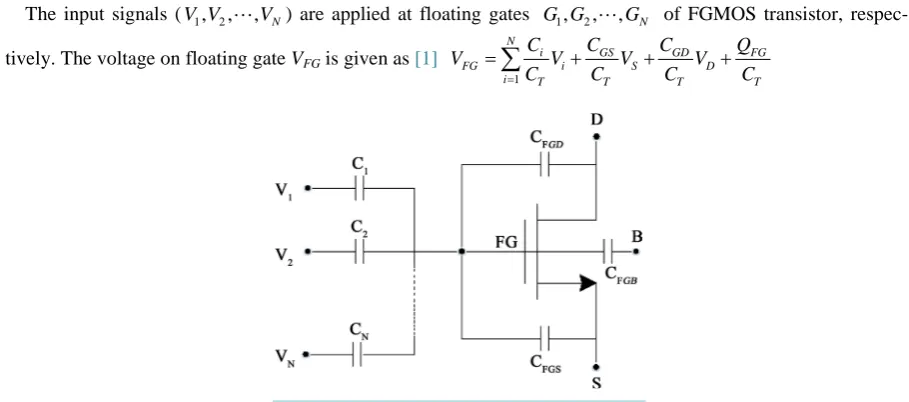
FGMOS transistor has multiple inputs whose gate is subject to capacitive couplings between itself and input terminals. Threshold voltage of the transistor is tuned by capacitor values and applied bias voltage. Figure 1
shows equivalent representation of FGMOS transistor [1].
The input signals (V V1, 2,,VN) are applied at floating gates G G1, 2,,GN of FGMOS transistor,
respec-tively. The voltage on floating gate VFG is given as [1]
1
N
i GS GD FG
FG i S D
i T T T T
C C C Q
V V V V
C C C C
=
[image:2.595.84.539.511.712.2]=
∑
+ + +where Ci is the set of capacitors associated with effective inputs and the floating gate. Total floating gate capa-
citance is given by
1
N
T i FGS FGD FGB
i
C C C C C
=
=
∑
+ + + where CFGD, CFGS and CFGB are overlap capacitances offloating gate with drain, source and bulk, respectively, VD is the drain voltage, VS is the source voltage, VB is the
bulk voltage, and QFG is the residual charge trapped in the oxide-silicon interface during fabrication process. By
the justification suggested in [8], neglecting residual charge, QFG and assuming CiCFGD, CFGB[1], the drain
current of FGMOS transistor in saturation region can be expressed as
2
1 2
N
D i iS T
i
I β K V V
=
= −
∑
where ki = Ci/CT, β is the transconductance, VT is the threshold voltage.
3. Circuit Descriptions
3.1. Proposed FGMOS Voltage Buffer
Analog voltage buffers play a significant role in mixed signal designs where they are used for signal monitoring and for driving large capacitive loads [16]. Voltage buffer with floating gate transistors has been implemented with modifications being made to the circuit of voltage buffer implemented using CMOS whose structure is similar to differential difference amplifier [17], published in [18].
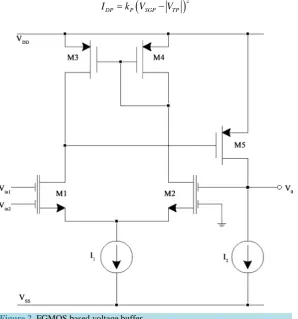
The proposed FGMOS circuit is obtained by replacing the matched differential stage (M1 and M2), by two input floating gate transistors. The configuration is similar to DDA realization, but the first and second inputs are removed; hence the third input and output become a voltage follower building block. The complete FGMOS voltage buffer is shown in Figure 2. PMOS transistors operate in saturation region described by the following equation:
(
)
2DP P SGP TP
[image:3.595.167.466.395.715.2]I =k V −V
where kP =
(
µPCOX 2)(
W L)
, VTP is threshold voltage, μP is surface mobility, COX is channel oxidecapacit-ance, W is channel width and L is channel length of the transistor. M1 and M2 operate in saturation region and their drain currents can hence be written as:
(
)
21 1 1 2 2
2
D in S in S T
I = β V K +V K −V
(
)
(
)
22 0 1 2
2
D S S T
I =β V K + −V K −V
With current mirrors M3 and M4 perfectly matched, ID1=ID2.
(
)
2(
(
)
)
21 1 2 2 0 1 2
2 Vin SK Vin SK VT 2 V KS VS K VT
β + − =β + − −
Cancelling the common terms gives,
0 1 in1 1 in2 2
V K V K V K
⇒ = +
2
0 1 2
1
in in
K
V V V
K
⇒ = +
If Vin2 is zero, then V0 = Vin1, i.e., the output follows the input, thus the circuit operates as a voltage buffer.
3.2. Proposed FGMOS Analog Inverter
Differential difference voltage buffer (DDVB) [19] basically consists of two voltage buffers which invert the input to the first buffer from the input to the second buffer, hence acts as an analog inverter. CMOS implemen-tation of DDVB has been presented in [17].
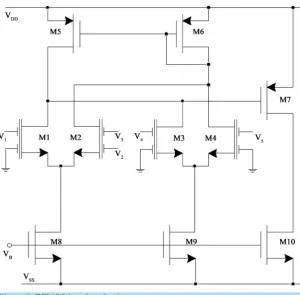
Proposed FGMOS analog inverter is obtained by replacing MOSFETs M1, M2, M3 and M4 in DDVB circuit
[image:4.595.162.463.417.712.2][19] by two input floating gate transistors which results in circuit of Figure 3. All p-type and n-type MOSFETs as well as floating gate transistors in the proposed circuit operate in saturation region.
3.3. Proposed FGMOS Based WTA Circuit
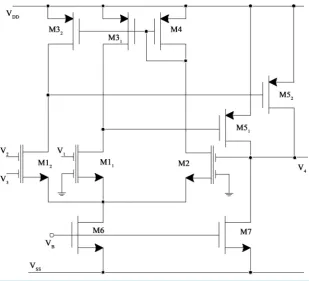
The proposed n-input FGMOS WTA maximum circuit as indicated in Figure 4 is drawn on similar lines as CMOS WTA max circuit published in [18]. All MOSFETs and floating gate transistors operate in strong inver-sion saturation region with VGS > VT. The operating principle remains the same.
4. Simulation Results
The conventional and proposed FGMOS based analog signal processing circuits are simulated using SPICE (Pspice version 16.5) in CMOS 180 nm technology. Rail-to-rail input range is assumed and a supply voltage of ±1.25 V is taken for simulating both circuits. The aspect ratios of the transistors of the conventional circuits and proposed circuits are listed in Table 1. The performance parameters of the proposed circuits and their corres-ponding conventional circuits are compared in Table 2. To overcome DC convergence error during simulation because of the floating gate (FG) of FGMOS, model suggested in [1] has been used in all proposed FGMOS based circuits. In this model, very high value resistors (RG) are connected in between the FG node and a set of
voltage sources.
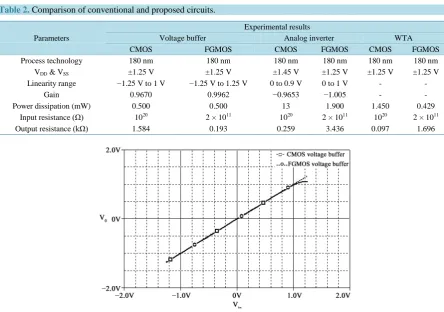
DC response of CMOS voltage buffer and FGMOS based voltage buffer is shown in Figure 5. Proposed FGMOS voltage buffer was implemented with two inputs to floating gate MOSFET M1. Output was observed at one of the inputs to M2, with input to the MOSFET being grounded. It can be seen from the DC analysis that the operating (linearity) range increases in case of FGMOS voltage buffer compared to CMOS voltage buffer. While it can be observed from simulation that the proposed FGMOS based voltage buffer justifies its operation in the entire supply voltage range, i.e., from −1.25 V to 1.25 V, CMOS based voltage buffer operates as a buffer in the voltage range from −1.25 V to 1 V. This is evident due to the fact that the effective input signal at the floating gate is scaled down by equivalent capacitance ratio (Ci/CT), which results into a lower distortion and
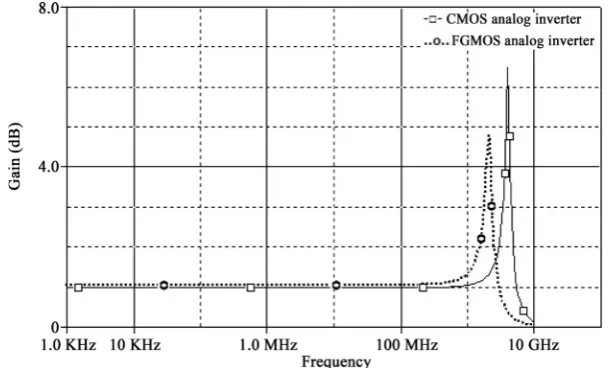
[image:5.595.159.469.429.710.2]hence a larger input range is achieved. Frequency response of conventional and proposed voltage buffer is shown in Figure 6. DC response for CMOS analog inverter and the proposed FGDDVB are shown in Figure 7. Simulation results reveal that power dissipation reduces drastically for the proposed FGDDVB. The linearity range has increased for the proposed FGDDVB (0 to 1 V) compared to the conventional CMOS based analog inverter (0 to 0.9 V). Frequency response of conventional and proposed analog inverter are shown in Figure 8. It
Table 1.Aspect ratio values(a) conventional CMOS buffer and proposed FGMOS voltage buffer; (b) conventional DDVB (analog inverter) circuit using CMOS; (c) proposed FGDDVB circuit; (d) conventional WTA using CMOS and proposed FGMOS based WTA.
(a)
Transistor W (µm) L (µm)
M1 - M2 M3 - M5
1 5
0.25 0.25
(b)
Transistor W (µm) L (µm)
M1 - M4 M5 - M7 M8 - M10
1 5 3 0.25 0.25 0.25 (c)
Transistor W (µm) L (µm)
M1 - M2 M3 - M4 M5 - M7 M8 - M10
1 3 5 3 0.25 0.25 0.25 0.25 (d)
Transistor W (µm) L (µm)
M11 - M12 M2 M31 - M32 M51 - M52 M6 - M7
[image:6.595.88.533.396.708.2]1 1 5 5 3 0.25 0.25 0.25 0.25 0.25
Table 2. Comparison of conventional and proposed circuits.
Parameters
Experimental results
Voltage buffer Analog inverter WTA
CMOS FGMOS CMOS FGMOS CMOS FGMOS
Process technology 180 nm 180 nm 180 nm 180 nm 180 nm 180 nm VDD & VSS ±1.25 V ±1.25 V ±1.45 V ±1.25 V ±1.25 V ±1.25 V Linearity range −1.25 V to 1 V −1.25 V to 1.25 V 0 to 0.9 V 0 to 1 V - -
Gain 0.9670 0.9962 −0.9653 −1.005 - -
Power dissipation (mW) 0.500 0.500 13 1.900 1.450 0.429
Input resistance (Ω) 1020 2 × 10¹¹ 1020 2 × 10¹¹ 1020 2 × 10¹¹ Output resistance (kΩ) 1.584 0.193 0.259 3.436 0.097 1.696
Figure 6. AC response of conventional CMOS and proposed FGMOS based voltage buffer.
Figure 7. DC response of conventional CMOS and proposed FGMOS based DDVB.
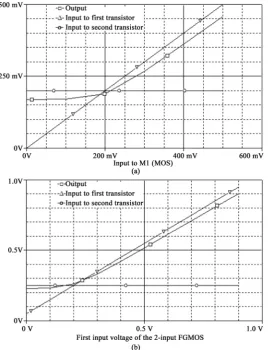
[image:7.595.160.467.518.702.2]can also be seen that the proposed configuration operates at lower supply voltage compared to the conventional DDVB. DC response and frequency response of CMOS WTA and the proposed FGMOS based WTA are shown in Figure 9 and Figure 10 respectively. From the simulation results it can again be observed that power dissipa-
Figure 9. (a) DC response of conventional CMOS WTA; (b) DC response of proposed FGMOS WTA.
[image:8.595.152.476.510.702.2]tion is reduced for proposed WTA circuit. In general, for all the proposed FGMOS based analog signal processing circuits, power dissipation is reduced compared to the conventional circuits proposed earlier.
5. Conclusion
In this paper, novel FGMOS based analog signal processing circuits—voltage buffer, analog inverter and win-ner-take-all circuits are presented. All proposed circuits operate at ±1.25 V. A larger operating range is achieved for FGMOS based voltage buffer and FGMOS based analog inverter compared to their corresponding conven-tional circuits, as desired. Power dissipation is reduced in all the proposed FGMOS based circuits, thus making these circuits useful in low-voltage and low-power applications. The proposed circuits are intended to find ap-plications in low voltage, low power consumer electronics.
Acknowledgements
The work was carried out at Netaji Subhas Institute of Technology, New Delhi (University of Delhi) as a partial fulfillment of engineering degree.
References
[1] Rodriguez-Villegas, E. (2006) Low Power and Low Voltage Circuit Design with the FGMOS Transistor (IET Circuits, Devices and Systems Series 20). The Institution of Engineering and Technology, London.
[2] Kumar, M.G.L., Khare, K. and Sharma, P. (2012) Low Voltage-Power-Area FGMOS Neural Classifier Circuit for VLSI Analog BIST. International Journal of Engineering Research & Technology, 1, 1-4.
[3] Pandey, R. and Gupta, M. (2010) FGMOS Based Voltage-Controlled Grounded Resistor. Radioengineering, 19, 455- 459.
[4] Berg, Y. and Lande, T.S. (1997) Programmable Floating Gate MOS Logic for Low-Power Operation. Proceedings of IEEE International Symposium on Circuits and Systems, 3, 1792-1795. http://dx.doi.org/10.1109/iscas.1997.621493
[5] Manhas, P.S., Sharma, S., Pal, K., Mangotra, L.K. and Jamwal, K.S. (2008) High Performance FGMOS-Based Low Voltage Current Mirror. Indian Journal of Pure & Applied Physics, 46, 355-358.
[6] Liming, Y., Embadi, S.H.K. and Sanchez-Sinencio, E. (1997) A Floating Gate MOSFET D/A Converter. Proceedings of IEEE International Symposium on Circuits and Systems, 1, 409-412. http://dx.doi.org/10.1109/iscas.1997.608754
[7] Srivastava, R., Gupta, M. and Singh, U. (2014) Low Voltage Floating Gate MOS Transistor Based Four Quadrant Mul-tiplier. Radioengineering, 23, 1150-1160.
[8] Gupta, M., Srivastava, R. and Singh, U. (2014) Low Voltage Floating Gate MOS Transistor Based Differential Voltage Squarer. ISRN Electronics, 2014, Article ID: 357184.
[9] Ramirez-Angulo, J., Choi, S.C. and Altamirano, G.G. (1995) Low Voltage Circuits Building Blocks Using Multiple Input Floating Gate Transistors. IEEE Transactions on Circuits and Systems - I, 42, 971-974.
http://dx.doi.org/10.1109/81.477210
[10] Moolpho, K. and Ngarmnil, J. (2006) Low Voltage High-Performance Class-AB FGMOS Buffer. IEEE Asia Pacific Conference on Circuits and Systems, Singapore, 4-7 December 2006, 1779-1782.
http://dx.doi.org/10.1109/apccas.2006.342163
[11] Gupta, M., Singh, U. and Srivastava, R. (2013) High-Frequency and Low-Power Output Stages Based on FGMOS Flipped Voltage Follower. ISRN Electronics, 2013, Article ID: 914058.
[12] Trejo-Guerra, R., Tlelo-Cuautle, E., Jimenez-Fuentes, M. and Sánchez-López, C. (2010) Multiscroll Oscillator Based on Floating Gate CMOS Inverter. 7th International Conference on Electrical Engineering Computing Science and Au-tomatic Control (CCE), Tuxtla Gutierrez, 8-10 September 2010, 541-545.
http://dx.doi.org/10.1109/iceee.2010.5608587
[13] Alfredsson, J., Aunet, S. and Oelmann, B. (2005) Basic Speed and Power Properties of Digital Floating-Gate Circuits Operating in Subthreshold. Proceedings of IFIP VLSI-SOC 2005, 229-232.
[14] Berg, Y., Aunet, S., Ness, O. and Hovin, M. (2001) Floating-Gate CMOS Differential Analog Inverter for Ultra Low- Voltage Applications. IEEE International Symposium on Circuits and Systems, 1, 9-12.
http://dx.doi.org/10.1109/iscas.2001.921775
[15] Shen, J., Zhang, Y.X. and Mu, G. (1993) Optical Pattern Recognition System Based on a Winner-Take-All Model of a Neural Network. Optical Engineering, 32, 1053-1056. http://dx.doi.org/10.1117/12.61200
Buf-fer. IEEE International Symposium on Circuits and Systems, 2, 1008-1011. http://dx.doi.org/10.1109/iscas.2005.1464761
[17] Sackinger, E. and Guggenbuhl, W. (1987) A Versatile Building Block: The CMOS Differential Difference Amplifier. IEEE Journal of Solid-State Circuits, 22, 287-294. http://dx.doi.org/10.1109/JSSC.1987.1052715
[18] Prommee, P. and Chattrakun, K. (2011) CMOS WTA Maximum and Minimum Circuits with Their Applications to Analog Switch and Rectifiers. Microelectronics Journal, 42, 52-62. http://dx.doi.org/10.1016/j.mejo.2010.09.004