Fuzzy based Congestion Detection in Computer Network
Vishal Chandra
Research Scholar, SGVUJaipur, Rajasthan, India
Soumya Mukherjee
Asst. ProfessorO.P Jindal Institute of Technology
ABSTRACT
The traditional transmission control protocols are not so efficient for high speed computer networks and it has been a challenge to design a model that can be able to reduce congestion problem. In now days our life is very much affect by the internet. In any network, network congestion is the one of the most complex, critical, high priority and fundamental problem. So internet is affected by it. Congestion cause packet loss in data and long delay time to reach the packet. It requires intelligent, robust, control approach to obtain satisfactory performance. In this paper it is try to solve network congestion problem with the help of Fuzzy theory with various membership functions and using Mamdani rule. There are various network parameters in which computer network congestion depends such as packet size, bandwidth, buffer size, transmission rate, packet drop probability. This paper used some of the major factors in which congestion depends. Fuzzy means vague, that cannot be determine as yes or no. it gives the degree of truthfulness. With the help of this paper one can judge the degree of congestion. How much congestion is right now, within various circumstances? This help may help to reduce, handle, and manage network congestion. Matlab software used to calculate the degree of congestion over various network parameters. This is one of the most economic fuzzy rule based model by which it is easy to detect congestion before congestion collapse so that effective steps is taken to prevent the risk of congestion collapse. The quality of service is secured by the better performance of this model. It is a decision making model. In this paper intelligent solution of congestion in computer network is given on the basis of fuzzy logic.
Keywords
Fuzzy theory, Congestion detection, Computer Network, Matlab, congestion control
1.
INTRODUCTION
From the beginning of the evolution of internet or computer network, network congestion problem is one of the major issue. There are various methods and algorithms are developed to minimize the congestion or avoid the congestion. A network is said to be congested if too many incoming packets try to access the same router’s buffer, thus resulting the packet drop. In this situation, the network load exceeds the capacity of network. When congestion occurs, the very first actions taken by router and transmission protocols in order to avoid a congestion collapse and moreover ensure network stability, fair resource allocation to network users and throughput efficiency. There are various factors or situations due to which network congestion occurs some of these are as follows:-
Packet size Packet sending rate Bandwidth
Packet drop probability Buffer size
Propagation delay Processor speed of routers Round trip time
Incoming and outgoing link capacity Queue size …..etc.
In this paper only six most important factors has chosen over which network congestion mainly depends.
This paper is used to detect the degree of congestion in any given time. When congestion occur, after observing this congestion and considering the main factor of congestion, one easily handle the congestion situation. It can be also used for congestion prediction at any given time. To validate this proposed model Matlab software is used, in which fuzzy logic toolbox is used. Membership functions of different factor are considered and with appropriate if-then rule. The outcome of this expert system is degree of congestion.
2.
NETWORK CONGESTION
Network Congestion [3] is considered as a catastrophic event. Congestion is associated with different properties, which are depending upon the various characteristics of the existing underlying networks, the transmission mechanisms, protocols, the level of flow contention, and the functionality of network routers. Therefore, the impact of congestion may be catastrophic or may temporary or easily controllable. If traffic increases then packet loss happened, at very high traffic performance will be collapsed. Network layer and transport layer are both responsible for handling and controlling congestion. If many incoming packets from multiple input for same output link then queue may occur of packets in buffer of routers, due to insufficient memory in buffer packet loss happen from tail of the queue. Researches show if router buffer size is infinity then also congestion gets worse this is due to delayed packets timeout, retransmitted of packets, duplicates increase load which makes congestion worse. Congestion are also due to processor of routers, low bandwidth, mismatch between system parts of network, and may be bottleneck problem. There are two approaches to handle congestion
1) Closed loop
2) Open loop
In closed loop it monitor system to detect congestion, pass information to where action is taken, adjust system operation to correct problem. We track congestion and when congestion occur it is try to recover the situation. It is based on after congestion.
3.
FUZZY THEORY
Fuzzy logic (FL) [11] is a multi-valued logic. Prof. L.A.Zadeh first introduced the concept of FL in 1960’s. Now it is using in various domain of science and technology such as medical science, astronomy, computer science, artificial intelligence. The nature of Fuzzy logic is inaccurate rather than fixed and precise.
Fuzzy theory is used where we are not rigid with yes and no or 0 and 1. Fuzzy set is very much similar to crisp set but the difference between them is elements in fuzzy set has membership value between 0 and 1. [12]
To make a fuzzy expert system there are following steps: [13]
I. Linguistic variable determination
II. Fuzzifications
III. Inference engine (if then rule and data from knowledge base)
IV. Defuzzification
V. Crisp output
4.
RELATED WORK
Congestion control in computer networks and their components has been studied by different researches. It is tried to control, manage, handle the congestion, and tried to introduce the congestion signs and define the avoidance methods. Few of them presented protocols, techniques have used the fuzzy methods for congestion control in computer network.
Congestion Detection and Avoidance (CODA)
In this protocol first try to avoid conditions which make network congestion, then after we try to track congestion detection factors. Congestion avoidance more costly than congestion detection, since it is very difficult to predict those conditions which should avoid to minimize congestion, but congestion detection is easy to implement because we can trace congestion on the basis of few parameters
Event to sink Reliable Transport
This protocol is for congestion control in computer networks. Those packets are preferred whose sink is in least distance. That require low transmission power and time.
Rate Controlled Reliable Transport (RCRT) [7]
This protocol used where packet transfer rater matters. Those nodes are preferred whose transfer rate is high, those packets are preferred whose transmission rate is high.
Priority-based Congestion Control Protocol (PCCP) [8]
This protocol is used where packets are propagated according to priority of packets. It means packet whose priority is higher move first through the router than others. This also reduce the congestion since packets are transferred according to their priorities.
5.
PROPOSED MODEL
This can be used to detect and reduce congestion in computer. These papers use the concept of fuzzy theory to detect congestion.
There are various factors on which network congestion depends, but in this paper there are only six most important factors are used. They are as follows:
1. Packet size
2. Bandwidth
3. Processor speed of routers
4. Buffer size of routers
5. Packet propagation delay
6. Packet drop probability
5.1.
Packet size
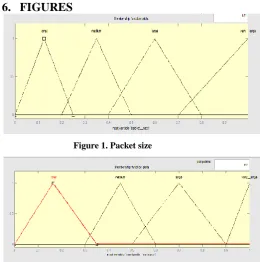
In computer network congestion packet size is most important. Small size of packet occupy less memory in router buffer. It also require less power than long size packet, also it is easy to transmit small packets than large packets, because if a packet lost then only small packet have to retransmit not the larger one thus it reduces the congestion. In this paper the smallest packet size is zero bytes, which is hypothetical. In this paper fuzzy linguistic variables are chosen in four terms for packet size they are as follows :
{Small, medium, large, very large}
Small lies between 0 – 3000 bytes
Medium lies between 2500 – 5000
Large lies between 4000 –10000
And very large lies between >100000
The above value is taken as between 0 and 1in graph as membership function. The whole range is distributed between 0 – 1. When the give input value in between 0 and 1 then Matlab automatically change it into linguistic variable according to their give limit.
Figure 1
5.2.
Bandwidth
One of the most important factor in network congestion is bandwidth available in network. For large bandwidth chance of congestion in quite low. This paper uses the factor available bandwidth for transmission. As bandwidth shrink then congestion possibility increases. Bandwidth is like pipeline of water supply if pipe is empty the congestion is not, as pipe fill then chance of congestion increases. Sometimes it is also responsible for bottleneck problem due to large difference in network connections. In this paper four fuzzy linguistic variables are taken to represent bandwidth, they are as follows:
{Low, medium, high, very high}
Low lies between 0 – 25 %
Medium lies between 20 – 50 %
High lies between 40 – 75 %
Very high lies between 70 – 100 %
The available bandwidth is taken as percentage (%) means how much (%) bandwidth is available for transmission. The whole range is distributed between 0 – 1. When the given input as percentage then Matlab automatically converts it into linguistic variable according to their ranges.
5.3.
Processor Speed
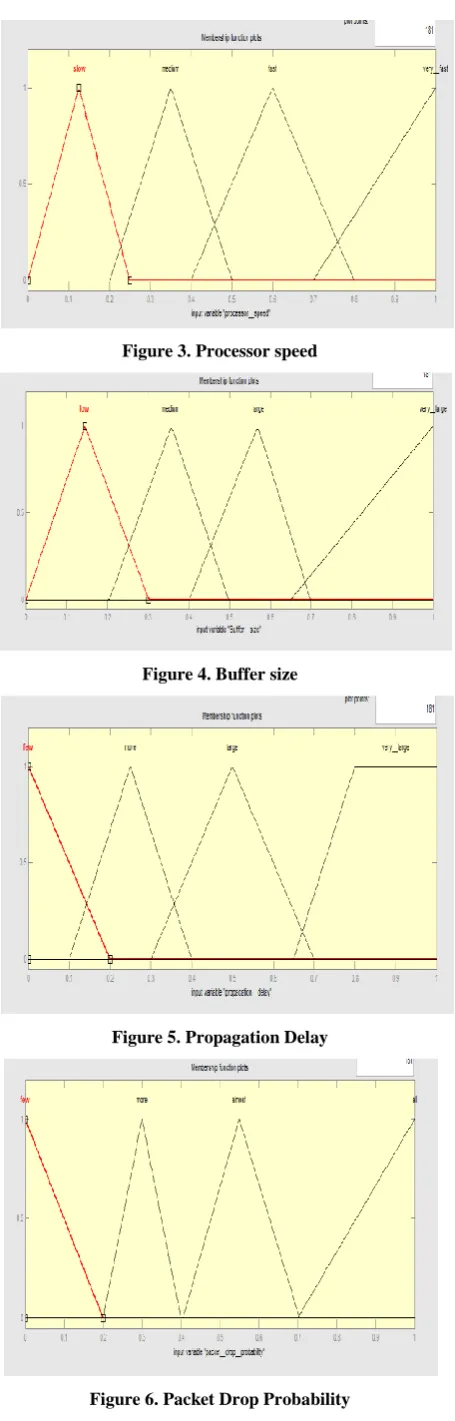
Network congestion also depends upon processor speed of routers. All tasks are managed and done by processor itself in routers. If routers’ clock speed is slow then the response time of router will also slow, this results tail drop of packets also increase the queue length. Propagation delay will also occur if processor speed is slow, because processor needs more time to operate to the packets, this may produce bottleneck problem in network in which the router attached. There are four fuzzy linguistic variables are taken for represent processor speed they are as follows:
{Slow, medium, fast, very fast}
Slow lies between 0 – 250 MHz
Medium lies between 200 – 500 MHz
Fast lies between 400 – 1000 MHz
Very fast lies between 800 – above MHz
The processor speed is taken in Matlab fuzzy membership graph between 0 – 1 as a percentage of clock speed. The whole range is distributed between 0 – 1. When the given input as between 0 – 1 then fuzzy expert system automatically convert it into linguistic variable according to their ranges.
Figure 3.
5.4.
Buffer Size
Buffer size of router also affects the congestion in network. Each and every router has buffer with its own fixed size buffer which cannot be exceed. If buffer size in low then it cannot handle much more packets, this result packet drop, and then packets will be retransmitted which results in congestion in network. Researches show even if buffer size is infinity then also network congestion goes worse, due to long queue in buffer, response time increases. Comparative studies shows if buffer size increase congestion may reduce. In this paper there are four fuzzy linguistic variables are taken to represent buffer size, they are as follows:
{Small, medium, large, very large}
Small lies between 0 – 6000 bytes
Medium lies between 5000 – 12000 bytes
Large lies between 10000 – 15000 bytes
Very large lies between 14000 – above.
In Matlab fuzzy membership graph all values are taken as between 0 – 1. The whole range is distributed between 0 – 1. When input is given to fuzzy expert system then expert system automatically converts it into linguistic variable, the do the required calculations.
Figure 4.
5.5.
Propagation Delay
Propagation delay happened in network due to many reasons such as bottleneck problem, slow processor, long queue length and many more. This also responsible for network congestion because if propagation delay happened there will be very few packets will come out from router than incoming packets to the router, this result packet drop from router’s buffer and retransmission of the packets, this results the congestion in network. Four fuzzy linguistic variables are used to represent the propagation delay, they are as follows:
{Low, medium, high, very high}
Low lies between 0 -. 4 milliseconds
Medium lies between 3 – 5 milliseconds
High lies between 4 – 8 milliseconds
Very high lies between 7 – above.
In Matlab fuzzy membership graph are taken limit within 0 – 1. The whole range of propagation delay is distributed between 0 – 1. When we give input to fuzzy expert system then it automatically convert it into linguistic variables and perform desire tasks.
Figure 5.
5.6.
Packet Drop Probability
In RED algorithm packet drop probability can be calculated. In other algorithms also like BLUE, FRED etc. can calculate packet drop probability. It also increase the congestion in network. Since due to drop probability, if it high packets are retransmitted from the source, this increases the congestion in network. In this paper four linguistic variables are taken to represent packet drop probability. They are as follows:
{No, some, more, almost}
No lies between 0 - 0.2
Some lies between 0-1 – 0.4
More lies between 0.3 – 0.8
Almost lies between 0.7 and above.
The packet drop probability is taken in Matlab fuzzy membership graph between 0 – 1. The whole range is distributed between 0 – 1. When the given input as between 0 – 1 then fuzzy expert system automatically convert it into linguistic variable according to their ranges.
Figure 6.
[image:3.595.317.578.476.739.2]6.
FIGURES
Figure 1. Packet size
Figure 3. Processor speed
Figure 4. Buffer size
[image:4.595.55.283.62.774.2]Figure 5. Propagation Delay
[image:4.595.317.548.69.267.2]Figure 6. Packet Drop Probability
Figure 7 Rules (if- then)
7.
CONCLUSION AND FUTURE
SCOPE.
This paper can be used in both closed loop and open loop approach for network congestion successfully. It is basically a congestion detection technique which uses six parameters o which congestion can be detected. This paper used fuzzy theory which is one the most popular approach for decision making. This paper has only six factors on which congestion depends, there are many factors over which congestion done, one can choose other factors for calculation. This very flexible approach for congestion detection, it can also be used as a congestion control technique, since we have a knowledge of network any time we take measures for minimizing the congestion and also predict the congestion collapse. Membership graph may be changed for different result, but I found this distribution of values in membership function graph is optimal and satisfactory. One can add some more factors to get more precise result. In this paper Matlab software is used to demonstrate congestion detection, in future other network simulator can be used for demonstrate congestion.
8.
REFERENCES
[1] ATM Forum, “The ATM Forum Traffic ManagementSpecification Version 4.0,” Ftp://ftp.atmforum.com/pub/approved-specs/af-tm-0056.000.ps, April 1996.
[2] M. Hluchyi, L. Roberts, B. Makrucki, T. Tofigh, A. W.Barnhart, B. Holden, G. Fedorkow, J. Daigle, H.Suzuki, G. Ramamurthy,P. Newman, N. Giroux, R.Kositpaiboon, S. Sathe, G. Garg, and N. Yin., “Closed-Loop Rate-Based Traffic Management” AF-TM 94-0211R3, April 1994.
[3] R. Jain, K. K. Ramakrishna, and D. M. Chiu,“Congestion Avoidance in Computer Networks with a Connectionless Network Layer,” Digital Equipment Corporation, Technical Report DEC-TR-506, pp. 17,August 1987.
[4] P. Newman, “Traffic Management for ATM Local Area Networks,” IEEE Communication Magazine, 32(8):44- 50, Aug. 1994.
[6] A. W. Barnhart, L. Roberts, B. Makrucki, T. Tofigh, B.Holden, G. Fedorkow, J. Daigle, M. Hluchyi, H. Suzuki, G. Ramamurthy, P. Newman, N. Giroux, R. Kositpaiboon, S. Sathe, G. Garg, and N. Yin, “Closed- Loop Rate-Based Traffic Management,” ATM Forum Contribution 94-0438R1, need city and state, July 1994.
[7] A. Charny, D. Clark, and R. Jain, “Congestion Control With Explicit Rate Indication,” AF-TM 94-0692, July 1994.
[8] A. Charny, “An Algorithm for Rate Allocation in a Cell-Switching Network with Feedback,” MIT LCS/TR- 601, May 1994.
[9] L. Roberts, “Enhanced PRCA (Proportional Rate- Control Algorithm),” AF-TM 94-0735R1, Aug. 1994.
[10]F. Chiussi, Y. Xia, and V. Kumar, “Dynamic Max Rate Control Algorithm for Available Bit Rate Service in ATM Networks,” Proceedings of the IEEE GLOBECOM, 3:2108-2117, November 1996.
[11]L.A. Zadeh, “Fuzzy Sets”, Information and Control, vol. 8, issue. 3, pp.338-353, 1965.
[12]L.A. Zadeh, “Fuzzy Algorithms”, Information and Control, vol. 12, issue. 2, pp. 94-102, 1968.