On the Problem of Modeling of the Relations between
Documents
Yu.V. Leonova
*, V.B. Barakhnin
Institute of computation technologies SB RAS, Novosibirsk, 630090, Russia *Corresponding Author: [email protected]
Copyright © 2013 Horizon Research Publishing All rights reserved.
Abstract
The problem of an adequate description of various aspects of the inter-related information is addressed when avoiding of duplication of information is required. We are dealing with difficult documents where one document is a part of another document. The proposed solution to this problem lies in the specific way of storing the essential information. Each fact related to the specific identity or some property of this identity is stored in a single document that establishes that particular property when dealing with the relations between documents in the ''many-to-many'' manner. A model for the directed links between documents is arranged by establishing a set of documents specifying binary relations with additional attributes. It actually transfers the built relations to the level that defines the structure of documents.Keywords
Information Model, Horizontal Relations, Scientific Information System, Documents1. Introduction
While creating information systems with Internet access targeted for the scientific community, it is very important to provide the most comfortable navigation on the net, especially using the hypertext feature. Unfortunately, these is not always realized. In particular, considering the well known Russian information systems in mathematics such as Math-Tree [1] and Math-Net.ru [2], we observed that the inner hierarchical connections between documents are absent. In some foreign systems such connections are available but, as a rule, these system are resource specialized. For example, the portal Mac Tutor History of Mathematics [3] contains a very detailed information with cross-references but bibliographic information is represented as a short list of works.
In dealing with the informational systems there can be a problem of possible inconsistency of information. Firstly, the inclusion of the common parts of various documents could result in the appearance of multiple information about
the same object. Such situation is possible for example when a person works in different organizations, takes part in different projects and has many publications. This may cause serious problems when dealing with different versions of information as a result of its modification.
Moreover, to represent complex documents when one document is a part of another (completely or partly), it is necessary to establish relations between the documents. Such situation appears when the true statement may be constructed about the identities described by documents (having interest from the point of view of the information systems contents), like: “Identity A is (was) something in relation with identity B”, or “Identity A has (had) identity B in some quality”. For example: “Euclid - is the author of “Beginning” ” or “S.L. Sobolev was the director of the Institute of Mathematics of SB RAS”. It is well seen that the types of such relations may be different and this circumstance must be taken into account in the process of modeling of the relations between the documents.
Therefore, it is necessary to design a tool for the identification, specification and visualization of horizontal relations between identities, and information of these identities can be contained in a number of documents, and also within the documents which are parts of more complex documents. One of the main elements of this technology is to design the information model for relations and subject connections between the documents in the system.
Note that for the library systems constructed on the basis of the protocol Z39.50 and its versions [4], the complete duplication of the official information is implemented. A similar situation appears in the information systems constructed on the basis of LDAP-directories [5] in which there is a powerful system of cross-references, but the model being used does not admit relations “many-to-many”. Even if such relations do appear, there is a necessity to duplicate the information, which could result in a dis-coordination of the information in the system.
Naturally, the methods for solution of such problem were discussed earlier in some works [6, 7]. However the main approach to representing data in these works is in consideration of multiple relations followed by their decom-position in the process of normalization. In contrast to these papers, we construct an informational model by using the binary relations only, and then using the additional attributes not fitting the common scheme.
Therefore, the decomposition is carried out on a higher level of abstractness from the data structure, which makes our model more universal.
2. Model of the Document in the System
Information system is represented by a number of documents connected by different relations, which describe some identities (i. e. objects, facts or concepts). The information about some identities is kept in the system either in the form of the documents that represent and describe or model it, or in the form of mentioning of this identity, presented in other documents containing indirect information about this identity.Obligatory attribute of our information system which makes it different from usual web-sites is the presence of a catalogue containing the metadata of documents.
According to the standards of open systems interconnection (OSI) [8], the structure and the content of the documents must be described in line with international schemes for data. For describing the corresponding schemes of data they use metadata determining the structure and the semantic content of the document. In our system the information resource equipped with the meta-description (metadata) according to the OSI recommendations is called the document.
Determination 1. Document di is called a couple: di=<Si, Vi>,
where Si is the structure of the document in the consequence with selected data system;
Vi - content of the document (information filing).
Determination 2. Collection – a number of documents with definite fixed structure, the content of which is similar to thematic direction.
From the point of view of unification of the work with the documents, we shall represent the information system in the form of a set of collections. Metadata describing the structure and the content of the documents are subdivided into the descriptive and the structural metadata.
The structural metadata determines the structure and the properties of the documents according to which they are
processed (types, connections, formats of representation, limits to access direction etc). The descriptive metadata describe the semantic content of the document (title, short content, etc). Note that the descriptive metadata characterizing the documents may be part of the document and at the same time may contain information of the document (main data and the additional data, such as authors, title, date of creation, etc) according to the selected data scheme.
An element of the scheme data of the present collection will be called a structural element(further, an element), has an identifier and some properties.
Therefore Element E is a totality <ID, P>, where ID - identifier of the element; P - properties of the element.
An example of the element has a value (or content). The properties of the element determine the character of the work with the element.
Type of an element can be selected from a dictionary. This type determines the rules of the work with the element and, therefore, is a property of the element.
Examples of the element: title of the document, abstract of the document, surname in the visiting-card, authors of the document. Value of the element is its specific content.Properties of the element describe its structure. For the element of the visiting-card “surname” value is Matveev, identifier - 1, properties - “word” type.
Note that an external object may be the value of the element also. For example for the element of the visiting-card “photography” the value is the external object - graphic file.
Structure of the documents is a set of structural elements. The content of the document includes the values of the elements that form the document.
3. Information Model of Information
System
[image:2.595.119.481.679.742.2]In accordance with the principles of OSI [8], documents must be transferred inside the information system in a unified exchange format. By exchange format we mean such a format which contains both structure of the description data and the data itself. Therefore, the information system must have at least 3 level for presentation of the information. It agrees with the principles of modern technologies for construction of the information systems (Microsoft.Net [9], XForms [10]).
Figure 1. Scheme of flow the document in information system
Level of storage
information
(repository)
Level of processing
information
(structure)
Level of
presentation
Figure 2. Representation of document The basis of such concept is a principle of separation of
the storage system from its structure and a way of presentation of the information (Figure 1).
• Level of storage of information - stored representation of data and metadata in a form determined by the repository of data.
• Level of processing of information - internal (exchange) representation of the document. Document in exchange representation contains both data and structure.
• Level of presentation of information - representation of the document in a form comfortable for user.
The flow of document between the levels occurs in both directions, which gives the opportunity for both presentation of the information and implementation of changes.
In the multi-user information system it is necessary to supply: 1) differentiation of access rights to information resources for each user; 2) differentiation of access rights to structural elements of the document. Solution of these problems may demand an introduction of two additional levels, but they are beyond the scope this article, as we discuss only the technological part of the system.
Consider the functioning of the system in the direction of movement of the information “level of storage - level of presentation”.
The movement of the document between the levels occurs to both sides, which gives a possibility of both presentation of the information and adding the changes.
In the multi-user information system it is necessary to supply: 1) differentiation of rights to the access of the user
to information resources; 2) differentiation of rights to access to structural elements of the document. Solution of these problems may demand an introduction of two additional levels, but they are beyond this article, as we discuss only the technologic part of the system.
Consider the functioning of the system in the direction of movement of the information “level of storage - level of presentation”.
1. “Level of storage” determines in what way the system stores the document - in relational table, directory (LDAP) etc. Level of storage performs the selection from the repository and transfers it to the level of representation for working up.
2. On the “level of processing” the calculation of relations and generation of internal representation of the document from the stored representation is performed. Information of
the level of representation is necessary for supplying interoperability with other systems. Internal representation is an intermediate document containing a set of elements in an exchange format (associative array containing data and meta description), for example XML. Internal representation is transferred to the level of presentation or external inquiry.
3. On the “level of presentation” a presentational representation of the document is generated from internal representation by using a template in a form suitable for presentation to the user.
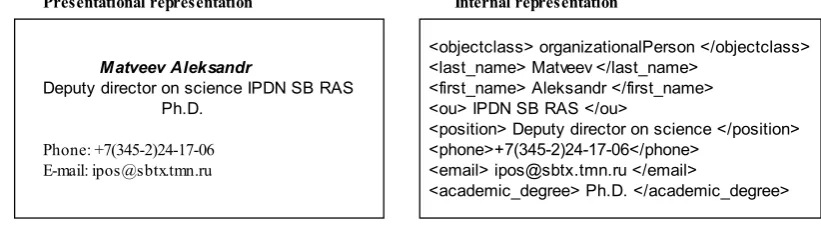
Figure 2 shows an example of presentational and internal representation of the document.
4. Model of Relations between the
Documents in the Information System
To solve the formulated problems, we have to determine the connections (relations) between the documents. As the basis of our model for relation between the documents in the information system we took the model RDF [11] describing representation the resources and relations between them. Description of resources in the RDF is a set of statements about properties of the resource. Every statement represents: resource, named property, and its meaning. The relations between the resources are represented by named properties. For example, a statement that Korobeinikov S.N. is the author of the book “Unlinear deformation of solid bodies” in notation of N-Triples (RDF) may be expressed as such:<Korobeinikov S.N.> <AuthorOf>
<Unlinear deformation of solid bodies>.
The main difference of our model from RDF is that the relations constructed by us are transferred on the level of the elements that determine the structure of documents. In the considered information system, the relation itself is not determined by the resource structure but rather by the structural metadata of the collections of documents in the system.
In our system the relations between the documents are established by specifying a number of documents using binary relations which, according to one form of notations used by RDF, may be written as A(R,V): object R has attribute A with value V. For example, the fact that Barakhnin V.B. holds a post in the Institute of Computation Matveev Aleksandr
Deputy director on science IPDN SB RAS Ph.D.
Phone: +7(345-2)24-17-06 E-mail: [email protected]
<objectclass> organizationalPerson </objectclass> <last_name> Matveev </last_name>
<first_name> Aleksandr </first_name> <ou> IPDN SB RAS </ou>
<position> Deputy director on science </position> <phone>+7(345-2)24-17-06</phone>
<email> [email protected] </email>
<academic_degree> Ph.D. </academic_degree>
[image:3.595.96.507.82.199.2]Technologies SB RAS is written down as follows: Post (“ICT SB RAS”, “Barakhnin V.B.”),
where “Post” is some value from the list (thesaurus) of posts.
In the information system for scientific association we distinguish 2 types of relations:
• Relation of the order between the documents constructing the hierarchy of subordination in the collection, for example, relation of hierarchy of subordination between the documents in the collection “Organizations”:
Head(“Chair of mathematic modeling”, “MMF of NSU”).
Note that such type of relations assumes the establishment of only one-way connection between the documents.
●Relations of connection between the documents, for example relation of the type of belonging between the documents of collection “Organizations” and documents of collection “Persons”:
Post (“ICT SB RAS”, “Barakhnin V.B.”).
This type of relations admits the establishment of the two-way connection between the documents. It means that thereverse connection may exist concurrently, for example Position (“Barakhnin V.B.”, “ICT SB RAS”).
Direction of connection is determined by the order of the arguments in relation A(R,V).
Therefore any object may also play a role of the value. The difference between the relations of the first and the second types is that the relations of the first type have initially a property of hierarchy and relations of the second type have not initial properties. The properties of relations of the second type are determined for every specific relation. As a rule, the relation of the first type has no more than one attribute, for example, type of subordination (territorial, scientific-methodical etc).
Relations of the second type usually have some additional attributes. For example, relation of the type “Post” does not simply describe the affiliation of a person to an organization but also has the next attributes: name of the post, keywords, date of assignment, date of the termination of contract, etc.
For the relation A(R,V) argument R has notation as a
head document while the argument V is a subordinate document.
A document in the system may be connected with any number of documents. Between two documents there may be direct and reverse relations.
Direct relation - relation of the head document to a subordinate document, for example, relation of the document “identification card of organization“ to the document containing multitude of subdivisions, employees or list of additional information. Document from collection “Persons” or “Organizations”, may be connected with the documents from the collection of additional information, for example, list of additional data.
Reverse relation - relation of the subordinate document to the head document.
For the one-way relations, the “parental” document always knows its “daughter” documents and a “daughter” document knows nothing about its “parent”. For navigation within collections, it is necessary to have a registration for the reverse relations within documents.
Distinguishing these two types of relations between the documents, we solve the following problems:
● navigation in collections;
● establishment of connections between the documents (hyper references, insertions).
Based on the relations of the second type, it is possible to distinguish two types of elements in the document:
● elements, whose content does not depend on the values of relations of the attributes;
●elements, whose content can depend on the values of relation attributes (for example, official information depends on the post of a person in organization).
Note that the elements of second type can contain lists of references in other documents, or lists of insertions.
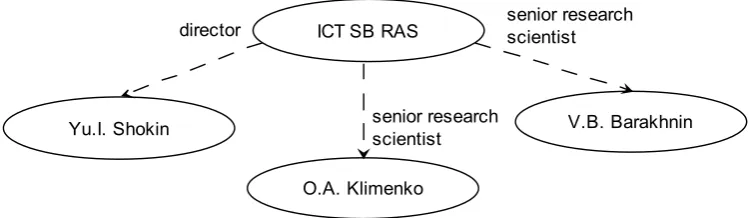
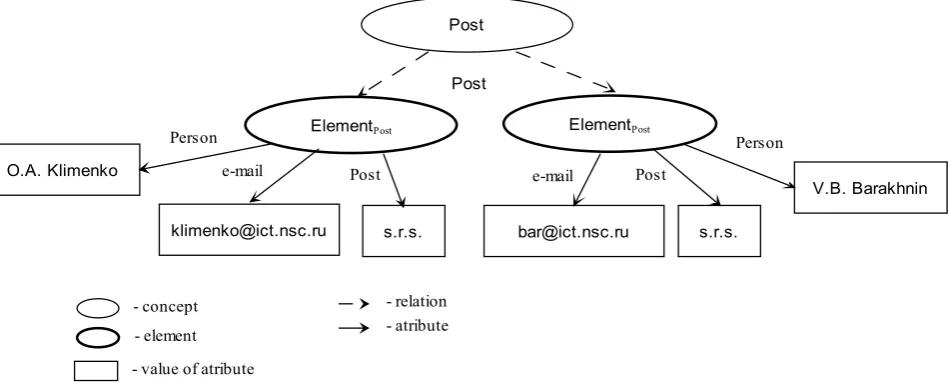
Figure 3 shows direct connections of collection “Organizations” and collection “Persons”, figure 4 - collection “Publications” and collection “Persons”, figure 5 - structure of the additional attributes for relations of the second type that accounts the multiple type of relations between identities.
Figure 3. Connections between documents of collection “Organizations” and collection “Persons” ICT SB RAS
Yu.I. Shokin
O.A. Klimenko
V.B. Barakhnin
director senior research scientist
[image:4.595.117.492.577.686.2]Figure 4. Connections between documents of collection “Publications” and collection “Persons”
Figure 5. RDF-representation of additional attributes of relations of the second type taking into account that the type can be multiple However, the considered scheme does not solve all the
problems that appear while constructing the information systems for scientific community. For example, the problem of loss of actuality of the information is not resolved.It could be related to various types of organizations or associations, etc. However, it may not be a serious issue. For example, one could be interested in the Bubnov-Galerkin method for solving of operation equations, or biography of I.G. Bubnov, but it is unlikely that we will look for this information by searching the data for the Naval Academy where Bubnov had worked in the past.
Therefore the information should be grouped either ●around scientist persons;
●around conceptions and facts of science;
●around realities of surrounding world described by science (for natural and some humanitariansciences).
Within the scope this article, we are interested in the first approach (technique for constructing information models within the approach that uses thesauruses considered in [12]; the third approach is based mainly on the systematization of specificidentity considered within the scope of corresponding science.
For the information model of a system targeted atthesearch for a person, there is a need to compare all his/her positions and identities(for example, for publication record) i. e. to use the approach which is in reverse to what was
described above. Solving of this problem with the help of context inquiries (even to the specific field) is not always comfortable as it may result in irrelevant documents.
Therefore, a reverse model of relations is needed, which should have a universal character.
Therefore, documents of the information system are grouped according to the following principle: there is aespecially distinguished collection “Persons” and a number of other collections: “Publications”, “Organizations”, “Associations” (societies, journals, etc) and all relations are constructed around persons.
A person may hold different positions, be an author or the editor of a publication, holdpositions in organizations, be a chairman or a member of the panel, etc. All these cases are represented by one type of relations - “Position”, which can be identified by different names (director, post-graduate, chairman of the panel, author, etc).
Based on the documents connected with relations, we can generate the following representation of the document using the appropriate inquiry:
<id = “14”>
<LastName>Fedotov</LastName> <FirstName>Anatolyi</FirstName>
<MiddleName>Mikhailovich</MiddleName> <Position>
<organization name=”ICT SB RAS”> Fortran-90
Yu.I. Shokin Bo Einarsson
A.N. Zudin
L.B. Chubarov author
author editor
editor
Post
ElementPost ElementPost Post
O.A. Klimenko
[email protected] s.r.s. [email protected] s.r.s.
V.B. Barakhnin
Person Person
e-mail Post e-mail Post
- concept - element - value of atribute
[image:5.595.79.533.80.187.2] [image:5.595.71.546.219.413.2]<post>Chief of department</post> <post>Deputy director on science</post> </organization>
</Position>
5. Use the Model in the Information
System “Web-Resources of the
Mathematical Content”
The information system “Web-resources of the mathematical content” [13, 14] created in ICT SB RAS is intended to catalogue the mathematical internetresources aimedat collection of the information required for the relevant search. In the process of working with the system it becomes apparent that the tree-like structure of the information, regulating the documents according to their type is not sufficient. Tree-like structure may include various types of identity types, i.e. person, society, institute, department, laboratory, group, faculty, chair, scientific school, conference, seminar, edition, journal, book, article, project, package of programs, library, collection of data base, forum, and other “Mathematic Subject Classification” [15] identities used by American and European mathematical societies. In the new version of the system we address internal connections between the documents according to the described technique. These connections allow output of information on the organization to display information about persons affiliating with it along with publications of these persons when giving information about the person, thus providing hyper-references linking the site of corresponding organization with a list of resources – publications of the specific person, etc. As our first step, we have introduced the above mentioned modification for the resources of the recent version of “Mathematicians of SB RAS” [16].
Information in this version is divided into two parts, biographic and bibliographic. Biographic part is based on the information system “Database of organization and employees of SB RAS” [17] and it consists of the list of organizations and employees, and also information about relations between the elements of the named lists and attributes of these connections (post, contact information, etc). The mentioned information is displayed in the visiting card of a person even if this person holds a few posts (in one or different organizations), thus information about all posts is mentioned.
The bibliographic part consists of different databases. It includes publications of employees of the institute, content of the journals published in SB RAS, own bibliographic database of the system “Web-resources of the mathematical content”, etc. At present, the information from different data bases is represented independently, but we plan to create a common output system that eliminates duplications.
6. Conclusion
Thus, in this article we have solved the problem of an adequate description of the various aspects of the relationship between identities. The essential requirementis to avoid duplication and to represent complex documents embedded into each other. The solution to this problem is to store information about each of the facts related to a particular entity, or to a certain property of an entity, in a single document. This document establishes, where necessary, the relationship between many groups of documents. To do this, we create a model, which establishes links between documents based on a set of documents. This set specifies binary relations, with additional attributes. This attributes are designed to build relationships at a certain level of elements that defines the structure of documents.
REFERENCES
[1] Portal MathTree. www.mathtree.ru [2] Portal Math-Net.RU. www.math-net.ru
[3] Portal MacTutor History of Mathematics. http://www-history.mcs.st-and.ac.uk/history/
[4] Zhizhimov O.L., Mazov N.A. Principles of Construction of the Distributed Information Systems on the Basis of the Protocol Z39.50. Novosibirsk: Publ. ICT SB RAS, 2004. 361 p.
[5] Valiev M.K., Kitaev E.L., Slepenkov M.I. Usage of the Service of Directories LDAP for Representation of a Metainformation in Global Computing Systems. www.keldysh.ru/metacom-puting/ism99.html
[6] Ullman J.D. Principles of database system. Comp. Sci. Press, 1980.
[7] Maier D. The Theory of Relational Databases. Comp. Sci. Press, Rockville, MD, 1983.
[8] The concept of open systems // Materials to the Interbranch Program “Development and Application of Open Systems”. http://www.informika.ru/windows/inftech/opensys/3/concept /os_1.html
[9] Microsoft.Net. www.microsoft.com/net/
[10] XForms 1.0. W3C Working Draft 16 February 2001. http://www.w3.org/TR/2001/WD-xforms-20010216
[11] Resource Description Framework (RDF) Model and Syntax Specification. W3C Recommendation 22 February 1999. http://ww.w3.org/TR/1999/REC-rdf-syntax-19990222/ [12] Barakhnin V.B. Development of the thesaurus of data
domain of “Mathematician” // Materials Intern. Conf. “Computational and Informational Technologies for Science, Engineering and Education”. Pt 1. Ust-Kamenogorsk, Kazakhstan, Sept. 11–14, 2003. P. 111–115. (in Russian). [13] Barakhnin V.B., Guskov A.E., Klimenko O.A. et al.
[14] Information System “Web-resources of the Mathematical Content”.
http://ww.nsc.ru/win/math-pub/mathem_www.html
[15] Information System “Mathematicians of SB RAS”. http://www.sbras.ru/sbras/math_soran/eng/
[16] Mathematics Subject Classification.
http://www.ams.org/msc/