On the Equilibrium and Stability of ITER
Relevant Plasmas
Ap Kuiroukidis
1,
G. N. Throumoulopoulos
2,∗,
H. Tasso
31Physics Department, University of Ioannina, GR 451 10 Ioannina, Greece
2Technological Education Institute of Serres, 621 24 Serres, Greece
3Max-Planck-Institut f¨ur Plasmaphysik, D-85748 Garching, Germany
Copyright c⃝2015 by authors, all rights reserved. Authors agree that this article remains permanently
open access under the terms of the Creative Commons Attribution License 4.0 International License
Abstract
We present recent results on steady states of translational symmetric and axisymmetric ITER relevant plasmas with incompressible sheared flow in connection with a generalized Grad-Shafranov (GGS) equation and on their stability. On the basis of a vari-ety of ITER pertinent solutions of the GGS equation constructed it turns out that the flow affects noticeably the equilibrium quantities in qualitative agreement with the advanced confinement regimes phenomenology. Also, application of a sufficient condition for linear stability indicates that stabilization is mainly caused by the variation of the magnetic field in the direction perpendicular to the magnetic surfaces, related to the magnetic shear, depends on the plasma shaping and is sensitive to the up-down asymmetry. In certain cases the sheared flow has a weaker stabilizing effect enhanced by the equilibrium nonlinearity.Keywords
Magnetohydrodynamics, Equilibrium, Stability, Tokamak, Advanced Confinement1
Introduction
It has been established in a number of fusion devices that sheared flows both zonal and mean (equilibrium) play a role in the transitions to improved confinement regimes as the L-H transition and the Internal Trans-port Barriers (ITBs). These flows can be driven ex-ternally in connection with electromagnetic power and neutral beam injection for plasma heating and current drive or can be created spontaneously (zonal flows). In the latter case the physical mechanism driving the flow is not completely understood; potential mechanisms are related among others to a residual stress, up-down asym-metry and the turbulence itself. Also, it remains physi-cally rather unclear the role of the flow, no matter how is created, in the transitions to improved confinement regimes. The current experimental evidence and theo-retical studies indicate that zonal flows in conjunction
with externally driven ones suppress the turbulence thus contributing in the formation of transport barriers (cf the reviews [1, 2, 3]).
Equilibria with sheared flows which can be employed as starting points of stability and transport studies have been constructed on the basis of generalized Grad-Shafranov equations (GGSs) [e.g. Eq. (1) below]. The stability of fluids and plasmas in the presence of equilib-rium flows non parallel to the magnetic field remains a tough problem reflecting to the lack of necessary and suf-ficient conditions. Only for parallel flows few sufficient conditions for linear stability are available (e.g. [4]-[7]).
In an attempt to contribute to the understanding of the development of ipmroved confinement regimes in tokamaks, in this contribution we construct novel mag-netohydrodynamic steady states and review recent ones [18]-[22] of translational symmetric and axisymmetric plasmas with incompressible sheared flow of arbitrary direction either with monotonically increasing safety fac-tor profiles, pertinent to the L-H transition, or with re-versed magnetic shear usually associated with the forma-tion of ITBs. Specifically, linear and nonlinear soluforma-tions of the GGS equation (1) including non parallel flows of plasmas surrounded by a diverted ITER pertinent boundary have been constructed analytically, quasian-alytically and numerically. The equilibrium charac-teristics in connection with the improved confinement regimes phenomenology are also examined. Further-more, for flows parallel to the magnetic field we exam-ine the lexam-inear stability of the equilibria constructed by means of the sufficient condition of [6].
2
Solutions and equilibrium
char-acteristics
The equilibrium of an axisymmetric plasma with incompressible flow satisfies the generalized Grad-Shafranov equation [8, 9, 10]
∆∗u+1 2
d du
(
X2 1−M2
p )
+µ0R2
dPs(u)
du
+µ0
R4 2 d du [ ϱ ( dΦ du
)2]
= 0 (1)
and the Bernoulli equation for the pressure
P =Ps−ϱ [
v2 2 −R
2
(
dΦ
du
)2]
. (2)
Here,u(R, z) is the poloidal magnetic flux function [with (z, R, ϕ) cylindrical coordinates withzcorresponding to the axis of symmetry],Mp(u) the Mach function of the
poloidal velocity with respect to the poloidal-magnetic-field Alfv´en velocity,Ps(ψ) the pressure in the absence
of flow, Φ(u) the electrostatic potential,ϱ(u) the plasma density,X(u) relates to the toroidal magnetic field and ∆⋆ :=R2∇ ·(∇/R2). Derivation of (1) and (2) is pro-vided in [8, 9, 10]. Once the free functionsMp(u),Ps(u),
Φ(u),ϱ(u) andMp(u) are assigned, Eq. (1) can be solved
under appropriate boundary conditions. The respective GGS equation for a translational symmetric plasma is given by Eq. (8) of [9].
We have solved Eq. (1) in three alternative ways: i) by constructing analytic solutions including exten-sions of the Solov´ev solution, the generic linear solution of [11] and the nonlinear solution of [12], ii) by using appropriate ansatz for the unknown poloidal magnetic flux function which reduces the original equation to a set of ODEs and algebraic constraints; then this set of equations is solved numerically, and iii) fully numeri-cally by prescribing analytinumeri-cally either a D-shaped or a diverted boundary. Here we present a new numeri-cal solution for parallel flow (Φ′(u)≡0) constructed as follows. First, we make the normalizations ρ= R/R0,
ζ = z/R0, where R0 is the major radius of the config-uration; ˜u = u/u0, ˜Ps = Ps/P0, ˜X = X/X0, where
X0 :=u0/R0,u20:=P0µ0R04and P0 is a reference pres-sure. Eq. (1) is then written in the dimensionless form
[∂ρρ−(1/ρ)∂ρ+∂ζζ]˜u +
1 2
d du˜
[
˜
X2
1−M2 p ]
+
+ ρ2d
˜
Ps
du˜ = 0. (3) Choosing the free-function terms as
˜
X2 (1−M2
p)
= [ ˜X02+ 2 ˜X1u˜+ ˜X2u˜2+ 2 3
˜
X3u˜3], (4)
˜
Ps(˜u) = ˜P0exp
[
V2
(
1 (˜ua−u˜b)2−
1 (˜u−u˜b)2
)]
, (5)
Eq. (3) assumes the form
[ ρ∂ ∂ρ ( 1 ρ ∂ ∂ρ ) + ∂ 2 ∂ζ2 ] ˜
u + ( ˜X1+ ˜X2u˜+ ˜X3u˜2) +
+ ρ2
(
dP˜s
du˜
)
= 0 (6)
Here, ˜ua (˜ub) is the normalized poloidal flux function
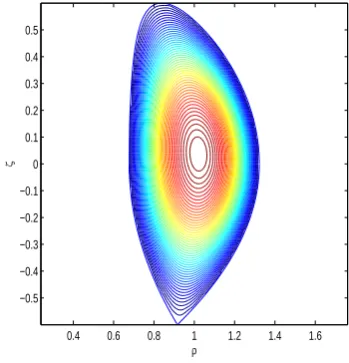
on the boundary (magnetic axis); ˜X0, X˜1, X˜2, X˜3, P˜0, and V are dimensionless constants. We prescribe ana-lytically a fixed boundary with a lower X-point by the parametric equations (17)-(20) of [21] and solve numer-ically Eq. (6 ) by adopting the nine-point-formula in-tegration scheme described in detail in Section 4 of our previous paper [21]. Also, we assign the following para-metric values: R0= 6.2 m,P0= 1.6×10⁵Pa=1.58 Atm implying thatX0= 2.78 Wb/m andu0= 17.23 Wb. An ITER-like configuration in connection with this solution is given in Fig. 1. The safety factor of this equilibrium
ρ
ζ
[image:2.595.338.513.312.494.2]0.4 0.6 0.8 1 1.2 1.4 1.6 −0.5 −0.4 −0.3 −0.2 −0.1 0 0.1 0.2 0.3 0.4 0.5
Figure 1. ITER pertinent numerical equilibrium solution in
con-nection with the choice (4) and (5) for major radius, R0 =6.2
m, minor radius,a=2 m, elongation,κ=1.64 and triangularity,
δ = 0.5. The bounding flux surface corresponds to ˜ub = 1 Wb,
with ˜ua= 1.23 for the magnetic axis.
increases monotonically from the magnetic axis to the boundary. A stability consideration in connection with the L-H transition is made in Sec. 3. The solution holds for arbitrary Mach functions, M2
p(u), and densities, ϱ.
To completely, construct the equilibrium we have made several choices of these functions, e.g.
ϱ(u) = ϱa (
1−u 2
u2 b
)λ
, (7)
Mp2 = Ma2
[ 1− ( u ub )]n , (8)
Mp2 = M02(˜ua−u˜)m(˜u−u˜b)n (9)
Here, the free parametersϱa andMa2 correspond to the
maximum values of ϱ andMp2, M02 relates to the max-imum value of Mp2; m andn are connected to the flow
shear. In particular, (8) is peaked on- while (9) is peaked off-axis in connection with respective auxiliary heating of tokamaks. For the equilibrium of Fig. 1 we have chosenM2
More general the equilibria constructed here and in our past studies [17]-[22] have either safety factor pro-files monotonically increasing from the magnetic axis to the plasma edge pertinent to the L-H transition or re-versed magnetic shear related to the formation of ITBs. The equilibrium characteristics have been examined by means of the pressure, safety factor (q), current den-sity, toroidal velocity, poloidal Mach function and elec-tric field (E) associated with the non parallel flow. It turns out that:
0.5 1 1.5 2 2.5 3 3.5 4 4.5 5 3
4 5 6 7 8 9 10 11
[image:3.595.77.251.195.382.2]−R06Φ1 qb
Figure 2. Dependence of the edge (boundary) safety factorqb
on an electrostatic potential parameter Φ1, withqa = 1, for an
anlytic solution of (1) constructed in [18] [Eqs. (22) and (23)
therein]. The curve indicates that theq-profile becomes flatter as |Φ1|increases
0.8 0.9 1 1.1 1.2 1.3 −20
−15 −10 −5 0 5 10
ρ
vφ
(Km/sec)
Φ1=−1.50
[image:3.595.71.246.479.661.2]Φ1=0
Figure 3. Toroidal velocity for an analytic solution of (1) con-structed in [18] [Eqs. (22) and (23) therein] with different values of an electrostatic-potential parameter Φ1andqa= 1. The graphs
indicate that the larger|Φ1|is the higher the amplitude and shear ofvϕ
• Emakes theq-profile flatter (Fig. 2) and increases the magnitude and shear of the toroidal velocity (Fig. 3) in qualitative agreement with experimental evidence on the formation of ITBs, thus indicating a stabilizing effect of the electric field.
• The maximum of Etakes larger values as the flow amplitude increases but its position is insensitive to the flow.
• The results indicate stabilization by synergetic ef-fects of E and magnetic shear. A synergism of reversed magnetic shear and sheared poloidal and toroidal rotation, consisting in that on the one hand the reversed magnetic shear plays a role in trigger-ing the ITBs development while on the other hand the sheared rotation has an impact on the subse-quent growth and allows the formation of strong ITBs, was observed in JET [13] and DIII-D [14].
3
Stability Consideration
We now consider the linear stability of the equilib-ria constructed for field aligned flows by applying the sufficient condition of [6]. This condition states that a stationary equilibrium with field aligned incompressible flow and constant mass density is stable to small three dimensional perturbations ifM2
p <1 andA≥0 where
A = A1+A2+A3+A4, (10)
A1 = −(J× ∇u)2, (11)
A2 = (J× ∇u)·(∇u· ∇)B, (12)
A3 = − 1 4(1−M
2 p)−
1dM 2 p
du |∇u|
2∇u· ∇B2, (13)
A4 = − 1 2(1−M
2 p)−
3/2dM 2 p
du |∇u|
4g, (14)
g = √ 1 1−M2
p (
dPs
du − dMp2
du B2
2
)
. (15)
The quantities in(10)-(15) are dimensionless with the tilde dropped for notation simplicity. The quantity A1 being always negative consists a destabilizing contribu-tion potentially related to current driven modes. The other terms can be either stabilizing or destabilizing. Specifically, the term A2 relates to the current density and the variation of the magnetic field perpendicular to the magnetic surfaces. The termA3 involves the shear and magnitude of the flow in conjunction with the vari-ation of the magnitude of the magnetic field perpen-dicular to the magnetic surfaces. A4 is mostly a flow term depending on the magnitude and the shear of the flow. The flows satisfying (1) are inherently sub-Alfv´enic (M2
p <1) because of an integral transformation involved
[9]. To apply the condition we set in Eq. (1) Φ′≡0 and
ϱ = ϱa = 1. Also, Mp is now the Alfv´en Mach
func-tion of the parallel velocity because in this case it can be shown that the poloidal Mach function, the respec-tive toroidal Mach function and the (total) parallel Mach function are equal one another.
Application of the conditionA≥0 for a variety of the equilibria constructed led to the following conclusions.
−0.4 −0.2
0 0.2
0.4
−0.5 0 0.5 −8000 −6000 −4000 −2000 0 2000
x y
[image:4.595.343.512.64.244.2]A
Figure 4. Two-dimensional plot of the stability quantityAfor a translational symmetric equilibrium solution [19] with parallel
flow. For most part of the plasma domainAis non-negative and
assumes negative values only in the core region.
• Stabilization is mainly caused by the term A2 re-lated to the magnetic shear.
• Depending on the Mach-function profiles and the values of the free parameters the flow and flow shear may have rather weak stabilizing effects. It is clar-ified, however, that this is far from a “universal” result; there are cases of flow and flow shear desta-bilization.
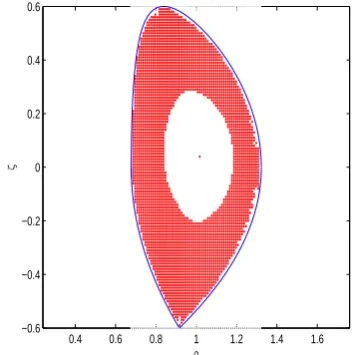
[image:4.595.85.267.69.243.2]• In certain cases stability is improved by the equi-librium nonlinearity in agreement with past equilib-rium studies in plane geometry [15, 16]. A pertinent example supporting this result in connection with the equilibrium of Fig. 1 is presented in Figs. 5-7. Fig. 5 refers to a static equilibrium (M0= 0) for the value of the nonlinear parameterV = 1.5 for which the stability conditionA≥0 is nearly nowhere sat-isfied. We conjecture that this corresponds to the L state. In the stability graph of Fig. 6 associated with a stronger equilibrium nonlinearity (V = 2.2) and off-axis flow [Eq. (9)] the condition A ≥ 0 is satisfied in a major part of the plasma indicated by the red-colored region. This may correspond to the H state. Respective curves of the quantityAon the planez= 0 are given in Fig. 7.
• The stability is affected by the plasma shaping and is sensitive to even small up-down asymmetry. According to the above results and the believe that the sheared flow is developed during the L-H transition we conjecture that a static equilibrium could correspond to the L state and a stationary equilibrium with flow shear and stronger nonlinearity to the H state. In a qua-sistatic evolution approximation the plasma then poten-tially evolves through successive states with increased equilibrium nonlinearity and sheared flow. A similar process may be relevant to the formation of Internal Transport Barriers according to the results of [22].
0.4 0.6 0.8 1 1.2 1.4 1.6 −0.6
−0.4 −0.2 0 0.2 0.4 0.6
ρ
ζ
Figure 5. Stability graph for the equilibrium of Fig. 1
corre-sponding to the L-sate forM0= 0 andV = 1.5 showing the sign
of the stability quantityA. Only in the minor red colored spots it
holdsA≥0 and therefore this condition is nearly nowhere
satis-fied.
0.4 0.6 0.8 1 1.2 1.4 1.6 −0.6
−0.4 −0.2 0 0.2 0.4 0.6
ρ
[image:4.595.337.514.330.508.2]ζ
Figure 6. Stability graph for the equilibrium of Fig. 1 cor-responding to the H-state with strong equilibrium nonlinearity (V = 2.2) and sheared flow (M2
0 = 0.01 andm =n= 2). The
stability conditionA≥0 is satisfied in the red-colored region.
0.8 0.9 1 1.1 1.2 −10
−8 −6 −4 −2 0 2 4 6 8 10
ρ
A
A=AL
A=AH
[image:4.595.339.514.585.768.2]4
Conclusions
In a series of recent studies [17]-[20] and here we have constructed linear and nonlinear equilibria either with monotonically increasing safety factor profiles or with reversed magnetic shear. For non parallel flows it turns out that the electric field makes the safety factor flatter and increases the magnitude and shear of the toroidal velocity in qualitative agreement with experimental ev-idence on the formation of ITBs in tokamaks, thus indi-cating a potential stabilizing effect of the electric field. For parallel flows application of a sufficient condition for linear stability implies that the variation of the mag-netic field perpendicular to the magmag-netic surfaces has a stabilizing effect with a possible weaker contribution from the sheared flow. The results indicate that depend-ing on the Mach function profile and the values of the free parameters the sheared flow in conjunction with the equilibrium nonlinearity can play a stabilizing role and that the stability is affected by the up-down asymmetry.
Acknowledgements
GNT wishes to thank George Poulipoulis and Alexan-der Nindos for useful discussions. This work has been carried out within the framework of the EUROfusion Consortium and has received funding from (a) the Na-tional Programme for the Controlled Thermonuclear Fu-sion, Hellenic Republic, (b) Euratom research and train-ing programme 2014-2018 under grant agreement No 633053. The views and opinions expressed herein do not necessarily reflect those of the European Commission.
REFERENCES
[1] K. Itohy and S-I Itoh, Plasma Phys. Control. Fusion 38, 1 (1996).
[2] R. C. Wolf, Plasma Phys. Control. Fusion 45, R1-R91
(2003).
[3] C. D. Challis, Plasma Phys. Control. Fusion 46, B23
(2004).
[4] S. Friedlander, M.M. Vishik, Chaos5, 416 (1995).
[5] V. A. Vladimirov and K. I. Ilin, Phys. Plasmas5, 4199
(1998).
[6] G. N. Throumoulopoulos and H. Tasso, Phys. Plasmas 14, 122104 (2007).
[7] P. J. Morrison, E. Tassi, N. Tronko, Phys. Plasmas20
042109 (2013).
[8] H. Tasso and G. N. Throumoulopoulos, Phys. Plasmas 5, 2378 (1998).
[9] C. Simintzis, G. N. Throumoulopoulos, G. Pantis, and
H. Tasso, Phys. Plasmas8, 2641 (2001).
[10] G. N. Throumoulopoulos, H. Tasso, G. Poulipoulis, J.
Plasma Physics74, 327 (2008).
[11] C. V. Atanasiu, S. Gunter, K. Lackner, and I. G.
Miron, Phys. Plasmas11, 3510 (2004).
[12] G. Cicogna, F. Pegoraro and F. Ceccherini, Phys.
Plasmas17, 102506 (2010).
[13] P. C. de Vries, E. Joffrin, M. Brix et al., Nucl. Fusion 49, 075007 (2009).
[14] M. W. Shafer, G. R. McKee, M. E. Austin et al., Phys.
Rev. Lett.103, 075004 (2009).
[15] G. N. Throumoulopoulos, H. Tasso and G. Poulipoulis,
J. Phys. A: Math. Theor.42, 335501 (2009).
[16] G. N. Throumoulopoulos and H. Tasso Phys. Plasmas 17, 032508 (2010).
[17] G. N. Throumoulopoulos, H. Tasso, Phys. Plasmas19,
014504 (2012).
[18] Ap Kuiroukidis G. N. Throumoulopoulos, Phys.
Plasmas19,19, 022508 (2012).
[19] Ap Kuiroukidis and G. N. Throumoulopoulos, J.
Plasma Physics79, 257 (2013).
[20] Phys. Plasmas 21, 032509 (2014); Plasma Phys.
Control. Fusion56, 075003 (2014) .
[21] Ap Kuiroukidis and G. N. Throumoulopoulos, J.
Plasma Physics80, 27 (2014).
[22] Ap Kuiroukidis and G. N. Throumoulopoulos, J.
![Figure 2.Dependence of the edge (boundary) safety factoron an electrostatic potential parameter Φanlytic solution of (1) constructed in [18] [Eqs.therein]](https://thumb-us.123doks.com/thumbv2/123dok_us/8788705.908257/3.595.77.251.195.382/dependence-boundary-factoron-electrostatic-potential-parameter-fanlytic-constructed.webp)