The Competitiveness in the Function of Wages in Mexico
Jose Vargas-Hernandez
1,*, Gabriela Muratalla-Bautista
2, Martha Lizbeth Bautista Ramirez
11University Center for Economic and Managerial Sciences, University of Guadalajara, Mexico
2Department of Economic and Administrative Sciences of the Morelia Valley Institute, Technological National of Mexico, Mexico
Copyright©2018 by authors, all rights reserved. Authors agree that this article remains permanently open access under the terms of the Creative Commons Attribution License 4.0 International License
Abstract
This work aims to analyze the structure, characteristics and managerial performance in 32 federative entities of the Mexican Republic to determine its levels of competitiveness. It splits of a previous study realized inside which a model applies it to measure the managerial competitiveness. In the model, it takes the salary and the value as variables to measure the competitiveness. The results of the research confirm the hypothesis of which the competitiveness of the States can decide slant of the managerial structure, the productivity and therefore a higher wage advantage.Keywords
Managerial Structure, Mexico, Wages, Added Value1. Introduction
The aim of this work of research is to determine the structure, characteristics and managerial discharge of the SMEss (Mike, Small and Medium-sized Enterprise) and the BC (Big Company) to the interior of the Mexican republic of 32 federative entities; in order to observe that Been are or not competitive. It splits of a previous study realized by Unger, Flowers and Ibarra [1], inside which a model applies himself to measure the competitiveness of the states, they believe two subgroups, the first one it includes the competitive states and the second one to the not competitive states, the application of this model will be done for all the states of the country classifying the SMEss and the BC to know the managerial behavior and to demonstrate if these States are or not competitive.
According to INEGI's 2009 economic censuses, the most representative companies in almost all countries of the world are micro, small and medium-sized enterprises; these are distinguished by their ability to generate jobs and their participation in economic growth (Góngora [2]). That is why, in order to stimulate the economy of any country, it is of the utmost importance to increase the number of this type of company, but also to seek strategies for its
permanence in the market.
In the Mexican country, the SMEss and the BC they have turned into important economic units on having multiplied its benefits from the utilization of the own resources of every entity and to translate them in usefulness. Worldwide different criteria exist to establish the definition of them; nevertheless, the most used criterion is the number of employees, though in occasions it is complemented by the volume of sales, for mentioning some. In the table 1 appears the distribution of the companies of agreement to its size.
Table 1. Type of company in Mexico
Type of company Personal (In million weight) Net Sales
Mike Up to 15 persons 30
Small Up to 100 persons 400 Median Up to 250 persons 1,100
Big More 251 persons Source: own elaboration on the basis of the DOF [3].
In many regions, the SMEss is the only source of employment and of economic renovation (By Hernández, Ramirez Ruiz, Ayala Rodríguez and Bonilla [4]). The SMEss cross transcendental changes due to the globalization and the economic opening that has experienced our country, since they are a fundamental element for the economic development. They constitute an important part of the national economy for the commercial agreements that Mexico has had in the last years contributing in a high percentage the productivity, competitiveness and Sustainability, as well as the increase of participation in the markets, in a frame of increasing productive sequences that generate major added national value.
Thus, high wage participation will be an incentive to invest in ways of increasing labor productivity. In addition, a high share of wages in national income can promote workers' efforts to improve labor productivity.
The economy of the Mexican country needs to be made a greater investment in machinery, equipment and new technologies. In addition, it requires establishing active sectoral policies of training, training and encouragement to the productivity of the workers in general. An improvement in labor productivity would result in a more competitive international manufacturing sector, which would not only contribute to expanding and diversifying exports but also reducing the vulnerability of the Mexican economy to declines in US economic activity (Cuevas [6]). In the document called employment, productivity and wages in Mexico: A short and long term analysis for the manufacturing sector, which evaluates the existence of statistically significant long and short term relationships between wages, productivity and Employment in the Mexican manufacturing sector. In which it was found that in the long run, wages share common movements with productivity and employment, but not in the short term. These results suggest that the labor market in this industry is rigid, in the sense that wages do not respond to transient shocks in productivity and employment (Rodríguez and Castillo [7]).
For ends of this work an analysis is done of each one of the economic activities of the States of Mexico, selecting the total for industrial branches. Additional, the variables of interest were selected in the study (economic units, occupied total personnel, personnel remunerated, total of remunerations, gross total production, added sensual brute value, gross capital formation I fix, total investment, total array of fixed assets, total depreciation of fixed assets). They appear as specific aims.
A. To describe the competitiveness depending on the wages and the added value.
For it, in the present research it considers to describe the relation that exists between the performance of the companies and the competitiveness of the states, establishing the following hypotheses:
1) H0 The performance of the companies they determine the level of competitiveness of the states. 2) H1 The competitiveness of the states of the country measures up across the managerial structure SMEs.
1. Empirical Review of the Managerial Structure and the Competitiveness
In this paragraph one presents the review of the empirical literature of the investigations that have been effected and are related to the labor productivity and the competitiveness in Mexico, in the different economic entities, managerial activities or size of the same ones. That operates inside the Mexican territory.
In Mexico the general panorama of the studies on the managerial structure, businessmen, merchant, etc., it presents very heterogeneous characteristics. The present work focuses in the classification of the companies for its size, since there is described the behavior of the SMEss and the BC to identify that Been of the Mexican Republic are competitive. Likewise, the competitiveness is described depending on the wages and the added value that is generated in every federative entity.
The intangible capacities for the micro-managerial competitiveness in Mexico realized by Sources, Fuentes, Osorio and Mungaray [8], where its principal aim was a model elaborated panel’s economical of the Mexican micro-companies, in four economic sectors as it are the manufacture, trade, services and construction. Eight models of panel moved along with random effects where the competitive advantages are related to external and internal factors of the economic units. Inside the principal findings that thought that significant differences between the micro-company exist according to the criteria of evaluation, besides which the intangible capacities perform supreme importance for the impulse of the competitiveness.
Other one of the researches that were realized is the productivity and the human capital complementary sources of the competitiveness in the states in Mexico. In it, the most significant result is that they exist in two types of entities as for conditions of competitiveness. Those who are more competitive have a more productive and diversified economy, besides possessing the better human capital and major levels of productivity. The states are the Distrito Federal, Queretaro, the Estado de Mexico, Jalisco and the states of the north border. This is that the most competitive states possess a more diversified productive structure. Those of minor competitiveness depend in major degree of few activities that represent a major importance for the local economy Unger, Flowers and Ibarra, [1].
In the article named it structures organizational and its designs’ measure: descriptive analysis in industrial SMEs of Bogota. It obtains the theoretical foundations brings over of the design parameters of the structure of the organizations. The study that was realized is of descriptive type in a sample of 92 manufacturing SMEs. The principal findings that were obtained are the re-design organizational doesn’t do on the basis formal and systematic exercise. This means that the actions of restructuring depart from the necessidade of re-defining the staff of personnel and not to correspond to a previous analysis of the design parameters organizational Marín and Diego, [9].
and their intervention in the groups such as motivation, participation, satisfaction, consensus, cohesion and conflict have a high incidence in productivity (Cequea and Rodríguez-Monroy [10]).
In the research carried out by Cuevas [6], which he calls Mexico, the dynamics of manufacturing exports evaluates different determinant variables. Among the main results obtained is that manufacturing exports are positively related to labor productivity and external demand. Thus, the repercussions of an international recession on Mexican exports could be offset, to a certain extent, by increasing labor productivity. In addition, a depreciation of the real exchange rate does not increase, but reduces manufacturing exports in the short term.
Graña and Kennedy [11] mention that the country of Argentina during the period 1950-2006 shows an evident deterioration of wage participation, which goes from 48% to 34% of total income, expresses a productivity increase of 116% jointly with a real wage deterioration of 15%. If the period is extended to cover the last triennium (2006-2009), the situation is not markedly different: the decline in salaried participation is 41.2%, productivity has an increase of 137% and a fall in the real wage of the 6%. One of the most important subperiods was in the mid-1970s (1970-1972), in which salaried participation fell by 44%, productivity expanded by 32%, while real wages collapsed by 32%.
The competitiveness of Mexico on the market of fruits and vegetables of the United States of America (USA) has increased for the changes in the bosses of demand in this country, since products consume fresh food. It is for that the production and export of fruits and vegetables has turned into the most dynamic area of the Mexican agriculture, since it is one of the principal exporting countries of these products. The analysis of competitiveness of the principal vegetables and fruits that the country exports to EUA supports it leadership, in these days it competes with other nations, which every time earn more market shares putting in risk this sector in a short term Macias, [12].
The concept of competitiveness is very wide since there exists a very widespread use that is done of the same one and of the abundant literature on the topic, ambiguity exists in the meaning that gives him. The competitiveness associates with the profitability, productivity, costs, added value, participation of the market, export, technological innovations, among others McFetridge, [13]. Unger et to. [1] measure the competitiveness of the states across two economic fundamental indicators, the labor productivity and the wages. Each of these indicators is associated with the economic activities of every state and hereby it classifies and groups the states according to its conditions of competitiveness to orientate measures of politics.
The present work is based on the study of the labor productivity and the wages I mediate as explanatory variables of the competitiveness revealed of the states,
doing in parallel an observation on the specializations that the entities possess in it respective industries. United to this there will be calculated the index of relieved competitiveness focused on the size of company and for economic activity. Likewise, there will be calculated the level of industrial concentration and Herfindahl-Hirschman's indexes (IHH) and Dominancia's Index (DI).
2. Methods
The analysis of the competitiveness is done in consideration of two economic fundamental indicators, the labor productivity and the wages with the intention it is to distinguish to the states as for two criteria:
A. For types of State according to its conditions of competitiveness - competitive and not competitive. B. For subgroups in which every State reflects its)
conditions of productivity and wages Unger et to [1].
The variable to using is the value Added Censal Bruto (Thousands of pesos).
The Plan of processing of the information will elaborate indexes to measure the competitiveness, depending on wages and added value, and competitiveness for condition and stratum (SMEss - BC).
A Estimation of Advantage for Labor Productivity and Advantage for Salary.
The study of the regional competitiveness begins with the labor productivity, but it has to go beyond the description of the result, it is necessary to study other dimensions typical of any territory Martin and Sunley, [14]. In this work it is deepened in the version of competitiveness of the activities and entities, "the estimation consists of integrating (repaying) two fundamental elements of the economic competitiveness: the labor productivity relative to that of the country (advantage revealed by productivity), and the wage relative level that associates as indicator of the employment of manpower with better qualification (revealed wage advantage) " Unger et to [1].
The variables selected for the estimation of advantage by labor productivity and advantage by salary with regard to the economic census 2009 are the following ones:
a Added sensual brute value. b Remunerated Personnel. c Total of remunerations.
Personnel)
B Index of Relative or Revealed Competitiveness (ICR)
Ith information of the variables of the Economic Censuses of the INEGI [15] (added sensual brute value, Personnel Remunerated and total of remunerations) are calculated separately each of the advantages revealed of the state. First the product is obtained by worker for the state (VA/L) Edo. and Country is divided by the same reason but national (VA/L). The same thing happens for the remunerations average (W/L) Edo. between (W/L) Country. Both measures as a whole bring us over to the relative or "revealed" competitiveness C ** of the activity in the state Unger et to. [1].
In other words the competitiveness of the activities in every entity can there turns in the comparison of every activity respect of two factors:
a The estimation of the labor productivity of every activity in the State with regard to the same national (VA/L)
b The comparison of the average salary of the activity in the State with the wage national average of the above mentioned activity (W/L).
The following formula expresses the sum of both advantages in relation to the activities of every state.
Formula 1.
𝐶𝐶𝑎𝑎𝑎𝑎𝑎𝑎∗∗ =�𝑉𝑉𝑉𝑉𝐿𝐿 �+��𝑊𝑊𝐿𝐿 � −1�=
⎣ ⎢ ⎢ ⎢ ⎡
⎝ ⎜ ⎛
𝑽𝑽𝑽𝑽 𝑳𝑳𝒆𝒆𝒆𝒆𝒆𝒆
𝑽𝑽𝑽𝑽 𝑳𝑳𝒑𝒑𝒑𝒑.í𝒔𝒔
⎠ ⎟ ⎞
⎦ ⎥ ⎥ ⎥ ⎤
+
⎣ ⎢ ⎢ ⎢ ⎡
⎝ ⎜ ⎛
𝑾𝑾 𝑳𝑳𝒆𝒆𝒆𝒆𝒆𝒆
𝑾𝑾 𝑳𝑳𝒑𝒑𝒑𝒑.í𝒔𝒔
⎠ ⎟ ⎞
−1
⎦ ⎥ ⎥ ⎥ ⎤
Notes:
1. The advantage by productivity is obtained of (VA/L)*
2. The advantage by salary is obtained of (W/L)*
Analysis of the Obtained Results
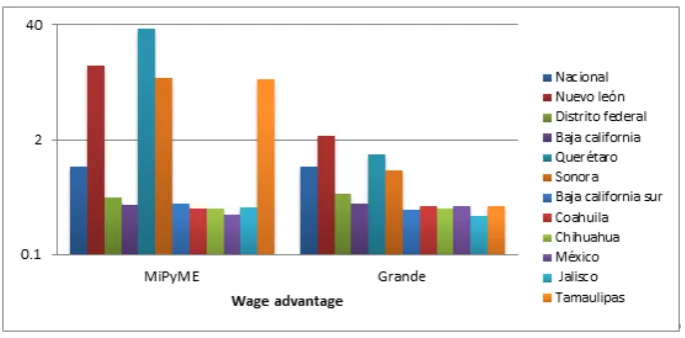
In the isolated present the results show themselves information obtained by means of the realized investigation(research), since they are the comparison of the wage advantage between the SMEss and the BC of each one of the states that shape the Mexican republic, taking as a base the information obtained in the economic census 2009, INEGI, [16]. Figure see 1.
The figure 1 shows the comparison of the Wage Advantage among the SMEs and BC. The SMEss in Queretaro' state with 36.65 a major wage remuneration is observed, followed again Leon with 13.96, Sonora 10.06, Tamaulipas 9.6, Native 0.99, Mexico City 0.44, Baja California Sur 0.38, Baja California 0.36, Jalisco 0.34, Coahuila and Chihuahua with 0.33 respectively and finally the State of Mexico with 0.28. While the Big Company the first place it obtained the state Nuevo Leon with 2.20, followed by Queretaro with 1.37, 0.98, Sonora 0.89, Mexico City 0.48, Tamaulipas and Coahuila are at the same level, Baja California, followed by Chihuahua, Baja California Sur and finally Jalisco state.
As shown in the figure 2, the State of Nuevo Leon with the 1.12 has the higher wage level, followed by Queretaro the 1.11, Sonora 1.01, National 0.99, Tamaulipas 0.98, Mexico City 0.47, Baja California Sur 0.37, Baja California 0.36, Chihuahua and Coahuila 0.33, Jalisco 0.32 are maintained with the same competitive wage level and finally the State of Mexico 0.29.
In figure 3 below is shown the relative competitiveness index. This index is obtained through data of productivity advantage and wage advantage. Queretaro is the State with the highest relative competitiveness with the 1.23, followed by Nuevo Leon 1.22, Tamaulipas 0.99, National 0.96, Sonora 0.95, Mexico City 0.811, Baja California Sur 0.54, Baja California 0.37, Jalisco 0.24, State of Mexico 0.811, Chihuahua 0.21, and finally Coahuila 0.07.
[image:4.595.127.470.546.715.2]Source: Own elaboration based on data from the 2009 Economic Census, INEGI.
Source: Own elaboration based on data from the 2009 Economic Census, INEGI.
Figure 2. Wage advantage by federal entity and national (2009)
[image:5.595.127.471.281.446.2]Source: Own elaboration based on data from the 2009 Economic Census, INEGI.
Figure 3. Relative competitiveness index by federal entity and national (2009) This table 2 it can appreciate the elaborated indexes of
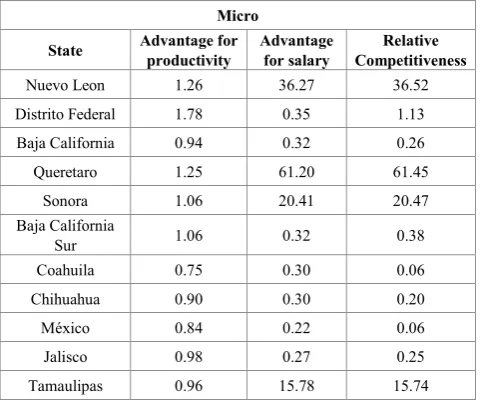
the advantage for productivity, the advantage for salary and the relative competitiveness of the micro company for New Leon, D.F., Sonora, Baja California, Baja California Sur, Queretaro, Coahuila, Chihuahua, Estado de Mexico, Jalisco and Tamaulipas. It is possible to observe that in the productive state’s advantage that the major goes to Distrito Federal with the 1.78, on the other hand in the index of advantage for salary and the competitiveness relative the state that has it is Queretaro with 61.20 and 61.45, respectively. In addition, it can be observed that in the microenterprises the Advantage for salary has a high correlation with the relative to the Relative Competitiveness in which they emphasize like first place the state of Queretaro with 61.20 and 61.45 respectively, followed by Nuevo Leon with 36.27 And 36.52. On the other hand, the Advantage for productivity, which has the highest index is the Federal District with 1.78 but is in the last places in the other indexes analyzed, is not necessarily having a high index of Relative Competitiveness brings with it an effect in the same Measured in Advantage for productivity and Advantage for productivity.
Table 2. Comparison of Indexes of advantage for productivity - salary and relative Competitiveness of the micro company (2009)
Micro
State Advantage for productivity Advantage for salary Competitiveness Relative
Nuevo Leon 1.26 36.27 36.52
Distrito Federal 1.78 0.35 1.13 Baja California 0.94 0.32 0.26
Queretaro 1.25 61.20 61.45
Sonora 1.06 20.41 20.47
Baja California
Sur 1.06 0.32 0.38
Coahuila 0.75 0.30 0.06
Chihuahua 0.90 0.30 0.20
México 0.84 0.22 0.06
Jalisco 0.98 0.27 0.25
Tamaulipas 0.96 15.78 15.74
Source: Own Elaboration with information of the Economic Census 2009, INEGI.
[image:5.595.302.543.504.704.2]and the relative competitiveness of the great company for Nuevo Leon, D.F., Sonora, Baja California, Baja California Sur, Queretaro, Coahuila, Chihuahua, Edo. de Mex., Jalisco and Tamaulipas. In this one figure highlights the index of wage advantage and relative competitiveness in Nuevo Leon being of 2.20 and 2.17 respectively, with an index very raised in comparison of the rest of the entities.
Table 3. Comparison of Indexes of advantage for productivity - salary and relative Competitiveness of the Great Company (2009)
Big
States Advantage for productivity Advantage for salary Competitiveness Relative
Nuevo Leon 0.97 2.20 2.17
Distrito Federal 1.15 0.48 0.63 Baja California 1.15 0.37 0.52
Queretaro 0.76 1.37 1.13
Sonora 0.69 0.89 0.57
Baja California
Sur 0.99 0.32 0.32
Coahuila 0.68 0.35 0.04
Chihuahua 0.50 0.33 -0.17
México 1.01 0.36 0.37
Jalisco 0.73 0.27 0.01
Tamaulipas 0.79 0.35 0.14
Source: Own Elaboration with Economic Census’ information 2009, INEGI.
In the above table, it can be observed that in the large companies they show the same behavior referring to the Advantage for salary index with high correlation with Relative Competitiveness in which the first place is the state of Nuevo Leon with 2.20 and 2.17 Respectively, followed by Queretaro with 1.37 and 1.13, which is very low compared to microenterprises at the national level. On the other hand, the Advantage for productivity that presents the highest index is Baja California and the Federal District with 1.15 in each of them, but they are in the last places in the other indexes analyzed.
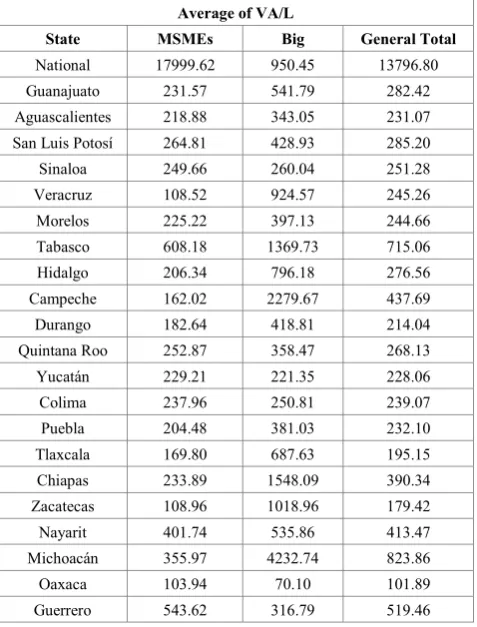
In the table 4 the behavior of the Value proves to be Attaché / personnel Remunerated of the National average, Aguascalientes, Campeche, Chiapas, Colima, Durango, Guanajuato, Guerrero, Hidalgo, Michoacan, Morelos, Nayarit, Oaxaca, San Luis Potosi, Quintana Roo, Sinaloa, Tabasco, Tlaxcala, Veracruz, Yucatan and Zacatecas. The National average presents to major competitive level of Added Value, follows the average Michoacan, Tabasco, Guerrero, Campeche, Nayarit, Chiapas, San Luis Potosi, Hidalgo, Quintana Roo, Sinaloa, Veracruz, Morelos, Colima, It populates, Aguascalientes, Yucatan, Durango, Tlaxcala, Zacatecas and Finally Oaxaca's state.
In the table 5 the behavior of the Value proves to be Agregado/Personal Remunerated of the National average,
Aguascalientes, Campeche, Chiapas, Colima, Durango, Guanajuato, Guerrero, Hidalgo, Michoacan, Morelos, Nayarit, Oaxaca, San Luis Potosi, Quintana Roo, Sinaloa, Tabasco, Tlaxcala, Veracruz, Yucatan and Zacatecas. The National average presents a major competitive level of Added Value, follows the average Michoacan, Tabasco, Guerrero, Campeche, Nayarit, Chiapas, San Luis Potosi, Hidalgo, Quintana Roo, Sinaloa, Veracruz, Morelos, Colima, It populates, Aguascalientes, Yucatan, Durango, Tlaxcala, Zacatecas and Finally Oaxaca's state.
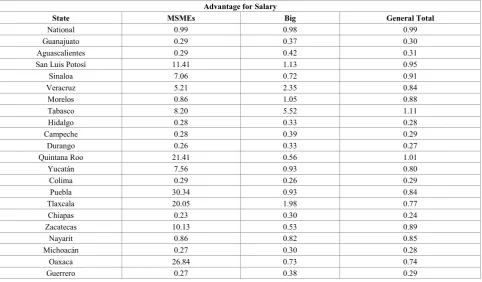
In the table 6, there appears the comparison of the Wage Advantage of the MiPyMEs. The state of Populates Zacatecas, Tabasco shows a major wage remuneration followed by the state of Oaxaca, Quintana Roo, Tlaxcala, San Luis Fortune, Yucatan, Sinaloa, Veracruz, National Average, Morelos, Nayarit, Aguascalientes, Guanajuato, Colima, Campeche, Hidalgo, Guerrero, Michoacan, Durango and Chiapas. In the Big Company it is Tabasco's state, Veracruz, Tlaxcala, San Luis Potosi, Morelos, Yucatan, It populates, Nayarit, Oaxaca, Sinaloa, Quintana Roo, Zacatecas, Aguascalientes, Campeche, Guerrero, Guanajuato, Hidalgo, Durango, Chiapas, Michoacan and Colima.
Table 4. Comparison of Value Added between Remunerated Personnel (2009)
Average of VA/L
State MSMEs Big General Total
National 17999.62 950.45 13796.80 Guanajuato 231.57 541.79 282.42 Aguascalientes 218.88 343.05 231.07 San Luis Potosí 264.81 428.93 285.20 Sinaloa 249.66 260.04 251.28 Veracruz 108.52 924.57 245.26 Morelos 225.22 397.13 244.66 Tabasco 608.18 1369.73 715.06 Hidalgo 206.34 796.18 276.56 Campeche 162.02 2279.67 437.69 Durango 182.64 418.81 214.04 Quintana Roo 252.87 358.47 268.13 Yucatán 229.21 221.35 228.06
Colima 237.96 250.81 239.07
Puebla 204.48 381.03 232.10
Tlaxcala 169.80 687.63 195.15 Chiapas 233.89 1548.09 390.34 Zacatecas 108.96 1018.96 179.42 Nayarit 401.74 535.86 413.47 Michoacán 355.97 4232.74 823.86
Oaxaca 103.94 70.10 101.89
[image:6.595.53.293.195.399.2] [image:6.595.303.542.387.701.2]Table 5. Comparison of Value Added among Remunerated Personnel (2009).
Average of VA/L
State MSMEs Big General Total
National 17999.62 950.45 13796.80
Guanajuato 231.57 541.79 282.42
Aguascalientes 218.88 343.05 231.07
San Luis Potosí 264.81 428.93 285.20
Sinaloa 249.66 260.04 251.28
Veracruz 108.52 924.57 245.26
Morelos 225.22 397.13 244.66
Tabasco 608.18 1369.73 715.06
Hidalgo 206.34 796.18 276.56
Campeche 162.02 2279.67 437.69
Durango 182.64 418.81 214.04
Quintana Roo 252.87 358.47 268.13
Yucatán 229.21 221.35 228.06
Colima 237.96 250.81 239.07
Puebla 204.48 381.03 232.10
Tlaxcala 169.80 687.63 195.15
Chiapas 233.89 1548.09 390.34
Zacatecas 108.96 1018.96 179.42
Nayarit 401.74 535.86 413.47
Michoacán 355.97 4232.74 823.86
Oaxaca 103.94 70.10 101.89
Guerrero 543.62 316.79 519.46
Source: Own Elaboration with Economic Census’ information 2009, INEGI
Table 6. Comparison of the Wage advantage between the MSME, BC and the General Total (2009)
Advantage for Salary
State MSMEs Big General Total
National 0.99 0.98 0.99
Guanajuato 0.29 0.37 0.30
Aguascalientes 0.29 0.42 0.31
San Luis Potosí 11.41 1.13 0.95
Sinaloa 7.06 0.72 0.91
Veracruz 5.21 2.35 0.84
Morelos 0.86 1.05 0.88
Tabasco 8.20 5.52 1.11
Hidalgo 0.28 0.33 0.28
Campeche 0.28 0.39 0.29
Durango 0.26 0.33 0.27
Quintana Roo 21.41 0.56 1.01
Yucatán 7.56 0.93 0.80
Colima 0.29 0.26 0.29
Puebla 30.34 0.93 0.84
Tlaxcala 20.05 1.98 0.77
Chiapas 0.23 0.30 0.24
Zacatecas 10.13 0.53 0.89
Nayarit 0.86 0.82 0.85
Michoacán 0.27 0.30 0.28
Oaxaca 26.84 0.73 0.74
Guerrero 0.27 0.38 0.29
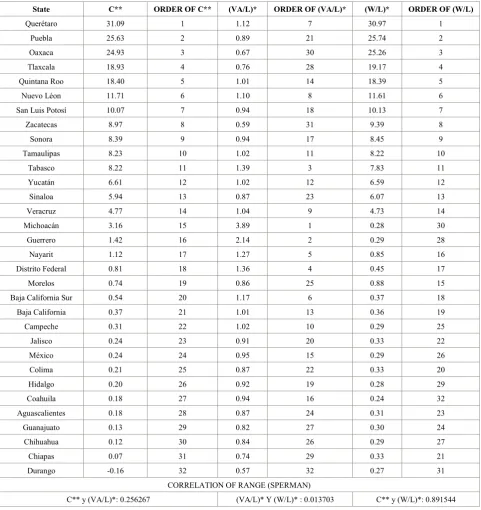
[image:7.595.56.542.91.374.2] [image:7.595.57.540.409.691.2]As it appears in previous following table is observed the position in which there was placed every state of the Mexican Republic in the comparison of the Competitiveness, Productivity and Wages of the General Total, where 1 means that it is the most competitive state and 32 the least competitive. Likewise, there were
calculated the Correlations of range of the General Total of the States; in case of C** and (VA/L)*: 0.25626; and (VA/L)* And (W/L)*: 0.013703; since the value approaches 0 wants to say that there is no linear correlation in case of C ** and (W/L) *: a positive correlation exists 0.891544.
Table 7. Classification of Competitiveness, Productivity and Wages: Correlations of range of the Total of the States.
State C** ORDER OF C** (VA/L)* ORDER OF (VA/L)* (W/L)* ORDER OF (W/L)
Querétaro 31.09 1 1.12 7 30.97 1
Puebla 25.63 2 0.89 21 25.74 2
Oaxaca 24.93 3 0.67 30 25.26 3
Tlaxcala 18.93 4 0.76 28 19.17 4
Quintana Roo 18.40 5 1.01 14 18.39 5
Nuevo Léon 11.71 6 1.10 8 11.61 6
San Luis Potosí 10.07 7 0.94 18 10.13 7
Zacatecas 8.97 8 0.59 31 9.39 8
Sonora 8.39 9 0.94 17 8.45 9
Tamaulipas 8.23 10 1.02 11 8.22 10
Tabasco 8.22 11 1.39 3 7.83 11
Yucatán 6.61 12 1.02 12 6.59 12
Sinaloa 5.94 13 0.87 23 6.07 13
Veracruz 4.77 14 1.04 9 4.73 14
Michoacán 3.16 15 3.89 1 0.28 30
Guerrero 1.42 16 2.14 2 0.29 28
Nayarit 1.12 17 1.27 5 0.85 16
Distrito Federal 0.81 18 1.36 4 0.45 17
Morelos 0.74 19 0.86 25 0.88 15
Baja California Sur 0.54 20 1.17 6 0.37 18
Baja California 0.37 21 1.01 13 0.36 19
Campeche 0.31 22 1.02 10 0.29 25
Jalisco 0.24 23 0.91 20 0.33 22
México 0.24 24 0.95 15 0.29 26
Colima 0.21 25 0.87 22 0.33 20
Hidalgo 0.20 26 0.92 19 0.28 29
Coahuila 0.18 27 0.94 16 0.24 32
Aguascalientes 0.18 28 0.87 24 0.31 23
Guanajuato 0.13 29 0.82 27 0.30 24
Chihuahua 0.12 30 0.84 26 0.29 27
Chiapas 0.07 31 0.74 29 0.33 21
Durango -0.16 32 0.57 32 0.27 31
CORRELATION OF RANGE (SPERMAN)
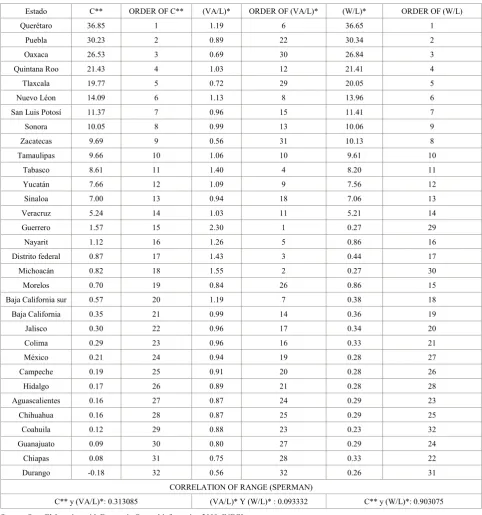
[image:8.595.58.540.181.692.2]In the table 8 classification of competitiveness, productivities and wages correlations of range of the MSMEs of the states, observes the position in which there was placed every state of the Mexican Republic in the comparison of the Competitiveness, Productivity and Wages of the MSMEs, where 1 means that it is the most competitive state and 32 the least competitive. Likewise,
there were calculated the Correlations of range of the General Total of the States; in case of C** and (VA/L)*: 0.313085; and (VA/L)* and (W/L)*: 0.093332; since the value approaches 0 wants to say that there is no linear correlation in case of C** and (W/L)*: a positive correlation exists 0.903075.
Table 8. Classification of Competitiveness, Productivity and Wages: Correlations of range of the MSMEs of the States. Estado C** ORDER OF C** (VA/L)* ORDER OF (VA/L)* (W/L)* ORDER OF (W/L)
Querétaro 36.85 1 1.19 6 36.65 1
Puebla 30.23 2 0.89 22 30.34 2
Oaxaca 26.53 3 0.69 30 26.84 3
Quintana Roo 21.43 4 1.03 12 21.41 4
Tlaxcala 19.77 5 0.72 29 20.05 5
Nuevo Léon 14.09 6 1.13 8 13.96 6
San Luis Potosí 11.37 7 0.96 15 11.41 7
Sonora 10.05 8 0.99 13 10.06 9
Zacatecas 9.69 9 0.56 31 10.13 8
Tamaulipas 9.66 10 1.06 10 9.61 10
Tabasco 8.61 11 1.40 4 8.20 11
Yucatán 7.66 12 1.09 9 7.56 12
Sinaloa 7.00 13 0.94 18 7.06 13
Veracruz 5.24 14 1.03 11 5.21 14
Guerrero 1.57 15 2.30 1 0.27 29
Nayarit 1.12 16 1.26 5 0.86 16
Distrito federal 0.87 17 1.43 3 0.44 17
Michoacán 0.82 18 1.55 2 0.27 30
Morelos 0.70 19 0.84 26 0.86 15
Baja California sur 0.57 20 1.19 7 0.38 18
Baja California 0.35 21 0.99 14 0.36 19
Jalisco 0.30 22 0.96 17 0.34 20
Colima 0.29 23 0.96 16 0.33 21
México 0.21 24 0.94 19 0.28 27
Campeche 0.19 25 0.91 20 0.28 26
Hidalgo 0.17 26 0.89 21 0.28 28
Aguascalientes 0.16 27 0.87 24 0.29 23
Chihuahua 0.16 28 0.87 25 0.29 25
Coahuila 0.12 29 0.88 23 0.23 32
Guanajuato 0.09 30 0.80 27 0.29 24
Chiapas 0.08 31 0.75 28 0.33 22
Durango -0.18 32 0.56 32 0.26 31
CORRELATION OF RANGE (SPERMAN)
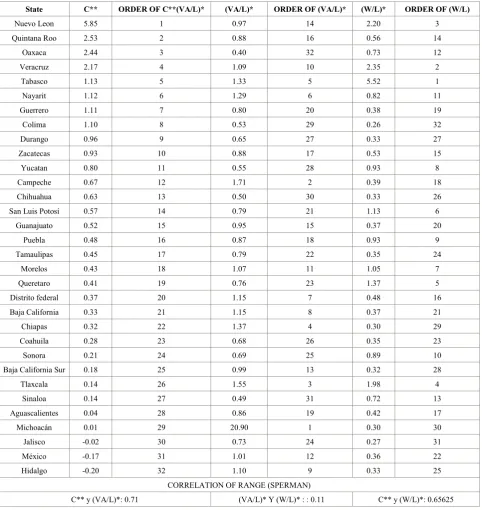
[image:9.595.56.539.191.707.2]As one shows in the table 9 is observed the position in which there was placed every State of the Mexican Republic in the comparison of the Competitiveness, Productivity and Wages of the MSME, where 1 means that it is the most competitive state and 32 the least competitive. Likewise, there were calculated the Correlations of range
of the General Total of the States; in case of C** and (VA/L)*: 0.71; and C** and (W/L)*: a positive correlation exists 0.65625 since the values approach 1, in case of (VA/L)* And (W/L)*: 0.11; since the value approaches 0 wants to say that there is no linear correlation.
Table 9. Classification of Competitiveness, Productivity and Wages: Correlations of range of the Great Company of the States.
State C** ORDER OF C**(VA/L)* (VA/L)* ORDER OF (VA/L)* (W/L)* ORDER OF (W/L)
Nuevo Leon 5.85 1 0.97 14 2.20 3
Quintana Roo 2.53 2 0.88 16 0.56 14
Oaxaca 2.44 3 0.40 32 0.73 12
Veracruz 2.17 4 1.09 10 2.35 2
Tabasco 1.13 5 1.33 5 5.52 1
Nayarit 1.12 6 1.29 6 0.82 11
Guerrero 1.11 7 0.80 20 0.38 19
Colima 1.10 8 0.53 29 0.26 32
Durango 0.96 9 0.65 27 0.33 27
Zacatecas 0.93 10 0.88 17 0.53 15
Yucatan 0.80 11 0.55 28 0.93 8
Campeche 0.67 12 1.71 2 0.39 18
Chihuahua 0.63 13 0.50 30 0.33 26
San Luis Potosí 0.57 14 0.79 21 1.13 6
Guanajuato 0.52 15 0.95 15 0.37 20
Puebla 0.48 16 0.87 18 0.93 9
Tamaulipas 0.45 17 0.79 22 0.35 24
Morelos 0.43 18 1.07 11 1.05 7
Queretaro 0.41 19 0.76 23 1.37 5
Distrito federal 0.37 20 1.15 7 0.48 16
Baja California 0.33 21 1.15 8 0.37 21
Chiapas 0.32 22 1.37 4 0.30 29
Coahuila 0.28 23 0.68 26 0.35 23
Sonora 0.21 24 0.69 25 0.89 10
Baja California Sur 0.18 25 0.99 13 0.32 28
Tlaxcala 0.14 26 1.55 3 1.98 4
Sinaloa 0.14 27 0.49 31 0.72 13
Aguascalientes 0.04 28 0.86 19 0.42 17
Michoacán 0.01 29 20.90 1 0.30 30
Jalisco -0.02 30 0.73 24 0.27 31
México -0.17 31 1.01 12 0.36 22
Hidalgo -0.20 32 1.10 9 0.33 25
CORRELATION OF RANGE (SPERMAN)
[image:10.595.58.541.181.692.2]3. Discussion
As shown in table 7, the ranking of competitiveness, productive advantage and the salary advantage of the rank correlations of the total of the states being the most competitive the one of Queretaro with a value of 31.09 and the less competitive one of Durango with -0.16. In productivity is Michoacán with 3.89 and the least productive Durango 0.57. Finally, the salary advantage that the number one of the states is Queretaro with 30.97 and the thirty-two is Coahuila with 0.24. The results obtained from competitiveness have a high relation with wages, but not with the productive advantage, since as mentioned by Cequea and Rodriguez-Monroy [10], the factors that have a high influence on the productivity of the organizations are those that intervene in The performance of people and their results, among which we can mention the interpersonal skills of management, training, development and internalization of objectives, motivation, participation, satisfaction, consensus, cohesion and conflict.
Within the results obtained in this research it is observed that the index of the wage advantage the state that is in position 1 is Queretaro, however, in the advantage of productive is in the place 7. In contrast, the state of Michoacán was placed in position 1 and the advantage of the salary is in the 30 of the 32 that make up the Mexican Republic. This affirms the results obtained by Rodríguez and Castillo [7] in which it was found that, in the long run, wages share common movements with productivity and employment, but not in the short term.
The importance of the stratification of the companies in Mexico that announces the official diary of the federation (ODF) in December, 2002, is very important, since depending on the number of workers' range the companies qualify as mike, small, medium or big and this stratification is applied to the economic census corresponding to the period 2009. In addition, the intangible capacities for the micro-managerial competitiveness in Mexico of four economic sectors like it are the manufacture, trade, services and construction Sources, Fuentes, Osorio and Mungaray [8].
In Mexico, the SMEs together with the micro-companies represent more than 99% of all the companies; of which 4'877,070 are micro-companies, 214,956 small ones and 42,415 medium companies, whereas they are 9,615 big companies. Besides being a majority they represent an important part of the employment in Mexico since he constitutes a 78.5% of employment on the part of the MSMEs and 21.5% of the GE; united to it the SME occupies 78,5%de the workforce and contributes with 52% of the national GDP, whereas the great company occupies 21,5% of the generation of employments and contributes with 48% of the national GDP, since already it is possible to observe in the figures 1 and 2 in which it is estimated that exactly the MSMEs are those that contribute major employment in the Mexican country INEGI [15].
It is necessary to mention that though the MSMEs constitute an important part of the employment generated in Mexico and its contribution to the GDP is high than the GE, the SMEs do not rely on many of the necessary resources in order that they develop in a full way and there exist in the country big problems that affect them to a great extent, affecting its competitiveness with regard to the big companies. In addition, in the study realized by Macias[12] one of the principal results is that the analysis of competitiveness of the principal vegetables and fruits that Mexico exports to EUA, in these days competes with other nations, which every time gain more market shares putting in risk this sector in a short term.
The calculation of the structure was obtained by size and sector of the companies in Mexico, where the industrial, commercial activities and of services of the micro company 3 represent a total '534,526 (94.98%), Small 142,653 (3.83%), median 37,186 (1.00%) and the Big one with 7,055 (0.19%). This is reaffirmed as it there mentions Romero [18] in Mexico the general panorama of the studies on the managerial structure, businessmen, merchant, etc., it presents very heterogeneous characteristics. Likewise, it describes the competitiveness depending on the wages and the added value that is generated in every federative entity. One of the principal results is observes the comparison of the state ranking of the IMCO Mexican Institute for the Competitiveness [12] and the competitiveness freed from the economic census 2009, classifying the competitiveness freed from the general total, MSMEs and the Great Company, where is observed the position in which there was placed every state of the Mexican Republic in which 1 means that it is the most competitive state, for the MSMEs the state that this in the position 1 is Queretaro and in the position 32 it is Durango. For the Big Company, they are Nuevo Leon and Hidalgo like it can observe in the tables 7 and 8. Mentions Unger Flowers and Ibarra [1] the most competitive states have a more diversified productive structure. This is to minor competitiveness one depends in a major degree of few activities that represent a major importance for the local economy.
On the other hand, is observed that in these competitive states the salaries change according to the position of the state; for example, in case of the General Total the same competitive states meet with the exception of the state of Yucatan, since Tlaxcala's state relies on a major wage and productive competitiveness. In the MSMEs, there meet the best and more favorable conditions of productivity and high-level wage; Queretaro is the state with major wage remuneration with 36.6%; and in the great company Tabasco 5.5 are located first as the state by major wage remuneration, they follow the state of Veracruz, New Leon, Tlaxcala, Queretaro, San Luis Potosí, Morelos, National Average, Yucatan, It populates and Sonora.
Lowers California South, Queretaro, New Leon, Veracruz, Campeche and Tamaulipas. In the MSMEs Guerrero it is the state with major productive competitiveness consecutive by Michoacán’s state, Distrito Federal, Tabasco, Nayarit, Queretaro, Baja California Sur, Nuevo Leon, Yucatan, Tamaulipas and Veracruz. In the great company Michoacán it is the state with major productive competitiveness, follows by state of Campeche, Tlaxcala, Coahuila, Tabasco, Nayarit, Distrito Federal, Baja California, Hidalgo, Veracruz and Morelos.
Another important finding is that a higher salary increases production costs by what corresponds to the hand, which causes a decrease in the productive advantage, while when wages decrease the productive advantage suffers an increase. In the research results of Vergeer and Kleinknecht [5] is that to a greater participation of the wages in the national income the companies will try to reduce to the maximum the labor factor that directly affects the costs of production. Thus, high wage participation will be an incentive to invest in ways of increasing labor productivity.
Given the indexes IHH and DI for the General Total and the MSMEs the states of Fall California, Coahuila, Colima, Chihuahua, Morelos, Nayarit, Puebla, Sinaloa and Yucatan are states with a monopolistic control, since the results go to 10,000. While the rest of the states, present a competitive structure. In case of the Great Company the states of Chihuahua and Sinaloa are states that rely on a monopolistic control, since the results go to 10,000; whereas, the rest of the states present a competitive structure.
4. Conclusions
The intention of this investigation’s work has been to observe the managerial discharge across the relative competitiveness of 32 federative entities of the country. For it they were elected 18 of 20 branches of the economic activity, I classify the MSMEs and the Great Company and the importance of the activities was outlined in the productivity, the employment and the salary for every state of the Mexican Republic included the National level.
The relative competitiveness was constructed from the sum of the estimations of advantage by productivity and advantage by salary by state; giving proved a group of competitive states significantly over another group of minor competitiveness. In case of the Ranking IMCO [11], the relative total competitiveness, relative competitiveness SMEs and competitiveness Great Company the results were varied; since the competitive states are characterized by major both productive and wage levels.
On the other hand, the early hypotheses are confirmed where the competitiveness of the conditions states of the country measures up across the managerial structure of the SMEs, since the most competitive conditions states (it is
that of case of the SMEs or the G.E.) they possess a managerial structure, a productivity and therefore a higher wage advantage, whereas the least competitive states depend on few activities and rely on indexes of productivity and wage minor. This way so, the performance of the companies determines the level of competitiveness of the states.
Future researches must consider the economic census corresponding to the period 2014 that the INEGI has just made official, for a deeper analysis, likewise repay the economic census 2004 to see how it has changed in this period of time and to observe if the raised hypotheses continue being fulfilled or are rejected.
REFERENCES
[1] Unger, K.; Flores, D. e Ibarra, J. E. (2014). Productividad y capital humano: fuentes complementarias de la competitividad de los estados mexicanos. El Trimestre Económico, Vol. LXXXI. No. 4. Pp. 909-941.
[2] Góngora, J. P. (2013). El Panorama de las micro, pequeñas y medianas empresas en México. Comercio Exterior, Vol. 63, Núm. 6.
[3] DOF Diario Oficial de la Federación (2002). Ley para el desarrollo de la competitividad de la micro, pequeña y mediana empresa. Publicado el 30 de diciembre de 2002. [4] De La O, Hernandez., Ramírez, A.J., Ayala D., y Bonilla, F.
(2007). Impacto socioeconómico de la PyME en México. En C. Fong Reynoso (Ed.), La PyME en México. Situación Actual y Retos Estratégicos. Guadalajara: Ed. Universidad de Guadalajara.
[5] Vergeer, R. y Kleinknecht, A. (2014). ¿Cómo afecta la desreglamentación a la productividad laboral? Análisis con datos de panel de 20 países de la OCDE (1960-2004). Revista Internacional del Trabajo. Vol. 133(2014), No. 3. Pp.403-435.
[6] Cuevas, V. M. (2010). México: dinámica de las exportaciones manufactureras. Revista Cepal. Núm. 102. Pp. 153-174.
[7] Rodríguez, E. M y Castillo, P. R. (2009). Empleo, productividad y salarios en México: Un análisis de corto y largo plazo para el sector manufacturero. EconoQuantum. Vol. 5, No. 2. Pp.7-21.
[8] Fuentes, N., Osorio, G. y Mungaray, A. “Capacidades intangibles para la competitividad microempresarial en México”, en: Revista Problemas del Desarrollo. México. Vol. 186 (47), julio-septiembre, 2016, pp.83-106.
[9] Marín, I. Y Diego, A. “Estructura organizacional y sus parámetros de diseño: análisis descriptivo en pymes industriales de Bogotá”, en: Estudios Gerenciales. [on line] Vol. 28, Núm. 123, abril-junio, 2012, pp. 43-63. http://www.redalyc.org/articulo.oa?id=21224852003> ISSN 0123-5923
y factores humanos. Un modelo con ecuaciones estructurales. INTERCIENCIA, Vol. 37, Núm. 2. Pp. 121-127.
[11]Graña, J. y Kennedy, D. (2011). Producción de la riqueza social y su distribución: productividad y salarios en Argentina. Medio siglo en perspectiva latinoamericana e internacional. Cuestiones de Sociología: Revista de estudios sociales, Núm. 7 Pp. 27-53.
[12]Macias, A. “Competitividad de México en el mercado de frutas y hortalizas de Estados Unidos de América”, en: Agroalimentaria. Vol. 16, Núm. 31, julio-diciembre, 2010, pp. 31-48.
[13]McFetridge, D. (1995), “Competitiveness: Concepts and measures”, Occasional Paper N°5, Industry, Canada. [14]Martin, R. y P. Sunley. “Desconstructing cluster: policy
panacea or chaotic concept”, en: Journal of Economic Geography. 2003, pp. 5-35.
[15] INEGI Instituto Nacional de Estadística y geografía (2009). Micro, pequeña, mediana y gran empresa: estratificación de los establecimientos: Censos económicos 2009. México: INEGI, c2011. [on line] http://goo.gl/Xpnk7Z
[16] INEGI Instituto Nacional de Estadística y geografía (2009). Censo Económico 2009. Consultado Junio 2014. [on line] http://www.inegi.org.mx/ http://goo.gl/lDpQGR
[17] IMCO Instituto Mexicano para la Competitividad (2008). Índice de competitividad estatal 2008: Aspiraciones y realidad; las agendas del futuro, México DF. 2008 [on line] http://goo.gl/bGLJcZ
[18] Romero Ibarra, M. E. (2003). La Historia Empresarial. Historia Mexicana. El Colegio de México A.C., Distrito Federal, México. Vol. LII, Núm. 3, enero-marzo, 2003, pp. 806-829.