Enhancing Informed Choice for Genetic Screening:
A Pilot Study
Christy L. Skelly
1,*, Suzan Ulrich
21Florida Southern College, United States 2Saint Catherine University, United States
Copyright © 2014 Horizon Research Publishing All rights reserved.
Abstract
Birth defects are the leading cause of infant mortality. New tests offer screening for many fetal aneuploidies. These tests are offered very early in pregnancy and clients are faced with many options. This has made the education of the client more challenging and threatens the ability of the client to make an informed choice. The purpose of this project was to measure the level of informed choice women reported after making a decision on whether or not to have the many optional prenatal genetic screening tests. The level of informed choice was measured using the Multi-dimensional Measure of Informed Choice (MMIC), at a Midwestern private OB-GYN office. This capstone project was a small pilot study which included 26 prenatal clients. Seventy-five percent of the prenatal clients had good knowledge and 57 percent made an informed choice. Future studies and methods will focus on improving this reported level.Keywords
Fetal Aneuploidy, Informed Choice, Prenatal Genetic Screening1. Introduction
More infants die from birth defects than any other cause. Birth defects accounted for 5,107 infant deaths, or 6.15 deaths per 1,000 live births in 2010. [1] A birth defect is a structural, metabolic, or functional abnormality [2]. One in every 33 babies born in the United States is born with a birth defect, affecting approximately 120,000 babies each year [3]. Most birth defects are believed to be caused by harmful behaviors or a combination of teratogenic and genetic factors [4]. Prenatal genetic screening tests are often able to screen for fetal aneuploidy and there are new testing options continually being developed. The education of the client about available prenatal genetic screening test options is vital to ensuring the informed choice of the client. Current practice guidelines state that all prenatal clients, regardless of age risk, should be offered screening for fetal aneuploidy [5].
Evidence exists that many patients are not able to make an informed choice regarding optional prenatal testing because of the lack of information, lack of correct information, faulty information delivery, faulty information delivery system, a failure of client’s values to be reflected in the decision, and inadequate healthcare provider knowledge [6-15]. Healthcare providers have an ethical duty to ensure that an informed choice is being made.
As evidence based practice continues to evolve, the process of measuring and collecting data regarding informed choice is vital. Informed choice is endorsed by the current national and international guidelines such as The World Health Organization and the American Congress of Obstetricians and Gynecologist (ACOG) and the American College of Nurse-Midwives (ACNM) [5, 16, 17]. Many health care providers may need additional education and support to remain up to date on current and ever-changing options so they can fully inform prenatal clients [7,13, 18-20].
2. Materials and Methods
This descriptive study utilized a convenience sample to measure the level of informed choice of prenatal clients regarding optional prenatal genetic screening tests. Clients who wished to participate in the study were asked to complete the MMIC tool [10] after they received routine education regarding the prenatal tests. The inclusion criteria of this purposeful sample included clients who were 18 years of age or more, literate, and pregnant.
2.1. Tool
maker’s values and behaviorally implemented” [10, p100]. The tool consists of an eight item knowledge test, a four item attitude scale, and the respondent’s testing decision. The tool was tested for reliability using a Cronbach’s alpha achieving values of 0.68 and 0.78 for the knowledge and attitude components. [8]. The tool has been widely used and continues to be used today [21]. The tool was modified to reflect current testing options.
2.2. Method
The author of the tool was located and permission for use was obtained. The tool was adapted to reflect the current genetic screening test options and a demographic component was added. The tool was administered by two nurse practitioners at a prenatal visit following education about prenatal testing. Inclusion criteria specified that the prenatal client was 18 years of age or older, English speaking and literate, and had already made the testing decision. IRB approval was received from Frontier Nursing University. The nurse practitioners were instructed on how to obtain informed consent for the study and on the administration of the tool. Clients were numbered and confidentiality was maintained. The demographic information was collected with the informed consent page and the MMIC tool in order to describe the participants. The data collection took place over two to four weeks in the summer of 2012. A minimum of twenty-five clients was targeted. Thirty clients completed the tool.
2.3. Data Analysis
There were two MMIC tools returned with incomplete data in the knowledge and attitude sections so analysis included only 28 tools. There was one subject who did not indicate the testing decision, so when the testing decision was calculated, the n was 29. Because this is a multi-dimensional tool and all sections must be complete to assess informed choice, informed choice was calculated for the 26 prenatal clients who completed all sections of the MMIC tool. The knowledge scores were computed, ranked, and means were calculated. A score lower than 5 indicates poor knowledge and the level at and above 5 indicates good knowledge. The attitude questions each had a possible range of 1 to 7. The lower the score, the more positive the attitude reported. The attitude score was calculated individually per item and a mean attitude score was tallied. The testing decision was recorded for each subject. Finally, scores were analyzed for informed choice. All, who made an informed choice required a good knowledge score, and a testing decision that corresponded to the attitude score. Therefore, a client with good knowledge and a positive attitude who opted to have the testing made an informed choice. Inversely, a client with good knowledge, a poor attitude who opted not to have the testing also made an informed choice. All clients who had poor knowledge did not make an informed choice even if the attitude and
decision matched.
3. Findings
3.1. Demographics
The educational level of the clients was not assessed individually. However, the high school graduation rate within this population is 81.4 percent with 30 percent living below the poverty level [22]. One survey had blank demographic information but had complete data on the MMIC tool. The demographics of the 25 of the 26 prenatal clients in whom the informed choice was measured were tallied. Nine prenatal clients reported that this was their first pregnancy, while for 10 prenatal clients, it was their second pregnancy, three prenatal clients were experiencing their third pregnancy, two prenatal clients their fourth pregnancy, and one subject was pregnant for the fifth time (see table 1).
Table 1. Pregnancy Number
Pregnancy Number First Second Third Fourth Fifth
Prenatal Clients 9 10 3 2 1
[image:2.595.313.555.540.584.2]The weeks pregnant when surveyed ranged from eleven to 37 weeks (see table 2).
Table 2. Weeks Pregnant
Weeks of Gestation #
12 weeks or less 4
13-20 weeks 4
21-28 weeks 7
29-37 weeks 3
No Response 7
Total 25
The prenatal clients ranged in age from X to X prenatal clients (see table 3).
Table 3. Age of Prenatal Clients
Age Range 18-24 25-30 31-35 36-40
Prenatal Clients 5 11 5 4
Four prenatal clients reported that they did not have a religious preference. Twenty-one prenatal clients did report a religious preference with 10 of those 21 reporting the type of preference or denomination (see table 4).
Table 4. Religious Preference
Religious Preference #
No Religious Preference 4
I do have a Religious Preference 21
Christian 7
Catholic 1
United Methodist 1
Seven of the 16 (44%) participants with previous pregnancies reported that they had genetic testing before. Thirteen of the prenatal clients reported knowing someone who had genetic testing with one subject also reporting that the experience of having the testing was a good experience. The participants were asked if they had any previous experiences with genetic disorders in their family or friends that they would like to share. The genetic disorders reported included Muscular Dystrophy (reported by 2 prenatal clients), Autism, Neural Tube Defect, Fragile X, and Down syndrome. One subject reported the concern of the testing giving false fears of possible problems.
3.2. Knowledge
A ranking of the knowledge scores was completed. The mean score for the knowledge section was 5.357 with a possible range from 0 to 10 and an achieved range of 1 to 8. A score lower than 5 indicates poor knowledge and the level at and above 5 indicates good knowledge. Seven of the prenatal clients had poor knowledge and 21 of the prenatal clients had good knowledge. The results for knowledge are reported below (see table 5).
Table 5. Knowledge Measures
Knowledge Measures Number/Percentage
Range Possible 0 to 10
Range Achieved 1 to 8
Mean 5.357
Median 5.5
Good Knowledge 5 or above 7 (25%)
Poor Knowledge below 5 21 (75%)
Total number of Participants 28
[image:3.595.56.300.500.675.2]3.2. Attitude
Table 6. Attitude Measures
Attitude Measures Values
Range Possible 4 to 28
Range Achieved 4 to 22
Mean 14.25
Median 16.5
Positive Attitude cut-off below 12
Negative Attitude cut-off higher than 12
Prenatal clients 28
Prenatal Clients with a Positive Attitude 7 (25%) Prenatal Clients with a Negative Attitude 21(75%)
The four attitude questions each had a possible range of 1 to 7. The lower the score, the more positive the attitude reported. The total possible attitude range was from 4 to 28. The actual achieved range was from 4 to 22. The Overall attitude mean was 14.25 with an N of 28. All of the items were tallied for an individual mean as well. A ranking of the
attitude scores was completed. The median was 16.5. Prenatal clients with a score of 12 or higher had a negative attitude and those with a score lower than 12 had a positive attitude. Seven of the prenatal clients were found to have a positive attitude and twenty-one of the prenatal clients were found to have a negative attitude. The results for attitude are reported below (see table 6).
3.3. Testing Decision
The testing decision was recorded for 29 prenatal clients. Eleven prenatal clients decided to have the testing. The n value for the testing decision was 29 with one client not reporting the decision. The values for the testing decision are listed below (see table 7).
Table 7. Testing Decision
Testing Decision Measures Numbers/Percentage
Decided to have testing 11 (38%)
Decided not to have testing 18 (62%)
Total number of Participants 29
3.4. Informed Choice
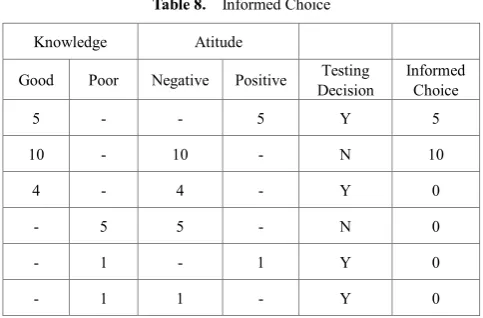
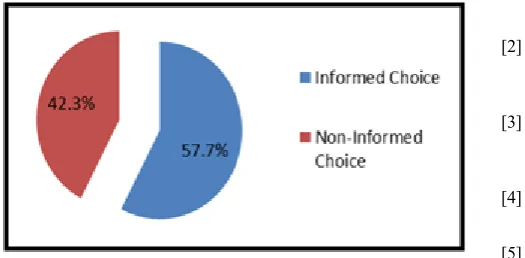
[image:3.595.311.553.593.752.2]According to the MMIC, an informed choice is made when a client has a positive attitude, good knowledge, and decides to have the testing or; the client has a negative attitude, good knowledge, and decides not to have the testing. Four of the prenatal clients were omitted due to incomplete data. An informed choice was made by 15 of the 26 prenatal clients (see table 8 and fig.1). Therefore, only a little over half of the prenatal clients made an informed choice. This level of informed choice is comparable to the levels reported in the literature. The original study by Marteau, Dormandy, and Michie reported a 42.8% level of informed choice [10] and other subsequent studies show 59% [8], 41% [6], and 37% [12]. One recent study illuminated the complete omission of testing in 87 of the 100 participants studied [13]. Clients rely on the education of their health providers; therefore much more attention should be given to measuring informed choice in all aspects of care.
Table 8. Informed Choice
Knowledge Atitude
Good Poor Negative Positive Decision Testing Informed Choice
5 - - 5 Y 5
10 - 10 - N 10
4 - 4 - Y 0
- 5 5 - N 0
- 1 - 1 Y 0
Figure 1. Percentage of Prenatal Clients and Choice Level
3.5. Limitations
This study was a small pilot study and therefore the results are not generalizable to larger population. However, the data was used internally to inform and transform the educational method of the clients within the setting. The sample was a small convenience sample and this also poses possible bias to the study results. Additional randomization and a larger sample size are imperative for future studies. Further analysis of the clients who made an informed choice will also be valuable. The variables of educational level and socioeconomic status would ideally also be included in future studies.
4. Conclusions
As technology advances, it is imperative for the advanced practice nurse and all prenatal care providers to provide current information about optional prenatal genetic tests. Clients who make choices about the testing that are consistent with good education and the client’s attitude are informed. This study revealed the current level of informed choice at one practice and produced a genetic screening toolkit to assist in education clients. Future studies and method will focus on increasing this level.
Acknowledgements
This study was part of a Capstone Project for Frontier University. I am very grateful to the program director, Dr. Barbara Anderson, my Capstone Chair Dr. Suzan Ulrich, my content expert Dr. Gretchen Mettler and my assistant and mother Dr. Loretta Reinhart for their guidance and support during this study.
REFERENCES
[1] TJ Mathews, Marian F. MacDorman. Infant mortality statistics from the 2010 period linked birth/infant death data set. National Vital Statistics Reports, Vol.62, No.8, 1-27,
2013.
[2] March of Dimes. Medical Resources. Online available from http://www.marchofdimes.com/professionals/medical-resour ces.aspx#QATabAlt
[3] March of Dimes. Birth Defects Research. Online available fromhttp://www.marchofdimes.com/research/birth-defects-re search.aspx#QATabAlt
[4] CDC. Birth Defects: Leading Cause of Infant Death. Online available from http://www.cdc.gov/Features/dsInfantDeaths/ [5] ACOG. Practice Bulletin 77: Clinical management guidelines
for obstetricians-gynecologists: Screening for fetal chromosomal abnormalities. 2007
[6] E. Dormandy, R. Hooper, S. Michie,T.M. Marteau. Informed choice to undergo prenatal screening: A comparison of two hospitals conducting testing either as a part of a routine visit or requiring a separate visit. Journal of Medical Screening, Vol. 9, no. 3, 109-114, 2002.
[7] S. Gammons, R. Sooben, S. Helam. Support and information about Down syndrome screening. British Journal of Midwifery. Vol. 18, No. 11, 700-708, 2010.
[8] S. Michie, E. Dormandy, T. Marteau. The multi-dimensional measure of informed choice: A validation study. Patient Education and Counseling. Vol. 48, No.1, 87-91, 2002. [9] R.M. Farell, B. Nutter, P.K. Agatisa. Meeting patients’
education and decision making needs for first trimester prenatal aneuploidy screening. Prenatal Diagnosis. Vol. 31, No. 13, 1222-1228, 2011.
[10] T.M. Marteau, E. Dormandy, D. Michie. A measure of informed choice. Health Expectations. Vol. 4, No. 2, 99-108, 2001.
[11] H.J. Rowe, J.R.W. Fisher, J.A. Quinlivan. Are pregnant Australian women well informed about prenatal genetic screening? A systematic investigation using the multidimensional measure of informed choice. Australian and New Zealand Journal of Obstetrics and Gynaecology. Vol. 46, no. 5, 433-439, 2006.
[12] H. Rowe, J. Fisher, Quinlivan. Women who are well informed about prenatal genetic screening delay emotional attachment to their fetus. Journal of Psychosomatic Obstetrics & Gynaecology. Vol. 30, No. 1, 34-41. 2009.
[13] H. Skirton, O. Barr. Antenatal screening and informed choice; A cross-sectional survey of parents and professionals. Midwifery. Vol. 26. No. 6, 596-602, 2010.
[14] D. Tapon. Prenatal testing for Down syndrome: Comparison of screening practices in the UK and USA. Journal of Genetic Counsel. Vol. 19, No. 2, 112-130, 2010.
[15] R.M. Farrell, N. Dolgin, S.A. Flocke, V. Winbush, M.b. Mercer, C. Simon. Risk and uncertainty: Shifting decision making for aneuploidy screening to the first trimester of pregnancy. Genetics in Medicine: Official journal of the American College of Medical Genetics. Vol. 13. No. 5, 429-436, 2011.
1, 24-28, 2010.
[17] ACNM. Share with women: Making decisions about prenatal tests from birth defects. Journal of Midwifery & Women’s Health. Vol. 50, No. 3, 255-256, 2005.
[18] C. Nagle, S.Lewis, B.Meiser, J.Gunn, J. Halliday, R.Bell. Exploring general practitioners’ experience in informing women about prenatal screening tests for foetal abnormalities: A qualitative focus group study. BMC Health Services Research. Vol.8, 114, 2008.
[19] B.K. Potter, N.O’Reilly, H.Etchegary, H.Howley, I.D. Graham, M.Walker, D.Coyle, Y Chorny, M/Cappelli, I. Boland, B.J. Wilson. Exploring informed choice in the
context of prenatal testing: Findings from a qualitative study. Health Expectations. Vol.11. No.4, 355-365. 2008.
[20] S. Keilman, L.Isley. Current options for prenatal genetic testing. Infertility & Reproductive News. Vol.3. No.1, 20-21, 2011.
[21] N.A. Kasparian, C.E. Wakefield, B. Meiser. Assessment of psychosocial outcomes in genetic counseling research: An overview of available measurement scales. Journal of Genetic Counseling. Vol16, No.6, 693-712.
[22] U.S. Census Bureau. State and County Quick Facts Online available from