Effect of Pre-treatments and Drying Methods on
Dehydration and Rehydration Characteristics of Carrot
Muhammad Al-Amin , Md. Sajjad Hossain, Abdullah Iqbal
*Department of Food Technology & Rural Industries, Bangladesh Agricultural University, Bangladesh
Copyright © 2015 Horizon Research Publishing All rights reserved.
Abstract The study was conducted to evaluate the effect
of pre-treatments (0.1%KMS, 0.2%KMS, 0.3%KMS and blanching) and drying methods (mechanical drying and solar drying) on the dehydration and rehydration characteristics of carrot. The two drying methods yielded dehydrated products with different dehydration ratio, rehydration ratio, co-efficient of reconstitution and moisture content in both the dehydrated and rehydrated materials. It was seen that the drying time has been influenced by pre-treatments and drying methods. Pre-treatments increased drying time (for 0.3%KMS) and higher drying time (for 0.3%KMS) was required in solar drying. Pre-treatment, drying methods and boiling time affected the various rehydration properties. Highest rehydration ratio (3.70) and co-efficient of reconstitution (0.48) values were found for 0.1% KMS pre-treated mechanically dried and 0.2% KMS pre-treated solar dried carrots, respectively. Mechanical drying method was found better both for dehydration and rehydration properties for all the pre-treatments for example, 0.1%KMS pre-treated carrot gave co-efficient of reconstitution 0.48, while this value was 0.45 for same pre-treatment in solar drying.Keywords
Pre-treatments, Carrot, Dehydration, Rehydration, Reconstitution, Kinetics1. Introduction
The carrot (Daucus carota) is a root vegetable, usually orange, purple, red, white or yellow in color, with a crisp
texture when fresh. It is a rich source of β-carotene and
contains other vitamins, like thiamine, riboflavin, vitamin B-complex and minerals. The consumption of carrot mainly as raw, juice, salads, cooked vegetable, sweet dishes etc [1]. In recent years, the consumption of carrot and its products have increased steadily due to their recognition as an important source of natural antioxidants besides, anticancer
activity of β-carotene being a precursor of vitamin A [2, 3].
Carrot being perishable and seasonal, it is not possible to make it readily available throughout the year. Dehydration of
carrot during the main growing season is one of the important alternatives of preservation to develop further value added products throughout the year. Processing of carrots into products like canned slices, juice, concentrate, pickle, preserve, cake, and halwa are some of the methods to make this important vegetable available throughout the year.
Drying of vegetable is an important means of preservation. Out of various methods available to extend the shelf life of perishable crops, dehydration is one of the easy and less expensive processes. Drying is a complex process involving transient heat and mass transfer and various factors should be taken into account [4]. For an optimized dryer and process design and improved drying process parameters and hence quality, heat and mass transfers in the product during drying should be analyzed. A number of internal and external parameters influence drying behavior. External parameters include temperature, velocity and relative humidity of the drying medium (air), while internal parameters include density, permeability, porosity, sorption–desorption characteristics and thermo-physical properties of the material being dried [4].
Pre-treatment improves nutritional, sensorial and functional properties of the dehydrated food without changing its integrity. It also improves the texture as well as stability of the pigment during dehydration and the storage of dehydrated product [5, 6]. Carrot can be dried in either a mechanical dryer or a solar dryer. In mechanical dryer temperature usually remains higher than solar dryer. This leads to high production rates and improved quality products due to shorter drying time and reduction of the risk of insect infestation and microbial spoilage. Since mechanical drying is not dependent on solar light, it can be done as and when necessary.
water to dried products, rate of heating and length of cooking are some of the important factors for reconstitution [9]. But the effect of pre-treatments has not been studied yet. That is why, the present study has been conducted for analyzing the various effects of pre-treatments on the dehydration and rehydration characteristics of carrots and to observe the storage behavior of the dehydrated carrot.
2. Materials and Methodology
The experiment was conducted in the laboratory of the Department of Food Technology and Rural Industries (DFTRI), Bangladesh Agricultural University, Mymensingh, Bangladesh.
The fresh and tender carrots (Daucus carota) were procured from local market. Chemicals used were of reagent grade and collected from laboratory stock of DFTRI. Medium density polyethylene bags were used for storage of dried samples throughout the experiment.
2.1. Proximate Analysis
The fresh carrots were analysed for moisture, protein, fat, carbohydrate, vitamin C, ash, titrable acidity, pH, total soluble solids and total carbohydrate content as per the methods summarized by [10].
2.2. Pre-treatments
For this study fresh and tender carrots were selected and washed thoroughly with potable water. The carrots were then cut into 5 mm thick slices. For experimental studies the prepared carrot slices were blanched for 5 min. in boiling water. Three solutions were prepared in three different pans. These solution were contained 0.1% KMS (Potassium Meta bi-Sulphite), 0.2% KMS, and 0.3% KMS, respectively. Then prepared carrot slices were soaked in those solutions for 5 minutes. After 5 minutes, the carrot slices were separated from the solution and the surface water of carrot slices were removed by blotting with filter paper.
2.3. Drying Methods
Two types of drying were applied: Solar drying and Mechanical drying.
2.3.1. Solar-drying
Algate Solar Dryer (A.S.D) was used in this investigation. Algate dryer is a dryer in which black polythene is spread over a plane concrete or hard dried soil surface and the materials to be dried are placed on it. The black surface as well as the samples absorbs the solar radiation quickly, as a result, there is an increase in the heat inside the dryer which causes the faster removal of moisture from the product which
are placed for drying. There is no temperature control system. So, the effect of temperature on the rate of drying cannot be determined. The blanched and sulphited (pre-treated) carrot slices were placed on a stainless steel tray to dry in the solar dryer. The tray load was 0.75 lb of prepared carrot slices per square ft. The time required for removal of moisture to safe level (5 to 7% moisture) was 16-20 hours and temperature was at a range of 30-60°C. The dried carrot slices were cooled, packed in polyethylene bags. After sealing the dried carrots were stored at room temperature in the laboratory for further investigations.
2.3.2. Mechanical drying
Cabinet drier, model OV-165 (Gallen Kamp Company) was used for the dehydration of carrot slices. The dryer consists of chamber in which trays of products were placed. Air was blown by a fan past a heater and then across the trays of products being dried. The carrots were dried with tray load of 0.75 lb/ft2 at drier temperature of 60°C for periods upto
6-7hours. After drying to a safe level of moisture content (5-7%), the dried samples were cooled, packed in polyethylene bags and kept at room temperature in the laboratory.
2.4. Procedure for Rehydration (Reconstitution)
Rehydration is a process of refreshing the dried material in water. Both the solar-dried and mechanically dried carrots were reconstituted as follows: each sample was pre-soaked in water for 45 min. and then six beakers of each 500 ml capacity were taken and 150 ml water and 2g of dried sample were poured into each beaker. The contents were then boiled for 5, 10, 15, 20, 25, 30 minutes, respectively. The dried samples were added to the water when boiling started and counting of time began after that. It was necessary to add 20-30 ml of extra water for the last two tests to maintain the liquid level than for shorter boiling duration. After boiling, the liquid portion was drained off and excess water was removed by filter paper. The rehydrated materials were removed from the filter paper and weights were recorded separately and the following parameters were calculated.
Dehydration ratio = Wt. ofpreparedWt. ofdriedmaterialmaterialbeforedrying
Rehydration ratio = WtWt. . ofofdehydratedrehydratedmaterialmaterial
Co-efficient of reconstitution = RehydrationDehydrationratioratio
2.5. Percent Water in Rehydrated Material
The percent water in rehydrated material was determined as per the methods of [10].
Percent water in rehydrated material:
2.6. Studies on Storage Behavior of Dried Carrots Both solar dried and mechanically dried carrots were packed in sealed polyethylene bags (medium density film) and stored for 2 months at room temperature. Atmospheric temperatures and relative humidity over the storage period ranged from 27-34°C and 60-92%, respectively. The observations were made at 1-week intervals for moisture contents and organoleptic properties such as colour and flavour of dried products.
3. Result and Discussion
3.1. Proximate Composition of Fresh Carrot
The fresh carrot was analyzed for moisture, ash, fat, protein, vitamin C and total carbohydrate. The results are presented in Table 1. The results are almost similar to those reported by [11] except for moisture and carbohydrate content. They showed the nutritive value of carrot per 100 g edible portion as: moisture 86.00%, ash 0.70%, protein 1.70%, fat 0.30% and total carbohydrate 11.30%. The dry basis calculation showed that carrot is rich in protein content. It is seen that carrot contains higher amount protein than rice (9%db) and slightly lower than wheat (13.4%db). The variation in water content and carbohydrate content of carrot might be due to varietal difference, stage of maturity, the growing condition and the post-harvest storage condition of carrot.
Table 1. Proximate composition of fresh carrot
Composition Percentage (%wb) Percentage (%db)
Moisture (%wb) 87.77 717.66
Ash (%) 0.6 4.91
Protein (%) 1.65 13.4
Fat (%) 0.3 2.45
Vitamin C (mg/100 g) 3.75 -
Carbohydrate (%) 9.68 79.15
3.2. Drying Behavior of Carrot
Experiments were conducted to determine the effects of pre-treatments and drying methods on dehydration and rehydration properties of carrot using a mechanical dryer and a solar dryer. The temperature of the mechanical dryer was 60°C, while the temperature in the solar dryer fluctuated from 30ºC to 60°C. This fluctuation was due to black body inside the drier which was covered by polyethylene and the intensity of sun light.
Carrot slices were dried in the mechanical dryer (at 60ºC, at constant loading density, 0.75 lb/ft2) and in the solar dryer
(at 30-60ºC, at loading density 0.75 lb/ft2) using single layer.
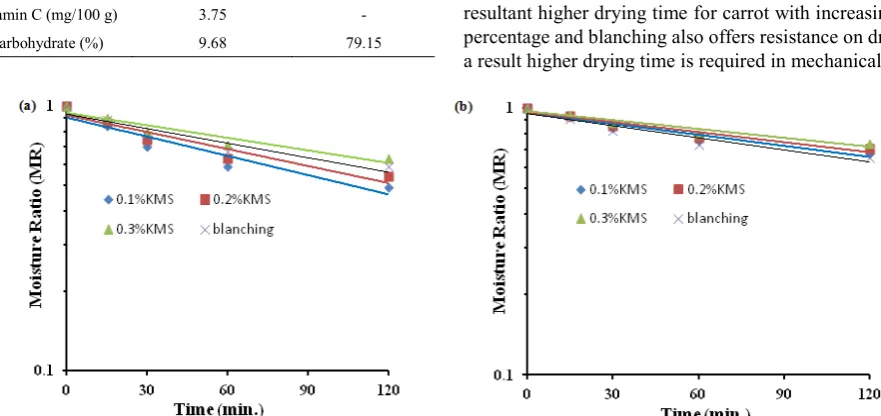
The experimental data were analyzed by as per the Fick’s 2nd law of diffusion and moisture ratio (MR) versus drying time (min) were plotted on a semi-log co-ordinate and regression lines and equations were obtained (Figure 1(a) and Figure 1(b)and equations 1 to 8)).
MR = 0.9041e−0.006t(For 0.1% KMS pre-treatment) (1)
MR = 0.9225e−0.005t(For 0.2% KMS pre-treatment) (2)
MR = 0.9307e−0.004t(For 0.3% KMS pre-treatment) (3)
[image:3.595.79.520.527.735.2]MR = 0.9416e−0.004t(For Blanching pre-treatment) (4) Figure 1(a) was constructed to show first falling rate period taking only data for two hour period of drying although for complete drying 6-7 hours were required. From Figure 1(a) and the above developed equations it is seen that at constant loading density and constant temperature lower time is required for drying carrot slices with 0.1 %KMS pre-treatment than that required for 0.2% KMS and 0.3% KMS pre-treatment and higher time is required for 0.3% KMS pre-treatment to dry to a specific moisture ratio for mechanical drying. In case of 0.2% KMS pre-treatment time is required for higher than 0.1% KMS pre-treatment and lowers than 0.3% KMS pre-treatment. In other words, it can be said that KMS has profound influence on drying time and it offers higher resistance to both heat and mass transfer with resultant higher drying time for carrot with increasing KMS percentage and blanching also offers resistance on drying, as a result higher drying time is required in mechanical drying.
From equations 1 to 4 it is seen that rate constant decreases gradually for drying of carrot with increasing percentage of KMS and also decreases during blanching but less than comparing with 0.3% KMS pre-treatment. This implies that at specific moisture ratio, more amount of water is evaporated per unit area for a given time from the samples of carrots with lower percentage of KMS than that of carrots with higher KMS when they are exposed to same drying atmosphere. Here, 3rd highest rate constant was found for
blanching pre-treatment. This behavior is attributed due to higher mass transfer resistance given by KMS and blanching treatment. From Figure 1(a), it is seen that the drying curves follow first order reaction kinetics and curves were drawn only to show first falling rate period. Similar characteristics were found by [12]. Here, rate constants decreases gradually with increasing percentage of KMS. It is also seen from Figure 1(a), KMS gives resistance to dry the pre-treated carrot. More percentage gives more resistance and takes more time to dry the sample to a specific moisture ratio. Similar properties were found by [13] and [12] where they showed that drying curves follow the first order kinetics and KMS increased the drying time.
MR = 0.9573e−0.0039t(For 0.1% KMS pre-treatment) (5)
MR = 0.9625e−0.0037t(For 0.2% KMS pre-treatment) (6)
MR = 0.9704e−0.0035t(For 0.3% KMS pre-treatment) (7)
MR = 0.95e−0.0038t(For Blanching pre-treatment) (8)
Figure 1(b) was constructed to show first falling rate period taking only data for two hour period of drying although for complete drying 16-20 hours were required. From Figure 1(b) and the above developed equations it is seen that at constant loading density and constant temperature lower time is required for drying carrot slices with 0.1% KMS pre-treatment than that required for 0.2% KMS and 0.3% KMS pre-treatments and higher time is required for 0.3% KMS pre-treatment to dry to a specific moisture ratio during solar drying. In case of 0.2% KMS pre-treatment time is required for higher than 0.1% KMS pre-treatment but lower than 0.3% KMS pre-treatment. In case of blanching pre-treatment, lowest time is required in comparison with 0.1% KMS, 0.2% KMS and 0.3% KMS pre-treatment to dry in solar drying. In other words, it can be said that KMS has profound influence on drying time and it offers higher resistance to both heat and mass transfer with resultant higher drying time for carrot with increasing KMS percentage and blanching offers least resistance on drying, resulting lower drying time is required in solar drying. From equations 5 to 8 it is seen that rate constant decreases gradually for drying of carrot with increasing percentage of KMS. This implies that at specific moisture ratio, more amount of water is evaporated per unit area for a given time from the samples of carrots with lower percentage of KMS than that of carrots with higher KMS when they are exposed to same drying atmosphere. Here, 2nd highest rate constant
was found for blanching pre-treatment. In mechanical drying method, for blanching, 2nd highest rate constant was also
found. This behavior is attributed due to higher mass transfer resistance given by KMS and blanching treatment. Similar behavior was found by [14].
In mechanical drying, the dryer took less time to dry the samples to a specific moisture ratio (MR) in compare to solar drying. Mechanical dryer also dried the samples more uniformly than solar dryer because of constant drying temperature. This was caused because in solar dryer temperature fluctuated from 30 to 60oC. That is why, less
uniformity was found in the solar dried samples. This characteristic influenced the rehydration properties of dried samples.
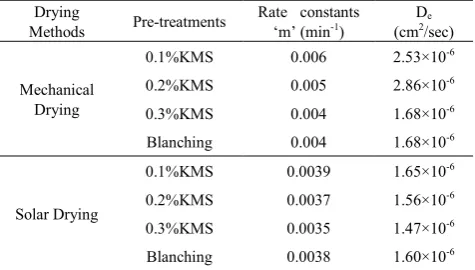
Subsequently,diffusion co-efficient of mechanically dried and solar dried carrots were calculated using the equation (m = π2De
L2 ). The De values are listed in Table 2.
Table 2. Diffusion Co-efficient (De) of mechanically dried and solar dried carrots
Drying
Methods Pre-treatments Rate constants ‘m’ (min-1) (cmD2/sec) e
Mechanical Drying
0.1%KMS 0.006 2.53×10⁻⁶
0.2%KMS 0.005 2.86×10⁻⁶
0.3%KMS 0.004 1.68×10⁻⁶
Blanching 0.004 1.68×10⁻⁶
Solar Drying
0.1%KMS 0.0039 1.65×10⁻⁶
0.2%KMS 0.0037 1.56×10⁻⁶
0.3%KMS 0.0035 1.47×10⁻⁶
Blanching 0.0038 1.60×10⁻⁶
It is seen from the Table 2 that, the Diffusion Co-efficient of mechanically dried and solar dried carrots decreases with increasing percentage of KMS. That means KMS has profound effect on Diffusion Co-efficient values. It is also seen from Table 2 that, mechanical drying method gave higher Diffusion Co-efficient value than solar drying method.
3.3. Rehydration Characteristics of Carrots
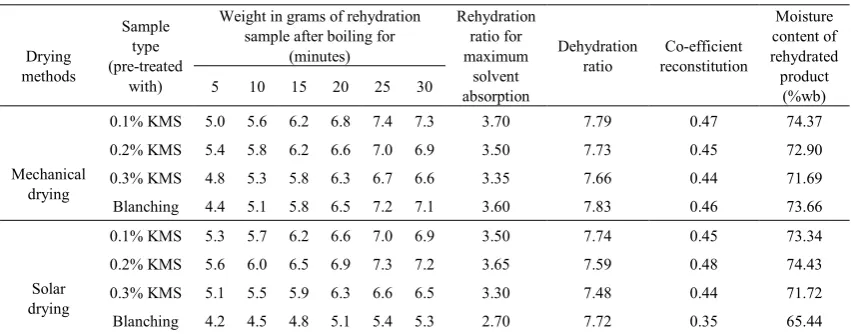
[image:4.595.314.552.324.459.2]Table 3. Effect of drying methods and pre-treatments on rehydration characteristics of dried carrots
Drying methods
Sample type (pre-treated
with)
Weight in grams of rehydration sample after boiling for
(minutes)
Rehydration ratio for maximum
solvent absorption
Dehydration
ratio reconstitution Co-efficient
Moisture content of rehydrated product
(%wb)
5 10 15 20 25 30
Mechanical drying
0.1% KMS 5.0 5.6 6.2 6.8 7.4 7.3 3.70 7.79 0.47 74.37
0.2% KMS 5.4 5.8 6.2 6.6 7.0 6.9 3.50 7.73 0.45 72.90
0.3% KMS 4.8 5.3 5.8 6.3 6.7 6.6 3.35 7.66 0.44 71.69
Blanching 4.4 5.1 5.8 6.5 7.2 7.1 3.60 7.83 0.46 73.66
Solar drying
0.1% KMS 5.3 5.7 6.2 6.6 7.0 6.9 3.50 7.74 0.45 73.34
0.2% KMS 5.6 6.0 6.5 6.9 7.3 7.2 3.65 7.59 0.48 74.43
0.3% KMS 5.1 5.5 5.9 6.3 6.6 6.5 3.30 7.48 0.44 71.72
Blanching 4.2 4.5 4.8 5.1 5.4 5.3 2.70 7.72 0.35 65.44
It was seen that boiling up to 25 minutes gave the highest rehydration ratio (until disruption of structure) after which it was reduced a little bit. The various reconstitution data for mechanically dried and solar dried carrot with 0.1% KMS, 0.2% KMS, 0.3% KMS and blanching pre-treatments are shown in Table 3.
For mechanically dried carrot, rehydration ratio with 0.1% KMS pre-treatment was higher than 0.2% KMS, 0.3% KMS pre-treated and blanching pre-treated carrot and they are 3.70, 3.50, 3.35 and 3.60, respectively. From this result, it is obvious that KMS and blanching have profound effect on rehydration of carrots. Higher percentage of KMS decreased the rehydration ratio and increased shrinkage. Cellular and structural disruption during blanching might have contribution to increase the rehydration rate of carrots and decreased shrinkage. It is also observed that after 25 minute boiling of the sample, the regained weight remained near about the same as the samples approached saturation condition.
In case of solar dried carrots, rehydration ratio for 0.1% KMS, 0.2% KMS, 0.3% KMS and blanching pre-treatments was 3.50, 3.65, 3.30 and 2.70, respectively. There also have profound the effect of KMS and blanching on rehydration. These variations though very small, might have occurred due to the reasons that are mentioned for mechanically dried samples. The rehydration ratio values for solar dried samples are almost similar to those of mechanically dried samples, which are shown in Table 3. The rehydration ratio values were lower for solar dried samples than those of mechanically dried samples. It was also found that prolonged boiling reduces rehydration ratio which was due to the increase in leaching losses. On the other hand, shorter boiling time adversely affects rehydration ratio due to the inadequate absorption of solvents.
For mechanically dried samples, the co-efficients of reconstitution were 0.47, 0.45, 0.44 and 0.46 for carrots with 0.1% KMS, 0.2% KMS, 0.3% KMS and blanching pre-treatments, respectively and are higher than those of solar dried samples 0.45, 0.48, 0.44 and 0.35 for 0.1% KMS, 0.2% KMS, 0.3% KMS and blanching pre-treatments, respectively. It indicates that mechanically dried carrots
possess better reconstitution properties than solar dried counterparts. This behavior may be attributed to the change in rate of drying during two methods [15]. Mechanical drying gives higher rate of drying resulting in higher co-efficient of reconstitution than solar dried counterparts due to slower drying rate.
As compared to the moisture content of the fresh carrots 87.77% (wb), rehydrated samples contained significantly lower moisture content (71.69-74.37%, wb) for mechanically dried and (65.44-74.43%,wb) for solar dried carrots, respectively. The low moisture content attained following rehydration due to the loss of water during drying process, with resultant increase in the concentration of dissolved substances in the tissue of vegetables. This may lead to the irreversible damage to the texture and these textural changes cause the tissues to shrink. As a result, upon reconstitution (depending on the conditions of drying), they were not able to regain their initial moisture content, volume (or weight) and tenderness.
The dehydration ratio was found to be in the range from 7.66 to 7.83 for mechanically dried and 7.48 to 7.74 for solar dried carrots, respectively. Mechanical drying gives higher dehydration ratio than solar drying due to faster drying rate.
3.4. Storage behavior of dried carrot
[image:5.595.92.518.87.254.2]time to time. For this reason the stored samples absorbed a small amount of water from atmosphere.
4. Conclusions
Carrot is a highly nutritious vegetable. During peak season due to lack of adequate processing facilities, farmers are bound to sell their produce at a very low price. But if farmers can process their produce by effective and economic ways, they will be able to get proper price and get encouraged to maximize production. Mechanical and solar drying systems along with different pretreatments may be used for both large scale and small industries.
REFERENCES
[1] Kaur, G., Jaiswal, S.P., Brar, K.S. and Kumar, J.C. (2009). Physico-chemical characteristics of some important varieties of carrot. Indian Food Pack, 30(2):5–8.
[2] Dreosti, I.E. (1993). Vitamins A, C, E and beta-carotene as protective factors for some cancers. Asia Pacific Journal of Clinical Nutrition. 2:5-21.
[3] Speizer, F.E., Colditz, G.A., Hunter, D.J., Rosner, B. and Hennekens, C. (1999). Prospective study of smoking, antioxidant intake and lung cancer in middle aged women. Cancer Causes Control. 10:475-482.
[4] Prakash, S, Jha, S.K., Datta, N. (2004). Performance evaluation of blanched carrots dried by three different driers. Journal of Food Engineering. 62:305-313.
[5] Raoult-Wack. (1994). Dehydration and storage of dehydrated product. World Journal of Dairy & Food Sciences.
4(1):12-14.
[6] Rastogi, N., Raghavarao, K., Niranjan, K. and Knorr, D. (2002). Recent developments in osmotic dehydration: methods to enhance mass transfer. Trends in food science and technology.13:48 59.
[7] Krokida, M.K. and Marinos-Kouris, D. (2003). Rehydration kinetics of dehydrated products. Journal of Food Engineering.
57:1–7.
[8] Singh, B., Panesar, S., Nanda, V. (2007). Rehydration Kinetics of Un-Osmosed and Pre-Osmosed Carrot Cubes. World Journal of Dairy & Food Sciences 2(1) 10-17. [9] Rastogi, N.K., Nayak, C.A. and Raghavarao, K.S.M.S. (2004).
Influence of osmotic pre-treatments on rehydration characteristics of carrots. Journal Food Engineering. 65:287–292.
[10] Ranganna, S. (2003). Hand book or analysis and quality control -for ftuit and vegetables products 2nd ed. Tata McGraw Hill Pub. Co. Ltd. New Delhi.
[11] Karmoker, P., Saha, T. and Shams-Ud-Din, M. (2011). Processing and preservation of mixed chips from potato, papaya and carrot. Bangladesh Journal of Agricultural Engineering. 22(1&2): 53-60.
[12] Iqbal, A. and Islam, M.N. (2005). Dehydration kinetics of cauliflower and cucumber. Bangladesh journal of Crop Scienc. 16(1): 113-122.
[13] Domagala, A., Witulska, Marzena, Janus, P. (1996). Kinetics of drying of carrots in an industrial pentabelt dryer. Polish Journal of Food & Nutrition Sciences. 5(3): 121-130. [14] Machewad, G.M., Kulkarni, D.N., Pawar, V.D. and Surve,