WITH APPLICATION TO IMPERFECTION SENSITIVITY IN BUCKLING
Thesis by
James Paul Keener
In Partial Fulfillment of the Requirements
For the Degree of Doctor of Philosophy
California Institute of Technology Pasadena, California 91109
1972
Acknowledgements
The author wishes to thank Professor Herbert B. Keller for making many helpful suggestions regarding the problems treated in this thesis. He has given freely of his time in offering ·advice, encouragement, and patient supervision throughout the course of this work.
The author is grateful to Mrs. Vivian Davies for her conscientious and painstaking typing of the manuscript.
The work represented by this thesis would have been con-siderably more difficult were it not for the constant love and encouragement of his wife Kristine,
to
whom much credit is due.Abstract
The branching theory of solutions of certain nonlinear elliptic partial differential equations is developed, when the non-linear term is perturbed from unforced to forced. We find
families of branching points and the associated nonisolated solutions which emanate from a bifurcation point of the unforced problem. ·Nontrivial solution branches are constructed which contain the
non-isolated solutions, and the branching is exhibited. An iteration procedure is used to establish the existence of these solutions, and a formal perturbation theory is shown to give asymptotically valid results. The stability of the solutions is examined and certain solution branches are shown to consist of minimal positive solutions, Other solution branches which do not contain branching points are also found in a neighborhood of the bifurcation point.
The qualitative features of branching points and their
Table of Contents
PART TITLE PAGE
I . Introduction 1
II General Imperfection Theory 7
III
IV
II. 1 Notation and Definitions 7
II. 2 Perturbation Theory for Nonisolated Solutions 13 II. 3 Existence of Nonisolated Solutions 24 II. 4 Comparison of Iteration Scheme and Perturbation
Procedure
36
II. 5 Extension of Solution Branch from Nonisolated
Solution
46
II.
6
Stability of Extended Solution Branch59
II. 7 Minimal Positive Solutions 65
II. 8 Other Solution Branches 91
Dynamic Buckling of Columns and Arches III. 1
III. 2
III. 3
Introduction
Equilibrium States and their Relationship to Imperfection Theory
Dynamic Treatment of Global Stability Buckling of an Imperfect Column on a Nonlinearly
Elastic Foundation
101 101 103 115
131
Illustrations 147
Chapter I
Introduction
Branching is a change in the number of solutions u of an equation
(1. l) g(~. u) = 0
produced by a small change in the real parameter ~- Those values ~ at which branching occurs are called branching points, and the corresponding solutions are called nonisolated solutions of (1.1). If solutions u of (1. l) are also arbitrarily small in a neighborhood of the branching point and u
=
0 is a solution for all ~. then the phenomenon is called bifurcation, and the branching point is called a bifurcation point. The problem (1.1) is called "unforced" if g(~. 0) = 0 for all real values of ~. and it is called "forced" if g(~. 0)*
0 for some values of ~- In this thesis, we are concerned with the behavior of branching points and solutions in their neig h-borhood, as the problem (1. l) is perturbed from an unfqrced to a forced problem. Letting T represent a "forcing" parameter, we are interested in finding solutions of(1. 2) G(~. T, u)
=
0G(A.,T,O)::;tOwhen T::;t 0.
As a simple illustration consider the single algebraic equation given by
(1. 3) X
+
f(A_, T, X) : 0where f(A., 0, 0)
=
0 and f(A., T, 0) ::;t 0 if T ::;t 0. When T = 0, x= 0
is a solution of (1. 3) for any value of A.. From the implicit function theorem, we know that the identically zero solution is the only arbitrarily small solution of (1. 3) in a neighborhood of A.=
A.0, provided the Jacobian of (1. 3) evaluated at (A., T, x) = (A.0 , 0, 0) does not vanish, or symbolically, if(1. 4) J(A.0 , 0, 0) - 1
+
f ( A.0 , 0 , 0 )*
0 . XIf (1. 4) does not hold then the point (A., x) = (A.0 , 0) is a possible bifurcation point with T = 0. Similarly if (A., T, x) = (A.I, TI, xi) is a nontrivial solution of (1. 3) then by the implicit function theorem we know that there is a unique function x = x(A.) with x(A.I) = xi when T = TI is fixed, provided
(1. 5)
Suppose that for X. = X.0 , equation (l. 4) fails to hold, and that X.= X.0 is a bifurcation point of (l. 3) with T = 0. Then we can find the possible branch points of {1. 3) which lie in a neighborhood of (X., T) = (X.0 , 0) by applying the implicit function theorem to the system
X+
f{X.,T,x} = 0 (l. 6)1
+
f {X., T, x) = 0 . XSince fx_ (X., 0, 0) = 0 by assumption, we know that there are functions X. = X.(x) and T = T(x} which satisfy the system (l. 6) for x sufficiently small, whenever
(1. 7)
A condition very similar to {1. 7) will be assumed in the more
general discussion in Chapter II. The functions X.
=
X.(x) and T = T(x) represent a family of possible branching points of (1. 3) emanating from X.=
X.0 and T=
0. One could now study neighboring solutions to determine if branching occurs.A simple algebraic example posses sing characteristics which
we will find in other more general problems is given by
The solutions of (1. 8) are
(1. 9) X±=
l
1-X. ±z
1 V I (A_-l)2-4TWhen T = 0, the solutions reduce to x = 0 and x = 1-~, so that the point ~
=
1 is a bifurcation point. When T<
0 the two solutions given by (1. 9) are well defined with x+>
0 and x<
0 for all values of ~. However, when T>
0, real valued solutions do not exist forl -
2T
~
<
~
<
l + 2TYz, and the points~
=
1 ±2T~
are branching±
points of equation (1. 8). The accompanying plot shows the solution curves (1. 9) for various values of T.
X
T>O
\
Equation (1. 2) can represent very general operator equations.
In this the sis we are concerned primarily with nonlinear boundary
value problems involving either second or fourth order partial
differential operators. It is a simple matter to consider more
general operators, such as compact nonlinear operators on a
Hilbert space, since most of the changes necessary are notational
only. Our primary application is to the buckling of imperfect
engineering structures [3] ':',
L4],
[15}, where T represents theamplitude of some imperfection, and the branching point represents
the load at which buckling may occur.
Our general results for second order equations make use of
a perturbation procedure coupled with an iteration technique used by
H. B. Keller [17} for bifurcation problems. The perturbation
pro-cedure is used to suggest the proper form of the solution. Then
the iteration technique is used to prove the existence of such
solutions. In Sections II. 2 through II. 4 we show the existence of a
unique family of nonisolated solutions for certain values of T
sufficiently small. The perturbation procedure is also shown to be
asymptotic. In Section II. 5, a solution branch is constructed
through a nonzero nonisolated solution of (1. 2). In Section II. 6,
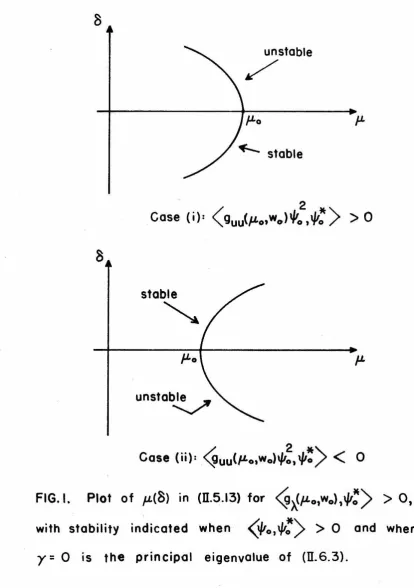
the 11 stability" of the constructed branch is examined, and is simply
summarized in Figure 1. Under certain circumstances, given in
Section II. 7, part of the solution branch constructed in Section II. 5
is shown to be a branch of minimal positive solutions, in the sense
of Keller and Cohen [19]. Furthermore, conditions are given under
which a branching point is the least upper bound of values >-. for which positive solutions of (1. 2) exist with T fixed. The bifurcation
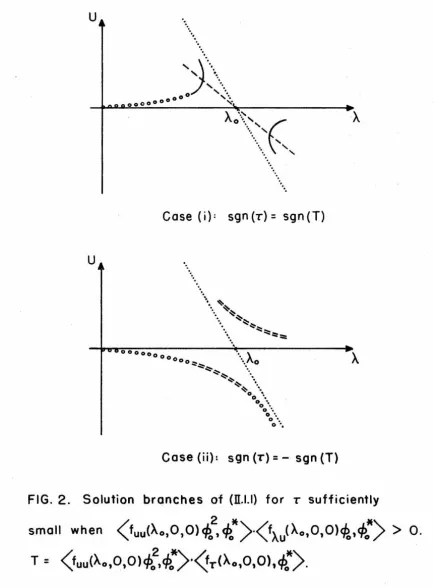
diagram is completed in Section II. 8, where it is shown that for all values of T sufficiently small, (1. 2) has two distinct solution
branches, although some of these branches may not contain
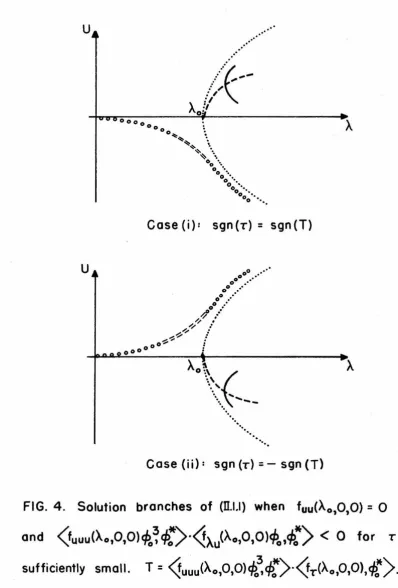
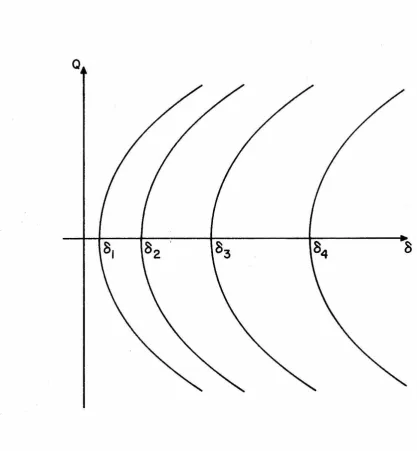
branching points. A graphical summary of the main results in Chapter II is given in Figures 2, 3 and 4.
In Chapters III and IV, these ideas are applied to t1Le dynamic
buckling of arches and imperfect columns and to the buckling of an imperfect column on a nonlinearly elastic foundation, respectively.
In Chapter III, global stability characteristics for the buckled e quilib-rium states of an imperfect column are studied using the qualitative
features of nonisolated solutions discussed in Chapter II. In Chapter IV,
an advantage in using the present iteration technique in problems of imperfection sensitivity in buckling is demonstrated. It is a simple consequence of our approach that an approximate solution of the
buck-ling load is asymptotic to the exact solution. Approximation techniques used elsewhere do not have this feature [3].
Equation number (1. 1) refers to the first equation of Section 1 of the given chapter. Similarly, Theorem 3-1 refers to the first
theorem of Section 3 of the given chapter. When referenc.e is made
Chapter II
General Imperfection Theory
II.l. Notation and Definitions.
We want to study branching phenomena for elliptic boundary
value problems of the form
(1. 1) Lu
+
f(>-., T, u) = 0 xEDBu = 0 x E
aD .
Here x = (x1 , , x ) and L is the uniformly elliptic second order
n
operator defined on D by
(1. 2)
n
\' 82 u
Lu
=
L; a .. (x) n n lJ ox. ux.i,j=l 1 J
n
\'
au
+
L; a.(x) Jo
x
.
J
- a
0(
x
)u .
j=lThe boundary operator
B
is defined onoD
by(1. 3) Bu
=
b0(
x)u
+
n
b 1 (x)
~
f3 j (x) j=lau
ox.
J
where for notational purposes we will denote
n
~~
=~
j=l
f3.(x)
au
Jax.
k+a
We denote by C (0) the space of real valued functions which are k times continuously differentiable on a point set
n'
and have Holder continuous kth derivatives on0
with Holder exponent a. We assume that D is a bounded domain in .HR.n with boundaryaD
of class C2+a. The coefficients a .. (x) , a.(x), a0 (x)>
0 are assumed1J J
to be in Cz+a(D) , C1+a(D) and Ca(D) respectively, while b0 (x) , b1(x) , f3.(x) are in CI+a(aD) for some aE(O,l).
1 The uniform
ellipticity of L implies that for all unit vectors y = (y1 , ••• , y n)
n
(1. 4)-i)
I:
a .. (x) y.y. ~a> 01J 1 J XED .
i,j=l
Taking n. (x) to be the components of the unit outward normal at 1
X E an, we assume that the coefficients of the boundary operator B
satisfy
n n
(1. 4) -ii)
~
13.
(x) n.(x)>
0I:
f3Z.(x) = lJ J J
j=l j=l
and that an can be decomposed into an = an1
U
aD2 where(1.4)-iii)
(1.4)-iv) b0 (x) ~ 0 b1 (x)
>
0 X E 8D2 •The assumed smoothness assumptions on L and B are
Q '
-9-(1. 5) Lu(x)
=
F(x)xED
Bu(x)
=
0xe:aD
2 + a
-has a unique solution, u(x) E C (D) ( [26], pp 134-136). These
assumptions further imply that L and B satisfy the strong maximum
principle [ 31] which leads to
Proposition (1): If cj> (x) E C' (D)
n
C 2 (D), theni - Lq> ~ on D , B q> ;::,: 0 on
an
~ q>(x);::,: 0 on Dii - Lq>
<
on D ,Bq,;::,: 0
onan
;:::.
q>(x)>
0
onD
Furthermore, if cp(x)
=
0 for some X€aD,
thenaq,
aa
<
0xe:aD
where
a:
is the directional derivative taken in any outward direction.We will assume that the nonlinearity f(A., T, u) satisfies
f(A., 0, 0)
=
0 for all real A., and f(A., T, 0) =F 0 if T =F 0. We willa 2+a
assume that f(A., T, u) E C (D) whenever u E C (D), and the partial
derivative at A., T,u satisfies f (A., T, u) E Ca(D) when u E CHa(D). All u
other derivatives up to and including third order are assumed to be
continuous on D if u E C2+a (D). Although f(A., T, u) is allowed to
The standard bifurcation problem with T
=
0 has been treated in numerous places ( (7], ll7],[21], [25], [34], [38] ).
One resultof these studies
[25]
is that branching c;:an occur at a point (X., u) =(X.0 , 0) only if there are nontrivial solutions of the problem
(1. 6) xED
Bcjl = 0 x E
an.
For the forced case with To
*
0, a point (X.0 , u0 ) can be a branchingpoint of (1. l) only if there are nontrivial solutions to the problem
resulting from linearization of (1. l) about the known solution at X.
=
X.0 •That is, there must be nontrivial solutions to
(1. 7)
Ll)J
+
f ( X.0 , T 0 , u0 ) ljJ=
0 uBl)J
=
0x ED
XEOD
where (X.0 , To, u0 ) satisfy (1.1). Solutions (u, l)J, X., T) satisfying both (1.1) and (1. 7) will be referred to as non-isolated solutions of (l.l) corresponding to the point X..
To provide a starting point for our investigation, we will
assume that there is a number X.0 and a nontrivial function
z+a-<Po (x) E C (D) which satisfy (1. 6). The quadruple (u, l)J, X., T)
=
(0, <Po, X.0 , 0) will be referred to as a trivial nonisolated solution of
(l.l). We will also assume that all solutions of (1. 6) are multiples
(1. 10)
By defining the inner product
(u, v) =
J
u(x) v(x) dxD
.. ,..
,.,
we can define adjoint operators L~ and B' to be those operators
satisfying
(1. 11) (v, Lu) - (u, L
*
v)=
0z+a-
,:,
whenever u, v, E C (D) and Bu = 0, B v = 0. The operators which
result from this definition are given by ( [
6]
, [13])
n 82
(a .. (x)v) n
)!:::
(1. 12) Lv
=
~
1ax.
ox.
-~
8(a. (x)v)
ax. - a0 (x)v , x E D .
i, j=l 1 J j=l J
B,:,v = 0 is defined by requiring
(1. 13)
n n
P[u, v] =
~
[ : u ux. 1J a .. v-~
0 (a .. v)u]+L
a. uv = 0ux. lJ l
i,j=l 1 J i=O
x E
oD.
when Bu = 0. For p(x)EC (D), a - whenever
(1. 14) L<j:>
+
p(x) <j:>=
0 X€ DB<j:>
=
0 xEo Dhas a nontrivial solution, we know from the study of spectral theory
>:~ >!<
··-(1. 15) L <j>
+
p (x) <!>,,.=
0'~ ~~
B <j>
=
0also has a nontrivial solution, and the null space of equation (1.14)
is of the same dimension as the null space of (1.15). The Fredholm Alternative Theorem [6] holds for solutions of
(1. 16) Lv
+
p(x)v=
g(x) .Z
+a-Specifically, this asserts that (1.16) has a solution v(x)E C (D)
a -provided g(x) E C (D) and
(1. 17) ( g(x) ,
<Po)
>:~=
0where
<j>'~
is a solution of (1. 15). Let A(x) E C(D) be a 11weightfunction11 such that
(<P
o
(x) , <j>'~0(x) A(x) ) of. 0. We make the stronger
assumption that if the solution v(x) in (1. 16) is made unique by
requiring the orthogonality condition
(1. 18)
,.,
( v(x) , <j>~ (x) A(x) )
=
0then there exists a constant G> 0 such that
The notation has been chosen with an eye toward general
-izations. If we wanted L to be an operator in a real Hilbert space
H, then the inner product (1.10) could be chosen appropriately. The
inequality (1. 19) could be assumed to hold in the induced norm of
H, and many of the results that follow would be true with only a
slight change of wording.
II. 2. Perturbation Theory for Non-isolated Solutions.
Formal perturbation theory is often used to obtain useful
approximations to solutions of nonlinear boundary value problems.
The ideas used in the method originated in the work of Lindstedt
and Poincare [30] on periodic motion in celestial mechanics.
Recently it has been applied by J. B. Keller and others [22], [23] ,
[29] to a number of nonlinear boundary value problems arising in
such diverse areas as nonlinear optics, heat conduction, and
super-conductivity.
In this section, we will develop a formal perturbation scheme
which indicates the form of nontrivial non-isolated solutions of (1.1).
We will show that this scheme is well defined and can be carried
out to arbitrary order provided the nonlinearity f(:>-., T, u) is sufficiently
differentiable in each of the arguments :>-., T and u. It will be the
task of later sections to show the validity of this perturbation
scherne.
nonis olated solution of (l. l). Our hope is that this solution is an
element of a branch of nonisolated solutions, and that this branch
can be represented parametrically with some parameter E . If
this parametric representation is also sufficiently differentiable at
the known s elution (u, ljJ, A., T) = (0, <Po, A.0 , 0), then we can expand the
parametric representation in a Taylor series about known solution.
We choose the parameter E so that (u(x,E), ljJ(x,E), 'A(E), T(E))
=
(O,<j>0 ,A.0 ,0) when E=O.
The first n+l terms of this Taylor expansion will be referred
. to as the nth perturbation expansion for nonisolated solutions of (l.l),
and will be in the form
( 2. l)
...__n
u (x, E) = € (u0 + E u1 + · · · + E u ) n
n
""n
ljJ (x, E) =
n 'A0 + E 'A 1 + · · · + E 'A n
n
E (To + E T1 + · • · + € T ) .
n
There are two equivalent ways to determine the coefficients
in (2.1). Since (2. l) is intended to be the Taylor series of solutions
of (l. 1), (l. 7) about € = 0, one could differentiate (l. l) and (l. 7) k
times, and then set € = 0, thus finding the equations which
deter-rnine the coefficients of the kth terms as functions of the previously
dete rn1ined cOl' ffic- i0nts. Alternately, one could substitute expression
powers of E , and then equate coefficients of like powers of E . The equations which result will again determine the kth set of coefficients
as functions of previously determined coefficients. Since these two methods are equivalent, both require that the nonlinearity f(}.., T, u) have smooth derivatives of at least order n.
(2. 2)
(2. 3)
(2. 4)
(2. 5)
Carrying out the above expansion procedure, we get
Lu0
+
fu(}..0 ,0,0)u0=
-fT(}..0 ,0,0)T0 Bu0=
0Lu1
+
f (}..0 , 0, O)u1u
xEaD
L¢0
+
fu (}..0 , 0, 0) <Po = 0 B¢0 = 0xE
a
D.XED
xE aD
xED xED
*·
Since the operator L
+
f (}..0 , 0, 0) has a null space spanned~!;:
by <Po , we know by the Fredholm alternative theorem that
equations (2. 2) - (2. 5) can be solved if and only if the right hand >:C
side of each equation is orthogonal to q,0 as in (1.17). This
con-dition determines the constants >...1 , To and T1 in (2. 2) - (2. 5).
Furthermore these solutions will not be unique, since we may add
any multiple of q,0 to the solution. To make the solutions unique,
we require
>:c
( ljl(x),q,0 (x) fX.u(X.0 ,0,0)) = 1 (2. 6)
*
( u(x), q,0 (x) fX.u(X.0 , 0, 0) ) = €
This places a restriction on the terms of the perturbation expan-sion (2. 1), requiring that
*
( q,o, q,o fXu (X.o, 0, 0))
=
1 (2. 7)*
( uo, q,o fX.u(X.o' 0, 0))
=
land
*
(ljl.
,q,
0 £>... (>...0 , 0, 0) ) = 01 u
(2. 8) i = 1, 2,
*
( u., q,0 fX. (>...0 , 0, 0) )
=
01 u
In order to solve (2. 2), the Fredholm alternative theorem
requires that
(2. 9) To ( f (>,.0 , 0, 0) , <Po
*
) = 0 .T
*
Assuming that (f (X.0 , 0, 0) , <Po)* 0, we must have To= 0. With
T
To
=
0, equations (2. 2) and (2. 4) are identical so that, applying (2.7),(2.10) u 0 (x) = <Po (x) .
Using this information, equation (2. 3) becomes
(2.11) xE D
xE
aD.
Applying the Fredholm alternative theorem to (2.11), we have
(2.12)
Similarly, from equation (2. 5) we get
Equations (2.12) and (2.13) are two linear sin1ultaneous
equations for >--.1 and T 1 . The determinant of this systen1 is
(2. 14)
so that these equations can be solved provided D
*
0. If D*
0, thesolution of (2.12) - (2.13) is
2 'l<
(fuu(>--o,O,O), <J>o,<J>o)
....
(f>--.u (>--o' 0, 0) <Po'
<j>; )
(2.15)
2 >:.C 1 (fuu (>--o' 0, 0) <Po , <Po )
Tl
=
~*
( f ( >--.0 , 0, 0), <Po )
T
Of interest in many applications is the relationship between
>--., the "buckling load," and T, the "imperfection amplitude. 11
According to (2. 1)
so if T 1
*
0, we can find >--. :: >--.( T) approximately. In particular,(2.16)
and
2
*
...._ =
C
(fuu(>--o,O,O)<J>o,<J>o) T2
<J
,., -t- 0(E3 ) ,(>--.0 , 0, 0), <l>o, )
(2.17)
can be combined to give
2
*
(fuu P.-o' 0, 0) <Po' <Po )
*
(fx_u(X.o,O,O)<j>o,<l>o)
(2. 18)
'K
= X.0±TYz
)'C: 2 , ....
[2(fT(X.
0
,0,0),<j>~) · (fuu(X.0,0,0) <j>0
,¢0
~)]:~
(fx_u(X.o,O,O)¢o.<l>o)
where T must be restricted so that X. is real.
Yz
+
O(T),In many applications, f uu (X.0 , 0, 0)
=
0, so that (2.18) is notvalid. Suppose there is an integer p such that
(2.19)
k
a
f ( X.o ' 0' 0)<
auk
=
0aP+1f(X.0 ,0,0) aup+I
2 ~ k~p
p+I ,,,
<Po , ¢o' )
*
0 .Then the perturbation equations can be shown to reduce to
(2. 20)
(2.21
Luk + fu(X.0 , 0, O)uk = 0
Buk
=
0Lup
+
fu("0,0,0)up= -
["Pf"u("0,0,0)u0+
+
f (X.0,0,0)TJ
Bu = 0
p
T p
x €
aD
xED k=O,l,2, ... ,p-1
x€
aD
aP+ 1 f ( X.o, 0, 0) aup+I
X€ D
and
(2. 22) X€ D k
=
0, 1, 2, ...• p-1B4\:
=
0 X€ 8D[
aP+1f('X.0,0,0)
{
Llj;k+fu('X.0,0,0)lj;p=- 'X.pf'X.u('X.0,0,0)<j>0+ ()up+1
(2.23)
B·'· '~"p =0 xE8D '
and the conditions (2. 7) and (2. 8) are required to hold.
According to equations (2. 20) and (2. 21),
(2. 24)
{
u0 (x)
=
<l>o (x)k = 1, 2, ... p-1 ' p+1 <l>o
- 1 ] ,xED
p.
and the calculations used in deriving (2. 20) - (2. 23) show that
(2.25) k
=
1, 2, ...• p-1 .Using (2. 24) and (2. 25) in (2. 1), the form of the solution reduces to
~p
(2. 26)
:;:-P
= E (<Po + Epu ) + O(Ep+Z)
p
=<j>0 +Eplj; +0(Ep+1)
p
=
'X.0 + Ep'X. +
O(Ep-1-1 ) p
P
+
1 p+zInvoking the Fredholm alternative theorem in (2. 21) arid (2. 23), we
can find }...p and T p" Specifically,
(2.27)
=
*
}... (f}...u(}...o,O,O)<j>o.<\>o)=
p
so that
(2. 28) T =
-,-P~-p
(p+l)!1 ap+t f(}...0, 0, 0) p+I
(p+ 1)!
<
aup+l1 ap+t £(}...0,0,0)
<
p! aup+l
*
(f (}...0,0,0), <\>o )T
<!>o
p+l
<!>o
*
'<!>o>
*
<!>o>
At the outset, we assumed conditions (2.19) that assured us that
T -=t- 0. Now we can solve for }...
=
}...(T) approximately. Doing so, pwe get
(2 .29)
p
p+l
}... :}... _ _ T _ ((p+l)!
0 p! p
Thus, the buckling load }... is altered by imperfections in the order
of Tp/p+ 1 for T sufficiently small.
We would like to show that the perturbation scheme given by
(2. 1) is well defined, and that the kth terms of the expansion are
previously determined k terms. If we assume that f(>-., T, u) is at
least n+2 times continuously differentiable in all variables, then
expanding f(>-., T, u) in a multivariable Taylor series with remainder
near >-. = >-.0 , T = 0, u = 0, and substituting (2.1) into the Taylor
series, it is easy to see that
(2. 30) +~~(
~
1cr
Lfu(>-.0,0,0)uk + f>-.u(>-.0,0,0)u0 >-.k + £T(>-.0,0,0)Tk+ Pk{ u0 , • · :uk_1;
>-
1 , ..·,~_
1
;
To, .. ·.Tk_JJ
+ O(t-1-2)(2. 31)
On substituting (2. 30) and (2. 31) into (1. 1), (1. 7) we get
(2.32)
"'"'n
Bu
=
0 , X€ 8 Dand { Llj! ""n +fu(>-.0,0,0)lj! ""n =-~
f,
k[~
( { })l
n+I1
€ .~l fu>-.(>-.0,0,0)>-.j+Qj ... lJ.k-iJ+O(E )(2.33) J- xED
Equating like powers of E, we have
{
Luk
+
fu(X.00 ,O)uk=
-[fx.u(X.0,0,0)u0~
+
fT(A.0 , 0, O)Tk+
Pk{ · · }](2. 34)
Buk
=
0 XEan
k=
1, 2, n .XED
XED
As before, equations (2. 34) and (2. 35) can be solved only if
the Fredholm alternative is satisfied. Using that u0 =
lJ.Io
= cj>0 , theresulting equations are
(2.36)
and
Notice now that using equations (2. 34) - (2. 37) determines the kth
terms of the expansion (2.1), uk, lj.Jk , X.k and Tk as functions of
the previously determined k terms. The equations (2. 34) - (2. 37)
are linear, and involve the same differential operator and matrix
operator for each term of the expansion. This assures us that the
D of (2.14) does not vanish, and provided f(A, T, u) is sufficiently
differentiable. The condition (2. 8) makes the procedure unique.
The solutions of (2. 36) and (2. 37) are
and
k-I
(f (A O
~)
<jJ *)[1::
((f
,(A0
,0,0)A..+Q.{u0
,""",u._ ;AI;·· ,A.._;T0;··,T._})
0• , , 0 U/\. J J J I J I J l
T .
J:::l
When the coefficients ~ , tVk , Ak and Tk are substituted into (2.1),
the resulting expansion is an asymptotic solution of (l.l) for E
suf-ficiently small. This fact will be shown in Section 4.
II. 3. Existence of Non-isolated Solutions.
In Section II. 2, we were able to develop a perturbation
scheme which gave rise to expressions which we hope are
approxi-n1atc solutions of (l.l), (l. 7). At this stage, however, we do not
even know that (l.l), (l. 7) have "nontrivial" solutions. In order to
in a form suggested by the perturbation m ethod, namely
(3. l)
u(x,E)
=
E<j>0 +Ezv(x,E), ljJ(x,E)=
cj>0 + EX(x,E), >-.(E) = >-.0 + E j.L(E)T(E) = EZl'/(E) ,
where
cJ>o
(x) satisfies (1.6).
In addition, we require that*
(v(x,E) , cj>0 (x) f>-.u(>-.0,0,0)) = 0 (3. 2)
(x(x,E)
We must show that for some nontrivial range of the parameter E,
0 ~ jEI ~ E0 , the functions v(x,E), x(x,E), !J.(E), l'/(E) exist and are
bounded uniformly in E . If this can be shown, then as E approaches
zero, the solutions (3.1) approach the trivial solution (u, ljJ, >-., T)
=
(0, cj>0 , >-.0 , 0) continuously. Furthermore, the solutions (3. l)
cons-titute a family of nonisolated solutions of (1. l) depending continuously
on the parameter E .
To carry out the analysis for this problem, we will make
use of the identity
(3. 3)
1 dg
g(a) - g(b) = (a-b)
J
dx (sa+ (l-s)b) ds0
dg
To use this identity for (1.1), (1. 7) we will assume that f(X., T, u)
has at least three continuous derivatives in X., T and u. Substituting
(3.1) into (1.1) and (1. 7) gives
(3 .4)
and
(3.5)
u € u
r
Lv+ f ( X.0,0,0)v = - - \ [f(X., T, u) - f (X.0 ,0 ,O)u] =-~-11
(€)J
1
fT(X., s T ,u)ds +
ra-(
<j>
0
+~t
v)JJ\'-u(X.0+sE f.J.,O,tu)ds dt- 0 0 0
2
j
'
lll
J
+ (<j>0+Ev) f (X.0 ,0,stu) sdtds
0 0 uu xE D
= P(v, f.J., 11, E ;x)
Bv = 0 , x€ 8 D
LX+ f (X.0 ,0,0)x=
_1_~-f
(X.,T,u)- f (>-.0 ,0,0)]4J
u € u u
"'_ff.J.J\
L
(X.0+SEf.J.,0,u)ds+E11Jf (X., ST,u)ds0 AU 0 TU
+ (<j>o+Ev)j. 1
f (X.0,0,su)ds] (<j>0+EX) 0 uu
=Q(v,x,f.L,11,E; x) xED
Bx
=
o
XE 8DEquations (3. 4) and (3. 5) are of the form (1. 16) and can be solved for
v and X only if the orthogonality conditions
>:.::
(P(v, f.J.,11,E; x), <Po )
=
0(3. 6)
,,.
hold. These solutions, i f they exist, arc only determined to within an additive multiple of
<Po,
unless the conditions (3. 2.) are satisfied.The orthogonality condition (3. 6) provides the m ethod by which we intend to solve (3. 4) and (3. 5). We will solve them iteratively, first by choosing values of
n
and 1-.1. so that (3. 6) holds, and then solving (3. 4) and (3. 5) for the functions v and X· With the new functions v and X• we must choose new values of 11 and 1-.1. so that (3. 6) again holds, and the process continues indefinitely. If we can show that this process converges, then roughly speaking, we will have found a solution of (3. 4) and (3. 5). This iterationscheme is a modification of the standard technique of Lyapunov and Schmidt ( 38] suggested by the treatment in
[17)
of the bifurcationproblem (1. 1) with T
=
0.To formulate the contraction mapping we introduce the sets of functions
I
2+a ·'-(3.7) BK={y(x) y(x)EC (DJ,!IYII~K ,(y(x),<j>~-(x)f:\u(:\
0
,0,0))=0},and the real interval
(3. 8)
Notice that
s
I (p'r)
depends on p andpr
but not onr
alone. For each v(x)' x(x) EBK
andn'
fJ. E !)K ' a transformation T E is defined for each E in 0 ~ IE I ~ E I bywhere
j
.l*
((<j>o+EX) 0
fX.u(X.0+ sE fJ., 0, u)ds, <Po)
(3. 10)
=-
((<j>0+Ev)(<j>0+Ex)j. 1f (X.0 ,0,
su)ds,<j>~)
0 uu
l
i >'<-Er]((<j>0+EX) f (A,ST,U)ds,<j>~),
0 TU
-
-
r- (
1L v + £ u (.~0 •
o . o,
v= -
c,
J0
r
T <x..
sT. u > d s-
rir
I+ fJ.(cpo+Ev)J 0J0
~(X.0+SEfJ.,O,tu)dsdt
(3.12)
+ (¢0+Evt
JJif
(X.0,0,stu)sdt ds] xED0 0 uu
(3. 13)
Bx
=
0 ' X€aD
-29-1
+En(<j>0 +Ex)J f (J\.,sT,u)ds
0 TU
This definition of T induces an iteration procedure in a E
natural way. Suppose we let an initial iterate be ( v 0 (E, x),
x
0(E, x),f-lo (E),
n°
(E)). Then we define the sequence of iteratesv (E,x), X (E,x), 1-l (€),
n
(E) by{ ( v v v v ) }
( 3 .14) [Vv+l, Xv+l, r-11
V+l
n
v+l]
=
TE[
v , Vx .
V 1-l • Vn
VJ
.
We are now able to state and prove the following
Theorem 3-1: Let S1 = S1 (p, r) for some fixed p ~ 1, pr ~
1.
Suppose that
(3. 15) and
f (J\. T u) f f f f f f f f . f
T 1 1 1
J\.1
}\u' UU1
TU' uuu' J\.uu' TUU' TTU J\.J\.u
*
and that (f T (>. .. 0 , 0, 0), <l>o) ( <l>o f}..u 0'-o, 0, 0), <l>o
*
) =I= 0 . Then there are real positive constants E 0 and K , E 0 ~ p , E 0 K ~ pr
such that theinto UK , and TE is a contraction on UK for all E 0 ~ IE I~ E 0.
Furthermore, the problem (1.1), (1. 7) has a nontrivial solution of the form (3.1) where v(x,E), X(x,E), j-L(E), 7'}(€) satisfy (3. 4) - (3. 6) and are the limits of the iteration scheme generated by TE for any initial iterates in UK
( 3. 16)
Proof: For notational purposes, define
= sup
I
g(w)I
w ES1Since S1 depends on the numbers
p
andpr
but not onr
alone, we can use the norm (3.16) without knowingr.
We need only require that Eo~p,
EoK ~pr.
By requiring Eo~ max{l, 1/K} we can use the normII
gII
s with p=
1, pK=
1.By virtue of the smoothness assumptions we made about inverting the operator L
+
f (}..0 , 0, 0) (cf. (1.16) ), to show that TU E
maps UK into
'l1<: ,
we need only find appropriate constants K and E1 that define~
andSJK .
*
We assumed that
I
(<j>0 fu}..(}..0,0,0),<j>0 ) i=a=t:O and-
31-(3.17)
for {X.,T,U)ES1. Then if (v,x,f.L,l"J)EUK for some E 1 ,K with E1~1,
E 1 K ~ 1 , we have
{3. 18) {
I~
I~
.f
Q' if? {II
<I> II 00 + E 1 K) [(II
<I> II 00 + E 1K) II f UU II S + E 1 K II f UT II SJ
~ At
+
E 1 B1 {E 1 , K) ,(3.19)
{- 2 [ - z
II
fuu lis]lnl
~13
if?I~J.I{II<!>II
00
+E1K)IIfux.lls+{ll<t>lloo+E
1
K) ~
2
-~ A2
+
E 1 Bz (E 1 , K) ,{3. 20)
and
(3. 21) {
II
X
II 00~
G( II <j> II 00 + E 1K)[1
~I
II
f ' UA.II
S + (II
<I>II
00 + E 1K)II
f UUII
S+ E 1 K II f II
J
~
A4 + E 1 B4 {E 1> K) , U'T S*
where <1?
=
(1,
I <j>0 I) . The positive numbers Ai do not depend on E 1 or K, and the positive numbers Bi{E 1 ,K) are bounded on compact(3.22) A.
+
E 1 B. (E 1 , K) ~ K1 1 i = l , 2 , 3 , 4 .
This is easily accomplished, since B. (E 1 ,K) depend continuously on 1
E 1 and K, we can pick K
>
max{A.}
,
and then find an E1>
0
i=l,2,3,4 l 1
so that ( 3. 22) holds. Letting Ez=min{l, K, E1} we have that
TE: UK- UK for 0 ~IE I ~ Ez. The second part of the proof involves finding Eo ~ e2 so that TE is a contraction on UK for 0 ~ /el~ e0 •
Suppose we let w1 = (v,x,!J-,1]) eUK and w2 = (y,z;,,v,K)eUK. Then we
can show that there exists a positive constant M such that
(3. 23)
where
In particular, with some straight forward calculations, it 1s easily shown that
(3. 24)
(3. 26)
and
(3.27)
where
II
~-y
IL
~
GIE I [
A~nll
v-y
IL+
An11-L-v
I
+ A33
ITJ-K 1]
+
GA:34
I~
-K
I +
GA:3s
I~-~
I
•
lix-~ II~
GIE
I [A4tll v-y II+
A4z
llx-l;, II+
A4311-L-v
I+ A44 ITJ-K 1]
00 00 00
Au=~~=(II<J>I!+l)[ll£
00 UU11+11£ .. II+E
it UU/\. S 22(II<J>II+l)ll£
00 UUU SII+Ezllf
UU 'TII,
SA1z = A4z =
KII
f U/\. ,II +II
S f U 'TII
S+ (II <l>
II
00+1)
II
f UUII
S•
A13=~3=
(ll<l>IIJl)[Ez
ll£uX.'TIIs+~ll£uX.X.IIs]•
A14=~4=
(ll<l>llcJ1)[11fu'TIIs+
€~
ll£u'T'TIIs]'
(3.28)Az
1=
(II
<l>
II
oo
+ 1l11
Ll
fuu s
II
+ Ebz
(
Jl
<l>
II
oo
+
1)II
fuuu
II
s
+
i II£ ,
uu
II
l_._
KII
f ,II
+
II
fII
,
1\.
sj
u/\. s
'TUs
Azz
=
A:3z =
K~(II
<l>
IIJl)
II
fuX.X.
11
8+
II
f..,.x_lis]
•
Clearly,
(3. 24) - (3. 28)imply the existence of a constant
Msuch
that
(3. 23)holds.
By choosing
0<
€3 M<
1, the
mapping
TE is
a
We have now shown that for
jEI
.:::;
Eo,
TE maps UK into itselfand is a contraction. But this is not sufficient to show that the
iteration scheme generated by T converges to a solution of (3. 4)
-€
(3. 6). We know by virtue of the contraction that the sequences
and {fJ.v(€)} converge. By a simple induction we also know that
v v z+a
-v (€, x) , X (€, x) € C (D). This allows us to apply the Compact
-ness Theorem 12.2 of Agmon, Douglis and Nirenberg [1] , which
justifies taking the limit v - oo in (3.14).
Q.E.D.
It is easy to see that a solution of the form (3. l) is
unique. If it were not unique, then there would be two solutions,
say w1 -:/< w2 which both satisfy (3. 4) - (3. 6). Thus, both w1 and
w2 are fixed points of the mapping T given by (3.10) - (3.13), so
E
that w1 = w1 and Wz = w2 • Applying (3. 23} we see that
(3. 29)
whenever
I
€I .:::;
E 0 which is a contradiction. Thus, w1 = w2 , andthe solution is unique.
The proof of Theorem 3.1 assured us that nonisolated
solutions of (1. 1) are of the form (3. 1), where v(E, x), X(E, x) , fJ.(E),
and TJ(E) are uniformly bounded by K for
lei
.:::; €0 • To know moreabout the quantitative behavior of the solution, we would like to
know more about fJ.(E) and T](E). We know that fJ.(E) and TJ(E) are
is an integer p such that
(3.30)
<
aP+I f(X.0,0,0) ()up+ I
= 0
2 ~ k ~ p.hp+I
'1'0 '
<Po
*
)
*
0holds, and assume that all third derivatives of f(X., T, u) exist and are continuous. Then applying the identity (3.3) to (3.10) and (3.11)
we find
and
(3.32)
=
Although (3. 31) and (3. 32) include implicit dependence on !J.(E) and
n(e:)
in the O(E) and O(Ep) terms, we know thatI!J.(E)i
~
K ,I
'll(E)I
~ K forIE
I
~ € 0 , and this permits the determination of theasymptotic form of jJ.(E) and
n(e:)
asle:
I -
0.The system (3. 31) - (3. 32) can be solved for E sufficiently
{3.33) !J.(E)
{3 .34)
n
(E)p-1
= -
_E _ _ p!p+I )
a
f(> ... 0,0,0+t
*
( p+ I
<P~
' <Po )
au
p+l
a
f(A-0,0,0) p+I ( p+ I<Po
,
au
pP- I
=
E {p+I)!*
<Po
)
Coupling (3. 33) and (3. 34) with the form of the solution (3. 1), we see that the perturbation solution (2. 26) - {2. 28) is asymptotic to the solution {3.1) as E - 0. In section 4, we will show that this is true for the perturbation scheme with any number of tern1s.
II. 4.
Comparison of Iteration Scheme and Perturbation Procedure.In Section 3 we found a mapping T whose fixed point gave
E
rise to solutions of (1.1), (1. 7) for each
E,
0 ~\E\
~ Eo. Theiterations generated by T were found to converge to the fixed E
point for all initial iterates in UK .
In this section, we will examine the iterations generated by the initial iterate
To estimate the errors of the kth iterate w , k we apply (3. 23) to get
(4. 2)
where € 0 1s chosen so that € 0 M
<
1.
Applying ( 4. 2) recursively wefind that
(4. 3)
{
A simple application of the triangle inequality implies
(4. 4)
=
K(le IMt
1-<le
IM)m
1-
leI
Mand passing to the limit as m - oo , we get
(4. 5)
where w
=
(v(e,x), x(e,x), f.J.(€), T](e)) is a solution of (3.4) -· (3.6). Writing this another way, as € - 0, we haveWe can interpret this information in terms of the solutions
of (1.1), (1. 7) in the form (3.1). The sequence {wk} corresponds
for € fixed to finding a sequence (uk (E, x), lj;k (E ,x), f.Lk (E), TJk (E))
where
k
k
u (E, x) = E <j>0
+
E 2 v (E , x)k k
ljJ (€, x) = <j>0
+
€X
(E, x)(4. 7)
k
X.0
+
E fJ. (€)k 2 k
T (E)
=
€n
(€ ) ,with initial iterate
(4. 8)
Furthermore, (4.6) tells us that
( 4. 9)
We would now like to show that the perturbation method
-39-E - 0. Specifically, we will show that (4. 9) holds for the iterates (4. 7) and also for the perturbation terms (2.1). To do so we
prove the following
Theorem 4-1: Let the hypotheses of Theorem 3-1 hold, and let (2. 30) and (2. 31) be satisfied for all E ,
I
Ei ~ Eo. Let (u -n-n-<n-n ,ljJ ,A. ,T ) be of the form (2.1) with ui(x), ljJi(x) bounded on D for i::: 1,2,··· n.. n n n n
Then the 1terates (u , ljJ , X. , T ) of ( 4. 7) and the perturbation
-n -n -n -n
expansions (u , X. , X. , T ) of (2.1) and (2. 34) - (2. 37) satisfy
11
n -n
u (E , x) - u (€ , x)
II
(4.10)
Note that applying the triangle inequality with (4. 9), (4. 10) assure us that the perturbation method is asymptotic to the known solution
as
E-o.
Proof: The proof of a similar fact for the bifurcation
v+I
X. -X.o. v v v v v
*
v v v v v v v*
(4.11) ( ·1(f (X. ,0, u )\jJ -f (X.0,0,u )\jJ
,cp
0 )=- (f (X. ,T ,u )\jJ -f (X. ,O,u )tji ,<(>0 )
X.v _ X.o u u u u
v+I "' ,v+I , "'
T V V V . V V -.< ( f\. -f\.Q V V V -r-- (f(X. ,T ,u )-f(X: ,O,u
),cp
0)+ )(f(X. ,O,u )-f(X.0,0,u
),cp
0)Tv ~-X.o
(4.12)
v v ~~
=- (f(X.0 , O,u ) - f (X.0,0,0)u, ¢>o ) ,
u
[ v+I
v+ I v+ 1 T v v v v v
Lu
+
fu(X.0,0,0)u=-
- v -0(X:,
T , u ) - f(X., 0, u ))T
(4.13)
Buv+l
=
0 ,v v v v v
+
f (X., T , u ) - f (X. ,O,u )u u
(4.14)
v
J
v+
f (X.0 , O,u ) - f (X.0,0,0) \jJ ,provided Tv io: 0 and
X
=f. X.0 • If Tv= 0, the expres sian f(X.v ' Tv ' uv) -f(X.v 0 uv) ' 'v
T
is replaced by f (X.v,O,uv) in (4.12) and (4.13).
T
Similarly, if X.v = X.0 , the
expression fu(X.v,O,uv)-fu(X.0 ,0,uv)/ >...v->..0 is r eplaced by f>...u(X.0 ,0,uv)
in (4.11) and (4.14), and f(X.v, O,uv)-f(X.0 , 0, uv)/>...v ->...0 is replaced by
fA(X.0 ,0,uv) in (4.12) and (4.13).
Suppose that (4.10) holds for some n> 0. This implies
n -n
u = u + E n+z e (E) ,
n
I
I
enI)
= 0(1) ,l)Jn=~n+En+len(E)'
II
enll = 0(1) ,(4.15)
n -n
X. =X. +E n+l
1-Ln
(E) ,11~-Lnll
= 0(1) ' n -n n+zlinn
II
= 0(1) T = T + E 11 (E) ,n
Applying (4.15) with (2. 30) and (2. 31) we see that
(4.16)
and
(4.17}
n n n n n n
f(X , T , u ) = f (X.0,0,0)u + f (X.0,0,0)T +E f, (X.0,0,0)u0(X ->...0 )
u T ~u
n+l
+
EL:
Ek Pk{ U 0 , ..,~-l
;
X.1 , "'•\c-l; T 0 , "·,Tk - l }+0(En1S),k=l
n n n n
f (X , T , u )
=
f (X.0,0,0)+
f , (X.0 ,O,O){X ->...0 )u u u~
(4. 18)
n+I
~+I
=
'X.o + I Ekj3k + O(En+z) 'k=O
then (4.17), (4.18) combined with (4.11) give
k=2
n+I k n+I
(4.19) = - I Ek I
(Qj{u
0
,'~uj_
1
;'X.
1
,"','X.j_
1
;
T
0
,'
"
,Tj_
1
}l\ik-j'<j>~)+I
Ekqk+O(E:fl+Z)k=l j=l k=2
where
where 'X.k, Tk' uk and
lJic
are the coefficients of the perturbation scheme given by (2. 34), (2. 35). (2. 38) and (2. 39). Suppose that 'X.k = 0 fork= 1, "'p-1 and 'X.p if:. 0. Then qk=
0 for k~p. If p::;:,n+I k
n+l, then the polynomial :L E qk vanishes identically, and the k=z
corresponding terms involving this polynomial are n+I k
In
~ n+I(4.19). If p~n, then .1: E qk :l:E k+E f-Ln is
k:Z k=I
not present in a polynomial of order E • In either of these cases, equating the coefficients of E in (4. 19) gives
Comparing this with (2. 38) we see that !3I = "-I. In fact it is easily
seen that !3k = A.k for k = 1, 2, · · · , min(p, n+l).
If p ~ n we must still determine !3k for k ? p+l. Suppose
that for some k ;t p+l, !3 = A for v
<
k . Then we observev v
(4. 20)
n+I k
:£: € !3k k=I
=
n+I k p+I .
Since 2,; € qk is a polynomial of order E , equahng the
coef-k=z
ficients of ek in (4.19)
k
(4.21) !3k(f '(A.o, 0, 0 )lfio,<P6)
= -
\'
(Q .{uo; ·,u. ; A I.·,x.. ;
To; ·,T. } d;lr -J· ' A,*o )u 1\. j~ I J
ri
ri
ri
'i "' ·rk-1
j=I
which upon comparison with (2. 38), shows that t3k = Ak. This
process can be carried out for all p+l ~ k ~ n+ l , which completes
the induction necessary to show that
n+I ~
(4.22) An+I = Ao +
~
Ek Ak+O(En+2)=An+I+O(En+z)k=I
In a similar manner, combining (4. 12), (4. 16) with (4. 20} and
k=o
(4.23)
where
k=l
n+1
- E
~
Ek (Pk{ u0 ;~uk_
1
,>-.. 1,"' ,>-..k_1,o;
·
,o},<J>~)
+E k=1
n+t k ~ E 'Yk k=o
n+1
k=1
where we have assumed Tn+I (E) to be of the form n+t
(4.24) Tn+l = E
~
Ek 'Yk + 0(En+3) .k=O
The argument is now exactly the same as the argument given above and will not be repeated. The result of the argument is that
fo r k = 0,1, ... n+l, or that
n+l
(4.26) T n+t
=
E '\'LJ
E k Tk+
O( n+3) E = -Tn+t+
O(En+3 ).The final step of the inductive argument involves substituting
(4.16), (4.17), (4.22) and (4.26) into (4.13) and (4.14). In light of
(4. 20) and the similar relationship for the quotient Tv+1/Tv , it 1s
easy to see that
( 4. 2 7) X E D '
x E
aD,
and
(4.28) XE D '
XE 8D.
The right hand sides of (4. 27) and (4. 28) consist of the differences
of right hand sides of (4.13) and (2. 32) and of (4.14) and (2. 33)
respectively. Since each right hand side expression is orthogonal
*
to
cp
0 , so also must their differences be orthogonal. By (1.19) theinverse of the differential operator L
+
f (A.0,0,0) is bounded, so thatu
(4. 29) II u n+I_;;n+I Jl
=
0 (En+3) '00
and
The expressions (4. 22), (4. 26), (4. 29) and (4. 30) are of the form (4.10), so the induction argument, and hence the proof of the
theorem, is complete. Q.E .D.
II. 5. Extension of Solution Branch from Nonisolated Solution.
In the previous sections, we showed that there are non-trivial nonisolated solutions of (1. 1) depending continuously on a parameter E for
I
El ~ Eo. In this section we want to show circum-stances under which a nonisolated solution of (1.1) is an element of a nontrivial solution branch with T fixed. To do so we will
construct the solution branch of (1.1) which contains a given non-isolated solution. A similar problem has been treated by Dean and Chambre
[8), [ 9).
Suppose To* 0 is fixed arbitrarily. If we make the identification
(5. 1)
equation (1. 1) becomes
(5. 2)
g(X.,u)
=
f(X.,T0 ,u) ,Lu
+
g(X., u)=
0 Bu = 0XED ' xE an
nonisolated s elution of (5. 2) for X.
=
fJ.o.*
Accordingly, there exist
functions l!Jo (x) and l!Jo (x) which satisfy
(5. 3)
and
(5. 4)
LljJ
+
gu (fJ.o, w0 (x))yJ = 0BljJ = 0
L* l!J*
+
gu (fJ.o , w0 (x) )ljJ"'"=
0*
>!<BljJ = 0
X
ED
'
xE8D
XED '
x€8D
respectively, where g (fJ.o ,w0 (x)) is the partial
u derivative of g(A., u)
*
*
at (fJ.o
,
w
0 (x)), and L , B are adjoint operators defined previously.We will assume that all solutions of (5. 3) and (5. 4) can be rep
-,.,
resented as multiples of l!Jo (x) and ljJ~ (x) respectively. With these
assumptions, the Fredholm alternative theorem (1.16) - (1.19) is
applicable when solving equations such as (5. 3) with a nonzero
right hand side.
We want to find solution sets (fJ.,w(x)) of (5. 2), if they exist,
such that fJ.-fJ-0 and w(x) - w0 (x) are small. A natural way to
pro-ceed is to use the perturbation method to suggest the form of such
solutions, and then to construct a contraction mapping which shows
that the suggested form leads to solutions. Suppose we assume an
~(x,
0)=
Wo (x)+
OWl (x)+
02 Wz (x)+
(5. 5)
Substituting (5. 5) into (5. 2), expanding g(;;,
~)
in powers ofo,
andequating the coefficients of like powers of
o,
leads to the equations(5. 6)
(5. 7)
and
Lw0
+
g(fJ.0 ,w0 )=
0 Bw0 = 0Lwl
+
gu(fJ.o,wo)wl=
-gx_(fJ.o,wo)fJ.I Bw1=
0XED •
XE
aD
XED •
XE
aD
,
Lwz
+
gu (fJ.o, wo)wz= - [
gX. (fJ.o, wo)fJ.z+
iguu (fJ.o, wo)wi2(5 .8)
+
gA.u(fJ.o,wo)fJ.IWI+t
gx_x_(fJ.o,wo)fJ.I2J
XED ,Bw2
=
0 xEan,
provided the derivatives gX., gX.X.' gX.u and guu exist and are con-tinuous. In order that w2 be uniquely determined we require that
(5. 9)
-49-Equation (5. 6) is automatically satisfied by our definition of
JJ.o and w0 (x). Because
4;
0 satisfies (5. 3), the Fredholm alternativetheorem implies that (5. 7) can be solved only if
(5. 9) JJ-1 (g
x. (
JJ.o , w o ) , lJJo )*
=
0 .*
If we assume that (gx_(JJ.0 ,w0 ),
4;
0 )*
0, then (5. 9) implies that(5.10) JJ.I
=
0 , w1 (x)=
4;
0 (x) .Finally, the Fredholm alternative theorem applied to (5. 8) gives us
that
(5. 11)
Thus, the perturbation method indicates that solutions of (5. 2) are
of the form
(5.12)
~(
X
,
0) = Wo (x)+
6lJJo (x)+
0(62 ) ,;:;:'(o)
=
JJ.o+
62 JJ.z+
0(53 ) ,where f.Lz
=
-
z
1(guu (flo' wo)lJJo2
'~~
) >.'< (gx_(f.Lo, wo), lJJo)Motivated by the results of the perturbation m ethod (5.12),
w(x, 5)
=
w0 (x) + 5lj.J0 (x) + 52 y(x, 5) ,(5.13) fJ.(5)
=
fJ.o + 52 v(5) ,On substituting (5. 13) into (5. 2) we get
(5 .14)
Ly + gu(fJ.o,wo)Y
=
-
~2
[g(fJ.,w)-g(fJ.o,wo)-gu (fJ.o,wo )(w-wa)]=-
[v
f
1
gx.(fJ.o+ 52svlw)ds
0
By= 0
+ (lJ.lo+ 5y)
f
J
1
guu&o.wo+ 5st(lJ.lo+5y)) sdt ds]
0 0
=
P(y,v,O;x), XED,XEoD ,
Equation (5. 14) is of the form (1. 16) and can be solved for y only
if the orthogonality condition
(5. 15) <P(y, v, 5;x), ljJ
*
0 )=
0holds.
As before, we expect that we shall be able to find a solution
To set up such a procedure we introduce the set of functions
and the real interval
(5. 17)
In addition we introduce the set
For each y(x) in
/3K
and v EJlK
we define the mapping T0
for eacho
ino
~ 1o
1 ~o
1by
where
(5.19)
By= 0 , xE
oD ,
(y
Then, after picking some initial iterate (y0 , v0 ), a sequence of
iterates { yk, }'} will be generated by
(5. 20) ( y k+
1
, v k+1)
=
T ( o y , v . k k)We now state and prove the following
Theorem 5-l: Let S2 =S2(p,r) for some fixed p;:::;l, p r ~ 1. Suppose
that
( 5. 21)
and that
Then
:J
real positive constants 80 and M , 80 ;:::; p ,o
0M ;:::; p r suchthat the mapping T
0 given by (5.18), (5.19) maps WM =(BMx_9M)
into W M , and T
-53-Furthermore, the problem (5. 2) has a solution of the form (5.13)
for all
o
0 ~Io
I~o
0 , where y(x,o)
and v(o)
are the limits of theiterate {yk, vk} generated by (5. 20) for any initial iterate in WM.
Proof: The proof is similar to the proof of Theorem 3-1. We
need to show that the mapping T
0 given by (5.18), (5.19), is a
contraction mapping of WM into W M for appropriate constants
o
0and M . Again we will use the norm
(5. 22) sup \ g(w)
I
wES
Because of the smoothness assumptions we have placed on g(A..,u),
to show th<3.t T
0 maps W M into WM we need only find the constants
M and
o
0 which defineBM
, __9
M.
Since we assumed that \ (g;x.._ (fl-o, w0 ),
ljJ~
)l
=
y i= 0, we canrestrict
o
0 to be sufficiently small so that(5.23)
Suppose that (y, v) E WM for some M,
o
0 • Then(5. 24)
and
(5. 25)
where
~
=
(1, ]ljJ*
I>
The positive numbers A1 and A2 do not depend on M or
o,
andthe numbers B I (M, o) and Bz (M, o) are bounded on compact sets of
(M, o). We can easily find (M, 61 ) so that
(5. 26) i
=
1, 2,by picking M > max{A1,A2 } , and then finding the largest 61 for
which (5. 26) holds. By picking 62 =min {1,
~
,o
1} , we have thatT 8 : wM- WM for 0
~
10
I~
Oz.To show that T
0 is a contraction for I 6 I ~ 60 , assume that
w1 = (y, v) and w2 = (z, fJ.) are in WM. Then for lol ~ 62 we have
(5. 27)
and
(5. 28)
where
(5. 29)
z
llgII
{
Au=Azt=(llljJII+l)llg
II
+oz(llljJII+l) uu 6u8
+llg,
II ,
00 UU S 00 1\.U S
Clearly, (5. 27) - (5. 29) implies the existence of a constant C
>
0 suchthat
(5.30)
where wEWM.
Now, by choosing 0
<
o3 C<
1, the mapping T6 is a contraction on WM
for O~lol~ 80 , where 80 =min(o2,63 ).
To complete the proof we need only observe that the
compact-ness Theorem of Agmon, Douglis and Nirenberg
[1]
applies, as itdid in the proof of Theorem 3-1, and justifies taking the limit as
k - oo in (5. 20). Q.E.D.
The solution given by (5.13) is unique in the sense that there
1s only one solution of that form in S 2 (E 0,M). If there were two
solutions wi:/=w2 , each would be fixed points of T
0, and (5.30)
implies that
(5. 31)
ll
wi -wzII
~
<loI
C)II
wi -wzII .
For
I
ol~oo, this cannot hold, so that wi=wz is unique.We could compare the iteration procedure (5. 20) with the
perturbation scheme (5.12). Once again we would find that the
perturbation scheme is asymptotic to the iteration scheme, and that
than carrying out the details of such a proof, we will examine the
asymptotic expansion of the solution (y(o, x), v(o)), which are fixed
points of (5.18), (5.19).
Examining (5. 18), it is easy to see that
(5.32) v(o)
=
z
*
- (guu (!J.o 'Wo) lJ.Io , lJ.Io )
*
2 (g X. ( IJ.o ' w o ) , lJ.Io )
+
o(&) .Substituting (5. 32) into (5.13) we see that to the order which we have
taken the solution, the exact solution (5.13) and the perturbation
solution (5.12) agree asymptotically as &-0.
Knowing the form of the solution (5.13) gives us information
about those parameter values fJ. for which solutions of (5. 2) exist.
Since fJ.
=
t.J.o+ &2v(o), if v(O)>O, then solutions of (5. 2) exist in theneighborhood of (w0 , t.J.o) for which tJ.
>
IJ.o. If v(O) < 0, thensolutions of (5. 2) exist in the neighborhood of (w0 , f-Lo) for which
fJ. < f-Lo. In either case, the point tJ.
=
f-Lo is a branching point wherethe number of s elutions of (1. 1) changes from zero to two or from
two to zero as tJ. changes from tJ. <f-Lo to tJ.
>
f-Lo, in the respectivecases v(O)
>
0 and v(O} < 0.*
when (gx_ (t.J.o, w0 ), lJ.Io)
>
0.Figure l gives plots of t.J.(o) versus &
We have now shown circumstances under which a nonisolated
s elution of (1. 1} is an element of a solution branch of (1. 1) for T fixed.
Since in Section 3 we were able to show that nontrivial nonisolated
solutions of (l. 1) do exist, it is natural to ask how Theorem 5-l
If Eo found in Section 3 is sufficiently small, then the resulting eigenvalue X. = X.0
+
E f.!.(E) in (3. 1) remains isolated, so that the null space of (1. 7) remains one -dimension for I El ·~ E 0 •The hypotheses of Theorem 3-1 are sufficient to insure that the hypotheses of Theorem 5-l hold in S1 =Sdp, r) for certain nonzero
p,r,
for some fixed E, lei~E0
• Ap}Jlying Theorem 5-1, wesub-stitute into (5.13) for w0 (x), l\Jo (x) and f.lo, the nonisolated solutions of (1.1) found in Theorem 3-1 and given in the form (3.1). The resulting solutions of (1. 1) are
u = (E+ 6)<j>0 (x)
+
E2 v(x,E) +eox(x,E)+
62 y(x,E, o),(5.33)
T
=
E2 rj (E) ,where E is fixed, IE I ~Eo .
The solution of (1.1) given by (5. 33) is valid only if lol
<
60 •However, the number 60 is not independent of the number E . Notice in the proof of Theorem 5-l that 60 was chosen (cf. (5. 30))
so that
(5.34)
where
1 "
Since (p