The Thirty-Third AAAI Conference on Artificial Intelligence (AAAI-19)
Point2Sequence: Learning the Shape Representation of 3D
Point Clouds with an Attention-Based Sequence to Sequence Network
Xinhai Liu,
1Zhizhong Han,
1,2Yu-Shen Liu,
1∗Matthias Zwicker
2 1School of Software, Tsinghua University, Beijing 100084, ChinaBeijing National Research Center for Information Science and Technology (BNRist) 2Department of Computer Science, University of Maryland, College Park, USA
[email protected], [email protected], [email protected], [email protected]
Abstract
Exploring contextual information in the local region is impor-tant for shape understanding and analysis. Existing studies often employ hand-crafted or explicit ways to encode con-textual information of local regions. However, it is hard to capture fine-grained contextual information in hand-crafted or explicit manners, such as the correlation between dif-ferent areas in a local region, which limits the discrimina-tive ability of learned features. To resolve this issue, we propose a novel deep learning model for 3D point clouds, named Point2Sequence, to learn 3D shape features by cap-turing fine-grained contextual information in a novel im-plicit way. Point2Sequence employs a novel sequence learn-ing model for point clouds to capture the correlations by aggregating multi-scale areas of each local region with at-tention. Specifically, Point2Sequence first learns the feature of each area scale in a local region. Then, it captures the correlation between area scales in the process of aggregat-ing all area scales usaggregat-ing a recurrent neural network (RNN) based encoder-decoder structure, where an attention mech-anism is proposed to highlight the importance of different area scales. Experimental results show that Point2Sequence achieves state-of-the-art performance in shape classification and segmentation tasks.
Introduction
3D point clouds, also called point sets, are considered as one of the simplest 3D shape representations, since they are composed of only raw coordinates in 3D space. A point cloud can be acquired expediently by popular sensors such as LiDAR, conventional cameras, or RGB-D cameras. Fur-thermore, this kind of 3D data is widely used in 3D model-ing (Golovinskiy, Kim, and Funkhouser 2009), autonomous driving (Qi et al. 2017a), indoor navigation (Zhu et al. 2017) and robotics (Wang and Posner 2015). However, learning features or shape representations based on point clouds by deep learning models remains a challenging problem due to the irregular nature of point clouds (Qi et al. 2017b).
As a pioneering approach, PointNet (Qi et al. 2017b) re-solves this challenge by directly applying deep learning on point sets. PointNet individually computes a feature of each point and then aggregates all the point features into a global
∗
Corresponding author: Yu-Shen Liu
Copyright c2019, Association for the Advancement of Artificial Intelligence (www.aaai.org). All rights reserved.
feature by a pooling layer. This leads to PointNet being lim-ited by capturing contextual information of local regions. Attempting to address this issue, several researches take the aggregation of local regions into consideration. KC-Net (Shen et al. 2018) employs a kernel correlation layer and a graph-based pooling layer to capture the local information of point clouds. SO-Net (Li, Chen, and Lee 2018) and DGCNN (Wang et al. 2018) further explore the local structures by building k-nearest neighbors (kNN) graphs and integrating neighbors of a given point using learnable edge attributes in the graph. PointNet++ (Qi et al. 2017c) first extracts fea-tures for multi-scale local regions individually and aggre-gates these features by concatenation, where the two steps are repeated to complete the hierarchical feature extraction. Similarly, ShapeContextNet (Xie et al. 2018) segments the local region of a given point into small bins, then extracts the feature for each bin individually, and finally concatenates the features of all bins as the updated feature for the point. How-ever, most of these previous methods employ hand-crafted or explicit ways for encoding contextual information in lo-cal regions, which makes it hard to fully capture fine-grained contextual information, such as the correlation between dif-ferent areas in the feature space. However, the correlation between different areas in a local region is an important con-textual information. Fully exploiting this information might enhance the discriminability of learned features and improve the performance in shape analysis tasks.
We address this issue by proposing a novel deep learn-ing model for 3D point clouds, called Point2Sequence, to encode fine-grained contextual information in local regions in a novel implicit way. Point2Sequence employs a novel RNN-based sequence model for local regions in point clouds to capture the correlation by aggregating multi-scale ar-eas with attention. Specifically, each local region is first separated into multi-scale areas. Then, the feature of each area scale is extracted by a shared Multi-Layer-Perceptron (MLP) layer. Finally, our novel encoder-decoder based se-quence model aggregates the features of all area scales, where an attention mechanism is involved to highlight the importance of different scale areas. Experimental results show that Point2Sequence is able to learn more discrimi-native features from point clouds than existing methods in shape classification and part segmentation tasks.
• We propose Point2Sequence to learn features from point clouds by capturing correlations between different areas in a local region, which takes full advantage of encoding fine-grained contextual information in local regions.
• We introduce an attention mechanism to highlight the im-portance of different scale areas, and the feature extrac-tion of local regions is enhanced by leveraging the corre-lation between different area scales.
• To the best of our knowledge, Point2Sequence is the first RNN-based model for capturing correlations between dif-ferent areas in local regions of point clouds, and our out-performing results verify the feasibility of RNNs to effec-tively understand point clouds.
Related Work
Learning from point clouds by rasterization. As an ir-regular type of 3D data, it is intuitive to rasterize the point clouds into uniform sparse 3D grids and then apply volumet-ric convolutional neural networks. Some approaches (Wu et al. 2015; Maturana and Scherer 2015) represent each voxel with a binary representation which indicates whether it is oc-cupied in the space. Nevertheless, the performance is largely limited by the time and memory consuming due to the data sparsity of 3D shapes. Several improvements (Li et al. 2016; Wang and Posner 2015) have been proposed to relief the sparsity problem of the volumetric representation. However, the sparsity of 3D shapes is an inherent drawback, which still makes it difficult to process very large point clouds. Some recent methods (Su et al. 2015; Wang, Pelillo, and Siddiqi 2017) have tried to project the 3D point clouds or 3D shapes into 2D views and then apply 2D CNNs to rec-ognize them. Influenced by the great success of 2D CNNs for images, such methods have achieved dominant results in 3D shape classification and retrieval tasks (Kanezaki, Mat-sushita, and Nishida 2016). Due to the lack of depth infor-mation, it is nontrivial to extend view-based methods to per-point processing tasks such as per-point classification and shape classification.
Compared with uniform 3D grids, some latest studies uti-lize more scalable indexing techniques such as kd-tree and octree to generate regular structures which can facilitate the use of deep learning functions. To enable 3D convolutional networks, OctNet (Riegler, Ulusoy, and Geiger 2017) build a hierarchically partition of the space by generating a set of unbalanced octrees in the regular grids, where each leaf node stores a pooled feature representation. Kd-Net (Klokov and Lempitsky 2017) performs multiplicative transforma-tions according to the subdivisions of point clouds based on the kd-trees. However, in order to obtain rotation invariant of shapes, these methods usually require extra operations such as pre-alignment or excessive data argumentations.
Different from the above-mentioned methods, our method directly learns from point clouds without pre-alignment and voxelization.
Learning from point clouds directly. As a pioneer, PointNet (Qi et al. 2017b) achieves satisfactory performance by directly applying deep learning methods on point sets.
1 ' p
2 ' p
1 1 A
2 1 A
3 1 A
4 1 A
local region
1 R
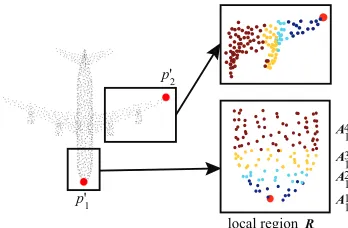
Figure 1: Theleftis an airplane point cloud with two sam-pled centroidsp01 andp02 in the red color. The rightis the corresponding local regions of p01 (below) and p02 (above), where different colors represent different area scales within the local region. For example, there are four different scale areas{A11,A21,A31,A41}in the local regionR1centered by
p01.
PointNet individually computes the feature of each point and then aggregates all the point features into a global fea-ture by pooling. This leads to PointNet limited by captur-ing contextual information in local regions. Some enhance-ments are proposed to address this problem by combining contextual information in local regions by hand-crafted or explicit ways. PointNet++ (Qi et al. 2017c) has been pro-posed to group points into several clusters in pyramid-like layers, where the feature of multi-scale local regions can be extracted hierarchically. PointCNN (Li et al. 2018) and SpiderCNN (Xu et al. 2018) investigate the convolution-like operations which aggregate the neighbors of a given point by edge attributes in the local region graph. However, with hand-crafted or explicit ways of encoding contextual infor-mation in local regions, it is hard for these methods to cap-ture fine-grained contextual information. In particular, the correlation between different areas in feature space is an im-portant contextual information, which limits the discrimina-tive ability of learned features for point cloud understanding.
correla-Segment
atio
n
scores
interpolating
×
1
0
2
4
shared MLP (256,128)
interpolating
F
C
12
8
F
C
12
8
×
5
0
MLP (32,64,128) max
pool
!"#
…
$
% &'
MLP (256, 512, 1024)
×
1
0
2
4
1 × 1024
F
C
5
1
2
F
C
2
5
6
F
C
4
0
1
×
4
0
Classificatio
n
scores
encoder
inp
ut
po
int
s
shared
MLP (128,128,128)
shared
max pool
… … …
!"
#
$ %&
shared
global feature
decoder max
pool
context vector
attention
!! ["
#, $ , "%, $ , "&]
'()*+-.'
/012
34
35
6
(b) Area feature extraction (c) Encoder-decoder feature aggregation (d) Local region feature aggregation
!"
(a) Multi-scale area establishment
(e) Shape classification
(f) Shape part segmentation !
"#
$#= {%#&, ' , %#(, ' , %)#} *#= {+#&, ' , +#(, ' , +#)}
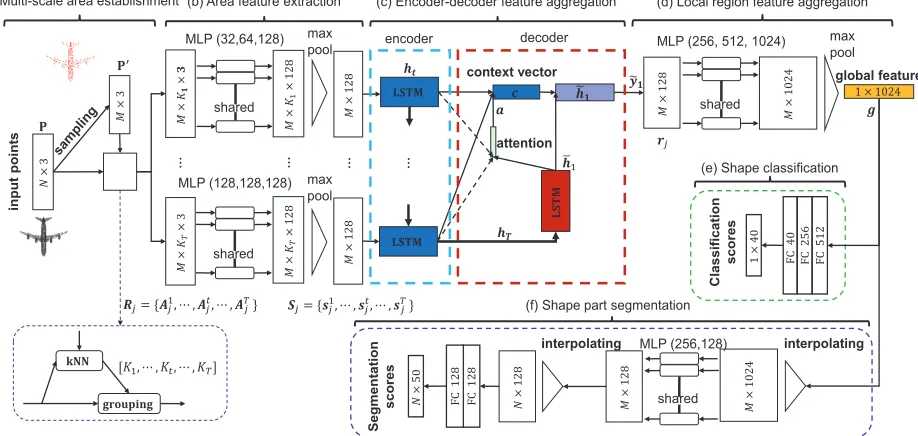
-Figure 2: Our Point2Sequence architecture. Point2Sequence first samples local regions from an input point cloud and estab-lishes multi-scale areas in each local region in (a). Then, MLP layer is employed to extract the feature of each multi-scale area in (b). Subsequently, the feature of each local region is extracted by attention-based seq2seq structure in (c). Finally, the global feature of the point cloud is obtained by aggregating the features of all sampled local regions in (d). The learned global feature can be used not only for shape classification shown in (e) but also for part segmentation with some extension network shown in (f).
tion learning from RNN-based sequence to sequence struc-ture, Point2Sequence adopts a seq2seq encoder-decoder ar-chitecture to learn the correlation of different areas in each local region with attention.
The Point2Sequence Model
In this section, we first overview our Point2Sequence model, and then detail the model including multi-scale area estab-lishment, multi-scale area feature extraction, attention-based sequence to sequence structure and model adjustments for segmentation.
Overview
Figure 2 illustrates our Point2Sequence architecture. Our model is formed by six parts: (a) Multi-scale area establish-ment, (b) Area feature extraction, (c) Encoder-decoder fea-ture aggregation, (d) Local region feafea-ture aggregation, (e) Shape classification and (f) Shape part segmentation. The input of our network is a raw point setP={pi ∈ R3, i=
1,2,· · · , N}. We first selectM pointsP0 ={p0j∈R3, j=
1,2,· · · , M} from P to define the centroids of local re-gions {R1,· · ·,Rj,· · ·,RM}. As illustrated in Figure 1,
T different scale areas{A1j,· · ·,Atj,· · ·,ATj}in each lo-cal regionRj centered by p0j are established in the
multi-scale area establishment part, whereT different scale areas contain[K1,· · · , Kt,· · ·, KT]points, respectively. We then
extract aD-dimensional featurestj for each scale areaAtj
through the scale feature extraction part. In each local re-gionRj, a feature sequenceSj ={s1j,· · ·,s
t j,· · ·,s
T j}of
multi-scale areas is aggregated into aD-dimensional feature vectorrj by the encoder-decoder feature aggregation part.
Finally, a1024-dimensional global featureg is aggregated from the featuresrj of all local regions by the local region
feature aggregation part. Our model can be trained for shape classification or shape part segmentation by minimizing the error according to the ground truth class labels or per point part labels.
Multi-scale Area Establishment
Similar to PointNet++ (Qi et al. 2017c) and ShapeCon-textNet (Xie et al. 2018), we build the structure of multi-scale areas in each local region on the point cloud. This part is formed by three layers: sampling layer, searching layer and grouping layer. The sampling layer selects M points from the input point cloud as the centroids of local regions. In each local region, searching layer searches theKtpoints
in the input points and return the corresponding point in-dexes. According to the point indexes, grouping layer groups theKtpoints fromPto form each multi-scale area.
As shown in Figure 2, a certain amount of points are first selected as the centroids of local regions by the sampling layer. We adopt the farthest point sampling (FPS) to itera-tively selectM (M < N) points. The new added pointp0j is always the farthest point from points{p01, p02,· · · , p0j−1}
in the 3D space. Although random sampling is an optional choice, the FPS can achieve a more uniform coverage of the entire point cloud in the case of the same centroids.
[K1,· · · , Kt,· · ·, KT]nearest neighbors for each local
re-gionRjfrom the input points and returns the corresponding
indexes of these points. In the searching layer, we adopt kNN to find the neighbors of centroids according to the sorted Eu-clidean distance in the 3D space. Another optional search method is ball search (Qi et al. 2017c) which selects all points within a radius around the centroid. Compared with ball search, kNN search guarantees the size of local regions and makes it insensitive to the sampling density of point clouds.
Finally, by the grouping layer, these indexes of points are used to extract the points in each area of local region Rj,
where we obtain the points with the size ofM ×Kt×3in
the scale areaAtjof all local regions.
Multi-scale Area Feature Extraction
To extract the feature for each multi-scale area, a simple and effective MLP layer is employed in our network. The MLP layer first abstracts the points in each scale areaAt
jinto the
feature space and then the point features are aggregated into aD-dimensional featurest
j by max pooling. Therefore, in
each local regionRj, aT ×Dfeature sequenceSj of the
multi-scale areas is acquired.
In addition, similar to prior studies such as SO-Net (Li, Chen, and Lee 2018), the coordinates of points in each area
At
j are converted to the relative coordinate system of the
centroidp0jby a subtraction operation:pl=pl−p0j, where
lis the index of point in the area. By using the relative co-ordinate, the learned features of point sets can be invariant to transformations such as rotation and translation, which is crucial for improving the learning ability of networks. More-over, we also combine the area featurestj with the coordi-nates of area centroidp0
jto enhance the association between
them.
Attention-based Sequence to Sequence Structure
In this subsection, we propose an attention-based encoder-decoder network to capture the fine-grained contextual in-formation of local regions. Through the multi-scale area fea-ture extraction, each local regionRjis abstracted into a
fea-ture sequence rj. To learn from the feature sequence, we
adopt a RNN-based model to aggregate the features Sj of
size T ×D into a D dimension feature vectorsj in each
local region by an implicit way. To further promote the cor-relation learning between different areas in local regions, we employ an attention mechanism to focus on items of the fea-ture sequence.
Multi-scale area encoder. To learn the correlation be-tween different areas, a RNN is employed as encoder to in-tegrate the features of multi-scale areas in a local region. The RNN encoder is consisted by a hidden statehand an optional outputy, which operates on the input feature se-quenceSj = {s1j, . . . ,stj, . . . ,sTj}of multi-scale areas in
each local region. Each itemstj of the sequenceSj is a
D-dimensional feature vector and the length ofSjisTwhich is
also the steps of the encoder. At each time stept, the hidden
statehtof the RNN encoder is updated by
ht=f(ht−1,stj), (1)
where f is a non-linear activation function which can be a long short-term memory (LSTM) unit (Hochreiter and Schmidhuber 1997) or a gated recurrent unit (Cho et al. 2014).
A RNN can learn the probability distribution over a quence by being trained to predict the next item in the se-quence. Similarly, at timet, the outputytof the encoder can
be represented as
yt=Waht, (2)
whereWais a learnable weight matrix.
After forwarding the entire input feature sequence at step T, the last-step hidden statehT of the encoder is acquired,
which contains the context information of the entire input sequence.
Local region feature decoder. To obtain the featurerjfor
each local regionRj, we employ a RNN decoder to translate
the contextual information from the multi-scale areas inRj.
Different from the models in machine translation, there is no decoding target for the decoder in our case. To address this issue, we employhT as the decoding target which contains contextual information of the entire input feature sequence. Therefore, a one-step decoding process is adopt in our net-work to decode the featurerjfor each local regionRj.
Sim-ilar to the encoder, the decoder is also consisted by a hidden stateh¯and outputy¯. We initialize the¯h0with a zero state z0and the current hidden state of the decoder at step one can be updated by
¯
h1=f(z0,hT), (3)
wherefis an activation function as shown in Eq. (1). Simi-larly, the output of decodery1¯ is computed by
¯
y1=Wb¯h1, (4)
whereWbis a learnable matrix in the training.
To further enhance the decoding of the contextual infor-mation in the input feature sequenceSj, a context vectorc
is generated to help the predict of feature˜y1of local region with attention. Therefore, a new hidden stateh˜1and output ˜
y1 are computed in the decoder as introduced later, where we employ the outputy˜1to be the featurerj for each local
region.
Attention mechanism in decoder. Inspired by the thought of focusing on parts of the source sentence in the machine translation, we adopt an attention mechanism to highlight the importance of different areas in each local re-gion. The goal is to utilize the context vectorcwhich is gen-erated by
c=XT
t=1α(t)ht, (5)
whereαis the attention vector andtis the time step. The idea of our attention model is to consider all the hid-den states of the encoder when generating the context vector
Table 1: The shape classification accuracy (%) comparison on ModelNet10 and ModelNet40.
Method Input ModelNet10 ModelNet40
Class Instance Class Instance
PointNet (Qi et al. 2017b) 1024×3 - - 86.2 89.2
PointNet++ (Qi et al. 2017c) 1024×3 - - - 90.7
ShapeContextNet (Xie et al. 2018) 1024×3 - - 87.6 90.0 Kd-Net (Klokov and Lempitsky 2017) 215×3 93.5 94.0 88.5 91.8
KC-Net (Shen et al. 2018) 1024×3 - 94.4 - 91.0
PointCNN (Li et al. 2018) 1024×3 - - - 91.7
DGCNN (Wang et al. 2018) 1024×3 - - 90.2 92.2
SO-Net (Li, Chen, and Lee 2018) 2048×3 93.9 94.1 87.3 90.9
Ours 1024×3 95.1 95.3 90.4 92.6
Table 2: The accuracies (%) of part segmentation on ShapeNet part segmentation dataset.
mean Intersection over Union (IoU)
air. bag cap car cha. ear. gui. kni. lam. lap. mot. mug pis. roc. ska. tab.
# SHAPES 2690 76 55 898 3758 69 787 392 1547 451 202 184 283 66 152 5271
PointNet 83.7 83.4 78.7 82.5 74.9 89.6 73.0 91.5 85.9 80.8 95.3 65.2 93.0 81.2 57.9 72.8 80.6 PointNet++ 85.1 82.4 79.0 87.7 77.3 90.8 71.8 91.0 85.9 83.7 95.3 71.6 94.1 81.3 58.7 76.4 82.6 ShapeContextNet 84.6 83.8 80.8 83.5 79.3 90.5 69.8 91.7 86.5 82.9 96.0 69.2 93.8 82.5 62.9 74.4 80.8 Kd-Net 82.3 80.1 74.6 74.3 70.3 88.6 73.5 90.2 87.2 81.0 94.9 57.4 86.7 78.1 51.8 69.9 80.3 KCNet 84.7 82.8 81.5 86.4 77.6 90.3 76.8 91.0 87.2 84.5 95.5 69.2 94.4 81.6 60.1 75.2 81.3 DGCNN 85.1 84.2 83.7 84.4 77.1 90.9 78.5 91.5 87.3 82.9 96.0 67.8 93.3 82.6 59.7 75.5 82.0 SO-Net 84.9 82.8 77.8 88.0 77.3 90.6 73.5 90.7 83.9 82.8 94.8 69.1 94.2 80.9 53.1 72.9 83.0
Ours 85.2 82.6 81.8 87.5 77.3 90.8 77.1 91.1 86.9 83.9 95.7 70.8 94.6 79.3 58.1 75.2 82.8
generated by comparing the current hidden state h¯1 with
each source hidden statehtas
α(t) = exp(score(
¯ h1,ht))
PT
t0=1exp(score(¯h1,ht0))
. (6)
Here,scoreis referred as
score(h¯1,ht) =h¯>1Wcht, (7)
which is a content-based function to show the correlation be-tween these two vectors. Here,Wcis also a learnable weight matrix in the training.
With the help of Eq. (5), we can acquire the new hidden stateh1˜ based on the current hidden stateh1¯ in the decoder. Specifically, with the current hidden stateh1¯ and the context vector c, a simple concatenation layer combines the con-textual information of the two vectors to generate the atten-tional new hidden state as follows,
˜
h1=tanh(Wd[c;¯h1]). (8)
And the outputy1˜ is similarly computed by
˜
y1=Ws˜h1, (9)
whereWdandWsare variables to be learned.
Our attention-based sequence to sequence structure ag-gregates the sequential features Sj of multi-scale areas in
each local regionRjby an implicit way. So far, the features rjof all local regions with size ofM ×Dare acquired. In
the subsequent network, a 1024-dimensional global feature
gof the input point cloud is extracted from the features of all local regions by the global feature extraction part. As de-picted in Figure 2, we apply the global featureg to shape classification and part segmentation tasks.
Model Adjustments for Segmentation
The goal of part segmentation is to predict a semantic la-bel for each point in the point cloud. In Point2Sequence, a global feature of the input point cloud is generated. There-fore, we need to acquire the per-point feature for each point in the point cloud from the global feature. There are two optional implementations, one is to duplicate the global fea-ture withN times (Qi et al. 2017b; Wang et al. 2018), and the other is to perform upsampling by interpolation (Qi et al. 2017c; Li, Chen, and Lee 2018). In this paper, two interpo-late layers are equipped in our networks as shown in Figure 2, which propagate the feature from shape level to point level by upsampling. Compared with shape classification, it is a challenge task to distinguish the parts in the object, which requires more fine-grained contextual information of local regions. We implement the featureφpropagation according to the Euclidean distance between points in 3D space. The feature is interpolated by inverse square Euclidean distance wighted average based onknearest neighbors as
φ(p) =
Pk
i=1w(pi)φ(pi)
Pk
i=1w(pi)
, (10)
wherew(pi) = (p−1p
i)2 is the inverse square Euclidean
dis-tance betweenpandpi.
Table 3: The effect of the number of sampled pointsM on ModelNet40.
M 128 256 384 512 Acc (%) 91.86 92.34 92.54 91.86
Experiments
In this section, we first investigate how some key parame-ters affect the performance of Point2Sequence in the shape classification task. Then, we compare our Point2Sequence with several state-of-the-art methods in shape classification on ModelNet10 and ModelNet40 (Wu et al. 2015), respec-tively. Finally, the performance of our Point2Sequence is evaluated in the part segmentation task on ShapeNet part dataset (Savva et al. 2016).
Ablation Study
Network configuration. In Point2Sequence, we first sam-pleM = 384points as the centroids of local regions by the sampling layer. Then the searching layer and grouping layer selectT = 4scale of areas with[16,32,64,128]points in each area of a local region. The points in each area are ab-stracted into aD = 128dimensional feature by a 3-layer MLP and then these abstracted features are aggregated by max pooling. And the feature sequence of different areas in each local region is aggregated by the RNN-based encoder-decoder structure with attention. Here, we initialize the RNN encoder and decoder with h=128 dimensional hidden state, where LSTM is used as the RNN cell. The rest setting of our network is the same as in Figure 2. In addition, ReLU is used after each fully connected layer with Batch-normalization, and Dropout is also applied with drop ratio 0.4 in the fully connected layers. In the experiment, we trained our network on a NVIDIA GTX 1080Ti GPU using ADAM optimizer with initial learning rate 0.001, batch size of 16 and batch normalization rate 0.5. The learning rate and batch normal-ization rate are decreased by 0.3 and 0.5 for every 20 epochs, respectively.
Parameters. All the experiments in the ablation study are evaluated on ModelNet40. ModelNet40 contains 12311 CAD models from 40 categories and is split into 9843 for training and 2468 for testing. For each model, we adopt 1024 points which are uniformly sampled from mesh faces and are normalized into a unit ball as input.
We first explore the number of sampled pointsM which influences the distribution of local regions in point clouds. In the experiment, we keep the settings of our network as depicted in the network configuration section and modifies the number of sampled pointsM from 128 to 512. The re-sults are shown in Table3, where the instance accuracies on the benchmark of ModelNet40 have a tendency to rise first and then fall. The highest accuracy of 92.54% is reached atM = 384sampled points. This comparison implies that Point2Sequence can extract the contextual information from local regions effectively andM = 384is a optimum number of sampled points to coverage the whole point cloud.
Table 4: The effects of the type of RNN cell (CT) and hidden state dimensionhon ModelNet40.
Metric RT=LSTM GRU h=64 256 Acc (%) 92.54 92.18 92.46 92.18
Therefore, we employ the sampled pointsM = 384as the setting of our network in the following experiments. Then, as shown in Table 4, we show the effect of the type of the RNN cell (RT) and the dimension of the RNN hidden state h, respectively. The accuracy degenerates to92.18% when replacing the LSTM cell as the GRU cell. Based on the set-ting ofh= 128, we sethto 64 and 256, which reduce the accuracy ofh= 128to92.46%and92.18%. The above re-sults suggest that dimension of hidden state h = 128and the type of hidden state RT=LSTM is more suitable for our network.
Table 5: The effects of the attention mechanism (Att) and decoder (Dec) on ModelNet40.
Metric Att+ED No Att No Dec Con MP Acc (%) 92.54 92.26 92.42 92.06 91.73
We also discuss the impact of the attention mechanism, the decoder and the encoder-decoder structure on our net-work. We evaluate the performance of our network without the attention mechanism (No Att), without decoder (No Dec) and without encoder-decoder structure (No ED). In No ED, we remove the encoder-decoder from our network and ag-gregate the features of multi-scale areas in each local region by concatenating (Con) or max pooling (MP). In Table 5, the result of the attention mechanism with encoder-decoder (Att+ED) is better than the results of removing parts of the attention mechanism and encoder-decoder. This comparison shows that the decoder works better with the attention mech-anism, and the decoder without attention will decrease the capability of the network. And our RNN-based sequence to sequence structure outperforms hand-crafted manners such as concatenate (Con) and max pooling (MP) in aggregating feature of multi-scale areas.
Table 6: The effect of the number of scales T on Model-Net40.
T 4 3 2 1
Acc (%) 92.54 92.46 92.63 91.94
Moreover, we reduce the scale of local regionsT from 4 to 1 and remains the largest scale with 128 points. As de-picted in Table 6, we obtain a even better result of92.62% withT = 2 (K1= 64, K2 = 128). The results withT >1
are better than the result withT = 1, which shows that the strategy of multi-scale areas can be better in capturing con-textual information from local regions. Therefore, the num-ber of areasTaffects the performance of Point2Sequence in extracting the information from local regions.
GT Ours GT Ours GT Ours GT Ours
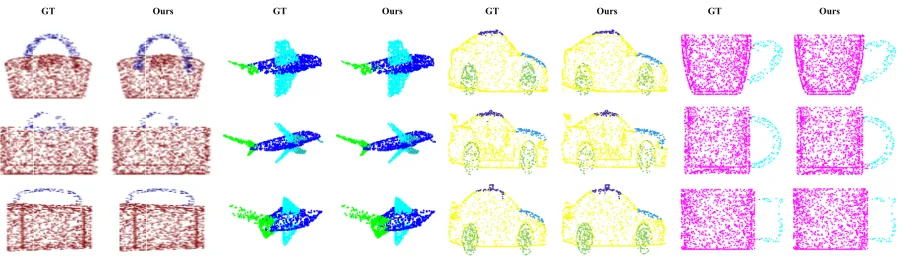
Figure 3: Visualization of part segmentation results. In each shape pair, first column is the ground truth (GT), and second column is our predicted result, where parts with the same color have a consistent meaning. From left to right: bag, airplane, car, and cup.
Table 7: The effect of learning rate on ModelNet40.
LR 0.0005 0.001 0.002 Acc (%) 91.94 92.63 91.86
we explore the effect of learning rate (LR) by setting it to 0.0005 and 0.002. As shown in Table 7, the highest accu-racy is reached at LR = 0.001. Therefore, LR = 0.001 is the optimal choice of Point2Sequence.
Shape Classification
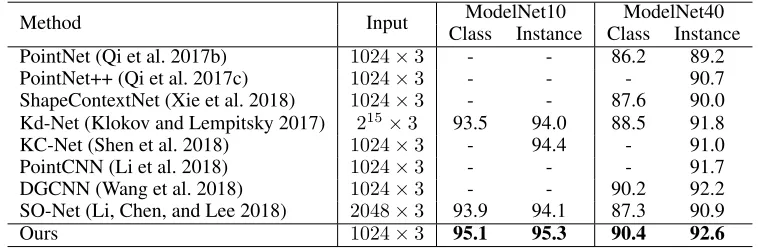
In this subsection, we evaluate the performance of Point2Sequence on ModelNet10 and ModelNet40 bench-marks, where ModelNet10 contains 4899 CAD models which is split into 3991 for training and 908 for testing. Table 1 compares Point2Sequence with the state-of-the-art methods in the shape classification task on ModelNet10 and ModelNet40. We compare our method with the results of eight recently ranked methods on each benchmark in terms of class average accuracy and instance average accuracy. For fair comparison, all the results in Table 1 are obtained un-der the same condition, which handles with raw point sets without the normal vector. By optimizing the cross entropy loss function in the training process, on both benchmarks, Point2Sequence outperforms other methods in class average accuracies and instance average accuracies. In ModelNet40 shape classification, our method achieves the instance accu-racy of 92.6% which is 1.9% and 0.2% higher than Point-Net++ (Qi et al. 2017c) and DGCNN (Wang et al. 2018), re-spectively. Experimental results show that Point2Sequence outperforms other methods by extracting the contextual in-formation of local regions.
Part Segmentation
To further validate that our approach is qualified for point cloud analysis, we evaluate Point2Sequence on the semantic part segmentation task. The goal of part segmentation is to predict semantic part label for each point of the input point cloud. As dipected in Figure 2, we build the part segmenta-tion branch to implement the per-point classificasegmenta-tion.
In part segmentation, ShapeNet part dataset is used as our benchmark for the part segmentation task, the dataset con-tains 16881 models from 16 categories and is spit into train set, validation set and test set following PointNet++. There are 2048 points sampled from each 3D shape, where each point in a point cloud object belongs to a certain one of 50 part classes and each point cloud contains 2 to 5 parts.
We employ the mean Intersection over Union (IoU) pro-posed in (Qi et al. 2017b) as the evaluation metric. For each shape, the IoU is computed between groundtruth and the prediction for each part type in the shape category. To cal-culate the mIoU for each shape category, we compute the average of all shape mIoUs in the shape category. Over-all mIoU is also calculated as the average mIoUs over Over-all test shapes. Similar to the shape classification task, we op-timized the cross entropy loss in the training process. We compare our results with PointNet (Qi et al. 2017b), Point-Net++ (Qi et al. 2017c), Kd-Net (Klokov and Lempitsky 2017), SO-Net (Li, Chen, and Lee 2018), KC-Net (Shen et al. 2018), ShapeContextNet (Xie et al. 2018) and DGCNN (Wang et al. 2018). In Table 2, we report the performance of Point2Sequence in each category and the mean IoU of all testing shapes. Compared with the stated-of-the-art meth-ods, Point2Sequence acquires the best mean instance IoU of 85.2%and achieves the comparable performances on many categories. Figure 3 visualizes some examples of our pre-dicted results, where our results are highly consistent with the ground truth.
Conclusions
Acknowledgments
Yu-Shen Liu is the corresponding author. This work was supported by National Key R&D Program of China (2018YFB0505400), the National Natural Science Founda-tion of China (61472202), and Swiss NaFounda-tional Science Foun-dation grant (169151). We thank all anonymous reviewers for their constructive comments.
References
Bahdanau, D.; Cho, K.; and Bengio, Y. 2014. Neural ma-chine translation by jointly learning to align and translate.
arXiv:1409.0473.
Bertolami, R.; Bunke, H.; Fernandez, S.; Graves, A.; Li-wicki, M.; and Schmidhuber, J. 2009. A novel connection-ist system for improved unconstrained handwriting recogni-tion.TPAMI.
Cho, K.; Van Merri¨enboer, B.; Gulcehre, C.; Bahdanau, D.; Bougares, F.; Schwenk, H.; and Bengio, Y. 2014. Learn-ing phrase representations usLearn-ing RNN encoder-decoder for statistical machine translation. arXiv:1406.1078.
Elman, J. L. 1990. Finding structure in time. Cognitive Science14(2):179–211.
Golovinskiy, A.; Kim, V. G.; and Funkhouser, T. 2009. Shape-based recognition of 3D point clouds in urban envi-ronments. InICCV, 2154–2161.
Hochreiter, S., and Schmidhuber, J. 1997. Long short-term memory.Neural Computation9(8):1735–1780.
Kanezaki, A.; Matsushita, Y.; and Nishida, Y. 2016. RotationNet: Joint object categorization and pose esti-mation using multiviews from unsupervised viewpoints.
arXiv:1603.06208.
Klokov, R., and Lempitsky, V. 2017. Escape from cells: Deep kd-networks for the recognition of 3D point cloud models. InICCV, 863–872.
Li, X., and Wu, X. 2015. Constructing long short-term mem-ory based deep recurrent neural networks for large vocabu-lary speech recognition. InICASSP, 4520–4524.
Li, Y.; Pirk, S.; Su, H.; Qi, C. R.; and Guibas, L. J. 2016. FPNN: Field probing neural networks for 3D data. InNIPS, 307–315.
Li, Y.; Bu, R.; Sun, M.; and Chen, B. 2018. PointCNN.
arXiv:1801.07791.
Li, J.; Chen, B. M.; and Lee, G. H. 2018. SO-Net: Self-organizing network for point cloud analysis. In CVPR, 9397–9406.
Luong, M.-T.; Pham, H.; and Manning, C. D. 2015. Effec-tive approaches to attention-based neural machine transla-tion.arXiv:1508.04025.
Maturana, D., and Scherer, S. 2015. Voxnet: A 3D convo-lutional neural network for real-time object recognition. In
IROS, 922–928.
Qi, C. R.; Liu, W.; Wu, C.; Su, H.; and Guibas, L. J. 2017a. Frustum pointnets for 3D object detection from RGB-D data.arXiv:1711.08488.
Qi, C. R.; Su, H.; Mo, K.; and Guibas, L. J. 2017b. Point-Net: Deep learning on point sets for 3D classification and segmentation. InCVPR.
Qi, C. R.; Yi, L.; Su, H.; and Guibas, L. J. 2017c. Point-Net++: Deep hierarchical feature learning on point sets in a metric space. InNIPS, 5099–5108.
Riegler, G.; Ulusoy, A. O.; and Geiger, A. 2017. OctNet: Learning deep 3D representations at high resolutions. In
CVPR.
Savva, M.; Yu, F.; Su, H.; Aono, M.; Chen, B.; Cohen-Or, D.; Deng, W.; Su, H.; Bai, S.; Bai, X.; et al. 2016. Shrec’16 track large-scale 3D shape retrieval from ShapeNet core55. InProceedings of the Eurographics Workshop on 3D Object Retrieval.
Shen, Y.; Feng, C.; Yang, Y.; and Tian, D. 2018. Mining point cloud local structures by kernel correlation and graph pooling. InCVPR.
Su, H.; Maji, S.; Kalogerakis, E.; and Learned-Miller, E. 2015. Multi-view convolutional neural networks for 3D shape recognition. InICCV, 945–953.
Sutskever, I.; Vinyals, O.; and Le, Q. V. 2014. Sequence to sequence learning with neural networks. InNIPS, 3104– 3112.
Wang, D. Z., and Posner, I. 2015. Voting for voting in on-line point cloud object detection. InRobotics: Science and Systems.
Wang, Y.; Sun, Y.; Liu, Z.; Sarma, S. E.; Bronstein, M. M.; and Solomon, J. M. 2018. Dynamic graph CNN for learning on point clouds. arXiv:1801.07829.
Wang, C.; Pelillo, M.; and Siddiqi, K. 2017. Dominant set clustering and pooling for multi-view 3D object recognition. InBMVC.
Wu, Z.; Song, S.; Khosla, A.; Yu, F.; Zhang, L.; Tang, X.; and Xiao, J. 2015. 3D ShapeNets: A deep representation for volumetric shapes. InCVPR, 1912–1920.
Xie, S.; Liu, S.; Chen, Z.; and Tu, Z. 2018. Attentional ShapeContextNet for point cloud recognition. In CVPR, 4606–4615.
Xu, Y.; Fan, T.; Xu, M.; Zeng, L.; and Qiao, Y. 2018. Spi-derCNN: Deep Learning on Point Sets with Parameterized Convolutional Filters. arXiv:1803.11527.
Zhu, Y.; Mottaghi, R.; Kolve, E.; Lim, J. J.; Gupta, A.; Fei-Fei, L.; and Farhadi, A. 2017. Target-driven visual naviga-tion in indoor scenes using deep reinforcement learning. In