University of Huddersfield Repository
Devlin, Anne, Adams, Karen, Hall, Lynne and Watts, Pauline
Educating Practice Teachers and Specialist Practice Mentors for their new role: Ensuring high
quality Practice Learning
Original Citation
Devlin, Anne, Adams, Karen, Hall, Lynne and Watts, Pauline (2014) Educating Practice Teachers
and Specialist Practice Mentors for their new role: Ensuring high quality Practice Learning. Project
Report. Health Education England.
This version is available at http://eprints.hud.ac.uk/id/eprint/22217/
The University Repository is a digital collection of the research output of the
University, available on Open Access. Copyright and Moral Rights for the items
on this site are retained by the individual author and/or other copyright owners.
Users may access full items free of charge; copies of full text items generally
can be reproduced, displayed or performed and given to third parties in any
format or medium for personal research or study, educational or notforprofit
purposes without prior permission or charge, provided:
•
The authors, title and full bibliographic details is credited in any copy;
•
A hyperlink and/or URL is included for the original metadata page; and
•
The content is not changed in any way.
For more information, including our policy and submission procedure, please
contact the Repository Team at: [email protected].
Educating Practice Teachers
and
Specialist Practice Mentors
for their New Role:
Ensuring high quality
practice learning
Final
Report
from
the
Task
and
Finish
Group
on
Co-authored by:
Anne Devlin
Deputy Dean, Teaching, Learning & Academic Partnerships
Anglia Ruskin University
Karen Adams
Senior Lecturer: Primary Care & Public Health
University of Huddersfield
Lynne Hall
Clinical Lead: Community and Primary Care Nursing
Health Education England
Pauline Watts
Professional Officer
CONTENTS
FOREWORD ... 1
EXECUTIVE SUMMARY ... 2
1 INTRODUCTION ... 3
1.1 Background and Context ... 3
1.2 Student HV Placement Quality ... 3
1.3 Purpose and Key Aims of the Task and Finish Group... 4
2. THE RESEARCH AND POLICY EVIDENCE INDICATING THE ATTRIBUTES OF EFFECTIVE PRACTICE LEARNING ... 6
2.1 Analysis of Survey to Practice Teachers, Mentors, Health Visiting Students and Senior Managers/Clinical Leads ... 9
2.1.1 Health Visitor Practice Teacher Survey: Summary of Key Points ... 9
2.1.2 Mentor Survey: Summary of Key Points ... 14
2.1.3 Service Manager/Clinical Lead Survey: Summary of Key Points ... 19
2.1.4 Health Visiting Student Survey: Summary of Key Points ... 24
2.1.5 Concluding Analysis ... 27
3. PRACTICE TEACHER AND MENTOR NATIONAL ROLE DESCRIPTORS ... 28
3.1 Practice Teacher Role Descriptor ... 28
3.2 Mentor Role Descriptor ... 31
4 EDUCATING PRACTICE TEACHERS AND SPECIALIST PRACTICE MENTORS FOR THEIR NEW ROLES: ... 34
4.1 Introduction ... 34
4.2 General Prompts for Higher Education Institutions and Lecturers ... 34
4.3 Key Topics to Cover – Practice Teachers ... 34
4.4 Practice Teacher Competency Statements ... 34
4.4.1 Teaching, Learning and Assessment ... 34
4.4.2 Supervision and Support ... 35
4.4.3 Leadership and Teams ... 36
4.4.4 Quality Assurance ... 36
4.5 Key Topics to Cover – Specialist Practice Mentors ... 37
4.6 Mentor Competency Statements ... 38
4.6.1 Teaching, Learning and Assessment ... 38
4.6.2 Leadership and Teams ... 38
4.6.3 Quality Assurance ... 39
5. HEALTH VISITING EDUCATION AND GOOD PRACTICE GUIDANCE AND RESOURCES ... 40
5.1 HEE Standards for Assuring Quality in Practice Placements ... 40
5.2. The Health Visitors’ Community of Practice Evidence Hub and HEE’s Technology Enhanced Learning (TEL) Programme ... 42
5.2.1. The Health Visitors Community of Practice Evidence Hub ... 42
5.2.2 The HEE Technology Enhanced Learning Programme (TEL) ... 43
4
6 COMMUNICATIONS STRATEGY TO HEALTH VISITING AND OTHER KEY
STAKEHOLDER GROUPS ... 45
7 CONCLUSION AND RECOMMENDATIONS ... 47
8 REFERENCES ... 49
9 APPENDICES ... 52
Appendix 1: NMC Practice Teacher Standards (NMC 2008) ... 52
Appendix 2: Task and Finish Group Membership ... 54
1
FOREWORD
The role of the Practice Teacher and Specialist Practice Mentor in the provision of a quality learning environment is without doubt, fundamental in ensuring that the health visiting profession are able to continue to deliver high quality care that meets individual and population health needs.
For the first time ever, we have a good understanding of what a good and indeed a bad practice placement looks like from the collective views of Student Health Visitors, Practice Teachers and Mentors, service managers and clinical leads. This engagement has enabled HEE to access qualitative information from every geographical area of the country that has been used to enhance the quality and consistency of student placement learning and student support through the development of common expectations and standards in this document. It also gives a clear understanding of the educational roles, responsibilities and educational preparation that will enable the best use of the educational and clinical expertise of Practice Teachers and Mentors both now and in the future.
The profile of Practice Teachers & Mentors has been raised considerably since the Health Visitor Implementation Plan 2011–15: a call to action (Department of Health, 2011), which presented a real opportunity to strengthen and grow the health visiting workforce. This drive to increase health visitor numbers has placed unprecedented pressure upon health visiting practice teachers to manage the educational preparation of a greater number of students which has resulted in the emergence of mixed placement models. In addition to this, the newly expanded health visiting workforce includes a high percentage of new and recently qualified practitioners who require robust preceptorship and support. With their combined educational and clinical expertise, practice teachers and specialist mentors are best placed to deliver. This document considers the wider parameters of the role and a plan for a new and redefined role is put forward with proposals to support continuing professional development.
Practice teachers and mentors represent a group of educationalists whose clinical and educational expertise expands over a number of specialist community nursing practice disciplines and it is therefore important that any proposed changes or developments in how the roles are defined and developed are considered in this context.
Consequently, while the primary focus of this document is centred on health visiting education, the findings presented here have resonance across all specialist community nursing practice disciplines, nursing and other non-medical practice learning situations. I am delighted to offer you a set of resources that will help you deliver placement excellence that will enable the health visiting profession to deliver services that are underpinned by access to high quality practice learning environments.
2
EXECUTIVE SUMMARY
This report presents the findings and deliverables from the Task and Finish Group on Health Visitor Practice Education established by Health Education England in February 2014. Its goals were to examine current models and experience of learning in practice, review the evidence-base related to effective learning in this milieu and develop standards and recommendations commensurate with excellent health visiting practice education.
After outlining the background and context that provided the foundation for this work in section 1, section 2 of the report provides a summary of the research and policy evidence-base outlining attributes associated with effective practice learning. We believe this review may be useful to many tasked with delivering effective placement-learning in a range of health settings.
Recent policy drivers aimed at expanding the health visiting workforce mean that those engaged with learning in the health visiting field are tasked with managing the educational preparation of a greater number of students and the preceptorship of significant numbers of recently qualified practitioners The survey of over 700 practice teachers, mentors, clinical managers and health visiting students indicated that the traditional one-to-one practice teacher student model, which had been prevalent in health visiting practice education, has been succeeded by a number of different models of practice teaching, supervision and support. The profile of practice teachers appears to have been raised considerably by the recent focus on expanding the health visiting workforce and the emergence of specialist practice mentors nationally was observed. While the survey indicated a generally positive response to the evolving models of practice learning, the expectations associated with these emerging roles and the educational preparation and support provided for them was unclear. This report presents national role descriptors for practice teachers and specialist practice mentors offering employers a framework to inform person specification. A competency framework for practice teachers and specialist practice mentors is also described with related recommendations for future education, training and continuing professional development. Given the plethora of evidence indicating the impact of the socio-cultural learning environment on the development of professional practitioners, Health Education England have developed a number of organisationally focused standards for assuring quality in practice placements, also detailed in this report. They facilitate the strategic managing of practice learning at all levels within the host provider and have the potential to form part of the annual quality monitoring applied to all commissioned education. Finally sharing ‘best practice’ and using evidence as a basis for practice is an important foundation for effective practice-based learning and the potential to exploit technology to support this critical engagement across the wider health visiting community is considered in this account.
3
1 INTRODUCTION
1.1
Background and Context
In August 2013 Health Education England (HEE) facilitated a workshop in partnership with NHS England (NHSE), Department of Health (DH) and Public Health England (PHE). The aim of this was to engage a broad range of key stakeholders to enable an improved understanding of the challenges of health visiting practice placements and the opportunities and measures that could be put in place to ensure that health visiting students are offered a quality learning experience. The stakeholders present included representation from NHS Employers, HEE Local Education and Training Boards, UNITE/CPHVA, Service Providers and the UKSC on Specialist Community Public Health Nurse Education.
A further joint workshop facilitated by Lisa Bayliss-Pratt, HEE Director of Nursing, and Hilary Garrett, NHSE Director of Nursing, followed on the 19th November 2013 to increase stakeholder involvement. While many of the attendees were different to the ones who attended the August workshop, much of the information gathered was reiterative.
A number of action themes emerged from these events that required a strategically led endeavour to develop an appropriate response and HEE, as lead agency for this strand of work established the Student Health Visitor Placement Quality Task and Finish Group to take this forward. This report presents an account of the work, outputs and recommendations of that task and finish group.
1.2
Student HV Placement Quality
Below is an account of the themes or issues that emerged from the August and November 2013 meetings which offer a robust rationale for forming the task and finish group to review health visiting practice education.
Student Health Visitor Practice Placements:
Models of Practice teaching have moved away from the traditional 1:1 approach (one practice teacher supporting one student) to models that generally incorporate practice mentors that are ‘long-arm’ supervised by a practice teacher
There is no definitive national recommendation or guidance on the practice teacher: student ratio leaving placement providers to create the operational solutions required to meet learning outcomes related to 50 per cent of the total learning experience
There are variations across the country in terms of the Higher Education Institution (HEI) approaches to linking academic staff with students when they are undertaking practice placements
Placement capacity is under strain in some areas (for example, London, Kent and Medway) due to increased student health visitor numbers and a dearth of practice teachers resulting in local areas collaborating to mitigate this
London areas have been recruiting qualified health visitors from Denmark, and their adaptation needs will further increase pressure on practice placements areas
The success of the ‘Call for Action’ (Department of Health, 2011) has led to a large number of newly qualified health visitors who need preceptorship entering the system. This has put an additional strain on practice teachers and preceptors with a subsequent impact upon student health visitors
There is a need for placement quality to be robustly monitored and assured
Practice Teachers
Many practice teachers have concerns about:
i) maintaining quality and safety if they are to be expected to have a higher ratio of students than they currently do
4 iii) Band 7 Team Leader posts appearing to be replaced by Band 6 posts
Practice teachers across England do not share a common job description that is supported by a competency framework
Some practice teachers are choosing to work just as health visitors. A greater understanding of their reasons for electing to do this is required
The professional aspirations of existing practice teachers is broadly unknown and needs to be understood and championed in terms of how their skills might be used and extended in the future i.e., higher education institutions refresher programmes, internal/external leadership roles, research and development, clinical academic careers etc.
The post 2015 role of practice teachers needs interpretation, i.e. extended role, provide internal teaching, provide study days/sessions, facilitate student nurse placements as an introduction to health visiting, inter-professional learning etc.
Practice teachers want/need to be able to access resources such as Virtual Learning Environments and higher education institutions libraries
Practice Teachers and Higher Education Institutions
As practice teachers have a key role in transforming the services, clear links need to be made between academic curricula and service delivery requirements now and the future Practice teachers generally feel that higher education institutions need to be more
responsive to continuing professional development requests that meets individual and service development needs
Education and Training Needs of Qualified Health Visitors to Support Student Health Visitor Placement
It is important to develop the existing health visitor workforce and transform services alongside increasing the health visiting workforce numbers to ensure that existing and newly qualified staff are operating cohesively
A whole team approach to learning and development via regular appraisal is required
Draft Student Health Visitor Placement Quality Project Proposals
Engage higher education institutions in the development of curricula to better reflect the new service requirements and changing role of the health visitor and the practice teacher
Develop a basket of indicators/performance measures to ensure consistent high quality practice placements and support arrangements
Further promote/raise the profile and understanding of the practice teacher role and to develop a common job description for the role to inform workforce planning
Support the development of learning hubs and shared learning opportunities Improve access to learning materials, resources and evidence informed practice Develop a competency framework/educational expectations for practice teachers
1.3
Purpose and Key Aims of the Task and Finish Group
The Task and Finish group met on a monthly basis between February and October 2014: see Appendix 2 for the group’s membership.
Its key purpose was to enhance the quality and consistency of student placement learning and student support through the development of common expectations and standards, see Appendix 3 for the task and finish group terms of reference. The goals of the project group were as follows:
5 To contribute to the development of standards and recommendations for future
education, training and continuing professional development (CPD) for practice teachers and mentors
To provide policy, practical and specialist expertise that identifies and facilitates sharing good practice, existing tools and guidance that is able to support enhanced practice education and contemporary health practice
To support the delivery of improved clinical placements and student support by means of internal and external communications and engagement with a range of relevant stakeholders including service providers
6
2.
THE RESEARCH AND POLICY EVIDENCE INDICATING THE
ATTRIBUTES OF EFFECTIVE PRACTICE LEARNING
This section presents a summary of selected published research, national and local policy papers and recent NHS inquiry evidence related to the attributes of effective practice learning and the practice teaching and mentoring of health visiting students. It has utilised international as well as national literature and studies from a range of sectors including, but not exclusively, related to health education. The analysis of evidence and policy/inquiry recommendations suggest that the following should be in place to facilitate effective practice learning.
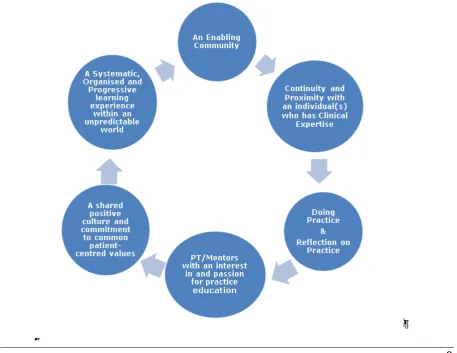
1. Students should be working with and alongside skilled and motivated/ enthusiastic practitioners (appears to be more important than a clinical teaching qualification), that enables them to see evidence based practice role-modelled and implemented within the real-world context of the health workplace. There is significant evidence that students trying out in practice and assimilating what works in the real world is the
fundamental mechanism that embeds theoretical learning into practical expertise.
The literature also suggests that they need to see the reality of what is practical, as opposed to ideal, rehearsed by other practitioners as a fundamental part of developing their own practical know-how (Benner, Tanner, & Chelsa, 1996; Bradshaw & Merriman, 2008; Clark & Holmes, 2007; Eraut, 2007a; Gerrish, et al., 2011; Houston & Cowley, 2002; Lave & Wenger, 1991; Lum, 2012; Moore, 2005).
2. Practice Teachers, Mentors and the wider practice community transmit the tacit knowledge and culture, i.e. the day-to-day working practices, the unwritten rules, as well as the acknowledged methods of working, often without being fully aware of these (Burton & Jackson, 2003; Cavendish, 2013; Devlin, 2014; Francis, 2013; Hodkinson & Hodkinson, 2003;
Keogh
, 2013; Pearcey & Elliot, 2004; Spouse, 2001a; White, 2010) Hence the importance and attributes of a positive culture or community for effective workplace learning have been illustrated consistently in national policyand national and international work. The attributes of good leadership, a clear
management steer, partnership working and quality care have also been identified as pivotal for the creation and maintenance of positive learning environments (Henderson, Briggs, Schoonbeek, & Paterson, 2011; Mantzoukas & Jasper, 2008). Matsoukis and Jasper maintain that the significance of the practice culture as a source of knowledge helped explain the conundrum of why nursing and other theories consistently fail to capture the totality of actual practice and concluded that attempts to integrate evidence-based practice were more likely to succeed using work-based rather
than traditional pedagogy (2008, p. 324). Not surprisingly, given theirs and others’
claims that all other knowledge-types are moderated by the prevailing clinical culture, they linked a positive workplace culture with learning and knowledge enhancement and therefore an important influence on how well practitioners perform in their roles. This literature supports a re-emphasis on a shared positive culture which has patients/clients at the centre of care delivery such as that represented by the NHS
Constitution values (Department of Health, 2013), as well as up-to-date and highly
motivated practice teams and educators.
3. Given that practice teachers, clinical supervisors and/or mentors also have a key impact on the workplace culture and learning within this sphere (Brammer, 2006; Saarikoski & Kilpi, 2002; White, 2010), the evidence supports the selection of practice teachers and mentors who have an interest in and passion for practice and practice education, have received appropriate educative preparation for their role and
continue to have annual (or similar) updating opportunities (Devlin, 2014; Spouse,
7 such as that often ascribed to practice teachers, for ‘knowledge brokering’ or significantly shaping the understanding and practice of ‘newcomers’ in the field.
4. Mentors and practice teachers need to feel valued for their contribution to practice learning, feel well supported by their teams and managers, and supported via supervision or informal networking with colleagues also engaged in practice teaching and mentorship (Wenger, McDermott, & Snyder, 2002; White, 2010; Willis, 2012). A recognition of the time and resource aspects of practice teaching and mentoring in health visiting, e.g. adjusted workload, office space and computers, is less easy to locate in the empirical literature but was widely acknowledged as an issue in Willis’ review of nursing education (2012). Adams (2013) found that practice teachers lacked a clear professional identity and that this affected the recognition that they were afforded for their role. Whilst practice teachers felt appreciated by their specialist practice students their perception was that employers did not value or fully understand their role. The practice teacher role was generally an addition to a full time caseload with no provision for protected time, space or resources. Haydock et al (2011) and Carr and Gidman’s (2012) studies drew similar conclusions and proposed that protected time was important in effectively undertaking the PT role.
5. Enabling communities of practice are those which comprise positive and skilled practice teachers/mentors who provide a protected (from complete exposure to the complexities of practice), safe and supportive environment for students to try out new skills, experiment, question and reflect, within the wider context of an engaged, constructive and helpful team (Benner, Tanner, & Chesla, 2009; Devlin & Mitcheson, 2013b; Eraut, 2007b; Lave & Wenger, 1991; Spouse, 2001b; Wenger, et al., 2002).
8
Figure 1.
Developing professional practice and expertise requires being in
practice and doing practice
[image:13.595.70.528.420.773.2]9
2.1
Analysis of Survey to Practice Teachers, Mentors, Health Visiting
Students and Senior Managers/Clinical Leads
An online survey was made available to practice teachers, mentors, clinical leads/managers and health visiting students for two weeks in March/April 2014, to explore their experience and perspectives of practice education in this milieu. There were 714 responses from 10 regions in England and one response from Wales. The next sections present a summary of the key findings emerging analysis of this data.
2.1.1 Health Visitor Practice Teacher Survey: Summary of Key Points
There were 192 PT respondents representing nine Regions across England.
Eight of the respondents were trainee PTs with the remaining sample having between 0-20 years of teaching experience.
15.6%
13.4%
26.9%
7.5%
5.4% 7.5%
15.6%
5.4%
2.7%
0.0% 5.0% 10.0% 15.0% 20.0% 25.0% 30.0%
Which
area
of
England
do
you
work
in,
e.g.
East
Midlands,
Yorkshire
and
Humber,
Thames
Valley
etc.?
8
83
29 29
4 10 1 3
0 10 20 30 40 50 60 70 80 90
In Training 0‐5 Years 5‐10 Years 10‐15 Years 15‐20 Years 20‐25 Years 25‐30 Years 30‐35 Years
10 Student numbers were significant and 79 per cent of 165 respondents had supported between 0-10 learners since September 2012, although the majority of these were health visiting students.
Unsurprisingly therefore, the satisfaction of seeing students develop and the recognition of the positives of this on their own as well as the profession’s development were cited as the most satisfying aspect of the PT role.
61
69
23
8
2 0 0 2
0 10 20 30 40 50 60 70 80
0‐5 5‐10 10‐15 15‐20 20‐25 25‐30 30‐35 35‐40
How many learners have you supported since September 2012?
Student health
visitor, 71.9% Student
nurse, 4.1% Trainee
practice
teacher,
2.3% Trainee mentor,
2.3%
Other (please
specify), 19.3%
What types of student?
Student health visitor Student nurse
Trainee practice teacher Trainee mentor
11 The most problematic aspects of the PT role were centred on the following key issues and these emerged strongly via several question strands:
Workload/time management issues in terms of meeting student and clinical (and possibly additional role) requirements
The numbers of students and reconciling clinical responsibilities with working in practice with students/travel etc., especially where the students had experienced problems, e.g. failing /unmotivated students
Organisational issues, e.g. unsupportive infrastructure, resources within caseload/organisation, HEI support, misunderstandings of the complexity of the role, backfill or other time-pressure factors/lack of allowance for these
163 respondents indicated they had received at least one type of preparation for becoming a practice teacher with 88 per cent indicating that this prepared them well enough for the role. There were a small number of useful additional suggestions to enhance this preparation including a greater focus on practice teaching within their educational preparation rather than general teaching skills. PTs would especially appreciate further input linked with the challenges of managing a busy workload and multiple students.
Enjoy teaching,
45.7%
Influence and
support role, 19.6% Professional
development, 13.7% Career progression,
10.5%
Improve standards,
10.5%
Why did you decide to become a Practice Teacher?
Enjoy teaching
Influence and support role
Professional development
Career progression
12 It was particularly interesting to note the PTs’ view of their role going forward as 147 responses were offered on this, with the majority indicating their belief that the PT role would change to a practice-leading, education-coordinating one in the future. The return to a 1-to-1 model of practice teaching and problems associated with long-arm models of education emerged in this analysis but should be viewed in line with the number of respondents mailing these comments (13).
Time/caseload,
37.9%
Training/supervisio n, 31.0% Peer support,
13.8%
Help with failing
students, 6.9%
Other , 10.3%
What additional support/input would you like to support your
PT role going forward?
Time/caseload
Training/supervision
Peer support
Help with failing students
Other
55
17
14
13
13
12
7
5
5
3
3
0 10 20 30 40 50 60
Role Development
Organisation
Evidenced‐based Practice and Supervision
Mentoring
Support Network and Resources
Student Relationship
Management
Recognition
Caseload
University
Other
13 Many of the respondents thought that the role of practice teacher would substantially change in future years as the reduction in student numbers would mean that the practice teacher role would become more about leading teams and preparing training for the organisation employing them, doing appraisals and becoming an educator for all staff, rather than student-focused. Several felt that practice teachers should take on more of a leadership role and practice-development role, although some expressed concern that the end to the ‘call to action’ programme may lead to a diminution in PT numbers and redaction of their role. Their concern was linked with the large number of recently qualified health visitors with little experience who should be supported in developing their knowledge and expertise. As one respondent put it, “We do not know what will happen after 2015, and this has been the anxiety most [practice teachers] have.”
There was an excellent response from the PTs indicating their view of a positive learning environment and what presented barriers to effective learning, 348 and 461 pieces of data from the 192 respondents.
The interesting point of note is that their views reflected the wider national and international literature regarding what comprises a good workplace learning environment, e.g. the quality and positiveness of relationships reflected in ‘teamwork and support’ (the PTs’ number one), time and resources, i.e. people and physical resources, the availability of educators and clinicians and the range of appropriate learning opportunities on offer (the PTs number 2, 3, and 4). The barrier to a good learning environment represented the opposite, PTs and clinicians with a too heavy workload and therefore lack of time to focus on students, an overcrowded working environment. The link between the data for both questions was very clear. Some concern about the respect/value accorded the role of PT also emerged from this data and is worth further consideration.
71 51
41 41 28
19 19 18 18 13 11 8 7 2 1
0 10 20 30 40 50 60 70 80
Teamwork and Support Student Experience Time and Resources Supportive Management Practice Placement Oppportunities Communication and Organisation Practice Educator Support Evidence Based Practice and Tools Training and CPD University Mentors Supervision and Assessment Respect and Recognition Recruiting Suitable Students Orientation and Induction
14 2.1.2 Mentor Survey: Summary of Key Points
205 mentors responded to the survey from 10 geographical regions.
The overarching themes emerging from the survey were positive with a greater proportion opting to take the role, although almost 40 per cent of respondents had been asked or felt obliged to undertake the mentoring of HV students. Nevertheless the majority expressed satisfaction with observing students developing within the profession and feeling their own professional knowledge was also updated. 147 mentors identified why they became a mentor with 58 skipping this question. A passion for teaching (55) and for their own development (17) contrasted with feeling obliged (45), being asked to take the role (13) and feeling a responsibility to do so (7), indicating a slightly higher number seeking the mentor role but also a significant proportion of those answering feeling some obligation to take on the task. The questionnaire did indicate significant experience of mentoring with 60 of 146 indicating they had mentored for over 5 years, 45 for between 1 and 3 years. It was apparent that while mentors had considerable experience of mentoring generally, these skills had only recently been utilised for mentoring within the health visiting field. It would appear that a fairly substantive proportion of the health visiting profession with significant generic experience of mentoring and considerable clinical expertise, have only recently become substantively engaged with health visiting learners, although they have many of the attributes congruent with the educator role.
There was a rich seam of positive comment concerning what mentors find satisfying about the mentor role with the majority indicating that supporting and working with students and observing their growing confidence, competence and appreciation of health visiting were satisfying. Personal development and contributing to professional standards were also cited, particularly linked with keeping their own practice updated.
South East, 33.7%
South West,
9.7%
London, 7.1% East of England,
16.8% East
Midlands,
5.6%
West Midlands,
10.7% Wales, 0.5%
Yorkshire and the
Humber, 9.7% North
East,
0.0% North West, 6.1%
Which area of England do you work in, e.g. East Midlands,
Yorkshire and Humber, Thames Valley etc.?
South East
South West
London
East of England
East Midlands
West Midlands
Wales
Yorkshire and the Humber
North East
15 The most problematic aspects of the mentoring role resonated with that seen in the PT survey, with some minor variations. These issues emerged strongly via several question strands concerned with the perceived challenges in the mentoring role. Workload/time pressures were most frequently cited as problematic in terms of attempting to meet student and clinical requirements. Mentors referred to retaining full caseloads as well as managing the complexities of the clinical and educative role. They were unclear about the expectations of the mentor role and how best to support students’ learning. Part-time mentors found this particularly challenging. Given the student numbers, reconciling clinical responsibilities with students’ practice learning was made difficult by other issues seen as complicating the learning journey, such as geography and travel, diary pressures, liaising with ‘long arms’, communication with the wider team etc. Mentors said they often felt busy and rushed much of the time and therefore concerned about the quality of the learning they could facilitate. This was particularly so where students had problems, e.g. failing /unmotivated students. The ‘paperwork’ associated with the educational role was also cited frequently as a challenge in the context of their wider working role.
The environment was the second most cited issue for dissatisfaction with mentoring particularly cramped office conditions and insufficient IT resources. Mentors spoke about their car and time in the car as being the only learning space they were able to ascertain from a busy working schedule in an environment where time for reflection and space were at a premium. Although less frequently mentioned in terms of respondent percentages, organisational changes and varying levels of input and support from management and HEIs emerged in several responses.
76
60
47
42
27
25
19
14
4
2
0 10 20 30 40 50 60 70 80
Student Development
Teaching and Sharing Knowledge
Self‐Development
Supporting Students
Practice
Other
Working with Students
Health Visitor Role
Nothing ‐ Very Little
Role Model
16 A large percentage of those responding felt ‘well enough’ prepared for the mentoring role but there was a consistent theme of seeking clarification about the expectations of mentoring within the HV student context and how best to support health visitor students’ learning in practice, especially those students experiencing difficulty.
86 60 45 22 11 10 9 5 4 4 4 3 2 2 2
0 10 20 30 40 50 60 70 80 90 100
Time Other Workload Underperforming Students Paperwork University Office Environment Change Management Part‐time Working Practice Teachers Student Numbers None Lack of Continuity Compensation
What are the least satisfying/challenging or most problematic
aspects of the Mentor role?
73 62 27 21 20 15 7 5 3 3 30 10 20 30 40 50 60 70 80
Other
Mentorship
Practice Teacher
University Course ‐ Study Day
Mentoring Experience
None ‐ Very Little
ENB998
Practice Teacher Course
PG Certificate
Health Visitor Training
Academic ‐ Lecturer
17 It appeared that preparation for and the actual role requirements were somewhat variable across the country, which is not surprising given the recent emergence of various PT models and related mentorship development. The respondents request for clarification about role and consistency of input and support to them from their managers and HEIs is probably a key finding of the survey, which if acted upon, would develop mentorship positively moving forward. Only 43 respondents answered the question concerning what additional preparation or CPD they would find useful but there was a consistency in their answers, with most indicating that further input about the role and expectations of mentorship and understanding the students’ needs and how to support them more effectively would be useful. Supervision and support throughout the mentoring year were also mentioned.
Of particular interest in the survey were the mentors’ detailed responses concerning what comprises a positive learning environment, which illustrates their view that the attitudes, motivation and welcoming culture within the immediate team are as important as the diversity of experience on offer to students and the knowledge base/expertise of immediate team members.
Training and
supervision,
46.5%
Understanding
of students'
needs, 18.6% Time/reduced
workload,
18.6%
Other,
16.3%
18
73 33
32 25 22 21 20 18 17 12 12 11 10 9 8 7 7 7 5 5 5 5 4 2 2
0 10 20 30 40 50 60 70 80
Team Variety of Experiences Time Practice Teacher Other Attitudes Leadership and Management Workload Environment Supporting Students Student Knowledgable and Up‐to‐date Learning Culture Communication Evidence Base IT Training Resources Supervision University Reflection Pedagogy Relationship Administration Change
19 2.1.3 Service Manager/Clinical Lead Survey: Summary of Key Points
There were 96 respondents to this part of the survey representing 9 Regions across England.
Of these, the largest group, 31 respondents (43.7%) said that the one-to-three model was offered in their organisation, followed by 22 respondents (31%), who said that their organisation used a one-to-one model. A further eight respondents (11.3%) said that they used a peripatetic roving mode while 10 (14.1%) indicated that their organisation used a different model to those specified. Six of these specified that their practice used long-arm mentoring.
Teaching development, student and mentor support and assessment comprised their main expectations of the PT role, with leadership, role modelling and caseload work, in terms of modelling best practice and acting as change agents, also identified. It is important to note what ‘teaching development’ refers to within the survey, to clarify how the PT’s and mentor’s
19 14
16 17 9
2 4 3
6
0 5 10 15 20
London East of England South West South East Yorkshire and Humber East Midlands West Midlands North East North West
Which area of England do you work in, e.g. East
Midlands, Yorkshire and Humber, Thames Valley
etc.?
31.0%
43.7%
11.3% 14.1%
0.0% 5.0% 10.0% 15.0% 20.0% 25.0% 30.0% 35.0% 40.0% 45.0% 50.0%
1 to 1 1 to 3 Peripatetic roving model
Other (please specify)
20 roles are distinguished by the clinical lead/manager respondents. Teaching development applied to the PT role involved a wide remit including, remaining competent to teach throughout their time as practice teacher; able to identify the learning needs of all students; providing high quality placements to students; leading on evidence-based practice and staying up to date in practice. Several respondents mentioned managing the quality of the learning environment and the need to highlight any training issues within the service. Others expected practice teachers to ensure learning and teaching took place across the workforce and not just with students, and expected PT engagement with the recruitment process. Practice teachers were expected to ensure that adequate time was spent with each student in order to balance student needs with the demands of the service, assist students to make the links between theory and practice; to maintain fortnightly oversight of their students’ diaries and provide feedback on written work and evidence. Overall it was their role to ensure that the students’ education met the aims and objectives of the relevant higher education institution and developed practitioners fit for contemporary service requirements. They were also expected to identify any early issues with students’ learning and performance and be able to assess clinical practice and sign off learners as competent. In addition to liaising with the university their role in supporting those mentoring and supervising students as well as directly supporting learners was highlighted.
There was an interesting resonance with the PT and Mentor surveys in relation to the factors that enabled PTs to undertake their roles effectively or not and many of the themes from the two previous accounts are replicated in this analysis. Designated time, reduced caseload and team support were seen as the most influential on effective practice teaching, with support from managers, good communication, joint working with HEIs, as well as personal commitment from the PT acknowledged as key factors. Two responders suggested national
14 13
11
9
9 8
7
7 6
5
5 4
2
2
2
0 2 4 6 8 10 12 14 16
Time
Caseload Team Support
CPD Opportunities
Leadership and Management Commitment
University
Other Supervision
Communication
Organisation
Mentors Student Ratio
Clear Expectations
Recognition
21 service specifications around the role would be useful, which is interesting in the light of the task and finish group mandate.
Just over 55% (43) indicated that that these expectations were fully met, with a further 26% suggesting they were mostly or partially met. Workload/caseload pressures, high student numbers, lack of resources including space and poor IT support and lack of designated time for the education role were the most cited reasons for less effective practice teaching, alongside the pace of service change, lack of support from managers and/or HEIs. Only 5 respondents specifically mentioned the development of the mentor with ‘long arm’ role as detrimental to student learning and under-performance was often linked with pressures within the system rather than with individual PT’s competence or motivation.
44 respondents gave a view about the PT future role development and some interesting ideas emerged from this which was very pertinent to the task and finish group’s task. Many suggested that they saw the role of the practice teacher as encompassing a much wider range of training and development than health visitor students, including supporting learning across the service, showcasing innovative practice and managing continuing professional development. It was suggested that the role wold have to involve supporting the large numbers of inexperienced and newly qualified staff moving through the service in the next few years. 14 respondents saw PTs supporting the development of practice as a whole, including performance management and as project leads to move forward good practice. Developing specific initiatives, such as developing integrated working in children’s and young people’s services, or translating policy and legislation into good practice and community development projects were all mentioned as opportunities for PTs to utilise their educative skills and drive forward professional practice and cascade knowledge and expertise to the HV workforce.
Educational and clinical leadership roles were suggested as respondents felt that a plan had to be set in place for the role of the practice teacher beyond 2015 to ensure robust development of the workforce in future years. Respondents suggested that the PT role had to be valued as a “key to quality in clinical practice, leadership and practice education and not just about having students”, and that national guidance regarding roles and responsibilities was now required as these varied widely across the country. Respondents also noted that joint working strategies were being explored to help roll out total integration of the healthcare profession and that the effectiveness and usefulness of this should be shared more widely. Finally it was proposed that practice teachers needed to take on the role of health consultants to help develop better integrated services which are outcome focused for children, and to transfer knowledge to the School Nursing Service to support staff undergoing the same transformation.
22 In contrast with the PT role the clinical manager/lead respondents (43) perceived the mentoring role be focused more directly on day-to-day student support and teaching, including seeking out learning experience for the students that met their objectives, facilitating their learning, giving them regular constructive feedback with clear areas of development and monitoring their progress. Having clinical expertise, keeping up to date and role modelling were seen as part of the expectations for a mentor, as it was for the PTs, but the focus of the mentors role appeared to be on the individual student within their team rather than the more strategic educative management associated with the PT role. Liaising with the PT was the second most cited response indicating an expectation that mentors support the clinical practice teachers in their role to provide a quality placement for students, act on advice and guidance from the practice teacher but also receive support from practice teachers in areas such as assessing the clinical competence of students and maintaining records of feedback, learning plans and achievements. Only 12 respondents represented a broader role for the mentor including maintaining tri-annual reviews, developing training packages for staff members, induction of new staff and developing learning tools and information for those new to their posts. Most respondents who answered suggested that their expectations of the mentor were fully met (40) with a much smaller number indicating they were only partially met (17).
Training, practice teacher and team support were seen as the most important factors in enabling mentors to undertake their role effectively, i.e. regular updates, a good mentorship programme within the higher education institution, training days, annual mentorship updates and workshops with peers. Support from practice teachers was seen as vital as they understood the pressures on mentors and some respondents also wanted to see mentors included in planning and interviews, regular meetings including those with students and restorative supervision. While workload pressures were cited as the main reasons for ineffective mentoring (27) lack of support and/or preparation for the role were also seen as
7
6
5
5
4
3
3
2
2
2
2
0 1 2 3 4 5 6 7 8
CPD
Time
University
Other
Restorative Supervision
Leadership
Training and Development
None
Educational Qualification
Clinical Supervision
Caseload
What additional support/input, including CPD do you think
Practice Teachers require to support them to deliver their role
23 important. Role specification was identified as an important factor in promoting effective mentoring, or where there were unclear expectations, ineffective mentoring. There was a limited response to the question about the future mentor’s role (34) with some suggestion that the role with students should be retained and could be extended beyond students to new and other staff, staff training and development and could be perceived as part of a pathway to becoming a practice teacher.
24 Learning development was by far the biggest category, and spanned a number of sub-categories. Respondents wanted good access to high quality relevant training, a workforce analysis of gaps in learning; designated professional development leads; commitment from the organisation to the importance of training staff; and efficient organisation of such training. Continuing professional development available both internally and externally was seen as key for many respondents, including inter-agency training but also regular updates on ‘bread and butter’ issues. Respondents also spoke of the culture conducive to all members of the health visiting team supporting learning, where there is engagement and passion throughout the organisation from the board downwards, and where the environment is safe, open and proactive. Teams, in particular clinical practice teachers, needed to be well trained, experienced, and crucially, highly motivated with a clear service vision, shared objectives, and shared respect and values. Good communication and liaison with the higher education institution was seen as key by several respondents, with others wishing to see communities of practice with regular forums and management support
The biggest conflict cited in managing the learning and clinical agenda was that of workload. Balancing the needs of all staff involved was seen as a key conflict, with team members having to be accommodating enough to allocate suitable work for students to complete their competencies, while picking up everything else to support their practice teachers. One respondent claimed that the needs of students were being prioritised, and the ‘practice teacher freed up’, but at the expense of other members of the team. However, they added: “Managers are looking at supporting those teams in a number of ways, including re-structuring teams to bring them together and using staff from other teams to give temporary support”. One manager noted that “all staff know that this is the final year of large student numbers and that once these cohorts are through we will have increased the HVs numbers significantly and that all teams will benefit from this increase in numbers. Knowing this has motivated most teams.”
2.1.4 Health Visiting Student Survey: Summary of Key Points
25 The contact with their PTs was very variable from weekly to monthly or longer, often depending upon geographical proximity, and also included more than one type of contact, e.g. email and telephone as well as face-to-face contact. The number of students supervised by their PTs also ranged widely from 1 to 6 or over students. The activities PT/students engaged in were those normally associated with the PT role and linking well with meeting NMC standards, e.g. discussion of learning plans, clinical experience, support and assessment, but students also identified joint visiting and specific activities in addition to the categories offered by the questionnaire. Students represented the full range of locations offered in the questionnaire from urban/city, NHS clinic/GP practice and rural locations. Only 28 described their caseload as corporate. When asked which team members they worked most closely with, 119 identified ‘health visitor’ and 63 their PT. The most popular description of their placement was supportive, friendly, interesting and busy. PT/Mentor/HV knowledge, availability, enthusiasm and support were cited as the most important factors to support practice learning, and this included a supportive, motivated and friendly wider team/working environment also. The range of experience offered, a well organised placement that enabled reflection, good communication and a positive approachable attitude were also frequently listed.
The top 3 barriers to learning were:
organisation, communication and logistics, referring to a range of difficulties in organising time with PT/mentors or being moved around the placement circuit
relational difficulties with PT/mentors or perceived limitations in their practical knowledge and expertise
limited time either in practice, or to reflect on practice, or because of the impact of university workload/curriculum.
29 students commented on staff being ‘too busy to explain things’ and 17 on the number of students being ‘a hindrance to learning’. Physical resources, e.g. office space and computers were also identified as problematic. Only 162 respondents answered the
Health Visitor, 119
Practice
Teacher, 63 Mentor, 44
Nursery
Nurse, 34 All,
18 Team Leader, 2
Staff Nurse, 2 School Nurse, 2 Early Years Visitor, 2
Which
team
members
do
you
work
most
closely
with?
Health Visitor
Practice Teacher
Mentor
Nursery Nurse
All
Team Leader
Staff Nurse
School Nurse
26 question asking what two changes in practice would have helped their learning of health visiting although this generated 200 responses in all.
Mentor/PT availability was the factor mentioned most frequently, either protected one-to one time with PTs/mentors or dedicated clinical teaching time, or fewer students allocated to PT/mentors. Time in practice via a reorganisation of practice experience available and the HEI curriculum was the second most popular response. Consistency in mentor/PT performance was raised in the context of students comparing the differences they had perceived across a range of PT/mentor models currently offered in practice, linked with a desire to experience a variety of exposure and so be ready to manage a range of cases when qualified. Consistency in practice assessment and a better understanding of this by mentors/PTs was also cited.
When asked about further observations about the PT/mentor role, 118 responded, 123 skipped the question and 4 had nothing to add. 47.5 per cent were positive about the professionalism and supportiveness of their PT/mentor with many indicating that continuity and positive relationships were the key to effective learning in this milieu.
However a further 20.3 per cent and 17.8 per cent felt that their PT/mentors were too busy and overstretched to support them effectively and/or there was inconsistency in their abilities as a clinical teacher, the currency of their knowledge and/or their expectations, e.g. the requirements of practice assessment. It was interesting that students made several suggestions in parts of the questionnaire to extend the learning community, e.g. via learning circles, action learning groups, and clinical learning days. There was a sense of PT/mentorship perceived as excellent when it worked effectively, but an awareness of some inconsistency related to this being achieved across the range of any cohort.
136 164
53 64
151
37 65
83
11 92
24
171
0 20 40 60 80 100 120 140 160 180
27
2.1.5 Concluding Analysis
Within the context of the ‘Call to Action’ and a significant increase in the numbers of health visiting commissions over the last 3 years, this survey was initiated to develop an insight into the current management of practice learning within health visiting workplaces and identify the focus of quality enhancement for professional learning within this sphere. The survey generated over 700 responses from students, mentors, practice teachers and managers/clinical leads representing 10 regions of England and Wales and the level of consistency emerging from the data suggests that there are some key insights emerging from this survey. The first of these is to note that the models of practice teaching in health visiting have moved considerably from the traditional 1-to-1 and are now more variable across England than hitherto. This supports a need to relook at the standards related to practice learning and the preparation of the wider workforce, both practice teachers and mentors, engaged in practice education. Given that the surveys reflected the perspectives of four groups, i.e. providers and users of practice education, the uniformity of their views also supports the development of a nationally agreed descriptors of the practice teacher and mentor roles and clarification of role-expectations.
The learning environment emerged as a strong theme within the survey indicating that consistently working alongside a knowledgeable practitioner within a supportive and positive team were pivotal to effective learning. Time and resources were also important with the majority of respondents indicating that time and resources to support the clinical educators’ role were often problematic and that physical resources, such as office space and IT equipment were also in short supply. Finally there were some very interesting suggestions concerning the development of the practice teacher and mentor role and various innovative approaches that could be incorporated into health visiting practice learning.
In the next section of this report the work of the task and finish group to develop practice teacher and mentor role descriptors, identify related competencies and recommendations for an educative framework are presented.
143
93 81
54
40 34
17 12 11
7 3
0 20 40 60 80 100 120 140 160
28
3.
PRACTICE TEACHER AND MENTOR NATIONAL ROLE DESCRIPTORS
The Practice Teacher and Mentor National Role Descriptors have been developed in response to a number of concerns raised by practitioners, students and service providers. The issues raised have included: inconsistency in the roles of Practice Teachers (PTs) and Mentors up and down the country, the lack of a common role descriptor, lack of understanding of the roles, varied use of people within the roles, concerns for the future of these roles when student numbers reduce, the need for roles to support newly qualified Practice Teachers and Mentors and to support team development moving forward, also a perceived low profile of the roles. Some of these issues re-emerged as on-going issues in feedback received as part of the National Placement Quality Survey conducted by Anne Devlin in 2014.
In response to these identified issues and expressed concerns, the Practice Teacher and Mentor National Role Descriptors have been designed to provide national guidance for what should be included in these roles and training required to ensure that Practice Teachers and Mentors have the knowledge and experience to carry out these roles effectively. By improving understanding of the roles, they will help to influence commissioning decisions and education provision decisions as well as providing consistency and clarity to those undertaking the roles.
The National Role Descriptors will be shared with service providers through national meetings with NHS Employers with a view to encouraging service providers to use the descriptors to inform local job descriptions and person specifications. The role descriptors will also be shared with higher education institutions to inform decisions on the educational expectations and content of practice teacher and mentor education and preparation. The role descriptors will also be shared with commissioners to inform the commissioning of both services and continuing professional development decisions.
In order to evaluate the impact of this work, a review of changes to job descriptions, role consistency, practitioner satisfaction, profile and understanding of the role, practice change and impact on education provision will be undertaken, supported by NHS Employers in autumn 2015.
3.1
Practice Teacher Role Descriptor
Role Summary
To be responsible for the provision and management of a high quality learning environment for any allocated student within the same discipline who is undertaking the Specialist Community Public Health Nurse (SCPHN) or other specialist areas training, including those supported by a mentor. This may include student practice teachers or students returning to practice in their specialist practice discipline
To be responsible for the identification of student learning needs, in partnership with the student, encouraging students to identify their transferable skills
To be responsible for facilitating learning opportunities in practice in order that the student/return to practice practitioner/ student practice teacher is given all reasonable opportunities to achieve the requirements of the Higher Education Institution and NMC proficiencies. To be responsible for the assessment of the student's proficiencies, and signing off the student as meeting the standards of proficiency for SCPHN practice To act as an educational development lead alongside other key educator and service
roles and, where applicable support, education of early years practitioners to ensure integrated education
To act as a role model to colleagues and learners to ensure high standards of care, including supporting clinical innovation and excellence in evidence based clinical practice
29 To create a supportive learning environment for mentors and pre-registration students,
including the provision of triennial reviews for mentors
To act as an advocate for the service and role, demonstrating delivery of national and local requirements through the relevant service model
To promote and share evidence based practice within the team and with partners To develop and provide expert advice within specified specialist area of interest
To influence and inform commissioning intentions both for service and education/ continuing professional development
To manage a clinical caseload and work as part of the local team working in line with commissioned services
To work in partnership with a variety of statutory and non-statutory agencies and families to ensure appropriate, innovative and high quality clinical experiences and placements
To provide assessment of skills and competencies and support for staff that are required to complete a performance improvement plan as a component of capability processes Responsibilities for Human Resources
Develops an individualised programme of learning for students
Manages and facilitates student’s learning programme within clinical placement, including assessment and verifying student’s learning portfolio
Works within organisation’s ‘Management Process for Student’s Progression’
Adheres to higher education institution and organisation’s procedures regarding failing students
Develops and utilises a range of teaching and facilitative skills according to identified needs of individual students
Develops the skills of reflective practice and self-awareness and assists learners to develop those skills
Develops learning programmes and assists the learner to keep a portfolio of learning that reflects their ability to meet the requirements of the course and relate theory to the practice setting
Undertakes marking (in some instances), assessment and supervision roles and ensures all documentation is completed to a high standard
Ensures the provision of allocated student time in accordance with the requirements of the programme
Completion of Triennial Review in accordance with NMC standards, including required attendance at Practice Teacher study days
Ensures maintenance of registration on the organisation’s live register of Practice Teachers and mentors
Attends all tripartite meetings with the mentor or equivalent and representative from the higher education institution to ensure and evidence the student’s progression
Participates in the recruitment and selection of students and other staff as required Communication and Working Relationships
Required to demonstrate empathy, persuasion and negotiating skills when conveying highly complex information in hostile environments where there may be challenging attitudes and behaviours posing barriers to understanding and co-operation
Promotes effective working relationships within their integrated team and wider partners Promotes effective working relationships by liaising with colleagues, GPs, Children’s
Centres, other professionals and statutory and voluntary agencies
30 Freedom to Act
Manages practice learning environment for students and other learners in line with Nursing Midwifery Council standards, organisation and higher education institution requirements
Responsible for assessment of students including those returning to practice and student practice teachers
Accountable for preceptorship or mentorship of newly qualified and newly appointed team members
Dimensions
Facilitate learning and undertakes the role of assessor in practice in the relevant specialist practice discipline including return to practice students, practice teacher students and colleagues if required
Utilises leadership and coordinating skills to engage others in the provision of a high quality learning environment
Actively promotes the ‘Team Around the Student’ philosophy. The ‘Team Around the Student’ comprises all the staff within the immediate team as well as others who can provide relevant learning experiences for the student
Works within NMC, organisation and higher education institution standards, guidance and practice
Provides preceptorship to newly qualified practitioners including newly qualified practice teachers and supports the learning and development of members of the team
Leads on the development of specific areas of clinical practice
Supports the delivery of the service, ensuring and maintaining high standards of evidence based practice
Works in partnership with the Practice Development Facilitator or equivalent and mentor to organise students’ experiences in line with organisation ‘Management Process for Students’ Progression’ developing supporting action plans and strategies as necessary Key Result Areas
Facilitates the learning of pre-registration and post-registration students in their specialist field of practice, student practice teachers and practitioners returning to practice to achieve their maximum potential
Ensures individuals within the team are aware of and work within a ‘Team Around the Student’ approach to provide a high quality learning environment
Works closely with higher education institutions, relevant Trust staff, alternative placement providers and line manager to provide a high quality learning experience for students and access to innovative practice placement experiences
Evidences effectiveness of practice teacher role through participating in triennial review in order to remain live on the local practice teacher register, maintains a portfolio which demonstrates how NMC standards (2008) for learning and assessment have been met, attends practice teacher study days, including annual update and completes higher education institution and organisation paperwork in a timely way
Together with the team, oversees updating and completion of the clinical practice placement audit in line with organisation standard and higher education institution requirements
Provides educational and clinical leadership
Leads and supports the provision within the team and district of high quality preceptorship and mentorship, including triennial reviews for mentors
Supports the organisation to become a provider of choice for excellence in clinical practice placements
31 Supports the organisation in the management of change and transformation of the
service
3.2
Mentor Role Descriptor
All registered practitioners have a responsibility to support learners and in the case of specialist practice nurses this extends to specialist practice students. It is a rewarding experience and one of the best ways of keeping professional practice up-to-date and of high standard.
Mentors are registered practitioners who have successfully undertaken a mentor preparation programme recognised by the NMC.
Mentors, practice teachers and students meet regularly to discuss progress against the competency framework and ensure that practice experience needs are met.
Role Summary
To facilitate the practice experience needs of specialist practice students, under the advice and guidance of a practice teacher
To act as an excellent role model to colleagues to ensure high standards of care, including supporting clinical innovation, excellence in clinical practice and to shape the future of the profession
To act as an advocate for the service and role, demonstrating delivery of national and local requirements through the relevant service model and within a transformed service To promote and share evidence based practice within the team and with partners
To manage a clinical caseload and work as part of the local team working in line with commissioned services
To work in partnership with a variety of statutory and non-statutory agencies and families to ensure appropriate, innovative and high quality clinical experiences and placements
To support the identification of student learning needs in partnership with the student and the practice teacher, and for facilitating learning opportunities in practice in order that the student is given all reasonable opportunities to achieve the requirements of the higher education institution and NMC proficiencies
To provide learning and day to day support in practice for specialist practice students To commit to attending regular meetings with the practice teacher and student, in order
to discuss student progression against the practice portfolio and to ensure t