ISSN: 1992-8645 www.jatit.org E-ISSN: 1817-3195
DEVELOPMENT OF A CONVERGENCE SCHEME FOR
ONE-TO-MANY COOPERATIVE WIRELESS SYSTEMS USING A
NON-COOPERATIVE GAME
OLUSEYE ADENIYI ADELEKE, MOHD FADZLI MOHD SALLEH
School of Electrical and Electronic Engineering, Universiti Sains Malaysia, Nibong Tebal, Pulau Pinang Malaysia
E-mail: [email protected]
ABSTRACT
In this paper, we propose a new scheme for ascertaining convergence in cooperative wireless communications, using a new type of game called the Bidding game. Previous related works have all considered networks with many source nodes interacting with either single or multiple relay nodes, but because of the need to consider how partners are selected as well as how power is allocated, we propose this new game-based convergence scheme, in which the conventional theories of economic bidding are applied and optimization tools are employed. In this work, we model the cooperative communication network as a single-user, multi-relay node system in which the source node acts as the auctioneer while the relay nodes or partners act as the bidders in the game. The resource being auctioned here is power. The relay node which offers the highest bid in terms of price is first selected by the source node and then allocated power by the source node and then the convergence scheme ascertains how fast convergence to equilibrium is reached in the game. We also show that there exists bidding and pricing mechanisms or strategies that lead to the maximization of network throughput or utility in cooperative communication networks. Simulations are run to validate our proposed scheme.
Keywords: Bidding game, Convergence, Cooperative communication, Power allocation, Relay node
1. INTRODUCTION
In the last few years, cooperative wireless communication has been seen as a veritable signal transmission technique aimed at exploiting spatial diversity gains over single antenna nodes in wireless communication networks. In this technique, several nodes act as partners or relays and share their resources to forward other nodes’ data to the destination. It has also been ascertained that this cooperation gives a significant improvement in system performance and reliability over the non-cooperative systems [1]. To fully take hold of the benefits of cooperative diversity or communication, appropriate partner selection and an efficient resource allocation are very essential, because, apart from the fact that these aid the harnessing of the benefits, the performance of cooperative communication as a whole depends on them.
Recently, several works have dealt with the issue of partner selection and resource allocation in cooperative communications. These works are found to be in two categories namely, centralized (for example, [2-4]) and decentralized (e.g.[5-12]). There have been more researches on the distributed systems because they are more favorable in
practical terms since they require only the local information of the nodes, unlike the centralized systems which require the global channel state information, and thus incur higher signaling overhead [13]. For instance, in [6], the authors proposed a partner selection scheme for distributed systems based on limited instantaneous SNR. The authors in [7] proposed a distributed power control framework for a single-source, multiple-relay system to optimize multihop diversity. In the last few years, game theory has grown to be a veritable tool in the analysis of distributed systems due to their autonomous and self-configuring capability. For instance, in [5] a non-cooperative game known as Stackelberg was employed to develop a power allocation algorithm. The network is modeled as a single user, multi-relay system in which the source acts as the buyer and the relays act as the sellers of resource (i.e. power). The authors in [14] studied and developed an auction-based power allocation scheme for a distributed cooperative network. In this work where there are many source nodes and only one relay node, the source nodes acts as the bidders while the relay acts as the auctioneer.
the purpose of optimal allocation of power. But unlike [14], each user acts as both a bidder and an auctioneer. In [1], the authors proposed a distributed ascending-clock auction-based algorithm for multi-relay power allocation where the source nodes are also many. A design of an auction-based power allocation scheme for many-to-one (multi-user, single-relay) cooperative adhoc networks was implemented in [15]. Furthermore, the authors in [14] extended their work to cover many users as well. It is also worthy of note that non-linear optimization tools were employed in the analysis by the authors in [13-15]. This is due to the fact that power as a resource is being maximized or optimized by either the source or the relay node.
However, unlike the work in [5] where a buyer-seller game is used in which the source node decides to select a partner node that gives it the highest utility by offering it a low price and at the same time develop an optimal power allocation scheme, in this work we propose a new power allocation scheme which is based on the bidding game. In this proposed game, the source is the auctioneer while the relay nodes are the bidders. Moreover, unlike the works in [1, 13-15] in which multiple source nodes are involved, and no attention is actually given to the selection of cooperating partners or relay nodes, we propose a single-user, multi-relay node system, which we call single-auctioneer, multi-bidders bidding game. Moreover, these past works did not focus on the speeds or times of convergence to equilibrium of the parameters like price or utility of the relay nodes which are crucial in determining how power is consumed on the network. This work thus intends to propose a new convergence scheme aimed at ascertaining how the prices and relay nodes’ utility converge to equilibrium, based on the bidding theory with a single source node, rather than multiple source nodes. This is so as to concentrate the entire transmit power from the source node for the cooperative process rather than have it shared among multiple source nodes. In addition, since we are also concerned with how the cooperating relay nodes are selected by the source nodes, we propose a scheme that is based on a single source interacting with multiple relay nodes.
The rest of this paper is organized as follows: Section II presents the background to this work. The proposed convergence scheme is described in Section III while Section IV gives the results and discussion. The conclusion is given in Section V.
2. BACKGROUND
2.1 Cooperative System Model
Fig.1a. A 3-node cooperative system model in the time division mode
Fig.1b A One-to-Many model of a cooperative wireless communication network
We consider a simple cooperative model as depicted in Fig. 1(a) where there is one relay and one source node. The schematic in Fig. 1(b) shows a single source node, which, in our work, acts as the auctioneer and N-relay nodes, which act as the bidders in our proposed auction or bidding game.
In the first time slot or Phase 1 (in Fig.1a), the source node broadcasts its information, and is received by the both the partner (r) and destination (d) nodes as follows:
(
s sd)
s dsd
P
G
X
Y
=
0.5+
η
(1)
(
)
i i
i s sr s r
sr
P
G
X
Y
=
0.5+
η
(2) where Ysd and Ysr respectively represent the
received signal from the source to destination, d
ISSN: 1992-8645 www.jatit.org E-ISSN: 1817-3195
transmitted from the source node while Xs
represents the transmitted data with normalized to unit energy. Gsd and Gsr denote channel gains from
s to d and from s to r respectively, and the AWG noises are given as
η
and denoted by n.During the first time slot, the SNR obtained at the destination node is given as
n
G
P
sd s
sd
=
γ
(3) Moreover, during the second time slot, the
i
sr
Y
is amplified and forwarded to the destination node; thus the signal received at the destination during the second time slot is given as(
r rd)
rd dd
ri i i
X
G
P
Y
=
0.5+
η
'(4) where rd
i
G
is the channel gain from relay todestination nodes while
η
'dis the noise received during the second phase, andi i i
sr sr d r
Y
Y
X
=
is the signal of unit energy thatthe relay receives from the source node and which it forwards to the destination node.
Now, using rd i
X
and (2), we rewrite (4) as follows:(
) (
(
)
)
(
)
dsr s
r s sr s d r r d r
n
G
P
X
G
P
G
P
Y
i i i
i i
'
5 . 0
5 . 0 5
. 0
η
η
+
+
+
=
(5) And using (5), we obtain the SNR through relaying, at the destination node as follows:
(
P
G
P
G
n
)
n
G
G
P
P
i i
i
i i i i
sr s d r r
sr d r s r d
sr
+
+
=
γ
(6) Next, the achievable transmission rate at the destination node will then be obtained. From the analysis above, the source has two options in this case:
Option1: the source node uses only the Phase1 transmission and obtains the rate
(
sd)
sd
W
C
=
log
1
+
γ
2
(7) where W is the bandwidth of the transmitted signal Option 2: the source node uses the two phases, and at the combining output (using MRC), achieves the following achievable rate:
(
sd srd)
d
sri i
W
C
=
log
1
+
γ
+
γ
2
2 = Cs(8) It can be seen in (8) that the srd
i
γ
is the additionalSNR increase when compared with the non-cooperative case, i.e. srd
i
SNR
≈
γ
∆
.Comparing option 1 above with option 2, the rate increase obtainable by the source node is given as follows:
{
,
0
}
max
C
srdC
sdC
i
−
=
∆
(9) We make the assumption that the Ps (source node’s
power) and that the power that would be allocated to a particular relay node would be a function of the amount of bid placed by that relay node.
2.2 Karush-Kuhn-Tucker Optimality Conditions
For a solution in a nonlinear optimization (NLO) problem to be optimal, there are some necessary conditions to be satisfied. These are referred to as the first order necessary conditions and are called the Karush-Khun-Tucker (KKT) conditions [16]. Where nonlinear constraints are involved (as in NLO), the KKT approach to nonlinear optimization makes use of and generalizes the method of Langrange multipliers, which conventionally are used in solving equality-constrained optimization problems.
A nonlinear optimization problem is now briefly considered in order to explain the applications of the KKT conditions [16]
min f(x) or
x
*arg
min
f
(
x
)
x
=
(a)s.t gi(x) – bi ≥ 0 i = 1,…k (b)
hj(x) – bj = 0 j = 1,…m (c)
where (a) is the objective function while (b) and (c) are the inequality and equality constraints respectively. In word form, it is intended to find the solution that minimizes f(x), provided the inequalities gi(x) ≥ bi and equalities hj(x) = bj hold
true. For this kind of nonlinear optimization, the necessary KKT conditions are as follows:
(i) gi(x*) – bi is feasible, where x* represents
(ii)
(
)
(
*)
0
1*
*
−
=
∇
∑
=
x
g
x
f
im
i i
λ
. Thiscondition applies to (a), (b) and (c)
(iii)
λ
*i(
g
i(
x
*)
−
b
i)
=
0
, i = 1,…k. Thisapplies to (b)
(iv)
λ
*i≥
0
,
i = 1,…k. This also applies to (b)These KKT conditions are applicable to this proposed scheme because, 1.) Optimization is involved, and 2.) The optimization in question is nonlinear.
3. GAME SCHEME-BASED RESOURCE
ALLOCATION
[image:4.595.95.274.337.458.2]3.1 Bidding Game Model
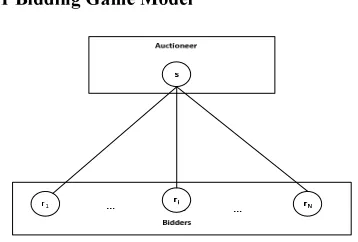
Fig. 2 Illustration of the bidding interaction between the auctioneer and the bidders
The main essence of a bidding game is auction. An auction is a decentralized economic mechanism for allocation of resources. In an auction, the players are the bidders and auctioneers, the strategies are the bids while allocations and prices are the bids’ functions. For our work, the source is the auctioneer who desires to sell bids to the highest bidder, the relay nodes are the bidders who wish to pay for the bids and the good or resource to be bought is power. According to [17], there are four components which determine the outcome of an auction. These components are (1) the information available to the bidders and auctioneer, (2) the bids placed by the bidders to the auctioneer, (3) the allocation of good or resource by the auctioneer, based on the placed bids, and (4) the payments made to the auctioneer by the bidder after the successful bidding.
In the cooperative scenario being considered here, and as mentioned earlier, power is the good or
resource that the bidders(relays) are going to bid for, from among which the source (auctioneer) would select the highest bidder (the relay that places the highest value in the bid profile).
Modeling the bidding game with these components, we have:
Information: The source node (auctioneer) announces a non-negative bid threshold Bth and a
price
p > 0 to all relays prior to the commencement of the bidding process;
Bids, bi: Relay ri places a bid
(which is a scalar), bi ≥ 0 to the
source node. After an iterative process to get the highest bidder, the source selects the most suitable relay;
According to [14], a bidding profile defined as vector b = (b1, b2,…bN) which contains the bids of
the relay nodes, where N is the number of relays involved in the game.
Allocation, Pall: The source, after
selecting the relay node, allocates power Pall based on the following:
P
B
b
b
P
N
j
th j
i all
∑
=+
=
1
(10)
where P is the total transmit power of the relaying partners available for the bidding game.
Fig. 2 shows an illustration of the bidding interaction between the auctioneer and the bidders. Let
N = {1, 2,…N}be a set of relay nodes available for
the bidding game. A 1 X N matrix ps denotes the
source power where
i r s
p
, ( ri
p
1, for only one sourcenode) represents the amount of power the source allocates to a relay node ri for forwarding data to
the destination node.
The sum of the rthi row of ps represents the total
ISSN: 1992-8645 www.jatit.org E-ISSN: 1817-3195
implemented, but if all elements are non-zero, full cooperation is enabled by the network.
Let Cs denote the achievable transmission rate
as derived in Section II.A for the source node at a given power allocation vector
{ }
Ni r s
i
p
1 ,
=
which can
be applied to different cooperative diversity techniques such as decode and forward, amplify and forward, estimate and forward or compress and forward.
Now, for the objective of this work: to allocate power on each relay node in order to maximize or optimize the total throughput and efficiency of the network and then ascertain the convergence to equilibrium. We formulate the optimization problem as follows (which we call NLO):
max Cs
(11)
s.t s
N
i r s
p
p
i
≤
∑
=1
, ,
∀
i
∈
N(12) variables
≥
0
s
p
(13) The objective function in OP above is concave, since Cs is a concave function of the power vector
{ }
Ni r s
i
p
1 ,
=
. It is also obvious that constraint (12) is
convex while affinity is observed in (13). It can thus be said without loss of generality that the set of the optimization problem in OP that is feasible is a convex one. It thus means that OP is a convex optimization problem; which solution is given as follows:
For that problem (11) – (13), the Lagrangian is
(
)
−
−
=
∑
∑
= =
N
i
s r s N
i i s
s
C
p
p
p
L
i
1 , 1
,
λ
λ
(14) where
λ
≥
0
is the Lagrange multiplier.Using the Karush-Kuhn-Tucker (KKT) theorem and conditions [18], the following necessary and sufficient conditions are obtained for two variables
p* and
λ
* which stand for the optimal and dual respectively.(
*)
*, '
i r s s
p
iC
=
λ
,∀
, *>
0
,
i
r s
p
i
∈
N(15)
,
0
1 , *
*
=
−
∑
=
N
i
s r s
i
p
ip
λ
∀
i
∈
N(16)
,
1 *
, s
N
i r
s
p
p
i
≤
∑
=∈
∀
i
N(17)
,
0
*
≥
p
λ
*≥
0
(18)
Noteworthy is that if
0
,
,ri
=
s
p
'(
, *)
=
0
i
r s
p
C
;which we obtained by evaluating the derivative of the Lagrangian function in (14) with respect to
i
r s
p
, . We propose, in the next section, a bidding game-based power allocation scheme to achieve the optimum solution for the optimization problem NLO.3.2 Proposed Power Allocation-Based Convergence Scheme
In the development of this scheme, the first step is to show that there exists auction equilibrium in the proposed bidding game. This is expedient because in any form of analysis using the game-theoretic concepts, a common objective is to ensure there are a convergence to and a unique Nash equilibrium. Then we propose our scheme to achieve the optimum allocation of power.
In this work, we wish to achieve an efficient resource allocation through a single-auctioneer multi-bidder bidding game where the auctioneer is the source node and the relay nodes are the bidders. An interaction between the source node (auctioneer) and the relay nodes (bidders) is illustrated in Fig. 2, in which the auctioneer dynamically announces a bid price to all the bidders and the bidders respond by placing bids so as to attract the auctioneer in selecting a particular bidder to which power would be allocated. The issue we are attempting to address is that of the maximum amount of power that can be allocated to the relay nodes by the source nodes without violating the power constraint and how fast the convergence to equilibrium is reached.
As mentioned earlier, the auctioneer (source, s) announces a price, which we call pth and each bidder (relay, ri) places or submits a bid bi to the
source, s.
Let pth = price value announced by the auctioneer,
b = bidding matrix or profile
where
b
i=
{ }
b
s,i Ni=1. However this auctioneer –(a) For a given price, pth, each bidder ri,
i
∀
determines its demand vector{ }
Ni r s i
p
1 , =, then places the corresponding
bid vector
{ }
Ni r s i
b
1 , =to the auctioneer;
(b) For the collected or submitted bids from the bidders, the auctioneer determines its own supply value as well and allocates the power based on those bids.
In essence, our main challenge is to develop a price value and a bidding matrix or profile so that the outcome of the proposed bidding game is equivalent to the optimum solution of OP. We thus introduce a 2-sided bidding game rule. One side is the bidder’s side while the other is the auctioneer’s side.
Side 1: For the bidders ‘side, each bidder, each of the bidders ri,
∀
i
places a bid in proportion tothe price given by the auctioneer and the power it intends to buy from it, i.e.
.
,
, ,ri th sri
s
p
p
b
=
∀
i
.Obviously, if
0
,ri=
s
p
⇒
no bidding takes place. Side 2: However, for the auctioneer’s side, the auctioneer aims at maximizing the surrogatefunction
∑
= N i r s r
s i
p
ib
1,
,
log
, using the mechanism in[19]; the differentiability and concavity in
i
r s
p
, being the factors for selecting the surrogate function.We propose the following:
Proposition: There is an optimum demand vector
{ }
N i r s ip
1 * ,= from each bidder
ri,
∀
i
, and an optimumsupply value from the auctioneer that agree with the OP
Proof of the proposition: The achievable transmission rate of source, Cs is related only to
{ }
Ni r s i
p
1 ,= without having an explicit relationship
with
{ }
r s iN ip
1 ,
= . Since
Cs is jointly concave in
{ }
N i r s ip
1 ,= , bidder
ri has the capability to decide its
demand
{ }
Ni r s i
p
1 * , =which satisfies (15) – (18), with
the optimal dual vector
λ
*given. From theillustrative graph in Fig.2, the power the auctioneer sells to bidder ri is equivalent to the power the bidder ri submits a bid for. This thus means that an optimal demand vector leads to an optimum supply vector. This proposition implies that, if the source
and relay nodes simply follow the proposed scheme rather than attempt to compute the local payoff selfishly, the global optimum can be achieved.
3.1.1 Bidder problem
We assume that the bidders do not place their bids just to impact the auctioneer’s price, especially when there are N bidders at play in the bidding market. There is the tendency for each bidder to want to maximize its utility or surplus (which is the difference between the payoff from buying power from auctioneer and its own payment for the power). From the auctioneer’s price, pth, bidder ri
determines its optimum demand according to the following function:
{
}
N ii i r s
i sr
N
i th p
s
r
C
p
p
U
, 1 1 ,max
∑
=−
=
= (19)After this, the bidder places its optimum bid to the auctioneer according to that optimal demand and the announced price pth as :
* , *
,ri sri s
p
b
=
,∀
i
(20)From the rule of concavity, it can be proved that the
utility
i
r
U
is jointly concave in{ }
Ni r s i
p
1 ,= where
Cs
(defined in (8)) is concave in
{ }
Ni r s i
p
1 , =. And as a
result of the concave nature of the utility, bidder ri
is able to optimize the unique power vector
{ }
N i r s ip
1 ,= so as to maximize its payoff. Finding the
1st
order derivative of
i
r
U
in (19) with respect toi
r s
p
, , the necessary and sufficient first order
condition can be obtained as:
(
*)
0
, ' * ,
=
−
=
∂
∂
th r s s r s rp
p
C
p
U
i i i,
p
i
i
r
s,
>
0
,
∀
(21) Having another look at (15), which is the KKT condition of NLO, it can be seen that if the auctioneer announces its price as
(
*)
, ' * * i r s s ith
C
p
p
=
λ
=
,∀
i
,∀
p
s,ri>
0
(22) it is then obvious that (21) agrees with (15). This clearly shows that the optimum power p* in the above bidder problem is in agreement with the one in NLO. It can thus be seen from the above analysis that, with an appropriate pricing and bidding, the individual optimum in the bidder problem in in good agreement with the global optimum.
ISSN: 1992-8645 www.jatit.org E-ISSN: 1817-3195
The next issue we need to address is the auctioneer problem. We can solve the optimum power supply or allocation by the auctioneer by the formulation of auctioneer problem in terms of the following optimization problem:
i
i sr
N i r s
p
b
, 1 ,log
max
∑
= (23)s.t s
N i r s
p
p
i≤
∑
=1 , (24) variablesp
≥
0
(25) The Lagrangian associated with the problem (23) – (25) is written as follows:
−
−
=
∑
∑
= = N i s r s N i r s r ss
b
p
p
p
L
i s i 1 , 1 , , 'log
λ
(26) whereλ
sdenotes the Lagrange multiplier of the auctioneer. From the KKT, theorem mentioned earlier, the KKT conditions for the auctioneer problem are arrived at as follows:* , * , s r s r s i i
b
p
λ
=
,∀
i
∈
N
(27)
0
1 * , *
=
−
∑
= N i s r ss
p
p
i
λ
(28)∑
=≤
N i s r sp
p
i 1 , (29),
0
*≥
p
*≥
0
s
λ
(30) If the above problem with its accompanying KKT conditions is compared with the NLO, we see that if
λ
i=
λ
sand bids are submitted / placed bybidders as
(
i)
ii sr s sr r
s
p
C
p
b
, ' * , * ,=
(31) It can be clearly seen then that (27) – (30) agree with (15) – (18) and the solution of the auctioneer problem is in agreement with the NLO.3.2 Algorithm for the Convergence Scheme
We now construct an algorithm to show the mechanism for the bidding game-based convergence scheme we are proposing. This mechanism is iteratively executed.
Algorithm for Single-Auctioneer Multi-Bidder Power Bidding Game
Initialize or Start up
Iterative process index is set up at t = 0
For every bidder node, initial mode is set to direct (non-cooperative) transmission
i.e. p(0) = diag (
p
1,
p
2,...
p
N)
: onlydiagonal elements are non-zero
A random 1 x N bid matrix,
b
(0)≥
0
isgenerated
Random vector value pth
Iterate
1.
t
←
t
+
1
2. Allocate power: Source (auctioneer) dynamically allocates power
i r s
p
, to
relay ri according to ( 1)
) 1 ( , ) ( , − −
=
t th t r s t r sp
b
p
i i ,N
i
∈
∀
3. Update bids: -
t
≥
1
;
- Auctioneer, s = 1;
- for each bidder ri, i = 1:N do
- if
0
) ( , ) (
>
∂
∂
t r s t rp
U
i , OR(
())
( 1) ,' −
>
tht tr s
s
p
p
C
i then
- s(t,r) (s,tr) s'
(
s(,tr))
i i
i
p
C
p
b
=
;- else
-
(
)
0
;
,
=
t
b
i r s- end if
- end for
−
+
=
∑
= −
N
i
s t
r s th t
th t
th
p
p
p
p
i 1
) (
, )
1 ( ) (
ψ
where
ψ
th= small constant incremental step-sizeUntil the price value converges
4. RESULTS AND DISCUSSIONS
A cooperative communication network consisting of one source node, one destination and four relay nodes is considered. The single destination node is situated at (0, 0) in a two-dimensional plane topology, while the relay nodes are randomly located on the network plane. The source node is acting as the auctioneer while the relays are acting as the bidders in the bidding game. It is assumed that all relay nodes have the same maximum power constraints, given as 10 dB. The path loss exponent is also set to be 3.0.
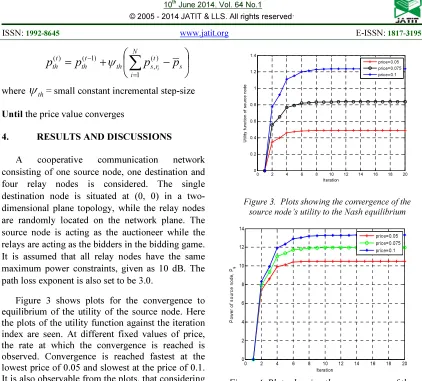
Figure 3 shows plots for the convergence to equilibrium of the utility of the source node. Here the plots of the utility function against the iteration index are seen. At different fixed values of price, the rate at which the convergence is reached is observed. Convergence is reached fastest at the lowest price of 0.05 and slowest at the price of 0.1. It is also observable from the plots, that considering the proximity criteria of relay – destination nodes, utility increases with price.
In the same vein, a similar situation is seen in Figure 4 but the plots show a variation between the power of the source node and the iteration index, at fixed values of price.
0 2 4 6 8 10 12 14 16 18 20 0
0.2 0.4 0.6 0.8 1 1.2 1.4
Iteration
U
ti
lit
y
f
u
nc
ti
on
o
f
s
our
c
e
nod
e
price=0.05 price=0.075 price=0.1
Figure 3. Plots showing the convergence of the source node’s utility to the Nash equilibrium
0 2 4 6 8 10 12 14 16 18 20
0 2 4 6 8 10 12 14
Iteration
P
o
w
e
r
o
f
s
o
u
rc
e
n
o
d
e
,
Ps
[image:8.595.86.508.82.463.2]price=0.05 price=0.075 price=0.1
Figure 4. Plots showing the convergence of the source node power to the Nash equilibrium
ISSN: 1992-8645 www.jatit.org E-ISSN: 1817-3195
0 0.1 0.2 0.3 0.4 0.5 0.6 0.7 0.8 0.9 1 0
0.1 0.2 0.3 0.4 0.5 0.6 0.7 0.8
destination
relay node 1 relay node 2
relay node 3
relay node 4
[image:9.595.309.515.75.289.2]source
Figure 5. Random locations of the relay nodes on the Cartesian plane
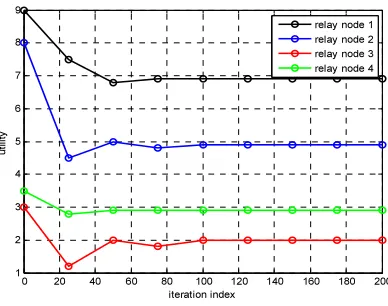
Figure 6 and Figure 7 show plots of the convergence speed of the price and utility (or payoff) for each of the participating relay nodes in the proposed bidding game scheme. The figures show that the prices and utilities both converge to equilibrium. It is also seen from our results that the closer a relay node is to the destination node, the higher the price it presents and therefore the higher the utility or payoff achievable by it. For instance, in this work, as seen in Figure 5, relay node 1 is the one located closest to the destination and farthest from the source node, and thus presents the highest price and has the highest utility.
Moreover, in Figure 8, a comparison of convergence of the relay nodes’ utility for the proposed scheme with the previous work of Yuan et al, 2011 is shown. It is seen that the convergence speed in this proposed bidding game scheme is higher than that in a previous related work (Yuan et al., 2011), proving that this proposed scheme outperforms the latter. The reason for this is not far-fetched; in this proposed scheme, the proximity criterion is introduced so as to exclude the not-so-beneficial relay nodes from the game, thereby reducing the convergence time since fewer relay nodes are now participating in the bidding game. It is clearly seen from the plots that the proposed scheme outperforms the previous one since the convergence is faster.
0 20 40 60 80 100 120 140 160 180 200 0
0.05 0.1 0.15 0.2 0.25 0.3 0.35
iteration index
b
id
d
in
g
p
ri
c
e
[image:9.595.85.512.79.282.2]relay node 1 relay node 2 relay node 3 relay node 4
Figure 6. Graph showing the convergence speed of bidding prices for the relay nodes
0 20 40 60 80 100 120 140 160 180 200 1
2 3 4 5 6 7 8 9
iteration index
u
ti
li
ty
relay node 1 relay node 2 relay node 3 relay node 4
Figure 7. Graph showing the convergence speed of utility for the relay nodes
0 20 40 60 80 100 120 140 160 180 200
0 0.05 0.1 0.15 0.2 0.25 0.3 0.35
iteration index
b
id
d
in
g
p
ri
ce
relay 1(Proposed) relay 1(Previous) relay 2(Proposed) relay 2(Previous) relay 3(Proposed) relay 3(Previous) relay 4(Proposed) relay 4(Previous)
Figure 8. Comparison of the convergence of the proposed scheme with the work of Yuan et al, 2011, using the
[image:9.595.323.517.338.491.2] [image:9.595.315.536.535.694.2]5. CONCLUSION
In this paper, we have proposed a new scheme for convergence in cooperative communication networks using a kind of game known as the bidding game. We were able to solve this problem by mapping a cooperative network into a single-auctioneer multi-bidder game where the source node acts as the auctioneer and the relay nodes act as the bidders. Through the implementation of this proposed scheme, the user can achieve the optimum in terms of the power bided for and the power sold, without violating the power constraints while ensuring a higher convergence speed and by extension, a prudent utilization of resource like power.
REFERENCES:
[1] M. W. Baidas and A. B. MacKenzie, "Auction-Based Power Allocation for Multi-Source Multi-Relay Cooperative Wireless Networks," in Global Telecommunications Conference (GLOBECOM 2011), 2011 IEEE, 2011, pp. 1-6.
[2] T. C. Y. Ng and Y. Wei, "Joint optimization of relay strategies and resource allocations in cooperative cellular networks," Selected Areas in Communications, IEEE Journal on, vol. 25, pp. 328-339, 2007.
[3] L. Yuan, T. Meixia, L. Bin, and S. Hui, "Optimization Framework and Graph-Based Approach for Relay-Assisted Bidirectional OFDMA Cellular Networks," Wireless Communications, IEEE Transactions on, vol. 9, pp. 3490-3500, 2010.
[4] D. Wenbing, T. Meixia, M. Hua, and H. Jianwei, "Subcarrier-pair based resource allocation for cooperative multi-relay OFDM systems," Wireless Communications, IEEE Transactions on,
vol. 9, pp. 1640-1649, 2010.
[5] W. Beibei, H. Zhu, and K. J. R. Liu, "Distributed Relay Selection and Power Control for Multiuser Cooperative Communication Networks Using Stackelberg Game," IEEE Transactions on Mobile Computing, vol. 8, pp. 975-990, 2009.
[6] A. Bletsas, A. Khisti, D. P. Reed, and A. Lippman, "A simple Cooperative diversity
method based on network path selection,"
Selected Areas in Communications, IEEE Journal on, vol. 24, pp. 659-672, 2006. [7] S. Savazzi and U. Spagnolini, "Energy
aware power allocation strategies for multihop-cooperative transmission schemes," Selected Areas in Communications, IEEE Journal on, vol. 25, pp. 318-327, 2007.
[8] D. Lingjie, G. Lin, and H. Jianwei, "Contract-based cooperative spectrum sharing," in New Frontiers in Dynamic Spectrum Access Networks (DySPAN), 2011 IEEE Symposium on, 2011, pp. 399-407.
[9] Y. Yang, H. Jianwei, Z. Xiaofeng, Z. Ming, and W. Jing, "Sequential Bargaining in Cooperative Spectrum Sharing: Incomplete Information with Reputation Effect," in Global Telecommunications Conference (GLOBECOM 2011), 2011 IEEE, 2011, pp. 1-5.
[10] D. Niyato, E. Hossain, and H. Zhu, "Dynamic spectrum access in IEEE 802.22- based cognitive wireless networks: a game theoretic model for competitive spectrum bidding and pricing," Wireless Communications, IEEE,
vol. 16, pp. 16-23, 2009.
[11] R. Shaolei and M. Van der Schaar, "Pricing and Distributed Power Control in Wireless Relay Networks," Signal Processing, IEEE Transactions on, vol. 59, pp. 2913-2926, 2011.
[12] D. Li, Y. Xu, J. Liu, and J. Zhang, "Relay assignment and cooperation maintenance in wireless networks: a game theoretical approach," Communications, IET, vol. 4, pp. 2133-2144, 2010.
[13] L. Yuan, T. Meixia, and H. Jianwei, "Auction-Based Optimal Power Allocation in Multiuser Cooperative Networks," in
Global Telecommunications Conference (GLOBECOM 2011), 2011 IEEE, 2011, pp. 1-5.
[14] H. Jianwei, H. Zhu, C. Mung, and H. V. Poor, "Auction-Based Resource Allocation for Cooperative Communications,"
Selected Areas in Communications, IEEE Journal on, vol. 26, pp. 1226-1237, 2008. [15] M. W. Baidas and A. B. MacKenzie,
ISSN: 1992-8645 www.jatit.org E-ISSN: 1817-3195
and Mobile Computing Conference (IWCMC), 2011 7th International, 2011, pp. 1677-1682.
[16] A. Ruszczynski, Nonlinear Optimization. Princeton, NJ: Princeton University Press, 2006.
[17] Z. Han, D. Niyato, W. Saad, T. Basar, and A. Hjorungnes, Game Theory in Wireless and Communication Networks, Theory, Models and Applications, 1st ed. vol. 1. U.S.A: Cambridge University Press, New York, 2012.
[18] S. Boyd and L. Vandenberghe, Convex Optimization. U.K: Cambridge University Press, 2004.
[19] F. P. Kelly, A. K. Maulloo, and D. K. H. Tan, "Rate control for communication networks: shadow prices, proportional fairness and stability," J. Oper. Res. Soc. ,