2016 International Conference on Computer, Mechatronics and Electronic Engineering (CMEE 2016) ISBN: 978-1-60595-406-6
An Efficient Merged Concurrency Control
Method for Concurrency Conflicts
Qiao SUN
1, Lan-mei FU
1, Bu-qiao DENG
1and Jia-song SUN
2,*1Beijing Guodiantong Network Technology Co., Ltd. Beijing, China
2E. E. Department, Tsinghua University, Beijing, China
*Corresponding author
Keywords: Distributed transaction, Two-phase locking, Optimistic concurrency control, Concurrency conflicts.
Abstract. Traditional distributed transaction protocol typically included two-phase locking (2PL) or optimistic concurrency control (OCC). However, both of them have the problems when more concurrency conflicts existed in the conditions for large amount requirements of data and processing. In this paper, we propose one merged concurrency control method in the distributed single transaction to support for conflicts more efficiently. TPC-C experiments and results implied that our merged distributed transaction has better ability to handle concurrency conflicts, especially in the case of many conflicts. It can read, write and recall operations with fully utilizing temporal redundancy and data network and be suitable for large-scale data and computationally intensive projects.
Introduction
With the rapid development of information technology and the size of the explosive growth of the Internet, the requirement for human society, storage and processing capabilities of various data is increasing. The growth rate of the number of users of various Internet services far exceeds the expected number of years ago on the Internet, but also far more than the processing power of a single machine. Although the performance of a single machine also has made significant progress, but there is a certain distance from the reach of mass demand services. Especially the ultra-large-scale sites typically require large-scale data processing capabilities. Such as Google, Microsoft such a large online services, its number of servers are more than a million of the order.
With this rapid development, the challenge had happened in many fields, which related with data storage/management/computing. The distributed storage and management system have been studied for many years. Distributed network solutions have the high stability and reliability, which can manage and schedule the nodes for storing the resource. Distributed storage methods generally require keeping/processing data in big volume to meet the needs of large amounts of data. There are many applications based on the distributed database system. Therefore, the failure or success of database system is relative directly with the applications and their values. Because its extension of database application and computer hardware environment, the development of distributed system is more important than ever, in particular under the condition of fast development of network technology.
management is an important and complicated part. A transaction is an atomic operation serial nature of ACID (atomicity, consistency, isolation and durability) and the term refers to a distributed transaction management server accessed by multiple objects affairs [1] [2].
If multiple users concurrently accessing the database will have a plurality of transactions simultaneously, access the same data. If uncontrolled concurrent operation may access and store incorrect data, undermine the consistency of the database. Therefore, the distributed database management system must provide concurrency control mechanism, which purpose is to ensure that multiple transactions in a distributed database system can be run concurrently, while also making each transaction and distributed database consistency. Its role mainly in the coordination between the same time access the same database file multiple transactions relations and prevent conflicts between these transactions generate a serial scheduling.
The transaction request needs the access to data in the multiple machines existed in the distributed storage system [3]. To ensure the serializability and to meet the requirements of the application semantics, the distributed concurrency control is required as a certain protocol. Traditional distributed transaction protocol is typically based on two-phase locking (2PL) [4] or optimistic concurrency control (OCC) [5]. When 2PL transaction serialization, their conflicts and OCC resort to suspension. Transaction constitutes the centralized database management system, which tends to support multithreaded access to take advantage of parallel hardware platform an important part. The application can then be wrapped in a transaction can access the database management system as per the rules of concurrency control. This enables users to develop applications without worrying about running on synchronous DBMS. Serialized by trading for many applications required isolation of the de facto standard form. By the conventional method used in the DBMS to perform, serialization hired specifically fine-grained locking [6].
However, two-phase locking and optimistic concurrency control have their own problems. The former has conflict in two transactions when they simultaneously access the same object. And it is difficult to handle big data, and object-oriented and real-time as well as the complexity of the demand is difficult to meet; the latter has no conflict in the context of a transaction, but the conflict more performance declined, mainly due to a large number of conflicts will lead to more validation failed restart repeatedly. In addition, it may have more possibility conflict when the system’s size increased, especially in real systems. In this case, some data might become "hot spots" and some bottlenecks happened here.
In this paper, we propose one merged concurrency control method in the distributed single transaction to support for conflicts more efficiently. Experiments in the internal network environment show that the merged method we proposed is more efficient and stable than single two-phase locking or optimistic concurrency control method. It can read, write and recall operations with fully utilizing temporal redundancy and data network and be suitable for large-scale data and computationally intensive projects.
The remainder of this paper is organized as follows: In Section II, we give an overview of two-phase locking and optimistic concurrency control; Section III introduced the implement of our merged distributed transaction architecture. The experiments and results are given in Section IV. We summarize our contribution in Section V.
Introduction of 2PL and OCC
Two-Phase Locking
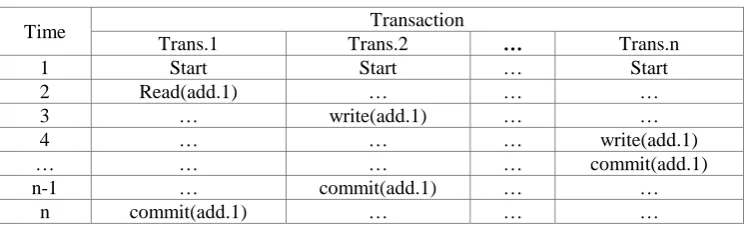
In stand-alone database, 2PL is the standard solution. Many databases, which had groundbreaking contribution to database fields, such as Gamma, Bubba and R* are carried out using the method 2PL concurrency control [3]. By this way, the transaction did not allow the implementation of actions in conflict, which shows in the table.1 as an example. In this example, transactions conflict over address one. Therefore, if a transaction attempts to access the conflict, one of the transaction is aborted conflict, or by delaying access until one transaction commit processing. It is a simple algorithm with simple achievement, so it provides a fast transaction operation. However, 2PL concurrency limit, because every conflict led to the suspension or even some conflict serializable transaction delay. This became the target applications that contain highly transactional data sharing long-running significant performance bottleneck.
[image:3.595.112.486.332.445.2]The primary performance cost of 2PL in the distributed environments is from other transaction blocking of data items resulting locking and restart in order to avoid a deadlock arising. Google recently launched a global level large-scale distributed storage Spanner [8], also used as the primary 2PL concurrency control methods, and the use of hurt waiting strategy as a method to avoid deadlock, while the introduction of a read-only use high-precision time stamps transaction method to access. However, Spanner requires cross-data center backup the status of a transaction, which will increase the cost of congestion caused by the transaction locking.
Table 1. An example for Two-phase locking.
Time Transaction
Trans.1 Trans.2 … Trans.n
1 Start Start … Start
2 Read(add.1) … … …
3 … write(add.1) … …
4 … … … write(add.1)
… … … … commit(add.1)
n-1 … commit(add.1) … …
n commit(add.1) … … …
Optimistic Concurrency Control
Consider the problem of providing shared access to a database organized as a collection of objects. We assume that certain distinguished objects, called the roots, are always present and access to any object other than a root, which gained only by first accessing a root and then following pointers to that object. Any sequence of accesses to the database that preserves the integrity constraints of data called as a transaction. If our goal is to maximize the throughput of accesses to the database, then there are at least two cases where highly concurrent access is desirable [9].
1) The amount of data is sufficiently great that at any given time only a fraction of the database can be present in primary memory, so that it is necessary to swap parts of the database from secondary memory as needed.
2) Even if the entire database can be present in primary memory, there may be multiple processors. In both cases, the hardware will be under-utilized if the degree of concurrency is too low.
However, as is well known, unrestricted concurrent access to a shared database will, in general, cause the integrity of the database to be lost. Most current approaches to this problem involve some type of locking. The locking approach has some inherent disadvantages such as lock maintenance represents an overhead that is not present in the sequential case or no general-purpose deadlock-free locking protocols for databases that always provide high concurrency.
Merged Distributed Transaction
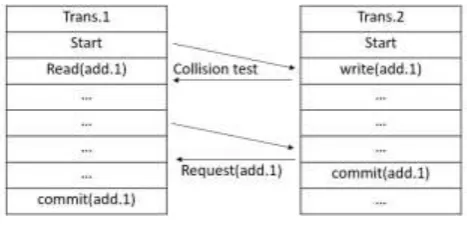
[image:4.595.180.414.232.346.2]Several recent works suggest employment of transactional memory in a distributed environment. The proposed schemes appear to be drawn from the classic hardware/software transactional memory protocols in which each transaction has to be validated before it terminates. In a distributed setting, this approach results in placement of blocking remote operations, whose purpose is to avoid/detect conflicts, on the execution critical path. Due to the relatively high network latency, the application threads spend a large portion of their time waiting for a response from remote peers. Overall, it seems that these schemes are not "optimistic" enough, trying to ensure validity of one transaction before executing another. In addition to the above problem, some schemes employ centralized and broadcast-based paradigms, which hinders their scalability [10].
Figure 1. Merged distributed transaction model.
In this paper, we propose a merged distributed transaction that combined the advantages of two-phase locking and optimistic concurrency control. As shown in Figure 1, there are collision test part and request part between two transaction run in the same time. When a client determines the request is a single partition transaction, it is forwarded to the primary partition is responsible for the data. It is primary used in master/slave replication agreements to ensure durability.
Under no-fault situation, the main transaction read request from the network and sends a copy to the backup. At the same time, the major transactions and secondary transaction together do the collision test if there is no collision of the major and secondary transaction proceed. If there is collision, we will stop secondary transaction and continue the major transaction. Because it is a partition of the transaction, it does not block. When major transactions are executed every mission, every transaction sent to an address minor needs when minor transaction is not busy, then satisfies the needs of this address, otherwise the address information is occupied, the main business has been waiting for, until the address is released. Finally, when the results of receiving an acknowledgment from the backup, the main transaction is sent to the client.
This method ensures that transactions are durable, efficient, without concurrency control to perform a single partition transaction. In most cases, the system does not record these transactions are executed intermediate information, which result a very low overhead. This is possible because the Switch between primary and secondary transaction does not play an important role in the distributed system. To ensure that deadlock does not occur, this concurrency control scheme will not revoke the log.
Implementation of Merged Distributed Transaction Processing
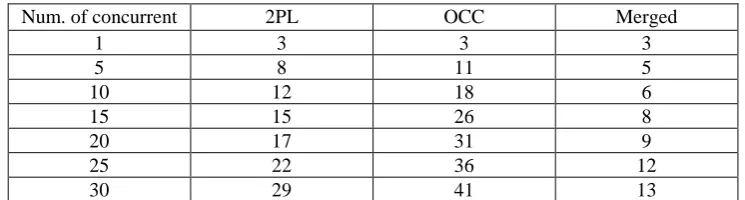
Table 2. An example for two-phase locking.
Num. of concurrent 2PL OCC Merged
1 3 3 3
5 8 11 5
10 12 18 6
15 15 26 8
20 17 31 9
25 22 36 12
30 29 41 13
Table 3. Submission success rate of three methods with different concurrent requests (%).
Number of concurrent
2PL OCC Merged
1 100 100 100
5 96 92 99
10 93 90 97
15 91 87 94
20 90 84 93
25 89 82 92
30 84 76 90
In order to test the performance, the merged method is evaluated in our lab network environment. The specific configuration of the experiment: 10 server IBM-x3650M4-2U (2CPU, 6-core 12-thread E5-2620 48G, Xeon memory, and 2T hard disk) and number of district is 30. The operating system is Ubuntu or Windows10. The FTP services are pre-installed. The FTP interfaces at the end of the client and the central data nodes are installed. The general use of local Linux interface is to complete the management operation.
In the experiments, each client sends requests to the server in accordance with the TPC rules. The number of clients was adjusted in this paper to test the conflict. In the experiments, each server services number of clients vary from 1 to 30. With the increasing number of clients, each server has more requirements of concurrency. The results of delay and submission success rate are shown in the table 2 and table 3. It can be clearly seen that delay and submission success rate of OCC and 2PL is closed when the conflicts are small; and the results of 2PL is better than those of OCC when the conflicts are larger. The possible reason is more conflicts make more probability of validation failed. The merged method is better than 2PL and OCC under the smaller conflicts and bigger conflicts, which implied the merged distributed transaction has better ability to handle concurrency conflicts, especially in the case of many conflicts.
Conclusions
Acknowledgment
This research was financially supported by Science and Technology Project of the State Grid Corporation of China (SGZJ0000BGJS1500433) and the State Grid Information & Telecommunication Group Co., Ltd. (SGITG-KJ-JSKF [2015]0003).
References
[1] Cheng G, Liu L, Qiang X, et al. Concurrent Control and Performance Optimization of Distributed Transaction in Heterogeneous Network Environment[C]. International Conference on Education, Management and Computer Science. 2016, pp.325-329.
[2] Seppo Sippu, Eljas Soisalon Soininen. Distributed Transactions [J]. Data-Centric Systems and Applications. 2014, pp.299-325.
[3] Shuai Mu. Extract More Concurrency from Distributed Transactions [D]. Ph.D. dissertation, Beijing: Tsinghua University, 2015.
[4] Thomasian A, Ryu I K. Performance Analysis of Two-Phase Locking [J]. IEEE Transactions on Software Engineering, 1991, 17(5):386-402.
[5] Lee K, Park S. Optimistic Concurrency Control [M]. 2011.
[6] Utkarsh Pandey. Optimizing Distributed Transactions: Speculative Client Execution, Certified Serializability, and High Performance Run-Time [D]. Master dissertation, USA: Virginia Polytechnic Institute and State University, 2016.
[7] Lin F, Xiahou J, Huang Q. Distributed Consistency Method and Two-Phase Locking in Cloud Storage over Multiple Data Centers [J]. Cybernetics & Information Technologies, 2015, 15(6):113-121.
[8] Wikipedia. Spanner [EB/OL]. https://en.wikipedia.org/wiki/Spanner.
[9] Kung H T, Robinson J T. On optimistic methods for concurrency control [C]. International Conference on Very Large Data Bases. 1979:213-226.