1
The London School of Economics and Political Science
The Limits of Social Mobility: social origins and career
patterns of British generals, 1688-1815
Andrew B. Wood
2
Declaration
I certify that the thesis I have presented for examination for the PhD degree of the London School of Economics and Political Science is solely my own work other than where I have clearly indicated that it is the work of others (in which case the extent of any work carried out jointly by me and any other person is clearly identified in it).
The copyright of this thesis rests with the author. Quotation from it is permitted, provided that full acknowledgement is made. This thesis may not be reproduced without the prior written consent of the author.
I warrant that this authorization does not, to the best of my belief, infringe the rights of any third party.
3
Abstract
Late eighteenth-century Britain was dominated by two features of economic life that were a major departure from previous eras, the economic growth of the Industrial Revolution and almost constant warfare conducted on a previously unprecedented scale. One consequence of this was the rapid expansion, diversification and development of the professions. Sociologists and economists have often argued that economic development and modernisation leads to
4
Acknowledgements
There are many people I would like to thank who assisted in the production of this thesis. In many respects a student can only be as good as his teachers. I was fortunate in having two excellent supervisors for this project, Dr Peter Howlett and Dr Patrick Wallis, who provided much encouragement, support and assistance. Thanks also to Professor Roger Knight who first gave me the idea that a project on generals or admirals would be interesting. My father, Brian Wood, provided assistance to me in a number of different ways, all of which are gratefully appreciated. A special note of thanks to Lord Crawford, The Right Hon.The Earl of Crawford & Balcarres, KT, GCVO, who allowed me access to the personal papers of Alexander Lindsay, 6th Earl of Balcarres. A debt of gratitude is owed to the various archivists who assisted me in my work. Karen Sampson and her team of the archivists at Lloyds TSB provided substantial help in facilitating access to the Cox ledgers. Much time was spent researching different bank accounts at the Royal Bank of Scotland and C. Hoare and Co. This research could not have been undertaken without the
assistance of Philip Winterbottom and Pamela Hunter. Kenneth Dunn, the Senior Curator at the National Library of Scotland, helped me immensely during my time in Edinburgh. The archivists at the Centre for Kent Studies, the National Archives and the British Library all provided invaluable assistance. Finally, the quality of this thesis would not be as high if it was not for the high quality of scholarship from previous historians of the eighteenth-century British army.
5
Table of Contents
Page
Chapter one: Introduction 9
I. Social mobility 9
II. Modernisation and social mobility 13
III. The modernisation of the military 18
Chapter two: The army and social mobility 34
I. The army as a mechanism of social mobility 34
II. Conclusion 56
Chapter three: What is a general? 58
I. Introduction 58
II. Rank in the army 59
III. Types of general 67
IV. Selection of generals for the study 73
V. Operational generals’ commands 79
VI. Conclusion 87
Chapter four: Family backgrounds 89
I. Introduction 89
II. Measuring social mobility 92
III. Generals’ intergenerational mobility 107
IV. Self-recruitment 116
V. Conclusion 124
Chapter five: Education and Marriage 127
I. Introduction 127
II. Education 130
III. Marriage 138
IV. Marital mobility of generals 149
6
Chapter six: Career patterns 160
I. Introduction 160
II. Entering the army 174
III. Career paths 185
IV. Merit 204
V. Regimental mobility 211
VI. Conclusion 216
Chapter seven: Rewards of army service 219
I. Introduction 219
II. Rewards and costs of army service 231
III. Short-term rewards 247
IV. Long-term gains: officers 260
V. Long-term gains: generals 270
VI. Conclusion 293
Chapter eight: Conclusion 297
I. Introduction 297
II. The limits of social mobility 298
III. Modernisation and social mobility 303
IV. Implications of this study 307
Appendices 310
1. Social backgrounds 310
2. Careers 329
3. Rewards 348
4.1 Data Sources: Social Backgrounds 371
4.2 Data Sources: Careers 392
4.3 Data Sources: Rewards 405
5. Market Prices of Commissions 407
7
List of Tables
Page
Table 1: Population of generals, 1747 and 1800 76
Table 2: Command appointments of operational generals 81
Table 3: Social status of generals’ fathers 107
Table 4: Social status of non-aristocratic generals’ fathers 111
Table 5: Aristocrats’ share of military ranks, 1714-1815 115
Table 6: Self-recruitment of generals 120
Table 7: Education of generals 133
Table 8: Age at first marriage for different social groups 145
Table 9: Marriage mobility of army officers by first marriage 152 Table 10: Marriage mobility of army officers by first marriage 155
Table 11: Officer places in the 27th foot 163
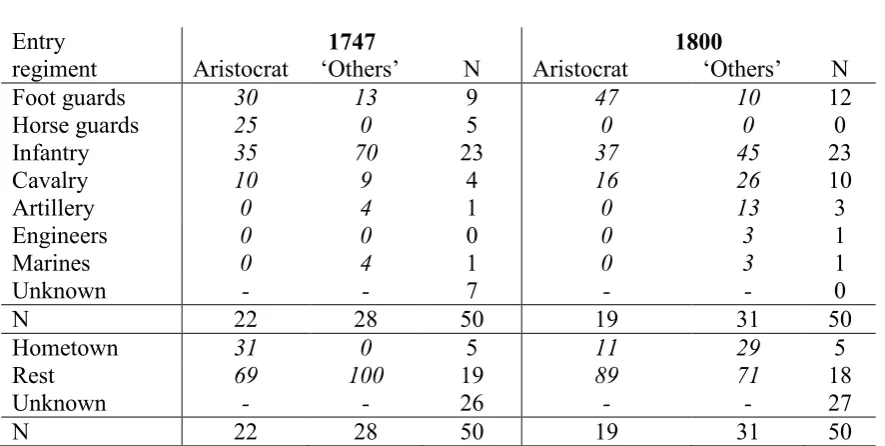
Table 12: Type of entry regiment 183
Table 13: Overall transition matrix for army ranks of 1747 generals 187 Table 14: Overall transition matrix for army ranks of 1800 generals 191 Table 15: Overall transition matrix for regimental ranks of 1747 generals 193 Table 16: Overall transition matrix for regimental ranks of 1800 generals 195
Table 17: Speed of promotion 198
Table 18: Promotions bought 199
Table 19: The role of merit in promotion 210
Table 20: Regimental mobility 212
Table 21: Regiment type 215
Table 22: Annual payments of subsistence and arrears to officers on the English
establishment, 1795 232
Table 23: Annual rewards and costs of non-sample officers, 1765-1774 249 Table 24: Average annual rewards and costs of future generals, 1761-1793
253 Table 25: Annual income and expenditure of future generals as lieutenant colonels
with Drummonds 258
Table 26: Estimated long-term returns of mid to late eighteenth-century infantry
officers 267
Table 27: Average annual rewards and costs of generals, 1758-1810 272 Table 28: Annual rewards and costs of Alexander Lindsay as Lieutenant Governor of
Jamaica 284
8
List of Graphs
Page
Figure 1: Annual nominal public expenditure on the army, 1692-1815 26
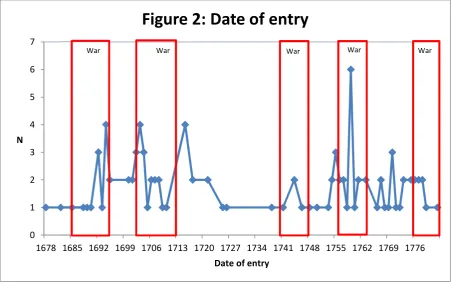
Figure 2: Date of entry 175
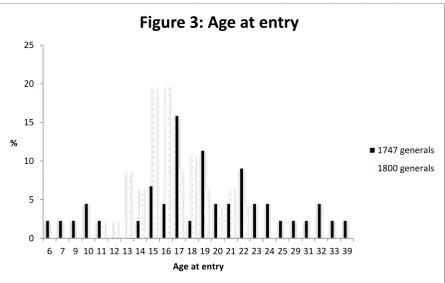
Figure 3: Age at entry 176
9
Chapter one: Introduction
I. Social mobility
Societies are usually arranged in a series of levels each indicating a different position in the social hierarchy determined by a combination of social status and income.1 Social mobility is the movement from one of these levels to another either higher (upward mobility) or a lower (downward mobility).2 The study of social
mobility is one of the most important topics in economic and social history as levels of social mobility can affect a country’s leadership, its political and social
philosophies, and rates of economic development.3 In a recent OECD report on social mobility, aimed at suggesting policy initiatives to increase rates of upward mobility, it was suggested the link between rates of social mobility and economic efficiency was twofold:
“HFirst, less mobile societies are more likely to waste or misallocate human skills and talents. Second, lack of equal opportunity may affect the motivation, effort and, ultimately, the productivity of citizens, with adverse effects on the overall efficiency and growth potential of the economyH."4
The views of this OECD report on the relationship between social mobility and economic development echo a wide-ranging literature from economic historians and sociologists that explicitly link rates of social mobility in a society with levels of economic development and modernisation. As Goldthorpe noted, it is generally
1
D.V Glass (Ed.), Social Mobility in Britain, (London, 1967), p. 5; P.A Sorokin, Social and Cultural Mobility, (New York, 1927), p.11.
2
S.M Lipset and R. Bendix, Social Mobility in Industrial Society, (Los Angeles, 1959), p. 1-2. 3
Ibid., p. vii. 4
OECD,"A Family Affair: Intergenerational Social Mobility across OECD Countries", Part II, Chapter 5,
10 believed that social mobility increases with economic development.5 One of the most well-known proponents of this view, David Landes, argued that social mobility was important to economic performance as nations which are able to put the ‘right people in the right place’ should be more competitive in the international
marketplace.6 Lipset and Bendix claim that rates of social mobility increase with industrial growth.7 They do concede there might be limits to this relationship as some countries have different rates of economic growth, but similar mobility rates. Thus, social mobility and industrial expansion rates may only be correlated until countries reach a certain level of industrialisation.8
In a similar fashion, some authors argue there was a close link between social mobility and modernisation. Sorokin notes since the eighteenth-century there have been high and increasing levels of social mobility in the transition from pre-modern to modern society.9 Kingsley Davis argued a relatively high rate of social mobility was a necessary pre-condition for the emergence of modern society.10 A long historical tradition has stressed the relative openness of the English governing class.11 Cahill, who conducted a comparative analysis of the eighteenth-century French and English aristocracy, using published works by historians, also found there were relatively
5
J.H Goldthorpe, "On Economic Development and Social Mobility", The British Journal of Sociology, 36 (4), (December 1985), p. 549; O.D Duncan, The American Occupational Structure, (New York, 1967), p. 429. 6
D.S Landes, The unbound Prometheus : technological change and industrial development in Western Europe from 1750 to the present, (London, 1960), p. 546.
7
Lipset and Bendix, Social Mobility, p. 27. 8
Ibid., p. 13. 9
Sorokin, Social and Cultural Mobility, p. 381. 10
Quoted in Goldthorpe, "On Economic Development”, p. 550. 11
11 high levels of social mobility in England.12 This high degree of social mobility has long been seen to have positively affected many key developments in Britain’s economic and social history.13 It is claimed social mobility played a critical role in the agricultural sector’s remarkable efficiency, early industrialisation and the absence of revolution.14 Some sociologists have found that levels of social mobility in Britain were increasing during the Victorian and Edwardian periods, time periods important in the development of modern society.15 Britain’s relative economic decline since the late Victorian period has also been linked to rates of social fluidity.16
The close relationship between social mobility, economic development and modernisation, however, is disputed by some authors. In one of the more recent, and long-run, studies of social mobility economic historian Greg Clark claims
England between 1200 and 2009 was a society without “persistent social class” and had in his view "complete" social mobility. He further asserts that since 2009
“persistent social class” has emerged, which is a reversal of the traditional
12
M.W McCahill, “Open Elites: recruitment to the French Noblesse and English Aristocracy in the eighteenth century”, Albion, 30 (4), (Winter 1998), p. 601, Table 3, p. 621.
13
G.E Mingay, The Gentry: the rise and fall of a ruling class, (London, 1976), pp. 5, 10; F.M.L Thompson,
English Landed Society in the Nineteenth Century, (London, 1963), pp. 122, 126; H. Perkin, Origins of Modern English Society, 1780-1880, (London, 1969), pp. 17, 37, 56, 61, 63; P. Jenkins, The Making of a Ruling Class: the Glamorgan gentry, (Cambridge, 1983), pp. 38-39.
14
L. Stone and J.C Fawtier Stone, An Open Elite? England 1540-1880, (Oxford, 1984), pp. 3-4; Perkin, Origins of Modern English Society, pp. 7, 17, 37, 56, 61, 63; F. O’Gorman, The Long Eighteenth Century: British political and social history 1688-1832, (London, 1997), pp. 108, 337; I.R Christie, Stress and Stability in late eighteenth-century Britain: reflections on the British avoidance of revolution: the Ford lectures delivered in the University of Oxford 1983-1984, (Oxford, 1984), pp. 56-59.
15
A. Miles, "How Open was 19th-century British society? Social mobility and equality of opportunity, 1839-1914", in A. Miles and D. Vincent (eds), Building European Society: occupational change and social mobility in Europe, 1840-1940, (Manchester, 1993), pp. 18-39.
16
12 relationship between social mobility and modernisation.17 In common with Clark, the prominent sociologist Goldthorpe also refutes that there was a close relationship between rates of social mobility and modernisation. In Goldthorpe’s view, social mobility in Britain over the long-run has been trendless and modernity has not increased rates of social mobility.18 He further contends that Britain's level of openness or social fluidity is no different from other similar societies and its unique development cannot be explained in terms of social mobility differences.19 In a similar fashion, some historians argue rates of social mobility were not increasing as Britain industrialised nor was Britain more open than other societies. Historians of the aristocracy claim European elites were more open than their English
counterparts because newcomers could directly purchase titles.20 The limited number of peerage creations during the eighteenth-century is often seen as
evidence of a closed aristocracy.21 These findings on the English titled aristocracy are sometimes extrapolated to the wider elite to conclude that:
“...There is little evidence here to suggest that the social elite was expanding vigorously in the
eighteenth century and finding room for large numbers of new comers. On the contrary, it indicates a considerable narrowing of the commanding social heights....”22
However, as some other historians have noted there are problems in using the titled aristocracy as a measure of mobility. Wasson pointed out it was dangerous to make broad conclusions about the openness of the elite based on evidence solely from the
17
G. Clarke, "Regression to Mediocrity?: Surnames and Social Mobility in England, 1200-2009", unpublished paper, (June 2010), pp. 1-4.
18
Goldthorpe, "On Economic Development”, pp. 558-560; J.H Goldthorpe, C. Llewellyn and C. Payne, Social Mobility and Class Structure in Modern Britain, second edition, (Oxford, 1986), chapters 4 and 12.
19
Goldthorpe, Llewellyn and Payne, Social Mobility and Class Structure, pp. 313-323. 20
M.L Bush, The English Aristocracy: a comparative synthesis, (Manchester, 1984), pp. 8-9; J. Cannon,
Aristocratic Century: the peerage of eighteenth century England, (Cambridge, 1984), p. 8. 21
Bush, The English Aristocracy, p. 8; Cannon, Aristocratic Century, p. 24. 22
13 titled aristocracy who were few in number.23 The Springs argued peerage creations were not an appropriate measure of class attitudes as the peerage was neither a distinctive economic or social class.24
II. Modernisation and social mobility
There may be some disagreement over the relationship between social
mobility, economic development and modernisation, but there are good reasons why modernisation may result in increased rates of social mobility. Firstly, modernisation often leads to an expansion in the number of professional vacancies. As Lipset and Bendix note, if the proportion of professional positions increases this should cause more upward mobility as long as the professions that expand retain their existing status and income levels.25 Secondly, the performance requirements of particular occupations may rise due to increasing professionalisation. If the supply of those with the skills who can meet these new demands is limited rates of social mobility will increase. 26
Modernisation in the eighteenth-century presented increased opportunities in professional occupations, such as law, the church, government and medicine, which
23
E.A Wasson, “The Penetration of New Wealth into the English Governing Class from the Middle Ages to the First World War”, Economic History Review, 51 (1), (Feb 1998), p. 26.
24
D. Spring and E. Spring, “Social Mobility and the English Landed Elite”, Canadian Journal of History, 21 (3), (Dec 1986), p. 345.
25
Lipset and Bendix, Social Mobility, pp. 57-60. 26
14 were important avenues of social mobility during this time.27 The professions
expanded rapidly during the eighteenth-century and some of these vocations experienced significant changes in the way they were organised. In addition to numerical expansion, specialist branches emerged from traditional professions, such as the law and the church, and completely new professions such as architecture came to the fore. The growth of the professions was partly due to demand created for professional services by economic growth. There was increased demand for lawyers who serviced the legal requirements of expanding businesses. A rise in disposable income of the middle and upper classes indirectly impacted the business of professions such as medical practitioners.28 By the end of the eighteenth-century many of these occupations bore some characteristics of modern professions, such as specialisation and division of labour.29 As Larson noted "... professional work was becoming a full-time means of earning a livelihood, subject to the dictates of
capitalist competition for income and profit....”30 However, they were still not fully professions in the modern sense as entry into these occupations tended to remain unrestricted until the nineteenth-century. The professions typically contained a mixture of the middling sort intent on advancement and younger sons of the elite.31 The diverse social backgrounds of those practising the traditional professions - the law, church, government and armed services – had important ramifications for their
27
G. Holmes, Politics, Religion and Society in England, 1679-1742, (London, 1986), pp. 272-275, 319, 349-350; P.J Corfield, Power and the Professions in Britain 1700-1850, (London, 1995), p. 223; Stone and Stone,
An Open Elite?, p. 402. 28
J. Rule, Albion's People: English Society, 1714-1815, (Harlow, 1992), pp. 55-84. 29
M. Pelling, "Medical Practice in Early Modern England: trade or profession?”, in W. Prest (ed.), The Professions in Early Modern England, (London, 1987), pp. 90-128.
30
M.S Larson, The Rise of Professionalism: a sociological analysis, (London, 1977), p. 13. 31
15 development. The social status of these professions increased and the highest professional ranks were allegedly dominated by the landed elite.32
Outside of wartime, law was probably the profession that acted as the main avenue of social advancement.33 However, the importance of law as an avenue for social mobility may have declined as the century wore on. Lucas found a significant drop in barrister enrolments between 1690 and 1800 and a notable rise in the
numbers of barristers from elite backgrounds during the late eighteenth-century, which may have restricted opportunities for new men.34 In contrast, the prospects for those entering the church seemed to improve during the eighteenth-century due to institutional innovations such as the Queen Anne’s Bounty of 1704. The real income of the clergy increased 200% between 1700 and 1830, an increase that positively affected most levels of this profession. At the beginning of the eighteenth-century there were 5,600 clergy jobs paying an annual wage of £50 or less compared to only 1,000 by 1810. 35 The increase in social status of the church profession did not seem to attract more aristocratic candidates. It is estimated that 40% of the clergy came from business, professions and lower rural society backgrounds.36 Thus, the clergy appeared to remain a middling profession.
32
G. Holmes, Augustan England: professions, state and society, 1680-1730, (London, 1982), p. 150; Corfield,
Power and the Professions, pp. 225-227. 33
Holmes, Augustan England, p. 123; Mingay, The Gentry, pp. 5-10; J.R Halliday, “Social Mobility, Demographic Change and the Landed Elite of County Durham, 1610-1819: an open or shut case?”, Northern History, 30, (1994), pp. 58-60.
34
P. Lucas, “A Collective Biography of Students and Barristers of Lincoln’s Inn, 1680-1804: a study in ‘Aristocratic resurgence’ of the eighteenth century”, The Journal of Modern History, 46 (2), (June 1974), pp. 235-237.
35
R. O’Day, The Professions in Early Modern England, 1450-1800, (London, 2000), p. 102. 36
16 Growth also increased chances for businessmen to rise in this period.
Expansion in trade and manufacturing created opportunities to advance for those entering business. One example of this was the career of Richard Arkwright.
Richard Arkwright was the son of a tailor who rose to great wealth and was knighted for his work as a cotton manufacturer and inventor of cotton spinning machinery.37 He was not alone in prospering through a business career as the work on the social backgrounds of MPs in this period shows. Christie’s ‘non-elite’ MPs were dominated by businessmen throughout the eighteenth-century.38 Wasson found there were significant numbers of new men from business serving in the Commons. The business share of MPs rose approximately 10% during the eighteenth-century to almost a third, which was a greater number than any other profession.39
Lawrence and Jean Stone have challenged this view that a business career was a good avenue to achieve social advancement in this period. In order to
determine how open the elite was to newcomers they examined 2,246 owners of 362 country houses in Hertfordshire, Northamptonshire and Northumberland between the sixteenth and nineteenth centuries.40 They concluded that “...those who did move up were rarely successful men of business....”, so the, “...idea that the fundamental cause of English political stability has been perennial openness of its landed elite to penetration by large numbers of newly enriched bourgeoisie is clearly no more than a hoary myth...”41 The Stones’ hypothesis found support from the research of Rubinstein into the very wealthy during the nineteenth-century. He contended new
37
ODNB, s.v. Arkwright, Richard (1732-1792). 38
I.R Christie, British ‘Non-Elite’ MPs 1715-1820, (Oxford, 1995), p. 129, Appendix A, p. 246. 39
Wasson, “The Penetration of New Wealth”, pp. 36-44. 40
Stone and Stone, An Open Elite?, pp. 452-453. 41
17 men of wealth purchased very little land and when they did it was not on a large scale. This led him to believe the landed aristocracy was a “...closed, caste-like group, hostile to new entries...”42
This rather controversial finding by the Stones has been challenged on three grounds.43 First, the appropriateness of using country houses as a proxy of elite status has been questioned. Halliday examined Durham’s hearth tax returns during the late seventeenth-century and found there was not necessarily a relationship between the size of houses and income.44 Second, it was pointed out the counties chosen by the Stone’s may not be representative of other counties or England’s experience generally.45 It may well be that social mobility varied greatly between different counties as Mingay once observed.46 Certainly, studies of social mobility in non-Stone counties tend to refute the suggestion that the landed elite were closed to men of business during the eighteenth-century.47 Third, there has been a great deal of disagreement between the Stones and other historians over what their figures mean. For Stone, the elite were closed to businessmen because only 93
42
W.D Rubinstein, Men of Property: the very wealthy in Britain since the Industrial Revolution, (London, 1981), pp. 213-222; W.D Rubinstein, “New Men of Wealth and the Purchase of Land in Nineteenth-Century Britain”, Past and Present, 92, (Aug 1981), pp. 125-147.
43
There has also been a vigorous debate between Thompson and Rubinstein over the validity of Rubinstein’s methodology and conclusions. See F.M.L Thompson, “Life after Death: how successful nineteenth century businessmen disposed of their fortunes”, The Economic History Review, 43 (1), (Feb 1990), pp. 40-61; W.D Rubinstein, “Cutting up Rich: a reply to F.M.L Thompson”, The Economic History Review, 45 (2), (May 1992), pp. 350-361; F.M.L Thompson, “Stitching it together again”, The Economic History Review, 45 (2), (May 1992), pp. 362-375.
44
Halliday, “Social Mobility”, pp. 50-51. 45
Halliday, “Social Mobility”, p. 51; E. Spring and D. Spring, “The English Landed Elite 1540-1879: a review”,
Albion, 17 (2), (Summer 1985), p. 150; Wasson, “The Penetration of New Wealth”, p. 37. 46
Mingay, The Gentry, pp. 9-10. 47
Halliday, “Social Mobility”, pp. 58-61; D. Rapp, “Social Mobility in the Eighteenth Century: the Whitbreads of Bedfordshire, 1720-1815”, The Economic History Review, 27 (3), (Aug 1974), pp. 380-394; R.G Wilson,
18 permanent newcomers from business rose to the elite between 1540 and 1880.48 Other authors place more significance on different statistics the Stone’s produced. The Stones showed 22% of families were newcomers to the elite, a reasonable proportion of whom were businessmen, which may demonstrate the elite was in fact relatively open to newcomers regardless of their background. 49
Even if businessmen did not purchase many country houses it does not necessarily mean the elite were closed to businessmen. The elite would only be closed if businessmen had the opportunity and desire to purchase a large landed estate, but were unable to do so. Research on eighteenth-century London merchants tends to indicate many businessmen simply did not aspire to a large landed estate and those that did were able to buy one.50 This lack of aspiration to purchase an estate was also found amongst many successful military contractors who simply did not wish to enter landed society.51
III. The modernisation of the military
If modernisation does lead to increased rates of social mobility a military career during the eighteenth-century may have been one of the best mechanisms for
48
L. Stone, “Spring Back”, Albion, 17 (2), (Summer 1985), p. 171. 49
H. Perkin, “An Open Elite?”, The Journal of British Studies, 24 (4), (Oct 1985), pp. 498-499; Spring and Spring, “Social Mobility”, pp. 338-339; Spring and Spring, “The English Landed Elite”, pp. 153-155. 50
N. Rogers, “Money, Marriage, Mobility: the big bourgeoisie of Hanoverian London”, Journal of Family History, 24 (1), (Jan 1999), pp. 29-30. A similar view of sixteenth century London merchants land purchases is given by R.G Laing, “Social Origins and Social Aspirations of Jacobean London Merchants”, The Economic History Review, 27 (1), (Feb 1974), pp. 28-47.
51
19 achieving upward social mobility. It is thought that during the early modern period modern warfare emerged due to key administrative, technological and ideological changes.52 However, the relative importance of different periods in contributing to the emergence of modern armies has been a subject of much controversy. Michael Roberts, in a seminal paper, contended armies and navies were transformed into modern fighting forces by a military revolution between 1560 and 1660. 53 Perhaps most importantly in this view, the development of systematic drill improved the effectiveness of armies and their size was transformed through administrative reforms.54 According to Roberts,
“...By 1660 the modern art of war had come to birth. Mass armies, strict discipline, the control of the state, the submergence of the individual, had already arrived; the conjoint ascendancy of financial power and applied science was already established in all its malignity; the use of propaganda, psychological warfare, and terrorism as military weapons was already familiar to theorists, as well as to commanders in the field. The last remaining qualms as to the religious and ethical legitimacy of war seemed to have been stilled. The road lay open, broad and straight, to the abyss of the twentieth century....”55
There were certainly important changes during this time and the origins of modern professional armies and navies can often be located in Roberts’s period of military revolution. In Britain during the time of Oliver Cromwell there was a large standing army of 40,000 men, which was professional in many respects.56 The main reason this is not regarded as the beginning of the modern British army is because Cromwell’s army had a coercive political function as opposed to one solely of
national defence.57 The first publicly funded national navy was created by Charles I
52
C. Townshend, “Introduction: the shape of modern war”, in C. Townshend (ed.), The Oxford History of Modern War, (Oxford, 2005), p. 3.
53
M. Roberts, “The Military Revolution, 1560-1660”, in C.J Rogers (ed.), The Military Revolution Debate: readings on the military transformation of Modern Europe, (Oxford, 1995), pp. 13-36.
54
Roberts, “The Military Revolution”, pp. 13-36. 55
Ibid., p. 29. 56
R.F Weigley, The Age of Battles: the quest for decisive warfare from Breitenfeld to Waterloo, (London, 1993), pp. 60-61.
57
20 with his ship money fleet.58 A key administrative development for the British navy was a series of Navigation Acts between 1651 and 1662, which increased England’s merchant marine, the main source for skilled navy personnel, by ensuring English trade could only be carried on English ships manned by British sailors.59
The argument for a military revolution between 1560 and 1660 is not without its problems. 60 More important technological and tactical changes may have occurred before 1560.61 Parker argues these changes included the construction of quadrilateral angled bastions along fort walls, the emergence of gunpowder in battles, the invention of powerful siege guns and heavily armed sailing ships.62 Not all authors agree with Parker’s views; for example, Lynn downplayed the importance Parker placed on angled bastions.63 Nevertheless, it does seem a valid point to consider the key military changes before 1560. Bean and Rogers believed
developments as far back as the fourteenth-century, when archers replaced cavalry as the most effective weapon of war, should not be neglected.64 It also seems questionable whether the reforms that Roberts claimed transformed warfare significantly altered the nature of armed conflicts. Some historians contend the
58
Weigley, The Age of Battles, p. 139. 59
D. French, The British Way in Warfare 1688-2000, (London, 1990), p. 3. 60
J. Black, A Military Revolution? Military Change and European Society, 1550-1800, (London, 1991), pp. 8-9. 61
G. Mortimer, "Introduction: Was there a ‘Military Revolution’ in the Early Modern Period?”, in G. Mortimer (ed.), Early Modern Military History, 1450-1815, (New York, 2004), p. 3.
62
G. Parker, The Military Revolution: military innovation and the rise of the West 1500-1800, 2nd Ed., (Cambridge, 1998), pp. 7-18, 43, 159.
63
J.A Lynn, “The trace italienne and the Growth of Armies: the French Case”, in C.J Rogers (ed.), The Military Revolution Debate: readings on the military transformation of Early Modern Europe, (Oxford, 1995), pp. 188-189.
64
21 improved tactics, such as systematic drill, did not affect the outcome of battles.65 Nor did larger armies necessarily increase their effectiveness as the actual numbers involved in battles remained the same.66 Finally, much of the administration could still be described as pre-modern, such as the heavy reliance on private contractors to raise armies due to the financial incapacity of many states.67
In contrast to Roberts’s period of military revolution, military change between 1660 and 1792 is often seen as limited. 68 It is pointed out that technology and tactical change remained relatively static during this period. There were only minor technological improvements, such as replacing pikes with bayonets, compared to earlier periods.69 Tactics also remained similar with few key improvements. The British Navy's fighting instructions, for example, which were first issued in the 1650s, remained in place for most of the eighteenth-century even though they reduced tactical flexibility. In consequence, battles and wars were indecisive as officers often
65
D.A Parrott, “Strategy and tactics in the Thirty Years’ War: the military revolution”, in C.J Rogers (ed.), The Military Revolution Debate: readings on the military transformation of Early Modern Europe, (Oxford, 1995), pp. 228, 234; S. Adams, “Tactics or Politics? The Military Revolution and Hapsburg Hegemony, 1525-1648”, in C.J Rogers (ed.), The Military Revolution Debate: readings on the military transformation of Early Modern Europe, (Oxford, 1995), pp. 256-268.
66
Rogers, “The Military Revolutions”, p. 76; Bean, “War”, p. 211; Parker, The Military Revolution, p. 72; C. Jones, “The Military Revolution and the Professionalisation of the French Army under the Ancien Regime”, in C.J Rogers (ed.), The Military Revolution Debate: readings on the military transformation of Early Modern Europe, (Oxford, 1995), p. 150; Parrott, “Strategy and tactics”, p. 239; Adams, “Tactics or Politics?”, pp. 256, 258.
67
Parrott, “Strategy and tactics”, pp. 240-245. 68
D. Gates, “The Transformation of the Army, 1783-1815”, in D. Chandler (ed.), The Oxford Illustrated History of the British Army, (Oxford, 1994), p. 138; J.R Western, “War on a New Scale: professionalism in armies, navies and diplomacy”, in A. Cobban (ed.), The Eighteenth Century: Europe in the age of Enlightenment, (London, 1969), p. 213; Weigley, The Age of Battles, pp. xii-xvi, 74; Parker, The Military Revolution, pp. 147, 153; J.A Lynn, “States in Conflict, 1661-1763”, in G. Parker (ed.), The Cambridge Illustrated History of Warfare: the triumph of the West, (Cambridge, 1995), p. 176; Black, A Military Revolution?, p. 1. 69
C. Barnett, Britain and her Army, 1509-1970, (London, 1970), pp. 128-129; B.P Hughes, Firepower:
22 tried to avoid defeat rather than seek victory, which usually resulted in wars ending once one side had been financially exhausted.70
This period of limited military change and indecisive warfare was seen to have ended with a second military revolution during the French revolutionary (1793-1801) and Napoleonic wars (1803-1815). Technology remained similar yet there were major tactical, ideological and administrative changes that appeared to alter the way wars were fought. New offensive tactics made stalemate in battle less likely. The British navy during the 1790s used aggressive melee tactics that increased the probability of victory in sea battles.71 Land forces also used more proactive tactics, such as the French army focusing on annihilating their enemies.72 Perhaps even more importantly, the ideological nature of warfare changed. Previously wars had been contests between rival monarchs, but the French wars after 1793 were a competition between monarchy and republicanism. This engendered greater levels of nationalism and patriotism amongst rival armies.73 The scale of warfare was transformed by the French introduction of conscription, which widened the social composition of recruits.74
70
French, The British Way, pp. 2-3, 11-12; Barnett, Britain and her Army, p. 230; Gates, “The Transformation of the Army”, p. 138; Weigley, The Age of Battles, pp. xii, 74, 542; Parker, The Military Revolution, pp. 43, 102-103; Western, “War on a New Scale”, p. 203.
71
French, The British Way, pp. 13, 99; J.A Lynn, “Nations in Arms, 1763-1815”, in G. Parker (ed.), The Cambridge Illustrated History of Warfare: the triumph of the West, (Cambridge, 1995), p. 209.
72
Gates, “The Transformation of the Army”, p. 134; Western, “War on a New Scale”, p. 216. 73
A. Forrest, “The Nation in Arms I: the French Wars”, in C. Townshend (ed.), The Oxford History of Modern War, (Oxford, 2005), pp. 59-62; Lynn, “Nations in Arms”, p. 186; Western, “War on a New Scale”, p. 216; Barnett, Britain and her Army, p. 230.
74
23 The view that eighteenth-century warfare can be divided into a long period of limited change and indecisive conflicts, which ended with a second military revolution at the turn of the century does seem rather problematic. For one thing, even if the probability of decisive battles was lower there were still decisive battles and even wars during this period of supposedly limited change and indecisive conflicts. Jeremy Black observes there were many decisive battles during the eighteenth-century, such as Minden (1759), but conceded wars may have been indecisive due to the ‘umbrella nature’ of conflicts.75 Yet, others claim the Seven Years War (1756-1763) was one of the most successful and decisive wars the British have ever fought.76 The British achieved unprecedented territorial gains and emerged as the leading nation in the world as a consequence of their success in this conflict.77 Brumwell argued the Seven Years War was an important watershed for the British Army as success in this war led to a dramatic expansion in the subsequent size of the peacetime establishment.78
There were also important administrative changes between 1660 and 1792, which were critical in the development of modern armies and navies. In Britain the first sizeable standing army, without a coercive political function, only existed in the late 1680s when James II had a force of 34,000.79 Nor was it until 1689, when the
75
Black, A Military Revolution?, p.27; J. Black, “The Military Revolution II: eighteenth century war”, in C. Townshend (ed.), The Oxford History of Modern War, (Oxford, 2005), pp. 49-50.
76
P. Kennedy, The Rise and Fall of British Naval Mastery, 3rd Ed., (London, 1991), p. 113; Colley, Britons, p. 101; T. Hayter, “The British Army and the First British Empire, 1714-1783”, in D. Chandler (ed.), The Oxford Illustrated History of the British Army, (Oxford, 1994), p. 121.
77
Colley, Britons, p. 148; Black, “The Military Revolution II”, p. 40; Lynn, “States in Conflict”, p. 182; H.V Bowen, War and British Society, 1688-1815, (Cambridge, 1998), p. 7
78
S. Brumwell, Redcoats: the British soldier and War in the Americas, 1755-1763, (Cambridge, 2002), p. 5. 79
24 Mutiny Act passed, that the legal existence of the standing army was recognised. Before this time the army was not even able to punish deserters as it had no legal standing. Thus, the worst punishment the army could inflict on anyone before the Mutiny Act became law was dismissal.80 In 1667 a new era in professionalisation began for the British navy with the requirement that potential officers must first pass qualifying exams and have served a minimum period of sea service – in 1677 this was three years, but gradually expanded over time so that by 1729 prospective officers had to serve six years - before they became an officer.81 This ensured a minimum standard of professional competence for all navy officers. Perhaps the greatest challenge for early modern navies was posed in feeding crews, while keeping them disease free and able to remain at sea for lengthy spells.82 During 1693, for instance, the British fleet only managed to remain at sea for two weeks before having to return home with its sailors in a ‘sickly and starving condition’.83 However, the quality of victualling was transformed between 1716 and 1757 so that by the Seven Years War Admiral Hawke was able to stay continually at sea for six months.84 The introduction of half pay for officers has been seen as a watershed in the modernisation of the military as it helped to transform the nature of officership by encouraging long service and the tendency for some families to specialise in the military profession.85 The purpose of half pay was to maintain a reserve of military
80
J. Childs, “The Restoration Army, 1660-1702”, in D. Chandler (ed.), The Oxford Illustrated History of the British Army, (Oxford, 1994), pp. 53-54; Barnett, Britain and Her Army, p. 124.
81
D.A Baugh, British Naval Administration in the Age of Walpole, (Princeton, 1965), pp. 95-101; French, The British Way, p. 33.
82
French, The British Way, p. 13; J. Brewer, The Sinews of Power: war, money and the English state, 1688-1783, (London, 1989), p. 36.
83
N.A.M Rodger The Command of the Ocean: a naval history of Britain, 1649-1815, (London, 2004), p. 291. 84
Rodger The Command of the Ocean, pp. 291, 304-307. 85
25 personnel that could be called on when the state required their services.86 Half pay was given to some army officers as early as 1641 and provided half their salary less any deductions when they were granted half pay.87 Accordingly, a colonel of foot received £1 4s per diem full pay and 12s half pay.88 The navy first introduced half pay in 1668, but it was not until 1714 that half pay was payable to all officers in the navy and army. This greatly increased the security and stability of the military profession as a viable full-time career option.
Finally, many of the ‘revolutionary’ changes of the second military revolution can be located in earlier eighteenth-century wars. The aggressive melee tactics of the British navy actually originated during the later stages of the American War of Independence (1775-1783).89 In contrast to earlier wars, this conflict saw a contest for the political support of the American people, which resulted in unprecedented levels of nationalism and patriotism.90 The American army, in common with the later French army, was drawn from a wider range of social backgrounds than the
personnel of ancien regime armies.91
86
M.F Odintz, “The British Officer Corps, 1754-1783”, unpublished PhD dissertation, The University of Michigan, (1988), p. 348; A.J Guy, Oeconomy and Discipline: officership and administration in the British Army, 1714-1763, (Manchester, 1985), Chapter 4.
87
The only on-going deduction from half pay was 2.5% of half pay for poundage. However, when army officers first transferred to half pay several deductions were made, as follows: 6d poundage, 6d Chelsea Hospital, 1d pells, 7s agency, 6s if an officer could not personally collect their half pay from the agent. See J. Williamson, A Treatise of Military Finance; containing the pay, subsistence, deductions and arrears of the forces on the British and Irish Establishments; and all the Allowances in Camp, Garrison and Quarters, & C. & C., 2nd Ed., (London, 1795), p. 29.
88
Williamson, A Treatise of Military Finance, 2nd Ed., pp. 27, 29. 89
Western, “War on a New Scale”, p. 216. 90
J. Black, Warfare in the Eighteenth Century, (London, 1999), p. 127; French, The British Way, p. 85; Paret, “Colonial Experience”, p. 58; Western, “War on a New Scale”, p. 216; T. Hayter, “The British Army”, pp. 128-129.
91
26 The scale of warfare certainly increased dramatically after 1793. However, the Seven Years War was the first conflict that saw war conducted on a significantly larger scale than previously. Seen in this light it could be argued the French
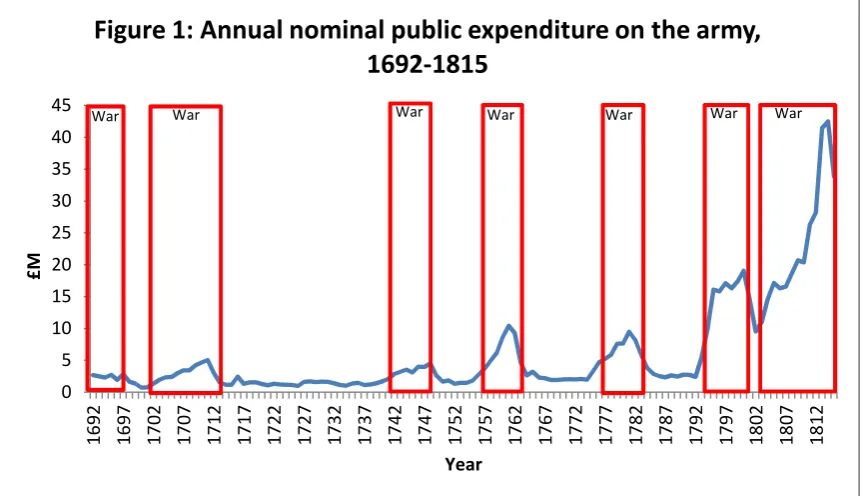
revolutionary and Napoleonic wars continued the upward trajectory of larger scale warfare that began in 1756 albeit in a much more sustained fashion. This is most evident when expenditure on the British army during the eighteenth-century is examined. Figure 1 shows the annual nominal public expenditure on army services between 1692 and 1815.
Note: These figures were obtained from three different reports. Army expenditure until the Act of Union in 1801 was divided into two different establishments, the English and Irish. The statistics on army spending from 1692 until 1800 are taken from reports concerning the net public income and expenditure of the English and Irish establishments. For some reason the Irish expenditure on army services is missing for 1726. Therefore, the spending on army services in 1726 is only for the English establishment. The third report detailed the gross public income and expenditure for the British establishment and provides the figures from 1801 until 1815.
Source:
[image:26.595.74.507.322.570.2]Parliamentary Papers, Volume XXXV (1868-1869), pp. 7-225, 231-355, 361-389. 0 5 10 15 20 25 30 35 40 45 1 6 9 2 1 6 9 7 1 7 0 2 1 7 0 7 1 7 1 2 1 7 1 7 1 7 2 2 1 7 2 7 1 7 3 2 1 7 3 7 1 7 4 2 1 7 4 7 1 7 5 2 1 7 5 7 1 7 6 2 1 7 6 7 1 7 7 2 1 7 7 7 1 7 8 2 1 7 8 7 1 7 9 2 1 7 9 7 1 8 0 2 1 8 0 7 1 8 1 2 £ M Year
Figure 1: Annual nominal public expenditure on the army,
1692-1815
War
27 The first significant increase in scale occurred during the Seven Years War (1757-1763). This is shown by peak expenditure on army services during war. Prior to the Seven Years War, the peak expenditure in any war year was £5.06 million in 1710, whereas in the Seven Years War expenditure peaked at £10.44 million. The wars after 1793 merely continued the larger scale spending on war that began in 1756, although this was at a greatly accelerated pace. The peak expenditure on the army during the eighteenth-century occurred in 1799 when £17.40 million was spent on the army. The Napoleonic Wars saw even greater expenditure as spending on the army reached as much as £42.4 million in 1814, although this latter figure is gross expenditure which consequently exaggerates the extent of spending. Another important point is, as Brumwell noted, expenditure on the army during peace remained at a much higher level than previously despite dramatic declines in peak wartime expenditure. Before the Seven Years War expenditure on the army during peace averaged £1.44 million per year, yet average peacetime expenditure between 1764 and 1792 increased to £2.48 million per year. It should be noted that
28 Estimating the size of the army during the eighteenth-century is difficult as there were differences between the numbers of men voted by parliament, the army establishment, and actual numbers serving. Historians of the army typically account for this difference by reducing the size of the official army establishment by 20%.92 In consequence, to allow for differences between the establishment and actual numbers serving the size of the army is estimated as the official army establishment after a reduction of 20% is made to compensate for any discrepancies. According to this method, the size of the army in 1746 was 62,132, which considerably increased in size to 96,507 in 1762, both peak years in these respective wars.93 This was fairly similar to the increases in army expenditure for this period; the size of the army almost doubled, while net expenditure on the army more than doubled. The size of the army then increased massively to 315,481 by the peak year of the Napoleonic Wars, 1814. 94 This increase was not as great as army expenditure, but was still a very significant increase as the size of the army more than tripled. These differences between army size and expenditure on army services were probably due to a
combination of inflation and the fact that Napoleonic War expenditure was only reported in gross terms.
The number of officers serving during peace, in common with peacetime expenditure on the army, also saw more sustained increases after the Seven Years War. According to Houlding, the peacetime establishment of 1718-1739 contained 1,950 officers compared to 2,600 between 1763 and 1771.95 The increased
92
S. Conway, War, State and Society in Mid-Eighteenth Century Britain and Ireland, (Oxford, 2006), pp. 57-61. 93
Parliamentary Papers, Volume XXXV (1868-1869),p. 699. 94
Ibid.,p. 702. 95
29 peacetime establishment after the Seven Years War owed much to the globalisation of warfare and expansion of Britain's empire that resulted from victory. These created more opportunities for army officers to be employed abroad than
previously.96 This was shown by the number of regiments permanently based in colonial locations significantly increasing; British regiments stationed in North America rose from two in 1738 to fifteen by 1764.97 India only began to have
regiments permanently based there from 1754 and by the 1780s there were often as many as nine regiments in this location.98
There were certainly some differences between army expenditure and the size of the army, which were probably caused by inflation and the reporting of Napoleonic War expenditure figures in gross terms. However, the main
characteristics in the expansion of large-scale conflict remained the same whether viewed through army expenditure or the size of the army. The first significant increase in scale of conflicts occurred with the Seven Years War as the peaks of expenditure or the size of the army showed. This watershed was also evident in a much larger peacetime establishment than previously in subsequent periods of peace. The scale of conflict after 1793 greatly increased compared to the major mid-eighteenth-century wars, but the conflicts near the turn of the nineteenth-century accelerated the trend towards large-scale warfare that began with the Seven Years War.
96
P.J Marshall, “Empire and Opportunity in Britain, 1763-1775: the Prothero Lecture”, Transactions of the Royal Historical Society, 5, (1995), p. 124.
97
Odintz, “The British Officer Corps”, p. 46.
98
30 The larger scale of conflicts affected the administration of the armed services, as Weber argued:
“...Only the bureaucratic army structure has allowed for the development of the professional standing armies which are necessary for the constant pacification of large estates of the planes as well as warfare against far distant enemies....”99
In other words, modernisation of the army was necessary to be able to conduct large scale warfare. Yet this was a very complex process and causality worked both ways. The increased scale of warfare and greater frequency of major wars also acted as a catalyst to intensify the pace of modernisation. Conway noted war helped to promote reform as attempts were made to make the armed services more
professional in order to increase their efficiency and state control of them. 100 Thus, there were often important administrative developments near the end of major wars. For example, the War of Austrian Succession ended in 1748, and between 1747 and 1751 there were the following reforms: fictitious names banned from muster rolls of guards regiments, reform of musters, regulation of stoppages from soldiers pay, restrictions on captain’s dividends, the introduction of a relief system for regiments posted abroad, regulations concerning uniforms provided to soldiers, the end of the custom designating regiments by colonel's names and the banning of placing personal coat of arms on regimental colours.101
Modernisation of the military did seem to produce increasing rates of social mobility for those using an army career to advance. Max Weber noted that the bureaucratization of armies brought with it increasing upward social mobility as there
99
H.H Gerth and C. Wright Mills (eds), From Max Weber: essays in sociology, (London, 1967), p. 222. 100
Conway, War, State and Society, p. 301. 101
31 was a “Htransfer of army service from the propertied to the propertylessH.”102 This thesis investigates the social mobility of a key group of army officers during the eighteenth-century when this modernisation took place. It examines the social origins and career patterns of the highest professional rank in the army, generals. The study focuses on the social mobility of generals for two reasons. Firstly, despite increasing rates of mobility among officers it is often claimed social mobility was very limited at the top end of the army as the highest ranks were dominated by the landed elite.103 This is in line with one of the dominant theories on social mobility, which Goldthorpe describes as the ‘closure thesis’. According to the ‘closure thesis’, social mobility generally occurs between individuals holding similar positions in society. The closer a person is to the top or bottom of a hierarchy the more limited mobility is as most mobility occurs for those at intermediate levels.104 Secondly, who became a general in the eighteenth-century had potentially important implications for military performance. The outcome of key battles, such as Waterloo, often depended on the quality of leadership displayed by commanding generals, which could be adversely affected if there was limited mobility among generals. The key questions this thesis addresses are closely related to these themes of limited mobility at higher ranks, and modernisation and mobility. In the first place, did the upper levels of the army
remain isolated from social mobility? In the second place, were the social origins and career patterns of generals different in the late eighteenth-century compared to their earlier counterparts?
102
Gerth and Mills, From Max Weber, p. 222. 103
Corfield, Power and the Professions, pp. 225-227; Holmes, Augustan England, p. 150. 104
32 In order to answer these questions the methodological approach is to
examine the social backgrounds and careers of generals at two points in time during the eighteenth-century representing fundamentally different eras in the
modernisation of the army. 1747 was chosen to represent the early eighteenth-century, a period that could be described as pre-modern, and 1800 represents the late eighteenth-century after most modernisation had occurred.
The thesis is structured in the following manner. Chapter two surveys the literature on the army and social mobility and chapter three addresses what it meant to be a general in the eighteenth-century as the nature of generalship during this time was different from today. The next two chapters are concerned with establishing rates of social mobility. The chapter on family backgrounds measures mobility rates through the most common methodological approaches to measuring mobility, an intergenerational study of the family backgrounds of generals’ fathers and the extent to which future generals were self-recruited. Apart from achieving upward mobility through career selection there are other mechanisms of mobility or what Sorokin terms "channels of social circulation”.105 In consequence, chapter four examines the role education and marriage, some of the most important "channels of social
circulation” apart from careers, played in the future generals’ mobility patterns. Two important aspects of an army career that were potentially affected by modernisation were the career patterns of officers, such as their career paths through the army, and rewards gained from service. This is because modernisation affected the way
105
33 officials in public bureaucracies were promoted and paid.106 Career patterns and rewards are particularly important topics in studying the mobility of British army officers as these two aspects of an army career are often seen as ways mobility was restrained.107 Hence, chapters five and six analyse the career patterns of the future generals and rewards gained from army service.
106
Gerth and Mills, From Max Weber, pp. 199, 203. 107
34
Chapter two: The army and social mobility
I. The army as a mechanism of social mobility
Non-military careers may have provided increased opportunities in the eighteenth-century to advance due to modernisation, but during times of war the army was probably one of the most important avenues of advancement.1 The army has always been an important avenue of social mobility as it offers the opportunity of upward mobility to those from even humble backgrounds.2 An army career gave relatively high status as historically officers were drawn from the aristocracy.3 It is estimated, for example, that most British aristocrats of military age had taken part in the War of the Roses during the second half of the fifteenth-century.4 The extent of this opportunity to advance through an army career greatly intensifies during periods of war, which was especially the case during the eighteenth-century due to the unprecedented expansion in the scale of warfare.
1
Stone and Stone, An Open Elite?, p. 197. 2
It is one of Sorokin’s main "channels of vertical circulation". See Sorokin, Social and Cultural Mobility, pp. 164-166. This was also shown by a recent study on the careers of doctors in the late eighteenth-century army medical service. See M. Ackroyd, L. Brockliss, M. Moss, K. Retford and J. Stevenson, Advancing with the Army: medicine, the professions, and social mobility in the British Isles, 1790-1850, (Oxford, 2006), pp. 16-19. 3
C. Storrs and H.M Scott, “The Military Revolution and the European Nobility, c. 1600-1800”, War in History, 3 (1), (1996), pp. 1-41; D. Ogg, Europe of the Ancien Regime, 1715-1783, (London, 1965), p. 154; M.S Anderson, War and Society in Europe of the Old Regime, 1618-1789, (London, 1988), pp. 118-121; Western, “War on a New Scale”, pp. 188, 203, 211; N.L Dodd, “British Officer Recruiting”, Military Review, 51 (7), pp. 37-42.
4
35 Sorokin outlined some of the reasons why the army is a particularly attractive career for advancing during war:
“HThis institution plays an especially important part in periods of militarism, or international or civil war. Whether intentionally or not, the service of a talented strategist, or a brave soldier, regardless of his social status, is highly appreciated at such periods. Besides, the war is apt to test the talent of the low born soldier or inability of a privileged noble. The great danger to the army and to the country imperatively urges the army and the country to put the soldier in the rank corresponding to his real ability. The services of the low born soldiers force rewards by promotion. The great losses among the commanding officers make it necessary to fill their places with people taken from the lower ranks. The war continuing, a leadership once obtained by a low born soldier is likely to grow, if he is a talented commanderH.”5
The assertion that the army during the course of the eighteenth-century
increasingly became a mechanism through which individuals achieved social mobility can be supported by comparing various studies’ findings on the social background of officers at different points in this period. At the foundation of the regular British army in 1661 most officers were ‘gentlemen officers’ who according to Childs were ‘more politicians than soldiers’. A study of these officers serving between 1661 and 1685 revealed that 59.9% were related to peers, baronets and knights.6 The social
backgrounds of officers became more diverse over time in line with the expansion of warfare. Hayes’ study of officers serving between 1714 and 1763 showed that in this period officers were now drawn from four different social groups: titled and untitled aristocrats, the middle class and professions, foreign officers and officers promoted from the ranks.7 Odintz’s study of four sample infantry regiments in the mid
eighteenth-century also showed a socially diverse officer corps. Officers that could be traced came from the following social groups: aristocracy and baronetage (11%),
5
Sorokin, Social and Cultural Mobility, p. 164. 6
Childs, The Army of Charles II, p. 37. 7
36 gentry (58%), middle-class (14%), foreign (15%) and working-class (2%).8 There is little research on the social backgrounds of army officers in the late eighteenth-century, but the research that has been done suggests officers came from an even wider range of social backgrounds than previously. Taking a sample of 100 officers drawn from the 1780 army list, Razell found that 60% of officers came from the middle class, 16% from the gentry and 24% from the aristocracy.9 This finding was supported by the qualitative assessment of other historians. Ward argued that during the Napoleonic Wars:
“...The immense augmentation of the army in the years of the revolution and again after 1803, the temper of the time, and perhaps also the natural disposition of the Duke of York and his staff, had led the Horse Guards to accept officers from a class of persons which in ordinary circumstances would have been denied advancement in the service. Whatever the causes, the Horse guards at the period of the Peninsular War was prepared to promote officers without money or interest on a greater scale than in the days of the King’s administration before the wars. Officially, the emphasis was upon merit, and the foundation of the Royal Military College had been an attempt, praiseworthy in its intentions, to give an effect to this policy....”10
Ward's view echoed Turner’s argument that the Napoleonic Wars saw an
unprecedented widening of the social groups that officers were drawn from, even including lower middling sorts such as butchers’ and tailors’ sons.11
The view that the army became an increasingly popular way of achieving social mobility as it expanded is not necessarily an opinion universally held. Some historians argue there was an adverse change in the social character of the army between the early and late eighteenth-century, which if correct would probably restrain levels of social mobility. Hayes claimed there was less ‘social snobbery’ in the early army compared to the late eighteenth-century. Evidence of this was the
8
Odintz, “The British Officer Corps”, Chart II, p. 182. 9
P. E Razzell, “Social Origins of Officers in the Indian and British Home Army, 1758-1962”, The British Journal of Sociology, 14 (3), (Sept 1963), Table 7, p. 253.
10
S.G.P Ward, Wellington's Headquarters: a study of administrative problems in the Peninsula, 1809-1814, (Oxford, 1957), p. 159
11
37 emergence of crack regiments in the later period when social criteria seemed to matter more than merit. In contrast, merit allegedly mattered more than social background in the early army.12 Similarly, Guy argued “H during the decades from the Regency to the outbreak of the Crimean War, the officer corps became charged with snobbery and elitism founded on the criteria of wealth and ostentation rather than military meritH.”13 Holmes and Christie asserted that there were more “rags to riches” stories during the early eighteenth-century than the later period.14 Burton and Newman, in analysing the career of General Sir John Cope, claimed “... Cope made use of almost the last occasion when it was still possible for an officer to advance rapidly without money or political favour....”15
The extent of any increase in social status through an army career may have also been limited. The existing literature on the eighteenth-century British army often contends senior officers were isolated from any expansion in social mobility.
Historians claim senior positions in the army were reserved for aristocrats.16 According to Guy, colonels and generals were drawn from a minority of privileged officers.17 Barker summed up the consensus view on the promotion prospects of eighteenth-century army officers succinctly when he said:
“...Irrespective of their ability, men of moderate means could not climb very high up the ladder of rank. So most of the regimental officers-the lieutenants, captains and majors-came from the middle ranks of
12
Hayes, “The Professional and Social Background”, pp. 103-107. 13
Guy, Oeconomy and Discipline, p.164; A.J Guy, “The Army of the Georges, 1714-1783”, in D. Chandler (ed.), The Oxford Illustrated History of the British Army, (Oxford, 1994), pp. 98-99.
14
Holmes, Augustan England, p. 269; Christie, British ‘Non-Elite’ MPs, p. 135. 15
I.F Burton and A.N Newman, “Sir John Cope: promotion in the 18th century army”, The Historical Review, 78 (309), (October, 1963), p. 667.
16
Guy, Oeconomy and Discipline, p. 89; Storrs and Scott, “The Military Revolution”, pp. 14-16, 36-37; French,
The British Way in Warfare, p. 5; Roy, “The Profession of Arms”, pp. 210-211; A.J Barker, Redcoats: the British soldier in America, (London, 1976), p.22; I.Roy,”The Profession of Arms”, pp. 212-213.
17
38 society, the rural aristocracy and the merchant classes in the cities, while senior officers-the colonels, brigadiers and generals-sprang from the nobility...." 18
The strong connection between aristocrats and generals is noted in more recent works as well. Collins, for example, calculated that nearly two thirds of operational generals serving in Spain during 1808 had aristocratic connections.19
The findings of those who have examined the social backgrounds of senior officers in more detail seem to support these views. Hayes found two thirds of all regimental colonels came from the upper levels of society and claimed more than 50% of Scottish colonels were titled aristocrats.20 However, Hayes’ conclusions may have been unduly affected by the way he analysed his data. Hayes sliced up
regimental colonels from the gentry into two distinct groups. The ‘influential landed gentry’ were included as part of his upper group along with noblemen and baronets. In contrast, the ‘country gentry’, professional classes and foreigners belonged to his lower group.21 The justification for this was that the ‘more influential landed gentry’ were in the upper group because they had inherited or acquired estates of their own. Yet, there was no mention of the size of the estates or whether they would have provided sufficient income to live off. A professional income may have still been necessary for some of these officers to survive. Another important point is that the upper group was dominated by the gentry as it only included 73 sons of aristocrats and baronets. It seems questionable to include the gentry and aristocracy as one social group because for the average member of these groups there were huge
18
Barker, Redcoats, p.22. 19
B. Collins, War and Empire: the Expansion of Britain 1790-1830, (Harlow, 2010), p.427. 20
Hayes, “The Social and Professional Background”, pp. 68-69; J. Hayes, “Scottish Officers in the British Army, 1714-1763”, Scottish Historical Review, 37 (April 1958), p. 27.
21
39 differences in the economic and social resources they could draw on. Razzell also found that senior officers came largely from the upper classes. According to his data, 57% of those holding the rank of major general and higher in 1830 were aristocrats.22 For a slightly later period, Otley demonstrated that 45.5% of generals had close connections with the landed elite, military elite or other elites.23 Of course, the smaller nineteenth-century army made it more difficult to get promoted and so the situation may have been different before 1815.24
The aristocratic dominance of high command was not necessarily restricted to the British army, but has been seen to be generally applicable to military forces during this time. In the late eighteenth-century navy there were perhaps justifiable complaints that aristocrats were monopolising command appointments.25 Certainly, the proportions of peerage and gentry serving in the navy seemed to increase significantly as the century progressed. Cavell showed both of these groups accounted for 5% of junior officers in 1761, but by 1801 this had risen to 17.6%.26 Moreover, according to Wareham 61% of all frigate captains, one of the most
popular command positions in the British navy, posted between 1801 and 1814 were
22
Razzell, “Social Origins of Officers”, Table 9, p. 254. 23
He defined the different types of elites as follows: (1) landed elite: “sons or sons-in-law of landowners who themselves owned, or whose direct ancestors owned 2,000 or more acres of land worth £3,000 per annum or more, or 3,000 or more acres of land worth £2,000 per annum or more in 1883”; (2) military elite: “sons or sons-in-law of army officers of the rank of major general and upwards, or of rear admiral and upwards”; (3) other elite: sons or sons-in-law of politicians, industrial directors, financiers, diplomatists, top civil service and colonial service administrators, etc”. See C.B Otley, “The Origins and Recruitment”, Table 17, p. 119. 24
Ackroyd et al, Advancing with the Army, pp. 171, 186-8. 25
N.A.M Rodger, “Commissioned Officers’ Careers in the Royal Navy, 1690-1815”, Journal for Maritime Research (online), (June 2001), p. 11, taken from
http://www.jmr.nmm.ac.uk/server/show/conJmrArticle.52/viewPage/11; T. Wareham, The Star Captains: frigate command in the Napoleonic Wars, (London, 2001), pp. 94-95; C. Consolvo, “The Prospects and Promotion of British Naval Officers, 1793-1815”, The Mariner’s Mirror, 91 (2), (May 2005), p. 152, footnote 65 p. 158.
26