1
LHV Predication Models and LHV Effect on the Performance of
CI Engine Running with Biodiesel Blends
B. Tesfa1, F. Gu, R. Mishra and A.D. Ball
University of Huddersfield, Queensgate, Huddersfield, HD1 3DH, UK
Abstract
The heating value of fuel is one of its most important physical properties, and is used for the design and numerical simulation of combustion processes within internal combustion (IC) engines. Recently, there has been a significant increase in the use of dual fuel and blended fuels in compression ignition (CI) engines. Most of the blended fuels include biodiesel as one of the constituents and hence the objective of this study is to investigate the effect of biodiesel content to lower heating value (LHV) and to develop new LHV prediction models that correlate the LHV with biodiesel fraction, density and viscosity. Furthermore, this study also investigated the effects of the LHV on CI engines performance parameters experimentally. To achieve the above mentioned objectives density, viscosity and LHV of rapeseed oil biodiesel, corn oil biodiesel and waste oil biodiesel at different blend fraction values (B0, B5, B10, B20, B50, B75, and B100, where ‘B5’ denotes a blend of 5% biodiesel and 95% mineral diesel, etc) were measured as per EN ISO 3675:1998, EN ISO 3104:1996 and DIN 51900 standards. The engine experimental work was conducted on a four-cylinder, four -stroke, direct injection (DI) and turbocharged diesel engine by using rapeseed oil and normal diesel blends. Based on the experimental results, models were developed which have the capability to predict the LHV corresponding to different fractions, densities and viscosities of biodiesel. The models are shown to produce consistent results with experimentally measured ones and compared with previous researches’ models. Furthermore the effects of LHV on brake
1
*Corresponding author
2
specific fuel consumption (BSFC) and thermal efficiency were analysed and it has been seen that for the neat biodiesel which its LHV is lower by 8% than diesel resulted in an increment of BSFC and thermal efficiency by 18% and 25% respectively.
Key words: Biodiesel, Lower heating value, Biodiesel blend, Biodiesel density, Biodiesel viscosity, Engine power
1.
Introduction
3
The heating value of fuel can be defined in two ways: the higher heating value (HHV), or gross calorific value, and the lower heating value (LHV), or net calorific value. HHV is determined by bringing all the products of combustion back to the original pre-combustion temperature, and in particular condensing any vapour produced to liquid water, while LHV is based on gaseous water (vapour) as the by product which is determined by subtracting the heat of vaporization of the water vapour from the HHV [14].
Although HHV has wider acceptance in biomass characterisation (biomass is renewable energy from plants sources), engine performance estimation models usually use LHV of the fuel [15]. This is due to the fact that automotive fuels contain only small amount of water (<0.05% by mass) which can be neglected during heating value estimation[16], [17].
4
calculated using the saponification point and iodine value. He also determined the HHV of vegetable oils, alcohols and alkanes experimentally and correlated these with their density and viscosity values [1],[23]. Sadrameli et al. [24] measured the heating values of pure fatty acids, also using a Parr bomb calorimeter, and developed a correlation of the LHVs of fatty acids with their molecular weight, density and carbon number. They also found that the heating value increases with increasing molecular weight and density of saturated fatty acid.
5
Table 1 Lower and Higher Heating Value prediction approaches
Author Correlations Accuracy Fuel type Remarks
Freedman and Bagby, 1989 [19]
HHV=76.71+154.77CN, HHV(Kg.cal/mole)
HHV=-431.08+11.03Mw
R2 =0.9900
R2 =0.9900
Saturated ethyl esters, unsaturated methyl esters and triglycerides
HHV calculated from Carbon number(CN), and Molecular weight(Mw) of methyl esters
Demirbas, 2000 [23] HHV=79.014 - 43.126ρ, HHV(kJ g-1), (g cm-3)
HHV=37.945+0.0491µ , HHV(kJ g-1), µ(mm s-2)
R2 =0.9380
R2= 0.9980
Vegetable oils, alcohols and alkanes
HHV calculated from density (ρ) and viscosity (µ ) of vegetable oils
Sadrameli et al., 2008 [24]
HHV = 0.0518Mw + 29.76 , HHV(MJ kg-1)
HHV = -93.4ρ + 122.67, ρ (kg m-3)
HHV=0.7271CN+31.419
R2= 0.9895
R2= 0.9798
R2= 0.9895
Saturated (C4–C18) and unsaturated (C18:1–3) fatty acids
HHV calculated from molecular weight(Mw),
density(ρ) and carbon number(CN) of fatty acids
Demirbas, 2009 [22] HHV = -0.0382ρ + 74.468, HHV(MJ kg-1),
ρ (kg m-3)
HHV = 0.6154µ + 38.998, µ(mm s-2)
R2= 0.8922 Vegetable oils and their biodiesel
HHV calculated from biodiesel density
Mehta and Anand, 2009 [15]
LHV = 0.0109(C/O)exp3 – 0.3516(C/O)exp(2) +4.2000(C/O) + 21.066-0.11NDB
LHV = 0.0011(H/O)exp3 – 0.0785(H/O)exp(2) +2.0409(H/O) + 20.992-0.100NDB
R2 =0.9900
R2 =0.9900
Straight and processed vegetable oils
LHV calculation from carbon to oxygen ratio and number of double bonds (NDB)
Krisnangkura, 1991 [21]
LHVTrig=1896000/SN − 0.6 IV — 1600
LHV FAME = 618,000/SN − 0.08 IV — 430.
1.16% accuracy
Triglycerides Methyl ester
6
The main reason for higher BSFC of an engine running with biodiesel is its LHV as discussed by Xue et al.[25] and Lapuerta et al. [26]. Xue et al.[22] and Lapuerta et al reported that from the total number of publications, 90% and 80% of the authors agreed that the BSFC of biodiesel is higher than the diesel respectively. However, the effects of LHV for range of biodiesel blends on BSFC and thermal efficiency of engine have been reported fairly.
Hence, the focus of this study is:
1) To develop LHV prediction models based on the major fuel physical properties such as density and viscosity as well as to investigate the application of the models for range of biodiesel feedstock’s which have been reported in the previous work.
7
2.
Experimental facilities and test procedures
Experimental facilities and procedures to investigate the LHV of biodiesel and its effects on the brake specific fuel consumption and thermal efficiency are described in section 2.1 and section 2.2 respectively.
2.1 Lower heating value measurement
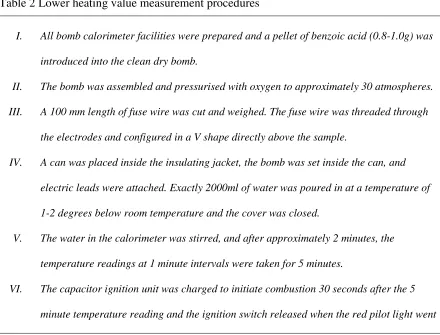
[image:7.595.73.513.415.750.2]The heating values of pure diesel and a range biodiesel blends (B5, B20, B50, B75 and B100) were determined in a Parr adiabatic oxygen bomb calorimeter, model 230/5. Three different biodiesel sources (corn oil biodiesel, waste oil biodiesel and rapeseed oil biodiesel) provided the biodiesel used in the analysis. The heating value was measured using the standard DIN 51900 procedures, summarised in Table 2. The density and viscosity of the biodiesel were also measured by the authors, using the EN ISO 3675:1998 and EN ISO 3104:1996 standards and these results are reported in an earlier publication [20].
Table 2 Lower heating value measurement procedures
I. All bomb calorimeter facilities were prepared and a pellet of benzoic acid (0.8-1.0g) was introduced into the clean dry bomb.
II. The bomb was assembled and pressurised with oxygen to approximately 30 atmospheres. III. A 100 mm length of fuse wire was cut and weighed. The fuse wire was threaded through
the electrodes and configured in a V shape directly above the sample.
IV. A can was placed inside the insulating jacket, the bomb was set inside the can, and electric leads were attached. Exactly 2000ml of water was poured in at a temperature of 1-2 degrees below room temperature and the cover was closed.
V. The water in the calorimeter was stirred, and after approximately 2 minutes, the temperature readings at 1 minute intervals were taken for 5 minutes.
8 out.
VII. The temperature was recorded 30 seconds after ignition and then every 30 seconds whilst it continued to rise. After the maximum temperature was reached, temperature readings for a further 5 minutes were taken, also at one minute intervals.
VIII. Graphs of temperature versus time were plotted using Matlab to determine the temperature change in the given time.
IX. The heat capacity of the calorimeter was calculated using the data from the benzoic acid test in equation (1). The lower heating value of benzoic acid (LHVba) and iron wire
(LHVw) are -26.421 kJg -1
and -6.694 kJg-1 respectively as per manufacturer data sheet W=(mbLHVba+mwLHVw)/∆Tb (1)
where W is the heat capacity of the calorimeter being used (J/K), mb is the mass of the
benzoic acid (kg), mw is the mass of the iron wire (kg), and ∆Tb is the temperature rise (K)
due to the benzoic acid combustion.
X. Steps I-IX were repeated for biodiesel blends B0, B10, B20, B50, B75 and B100. The LHVs for the blends were calculated using equation (2):
LHVb=(∆TW - mwLHVw)/mbd (2)
where ∆T is the temperature rise due to biodiesel combustion (K), W is the heat capacity of the calorimeter (J/K) being used which is calculated by equation (1).
2.2 Engine test facilities and procedures
9
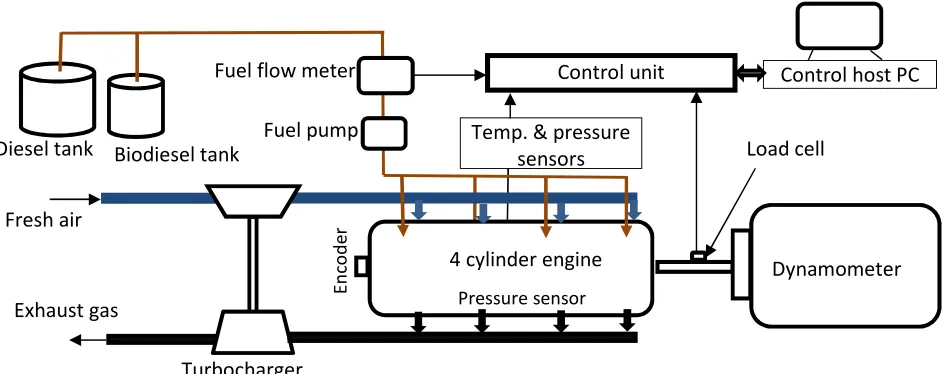
[image:9.595.60.532.126.313.2]for the engine combustion and performance characteristics, the engine test bed was instrumented with speed sensors, fuel flow metres and in-line torque meter.
Figure 1 Engine test facilities lay out
Table 3 Characteristics of engine
Technical parameters Technical data
Engine type Turbo charged diesel engine
Number of cylinders 4
Bore 103mm
Stroke 132mm
Compression ratio 18.3:1
Injection system Direct injection
Displacement 4.399 litre
Nominal Idling speed 800 rpm
Maximum rating gross intermittent 74.2kW @ 2200rpm
Maximum torque 425Nm @ 1300rpm
A Hengler RS58 speed sensor was used to measure the speed of the engine. Fuel flow was measured by a FMS-1000 gravimetric fuel measuring system which was controlled and Diesel tank
Turbocharger Exhaust gas
4 cylinder engine
Load cell
Pressure sensor
Fuel pump
E
n
co
d
e
r
Biodiesel tank
Fuel flow meter
Fresh air
Control unit Temp. & pressure
sensors
[image:9.595.115.489.365.690.2]10
[image:10.595.64.529.153.251.2]monitored by CADETV12 software [27]. The measuring range and accuracy of these instruments are presented in Table 4.
Table 4 Measuring instruments specifications
Instruments Type Range Accuracy
Fuel flow meter FMS-1000 gravimetric 0 - 300Kg/hr ±0.05% of reading
Speed sensor Hengstler RS58 0 - 10000rpm -
Load cell T10FS 0 - 1000Nm 0.006 to 0.002% of reading
During the testing process the engine was run for 10 minutes to enable it to come to steady state before any measurements were carried out. The maximum rated speed and maximum torque of the test engine is 2200rpm and 425Nm respectively. The tests were carried out for engine speed range from 1000 to 2000rpm with 100rpm increment at loads of 100Nm, 200Nm, 300Nm and 400Nm.
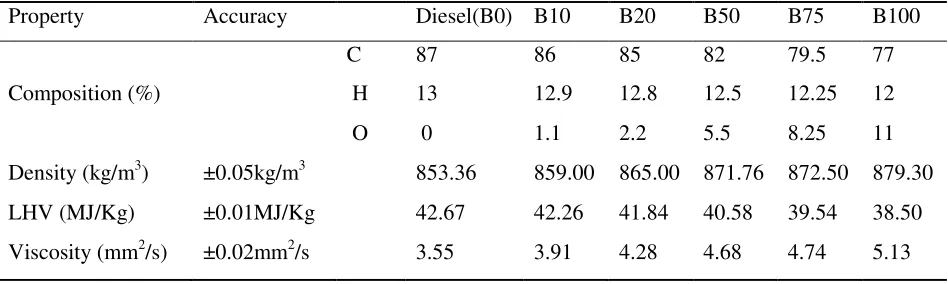
In this study, rapeseed biodiesel (ROB) obtained from a local company, had been blended with diesel and used for engine performance analysis. The blends were made in mixing tank with 10%, 20%, 50%, 75% and 100% biodiesel content by volume. The main physical properties such as composition, density, lower heating value (LHV) and viscosity of the rapeseed oil biodiesel were measured according to the official test standards in EU and the results were published by Tesfa et al [20]. The blends properties are presented in Table 5.
Table 5 Physical and Chemical properties of rapeseed biodiesel and its blends [20].
Property Accuracy Diesel(B0) B10 B20 B50 B75 B100
C 87 86 85 82 79.5 77
Composition (%) H 13 12.9 12.8 12.5 12.25 12
O 0 1.1 2.2 5.5 8.25 11
Density (kg/m3) ±0.05kg/m3 853.36 859.00 865.00 871.76 872.50 879.30
LHV (MJ/Kg) ±0.01MJ/Kg 42.67 42.26 41.84 40.58 39.54 38.50
[image:10.595.68.542.605.747.2]11
3.
Results and Discussion
3.1 Effects of biodiesel content on LHV values and LHV prediction models
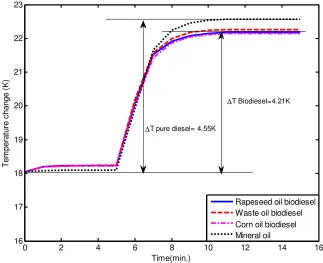
[image:11.595.133.456.441.704.2]Using the procedure mentioned in Table 2, the heating values of the biodiesel and its blends were obtained experimentally. To determine the energy equivalent of the bomb calorimeter, tests were carried out with a benzoic acid sample of known physical properties. The heat capacity of the bomb calorimeter was then calculated by equation (1) and was thereafter used in further analysis. Each sample of the biodiesel was tested three times and averaged values were used to calculate the associated heating values. The differences between lower heating values obtained from these tests did not exceed 0.45MJ/kg with a maximum deviation of 1.15%. The variation of temperature with time during the fuel combustion in the calorimeter is shown in Figure 2. It can be seen that the biodiesels derived from different sources resulted in almost the same combustion temperature curves. However, the biodiesel combustions yielded lower temperatures than pure diesel, by around 7.5%.
Figure 2 Temperature change in bomb calorimeter for biodiesels from various sources
0 2 4 6 8 10 12 14 16
16 17 18 19 20 21 22 23
Time(min.)
T
e
m
p
e
ra
tu
re
c
h
a
n
g
e
(
K
)
∆T pure diesel= 4.55K
∆T Biodiesel=4.21K
12
[image:12.595.105.489.333.664.2]The effects of the volumetric blend fractions on the heating value of the biodiesel are shown in Figure 3. From Figure 3(a) it can be seen that as the biodiesel blend fraction increases, the LHV decreases. The rapeseed biodiesel, corn biodiesel and waste biodiesel resulted in LHV of a reduction in by 9.96%, 10.19% and 9.67% respectively compared to pure diesel. This can be explained by the relative composition of the fuels as biodiesel has oxygen present in the structure which is not a component of conventional mineral diesel. As a consequence of the additional oxygen the carbon and hydrogen content is reduced from 86 to 77% for carbon and 14 to 12% for hydrogen [28]–[30]. Although the biodiesel result in lower LHV, the combustion process is improved due to the presence of the higher oxygen content of the fuel.
Figure 3 Variation of LHV with biodiesel fraction and for different biodiesel source types When comparisons were made between the LHVs of the three biodiesels (corn oil against rapeseed, and waste oil against rapeseed), the maximum difference was found to be 1.4%, as
0 10 20 30 40 50 60 70 80 90 100
37 38 39 40 41 42 43 44
Biodiesel fraction(%)
L
H
V
(M
J
/k
g
)
(a) Lower heating value of different biodeisel sources
Rapeseed oil biodiesel Corn oil biodiesel Waste oil biodiesel
0 10 20 50 75 100
0 0.5 1 1.5
Biodiesel fraction(v/v)
D
iff
e
re
n
c
e
in
L
H
V
(%
)
(b) Comparison of lower heating value of different biodiesel sources
13
depicted in Figure 3(b). This very small difference in LHV between the different feedstock sources of biodiesel implies that the feedstock source does not have significant influence on the LHV of the biodiesel. Consequently, in this study, only rapeseed oil biodiesel was used for further investigation of LHV.
To investigate the effects of biodiesel fraction on LHV, two correlations were developed. The first correlation (equation 3) was developed based on the experimentally measured LHV for the range biodiesel blends (see Table 5) was developed linear mixing equation. The correlation resulted in an R2 value of 0.991.
LHVblend = -0.041X+42.32 (3)
Where LHVblend is the lower heating value of the biodiesel blend (MJ/kg) and X is the biodiesel fraction (v/v).
Equation (3), can be used without measuring LHV of neat biodiesel and diesel, since it needs only the value of the biodiesel fraction. This brings the advantage of being able to carry out simulations of combustion and performance characteristics for engines running with a range of biodiesel blends.
The experimentally measured LHV of biodiesel blends was also correlated with experimentally measured density and viscosity values (presented in Table 6). The correlations of LHV versus density and LHV versus kinematic viscosity are shown in equations (4) and (5) respectively (with R2values of 0.981 and 0.976 respectively):
LHV= -0.167ρ +184.95 (4)
LHV= -12.88 ln(µ)+61.3 (5)
14
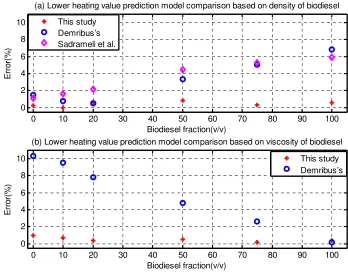
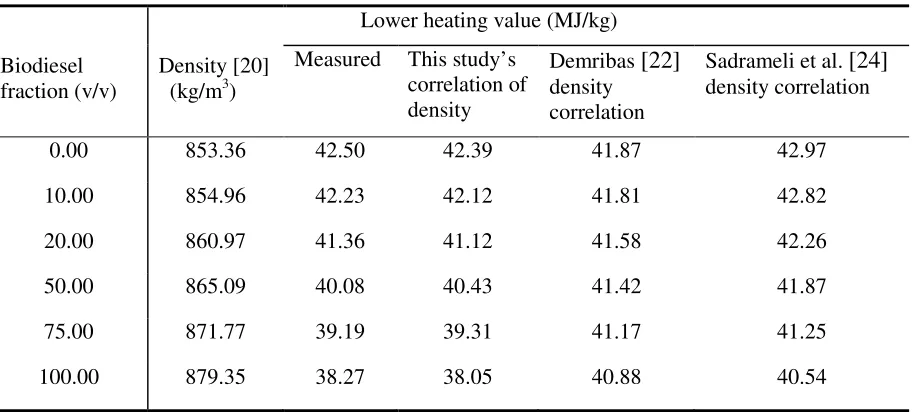
The density- and viscosity-based LHV prediction models have also been compared with the models of other researchers. Demribas [22] and Sadrameli et al. [24] developed regression models which correlate density with the LHV of pure biodiesel (B100) as presented in Table 1. The predictions of LHV were performed using the models of Demribas [22] and Sadrameli et al [24] and were compared with those derived from the authors’ approach, along with measured values. The measured and predicted LHVs are presented in Table 6, and the percentage deviations between the measured values and predicated values are shown in Figure 4(a).
[image:14.595.117.465.421.694.2]It can be seen that the predictions of this study and the measured values show a maximum error of 0.87%. However, the measured values deviate from the values obtained from the Demirbas and Sadrameli et al predictions by 6.82% and 5.93%, respectively. This higher deviation is possibly due to their models being developed only for pure biodiesel.
Figure 4 Lower heating value prediction models, error deviation comparison
Demribas [22] also developed a correlation between the lower heating value and the kinematic viscosity of neat biodiesel, as shown in Table 1. The values obtained from
0 10 20 30 40 50 60 70 80 90 100
0 2 4 6 8 10
Biodiesel fraction(v/v)
E
rr
o
r(
%
)
(a) Lower heating value prediction model comparison based on density of biodiesel
This study Demribus’s Sadrameli et al.
0 10 20 30 40 50 60 70 80 90 100
0 2 4 6 8 10
Biodiesel fraction(v/v)
E
rr
o
r(
%
)
(b) Lower heating value prediction model comparison based on viscosity of biodiesel
15
[image:15.595.72.528.206.412.2]Demribas’s correlation, measured lower heating values and predicted lower heating values from the correlation developed in this study are presented in Table 7. It can be seen that the measured values deviate by 1% from the values obtained from the correlation developed in this study and by 10.31% from the values obtained by Demribas, as shown in Figure 4(b). Table 6 Lower heating value prediction from the density of rapeseed oil biodiesel blends
Biodiesel fraction (v/v)
Density [20] (kg/m3)
Lower heating value (MJ/kg)
Measured This study’s correlation of density
Demribas [22]
density correlation
Sadrameli et al. [24]
density correlation
0.00 853.36 42.50 42.39 41.87 42.97
10.00 854.96 42.23 42.12 41.81 42.82
20.00 860.97 41.36 41.12 41.58 42.26
50.00 865.09 40.08 40.43 41.42 41.87
75.00 871.77 39.19 39.31 41.17 41.25
100.00 879.35 38.27 38.05 40.88 40.54
Table 7 Lower heating value prediction from the viscosity of rapeseed oil biodiesel blends
It can also be seen that the deviation of the values obtained from the Demribas correlation compared to the measured values, decrease with increase in biodiesel fraction, indicating that the Demribas correlation only most accurately predicts the lower heating value for pure
Biodiesel fraction (v/v)
Viscosity [20] (mm2/s)
Lower heating value (MJ/kg)
Measured This study correlation of viscosity
by Demribas [22]
viscosity correlation
0.00 3.58 42.50 42.08 38.12
10.00 3.67 42.13 41.83 38.13
20.00 3.79 41.36 41.53 38.13
50.00 4.28 40.08 40.29 38.16
75.00 4.68 39.19 39.27 38.17
[image:15.595.71.544.443.640.2]16
biodiesel. The correlation developed in this study, however, results in an acceptable percentage error when predicting the lower heating value for neat biodiesel and its blends.
[image:16.595.73.514.274.766.2]To investigate whether the models (equation (4) and equation (5)) developed in this study could predict the LHV of any biodiesel which are grown in any normal climate conditions and produced by any usual production process, comparisons were made based on extensive revisions done by Giakoumis [13] on physical properties of biodiesel.
Table 8 Measured [13] and predicted density, viscosity and lower heating value of biodiesel
Biodiesel type Density (kg/m3)
Viscosity (mm2/s)
Lower heating value (MJ/kg)
Measured
[13]
Predicted by Eq. (4)
Predicted by Eq. (5)
Beef tallow 874.3 4.83 37.22 37.54 38.94
Canola 881.6 4.4 37.98 38.74 37.72
Castor 917.6 14.52 37.63 23.37 31.71
Chiken fat 876.3 4.81 37.61 37.60 38.61
Coconut 870.8 2.78 36.90 44.66 39.53
Corn 882.2 4.32 36.8 38.98 37.62
Cottonseed 879 4.7 38.6 37.89 38.16
Croton 883.2 4.48 38.17 38.51 37.46
Fish 887.3 4.3 37.82 39.04 36.77
Hazelnut 877.9 4.55 38.8 38.31 38.34
Jatropha 878.7 4.72 38.05 37.84 38.21
Karanja 882.9 5.04 36.49 36.99 37.51
Lard 873 4.89 36.91 37.38 39.16
Linseed 891.5 4.06 39.54 39.78 36.07
Mahua 874.5 5.06 36.88 36.94 38.91
Neem 876.2 4.72 37.15 37.84 38.62
Olive 881.2 5.05 37.29 36.97 37.79
Palm 874.7 4.61 37.08 38.14 38.88
Peanut 882.9 4.77 38.05 37.70 37.51
Rapeseed 882.2 4.63 37.62 38.09 37.62
Rice brain 880.9 4.7 38.04 37.89 37.84
Rubber seed 882.3 4.79 37.82 37.65 37.61
Safflower 883.8 4.1 38.145 39.65 37.36
Soyabean 882.9 4.29 37.75 39.07 37.51
Sunflower 882.9 4.53 37.8 38.37 37.51
Waste cooking oil
17
Giakomis [13] recently presented the literature on biodiesel properties and fatty acid composition from International Journals and Conferences papers. The physical properties of twenty six different biodiesel feedstocks were reported, comprising of twenty-two edible and non-edible vegetable oils and four animal fats. From the Giaomis et al report, the biodiesel type, density, viscosity and lower heating values have been considered for the validation of the model developed in this study. The lower heating value of the twenty four biodiesel types are predicted by using equations (4) and (5) and presented in Table 8. From the twenty six biodiesels, the castor biodiesel which has higher density (917.6kg/m3) and viscosity (14.52mm2/s) and coconut which have lower density (870kg/m3) and viscosity (2.78mm2/s were excluded in this study.
[image:17.595.76.522.475.694.2]The deviation of the measured values and the predicted values with density and viscosity are shown in Figure 5 for both density and viscosity based models. It can be seen that for density based prediction, the maximum deviation is 8.5% for linseed oil based fuel.
Figure 5 Lower heating value prediction models, error deviation comparison
The LHV predicted by viscosity resulted in a maximum deviation of 6% the measured values. The percentage deviation can be explained as, different biodiesel feedstocks consist various
0 5 10 15 20 25
0 2 4 6 8 10 C h a n g e (% )
Based on density model Based on viscosity model
18
[image:18.595.73.525.212.677.2]fatty acid composition as shown in Figure 6. As it can be seen in the figure the fatty acid compositions range from C8:0 to C22:1. Even though the fatty acid composition affect the LHV, the correlation developed in equation (4) and (5) can predict the LHV for any biodiesel which is produced by any normal climate conditions and operation process based on the density and viscosity values of the biodiesel with acceptable error.
Figure 6 Fatty acid composition of vegetable and animal oils [13], [15]
0 20 40 60 80 100
Beaf Tallow Chicken Corn Cotteon seed Crambe Fish Hazelnut Jatropha Karanja Lard Linseed Olive Palm Peanut Rapeseed Rice bran Rubber seed Safflower sesame soybean sunflower Walnut Waste cooking oil
Fatty acid compostions (%)
T
y
p
e
o
f
o
il
Sum(C20:0 to C22:1)
C18:3
C18:2
C18:1
C18:0
19 3.2 Effects of LHV on engine performance
To investigate the likely effects of LHV on engine performance, experimental investigations were carried out on a CI engine running with diesel and biodiesel blends. Figure 7 shows the variation of the brake specific fuel consumption (BSFC) with engine speed for a range of biodiesel blends at different loads. The BSFC is the ratio of the mass flow rate of the fuel to the brake power output of the engine. It can be seen from the figure that the BSFC decreases as the engine speed increases, reaches its minimum value and then increases at higher engine speeds. This might be explained on the basis that, the heat losses through the combustion chamber walls is proportionally higher and the combustion efficiency is poorer at low speeds. These result in higher fuel consumption for the same amount of power produced al lower speeds, which result in higher BSFC. At higher speeds, the power required to overcome friction increases at a higher rate, resulting in a slower increase in output power with a consequent increases in BSFC. This phenomenon has been largely documented by previous research [31], [9], [10], [32]–[34]. The main reason for higher BSFC for an engine running with biodiesel blends is mainly due to the low heating value of the biodiesel as discussed in Figure 3.
20
Figure 7 BSFC versus engine speed for range of biodiesel blends
Figure 8 also shows that the B10, B20, B50, B75 and B100 results in a percentage change in BSFC of 1.5%, 3.5%, 10%, 14% and 18% respectively. This indicates that for a unit increase in biodiesel fraction, increases the BSFC percentage changes approximately by 0.18.
1000 1200 1400 1600 1800 2000 240 250 260 270 280 290 300 310 320 Engine speed(rpm) B S F C (g /k W h ) (a) 100Nm
1000 1200 1400 1600 1800 2000 200 210 220 230 240 250 260 270 Engine speed(rpm) B S F C (g /k W h ) (b) 200Nm
1000 1200 1400 1600 1800 2000 200 210 220 230 240 250 260 Engine speed(rpm) B S F C (g /k W h ) (c) 300Nm
21
Figure 8 Change in BSFC versus engine speed due to LHV
The thermal efficiency of the CI engine which was running with biodiesel blends (B10, B20, B50,
B75 and B100) and the diesel fuel has been computed for a range of engine speeds and load
conditions and is depicted in Figure 9. The brake thermal efficiency is calculated from BSFC and
lower heating value of the fuel as shown in equation (6) [35].
η= (3600/(BSFC*LHV))*106*100 (6)
Where η thermal efficiency (%), BSFC is the brake specific fuel consumption (g/kWh) of the
biodiesel and LHV is the lower heating value (J/kg) of the biodiesel.
Since the brake thermal efficiency is inversely proportional to BSFC, the trends observed are opposite
to that obtained for BSFC of the fuel in Figure 7. It can be observed from Figure 9 that at all conditions the thermal efficiency increases at lower engine speeds, reaches its maximum point and
then decreases. It can be also seen that, when the biodiesel content increases, the thermal efficiency
decreases. The thermal efficiency percentage change with corresponding LHV change is shown in
1000 1200 1400 1600 1800 2000 0 5 10 15 20 25 Engine speed(rpm) C h a n g e (% ) (a) 100Nm
1000 1200 1400 1600 1800 2000 0 5 10 15 20 25 Engine speed(rpm) C h a n g e (% ) (b) 200Nm
1000 1200 1400 1600 1800 2000 0 5 10 15 20 25 Engine speed(rpm) C h a n g e (% ) (c) 300Nm
22
Figure 10 for range of load conditions. It can be seen that, when the LHV is reduced by 7.79%, the thermal efficiency also reduced by up to 25%. Comparing the percentage change of BSFC with the
percentage change of thermal efficiency due to LHV variation, the latter resulted in a higher
percentage change. This is due to the effect of the LHV parameter on the thermal efficiency
[image:22.595.91.502.217.543.2]calculation (equation (6)).
Figure 9 Thermal efficiency versus engine speed of biodiesel blends
1000 1200 1400 1600 1800 2000
30 35 40 45 50 Engine speed(rpm) T h e rm a l e ff ic ie n c y ( % ) (a) 100Nm
1000 1200 1400 1600 1800 2000
30 35 40 45 50 Engine speed(rpm) T h e rm a l e ff ic ie n c y ( % ) (b) 200Nm
1000 1200 1400 1600 1800 2000
30 35 40 45 50 Engine speed(rpm) T h e rm a l e ff ic ie n c y ( % ) (c) 300Nm
1000 1200 1400 1600 1800 2000
23
Figure 10 Change in thermal efficiency versus engine speeds due to the LHV
4.
Conclusions
In this paper the effect of biodiesel blend on LHV has been systematically investigated, new LHV prediction models that correlate the LHV with biodiesel fraction, density and viscosity were developed. In addition, the effects of the LHV on CI engines performance were investigated experimentally. From this study the following conclusions can be drawn:
Biodiesel sources which are considered in this study (rapeseed oil, corn oil and waste oil) do not result in any significant differences in the measured lower heating values. The biodiesel fraction has a direct impact on the lower heating value of a biodiesel
blend. As the biodiesel fraction in a blend increases, the lower heating value shows a proportional decrease.
1000 1200 1400 1600 1800 2000
0 5 10 15 20 25 30 Engine speed(rpm) C h a n g e (% ) (a) 100Nm
1000 1200 1400 1600 1800 2000
0 5 10 15 20 25 30 Engine speed(rpm) C h a n g e (% ) (b) 200Nm
1000 1200 1400 1600 1800 2000
5 10 15 20 25 30 Engine speed(rpm) C h a n g e (% ) (c) 300Nm
1000 1200 1400 1600 1800 2000
24
Empirically derived LHV-predicting equations (density and viscosity based) provide values which closely match with the measured ones in this study and by previous author.
The neat biodiesel which its LHV is lower by 8% than diesel resulted in an increment of BSFC and thermal efficiency by 18% and 25% respectively.
Lower heating value is one of the most important parameters for estimating the design parameters and numerical simulation of combustion and estimating engine performance such as brake specific fuel consumption and thermal efficiency. The newly developed lower heating value models, correlated with biodiesel fraction, density, and kinematic viscosity, have significant application in the investigation of combustion characteristics, engine performance and emissions during engine simulation and development.
References
[1] M. N. Nabi and J. E. Hustad, “Influence of Biodiesel Addition to Fischer−Tropsch Fuel on Diesel Engine Performance and Exhaust Emissions,” Energy Fuels, vol. 24, no. 5, pp. 2868–2874, May 2010.
[2] J. J. MacKenzie, “Oil as a finite resource,” Nat Resour Res, vol. 7, no. 2, pp. 97–100, Jun. 1998.
[3] S. Shafiee and E. Topal, “An econometrics view of worldwide fossil fuel consumption and the role of US,” Energy Policy, vol. 36, no. 2, pp. 775–786, 2008.
25
[5] M. Balat, “Potential alternatives to edible oils for biodiesel production – A review of current work,” Energy Conversion and Management, vol. 52, no. 2, pp. 1479–1492, Feb. 2011.
[6] D. C. Rakopoulos, C. D. Rakopoulos, E. G. Giakoumis, A. M. Dimaratos, and M. A. Founti, “Comparative environmental behavior of bus engine operating on blends of diesel fuel with four straight vegetable oils of Greek origin: Sunflower, cottonseed, corn and olive,” Fuel, vol. 90, no. 11, pp. 3439–3446, Nov. 2011.
[7] F. Ma and M. A. Hanna, “Biodiesel production: a review,” Bioresource Technology, vol. 70, no. 1, pp. 1–15, Oct. 1999.
[8] A. Demirbas, Biodiesel: A Realistic Fuel Alternative for Diesel Engines. Springer, 2008.
[9] D. H. Qi, H. Chen, L. M. Geng, and Y. Z. Bian, “Experimental studies on the combustion characteristics and performance of a direct injection engine fueled with biodiesel/diesel blends,” Energy Conversion and Management, vol. 51, no. 12, pp. 2985–2992, Dec. 2010.
[10] A. N. Ozsezen and M. Canakci, “Determination of performance and combustion characteristics of a diesel engine fueled with canola and waste palm oil methyl esters,” Energy Conversion and Management, vol. 52, no. 1, pp. 108–116, Jan. 2011.
[11] B. Tesfa, R. Mishra, C. Zhang, F. Gu, and A. D. Ball, “Combustion and performance characteristics of CI (compression ignition) engine running with biodiesel,” Energy. [12] M. Naik, L. C. Meher, S. N. Naik, and L. M. Das, “Production of biodiesel from high
26
[13] E. G. Giakoumis, “A statistical investigation of biodiesel physical and chemical properties, and their correlation with the degree of unsaturation,” Renewable Energy, vol. 50, no. 0, pp. 858–878, Feb. 2013.
[14] C. Sheng and J. L. T. Azevedo, “Estimating the higher heating value of biomass fuels from basic analysis data,” Biomass and Bioenergy, vol. 28, no. 5, pp. 499–507, May 2005.
[15] P. S. Mehta and K. Anand, “Estimation of a Lower Heating Value of Vegetable Oil and Biodiesel Fuel,” Energy Fuels, vol. 23, no. 8, pp. 3893–3898, Aug. 2009.
[16] Biofule Systems Group LTD, “Biodiesel standards / specification.” [Online]. Available: http://www.biofuelsystems.com/specification.htm. [Accessed: 06-Mar-2013].
[17] P. B. L. Fregolente, L. V. Fregolente, and M. R. Wolf Maciel, “Water Content in Biodiesel, Diesel, and Biodiesel–Diesel Blends,” J. Chem. Eng. Data, vol. 57, no. 6, pp. 1817–1821, Jun. 2012.
[18] K. Raveendran and A. Ganesh, “Heating value of biomass and biomass pyrolysis products,” Fuel, vol. 75, no. 15, pp. 1715–1720, Nov. 1996.
[19] B. Freedman and M. O. Bagby, “Heats of combustion of fatty esters and triglycerides,” J Am Oil Chem Soc, vol. 66, no. 11, pp. 1601–1605, Nov. 1989. [20] B. Tesfa, R. Mishra, F. Gu, and N. Powles, “Prediction models for density and
viscosity of biodiesel and their effects on fuel supply system in CI engines,” Renewable Energy, vol. 35, no. 12, pp. 2752–2760, Dec. 2010.
27
[22] A. Demirbas, “Prediction of Higher Heating Values for Biodiesels from Their Physical Properties,” Energy Sources, Part A: Recovery, Utilization, and Environmental Effects, vol. 31, no. 8, pp. 633–638, 2009.
[23] A. Demirbaş, “A direct route to the calculation of heating values of liquid fuels by using their density and viscosity measurements,” Energy Conversion and Management, vol. 41, no. 15, pp. 1609–1614, Oct. 2000.
[24] S. M. Sadrameli, W. Seames, and M. Mann, “Prediction of higher heating values for saturated fatty acids from their physical properties,” Fuel, vol. 87, no. 10–11, pp. 1776– 1780, Aug. 2008.
[25] J. Xue, T. E. Grift, and A. C. Hansen, “Effect of biodiesel on engine performances and emissions,” Renewable and Sustainable Energy Reviews, vol. 15, no. 2, pp. 1098– 1116, Feb. 2011.
[26] M. Lapuerta, O. Armas, and J. Rodríguez-Fernández, “Effect of biodiesel fuels on diesel engine emissions,” Progress in Energy and Combustion Science, vol. 34, no. 2, pp. 198–223, Apr. 2008.
[27] B. Tesfa, R. Mishra, F. Gu, and A. D. Ball, “Water injection effects on the performance and emission characteristics of a CI engine operating with biodiesel,” Renewable Energy, vol. 37, no. 1, pp. 333–344, Jan. 2012.
[28] C. Carraretto, A. Macor, A. Mirandola, A. Stoppato, and S. Tonon, “Biodiesel as alternative fuel: Experimental analysis and energetic evaluations,” Energy, vol. 29, no. 12–15, pp. 2195–2211, Oct. 2004.
28
[30] X. Meng, G. Chen, and Y. Wang, “Biodiesel production from waste cooking oil via alkali catalyst and its engine test,” Fuel Processing Technology, vol. 89, no. 9, pp. 851– 857, Sep. 2008.
[31] C. D. Rakopoulos, D. C. Rakopoulos, D. T. Hountalas, E. G. Giakoumis, and E. C. Andritsakis, “Performance and emissions of bus engine using blends of diesel fuel with bio-diesel of sunflower or cottonseed oils derived from Greek feedstock,” Fuel, vol. 87, no. 2, pp. 147–157, Feb. 2008.
[32] C.-Y. Lin and C.-C. Chiu, “Burning characteristics of palm-oil biodiesel under long-term storage conditions,” Energy Conversion and Management, vol. 51, no. 7, pp. 1464–1467, Jul. 2010.
[33] A. Demirbas, “Progress and recent trends in biodiesel fuels,” Energy Conversion and Management, vol. 50, no. 1, pp. 14–34, Jan. 2009.
[34] D. Tziourtzioumis and A. Stamatelos, “Effects of a 70% biodiesel blend on the fuel injection system operation during steady-state and transient performance of a common rail diesel engine,” Energy Conversion and Management, vol. 60, no. 0, pp. 56–67, Aug. 2012.


![Table 8 Measured [13] and predicted density, viscosity and lower heating value of biodiesel](https://thumb-us.123doks.com/thumbv2/123dok_us/349634.1036002/16.595.73.514.274.766/table-measured-predicted-density-viscosity-lower-heating-biodiesel.webp)